


Joshua 4:18
Bible text: King James Version (1769 Blayney text) · Public domain
Bible text: King James Version with Strong's numbers · Public domain
Bible text: Berean Standard Bible · Public domain
Bible text: American Standard Version (1901) · Public domain
Bible text: World English Bible, Messianic edition · Public domain
Bible text: Geneva Bible (1599) · Public domain
Bible text: Young's Literal Translation · Public domain
- וַיְהִיVay·hiand it wasH1961Conj-w ¦ V-Qal-ConsecImperf-3msVerb Qal Consecutive Imperfect 3rd Singular Masculineוַandיְהִיit was
- כַּעֲלוֹתka·'a·lotjust as came upH5927Prep-k ¦ V-Qal-InfVerb Qal Infinitive Constructכַּjust asעֲלוֹתcame up
- הַכֹּהֲנִיםha·ko·ha·Nimthe priestsH3548Art ¦ N-mpNoun Plural Masculine Absoluteהַtheכֹּהֲנִיםpriests
- נֹשְׂאֵיno·se·'Ei[the] bearers ofH5375V-Qal-Prtcpl-mpVerb Qal Participle Plural Masculine Construct
- אֲרוֹן'a·Ron[the] ark ofH727N-mscNoun Singular Masculine Construct
- בְּרִיתbe·rit[the] covenant ofH1285N-fscNoun Singular Feminine Construct
- יְהוָהYah·wehYahwehH3068N-properNoun Proper Title
- מִתּוֹךְmi·Tokhfrom [the] middle ofH8432Prep-m ¦ N-mscNoun Singular Masculine Constructמִfromתּוֹךְ[the] middle of
- הַיַּרְדֵּןhai·yar·Denthe JordanH3383Art ¦ N-properNoun Proper LocationהַtheיַּרְדֵּןJordan
- נִתְּקוּni·te·Kuthey were drawn outH5423V-Niphal-Perf-3cpVerb Niphal Perfect 3rd Plural common gender
- כַּפּוֹתka·pOt[the] soles ofH3709N-fpcNoun Plural Feminine Construct
- רַגְלֵיrag·Lei[the] feet ofH7272N-fdcNoun Dual Feminine Construct
- הַכֹּהֲנִיםha·ko·ha·Nimthe priestsH3548Art ¦ N-mpNoun Plural Masculine Absoluteהַtheכֹּהֲנִיםpriests
- אֶל'eltoH413PrepPreposition
- הֶחָרָבָהhe·cha·ra·Vahthe dry groundH2724Art ¦ N-fsNoun Singular Feminine Absoluteהֶtheחָרָבָהdry ground
- וַיָּשֻׁבוּvai·ya·Shu·vuand they returnedH7725Conj-w ¦ V-Qal-ConsecImperf-3mpVerb Qal Consecutive Imperfect 3rd Plural Masculineוַandיָּשֻׁבוּthey returned
- מֵיmei[the] waters ofH4325N-mpcNoun Plural Masculine Construct
- הַיַּרְדֵּןhai·yar·Denthe JordanH3383Art ¦ N-properNoun Proper LocationהַtheיַּרְדֵּןJordan
- לִמְקוֹמָםlim·ko·Mamto their placeH4725Prep-l ¦ N-msc ¦ 3mpNoun Singular Masculine Constructלִtoמְקוֹמָplaceםtheir
- וַיֵּלְכוּvai·ye·le·Khuand they wentH1980Conj-w ¦ V-Qal-ConsecImperf-3mpVerb Qal Consecutive Imperfect 3rd Plural Masculineוַandיֵּלְכוּthey went
- כִתְמוֹלkhit·molas yesterdayH8543Prep-k ¦ N-msNoun Singular Masculine Absoluteכִasתְמוֹלyesterday
- שִׁלְשׁוֹםshil·Shomthree days agoH8032N-msNoun Singular Masculine Absolute
- עַל'aloverH5921PrepPreposition
- כָּלkolallH3605N-mscNoun Singular Masculine Construct
- גְּדוֹתָיוge·do·Tavits banksH1415N-fpc ¦ 3msNoun Plural Feminine Constructגְּדוֹתָיbanksוits
English is a literal word-by-word gloss of the Hebrew, not the KJV's wording. Why?
This is the original text the KJV's translators worked from — each Hebrew word with its own literal English meaning in this verse, prepared by scholars at Tyndale House, Cambridge. The KJV translates whole sentences, not word by word, so its wording differs: one Hebrew word can become several English words, and the KJV may choose “the LORD” where the gloss reads “Yahweh”. Both are faithful — they answer different questions. For the KJV's own rendering, switch to the KJV text.
Details
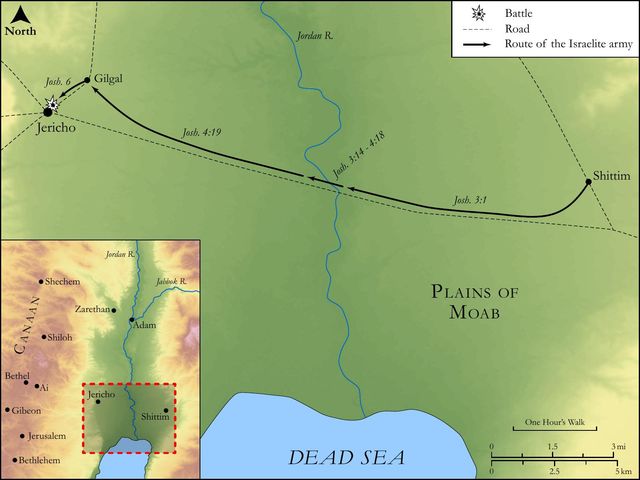
See on the biblical-era map
Study this verse
Public-domain commentary
Matthew Henry
From his Commentary on the Whole Bible. Henry comments on passages, not single verses — this entry covers Joshua 4:10–19.
The inspired historian seems to be so well pleased with his subject here that he is loth to quit it, and is therefore very particular in his narrative, especially in observing how closely Joshua pursued the orders God gave him, and that he did nothing without divine direction, finishing all that the Lord had commanded him (v. 10), which is also said to be what Moses commanded. We read not of any particular commands that Moses gave to Joshua about this matter: the thing was altogether new to him. It must therefore be understood of the general instructions Moses had given him to follow the divine direction, to deliver that to the people which he received of the Lord, and to take all occasions to remind them of their duty to God, as the best return for his favours to them. This which Moses, who was now dead and gone, had said to him, he had in mind at this time, and did accordingly. It is well for us to have the good instructions that have been given us ready to us when we have occasion for them.
I.The people hasted and passed over, v.
10. Some understand this of the twelve men that carried the stones, but it seems rather to be meant of the body of the people; for, though an account was given of their passing over (v. 1), yet here it is repeated for the sake of this circumstance, which was to be added, that they passed over in haste, either because Joshua by their officers ordered them to make haste, for it was to be but one day's work and they must not leave a hoof behind, or perhaps it was their own inclination that hastened them. 1. Some hasted because they were not able to trust God. They were afraid the waters should return upon them, being conscious of guilt, and diffident of the divine power and goodness. 2. Others because they were not willing to tempt God to continue the miracle longer than needs must, nor would they put the patience of the priests that bor the ark too much to the stretch by unnecessary delay. 3. Others because they were eager to be in Canaan, and would thus show how much they longed after that pleasant land. 4. Those that considered least, yet hasted because others did. He that believeth doth not make haste to anticipate God's counsels, but he makes haste to attend them, Isa 28:16.
II.The two tribes and a half led the van, Jos 4:12, Jos 4:13.
So they had promised when they had their lot given them on that side Jordan, Num 32:27. And Joshua had lately reminded them of their promise, Jos 1:12-15. It was fit that those who had the first settlement should be the first in the encounter of difficulties, the rather because they had not the incumbrance of families with them as the other tribes had, and they were all chose men, and fit for service, ready armed. It was a good providence that they had so strong a body to lead them on, and would be an encouragement to the rest. And the two tribes had no reason to complain: the post of danger is the post of honour.
III.When all the people had got clear to the other side, the priests with the ark came up out of Jordan.
This, one would think, should have been done of course; their own reason would tell them that now there was no more occasion for them, and yet they did not stir a step till Joshua ordered them to move, and Joshua did not order them out of Jordan till God directed him to do so, Jos 4:15-17. so observant were they of Joshua, and he of God, which was their praise, as it was their happiness to be under such good direction. How low a condition soever God may at any time bring his priests or people to, let them patiently wait, till by his providence he shall call them up out of it, as the priests here were called to come up out of Jordan, and let them not be weary of waiting, while they have the tokens of God's presence with them, even the ark of the covenant, in the depth of their adversity.
IV.As soon as ever the priests and the ark had come up out of Jordan, the waters of the river, which had stood on a heap, gradually flowed down according to their nature and usual course, and soon filled the channel again, v. 18. This makes it yet more evident that the stop which had now been given to the river was not from any secret natural cause, but purely from the power of God's presence, and for the sake of his Israel; for when Israel's turn was served, and the token of God's presence was removed, immediately the water went forward again; so that if it be asked, What ailed thee, O Jordan! that thou wast driven back? It must be answered, It was purely in obedience to the God of Israel, and in kindness to the Israel of God. There is therefore none like unto the God of Jeshurun; happy also art thou, O Israel! who is like unto thee, O people? Some observe here, by way of allusion, that when the ark, and the priests that bor it, are removed from any place, the flood-gates are drawn up, the defence has departed, and an inundation of judgments is to be expected shortly. Those that are unchurched will soon be undone. The glory has departed if the ark is taken.
V.Notice is taken of the honour put upon Joshua by all this (v.
14): On that day the Lord magnified Joshua, both by the fellowship he admitted him to with himself, speaking to him upon all occasions and being ready to be consulted by him, and by the authority he confirmed him in over both priests and people. Those that honour God he will honour, and when he will magnify a man, as he had said he would magnify Joshua (Jos 3:7), he will do it effectually. Yet it was not for Joshua's sake only that he was thus magnified, but to put him in a capacity of doing so much the more service to Israel, for hereupon they feared him as they feared Moses. Se here what is the best and surest way to command the respect of inferiors, and to gain their reverence and observance, not by blustering and threatening, and carrying it with a high hand, but by holiness and love, and all possible indications of a constant regard to their welfare, and to God's will and honour. Those are feared in the best manner, and to the best purpose, who make it to appear that God is with them, and that they set him before them. Those that are sanctified are truly magnified, and are worthy of double honour. Favourites of heaven should be looked on with awe.
VI.An account is kept of the time of this great event (v.
19): it was on the tenth day of the first month, just forty years since they came out of Egypt, wanting five days. God had said in his wrath that they should wander forty years in the wilderness, but, to make up that forty, we must take in the first year, which was then past, and had been a year of triumph in their deliverance out of Egypt, and this last, which had been a year of triumph likewise on the other side Jordan, so that all the forty were not years of sorrow; and at last he brought them into Canaan five days before the forty years were ended, to show how little pleasure God takes in punishing, how swift he is to show mercy, and that for the elects' sake the days of trouble are shortened, Mat 24:22. God ordered it so that they should enter Canaan four days before the annual solemnity of the passover, and on the very day when the preparation for it was to begin (Exo 12:3), because he would have their entrance into Canaan Graced and sanctified with that religious feast, and would have them then to be reminded of their deliverance out of Egypt, that, comparing them together, God might be glorified as the Alpha and Omega of their bliss.
Historical interpretation
Historical reception
1 surviving comment on this verse from the historical church.
After they had crossed over the Jordan, the waters returned to their place and overflowed all its banks as before. For the mystical Jordan also increases when the full number of the faithful enters in. Accordingly, we read, “Lift up your eyes and see that the fields are ripe for the harvest,” and again, “The harvest is plentiful but the laborers are few.” But he does not simply say “harvest” but “wheat,” according to what they have in the Septuagint. For this is a symbol of nourishment.
Continue studying Joshua 4:18 across the web’s major study libraries — every link below opens this exact verse, chapter, or book on the destination site.
Read & Compare
 BibleGatewayThis verse in more than 200 translations and 70 languages.
 Bible.comThe YouVersion reader — hundreds of translations, reading plans, and highlights.
 ESV.orgCrossway's official English Standard Version reader.
 NET BibleThe NET translation with 60,000+ translators' notes on every rendering decision.
 STEP BibleTyndale House's free study tool — original text, vocabulary, and scholarly resources.
 BibliaLogos Bible Software's free web reader.
 USCCBThe New American Bible (Revised Edition) with the U.S. bishops' study notes.
Commentaries
 BibleHub CommentariesDozens of classic commentaries on this verse, gathered on one page.
 StudyLightMore than 100 commentary sets — the largest collection on the web.
 BibleRefPlain-English commentary on what this verse means, verse by verse.
 Enduring WordDavid Guzik's free commentary on this chapter, widely used by Bible teachers.
 Bible Study ToolsVerse commentary alongside Greek and Hebrew study aids.
Original Language & Research
- BibleHub InterlinearThe verse word by word — original language, transliteration, and English.
- BibleHub LexiconEvery word's original-language definition and Strong's entry.
 Blue Letter BibleDeep-study tools — Strong's numbers, concordance, and word studies.
 SefariaThe Hebrew text with Rashi and centuries of Jewish commentary.
Sermons, Hymns & Audio


TrulyRandomVerse is not affiliated with these sites and doesn’t control their content. They’re linked because they’re genuinely useful.
Summary
Joshua 4:18 serves as the climactic conclusion to Israel's miraculous crossing of the Jordan River, precisely marking the moment God's supernatural intervention ceased. As the priests, bearing the sacred Ark of the Covenant, completed their passage onto the western bank, the divinely held-back waters of the Jordan immediately surged back to their normal, overflowing state. This verse underscores God's absolute sovereignty over creation, His meticulous timing, and the complete fulfillment of His promise to bring His people safely into the Promised Land, solidifying Joshua's leadership and Israel's faith.
Context
ShowHideLiterary Context
This verse provides the precise denouement to the extraordinary events detailed in Joshua chapter 3 and the preceding verses of Joshua chapter 4. Having spent forty years in the wilderness, the Israelites stood on the threshold of Canaan, facing the formidable obstacle of the Jordan River, which was at its annual flood stage during the harvest. The narrative meticulously details how this impassable barrier was supernaturally parted as the priests carrying the Ark of the Covenant stepped into its waters (Joshua 3:15-16). While the nation crossed on dry ground, the priests remained steadfast in the riverbed until every Israelite had passed. Joshua 4:1-17 describes the command to take twelve stones from the riverbed as a memorial for future generations and the subsequent erection of a second set of stones at Gilgal. Once these acts of remembrance were completed, Joshua 4:18 records the immediate restoration of the river's flow, confirming the completion of the divine act and the safe passage of God's people into the Promised Land.
Historical & Cultural Context
The Jordan River, particularly during the spring harvest (typically April/May), swells significantly from melting snows of Mount Hermon, transforming into a formidable, often impassable, barrier. For ancient peoples, a river at flood stage represented a virtually insurmountable natural defense, making any crossing perilous. The miraculous parting of the Jordan, therefore, was not merely a convenient passage but a profound demonstration of Yahweh's power over nature, echoing the earlier Red Sea crossing under Moses. This event served to unequivocally establish Joshua's authority as God's chosen leader, just as Moses' authority had been confirmed, and to instill fear of Israel's God in the hearts of the Canaanite inhabitants, as evidenced by Rahab's confession (Joshua 2:9-11). The Ark of the Covenant, central to the miracle, was the physical representation of God's presence and His covenant with Israel, underscoring that it was God, not human strength or ingenuity, who achieved this monumental feat.
Key Themes
ShowHideThe events surrounding the Jordan crossing, culminating in Joshua 4:18, powerfully articulate several key themes. Firstly, Divine Control and Sovereignty are paramount; the river's waters ceased and resumed flow at God's precise command, demonstrating His absolute dominion over creation and His meticulous orchestration of history. Secondly, the Confirmation of God's Presence is profoundly evident through the Ark of the Covenant, which acted as the focal point of the miracle, assuring Israel that Yahweh was indeed with them as they entered the land, fulfilling His promise to never leave them nor forsake them (Deuteronomy 31:6). Thirdly, the Precision and Completeness of God's Work is highlighted by the immediate return of the waters only after the priests' feet touched dry land, signifying that God's intervention was perfectly timed and fully accomplished, leaving no room for doubt or partiality. Finally, this event represents a significant Fulfillment of Promise, marking a crucial step in God's ancient covenant with Abraham to give his descendants the land of Canaan (Genesis 12:7). The miracle solidified Joshua's leadership and strengthened the nation's faith as they prepared to inherit their promised inheritance.
Exposition and Analysis
ShowHideKey Word Analysis
ShowHideThis term refers to a binding agreement or compact, often established by passing between pieces of flesh, symbolizing a solemn oath. In the context of the "Ark of the Covenant of the LORD," it emphasizes that the miracle was not merely a display of raw power but an act rooted in God's faithfulness to His established relationship with Israel. The Ark contained the tablets of the Law, representing the terms of this covenant, underscoring that God's actions are always consistent with His character and His promises to His people.
This word denotes a desert or dry ground. Its use here vividly contrasts with the normally overflowing Jordan River. The priests stepping onto "dry land" signifies the complete and miraculous cessation of the waters, allowing for a safe passage where none should naturally exist. It highlights the supernatural nature of the event, as God transformed an impassable watery barrier into solid ground, demonstrating His power to alter creation for His redemptive purposes.
This primitive root means "to turn back" or "to return." In Joshua 4:18, it signifies the immediate and complete restoration of the Jordan River to its natural, pre-miracle state. The rapidity of the waters "returning unto their place" underscores that the parting was a temporary, divinely orchestrated suspension of natural law, precisely timed to fulfill God's specific purpose. Once that purpose was achieved, the natural order was instantly re-established, leaving no doubt about God's absolute control.
Verse Breakdown
ShowHide"And it came to pass, when the priests that bare the ark of the covenant of the LORD were come up out of the midst of Jordan,"
This opening clause establishes the critical precondition for the river's return. The priests, who had stood steadfastly in the riverbed with the Ark of God's presence, were now completing their ascent out of the miraculous dry path. Their presence, symbolizing God's active intervention and covenant faithfulness, was essential to the miracle's sustenance, and their departure signaled its conclusion.
"[and] the soles of the priests' feet were lifted up unto the dry land,"
This vivid detail pinpoints the exact, instantaneous moment of transition. It's not merely that the priests were "coming up," but that their very last steps, the lifting of their feet from the miraculously dry riverbed onto the solid, dry ground of the western bank, triggered the change. This emphasizes the divine precision and the direct correlation between the priests' obedient action and the immediate cessation of the miraculous event.
"that the waters of Jordan returned unto their place,"
This is the immediate and dramatic consequence of the priests' exit. The "waters of Jordan," which had been supernaturally held back upstream, instantly surged back. The phrase "returned unto their place" implies a complete and rapid restoration of the river's flow, demonstrating that the previous stoppage was entirely a supernatural act, not a natural phenomenon that would gradually dissipate.
"and flowed over all his banks, as [they did] before."
This final phrase confirms the full restoration of the river to its normal, flood-stage condition. The Jordan was not merely flowing again but was "flowing over all his banks," just as it had been before the miracle began. This detail reinforces the magnitude of the initial miracle and the completeness of its reversal, leaving no doubt about God's absolute control over every aspect of the event and the perfect fulfillment of His purpose.
Literary Devices
ShowHideJoshua 4:18 employs several powerful literary devices to convey its profound theological message. Narrative Climax is profoundly evident as this verse provides the definitive resolution to the dramatic tension built in the preceding chapters regarding the Jordan crossing. It marks the precise and instantaneous end of the supernatural intervention, bringing the entire narrative arc of the crossing to a definitive and satisfying close. Divine Causation is central to the verse's meaning, as the text explicitly links the priests' actions (which represent God's command and presence) to the immediate and precise return of the waters, leaving no room for naturalistic explanations or chance. The entire event functions as powerful Symbolism, with the Jordan River representing an insurmountable barrier that only God can overcome, and the Ark of the Covenant symbolizing God's active, covenantal presence and His unwavering faithfulness among His people. Furthermore, the account of the Jordan crossing, concluded by this verse, establishes a powerful Parallelism with the Red Sea crossing (Exodus 14), reinforcing God's consistent power and faithfulness across generations and leaders, thereby confirming Joshua's divine appointment and establishing his authority akin to Moses.
Theological and Thematic Connections
ShowHideJoshua 4:18 profoundly illustrates God's absolute sovereignty, not only over the natural world but also over the timing and execution of His redemptive plans. The immediate return of the Jordan's waters upon the priests' exit underscores that God's miraculous interventions are purposeful, precisely timed, and cease once His specific objective is achieved. This demonstrates a God who is not chaotic or arbitrary but meticulously orchestrates events for the good of His people and the fulfillment of His promises. It also highlights the importance of human obedience (the priests remaining until commanded to move) in the unfolding of divine will. The event served as a powerful testimony to Israel, and to the surrounding nations, that Yahweh was indeed with them, confirming His covenant faithfulness and empowering them for the daunting task of conquering Canaan.
Reflection and Application
ShowHideJoshua 4:18 offers a profound lesson for believers today: God's power is not limited by any obstacle, and His timing is perfect. Just as He opened a way through the Jordan and then restored its flow with such precision, He is capable of making a way through our seemingly insurmountable challenges and then bringing us back to a new "normal" once His purpose is accomplished. This verse calls us to trust in God's unwavering presence and His meticulous care, even when facing daunting circumstances. It reminds us that divine intervention is often tied to our obedient steps of faith, as seen in the priests' willingness to stand in the riverbed until God's command for them to move. The completion of the miracle, precisely signified by the waters' return, assures us that God finishes what He starts, and His works are always purposeful and complete. We are encouraged to step out in faith, knowing that God will sustain us through the "crossing" and bring us safely to the other side, fulfilling His promises in our lives.
Questions for Reflection
ShowHideFAQ
ShowHideWhat is the significance of the Ark of the Covenant in this event?
ShowHideThe Ark of the Covenant was central to the Jordan crossing because it represented the very presence of God among His people and the covenant He had established with Israel. It was not a magical object, but a tangible symbol of Yahweh's commitment and power. When the priests, bearing the Ark, stepped into the Jordan, it was God Himself, through His presence, who caused the waters to part (Joshua 3:13). Similarly, when the Ark, carried by the priests, finally exited the riverbed, it signaled God's completion of the miracle, and the waters immediately returned. This emphasized that the entire event was a divine act, orchestrated by God's power and presence, not human effort or natural phenomena, thus reinforcing His sovereignty and faithfulness.
Why did God make the waters return immediately?
ShowHideGod made the waters return immediately for several key reasons, all highlighting His divine attributes. Firstly, it underscored the precision and completeness of His work; the miracle was sustained exactly as long as necessary to achieve its purpose—the safe passage of all Israel—and no longer. Secondly, it prevented any lingering reliance on the supernatural intervention itself, directing faith back to the Sovereign God who commanded it. The river's immediate return demonstrated that the parting was entirely His doing, a temporary suspension of natural law for a specific redemptive purpose. It also served as a clear demarcation, signaling the end of one phase (wilderness wandering and miraculous crossing) and the beginning of another (entering and conquering the Promised Land), emphasizing divine control over every transition.
How does this event relate to the Red Sea crossing?
ShowHideThe Jordan River crossing is presented as a direct parallel and theological echo of the Red Sea crossing in Exodus 14. Both events involve God miraculously parting waters to allow His people to pass on dry ground, demonstrating His absolute power over creation. Both served to confirm the leadership of God's chosen servant (Moses at the Red Sea, Joshua at the Jordan) in the eyes of Israel and their enemies. They were foundational acts of deliverance, marking significant transitions in Israel's journey from bondage to freedom and from wilderness to inheritance. The Jordan crossing, in particular, served as a powerful reminder to a new generation of Israelites that the same God who delivered their ancestors from Egypt was still with them, fulfilling His promises and empowering them for the challenges ahead (Joshua 4:23-24).
Christ-Centered Fulfillment
ShowHideThe miraculous crossing of the Jordan River, culminated by the precise return of its waters in Joshua 4:18, profoundly foreshadows the person and work of Jesus Christ. Just as the Ark of the Covenant, representing God's presence, opened the way into the earthly Promised Land, Jesus Christ is the ultimate embodiment of God's presence, the very Lamb of God who takes away the sin of the world, who opens the way into the true, heavenly inheritance. The Jordan, a formidable barrier to the Promised Land, can be seen as a type of death or separation from God, a final obstacle before entering rest. Jesus, through His own "crossing" of death and resurrection, has overcome this ultimate barrier, providing a new and living way for all who believe to enter into eternal life and fellowship with God (Hebrews 10:19-20). His resurrection, like the Jordan's waters returning, signified the completion of His redemptive work, securing our passage and demonstrating His absolute victory over sin and death (1 Corinthians 15:54-57). Furthermore, Christian baptism, often involving immersion in water, symbolically connects believers to Christ's death, burial, and resurrection, signifying our spiritual crossing from death to new life in Him (Romans 6:4; Colossians 2:12). Thus, Joshua 4:18, in its precise and powerful display of God's control and covenant faithfulness, points forward to the greater work of Christ, who is our ultimate way, truth, and life, leading us into the eternal presence of God (John 14:6).