


Exodus 14:26
Bible text: King James Version (1769 Blayney text) · Public domain
Bible text: King James Version with Strong's numbers · Public domain
Bible text: Berean Standard Bible · Public domain
Bible text: American Standard Version (1901) · Public domain
Bible text: World English Bible, Messianic edition · Public domain
Bible text: Geneva Bible (1599) · Public domain
Bible text: Young's Literal Translation · Public domain
- וַיֹּאמֶרvai·Yo·merand he saidH559Conj-w ¦ V-Qal-ConsecImperf-3msVerb Qal Consecutive Imperfect 3rd Singular Masculineוַandיֹּאמֶרhe said
- יְהוָהYah·wehYahwehH3068N-properNoun Proper Title
- אֶל'eltoH413PrepPreposition
- מֹשֶׁהmo·ShehMosesH4872N-proper-mNoun Proper Masculine
- נְטֵהne·Tehstretch outH5186V-Qal-Imp-2msVerb Qal Imperative 2nd Singular Masculine
- אֶת'et<obj.>H853DirObjMParticle Object Indicator
- יָדְךָya·de·Khayour handH3027N-csc ¦ 2msNoun Singular common gender Constructיָדְhandךָyour
- עַל'aloverH5921PrepPreposition
- הַיָּםhai·Yamthe seaH3220Art ¦ N-msNoun Singular Masculine Absoluteהַtheיָּםsea
- וְיָשֻׁבוּve·ya·Shu·vuso they may returnH7725Conj-w ¦ V-Qal-ConjImperf-3mpVerb Qal Conjunction+Imperfect 3rd Plural Masculineוְsoיָשֻׁבוּthey may return
- הַמַּיִםha·Ma·yimthe watersH4325Art ¦ N-mpNoun Plural Masculine Absoluteהַtheמַּיִםwaters
- עַל'aloverH5921PrepPreposition
- מִצְרַיִםmitz·Ra·yimEgyptH4714N-properNoun Proper Location
- עַל'aloverH5921PrepPreposition
- רִכְבּוֹrikh·Boits chariot[s]H7393N-msc ¦ 3msNoun Singular Masculine Constructרִכְבּchariot[s]וֹits
- וְעַלve·'aland overH5921Conj-w ¦ PrepPrepositionוְandעַלover
- פָּרָשָׁיוpa·ra·Shavits horsemenH6571N-mpc ¦ 3msNoun Plural Masculine Constructפָּרָשָׁיhorsemenוits
English is a literal word-by-word gloss of the Hebrew, not the KJV's wording. Why?
This is the original text the KJV's translators worked from — each Hebrew word with its own literal English meaning in this verse, prepared by scholars at Tyndale House, Cambridge. The KJV translates whole sentences, not word by word, so its wording differs: one Hebrew word can become several English words, and the KJV may choose “the LORD” where the gloss reads “Yahweh”. Both are faithful — they answer different questions. For the KJV's own rendering, switch to the KJV text.
Details
See on the biblical-era maps

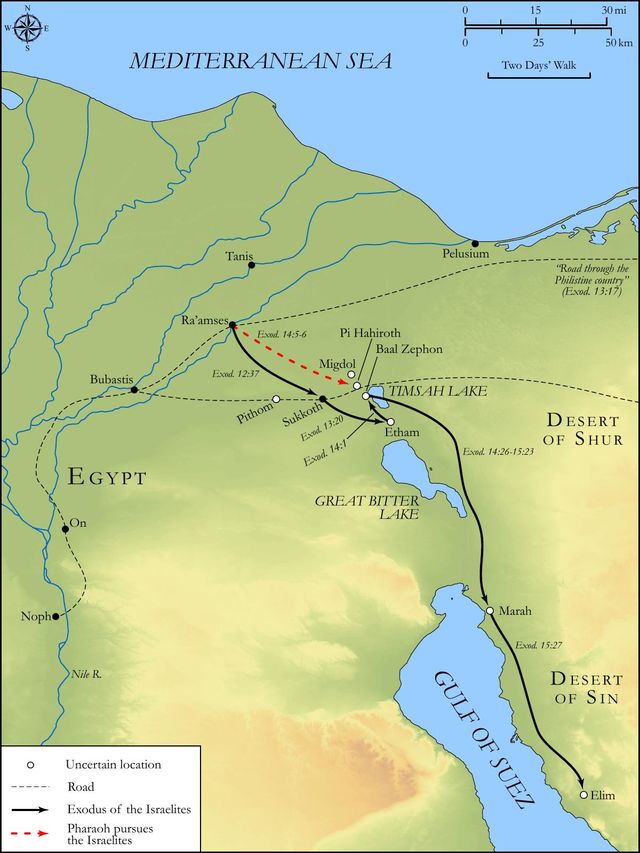
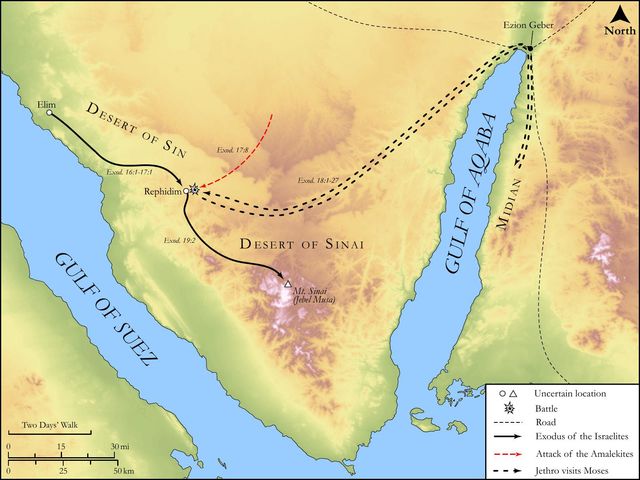
Study this verse
Public-domain commentary
Matthew Henry
From his Commentary on the Whole Bible. Henry comments on passages, not single verses — this entry covers Exodus 14:21–31. His three-level outline is real structure in the source text, so it is rendered as structure.
We have here the history of that work of wonder which is so often mentioned both in the Old and New Testament, the dividing of the Red Sea before the children of Israel. It was the terror of the Canaanites (Jos 2:9, Jos 2:10), the praise and triumph of the Israelites, Psa 114:3; Psa 106:9; Psa 136:13, Psa 136:14. It was a type of baptism, Co1 10:1, Co1 10:2. Israel's passage through it was typical of the conversion of souls (Isa 11:15), and the Egyptians' perdition in it was typical of the final ruin of all impenitent sinners, Rev 20:14. Here we have,
I.An instance of God's almighty power in the kingdom of nature, in dividing the sea, and opening a passage through the waters.
It was a bay, or gulf, or arm of the sea, two or three leagues over, which was divided, Exo 14:21. The instituted sign made use of was Moses's stretching out his hand over it, to signify that it was done in answer to his prayer, for the confirmation of his mission, and in favour to the people whom he led. The natural sign was a strong east wind, signifying that it was done by the power of God, whom the winds and the seas obey. If there be any passage in the book of Job which has reference to the miracles wrought for Israel's deliverance out of Egypt, it is that in Job 26:12, He divideth the sea with his power, and by his understanding he smileth through Rahab (so the word is), that is, Egypt. Note, God can bring his people through the greatest difficulties, and force a way where he does not find it. The God of nature has not tied himself to its laws, but, when he pleases, dispenses with them, and then the fire does not burn, nor the water flow.
II.An instance of his wonderful favour to his Israel.
They went through the sea to the opposite shore, for I cannot suppose, with some, that they fetched a compass, and came out again on the same side, Exo 14:22. They walked upon dry land in the midst of the sea, Exo 14:29. And the pillar of cloud, that glory of the Lord, being their rearward (Isa 58:8), that the Egyptians might not charge them in the flank, the waters were a wall to them (it is twice mentioned) on their right hand and on their left. Moses and Aaron, it is probable, ventured first into this untrodden path, and then all Israel after them; and this march through the paths of the great waters would make their march afterwards, through the wilderness, less formidable. Those who had followed God through the sea needed not to fear following him whithersoever he led them. This march through the sea was in the night, and not a moon-shiny night, for it was seven days after the full moon, so that they had no light but what they had from the pillar of cloud and fire. This made it the more awful; but where God leads us he will light us; while we follow his conduct, we shall not want his comforts.
This was done, and recorded, in order to encourage God's people in all ages to trust in him in the greatest straits. What cannot he do who did this? What will not he do for those hat fear and love him who did this for these murmuring unbelieving Israelis, who yet were beloved for their fathers' sake, and for the sake of a remnant among them? We find the saints, long afterwards, making themselves sharers in the triumphs of this march (Psa 66:6): They went through the flood on foot; there did we rejoice in him: and see how this work of wonder is improved, Psa 77:11, Psa 77:16, Psa 77:19.
III.An instance of his just and righteous wrath upon his and his people's enemies, the Egyptians. Observe here,
1.How they were infatuated. In the heat of their pursuit, they went after the Israelites into the midst of the sea, Exo 14:23. "Why," thought they, "may not we venture where Israel did?" Once or twice the magicians of Egypt had done what Moses did, with their enchantments; Pharaoh remembered this, but forgot how they were nonplussed at last. They were more advantageously provided with chariots and horses, while the Israelites were on foot. Pharaoh had said, I know not the Lord; and by this it appeared he did not, else he would not have ventured thus. None so bold as those that are blind. Rage against Israel made them thus daring and inconsiderate: they had long hardened their own hearts; and now God hardened them to their ruin, and hid from their eyes the things that belonged to their peace and safety. Surely in vain is the net spread in the sight of any bird (Pro 1:17); yet so blind where the Egyptians that they hastened to the snare, Pro 7:23. Note, The ruin of sinners is brought on by their own presumption, which hurries them headlong into the pit. They are self-destroyers.
2.How they were troubled and perplexed, Exo 14:24, Exo 14:25. For some hours they marched through the divided waters as safely and triumphantly as Israel did, not doubting but, that, in a little time, they should gain their point. But, in the morning watch, the Lord looked upon the host of the Egyptians, and troubled them. Something or other they saw or heard from the pillar of cloud and fire which put them into great consternation, and gave them an apprehension of their ruin before it was brought upon them. Now it appeared that the triumphing of the wicked is short, and that God has ways to frighten sinners into despair, before he plunges them into destruction. He cuts off the spirit of princes, and is terrible to the kings of the earth.
(1.)They had hectored and boasted as if the day were their own; but now they were troubled and dismayed, struck with a panic-fear.
(2.)They had driven furiously; but now they drove heavily, and found themselves plugged and embarrassed at every step; the way grew deep, their hearts grew sad, their wheels dropped off, and the axle-trees failed. Thus can God check the violence of those that are in pursuit of his people.
(3.)They had been flying upon the back of Israel, as the hawk upon the trembling dove; but now they cried, Let us flee from the face of Israel, which had become to them like a torch of fire in a sheaf, Zac 12:6. Israel has now, all of a sudden, become as much a terror to them as they had been to Israel. They might have let Israel alone and would not; now they would flee from the face of Israel and cannot. Men will not be convinced, till it is too late, that those who meddle with God's people meddle to their own hurt; when the Lord shall come with ten thousands of his saints, to execute judgment, the mighty men will in vain seek to shelter themselves under rocks and mountains from the face of Israel and Israel's King, Rev 6:15. Compare with this story, Job 27:20, etc.
3.How they were all drowned. As soon as ever the children of Israel had got safely to the shore, Moses was ordered to stretch out his hand over the sea, and thereby give a signal to the waters to close again, as before, upon he word of command, they had opened to the right and the left, Exo 14:29. He did so, and immediately the waters returned to their place, and overwhelmed all the host of the Egyptians, Exo 14:27, Exo 14:28. Pharaoh and his servants, who had hardened one another in sin, now fell together, and not one escaped. An ancient tradition says that Pharaoh's magicians, Jannes and Jambres, perished with the rest, as Balaam with the Midianites whom he had seduced, Num 31:8. And now,
(1.)God avenged upon the Egyptians the blood of the firstborn whom they had drowned: and the principal is repaid with interest, it is recompensed double, full-grown Egyptians for newborn Israelites; thus the Lord is righteous, and precious is his people's blood in his sight, Psa 72:14.
(2.)God reckoned with Pharaoh for all his proud and insolent conduct towards Moses his ambassador. Mocking the messengers of the Lord, and playing the fool with them, bring ruin without remedy. Now God got him honour upon Pharaoh, looking upon that proud man, and abasing him, Job 40:12. Come and see the desolations he made, and write it, not in water, but with an iron pen in the rock for ever. Here lies that bloody tyrant who bade defiance to his Maker, to his demands, threatenings, and judgments; a rebel to God, and a slave to his own barbarous passions; perfectly lost to humanity, virtue, and all true honour; here he lies, buried in the deep, a perpetual monument of divine justice. Here he went down to the pit, though he was the terror of the mighty in the land of the living. This is Pharaoh and all his multitude, Eze 31:18.
IV.Here is the notice which the Israelites took of this wonderful work which God wrought for them, and the good impressions which it made upon them for the present.
1.They saw the Egyptians dead upon the sands, Exo 14:30. Providence so ordered it that the next tide threw up the dead bodies,
(1.)For the greater disgrace of the Egyptians. Now the beasts and birds of prey were called to eat the flesh of the captains and mighty men, Rev 19:17, Rev 19:18. The Egyptians were very nice and curious in embalming and preserving the bodies of their great men, but here the utmost contempt is poured upon all the grandees of Egypt; see how they lie, heaps upon heaps, as dung upon the face of the earth.
(2.)For the greater triumph of the Israelites, and to affect them the more with their deliverance; for the eye affects the heart. See Isa 66:24, They shall go forth, and look upon the carcases of the men that have transgressed against me. Probably they stripped the slain and, having borrowed jewels of their neighbours before, which (the Egyptians having by this hostile pursuit of them broken their faith with them) henceforward they were not under any obligation to restore, they now got arms from them, which, some think, they were not before provided with. Thus, when God broke the heads of Leviathan in pieces, he gave him to be meat to the people inhabiting the wilderness, Psa 74:14.
2.The sight of this great work greatly affected them, and now they feared the Lord, and believed the Lord, and his servant Moses, Exo 14:31. Now they were ashamed of their distrusts and murmurings, and, in the good mind they were in, they would never again despair of help from Heaven, no, not in the greatest straits; they would never again quarrel with Moses, nor talk of returning to Egypt. They were now baptized unto Moses in the sea, Co1 10:2. This great work which God wrought for them by the ministry of Moses bound them effectually to follow his directions, under God. This confirmed their faith in the promises that were yet to be fulfilled; and, being brought thus triumphantly out of Egypt, they did not doubt that they should be in Canaan shortly, having such a God to trust to, and such a mediator between them and him. O that there had been such a heart in them as now there seemed to be! Sensible mercies, when they are fresh, make sensible impressions; but with many these impressions soon wear off: while they see God's works, and feel the benefit of them, they fear him and trust in him; but they soon forget his works, and then they slight him. How well were it for us if we were always in as good a frame as we are in sometimes!
Continue studying Exodus 14:26 across the web’s major study libraries — every link below opens this exact verse, chapter, or book on the destination site.
Read & Compare
 BibleGatewayThis verse in more than 200 translations and 70 languages.
 Bible.comThe YouVersion reader — hundreds of translations, reading plans, and highlights.
 ESV.orgCrossway's official English Standard Version reader.
 NET BibleThe NET translation with 60,000+ translators' notes on every rendering decision.
 STEP BibleTyndale House's free study tool — original text, vocabulary, and scholarly resources.
 BibliaLogos Bible Software's free web reader.
 USCCBThe New American Bible (Revised Edition) with the U.S. bishops' study notes.
Commentaries
 BibleHub CommentariesDozens of classic commentaries on this verse, gathered on one page.
 StudyLightMore than 100 commentary sets — the largest collection on the web.
 BibleRefPlain-English commentary on what this verse means, verse by verse.
 Enduring WordDavid Guzik's free commentary on this chapter, widely used by Bible teachers.
 Bible Study ToolsVerse commentary alongside Greek and Hebrew study aids.
Original Language & Research
- BibleHub InterlinearThe verse word by word — original language, transliteration, and English.
- BibleHub LexiconEvery word's original-language definition and Strong's entry.
 Blue Letter BibleDeep-study tools — Strong's numbers, concordance, and word studies.
 SefariaThe Hebrew text with Rashi and centuries of Jewish commentary.
Sermons, Hymns & Audio


TrulyRandomVerse is not affiliated with these sites and doesn’t control their content. They’re linked because they’re genuinely useful.
Summary
Exodus 14:26 records the climactic divine command to Moses, instructing him to extend his hand over the Red Sea, thereby causing the miraculously parted waters to return and engulf the pursuing Egyptian army, including their formidable chariots and horsemen. This pivotal instruction orchestrates the decisive act of divine judgment against Pharaoh's forces, ensuring Israel's complete and irreversible deliverance from the oppressive bondage of Egypt and profoundly demonstrating Yahweh's absolute sovereignty and power.
Context
ShowHideLiterary Context
This verse serves as the dramatic culmination of the Red Sea crossing narrative, immediately following the miraculous division of the waters in Exodus 14:21-22 which allowed the Israelites to pass through on dry ground. The preceding verses vividly describe the chaos and confusion among the Egyptian army as their chariot wheels became bogged down, signaling God's active intervention against them (Exodus 14:24-25). The command in Exodus 14:26 is the divine decree that seals the fate of Pharaoh's forces, fulfilling God's earlier promise to gain glory over Pharaoh, his chariots, and his horsemen (Exodus 14:4). This act completes the deliverance, ensuring that Israel's escape is not merely a temporary reprieve but a definitive separation from their oppressors.
Historical & Cultural Context
The Exodus narrative unfolds against the backdrop of ancient Egypt, a dominant superpower renowned for its military might and its pharaoh, who was revered as a divine king. The Egyptian army, particularly its chariotry, represented the pinnacle of ancient warfare technology and power, making their defeat by an unarmed, newly freed slave population utterly unprecedented and humanly impossible. God's act of judgment at the Red Sea was a direct challenge to the perceived invincibility of Egypt and its pantheon of gods. It was a public, undeniable demonstration of Yahweh's absolute supremacy over all earthly authorities and deities, especially those worshipped by the Egyptians. This event cemented Israel's identity as a nation delivered by a mighty hand and outstretched arm, profoundly shaping their understanding of God's power and faithfulness.
Key Themes
ShowHideExodus 14:26 powerfully contributes to several overarching themes within the book of Exodus and the broader Pentateuch. Foremost is the theme of Divine Sovereignty and Omnipotence, showcasing God's absolute control over creation and human affairs, using natural elements as instruments of His will. It underscores Divine Judgment against those who oppose God's purposes and oppress His chosen people, fulfilling His righteous indignation against Pharaoh's hardened heart (Exodus 9:16). Simultaneously, it highlights the theme of Divine Deliverance and Redemption, solidifying Israel's liberation from bondage and establishing Yahweh as their ultimate Rescuer and Protector. This event also reinforces the theme of Covenant Faithfulness, demonstrating God's unwavering commitment to His promises made to Abraham, Isaac, and Jacob (Genesis 15:13-14).
Exposition and Analysis
ShowHideKey Word Analysis
ShowHideThis is the sacred, covenantal name of God, emphasizing His self-existent, eternal nature and His personal, relational engagement with His people. In this context, it highlights that the command to Moses is not merely a suggestion but a divine decree from the sovereign God who actively intervenes in history to fulfill His redemptive purposes and demonstrate His absolute power.
This primitive root signifies to extend, spread out, or incline. Throughout the Exodus narrative, this action, performed by Moses at God's command, consistently precedes a miraculous display of divine power, whether for judgment or deliverance. Here, it denotes Moses acting as God's obedient instrument, a conduit through whom the Almighty's will is manifested, reversing the previous miracle and bringing about destruction.
This term, used in a dual sense, refers to the liquid element that had previously been supernaturally divided. In this verse, the "waters" are depicted as an obedient agent of God's will, returning to their natural state with devastating, divinely orchestrated force. This emphasizes God's absolute control over creation, turning what was a path of salvation into an instrument of judgment.
Verse Breakdown
ShowHide"And the LORD said unto Moses"
This opening phrase immediately establishes the divine origin and authority of the command. It underscores that the impending cataclysm is not a natural phenomenon or a human strategy, but a direct, intentional act initiated by Yahweh, the sovereign God of Israel. Moses is merely the recipient and executor of this divine instruction, highlighting God's active involvement in the deliverance of His people.
"Stretch out thine hand over the sea"
This is the specific, actionable command given to Moses. It echoes previous instances where Moses's extended hand, wielding his staff, was the visible sign of God's power (e.g., the plagues, the parting of the sea). Here, it signifies the reversal of the previous miracle, demonstrating God's ability not only to suspend natural laws but also to restore them for His purposes, with Moses acting as the obedient intermediary.
"that the waters may come again upon the Egyptians"
This clause reveals the precise purpose of the command: the re-engulfment of the Egyptian army by the sea. The phrase "come again" (Hebrew, shûwb) implies a reversal or return to a previous state, but with a divinely orchestrated, destructive outcome. The waters, which had been a path of salvation for Israel, now become the instrument of God's righteous judgment against their oppressors.
"upon their chariots, and upon their horsemen"
This final phrase specifies the targets of God's judgment, explicitly naming the core components of Egypt's military might. The mention of "chariots" and "horsemen" emphasizes the complete and utter destruction of the very forces that represented Pharaoh's power and the instrument of Israel's long-standing oppression. This ensures that no part of the pursuing army escapes, signifying a definitive and comprehensive victory.
Literary Devices
ShowHideExodus 14:26 is rich in literary devices that amplify its theological significance. The most prominent is Divine Command, where God directly issues an imperative to Moses, showcasing His absolute Sovereignty and active involvement in human history. The act of "stretching out the hand" functions as powerful Symbolism, representing the conduit of God's omnipotence through His chosen servant, Moses. This gesture, repeated throughout the Exodus narrative, consistently signals a miraculous display of divine power. There is profound Irony in the narrative: the very waters that provided a miraculous path of salvation for Israel now become the instrument of overwhelming destruction for their pursuers. Furthermore, the entire event is a dramatic Theophany, a visible and tangible manifestation of God's presence, power, and justice, demonstrating His faithfulness to His covenant and His unwavering commitment to His people. The verse also employs Foreshadowing, hinting at the complete and utter defeat of all those who stand against God's redemptive plan.
Theological and Thematic Connections
ShowHideExodus 14:26 stands as a monumental declaration of God's absolute sovereignty over creation and His unwavering commitment to His covenant people. It is a profound display of divine judgment against those who defiantly oppose His will and mercilessly oppress His chosen ones, simultaneously serving as the definitive act of deliverance for Israel from generations of bondage. This pivotal event solidifies the theological themes of God's omnipotence, His righteous justice, and His unfailing faithfulness to His promises, establishing Him as the ultimate rescuer and judge who acts decisively on behalf of His beloved. The Red Sea event is not merely a historical account but a foundational narrative that shapes Israel's understanding of Yahweh's character and power, serving as a perpetual reminder of His saving might.
Reflection and Application
ShowHideThis passage serves as an enduring and powerful reminder that God remains absolutely sovereign over all circumstances, even when we find ourselves overwhelmed by seemingly insurmountable "pursuing forces" or impossible obstacles in our lives. Just as He decisively intervened with overwhelming power to deliver Israel and execute judgment upon their oppressors, so too is He infinitely capable of bringing about justice, providing ultimate deliverance, and securing victory for His people today. We are called to cultivate a deep and unwavering trust in His perfect timing and His unfailing power, knowing with certainty that He will ultimately triumph over all evil, fulfill every one of His purposes for us, and bring His plans to glorious fruition. This narrative encourages us to release our anxieties and fears into His capable hands, resting in the assurance that our God is the God who parts seas and closes them again for His glory and our salvation.
Questions for Reflection
ShowHideFAQ
ShowHideWhy did God wait until the Egyptian army was fully within the seabed before commanding the waters to return?
ShowHideGod's timing was meticulously precise and strategically designed to ensure the most complete and undeniably comprehensive destruction of the Egyptian army. By allowing them to fully commit their forces into the seabed, God orchestrated a scenario that left no doubt about His absolute power and Israel's miraculous deliverance. This timing maximized His glory, demonstrating His control over both nature and human will, and leaving no room for any human explanation or alternative interpretation of the event. It was a definitive act of judgment that permanently severed Israel from their oppressors.
What is the broader theological significance of Moses stretching out his hand in this narrative and other Exodus accounts?
ShowHideMoses stretching out his hand is a profound and recurring motif throughout the Exodus narrative, consistently signifying his role as God's chosen instrument and obedient intermediary. It underscores that the miraculous events—from the plagues to the parting and closing of the Red Sea—were not a result of Moses's inherent power or magic, but rather God's omnipotent power working directly through an obedient human servant. This emphasizes the vital importance of human obedience to divine command for God's will to be accomplished on earth, highlighting the partnership between divine initiative and human response in the unfolding of redemptive history.
Christ-Centered Fulfillment
ShowHideThe dramatic Red Sea deliverance, culminating in the complete destruction of the Egyptian army, serves as a powerful type or foreshadowing of Christ's ultimate and decisive victory over sin, death, and the spiritual forces of evil. Just as God delivered Israel from physical bondage and the imminent threat of death at the hands of their oppressors, so Christ delivers humanity from the spiritual bondage of sin and the eternal threat of death through His perfect life, atoning crucifixion, and glorious resurrection. The very waters that brought righteous judgment upon the Egyptians prefigure the judgment that fell upon Christ on the cross, as He bore the full wrath of God for humanity's sin, thereby allowing His people to pass through to new life and freedom from condemnation (Romans 8:1-3). This monumental event also powerfully foreshadows Christ's final triumph over all His enemies and the complete, eternal salvation He secures for His church. As believers, we are metaphorically "baptized into Moses in the cloud and in the sea" (as described in 1 Corinthians 10:1-2), symbolizing our spiritual union with Christ in His death and resurrection, leading to our own deliverance from spiritual oppression and the power of darkness (Colossians 2:15 and Hebrews 2:14-15). The Red Sea miracle thus stands as a vivid Old Testament picture of the comprehensive redemption wrought by Christ.