


Exodus 14:16
Bible text: King James Version (1769 Blayney text) · Public domain
Bible text: King James Version with Strong's numbers · Public domain
Bible text: Berean Standard Bible · Public domain
Bible text: American Standard Version (1901) · Public domain
Bible text: World English Bible, Messianic edition · Public domain
Bible text: Geneva Bible (1599) · Public domain
Bible text: Young's Literal Translation · Public domain
- וְאַתָּהve·'a·Tahand youH859Conj-w ¦ Pro-2msPronoun Personal 2nd Singular Masculineוְandאַתָּהyou
- הָרֵםha·RemraiseH7311V-Hiphil-Imp-2msVerb Hiphil Imperative 2nd Singular Masculine
- אֶת'et<obj.>H853DirObjMParticle Object Indicator
- מַטְּךָma·te·Khayour staffH4294N-msc ¦ 2msNoun Singular Masculine Constructמַטְּstaffךָyour
- וּנְטֵהu·ne·Tehand stretch outH5186Conj-w ¦ V-Qal-Imp-2msVerb Qal Imperative 2nd Singular Masculineוּandנְטֵהstretch out
- אֶת'et<obj.>H853DirObjMParticle Object Indicator
- יָדְךָya·de·Khayour handH3027N-csc ¦ 2msNoun Singular common gender Constructיָדְhandךָyour
- עַל'aloverH5921PrepPreposition
- הַיָּםhai·Yamthe seaH3220Art ¦ N-msNoun Singular Masculine Absoluteהַtheיָּםsea
- וּבְקָעֵהוּu·ve·ka·'E·huand divide itH1234Conj-w ¦ V-Qal-Imp-2ms ¦ 3msVerb Qal Imperative 2nd Singular Masculineוּandבְקָעֵdivideהוּit
- וְיָבֹאוּve·ya·Vo·'uso they may goH935Conj-w ¦ V-Qal-ConjImperf-3mpVerb Qal Conjunction+Imperfect 3rd Plural Masculineוְsoיָבֹאוּthey may go
- בְנֵיve·nei[the] people ofH1121N-mpcNoun Plural Masculine Construct
- יִשְׂרָאֵלYis·ra·'ElIsraelH3478N-properNoun Proper Location
- בְּתוֹךְbe·Tokhin [the] middle ofH8432Prep-b ¦ N-mscNoun Singular Masculine Constructבְּinתוֹךְ[the] middle of
- הַיָּםhai·Yamthe seaH3220Art ¦ N-msNoun Singular Masculine Absoluteהַtheיָּםsea
- בַּיַּבָּשָׁהbai·ya·ba·Shahon the dry groundH3004Prep-b ¦ N-fsNoun Singular Feminine Absoluteבַּon theיַּבָּשָׁהdry ground
English is a literal word-by-word gloss of the Hebrew, not the KJV's wording. Why?
This is the original text the KJV's translators worked from — each Hebrew word with its own literal English meaning in this verse, prepared by scholars at Tyndale House, Cambridge. The KJV translates whole sentences, not word by word, so its wording differs: one Hebrew word can become several English words, and the KJV may choose “the LORD” where the gloss reads “Yahweh”. Both are faithful — they answer different questions. For the KJV's own rendering, switch to the KJV text.
Details
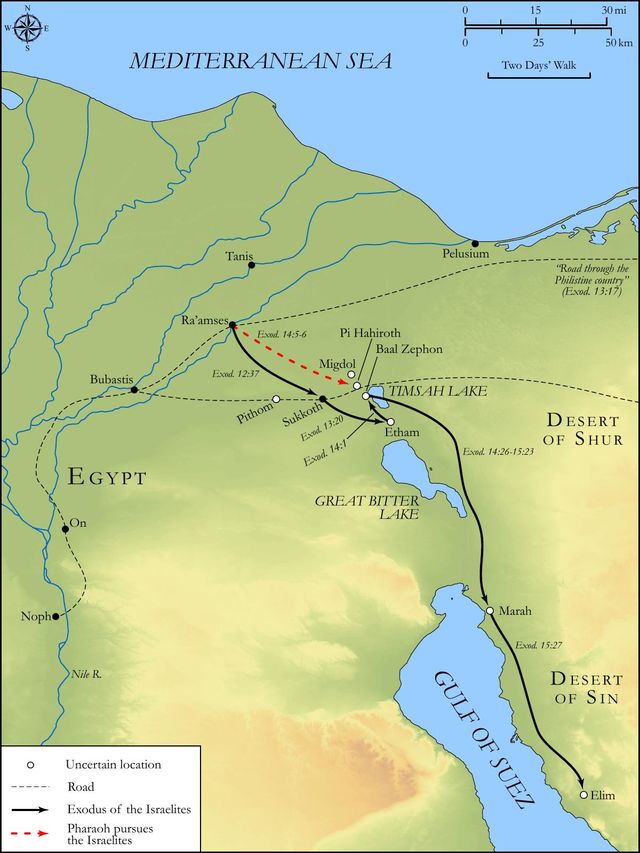
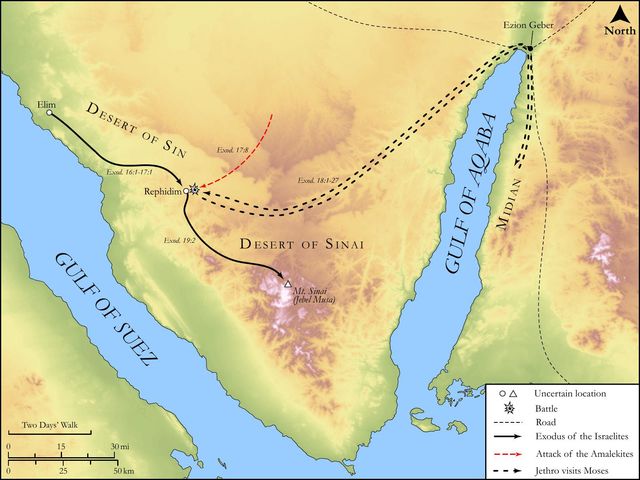
See on the biblical-era maps

Study this verse
Public-domain commentary
Matthew Henry
From his Commentary on the Whole Bible. Henry comments on passages, not single verses — this entry covers Exodus 14:15–20. His three-level outline is real structure in the source text, so it is rendered as structure.
We have here,
I.Direction given to Israel's leader.
1.What he must do himself. He must, for the present, leave off praying, and apply himself to his business (Exo 14:15): Wherefore cryest thou unto me? Moses, though he was assured of a good issue to the present distress, yet did not neglect prayer. We read not of one word he said in prayer, but he lifted up to God his heart, the language of which God well understood and took notice of. Moses's silent prayers of faith prevailed more with God than Israel's loud outcries of fear, Exo 14:10. Note,
(1.)Praying, if of the right kind, is crying to God, which denotes it to be the language both of a natural and of an importunate desire.
(2.)To quicken his diligence. Moses had something else to do besides praying; he was to command the hosts of Israel, and it was now requisite that he should be at his post. Every thing is beautiful in its season.
2.What he must order Israel to do. Speak to them, that they go forward. Some think that Moses had prayed, not so much for their deliverance (he was assured of that) as for the pardon of heir murmurings, and that God's ordering them to go forward was an intimation of the pardon. There is no going forward with any comfort but in the sense of our reconciliation to God. Moses had bidden them stand still, and expect orders from God; and now orders are given. They thought they must have been directed either to the right hand or to the left. "No," says God, "speak to them to go forward, directly to the sea-side;" as if there had lain a fleet of transport-ships ready for them to embark in. Note, When we are in the way of our duty, though we met with difficulties, we must go forward, and not stand in mute astonishment; we must mind present work and then leave the even to God, use means and trust him with the issue.
3.What he might expect God to do. Let the children of Israel go as far as they can upon dry ground, and then God will divide the sea, and open a passage for them through it, Exo 14:16-18. God designs, not only to deliver the Israelites, but to destroy the Egyptians; and the plan of his counsels is accordingly.
(1.)He will show favour to Israel; the waters shall be divided for them to pass through, Exo 14:16. The same power could have congealed the waters for them to pass over; but Infinite Wisdom chose rather to divide the waters for them to pass through; for that way of salvation is always pitched upon which is most humbling. Thus it is said, with reference to this (Isa 63:13, Isa 63:14), He led them through the deep, as a beast goes down into the valley, and thus made himself a glorious name.
(2.)He will get him honour upon Pharaoh. If the due rent of honour be not paid to the great landlord, by and from whom we have and hold our beings and comforts, he will distrain for it, and recover it. God will be a loser by no man. In order to this, it is threatened: I, behold I, will harden Pharaoh's heart, Exo 14:17. The manner of expression is observable: I, behold I, will do it. "I, that may do it;" so it is the language of his sovereignty. We may not contribute to the hardening of any man's heart, nor withhold any thing that we can do towards the softening of it; but God's grace is his own, he hath mercy on whom he will have mercy, and whom he will be hardeneth. "I, that can do it;" so it is the language of his power; none but the Almighty can make the heart soft (Job 23:16), nor can any other being make it hard. "I, that will do it;" for it is the language of his justice; it is a righteous thing with God to put those under the impressions of his wrath who have long resisted the influences of his grace. It is spoken in a way of triumph over this obstinate and presumptuous rebel: "I even I, will take an effectual course to humble him; he shall break that would not bend." It is an expression like that (Isa 1:24), Ah, I will ease me of my adversaries.
II.A guard set upon Israel's camp where it now lay most exposed, which was in the rear, Exo 14:19, Exo 14:20.
The angel of God, whose ministry was made use of in the pillar of cloud and fire, went from before the camp of Israel, where they did not now need a guide (there was no danger of missing their way through the sea, nor needed they any other word of command than to go forward), and it came behind them, where now they needed a guard (the Egyptians being just ready to seize the hindmost of them), and so was a wall of partition between them. There it was of use to the Israelites, not only to protect them, but to light them through the sea, and, at the same time, it confounded the Egyptians, so that they lost sight of their prey just when they were ready to lay hands on it. The word and providence of God have a black and dark side towards sin and sinners, but a bright and pleasant side towards those that are Israelites indeed. That which is a savour of life unto life to some is a savour of death unto death to others. This was not the first time that he who in the beginning divided between light and darkness (Gen 1:4), and still forms both (Isa 45:7), had, at the same time, allotted darkness to the Egyptians and light to the Israelites, a specimen of the endless distinction which will be made between the inheritance of the saints in light and that utter darkness which for ever will be the portion of hypocrites. God will separate between the precious and the vile.
Historical interpretation
Historical reception
1 surviving comment on this verse from the historical church.
Moses performed no sign without the mysterious wood, for he received from the Lord a rod to work wonders and prodigies in Egypt. Moreover, as a sign that he had heard things divinely, it was said to him, “Lift up your staff.” God, of course, did not need the assistance of a staff. But it was raised so that we might know how great was the mystery of that future wood which was prefigured by the shadow of this staff.
Continue studying Exodus 14:16 across the web’s major study libraries — every link below opens this exact verse, chapter, or book on the destination site.
Read & Compare
 BibleGatewayThis verse in more than 200 translations and 70 languages.
 Bible.comThe YouVersion reader — hundreds of translations, reading plans, and highlights.
 ESV.orgCrossway's official English Standard Version reader.
 NET BibleThe NET translation with 60,000+ translators' notes on every rendering decision.
 STEP BibleTyndale House's free study tool — original text, vocabulary, and scholarly resources.
 BibliaLogos Bible Software's free web reader.
 USCCBThe New American Bible (Revised Edition) with the U.S. bishops' study notes.
Commentaries
 BibleHub CommentariesDozens of classic commentaries on this verse, gathered on one page.
 StudyLightMore than 100 commentary sets — the largest collection on the web.
 BibleRefPlain-English commentary on what this verse means, verse by verse.
 Enduring WordDavid Guzik's free commentary on this chapter, widely used by Bible teachers.
 Bible Study ToolsVerse commentary alongside Greek and Hebrew study aids.
Original Language & Research
- BibleHub InterlinearThe verse word by word — original language, transliteration, and English.
- BibleHub LexiconEvery word's original-language definition and Strong's entry.
 Blue Letter BibleDeep-study tools — Strong's numbers, concordance, and word studies.
 SefariaThe Hebrew text with Rashi and centuries of Jewish commentary.
Sermons, Hymns & Audio


TrulyRandomVerse is not affiliated with these sites and doesn’t control their content. They’re linked because they’re genuinely useful.
Summary
Exodus 14:16 records God's direct command to Moses to supernaturally divide the Red Sea, enabling the terrified Israelites to escape Pharaoh's pursuing army by walking on dry ground. This pivotal instruction highlights God's absolute power over creation, His unwavering commitment to deliver His people, and the necessity of human obedience as a catalyst for divine intervention, transforming an impossible situation into a miraculous path to freedom.
Context
ShowHideLiterary Context
This verse is the climax of a tense narrative. Immediately prior, the Israelites, trapped between the formidable Egyptian army and the impassable Red Sea, are filled with terror and complain bitterly to Moses (Exodus 14:10-12). Moses, in turn, assures them that the Lord will fight for them and they need only be still (Exodus 14:13-14). God then rebukes Moses for crying out and issues the precise instructions of Exodus 14:15-16. Following Moses's obedience to this command, the sea divides (Exodus 14:21-22), and the Israelites cross, setting the stage for the destruction of the Egyptian army (Exodus 14:26-28).
Historical & Cultural Context
The Israelites were a newly freed slave population, unequipped for battle, facing the mightiest military power of their day—Pharaoh's chariots and elite forces. Among the nations, a nation's gods were often seen as reflecting the power of their people. Pharaoh's pursuit was not just a military maneuver but a reassertion of his divine authority and Egypt's supremacy. The Red Sea presented an insurmountable natural barrier, symbolizing the utter hopelessness of their situation from a human perspective. God's intervention, therefore, was a spectacular demonstration of His unique power, not only over human armies but over the very forces of nature, thereby humiliating the gods of Egypt and establishing His sovereignty over all creation. The "rod" Moses carries is not merely a shepherd's staff but has become, through the preceding plagues, a symbol of God's delegated authority and power, a visible instrument of divine judgment and deliverance.
Key Themes
ShowHideThis verse powerfully articulates several core theological truths that permeate the book of Exodus. God's Omnipotence and Sovereignty are profoundly demonstrated by His ability to command and divide a vast body of water, establishing Him as the supreme ruler, far above any earthly power or false deity. He is not limited by natural laws or human impossibilities, echoing His creative power seen in the very beginning. Furthermore, this miracle reveals God as Deliverer and Savior, making a way where there is no humanly conceivable way for His people's salvation from bondage and destruction. Finally, it underscores the Necessity of Obedience and Faith, as God requires Moses's active participation, teaching that He often works through human instruments, calling His people to acts of faith even when the outcome seems unfathomable. Moses's action is a visible sign of his trust in God's word, a foundational theme for Israel's journey in the wilderness.
Exposition and Analysis
ShowHideKey Word Analysis
ShowHideThis term refers to a staff or rod, which in Moses's hand had already become a powerful instrument of God's miraculous work, transforming into a snake (Exodus 4:2-4) and bringing about the plagues (Exodus 7:19, Exodus 8:5, etc.). Here, it symbolizes God's delegated authority and the visible means through which His power would be displayed. It emphasizes that while God performs the miracle, He chooses to work through human agency and obedience.
This Hebrew verb means "to cleave, split, or tear open." It implies a forceful, decisive, and complete separation, not merely a receding of shallow waters. It suggests an act of creation or re-creation, where God fundamentally alters the natural order to accomplish His will. This word is also used for splitting rocks (Psalm 78:15) or tearing open the earth, highlighting a powerful, supernatural intervention.
This word literally means "dry land" or "continent." Its inclusion emphasizes the supernatural nature of the miracle. The path through the sea was not muddy, treacherous, or merely shallow, but truly dry ground, making it feasible for a massive multitude, including their livestock, to cross swiftly and safely. This detail underscores the completeness and perfection of God's intervention, ensuring the comfort and safety of His people.
Verse Breakdown
ShowHide"But lift thou up thy rod, and stretch out thine hand over the sea, and divide it:"
This tripartite command to Moses highlights the immediate, active obedience required. Moses is not to passively wait but to perform a specific, visible act. The "rod" and "hand" are tangible symbols of his role as God's chosen intermediary, demonstrating that God works through His appointed servants. The command "divide it" is a direct imperative from God, indicating His sovereign power over the natural world. It's not a request but a declaration of what God will do through Moses's action, emphasizing divine initiative and power.
"and the children of Israel shall go on dry [ground] through the midst of the sea."
This clause states the miraculous outcome and the ultimate purpose of the divine command: the safe passage and deliverance of the Israelites. The phrase "through the midst of the sea" emphasizes the totality of the division—a path directly through the heart of the seemingly impassable barrier, leaving no doubt about the supernatural nature of the event. The "dry ground" confirms the supernatural nature of the path, ensuring the feasibility of the crossing for a large, diverse group, including children and livestock, without impediment.
Literary Devices
ShowHideThe verse employs direct command, emphasizing God's authoritative voice and Moses's immediate obedience. It also utilizes vivid imagery, painting a picture of a supernatural highway through the formidable Red Sea. The contrast between the overwhelming obstacle (the vast sea) and the simple, yet powerful, action (lifting a rod, stretching a hand) underscores the disproportionate power of God at work, highlighting that the miracle is entirely His doing. The promise of "dry ground" further enhances this imagery, creating a powerful visual of a supernatural pathway, an act of divine re-ordering of creation for the salvation of His people.
Theological and Thematic Connections
ShowHideThis verse powerfully articulates several core theological truths: God's Omnipotence and Sovereignty are demonstrated by His ability to command and divide a vast body of water, establishing Him as the supreme ruler, far above any earthly power or false deity. He is not limited by natural laws or human impossibilities. Furthermore, this miracle reveals God as Deliverer and Savior, making a way where there is no humanly conceivable way for His people's salvation from bondage and destruction. Finally, it underscores the Necessity of Obedience and Faith, as God requires Moses's active participation, teaching that He often works through human instruments, calling His people to acts of faith even when the outcome seems unfathomable. Moses's action is a visible sign of his trust in God's word. This event is a cornerstone of Israel's identity and a prototype for God's redemptive work throughout the biblical narrative.
Reflection and Application
ShowHideExodus 14:16 offers enduring lessons for believers navigating the "seas" of life in the modern world. When confronted with seemingly insurmountable obstacles—whether financial crises, relational breakdowns, health challenges, or spiritual battles—this verse serves as a powerful reminder of God's limitless power and His willingness to intervene on behalf of His people. We are encouraged to Trust in God's Deliverance: just as God made a way through the impassable Red Sea, He can create paths and solutions in our seemingly impossible situations, prompting us to look beyond our limited human resources and trust in His divine capacity to deliver. We are also called to Act in Obedience: while we may not be commanded to stretch out a literal rod, God often calls us to specific acts of faith and obedience, however small or illogical they may seem, as our willingness to take that first step can be the catalyst for His miraculous work. Finally, we should Remember His Faithfulness: the Red Sea crossing is a foundational historical example of God's unwavering faithfulness to His covenant promises, and remembering this and other past acts of God's deliverance—both in Scripture and in our personal lives—strengthens our faith to believe He remains the same faithful God yesterday, today, and forever.
Questions for Reflection
ShowHideFAQ
ShowHideWhy did Moses need to lift his rod if God was doing the miracle?
ShowHideGod, in His sovereignty, often chooses to work through human instruments, not because He needs them, but to involve humanity in His redemptive plan and to demonstrate His power through a visible act of obedience. Moses's rod had already become a symbol of God's delegated authority and power during the plagues. His action of lifting it was a public declaration of faith and obedience, a tangible sign that the ensuing miracle was God's work, performed through His chosen servant. It also served to authenticate Moses's leadership before the Israelites.
Was the Red Sea crossing a natural event or truly supernatural?
ShowHideThe biblical text clearly portrays the Red Sea crossing as a supernatural event, not a mere natural phenomenon. While God often uses natural means, the description of the sea dividing into walls of water on either side, the immediate appearance of "dry ground," and the precise timing of the waters returning to engulf the Egyptians, all point to direct divine intervention. The Hebrew word baqa ("divide" or "cleave") suggests a powerful, decisive act that goes beyond what a strong wind or low tide could achieve. The narrative emphasizes God's direct command and the miraculous nature of the event to underscore His unique power and glory.
Christ-Centered Fulfillment
ShowHideThe Red Sea crossing, commanded in Exodus 14:16, is a profound Old Testament type that finds its ultimate fulfillment and amplification in the person and work of Jesus Christ. Just as the Red Sea delivered Israel from physical bondage and the threat of death under Pharaoh, Jesus Christ delivers humanity from spiritual bondage to sin, death, and the power of the devil. His death on the cross and resurrection are the ultimate "way" made through the seemingly impassable barrier of human sin and divine judgment, leading His people to freedom. This event marked the birth of Israel as a nation, and similarly, Jesus's work is often described as a "new exodus" (as seen in Luke 9:31), where He leads His people through His own death and resurrection to a new life in the Kingdom of God, establishing the New Covenant. He is indeed the ultimate "Way" to the Father (John 14:6) through the impossible. Furthermore, the New Testament explicitly links the Red Sea crossing to Christian baptism, with 1 Corinthians 10:1-2 stating that the Israelites "were all baptized into Moses in the cloud and in the sea." This prefigures Christian baptism, which symbolizes a believer's identification with Christ's death and resurrection—dying to the old life of sin and being raised to new life in Christ (Romans 6:3-4). Just as Israel passed through the waters to a new identity and freedom, believers pass through baptism into a new identity as part of God's new covenant people. Finally, while Moses's rod symbolized delegated divine authority, Jesus possesses all authority in heaven and on earth (Matthew 28:18). He demonstrates His power over creation (such as calming storms, Matthew 8:26-27) and over sin and death, ultimately making the way for eternal life. The Red Sea miracle thus powerfully foreshadows Christ's ultimate victory over the powers that enslave humanity.