


Isaiah 43:16
Bible text: King James Version (1769 Blayney text) · Public domain
Bible text: Berean Standard Bible · Public domain
Bible text: American Standard Version (1901) · Public domain
Bible text: World English Bible, Messianic edition · Public domain
Bible text: Geneva Bible (1599) · Public domain
Bible text: Young's Literal Translation · Public domain
- כֹּהkohthusH3541AdvAdverb
- אָמַר'a·Marhe saysH559V-Qal-Perf-3msVerb Qal Perfect 3rd Singular Masculine
- יְהוָהYah·wehYahwehH3068N-properNoun Proper Title
- הַנּוֹתֵןha·no·Tenwho madeH5414Art ¦ V-Qal-Prtcpl-msVerb Qal Participle Singular Masculine Absoluteהַwhoנּוֹתֵןmade
- בַּיָּםbai·Yamin the seaH3220Prep-b ¦ N-msNoun Singular Masculine Absoluteבַּin theיָּםsea
- דָּרֶךְDa·rekha wayH1870N-csNoun Singular common gender Absolute
- וּבְמַיִםu·ve·Ma·yimand in watersH4325Conj-w ¦ Prep-b ¦ N-mpNoun Plural Masculine Absoluteוּandבְinמַיִםwaters
- עַזִּים'a·ZimmightyH5794Adj-mpAdjective Plural Masculine Absolute
- נְתִיבָהne·ti·Vaha pathH5410N-fsNoun Singular Feminine Absolute
English is a literal word-by-word gloss of the Hebrew, not the KJV's wording. Why?
This is the original text the KJV's translators worked from — each Hebrew word with its own literal English meaning in this verse, prepared by scholars at Tyndale House, Cambridge. The KJV translates whole sentences, not word by word, so its wording differs: one Hebrew word can become several English words, and the KJV may choose “the LORD” where the gloss reads “Yahweh”. Both are faithful — they answer different questions. For the KJV's own rendering, switch to the KJV text.
Details
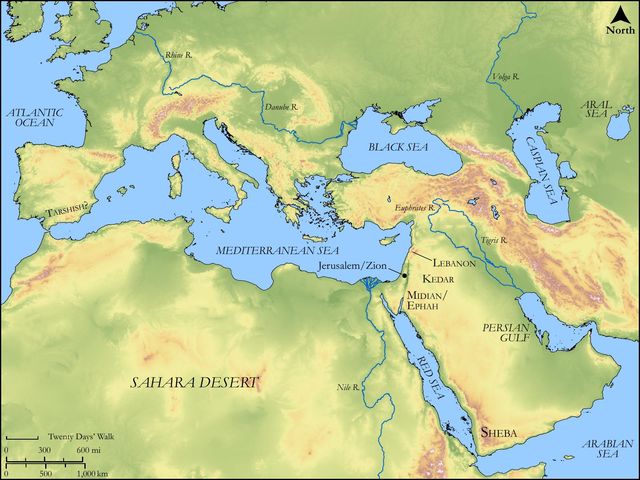
See on the biblical-era map
Study this verse
Public-domain commentary
Matthew Henry
From his Commentary on the Whole Bible. Henry comments on passages, not single verses — this entry covers Isaiah 43:14–21. His two-level outline is real structure in the source text, so it is rendered as structure.
To so low an ebb were the faith and hope of God's people in Babylon brought that there needed line upon line to assure them that they should be released out of their captivity; and therefore, that they might have strong consolation, the assurances of it are often repeated, and here very expressly and encouragingly.
I.God here takes to himself such titles of his honour as were very encouraging to them.
He is the Lord their Redeemer, not only he will redeem them, but will take it upon him as his office and make it his business to do so. If he be their God, he will be all that to them which they need, and therefore, when they are in bondage, he will be their Redeemer. He is the Holy One of Israel (Isa 43:14), and again (Isa 43:15), their Holy One, and therefore will make good every word he has spoken to them. He is the Creator of Israel, that made them a people out of nothing (for that is creation), nay, worse than nothing; and he is their King, that owns them as his people and presides among them.
II.He assures them he will find out a way to break the power of their oppressors that held them captives and filled up the measure of their own iniquity by their resolution never to let them go, Isa 14:17. God will take care to send a victorious prince and army to Babylon, that shall bring down all their nobles, and lay their honour in the dust, and all their people too, even the Chaldeans, whose cry is in the ships (for seamen are apt to be noisy), or whose cry is to the ships, as their refuge when the city is taken, that they may escape by the benefit of their great river. Note, The destruction of Babylon must make way for the enlargement of God's people. And in the prediction of the fall of the New Testament Babylon we meet with the cries and lamentations of the sailors, Rev 18:17, Rev 18:18. And observe, It is for Israel's sake that Babylon is ruined, to make way for their deliverance.
III.He reminds them of the great things he did for their fathers when he brought them out of the land of Egypt; for so it may be read (Isa 43:16, Isa 43:17): "Thus saith the Lord, who did make a way in the sea, the Red Sea, and did bring forth Pharaoh's chariot and horse, that they might lie down together in the bottom of the sea, and never rise, but be extinct. He that did this can, if he please, make a way for you in the sea when you return out of Babylon, and will do so rather than leave you there." Note, For the encouragement of our faith and hope, it is good for us often to remember what God has done formerly for his people against his and their enemies. Think particularly what he did at the Red Sea, how he made it,
1.A road to his people, a straight way, a near way, nay, a refuge to them, into which they fled and were safe the waters being a wall unto them.
2.A grave to his enemies. The chariot and horse were drawn out by him who is Lord of all hosts, on purpose that they might fall together; howbeit, they meant not so, Mic 4:11, Mic 4:12.
IV.He promises to do yet greater things for them than he had done in the days of old; so that they should not have reason to ask, in a way of complaint, as Gideon did, Where are all the wonders that our fathers told us of? for they should see them repeated, nay, they should see them outdone (Isa 43:18): "Remember not the former things, from them to take occasion, as some do, to undervalue the present things, as if the former days were better than these; no, you may, if you will, comparatively forget them, and yet know enough by the events of your own day to convince you that the Lord is God alone; for, behold, the Lord will do a new thing, no way inferior, both for the wonder and the worth of the mercy, to the things of old." The best exposition of this is, Jer 16:14, Jer 16:15; Jer 23:7, Jer 23:8. It shall no more be said, The Lord liveth that brought up the children of Israel out of the land of Egypt; that is an old thing, the remembrance of which will be in a manner lost in the new thing, in the new proof that the Lord liveth, for he brought up the children of Israel out of the land of the north. Though former mercies must not be forgotten, fresh mercies must in a special manner be improved. Now it springs forth, as it were a surprise upon you; you are like those that dream. Shall you now know it? And will you not own God's hand in it?
V.He promises not only to deliver them out of Babylon, but to conduct them safely and comfortably to their own land (Isa 43:19, Isa 43:20):
I will make a way in the wilderness and rivers in the desert; for, it seems, the way from Babylon to Canaan, as well as from Egypt, lay through a desert land, which, while the returning captives passed through, God would provide for them, that their camp should be both well victualled and under a good conduct. The same power that made a way in the sea (Isa 43:16) can make a way in the wilderness, and will force its passage through the greatest difficulties. And he that made dry land in the waters can produce waters in the dryest land, in such abundance as not only to give drink to his people, his chosen, but to the beasts of the field, also the dragons and the ostriches, who are therefore said to honour God for it; it is such a sensible refreshment, and yields them so much satisfaction, that, if they were capable of doing it, they would praise God for it, and shame man, who is made capable of praising his benefactor and does not. Now,
1.This looks back to what God did for Israel when he led them through the wilderness from Egypt to Canaan, and fetched water out of a rock to follow them; what God did for them formerly he would do again, for he is still the same. And, though we do not find that the miracle was repeated in their return out of Babylon, yet the mercy was, in the common course of Providence, for which it became them to be no less thankful to God.
2.It looks forward, not only to all the instances of God's care of the Jewish church in the latter ages of it, between their return from Babylon and the coming of Christ, but to the grace of the gospel, especially as it is manifested to the Gentile world, by which a way is opened in the wilderness and rivers in the desert; the world, which lay like a desert, in ignorance and unfruitfulness, was blessed with divine direction and divine comforts, and, in order to both, with a plentiful effusion of the Spirit. The sinners of the Gentiles, who had been as the beasts of the field, running wild, fierce as the dragons, stupid as the owls or ostriches, shall be brought to honour God for the extent of his grace to his chosen among them.
VI.He traces up all these promised blessings to their great original, the purposes and designs of his own glory (Isa 43:21):
This people have I formed for myself, and therefore I do all this for them, that they may show forth my praise. Note,
1.The church is of God's forming, and so are all the living members of it. The new heaven, the new earth, the new man, are the work of God's hand, and are no more, no better, than he makes them; they are fashioned according to his will.
2.He forms it for himself. He that is the first cause is the highest end both of the first and of the new creation. The Lord has made all things for himself, his Israel especially, to be to him for a people, and for a name, and for a praise; and no otherwise can they be for him, or serviceable to him, than as his grace is glorified in them, Jer 13:11; Eph 1:6, Eph 1:12, Eph 1:14.
3.It is therefore our duty to show forth his praise, not only with our lips, but in our lives, by giving up ourselves to his service. As he formed us, so he feeds us, and keeps us, and leads us, and all for himself; for every instance therefore of his goodness we must praise him, else we answer not the end of the beings and blessings we have.
Historical interpretation
Two Centuries of Reception
3 surviving comments on this verse. Each one is dated, so this reads as a timeline rather than a list.
Select a marker to jump to its quote. Markers stagger vertically where authors wrote within a few decades of each other.
Although these things were done to the Babylonians and Chaldeans, prophetically speaking, the future things that are “not yet” shall be as if already accomplished. God has completed these by himself, comparing the present events with those that happened earlier: I showed my divinity to those in Egypt and led my people through the Red Sea. I made a way “in the mighty water” and a dry path through that same sea when I threw the chariots of Pharaoh and his forces into the sea to the bed prepared for them, sinking down to the abyss and no longer able to rise. They were like those of old who were bent like a snuffed wick in a burning flame. I worked such things among the ancients, who in turn passed on the memory of those wonders to those of old who followed. But for the present I command them no longer to be amazed at those deeds, neither those done in Babylon nor those in Egypt.
(Verse 16, 17 and following) Thus says the Lord, who made a way in the sea, and a path in the mighty waters. Who brought out the chariot and horse, the army and the strong: they lay down to sleep together, they will not rise again; they are broken like flax, they are extinguished. Do not remember the former things, and do not consider the ancient things. Behold, I am doing something new, now it will spring forth; will you not know it? I will make a way in the wilderness, and rivers in the desert. The animals of the field will glorify me, the dragons and ostriches; for I have given waters in the wilderness, rivers in the desert, to give drink to my chosen people. I have formed this people for myself; they will proclaim my praise. LXX: For thus says the Lord, who makes a way in the sea, and a path in the mighty waters. Who brings out chariots and horses, and a multitude of warriors. But they lie down, they shall not rise; they are extinguished, extinguished like flax. Do not remember the former things, nor consider the things of old. Behold, I am doing a new thing; now it shall spring forth, shall you not know it? I will even make a way in the wilderness, and rivers in the desert. The beasts of the field, the sirens, and the daughters of ostriches will bless me, for I have given water in the wilderness and rivers in the dry land, to make my chosen people, my acquired people, drink. They will declare my virtues. The Lord, who destroyed and cast down Babylon and took away its mightiest ones from power, and made all the Chaldeans who sailed prosperously on the waves of this age captives, He Himself found a way in the rushing waters of the Red Sea, so that his liberated people could cross from Egypt. Whether it was he who made a path in the Red Sea, or who found a way in the raging waters of the river Jordan, so that the departure from Egypt and the entrance into the promised land would have a miracle. He submerged Pharaoh's chariots, horses, and entire army in the depths, who slept an eternal sleep. They were crushed and annihilated, like flax in a short span of time, and in an instant. For flax, even before being consumed by fire, is immediately extinguished due to its light substance, and dissolves into ashes. Therefore, I command you that among my signs and miracles, by which the most powerful city of Babylon was destroyed, and by which the way was opened for my people in the Red Sea and the Jordan river, you must not remember the past, for in the Gospel I am going to do much greater things; in comparison to which, the past should be forgotten. For I will no longer find a way in the Red Sea, but in the desert of the whole world. And not just one river or spring will burst forth from a rock, but many rivers that will refresh not bodies as before, but thirsty souls. And that which we read above will be fulfilled: You will drink the waters from the fountains of the Savior (On Chapter 12, Verse 3). Then, what has never been done will be done, so that all beasts and dragons, and ostriches who dwelt in the wilderness of the nations, and those who were like idolatry in their blood and the savagery of beasts, will glorify and praise me. As for the dragons, whom only Theodotius, as it is written in Hebrew, called Thannim (or Al. Thennim), the rest were interpreted as Sirens, monstrous creatures who would throw sailors to be torn apart by the barking Scyllaean dogs with their sweet song and deadly charm. And this means that those who were formerly devoted to pleasure and luxury are converted to the service of the Lord; although it is better to understand it as dragons, because they are joined with ostriches, since he spoke about beasts of the wilderness once, he put these animals, which are familiar in the desert. They will praise me, he says, and the animals of the field will glorify me, and the dragons, and the ostriches, because I gave waters in the desert of the nations, and rivers in the dry land of the peoples, so that my people, whom I have chosen for myself, or my chosen race, and the people whom I have acquired with my blood, may drink, and they may tell my praises and virtues.
How has he led chariots and horses? It is clear that Pharaoh pursued Israel by his own decision, for God had already spoken in this way to him: “I have raised you up as to show my power in you and so that my name might be made known throughout the earth.” Thus in a marvelous way God saves those who are fleeing from the desire for earthly things as they are pursued by the devil. God shows them that the wild waves of the present life are passable and that they will not be overwhelmed by trials but will arrive securely in the desert with a stilled and purified mind. They will eat the heavenly bread and drink the water from the rock. This is to share in Christ and to go through the Jordan and gain the Promised Land.
Continue studying Isaiah 43:16 across the web’s major study libraries — every link below opens this exact verse, chapter, or book on the destination site.
Read & Compare
 BibleGatewayThis verse in more than 200 translations and 70 languages.
 Bible.comThe YouVersion reader — hundreds of translations, reading plans, and highlights.
 ESV.orgCrossway's official English Standard Version reader.
 NET BibleThe NET translation with 60,000+ translators' notes on every rendering decision.
 STEP BibleTyndale House's free study tool — original text, vocabulary, and scholarly resources.
 BibliaLogos Bible Software's free web reader.
 USCCBThe New American Bible (Revised Edition) with the U.S. bishops' study notes.
Commentaries
 BibleHub CommentariesDozens of classic commentaries on this verse, gathered on one page.
 StudyLightMore than 100 commentary sets — the largest collection on the web.
 BibleRefPlain-English commentary on what this verse means, verse by verse.
 Enduring WordDavid Guzik's free commentary on this chapter, widely used by Bible teachers.
 Bible Study ToolsVerse commentary alongside Greek and Hebrew study aids.
Original Language & Research
- BibleHub InterlinearThe verse word by word — original language, transliteration, and English.
- BibleHub LexiconEvery word's original-language definition and Strong's entry.
 Blue Letter BibleDeep-study tools — Strong's numbers, concordance, and word studies.
 SefariaThe Hebrew text with Rashi and centuries of Jewish commentary.
Sermons, Hymns & Audio


TrulyRandomVerse is not affiliated with these sites and doesn’t control their content. They’re linked because they’re genuinely useful.
Summary
Isaiah 43:16 stands as a profound declaration of God's unparalleled power and unwavering commitment to His people. It serves as a majestic reminder of the LORD's sovereign ability to accomplish the seemingly impossible, specifically recalling His miraculous act of parting the Red Sea to forge a path for Israel. This verse functions as both a historical anchor, grounding God's future promises in His undeniable past faithfulness, and a prophetic assurance, establishing the foundation for His continued deliverance and provision, even when faced with overwhelming obstacles.
Context
ShowHideLiterary Context
Isaiah 43 is nestled within the "Book of Comfort" (Isaiah 40-55), a pivotal section of the prophet's work primarily addressed to the Jewish exiles in Babylon. This segment offers profound hope and assurance of future restoration following their period of judgment. Immediately preceding this verse, God emphatically declares His unique identity as the only Savior, emphasizing His unparalleled foreknowledge and omnipotence (e.g., Isaiah 43:10-13). He reminds Israel that He formed them for His praise and that He alone will blot out their transgressions (e.g., Isaiah 43:21-25). Verse 16 specifically harkens back to the Exodus, a foundational event in Israel's history, serving as a powerful precedent for the impending "new thing" (e.g., Isaiah 43:18-19), a new exodus from Babylon that will surpass the first in glory and demonstrate God's continued faithfulness.
Historical & Cultural Context
The primary audience for this message was the Jewish people enduring the Babylonian exile, a period marked by profound despair, national humiliation, and existential questioning of God's faithfulness. They were immersed in the polytheistic culture of Babylon, surrounded by its formidable gods and empires. The memory of the Exodus from Egypt, where God miraculously delivered their ancestors from the world's most powerful empire by parting the Red Sea (e.g., Exodus 14), was central to their national identity and their understanding of Yahweh's character. By recalling this specific, undeniable historical act, Isaiah grounds God's future promises in a tangible, irrefutable display of divine power, directly challenging any doubts about His ability to deliver them from their current seemingly insurmountable predicament. This historical anchor provided a vital source of hope and reassurance that the God of their past was still the God of their present and future.
Key Themes
ShowHideThis verse powerfully encapsulates several core themes prevalent throughout Isaiah and the broader biblical narrative. It underscores God's sovereignty and omnipotence, demonstrating His absolute control over creation and circumstances, even the most formidable natural barriers like the sea. It highlights the theme of divine deliverance and salvation, portraying God as the one who actively intervenes to rescue His people from impossible situations, not through human might but through His own miraculous power. The explicit reference to the past Exodus reinforces the theme of God's faithfulness to His covenant promises, assuring Israel that the God who acted mightily before will certainly do so again. Furthermore, it introduces the profound theme of God making a way where there seems to be no way, a concept central to understanding God's provision and guidance throughout history, from the Red Sea to the wilderness journey (e.g., Psalm 77:19) and beyond.
Exposition and Analysis
ShowHideKey Word Analysis
ShowHideThis is the sacred, covenantal name of God, often transliterated as Yahweh or Jehovah. Derived from the verb "to be," it emphasizes God's self-existence, eternal nature, and His personal, unchanging relationship with His people. When Isaiah declares, "Thus saith the LORD," it signifies that this is not merely a human pronouncement but a direct, authoritative word from the sovereign, covenant-keeping God of Israel, whose very name speaks of His unchanging faithfulness and infinite power to be who He is and to do what He promises.
This primitive root verb carries a vast semantic range, meaning "to give," but extending to "put," "make," or "bestow." In the context of Isaiah 43:16, it conveys God's active, intentional, and powerful agency in creating or establishing something. It denotes a dynamic act of divine will and power, indicating that God doesn't just find a way through the sea; He creates it, demonstrating His unparalleled creative power even in seemingly impossible scenarios. This emphasizes His initiative and omnipotence in bringing about deliverance.
From a root meaning "to tread," this word primarily refers to a road, path, or course. Figuratively, it can denote a course of life or mode of action. Here, it literally refers to a physical path miraculously opened through the sea, but it also carries the metaphorical weight of God providing a means of escape, a clear direction, or a comprehensive solution where none existed. Paired with "path" (nâthîyb), it emphasizes the clear, traversable route miraculously established by God, highlighting His providential guidance.
Verse Breakdown
ShowHide"Thus saith the LORD,"
This opening phrase functions as a classical divine oracle formula, immediately signaling that the words that follow are a direct, authoritative message from God Himself. It establishes the absolute truthfulness, infallibility, and power of the declaration, rooting it firmly in the character and authority of Yahweh, the covenant God of Israel. This divine pronouncement sets the tone for a message of sovereign power and infallible promise.
"which maketh a way in the sea,"
This clause immediately points to God's unparalleled power and creative ability, specifically alluding to the miraculous parting of the Red Sea during the Exodus (e.g., Exodus 14:21-22). This foundational event demonstrated God's absolute mastery over nature and His unwavering commitment to His people's deliverance. The emphasis is on God's active, intentional role in creating a path where there was only an impassable, life-threatening barrier, showcasing His ability to defy natural limitations.
"and a path in the mighty waters;"
This parallel clause powerfully reinforces the preceding statement, employing synonymous terms ("path" for "way," "mighty waters" for "sea") to amplify the miracle and its magnitude. "Mighty waters" conveys not just depth but also the immense power, turbulence, and overwhelming nature of the sea, making God's act of creating a traversable path through them all the more astounding. It serves as a testament to His supreme authority, irresistible strength, and His compassionate intervention on behalf of His people.
Literary Devices
ShowHideIsaiah 43:16 masterfully employs several literary devices to convey its powerful and reassuring message. Parallelism is prominently featured, with the idea of God creating a passage through water repeated in two closely related phrases: "a way in the sea" is echoed and intensified by "and a path in the mighty waters." This synonymous parallelism not only reinforces the miraculous nature of God's intervention but also adds a poetic rhythm and emphasis to the divine declaration. Allusion is central to the verse's impact, as it directly references the historical event of the Exodus and the parting of the Red Sea, a foundational and unforgettable narrative for Israel. This powerful allusion serves to remind the audience of God's past faithfulness and omnipotence, thereby building confidence for His future acts of deliverance. Furthermore, the "sea" and "mighty waters" function as potent symbols of insurmountable obstacles, chaos, and overwhelming danger, making God's act of "making a way" through them a profound symbol of His ability to overcome any human impossibility and bring order out of chaos for His people.
Theological and Thematic Connections
ShowHideIsaiah 43:16 is a profound theological statement on God's omnipotence, His unwavering commitment to His covenant people, and His nature as the ultimate Deliverer. It asserts that the God who performed the ultimate act of deliverance in the past—parting the Red Sea—is the very same God who will act in the present and future to save His people. This verse teaches us that God is not limited by natural laws, human limitations, or the seemingly insurmountable obstacles we face; He is the sovereign Creator who can defy all odds to fulfill His purposes. It underscores the biblical theme of God as the great Rescuer, who consistently intervenes on behalf of His people, turning impassable barriers into pathways of salvation. This divine characteristic is a source of immense hope and trust for believers facing their own "mighty waters," assuring them that God's power is limitless and His faithfulness is eternal.
Reflection and Application
ShowHideIsaiah 43:16 offers a timeless message of profound hope and assurance for every believer navigating the complexities of life. In a world often characterized by overwhelming challenges, seemingly impossible situations—whether personal crises, global uncertainties, or spiritual battles—this verse powerfully reminds us that our God is the God who makes a way where there appears to be no way. Just as He miraculously parted the Red Sea for ancient Israel, He is supremely capable of navigating us through the "mighty waters" of our lives, creating paths through financial distress, relational brokenness, debilitating health struggles, vocational dead ends, or spiritual stagnation. The call to us is to remember His past faithfulness, not only in the grand narratives of biblical history but also in the personal testimonies of our own lives, and to trust implicitly in His present power and future provision. This verse encourages us to shift our gaze from the daunting size of our problems to the infinite greatness of our God, believing with unwavering faith that He is always at work, making a way for His glory and our ultimate good.
Questions for Reflection
ShowHideFAQ
ShowHideWhat is the primary historical event referenced in Isaiah 43:16?
ShowHideThe primary historical event referenced in Isaiah 43:16 is the miraculous parting of the Red Sea during the Exodus of the Israelites from Egypt, as vividly described in Exodus 14. This event is a foundational narrative in Israelite history, serving as the quintessential demonstration of God's power to deliver His people from bondage through an impossible, supernatural act.
How does this verse offer comfort to those in difficult situations?
ShowHideThis verse offers profound comfort by reminding us that the God who performed such an extraordinary miracle in the past—creating a dry path through an impassable sea—is still active, powerful, and faithful today. For those facing seemingly insurmountable obstacles, whether personal, national, or spiritual, Isaiah 43:16 assures them that God is capable of "making a way" even through the most "mighty waters." It instills hope that He can deliver them from their present difficulties, just as He did for Israel, encouraging a deep trust in His omnipotence and unwavering faithfulness to His promises.
Christ-Centered Fulfillment
ShowHideIsaiah 43:16, with its powerful declaration of God making a way through the sea, finds its ultimate and most profound fulfillment in the person and work of Jesus Christ. While the Old Testament passage speaks of a physical deliverance through water, Christ is the one who makes a way for spiritual deliverance through the "mighty waters" of sin, death, and separation from God. He is the true and living "Way" (e.g., John 14:6), through whom humanity gains access to the Father. Just as God created a path through the Red Sea for physical salvation, Jesus, through His crucifixion and resurrection, cleared the path to eternal life, overcoming the ultimate barriers of sin and death (e.g., Hebrews 10:19-20). He is the Lamb of God who takes away the sin of the world (e.g., John 1:29), making a way for reconciliation and new life where there was only condemnation and spiritual death. Thus, the power displayed at the Red Sea is eclipsed by the greater power of Christ's atoning work, which provides a spiritual exodus for all who believe, leading them from the bondage of sin into the glorious freedom of God's kingdom (e.g., Colossians 1:13-14).