


Isaiah 43:17
Bible text: King James Version (1769 Blayney text) · Public domain
Bible text: King James Version with Strong's numbers · Public domain
Bible text: Berean Standard Bible · Public domain
Bible text: American Standard Version (1901) · Public domain
Bible text: World English Bible, Messianic edition · Public domain
Bible text: Geneva Bible (1599) · Public domain
Bible text: Young's Literal Translation · Public domain
- הַמּוֹצִיאha·mo·Tzi'who sent outH3318Art ¦ V-Hiphil-Prtcpl-msVerb Hiphil Participle Singular Masculine Absoluteהַwhoמּוֹצִיאsent out
- רֶכֶבre·khevchariotryH7393N-msNoun Singular Masculine Absolute
- וָסוּסva·Susand horse[s]H5483Conj-w ¦ N-msNoun Singular Masculine Absoluteוָandסוּסhorse[s]
- חַיִלCha·yilan armyH2428N-msNoun Singular Masculine Absolute
- וְעִזּוּזve·'i·Zuzand a strong [one]H5808Conj-w ¦ Adj-msAdjective Singular Masculine Absoluteוְandעִזּוּזa strong [one]
- יַחְדָּוyach·DavtogetherH3162AdvAdverb
- יִשְׁכְּבוּyish·ke·Vuthey lay downH7901V-Qal-Imperf-3mpVerb Qal Imperfect 3rd Plural Masculine
- בַּלbalnotH1077NegParticle Negative
- יָקוּמוּya·Ku·muthey roseH6965V-Qal-Imperf-3mpVerb Qal Imperfect 3rd Plural Masculine
- דָּעֲכוּda·'a·Khuthey were extinguishedH1846V-Qal-Perf-3cpVerb Qal Perfect 3rd Plural common gender
- כַּפִּשְׁתָּהka·pish·Tahlike <the> wickH6594Prep-k ¦ N-fsNoun Singular Feminine Absoluteכַּlike <the>פִּשְׁתָּהwick
- כָבוּkha·Vuthey were quenchedH3518V-Qal-Perf-3cpVerb Qal Perfect 3rd Plural common gender
English is a literal word-by-word gloss of the Hebrew, not the KJV's wording. Why?
This is the original text the KJV's translators worked from — each Hebrew word with its own literal English meaning in this verse, prepared by scholars at Tyndale House, Cambridge. The KJV translates whole sentences, not word by word, so its wording differs: one Hebrew word can become several English words, and the KJV may choose “the LORD” where the gloss reads “Yahweh”. Both are faithful — they answer different questions. For the KJV's own rendering, switch to the KJV text.
Details
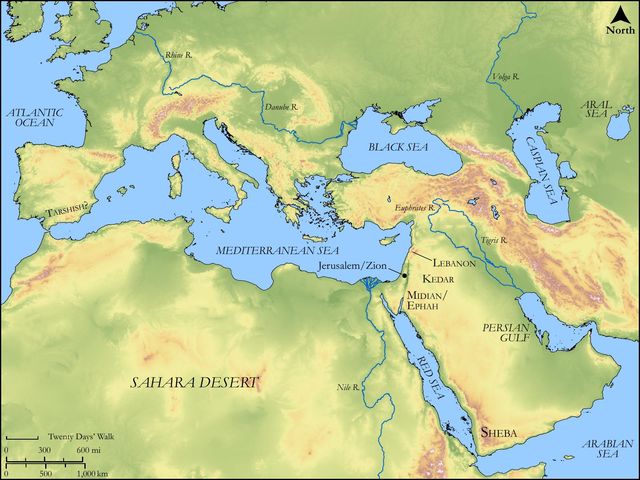
See on the biblical-era map
Study this verse
Public-domain commentary
Matthew Henry
From his Commentary on the Whole Bible. Henry comments on passages, not single verses — this entry covers Isaiah 43:14–21. His two-level outline is real structure in the source text, so it is rendered as structure.
To so low an ebb were the faith and hope of God's people in Babylon brought that there needed line upon line to assure them that they should be released out of their captivity; and therefore, that they might have strong consolation, the assurances of it are often repeated, and here very expressly and encouragingly.
I.God here takes to himself such titles of his honour as were very encouraging to them.
He is the Lord their Redeemer, not only he will redeem them, but will take it upon him as his office and make it his business to do so. If he be their God, he will be all that to them which they need, and therefore, when they are in bondage, he will be their Redeemer. He is the Holy One of Israel (Isa 43:14), and again (Isa 43:15), their Holy One, and therefore will make good every word he has spoken to them. He is the Creator of Israel, that made them a people out of nothing (for that is creation), nay, worse than nothing; and he is their King, that owns them as his people and presides among them.
II.He assures them he will find out a way to break the power of their oppressors that held them captives and filled up the measure of their own iniquity by their resolution never to let them go, Isa 14:17. God will take care to send a victorious prince and army to Babylon, that shall bring down all their nobles, and lay their honour in the dust, and all their people too, even the Chaldeans, whose cry is in the ships (for seamen are apt to be noisy), or whose cry is to the ships, as their refuge when the city is taken, that they may escape by the benefit of their great river. Note, The destruction of Babylon must make way for the enlargement of God's people. And in the prediction of the fall of the New Testament Babylon we meet with the cries and lamentations of the sailors, Rev 18:17, Rev 18:18. And observe, It is for Israel's sake that Babylon is ruined, to make way for their deliverance.
III.He reminds them of the great things he did for their fathers when he brought them out of the land of Egypt; for so it may be read (Isa 43:16, Isa 43:17): "Thus saith the Lord, who did make a way in the sea, the Red Sea, and did bring forth Pharaoh's chariot and horse, that they might lie down together in the bottom of the sea, and never rise, but be extinct. He that did this can, if he please, make a way for you in the sea when you return out of Babylon, and will do so rather than leave you there." Note, For the encouragement of our faith and hope, it is good for us often to remember what God has done formerly for his people against his and their enemies. Think particularly what he did at the Red Sea, how he made it,
1.A road to his people, a straight way, a near way, nay, a refuge to them, into which they fled and were safe the waters being a wall unto them.
2.A grave to his enemies. The chariot and horse were drawn out by him who is Lord of all hosts, on purpose that they might fall together; howbeit, they meant not so, Mic 4:11, Mic 4:12.
IV.He promises to do yet greater things for them than he had done in the days of old; so that they should not have reason to ask, in a way of complaint, as Gideon did, Where are all the wonders that our fathers told us of? for they should see them repeated, nay, they should see them outdone (Isa 43:18): "Remember not the former things, from them to take occasion, as some do, to undervalue the present things, as if the former days were better than these; no, you may, if you will, comparatively forget them, and yet know enough by the events of your own day to convince you that the Lord is God alone; for, behold, the Lord will do a new thing, no way inferior, both for the wonder and the worth of the mercy, to the things of old." The best exposition of this is, Jer 16:14, Jer 16:15; Jer 23:7, Jer 23:8. It shall no more be said, The Lord liveth that brought up the children of Israel out of the land of Egypt; that is an old thing, the remembrance of which will be in a manner lost in the new thing, in the new proof that the Lord liveth, for he brought up the children of Israel out of the land of the north. Though former mercies must not be forgotten, fresh mercies must in a special manner be improved. Now it springs forth, as it were a surprise upon you; you are like those that dream. Shall you now know it? And will you not own God's hand in it?
V.He promises not only to deliver them out of Babylon, but to conduct them safely and comfortably to their own land (Isa 43:19, Isa 43:20):
I will make a way in the wilderness and rivers in the desert; for, it seems, the way from Babylon to Canaan, as well as from Egypt, lay through a desert land, which, while the returning captives passed through, God would provide for them, that their camp should be both well victualled and under a good conduct. The same power that made a way in the sea (Isa 43:16) can make a way in the wilderness, and will force its passage through the greatest difficulties. And he that made dry land in the waters can produce waters in the dryest land, in such abundance as not only to give drink to his people, his chosen, but to the beasts of the field, also the dragons and the ostriches, who are therefore said to honour God for it; it is such a sensible refreshment, and yields them so much satisfaction, that, if they were capable of doing it, they would praise God for it, and shame man, who is made capable of praising his benefactor and does not. Now,
1.This looks back to what God did for Israel when he led them through the wilderness from Egypt to Canaan, and fetched water out of a rock to follow them; what God did for them formerly he would do again, for he is still the same. And, though we do not find that the miracle was repeated in their return out of Babylon, yet the mercy was, in the common course of Providence, for which it became them to be no less thankful to God.
2.It looks forward, not only to all the instances of God's care of the Jewish church in the latter ages of it, between their return from Babylon and the coming of Christ, but to the grace of the gospel, especially as it is manifested to the Gentile world, by which a way is opened in the wilderness and rivers in the desert; the world, which lay like a desert, in ignorance and unfruitfulness, was blessed with divine direction and divine comforts, and, in order to both, with a plentiful effusion of the Spirit. The sinners of the Gentiles, who had been as the beasts of the field, running wild, fierce as the dragons, stupid as the owls or ostriches, shall be brought to honour God for the extent of his grace to his chosen among them.
VI.He traces up all these promised blessings to their great original, the purposes and designs of his own glory (Isa 43:21):
This people have I formed for myself, and therefore I do all this for them, that they may show forth my praise. Note,
1.The church is of God's forming, and so are all the living members of it. The new heaven, the new earth, the new man, are the work of God's hand, and are no more, no better, than he makes them; they are fashioned according to his will.
2.He forms it for himself. He that is the first cause is the highest end both of the first and of the new creation. The Lord has made all things for himself, his Israel especially, to be to him for a people, and for a name, and for a praise; and no otherwise can they be for him, or serviceable to him, than as his grace is glorified in them, Jer 13:11; Eph 1:6, Eph 1:12, Eph 1:14.
3.It is therefore our duty to show forth his praise, not only with our lips, but in our lives, by giving up ourselves to his service. As he formed us, so he feeds us, and keeps us, and leads us, and all for himself; for every instance therefore of his goodness we must praise him, else we answer not the end of the beings and blessings we have.
Historical interpretation
Historical reception
1 surviving comment on this verse from the historical church.
(Verse 16, 17 and following) Thus says the Lord, who made a way in the sea, and a path in the mighty waters. Who brought out the chariot and horse, the army and the strong: they lay down to sleep together, they will not rise again; they are broken like flax, they are extinguished. Do not remember the former things, and do not consider the ancient things. Behold, I am doing something new, now it will spring forth; will you not know it? I will make a way in the wilderness, and rivers in the desert. The animals of the field will glorify me, the dragons and ostriches; for I have given waters in the wilderness, rivers in the desert, to give drink to my chosen people. I have formed this people for myself; they will proclaim my praise. LXX: For thus says the Lord, who makes a way in the sea, and a path in the mighty waters. Who brings out chariots and horses, and a multitude of warriors. But they lie down, they shall not rise; they are extinguished, extinguished like flax. Do not remember the former things, nor consider the things of old. Behold, I am doing a new thing; now it shall spring forth, shall you not know it? I will even make a way in the wilderness, and rivers in the desert. The beasts of the field, the sirens, and the daughters of ostriches will bless me, for I have given water in the wilderness and rivers in the dry land, to make my chosen people, my acquired people, drink. They will declare my virtues. The Lord, who destroyed and cast down Babylon and took away its mightiest ones from power, and made all the Chaldeans who sailed prosperously on the waves of this age captives, He Himself found a way in the rushing waters of the Red Sea, so that his liberated people could cross from Egypt. Whether it was he who made a path in the Red Sea, or who found a way in the raging waters of the river Jordan, so that the departure from Egypt and the entrance into the promised land would have a miracle. He submerged Pharaoh's chariots, horses, and entire army in the depths, who slept an eternal sleep. They were crushed and annihilated, like flax in a short span of time, and in an instant. For flax, even before being consumed by fire, is immediately extinguished due to its light substance, and dissolves into ashes. Therefore, I command you that among my signs and miracles, by which the most powerful city of Babylon was destroyed, and by which the way was opened for my people in the Red Sea and the Jordan river, you must not remember the past, for in the Gospel I am going to do much greater things; in comparison to which, the past should be forgotten. For I will no longer find a way in the Red Sea, but in the desert of the whole world. And not just one river or spring will burst forth from a rock, but many rivers that will refresh not bodies as before, but thirsty souls. And that which we read above will be fulfilled: You will drink the waters from the fountains of the Savior (On Chapter 12, Verse 3). Then, what has never been done will be done, so that all beasts and dragons, and ostriches who dwelt in the wilderness of the nations, and those who were like idolatry in their blood and the savagery of beasts, will glorify and praise me. As for the dragons, whom only Theodotius, as it is written in Hebrew, called Thannim (or Al. Thennim), the rest were interpreted as Sirens, monstrous creatures who would throw sailors to be torn apart by the barking Scyllaean dogs with their sweet song and deadly charm. And this means that those who were formerly devoted to pleasure and luxury are converted to the service of the Lord; although it is better to understand it as dragons, because they are joined with ostriches, since he spoke about beasts of the wilderness once, he put these animals, which are familiar in the desert. They will praise me, he says, and the animals of the field will glorify me, and the dragons, and the ostriches, because I gave waters in the desert of the nations, and rivers in the dry land of the peoples, so that my people, whom I have chosen for myself, or my chosen race, and the people whom I have acquired with my blood, may drink, and they may tell my praises and virtues.
Continue studying Isaiah 43:17 across the web’s major study libraries — every link below opens this exact verse, chapter, or book on the destination site.
Read & Compare
 BibleGatewayThis verse in more than 200 translations and 70 languages.
 Bible.comThe YouVersion reader — hundreds of translations, reading plans, and highlights.
 ESV.orgCrossway's official English Standard Version reader.
 NET BibleThe NET translation with 60,000+ translators' notes on every rendering decision.
 STEP BibleTyndale House's free study tool — original text, vocabulary, and scholarly resources.
 BibliaLogos Bible Software's free web reader.
 USCCBThe New American Bible (Revised Edition) with the U.S. bishops' study notes.
Commentaries
 BibleHub CommentariesDozens of classic commentaries on this verse, gathered on one page.
 StudyLightMore than 100 commentary sets — the largest collection on the web.
 BibleRefPlain-English commentary on what this verse means, verse by verse.
 Enduring WordDavid Guzik's free commentary on this chapter, widely used by Bible teachers.
 Bible Study ToolsVerse commentary alongside Greek and Hebrew study aids.
Original Language & Research
- BibleHub InterlinearThe verse word by word — original language, transliteration, and English.
- BibleHub LexiconEvery word's original-language definition and Strong's entry.
 Blue Letter BibleDeep-study tools — Strong's numbers, concordance, and word studies.
 SefariaThe Hebrew text with Rashi and centuries of Jewish commentary.
Sermons, Hymns & Audio


TrulyRandomVerse is not affiliated with these sites and doesn’t control their content. They’re linked because they’re genuinely useful.
Summary
Isaiah 43:17 stands as a powerful declaration of God's unrivaled might and His decisive, sovereign action in utterly annihilating forces that oppose His will and His people. This verse serves as a profound testament to divine judgment and ultimate deliverance, drawing upon a foundational historical event to underscore God's absolute control over the rise and fall of nations, demonstrating that no human power can withstand His omnipotent decree.
Context
ShowHideLiterary Context
Isaiah 43:17 is situated within the latter portion of the book of Isaiah (chapters 40-55), often referred to as the "Book of Comfort" or "Second Isaiah." This section primarily addresses the exilic community, offering profound hope, reassurance, and a renewed understanding of God's covenant faithfulness and redemptive power amidst their suffering in Babylon. Throughout these chapters, God consistently contrasts His unique identity as the only true God, the Creator, and the Redeemer with the impotent idols worshipped by the surrounding nations. Verse 17 specifically functions as a potent historical precedent, recalling God's past acts of salvation to guarantee His future deliverance for Israel, thereby reinforcing the overarching themes of God's unmatched power and His unwavering commitment to His people, a promise beautifully articulated in passages like Isaiah 43:1-3.
Historical & Cultural Context
The vivid imagery employed in Isaiah 43:17 directly alludes to the quintessential redemptive event in Israel's history: the Exodus from Egypt and, more specifically, the miraculous destruction of Pharaoh's formidable army at the Red Sea. Among the nations of that day, chariots and horses represented the zenith of military technology and power, symbolizing an overwhelming, seemingly invincible force. Egypt, as the dominant superpower of its era, possessed a vast and well-equipped army. The complete annihilation of such a force—chariots, horses, and soldiers—in the Red Sea, as meticulously described in Exodus 14:27-28, was an unparalleled demonstration of divine intervention. This event was not merely a historical anecdote but a foundational narrative that profoundly shaped Israel's identity and their understanding of God's absolute power to save and to judge.
Key Themes
ShowHideThis verse powerfully underscores several major theological themes prevalent throughout the book of Isaiah and the broader Old Testament. Firstly, it highlights Divine Power and Sovereignty, asserting that God is the ultimate orchestrator of history, capable of raising up and casting down any human power, as powerfully articulated in Psalm 76:5-6. Secondly, it emphasizes the Certainty and Finality of Judgment. The vivid imagery of total destruction—"they shall not rise: they are extinct, they are quenched as tow"—conveys an irreversible and complete divine judgment upon those who oppose God and His redemptive purposes. Finally, and crucially for the exilic audience, it powerfully portrays God as Deliverer and Redeemer. By utterly defeating the oppressor, God simultaneously demonstrates His unwavering faithfulness to His covenant people, Israel, providing them with salvation and freedom, a theme echoed with profound comfort in Isaiah 41:10.
Exposition and Analysis
ShowHideKey Word Analysis
ShowHideA primitive root meaning "to be extinguished." Figuratively, it conveys the idea of expiring, being dried up, or completely consumed. Its use here, translated as "extinct," emphasizes the absolute cessation of existence or power for the opposing force, leaving no remnant or possibility of revival. It denotes a permanent and irreversible end.
Another primitive root, meaning "to expire" or (causatively) "to extinguish" fire, light, or anger. Translated as "quenched," it reinforces the imagery of something being utterly put out, like a flame. When paired with "tow," it vividly describes the swift, effortless, and complete annihilation of the enemy, leaving no spark or ember of life or power.
This feminine noun refers to "flax" or, by implication, a "wick" or "tow." Tow consists of loose, dry fibers of flax or hemp, known for being extremely flammable and easily extinguished. The comparison of the mighty army to "tow" highlights their utter fragility and vulnerability before God's power, capable of being snuffed out instantly and completely, without any struggle.
Verse Breakdown
ShowHide"Which bringeth forth the chariot and horse, the army and the power;"
This initial clause establishes God as the sovereign agent who "brings forth" or causes the very existence and deployment of these formidable military elements. It is a profound statement of divine control, indicating that even the most powerful human forces operate ultimately within His purview and are subject to His will. The comprehensive listing of "chariot and horse, the army and the power" serves as a merism, encompassing the entirety of a complete, overwhelming military force, representing the full might and resources of an empire.
"they shall lie down together, they shall not rise:"
This clause describes the immediate, collective, and irreversible consequence of God's action against the opposing forces. To "lie down" in this context implies defeat, death, and permanent rest, often in a grave. The phrase "together" emphasizes the comprehensive nature of their downfall—no one escapes, and the entire entity is brought low. The emphatic declaration "they shall not rise" signifies the absolute finality of their defeat; there is no recovery, no regrouping, no resurgence of power. Their end is absolute and eternal.
"they are extinct, they are quenched as tow."
This final clause employs powerful metaphors and similes to underscore the totality, ease, and swiftness of the enemy's destruction. "Extinct" reiterates the idea of complete cessation of life and power, leaving no trace. The simile "quenched as tow" is particularly vivid: just as a small, easily flammable piece of tow is instantly extinguished by a drop of water or a puff of wind, so too is the mightiest human army effortlessly and completely snuffed out by God's power, leaving no lingering threat or possibility of revival.
Literary Devices
ShowHideIsaiah 43:17 masterfully employs several Literary Devices to convey its powerful and reassuring message. The most prominent device is Simile, vividly expressed in the phrase "quenched as tow." This comparison likens the formidable military might of the enemy to fragile, easily extinguished flax fibers, powerfully illustrating their utter vulnerability and insignificance before God's omnipotence. This also functions as a powerful Understatement of God's effort, implying that what seems insurmountable to humans is effortlessly dispatched by Him. The verse also utilizes Parallelism in its structure, particularly in the paired descriptions of the enemy's demise: "they shall lie down together, they shall not rise" and "they are extinct, they are quenched as tow." This repetition reinforces the theme of complete and irreversible destruction. Furthermore, there is an element of Hyperbole in phrases like "they shall not rise" and "they are extinct," emphasizing the absolute and final nature of God's judgment, leaving no room for doubt about the enemy's total and permanent defeat.
Theological and Thematic Connections
ShowHideIsaiah 43:17 stands as a profound theological statement on God's absolute sovereignty over all creation, including the most formidable human powers and geopolitical forces. It asserts unequivocally that no military might, no strategic genius, and no human force can ultimately stand against the will and power of the Almighty. This verse not only celebrates God's power to judge and destroy His enemies but also, and more importantly, highlights His unwavering commitment to deliver and redeem His chosen people. The judgment on the oppressor is always intrinsically intertwined with the salvation of the oppressed, demonstrating God's perfect justice and His unwavering covenant faithfulness. For Israel in exile, this historical reminder served as a powerful assurance that the same God who miraculously delivered them from the seemingly invincible power of Egypt would surely deliver them from the bondage of Babylon.
Reflection and Application
ShowHideIsaiah 43:17 offers profound comfort and a solemn warning for believers navigating the complexities of contemporary life. In a world often dominated by seemingly insurmountable challenges, oppressive practices, or deeply personal struggles, this verse serves as a potent reminder that no power, no obstacle, and no enemy is too formidable for our God to overcome. The same Almighty God who effortlessly extinguished the mightiest army of ancient Egypt is fully capable of bringing deliverance and victory in our lives today. We are therefore called to place our unwavering trust not in human strength, political power, or personal ingenuity, but in the invincible power of the Lord, who remains unchanging in His might and faithfulness. Conversely, this verse serves as a powerful warning to any who would oppose God's righteous will or His beloved people, highlighting the ultimate futility and certain destruction of resistance against His supreme authority. It calls us to profound humility and willing submission to His divine purposes, recognizing that His judgment is certain and final for those who persist in rebellion.
Questions for Reflection
ShowHideFAQ
ShowHideWhat historical event is Isaiah 43:17 primarily referencing?
ShowHideIsaiah 43:17 is primarily referencing the miraculous and decisive destruction of Pharaoh's army at the Red Sea, as vividly recorded in Exodus 14. This pivotal event, where the chariots, horses, and soldiers of Egypt were swallowed by the sea, stood as the quintessential demonstration of God's unparalleled power to deliver His people from bondage and to judge their oppressors. The imagery of "chariot and horse, the army and the power" being brought forth and then utterly destroyed directly aligns with this foundational moment in Israel's redemptive history.
What does the phrase "they are quenched as tow" mean?
ShowHideThe phrase "they are quenched as tow" is a powerful and vivid simile emphasizing the swift, effortless, and complete annihilation of the enemy. "Tow" refers to the loose, dry fibers of flax or hemp, which are extremely flammable and commonly used as tinder or kindling. Just as a tiny spark or flame can be instantly and completely extinguished by a breath of wind or a drop of water, so too was the mighty army of the enemy utterly and irrevocably destroyed by God's power. It signifies a total and final defeat, without any possibility of recovery or resurgence, highlighting the ease with which God overcomes even the most formidable human strength.
How does this verse apply to believers today?
ShowHideFor believers today, Isaiah 43:17 offers profound assurance, comfort, and a clear call to trust. It serves as a powerful reminder that no enemy, no obstacle, and no power—whether spiritual, political, or personal—is too great or too entrenched for God to overcome. When we face overwhelming challenges, feel threatened by oppressive circumstances, or grapple with seemingly insurmountable odds, this verse encourages us to remember that the same Almighty God who effortlessly defeated ancient armies is fully capable of bringing deliverance and victory in our lives. It strengthens our faith in His sovereign power and reminds us that His ultimate victory over all opposing forces is absolutely assured, as promised in passages like Romans 8:31.
Christ-Centered Fulfillment
ShowHideWhile Isaiah 43:17 directly recalls God's historic triumph over Egypt, its ultimate fulfillment and deeper theological resonance are found in the person and redemptive work of Jesus Christ. The "chariot and horse, the army and the power" ultimately represent all forces that oppose God's kingdom and His people, including the formidable spiritual powers of darkness, the dominion of sin, and the finality of death itself. Christ, through His crucifixion and resurrection, decisively "brought forth" these powers only for them to "lie down together" and "not rise." His death on the cross was not a defeat but a strategic victory, disarming and triumphing over the principalities and powers, making a public spectacle of them, as triumphantly declared in Colossians 2:15. The ultimate enemy, death itself, is "quenched as tow" through Christ's glorious resurrection, which swallowed up death in victory, fulfilling prophecies like that found in 1 Corinthians 15:54-57. Just as God delivered Israel from physical bondage, Christ delivers humanity from spiritual bondage, the tyranny of sin, and the sting of death, demonstrating His supreme power to make all things new and establish His eternal reign, foreshadowed in the majestic return of the Rider on the white horse in Revelation 19:11-16. Thus, Isaiah 43:17 points forward to the definitive and complete victory achieved by the Lamb of God, who utterly extinguishes all opposition to God's redemptive plan for His creation.