


Isaiah 43:18
Bible text: King James Version (1769 Blayney text) · Public domain
Bible text: Berean Standard Bible · Public domain
Bible text: American Standard Version (1901) · Public domain
Bible text: World English Bible, Messianic edition · Public domain
Bible text: Geneva Bible (1599) · Public domain
Bible text: Young's Literal Translation · Public domain
- אַל'almay notH408NegParticle Negative
- תִּזְכְּרוּtiz·ke·Ruyou rememberH2142V-Qal-Imperf-2mpVerb Qal Imperfect 2nd Plural Masculine
- רִאשֹׁנוֹתri·sho·Notformer [things]H7223Adj-fpAdjective Numerical Position Plural Feminine Absolute
- וְקַדְמֹנִיּוֹתve·kad·mo·ni·Yotand ancient [things]H6931Conj-w ¦ Adj-fpAdjective Plural Feminine Absoluteוְandקַדְמֹנִיּוֹתancient [things]
- אַל'almay notH408NegParticle Negative
- תִּתְבֹּנָנוּtit·bo·Na·nuyou considerH995V-Hithpael-Imperf-2mpVerb Hithpael Imperfect 2nd Plural Masculine
English is a literal word-by-word gloss of the Hebrew, not the KJV's wording. Why?
This is the original text the KJV's translators worked from — each Hebrew word with its own literal English meaning in this verse, prepared by scholars at Tyndale House, Cambridge. The KJV translates whole sentences, not word by word, so its wording differs: one Hebrew word can become several English words, and the KJV may choose “the LORD” where the gloss reads “Yahweh”. Both are faithful — they answer different questions. For the KJV's own rendering, switch to the KJV text.
Details
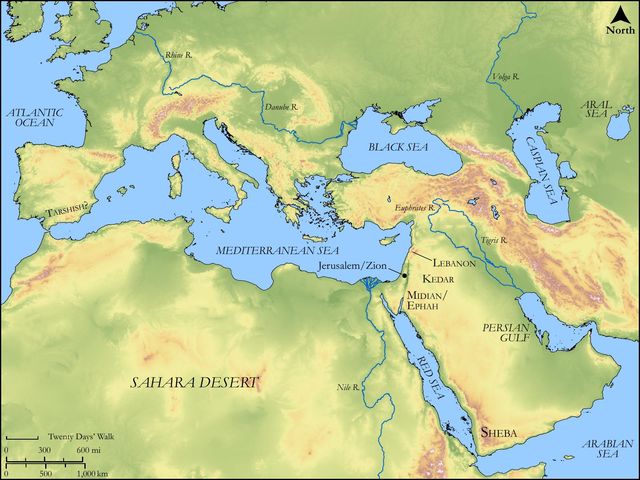
See on the biblical-era map
Study this verse
Public-domain commentary
Matthew Henry
From his Commentary on the Whole Bible. Henry comments on passages, not single verses — this entry covers Isaiah 43:14–21. His two-level outline is real structure in the source text, so it is rendered as structure.
To so low an ebb were the faith and hope of God's people in Babylon brought that there needed line upon line to assure them that they should be released out of their captivity; and therefore, that they might have strong consolation, the assurances of it are often repeated, and here very expressly and encouragingly.
I.God here takes to himself such titles of his honour as were very encouraging to them.
He is the Lord their Redeemer, not only he will redeem them, but will take it upon him as his office and make it his business to do so. If he be their God, he will be all that to them which they need, and therefore, when they are in bondage, he will be their Redeemer. He is the Holy One of Israel (Isa 43:14), and again (Isa 43:15), their Holy One, and therefore will make good every word he has spoken to them. He is the Creator of Israel, that made them a people out of nothing (for that is creation), nay, worse than nothing; and he is their King, that owns them as his people and presides among them.
II.He assures them he will find out a way to break the power of their oppressors that held them captives and filled up the measure of their own iniquity by their resolution never to let them go, Isa 14:17. God will take care to send a victorious prince and army to Babylon, that shall bring down all their nobles, and lay their honour in the dust, and all their people too, even the Chaldeans, whose cry is in the ships (for seamen are apt to be noisy), or whose cry is to the ships, as their refuge when the city is taken, that they may escape by the benefit of their great river. Note, The destruction of Babylon must make way for the enlargement of God's people. And in the prediction of the fall of the New Testament Babylon we meet with the cries and lamentations of the sailors, Rev 18:17, Rev 18:18. And observe, It is for Israel's sake that Babylon is ruined, to make way for their deliverance.
III.He reminds them of the great things he did for their fathers when he brought them out of the land of Egypt; for so it may be read (Isa 43:16, Isa 43:17): "Thus saith the Lord, who did make a way in the sea, the Red Sea, and did bring forth Pharaoh's chariot and horse, that they might lie down together in the bottom of the sea, and never rise, but be extinct. He that did this can, if he please, make a way for you in the sea when you return out of Babylon, and will do so rather than leave you there." Note, For the encouragement of our faith and hope, it is good for us often to remember what God has done formerly for his people against his and their enemies. Think particularly what he did at the Red Sea, how he made it,
1.A road to his people, a straight way, a near way, nay, a refuge to them, into which they fled and were safe the waters being a wall unto them.
2.A grave to his enemies. The chariot and horse were drawn out by him who is Lord of all hosts, on purpose that they might fall together; howbeit, they meant not so, Mic 4:11, Mic 4:12.
IV.He promises to do yet greater things for them than he had done in the days of old; so that they should not have reason to ask, in a way of complaint, as Gideon did, Where are all the wonders that our fathers told us of? for they should see them repeated, nay, they should see them outdone (Isa 43:18): "Remember not the former things, from them to take occasion, as some do, to undervalue the present things, as if the former days were better than these; no, you may, if you will, comparatively forget them, and yet know enough by the events of your own day to convince you that the Lord is God alone; for, behold, the Lord will do a new thing, no way inferior, both for the wonder and the worth of the mercy, to the things of old." The best exposition of this is, Jer 16:14, Jer 16:15; Jer 23:7, Jer 23:8. It shall no more be said, The Lord liveth that brought up the children of Israel out of the land of Egypt; that is an old thing, the remembrance of which will be in a manner lost in the new thing, in the new proof that the Lord liveth, for he brought up the children of Israel out of the land of the north. Though former mercies must not be forgotten, fresh mercies must in a special manner be improved. Now it springs forth, as it were a surprise upon you; you are like those that dream. Shall you now know it? And will you not own God's hand in it?
V.He promises not only to deliver them out of Babylon, but to conduct them safely and comfortably to their own land (Isa 43:19, Isa 43:20):
I will make a way in the wilderness and rivers in the desert; for, it seems, the way from Babylon to Canaan, as well as from Egypt, lay through a desert land, which, while the returning captives passed through, God would provide for them, that their camp should be both well victualled and under a good conduct. The same power that made a way in the sea (Isa 43:16) can make a way in the wilderness, and will force its passage through the greatest difficulties. And he that made dry land in the waters can produce waters in the dryest land, in such abundance as not only to give drink to his people, his chosen, but to the beasts of the field, also the dragons and the ostriches, who are therefore said to honour God for it; it is such a sensible refreshment, and yields them so much satisfaction, that, if they were capable of doing it, they would praise God for it, and shame man, who is made capable of praising his benefactor and does not. Now,
1.This looks back to what God did for Israel when he led them through the wilderness from Egypt to Canaan, and fetched water out of a rock to follow them; what God did for them formerly he would do again, for he is still the same. And, though we do not find that the miracle was repeated in their return out of Babylon, yet the mercy was, in the common course of Providence, for which it became them to be no less thankful to God.
2.It looks forward, not only to all the instances of God's care of the Jewish church in the latter ages of it, between their return from Babylon and the coming of Christ, but to the grace of the gospel, especially as it is manifested to the Gentile world, by which a way is opened in the wilderness and rivers in the desert; the world, which lay like a desert, in ignorance and unfruitfulness, was blessed with divine direction and divine comforts, and, in order to both, with a plentiful effusion of the Spirit. The sinners of the Gentiles, who had been as the beasts of the field, running wild, fierce as the dragons, stupid as the owls or ostriches, shall be brought to honour God for the extent of his grace to his chosen among them.
VI.He traces up all these promised blessings to their great original, the purposes and designs of his own glory (Isa 43:21):
This people have I formed for myself, and therefore I do all this for them, that they may show forth my praise. Note,
1.The church is of God's forming, and so are all the living members of it. The new heaven, the new earth, the new man, are the work of God's hand, and are no more, no better, than he makes them; they are fashioned according to his will.
2.He forms it for himself. He that is the first cause is the highest end both of the first and of the new creation. The Lord has made all things for himself, his Israel especially, to be to him for a people, and for a name, and for a praise; and no otherwise can they be for him, or serviceable to him, than as his grace is glorified in them, Jer 13:11; Eph 1:6, Eph 1:12, Eph 1:14.
3.It is therefore our duty to show forth his praise, not only with our lips, but in our lives, by giving up ourselves to his service. As he formed us, so he feeds us, and keeps us, and leads us, and all for himself; for every instance therefore of his goodness we must praise him, else we answer not the end of the beings and blessings we have.
Historical interpretation
Historical reception
1 surviving comment on this verse from the historical church.
(Verse 16, 17 and following) Thus says the Lord, who made a way in the sea, and a path in the mighty waters. Who brought out the chariot and horse, the army and the strong: they lay down to sleep together, they will not rise again; they are broken like flax, they are extinguished. Do not remember the former things, and do not consider the ancient things. Behold, I am doing something new, now it will spring forth; will you not know it? I will make a way in the wilderness, and rivers in the desert. The animals of the field will glorify me, the dragons and ostriches; for I have given waters in the wilderness, rivers in the desert, to give drink to my chosen people. I have formed this people for myself; they will proclaim my praise. LXX: For thus says the Lord, who makes a way in the sea, and a path in the mighty waters. Who brings out chariots and horses, and a multitude of warriors. But they lie down, they shall not rise; they are extinguished, extinguished like flax. Do not remember the former things, nor consider the things of old. Behold, I am doing a new thing; now it shall spring forth, shall you not know it? I will even make a way in the wilderness, and rivers in the desert. The beasts of the field, the sirens, and the daughters of ostriches will bless me, for I have given water in the wilderness and rivers in the dry land, to make my chosen people, my acquired people, drink. They will declare my virtues. The Lord, who destroyed and cast down Babylon and took away its mightiest ones from power, and made all the Chaldeans who sailed prosperously on the waves of this age captives, He Himself found a way in the rushing waters of the Red Sea, so that his liberated people could cross from Egypt. Whether it was he who made a path in the Red Sea, or who found a way in the raging waters of the river Jordan, so that the departure from Egypt and the entrance into the promised land would have a miracle. He submerged Pharaoh's chariots, horses, and entire army in the depths, who slept an eternal sleep. They were crushed and annihilated, like flax in a short span of time, and in an instant. For flax, even before being consumed by fire, is immediately extinguished due to its light substance, and dissolves into ashes. Therefore, I command you that among my signs and miracles, by which the most powerful city of Babylon was destroyed, and by which the way was opened for my people in the Red Sea and the Jordan river, you must not remember the past, for in the Gospel I am going to do much greater things; in comparison to which, the past should be forgotten. For I will no longer find a way in the Red Sea, but in the desert of the whole world. And not just one river or spring will burst forth from a rock, but many rivers that will refresh not bodies as before, but thirsty souls. And that which we read above will be fulfilled: You will drink the waters from the fountains of the Savior (On Chapter 12, Verse 3). Then, what has never been done will be done, so that all beasts and dragons, and ostriches who dwelt in the wilderness of the nations, and those who were like idolatry in their blood and the savagery of beasts, will glorify and praise me. As for the dragons, whom only Theodotius, as it is written in Hebrew, called Thannim (or Al. Thennim), the rest were interpreted as Sirens, monstrous creatures who would throw sailors to be torn apart by the barking Scyllaean dogs with their sweet song and deadly charm. And this means that those who were formerly devoted to pleasure and luxury are converted to the service of the Lord; although it is better to understand it as dragons, because they are joined with ostriches, since he spoke about beasts of the wilderness once, he put these animals, which are familiar in the desert. They will praise me, he says, and the animals of the field will glorify me, and the dragons, and the ostriches, because I gave waters in the desert of the nations, and rivers in the dry land of the peoples, so that my people, whom I have chosen for myself, or my chosen race, and the people whom I have acquired with my blood, may drink, and they may tell my praises and virtues.
Continue studying Isaiah 43:18 across the web’s major study libraries — every link below opens this exact verse, chapter, or book on the destination site.
Read & Compare
 BibleGatewayThis verse in more than 200 translations and 70 languages.
 Bible.comThe YouVersion reader — hundreds of translations, reading plans, and highlights.
 ESV.orgCrossway's official English Standard Version reader.
 NET BibleThe NET translation with 60,000+ translators' notes on every rendering decision.
 STEP BibleTyndale House's free study tool — original text, vocabulary, and scholarly resources.
 BibliaLogos Bible Software's free web reader.
 USCCBThe New American Bible (Revised Edition) with the U.S. bishops' study notes.
Commentaries
 BibleHub CommentariesDozens of classic commentaries on this verse, gathered on one page.
 StudyLightMore than 100 commentary sets — the largest collection on the web.
 BibleRefPlain-English commentary on what this verse means, verse by verse.
 Enduring WordDavid Guzik's free commentary on this chapter, widely used by Bible teachers.
 Bible Study ToolsVerse commentary alongside Greek and Hebrew study aids.
Original Language & Research
- BibleHub InterlinearThe verse word by word — original language, transliteration, and English.
- BibleHub LexiconEvery word's original-language definition and Strong's entry.
 Blue Letter BibleDeep-study tools — Strong's numbers, concordance, and word studies.
 SefariaThe Hebrew text with Rashi and centuries of Jewish commentary.
Sermons, Hymns & Audio


TrulyRandomVerse is not affiliated with these sites and doesn’t control their content. They’re linked because they’re genuinely useful.
Summary
Isaiah 43:18 serves as a profound divine injunction to the exiled people of Israel, urging them to shift their focus from the glorious acts of God's past deliverances, such as the Exodus, towards a new and even more magnificent work of salvation He is about to perform. This verse marks a pivotal transition, preparing the audience to anticipate fresh manifestations of God's power and faithfulness, thereby instilling hope for a future restoration that will surpass even their most cherished historical memories and redefine their understanding of God's redemptive capacity.
Context
ShowHideLiterary Context
Isaiah 43:18 is situated within the second major section of the book of Isaiah (chapters 40-55), often referred to as "Second Isaiah" or "Deutero-Isaiah." This section is primarily concerned with comforting the Jewish exiles in Babylon, proclaiming God's sovereignty over history, and announcing their imminent return to Judah. Chapters 40-48 specifically focus on God's unique identity as the only true God, contrasting Him with the impotent idols of Babylon and emphasizing His ability to declare the future. Preceding this verse, God has powerfully declared His unwavering commitment to Israel, promising to redeem them from captivity and gather them from the ends of the earth, as seen in passages like Isaiah 43:5-7. Immediately following, Isaiah 43:19 directly reveals the nature of this "new thing" – a new exodus, a way in the wilderness, and rivers in the desert, symbolizing a miraculous and unprecedented restoration that will eclipse past deliverances.
Historical & Cultural Context
The primary historical backdrop for Isaiah 43 is the Babylonian exile, which began with the destruction of Jerusalem and the Temple in 586 BC. The Jewish people were living in a foreign land, under foreign rule, and many felt abandoned by their God, questioning His power and faithfulness. Their national identity and faith were deeply rooted in past acts of divine deliverance, particularly the Exodus from Egypt, which served as the foundational narrative of God's covenant faithfulness and a constant source of hope. The "former things" and "things of old" would immediately evoke memories of the Red Sea crossing, the wilderness wanderings, and the miraculous provision God had demonstrated. However, these memories, while comforting, could also lead to a static expectation of God's work, preventing them from recognizing His new initiatives. The prophet's message here is designed to reorient their perspective from past glories to future hope, preparing them for a return that would, in many ways, parallel but also exceed the first Exodus, demonstrating God's dynamic and ever-present power.
Key Themes
ShowHideThis verse contributes significantly to several overarching themes in Isaiah. Firstly, it highlights Divine Innovation and Sovereignty, asserting that God is not bound by His past methods but is capable of continually doing "new things" that demonstrate His boundless power and creativity, as explicitly stated in Isaiah 43:19. This theme underscores God's active involvement in history and His ability to transcend human expectations. Secondly, it emphasizes a Forward Focus and Hope, instructing the people not to dwell exclusively on past deliverances or failures, but to cultivate an expectant anticipation of God's unfolding plans. This reorientation is crucial for a people facing despair, reminding them that God's future acts of salvation will surpass even the most miraculous events of their history. Finally, it reinforces the theme of Redemption and Restoration, assuring Israel that despite their current plight, God's covenant faithfulness guarantees their ultimate deliverance and renewal, a theme prevalent throughout Isaiah 40-55, promising a future that is not merely a return to the past, but a new and enhanced reality.
Exposition and Analysis
ShowHideKey Word Analysis
ShowHideThis primitive root means "to mark (so as to be recognized), i.e., to remember; by implication, to mention." It encompasses not just recalling facts, but actively bringing something to mind, considering it, and acting upon it. The negative imperative here, "Remember ye not," is a strong command to deliberately cease dwelling on or being defined by past events, not to erase them from memory, but to shift focus from them as the exclusive paradigm for God's activity. It implies a warning against a spiritual complacency that relies solely on historical precedents.
Derived from a word meaning "first," this term refers to things that are "first, in place, time or rank." In this context, it denotes God's initial or primary acts of salvation and covenant, most notably the Exodus from Egypt, which established Israel as a nation and defined their relationship with Yahweh. The prophet is not devaluing these foundational events but recontextualizing them in light of God's imminent, greater work. It refers to the well-known, established history of God's interaction with His people.
This primitive root means "to separate mentally (or distinguish), i.e., (generally) understand." It implies a deep mental engagement, to discern, attend to, or perceive with intelligence. The parallel negative imperative, "neither consider," reinforces the command to actively disengage from an over-preoccupation with the past. This is not about ignorance, but about preventing past experiences or interpretations from limiting their expectation of God's future actions, emphasizing a need for spiritual discernment regarding God's new initiatives.
Verse Breakdown
ShowHide"Remember ye not the former things"
This is a powerful negative imperative, not a mere suggestion. It commands the audience to deliberately stop recalling or fixating on God's past acts of deliverance, particularly the foundational Exodus and the wilderness wanderings. The intent is not to erase God's faithfulness from memory, but to prevent the past from becoming a spiritual comfort zone or a limiting framework that blinds them to God's new, unprecedented work. It challenges a mindset that might be looking backward rather than forward to God's dynamic activity.
"neither consider the things of old"
This clause serves as a synonymous parallelism, reinforcing the first command with another negative imperative. "Consider" (Hebrew: bîyn) implies deep reflection, discernment, and understanding. The instruction is to cease meditating on or analyzing ancient events as the sole or ultimate demonstration of God's power, because God is about to do something so novel and magnificent that it will redefine their understanding of His redemptive capacity. This phrase, coupled with "former things," encompasses the entirety of Israel's sacred history, urging them to look beyond these well-known precedents for God's future actions.
Literary Devices
ShowHideIsaiah 43:18 employs several powerful literary devices to convey its urgent message. The most prominent is Imperative, as the verse opens with two strong negative commands: "Remember ye not" and "neither consider." These are not gentle suggestions but direct instructions, demanding a decisive and immediate shift in the audience's focus. This is immediately followed by Parallelism, specifically Synonymous Parallelism, where "the former things" and "the things of old" refer to the same category of past divine acts, and "remember" and "consider" convey similar actions of mental engagement. This repetition intensifies the command, emphasizing the urgency of reorienting their perspective and preventing any misinterpretation of the divine instruction. While not explicit in this single verse, the broader context of Isaiah 43:19 implies a profound Contrast between the "former things" and the "new thing" God is about to do, setting up an expectation of divine innovation that transcends and even surpasses past experiences, highlighting God's dynamic and progressive nature in salvation history.
Theological and Thematic Connections
ShowHideIsaiah 43:18 stands as a pivotal theological statement on God's dynamic and progressive nature in salvation history. It challenges the human tendency to confine God to past paradigms, no matter how glorious, and instead calls for an expectant faith in His ongoing, often unprecedented, work. This does not negate the importance of remembering God's faithfulness throughout history; indeed, remembrance of His past acts often serves as a foundation for future trust. However, this verse elevates the understanding that God's redemptive plan is ever-unfolding and culminates in something greater. It anticipates a "new exodus" for Israel, a return from exile that would demonstrate God's power in ways that surpassed even the first Exodus. Theologically, it points to the principle that God's greatest acts are often yet to come, demanding a forward-looking faith that is open to His divine innovation and the surpassing glory of His future revelations, ultimately culminating in the new creation.
Reflection and Application
ShowHideIsaiah 43:18 offers profound guidance for believers today, encouraging a dynamic and forward-looking faith that is not bound by the past. It challenges us to avoid spiritual stagnation, where we might become so fixated on past victories, personal failures, or even cherished traditions that we fail to perceive or participate in God's present and future work. While we are called to remember God's faithfulness throughout history and learn from our experiences and His Word, this verse warns against allowing nostalgia or regret to blind us to the new ways God desires to move in our lives, our churches, and the world. It invites us to cultivate an expectant heart, trusting that God is always able to make a "way in the wilderness" and "rivers in the desert" (Isaiah 43:19) even in our most challenging or seemingly barren circumstances. Our focus should be on His unfolding purposes, embracing change, and anticipating His fresh anointing and direction, knowing that His best work is often still ahead and that His mercies are new every morning.
Questions for Reflection
ShowHideFAQ
ShowHideDoes Isaiah 43:18 mean we should forget God's past acts of deliverance, like the Exodus?
ShowHideNo, the verse does not command us to literally forget God's past acts. The Hebrew word for "remember" (H2142, zâkar) means more than just recalling facts; it implies active consideration, dwelling on, and being defined by something. The command "Remember ye not" is a call to shift focus and perspective. It warns against being so fixated on past glories (like the Exodus from Egypt) that one fails to recognize or anticipate God's new and greater works. God's past faithfulness remains foundational, serving as a testament to His character, but He is not limited to repeating Himself; He is constantly innovating His redemptive plan, leading His people into new expressions of His power and grace.
What are the "new things" God is doing that surpass the "former things"?
ShowHideImmediately following this verse, Isaiah 43:19 clarifies: "Behold, I will do a new thing; now it shall spring forth; shall ye not know it? I will even make a way in the wilderness, and rivers in the desert." For the exiles, this primarily referred to a "new exodus," a miraculous return from Babylonian captivity that would be even more glorious and comprehensive than the original Exodus from Egypt. It symbolized a new era of restoration, provision, and divine presence for Israel. The "new thing" emphasizes God's boundless power and creativity in bringing about salvation and renewal in unexpected ways, demonstrating His ability to act beyond historical precedent.
How does this verse apply to personal spiritual growth and overcoming past failures?
ShowHideFor personal spiritual growth, Isaiah 43:18 encourages us to release ourselves from being defined by past successes or failures. While we learn from history and our experiences, dwelling on past regrets or resting on past achievements can hinder our progress and prevent us from moving forward with God. God is a God of new beginnings and fresh mercies every morning (Lamentations 3:22-23). This verse invites us to embrace His ongoing work of transformation, to anticipate His fresh guidance, and to believe that He can do "immeasurably more than all we ask or imagine" (Ephesians 3:20) in our present and future, always leading us into new dimensions of His grace and purpose.
Christ-Centered Fulfillment
ShowHideIsaiah 43:18 finds its ultimate and most profound fulfillment in the person and work of Jesus Christ. While the immediate context points to a new exodus for Israel from Babylonian exile, the "new thing" God promised culminates in the New Covenant established through Christ's sacrifice. The "former things" of the Old Covenant, with its laws, sacrifices, and temple rituals, were glorious and divinely ordained, but they were shadows pointing to a greater reality (as seen in Hebrews 10:1-4). Jesus, as the Lamb of God who takes away the sin of the world, offered a perfect and final sacrifice that rendered the old sacrificial system obsolete (Hebrews 9:11-14). His resurrection marked the dawn of a new creation, where believers are made new in Him (2 Corinthians 5:17). The "way in the wilderness" and "rivers in the desert" (Isaiah 43:19) are realized in Christ, who is the Way, the Truth, and the Life (John 14:6) and who offers living water that quenches spiritual thirst, springing up to eternal life (John 4:10-14). Through Christ, God has indeed done a "new thing" that surpasses all previous acts of salvation, inaugurating an eternal covenant and a spiritual reality far grander than any historical deliverance. This new work culminates in the promise of a new heaven and a new earth, where God declares, "Behold, I make all things new" (Revelation 21:5).