


Isaiah 43:14
Bible text: King James Version (1769 Blayney text) · Public domain
Bible text: King James Version with Strong's numbers · Public domain
Bible text: Berean Standard Bible · Public domain
Bible text: American Standard Version (1901) · Public domain
Bible text: World English Bible, Messianic edition · Public domain
Bible text: Geneva Bible (1599) · Public domain
Bible text: Young's Literal Translation · Public domain
- כֹּהkohthusH3541AdvAdverb
- אָמַר'a·Marhe saysH559V-Qal-Perf-3msVerb Qal Perfect 3rd Singular Masculine
- יְהוָהYah·wehYahwehH3068N-properNoun Proper Title
- גֹּאַלְכֶםgo·'al·Khemyour redeemerH1350V-Qal-Prtcpl-ms ¦ 2mpVerb Qal Participle Singular Masculine Constructגֹּאַלְredeemerכֶםyour
- קְדוֹשׁke·Do·osh[the] holy [one] ofH6918Adj-mscAdjective Singular Masculine Construct
- יִשְׂרָאֵלYis·ra·'ElIsraelH3478N-properNoun Proper Location
- לְמַעַנְכֶםle·ma·'an·Khemfor sake yourH4616Prt ¦ 2mpParticle Conditionalלְמַעַנְfor sakeכֶםyour
- שִׁלַּחְתִּיshi·Lach·tiI have sentH7971V-Piel-Perf-1csVerb Piel Perfect 1st Singular common gender
- בָבֶלָהva·Ve·lahBabylon towardsH894N-proper ¦ SfxNoun Proper LocationבָבֶלָBabylonהtowards
- וְהוֹרַדְתִּיve·ho·rad·Tiand I will bring downH3381Conj-w ¦ V-Hiphil-ConsecPerf-1csVerb Hiphil Consecutive Perfect 1st Singular common genderוְandהוֹרַדְתִּיI will bring down
- בָרִיחִיםva·ri·Chim[as] fugitivesH1281Adj-mpAdjective Plural Masculine Absolute
- כֻּלָּםku·Lamall of themH3605N-msc ¦ 3mpNoun Singular Masculine Constructכֻּלָּall ofםthem
- וְכַשְׂדִּיםve·khas·Dimand [the] ChaldeansH3778Conj-w ¦ N-mpNoun Gentilic Plural Masculine Absoluteוְandכַשְׂדִּים[the] Chaldeans
- בָּאֳנִיּוֹתbo·'o·ni·Yotin shipsH591Prep-b ¦ N-fpNoun Plural Feminine Absoluteבָּinאֳנִיּוֹתships
- רִנָּתָםri·na·Tamtheir shout of joyH7440N-fsc ¦ 3mpNoun Singular Feminine Constructרִנָּתָshout of joyםtheir
English is a literal word-by-word gloss of the Hebrew, not the KJV's wording. Why?
This is the original text the KJV's translators worked from — each Hebrew word with its own literal English meaning in this verse, prepared by scholars at Tyndale House, Cambridge. The KJV translates whole sentences, not word by word, so its wording differs: one Hebrew word can become several English words, and the KJV may choose “the LORD” where the gloss reads “Yahweh”. Both are faithful — they answer different questions. For the KJV's own rendering, switch to the KJV text.
Details
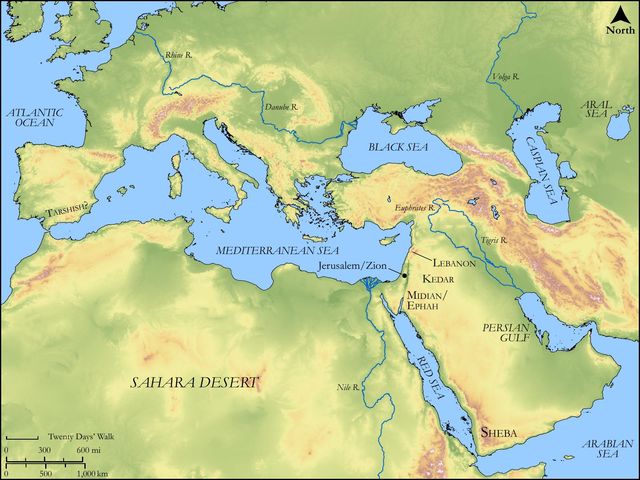
See on the biblical-era map
Study this verse
Public-domain commentary
Matthew Henry
From his Commentary on the Whole Bible. Henry comments on passages, not single verses — this entry covers Isaiah 43:14–21. His two-level outline is real structure in the source text, so it is rendered as structure.
To so low an ebb were the faith and hope of God's people in Babylon brought that there needed line upon line to assure them that they should be released out of their captivity; and therefore, that they might have strong consolation, the assurances of it are often repeated, and here very expressly and encouragingly.
I.God here takes to himself such titles of his honour as were very encouraging to them.
He is the Lord their Redeemer, not only he will redeem them, but will take it upon him as his office and make it his business to do so. If he be their God, he will be all that to them which they need, and therefore, when they are in bondage, he will be their Redeemer. He is the Holy One of Israel (Isa 43:14), and again (Isa 43:15), their Holy One, and therefore will make good every word he has spoken to them. He is the Creator of Israel, that made them a people out of nothing (for that is creation), nay, worse than nothing; and he is their King, that owns them as his people and presides among them.
II.He assures them he will find out a way to break the power of their oppressors that held them captives and filled up the measure of their own iniquity by their resolution never to let them go, Isa 14:17. God will take care to send a victorious prince and army to Babylon, that shall bring down all their nobles, and lay their honour in the dust, and all their people too, even the Chaldeans, whose cry is in the ships (for seamen are apt to be noisy), or whose cry is to the ships, as their refuge when the city is taken, that they may escape by the benefit of their great river. Note, The destruction of Babylon must make way for the enlargement of God's people. And in the prediction of the fall of the New Testament Babylon we meet with the cries and lamentations of the sailors, Rev 18:17, Rev 18:18. And observe, It is for Israel's sake that Babylon is ruined, to make way for their deliverance.
III.He reminds them of the great things he did for their fathers when he brought them out of the land of Egypt; for so it may be read (Isa 43:16, Isa 43:17): "Thus saith the Lord, who did make a way in the sea, the Red Sea, and did bring forth Pharaoh's chariot and horse, that they might lie down together in the bottom of the sea, and never rise, but be extinct. He that did this can, if he please, make a way for you in the sea when you return out of Babylon, and will do so rather than leave you there." Note, For the encouragement of our faith and hope, it is good for us often to remember what God has done formerly for his people against his and their enemies. Think particularly what he did at the Red Sea, how he made it,
1.A road to his people, a straight way, a near way, nay, a refuge to them, into which they fled and were safe the waters being a wall unto them.
2.A grave to his enemies. The chariot and horse were drawn out by him who is Lord of all hosts, on purpose that they might fall together; howbeit, they meant not so, Mic 4:11, Mic 4:12.
IV.He promises to do yet greater things for them than he had done in the days of old; so that they should not have reason to ask, in a way of complaint, as Gideon did, Where are all the wonders that our fathers told us of? for they should see them repeated, nay, they should see them outdone (Isa 43:18): "Remember not the former things, from them to take occasion, as some do, to undervalue the present things, as if the former days were better than these; no, you may, if you will, comparatively forget them, and yet know enough by the events of your own day to convince you that the Lord is God alone; for, behold, the Lord will do a new thing, no way inferior, both for the wonder and the worth of the mercy, to the things of old." The best exposition of this is, Jer 16:14, Jer 16:15; Jer 23:7, Jer 23:8. It shall no more be said, The Lord liveth that brought up the children of Israel out of the land of Egypt; that is an old thing, the remembrance of which will be in a manner lost in the new thing, in the new proof that the Lord liveth, for he brought up the children of Israel out of the land of the north. Though former mercies must not be forgotten, fresh mercies must in a special manner be improved. Now it springs forth, as it were a surprise upon you; you are like those that dream. Shall you now know it? And will you not own God's hand in it?
V.He promises not only to deliver them out of Babylon, but to conduct them safely and comfortably to their own land (Isa 43:19, Isa 43:20):
I will make a way in the wilderness and rivers in the desert; for, it seems, the way from Babylon to Canaan, as well as from Egypt, lay through a desert land, which, while the returning captives passed through, God would provide for them, that their camp should be both well victualled and under a good conduct. The same power that made a way in the sea (Isa 43:16) can make a way in the wilderness, and will force its passage through the greatest difficulties. And he that made dry land in the waters can produce waters in the dryest land, in such abundance as not only to give drink to his people, his chosen, but to the beasts of the field, also the dragons and the ostriches, who are therefore said to honour God for it; it is such a sensible refreshment, and yields them so much satisfaction, that, if they were capable of doing it, they would praise God for it, and shame man, who is made capable of praising his benefactor and does not. Now,
1.This looks back to what God did for Israel when he led them through the wilderness from Egypt to Canaan, and fetched water out of a rock to follow them; what God did for them formerly he would do again, for he is still the same. And, though we do not find that the miracle was repeated in their return out of Babylon, yet the mercy was, in the common course of Providence, for which it became them to be no less thankful to God.
2.It looks forward, not only to all the instances of God's care of the Jewish church in the latter ages of it, between their return from Babylon and the coming of Christ, but to the grace of the gospel, especially as it is manifested to the Gentile world, by which a way is opened in the wilderness and rivers in the desert; the world, which lay like a desert, in ignorance and unfruitfulness, was blessed with divine direction and divine comforts, and, in order to both, with a plentiful effusion of the Spirit. The sinners of the Gentiles, who had been as the beasts of the field, running wild, fierce as the dragons, stupid as the owls or ostriches, shall be brought to honour God for the extent of his grace to his chosen among them.
VI.He traces up all these promised blessings to their great original, the purposes and designs of his own glory (Isa 43:21):
This people have I formed for myself, and therefore I do all this for them, that they may show forth my praise. Note,
1.The church is of God's forming, and so are all the living members of it. The new heaven, the new earth, the new man, are the work of God's hand, and are no more, no better, than he makes them; they are fashioned according to his will.
2.He forms it for himself. He that is the first cause is the highest end both of the first and of the new creation. The Lord has made all things for himself, his Israel especially, to be to him for a people, and for a name, and for a praise; and no otherwise can they be for him, or serviceable to him, than as his grace is glorified in them, Jer 13:11; Eph 1:6, Eph 1:12, Eph 1:14.
3.It is therefore our duty to show forth his praise, not only with our lips, but in our lives, by giving up ourselves to his service. As he formed us, so he feeds us, and keeps us, and leads us, and all for himself; for every instance therefore of his goodness we must praise him, else we answer not the end of the beings and blessings we have.
Historical interpretation
Four Centuries of Reception
3 surviving comments on this verse. Each one is dated, so this reads as a timeline rather than a list.
Select a marker to jump to its quote. Markers stagger vertically where authors wrote within a few decades of each other.
(Verse 14.) Thus saith the Lord, your redeemer, the Holy One of Israel: For your sake I have sent to Babylon, and have brought down all their bars, and the Chaldeans glorying in their ships. I am the Lord, your Holy One, the creator of Israel, your king. LXX: Thus saith the Lord God, the Holy One of Israel, your redeemer: For your sakes I will send to Babylon, and will bring down all their fugitives, and the Chaldeans, in the ships of their rejoicing. I am the Lord thy God, the Holy One of Israel, who have shown your king, Israel. According to the Hebrew, the prophetic speech is still directed to Israel, to whom their redeemer, the Lord and Holy One of Israel, spoke these words: 'Because of you who preach the Gospel with me, to whom I said above: Do not be afraid, for I am with you, you who are the witnesses of my will, and you announce my other Son to the unbelieving world, I have sent my Son into Babylon and the confusion of this age. And I have removed all its bars, which are called Barihim in Hebrew (or Barichim, as interpreted by Theodotion).' And, he said, the Chaldeans are implied, I have removed those who boasted in their ships: in these, namely, who floated like ships among idols. No one doubts about the Chaldeans that they sound like demons. I, the Lord, have foretold these things, who am your Creator and the king of Israel. Moreover, according to the Septuagint, the meaning is quite different: I, the Lord, who have delivered you from dangers, and the holy one of Israel: because of you, I will send the king of the Medes and Persians to Babylon, and I will make its inhabitants flee, and the Chaldeans who captured you will be bound and transferred across the Caspian Sea to other nations. I, the Lord, have determined these future events, which will reveal that the King of Israel will be the one who believes.
[Isaiah] predicts the defeat of the Babylonians and the enslavement of the Chaldeans. They will suffer these misfortunes because of you, he says, since they were unwilling to recognize that their victory depended on my good will and that you were made prisoners because I rejected you.
“I have brought down all the runaways and the Chaldeans,” that is, “For your sake I will send you to Babylon” and will make the Medes rise, in order to deliver you from captivity. And when the Babylonians fly from you in every manner, through the land and the sea, they will be captured in “their ships” and be imprisoned. He calls “runaways” the Medes because of their previous weakness.
Continue studying Isaiah 43:14 across the web’s major study libraries — every link below opens this exact verse, chapter, or book on the destination site.
Read & Compare
 BibleGatewayThis verse in more than 200 translations and 70 languages.
 Bible.comThe YouVersion reader — hundreds of translations, reading plans, and highlights.
 ESV.orgCrossway's official English Standard Version reader.
 NET BibleThe NET translation with 60,000+ translators' notes on every rendering decision.
 STEP BibleTyndale House's free study tool — original text, vocabulary, and scholarly resources.
 BibliaLogos Bible Software's free web reader.
 USCCBThe New American Bible (Revised Edition) with the U.S. bishops' study notes.
Commentaries
 BibleHub CommentariesDozens of classic commentaries on this verse, gathered on one page.
 StudyLightMore than 100 commentary sets — the largest collection on the web.
 BibleRefPlain-English commentary on what this verse means, verse by verse.
 Enduring WordDavid Guzik's free commentary on this chapter, widely used by Bible teachers.
 Bible Study ToolsVerse commentary alongside Greek and Hebrew study aids.
Original Language & Research
- BibleHub InterlinearThe verse word by word — original language, transliteration, and English.
- BibleHub LexiconEvery word's original-language definition and Strong's entry.
 Blue Letter BibleDeep-study tools — Strong's numbers, concordance, and word studies.
 SefariaThe Hebrew text with Rashi and centuries of Jewish commentary.
Sermons, Hymns & Audio


TrulyRandomVerse is not affiliated with these sites and doesn’t control their content. They’re linked because they’re genuinely useful.
Summary
Isaiah 43:14 delivers a profound divine declaration from the LORD, who identifies Himself as Israel's Redeemer and Holy One. This verse functions as a powerful oracle of deliverance, assuring the exiled Israelites in Babylon of their imminent liberation. God unequivocally states His intention to intervene decisively on their behalf, orchestrating judgment upon Babylon and bringing about the downfall of its powerful elite and the Chaldeans, whose commercial supremacy, symbolized by their ships, will be utterly dismantled. It stands as a testament to God's unwavering covenant faithfulness, His sovereign control over nations, and His commitment to execute justice and redemption for His chosen people.
Context
ShowHideLiterary Context
Isaiah 43:14 is strategically placed within the "Book of Comfort" (Isaiah 40-55), a prophetic section primarily directed toward the Jewish exiles enduring captivity in Babylon. Chapter 43 itself commences with magnificent affirmations of God's unique identity as Israel's Creator and Redeemer, assuring His people of their preciousness in His sight and His commitment to ransom them from their bondage, as powerfully articulated in Isaiah 43:1-7. Following a divine challenge issued to the nations to acknowledge the singular true God and His foreknowledge of events (see Isaiah 43:8-13), verse 14 marks a crucial pivot. It transitions from general declarations of God's power to a specific, concrete prophecy regarding Babylon's impending downfall, thereby providing tangible evidence of God's ability and faithfulness to fulfill His promises. This verse immediately precedes further assurances of God's forthcoming new acts of salvation and the ultimate restoration of Israel, as detailed in Isaiah 43:15-21.
Historical & Cultural Context
The historical setting for Isaiah 43 is the traumatic period of the Babylonian Exile, which commenced in 586 BC with the catastrophic destruction of Jerusalem and the Temple, accompanied by the forced deportation of the Judean populace to Babylon. At this time, Babylon, under the formidable Neo-Babylonian Empire, reigned as the preeminent global power. It was celebrated for its immense wealth, unparalleled military might, and sophisticated urban infrastructure, which included an extensive network of trade routes along the Euphrates River and beyond. The Chaldeans constituted the ruling ethnic group within this dominant empire. For the Jewish exiles, Babylon represented the epitome of oppression, hopelessness, and seemingly insurmountable power. This prophecy, therefore, directly addresses their desperate plight, promising a dramatic reversal of the established world order through divine intervention. The vivid imagery of "ships" in the verse serves to highlight Babylon's formidable mercantile strength, as riverine and maritime trade were absolutely vital to its economic prosperity and widespread influence, making its destruction a comprehensive blow to its very foundation.
Key Themes
ShowHideIsaiah 43:14 profoundly contributes to several overarching theological and narrative themes found throughout the book of Isaiah and broader prophetic literature. It powerfully underscores Divine Sovereignty and Power, unequivocally demonstrating that the LORD, and not the seemingly invincible Babylonian empire, is the ultimate orchestrator of history and the arbiter of nations' destinies. God's self-identification as "your redeemer" emphasizes the central theme of God as Redeemer and Deliverer, highlighting His unwavering covenant faithfulness and His active, personal role in rescuing His people from bondage, much akin to His miraculous deliverance of Israel from Egypt (compare with Isaiah 43:16-17). The specific prophecy of Babylon's fall also speaks directly to the theme of Divine Justice Against Oppression, as God explicitly acts "for your sake" to humble the arrogant empire that held His beloved people captive. Finally, the authoritative opening declaration, "Thus saith the LORD," reinforces the Certainty and Authority of God's Word, assuring the exiles that this promised deliverance is not a mere wish or distant hope, but a divine decree that will undoubtedly come to pass, echoing the absolute authority of God's pronouncements found throughout the prophetic book, such as in Isaiah 40:5.
Exposition and Analysis
ShowHideKey Word Analysis
ShowHideThis primitive root signifies "to redeem according to the Oriental law of kinship," implying the sacred role of the next of kin. In ancient Israelite society, a go'el (redeemer) bore the responsibility of protecting family interests, avenging wrongs, buying back enslaved relatives, or redeeming lost property. By calling Himself Israel's go'el, God emphasizes His intimate, covenantal relationship with His people, portraying Himself as the ultimate Kinsman who possesses both the right and the responsibility to act decisively on their behalf, purchasing their freedom from the bondage of exile and restoring their dignity.
This primitive root means "to descend" or "to go downwards," and causatively, "to bring down." In this context, it vividly describes God's decisive, forceful, and intentional action against Babylon. It implies not merely a military defeat but a complete humbling, subjugation, and abasement of their power, indicating a precipitous fall from their exalted position of global dominance. This action is directly orchestrated by God Himself, demonstrating His absolute control over the destinies of nations.
This term refers to the dominant ethnic group and ruling class of Babylon. While it can also imply an astrologer, reflecting the Chaldeans' renowned reputation for occult practices and wisdom, here it specifically identifies the core populace and the powerful elite of the empire that held Israel captive. Their inclusion alongside "nobles" underscores the comprehensive nature of God's impending judgment, targeting both the leadership and the broader society that benefited from and perpetuated Israel's oppression.
Verse Breakdown
ShowHide"Thus saith the LORD, your redeemer, the Holy One of Israel;"
This opening clause authoritatively establishes the divine speaker's identity and absolute authority. "Thus saith the LORD" is a quintessential prophetic formula, underscoring the infallible truth and certainty of the ensuing declaration, indicating it is a direct message from God. The subsequent titles, "your redeemer" (Hebrew: go'el) and "the Holy One of Israel," are profoundly significant. "Redeemer" highlights God's covenant faithfulness and His active role as the kinsman who buys back and delivers His people from bondage. "The Holy One of Israel" emphasizes His transcendent purity, moral perfection, and unique divine nature, distinguishing Him from all pagan deities and affirming His singular power to accomplish what He declares.
"For your sake I have sent to Babylon,"
This clause explicitly reveals the motivation and the divine agency behind the coming judgment. God's action is unequivocally "for your sake"—for the benefit, liberation, and restoration of His people, Israel. The phrase "I have sent to Babylon" implies a divine commission or decree, suggesting that God is dispatching forces or circumstances (historically, this would be Cyrus's Persian army, though not named here) to execute His sovereign will upon the powerful empire. It signifies an active, deliberate, and purposeful intervention by God into human history.
"and have brought down all their nobles,"
This part of the verse details the immediate and devastating consequence of God's intervention. "Bringing down" signifies a complete overthrow, humiliation, and subjugation of Babylon's ruling class, powerful elite, and military leadership. It speaks to the dismantling of the very structures of power that oppressed Israel, demonstrating God's absolute sovereignty over human authority and His ability to humble the proud and bring low those who exalt themselves against His purposes.
"and the Chaldeans, whose cry [is] in the ships."
This final clause further elaborates on the comprehensive extent of Babylon's downfall. The "Chaldeans" represent the broader populace and the very heart of the Babylonian empire. The enigmatic phrase "whose cry [is] in the ships" powerfully refers to the destruction of Babylon's extensive commercial network and its economic lifeblood. It vividly symbolizes the lament of fleeing merchants, the destruction of their commercial fleets, or the general outcry of a city in profound distress as its economic prosperity, heavily reliant on river and sea trade, is utterly cut off. This imagery conveys the comprehensive nature of Babylon's collapse—not merely political or military, but also economic, social, and a source of profound despair.
Literary Devices
ShowHideIsaiah 43:14 masterfully employs several literary devices to convey its powerful and prophetic message. The verse commences with a Divine Oracle, immediately signaled by the authoritative and formulaic phrase "Thus saith the LORD," which establishes the absolute truth, certainty, and divine origin of the prophecy, emphasizing God's direct communication and unwavering intent. The identification of God as "your redeemer" and "the Holy One of Israel" utilizes Appellation or Divine Titles to underscore His intrinsic character and His intimate, covenantal relationship with His people, reinforcing His unique ability and unwavering commitment to act on their behalf. The phrase "brought down all their nobles" employs Metonymy, where "nobles" stands metonymically for the entire ruling power, military might, and political structure of Babylon, signifying a complete overthrow of their authority. Finally, the vivid imagery of "the Chaldeans, whose cry [is] in the ships" employs potent Symbolism and Imagery. The "ships" symbolize Babylon's immense commercial wealth, its global reach, and its reliance on extensive trade, particularly via the Euphrates River. The "cry" in the ships powerfully symbolizes the lament, distress, economic ruin, and utter despair that will accompany Babylon's catastrophic fall, depicting a scene of chaos and desolation as their prosperity, means of escape, and very foundation vanish.
Theological and Thematic Connections
ShowHideIsaiah 43:14 stands as a profound testament to God's unwavering commitment to His covenant people and His absolute sovereignty over all earthly powers. It reinforces the foundational biblical truth that God is actively and intimately involved in human history, orchestrating the rise and fall of empires not arbitrarily, but for the fulfillment of His divine purposes and the ultimate deliverance of His elect. This verse highlights the profound theme of divine justice, where the oppressor is brought low, and the oppressed are set free, demonstrating unequivocally that God hears the cries of His people and acts decisively on their behalf. It offers immense reassurance to believers that even in the darkest moments of captivity, despair, or seemingly insurmountable opposition, their Redeemer is actively at work, capable of overturning the most formidable human systems to bring about His promised salvation and restoration.
Reflection and Application
ShowHideIsaiah 43:14 offers immense comfort and a powerful call to radical trust in God's sovereign power, even when circumstances seem overwhelmingly against us. For the ancient Israelites, this prophecy was a beacon of hope in the midst of a seemingly hopeless exile, reminding them that their God was not confined by their chains or intimidated by the might of Babylon. For us today, it serves as a powerful and timeless reminder that no earthly power, no oppressive rule, and no personal struggle is beyond the reach of our Almighty Redeemer. When we feel captive to the bondage of sin, overwhelmed by fear, ensnared by addiction, or burdened by overwhelming life circumstances, this verse assures us that the very same God who brought down Babylon is actively working "for our sake." We are called to rest confidently in His unfailing promises, knowing that He is personally and actively engaged in our deliverance, not just from external foes but from all that seeks to enslave or diminish us. Our ultimate hope is not found in our own strength, the collapse of our perceived oppressors, or favorable circumstances, but solely in the steadfast, redeeming love of the Holy One of Israel.
Questions for Reflection
ShowHideFAQ
ShowHideWhat is the significance of God being called "the Holy One of Israel" and "your redeemer" in this verse?
ShowHideThese titles are profoundly significant, revealing both God's intrinsic character and the intimate nature of His relationship with His people. "The Holy One of Israel" (H6918, qâdôwsh) emphasizes God's transcendent purity, moral perfection, and unique divine nature, setting Him apart from all other gods, idols, and earthly powers. It underscores His absolute authority, unblemished righteousness, and singular majesty. "Your redeemer" (H1350, gâʼal) highlights God's intimate, covenantal relationship with Israel. In ancient Israel, a go'el was a kinsman-redeemer, a close relative with the legal right and moral responsibility to act on behalf of a distressed family member—to buy back property that had been lost, to avenge a wrong, or crucially, to free a relative from slavery. By taking on this title, God declares Himself to be Israel's ultimate Kinsman, personally committed to their deliverance from exile and their restoration, demonstrating His faithful love and active intervention on their behalf, as powerfully illustrated in the narrative of Boaz in Ruth 4:1-10.
Christ-Centered Fulfillment
ShowHideIsaiah 43:14, with its powerful declaration of God as Israel's Redeemer who orchestrates the downfall of oppressive empires, finds its ultimate and most profound fulfillment in the person and redemptive work of Jesus Christ. While God's intervention against Babylon was a historical act of physical deliverance for Israel, it profoundly foreshadows the far greater spiritual redemption accomplished by Christ for all humanity. Jesus is the ultimate Kinsman-Redeemer, born into humanity to fully identify with us and pay the ultimate price for our freedom. He did not merely bring down an earthly empire, but He decisively defeated the spiritual powers of sin, death, and the devil, which held all humanity captive (as declared in Colossians 2:15). Just as God acted "for your sake" to deliver Israel from physical bondage, Christ's entire mission was "for our sake," offering Himself as the Lamb of God who takes away the sin of the world. His sacrifice on the cross was the supreme act of redemption, purchasing us from the bondage of sin and reconciling us to the "Holy One" (as explained in Hebrews 9:12). The "cry in the ships" symbolizing Babylon's economic ruin and despair finds its spiritual parallel in the ultimate collapse of all worldly systems and powers that oppose God, culminating in the final judgment where Christ, the true King, establishes His eternal and righteous kingdom (as vividly depicted in Revelation 18). Thus, Isaiah 43:14 points forward to Christ as the divine agent who secures not merely national liberation, but eternal salvation and spiritual freedom for all who believe, demonstrating God's unwavering commitment to redeem His people through His beloved Son.