


Revelation 18:17
in a single hour, ruined!”
All the ship masters, passengers, sailors and everyone making his living from the sea stood at a distance
- ὅτιhotiSinceG3754CONJConjunction
- μιᾷmiain oneG1520A-DSFAdjective Dative Singular Feminine
- ὥρᾳhōrahourG5610N-DSFNoun Dative Singular Feminine
- ἠρημώθηērēmōthēhas been brought to desolationG2049V-API-3SVerb Aorist Passive Indicative 3rd Singular
- ὁho<the>G3588T-NSMDefinite article Nominative Singular Masculine
- τοσοῦτοςtosoutosso greatG5118K-NSMCorrelative pronoun Nominative Singular Masculine
- πλοῦτοςploutoswealthG4149N-NSMNoun Nominative Singular Masculine
- ΚαὶKaiAndG2532CONJConjunction
- πᾶςpaseveryG3956A-NSMAdjective Nominative Singular Masculine
- κυβερνήτηςkubernētēsshipmasterG2942N-NSMNoun Nominative Singular Masculine
- καὶkaiandG2532CONJConjunction
- πᾶςpaseveryG3956A-NSMAdjective Nominative Singular Masculine
- ὁho[one] whoG3588T-NSMDefinite article Nominative Singular Masculine
- ἐπὶepionG1909PREPPreposition
- τῶνtōnof theG3588T-GPNDefinite article Genitive Plural Neuter
- πλέωνpleōnsailingG4126V-PAP-NSMVerb Present Active Participle Nominative Singular Masculine
- ὁhotheG3588T-NSMDefinite article Nominative Singular Masculine
- ὅμιλοςhomilosmultitudesG3658N-NSMNoun Nominative Singular Masculine
- καὶkaiandG2532CONJConjunction
- ναῦταιnautaisailorsG3492N-NPMNoun Nominative Plural Masculine
- καὶkaiandG2532CONJConjunction
- ὅσοιhosoias many asG3745K-NPMCorrelative pronoun Nominative Plural Masculine
- τὴνtēntheG3588T-ASFDefinite article Accusative Singular Feminine
- θάλασσανthalassanseaG2281N-ASFNoun Accusative Singular Feminine
- ἐργάζονταιergazontaitrade byG2038V-PNI-3PVerb Present Middle Or Passive Deponent Indicative 3rd Plural
- ἀπὸapoatG575PREPPreposition
- μακρόθενmakrothena distanceG3113ADVAdverb
- ἔστησανestēsanstoodG2476V-2AAI-3PVerb 2nd Aorist Active Indicative 3rd Plural
English is a literal word-by-word gloss of the Greek, not the KJV's wording. Why?
This is the original text the KJV's translators worked from — each Greek word with its own literal English meaning in this verse, prepared by scholars at Tyndale House, Cambridge. The KJV translates whole sentences, not word by word, so its wording differs: one Greek word can become several English words, and the KJV may choose “charity” where the gloss reads “love”. Both are faithful — they answer different questions. For the KJV's own rendering, switch to the KJV text.
Details
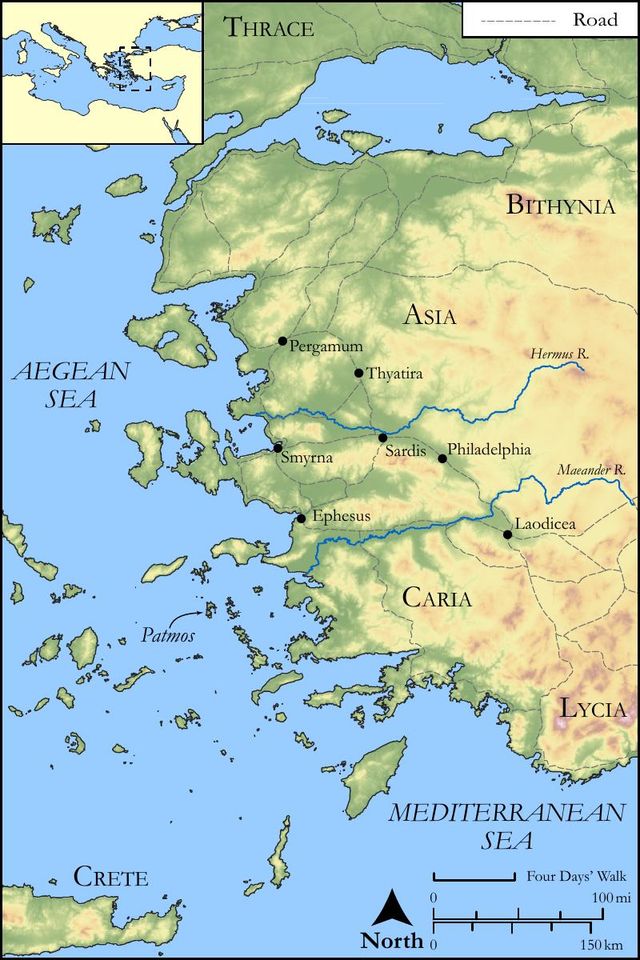
See on the biblical-era map

Study this verse
Public-domain commentary
Matthew Henry
From his Commentary on the Whole Bible. Henry comments on passages, not single verses — this entry covers Revelation 18:9–24. His three-level outline is real structure in the source text, so it is rendered as structure.
Here we have,
I.A doleful lamentation made by Babylon's friends for her fall; and here observe,
1.Who are the mourners, namely, those who had been bewitched by her fornication, those who had been sharers in her sensual pleasures, and those who had been gainers by her wealth and trade - the kings and the merchants of the earth: the kings of the earth, whom she had flattered into idolatry by allowing them to be arbitrary and tyrannical over their subjects, while they were obsequious to her; and the merchants, that is, those who trafficked with her for indulgences, pardons, dispensations, and preferments; these will mourn, because by this craft they got their wealth.
2.What was the manner of their mourning.
(1.)They stood afar off, they durst not come nigh her. Even Babylon's friends will stand at a distance from her fall. Though they had been partakers with her in her sins, and in her sinful pleasures and profits, they were not willing to bear a share in her plagues.
(2.)They made a grievous outcry: Alas! alas! that great city, Babylon, that mighty city!
(3.)They wept, and cast dust upon their heads, Rev 18:19. The pleasures of sin are but for a season, and they will end in dismal sorrow. All those who rejoice in the success of the church's enemies will share with them in their downfall; and those who have most indulged themselves in pride and pleasure are the least able to bear calamities; their sorrows will be as excessive as their pleasure and jollity were before.
3.What was the cause of their mourning; not their sin, but their punishment. They did not lament their fall into idolatry, and luxury, and persecution, but their fall into ruin - the loss of their traffic and of their wealth and power. The spirit of antichrist is a worldly spirit, and their sorrow is a mere worldly sorrow; they did not lament for the anger of God, that had now fallen upon them, but for the loss of their outward comfort. We have a large schedule and inventory of the wealth and merchandise of this city, all which was suddenly lost (Rev 18:12, Rev 18:13), and lost irrecoverably (Rev 18:14): All things which were dainty and goodly have departed from thee, and thou shalt find them no more at all. The church of God may fall for a time, but she shall rise again; but the fall of Babylon will be an utter overthrow, like that of Sodom and Gomorrah. Godly sorrow is some support under affliction, but mere worldly sorrow adds to the calamity.
II.An account of the joy and triumph there was both in heaven and earth at the irrecoverable fall of Babylon:
while her own people were bewailing her, the servants of God were called to rejoice over her, Rev 18:20. Here observe,
1.How universal this joy would be: heaven and earth, angels and saints, would join in it; that which is matter of rejoicing to the servants of God in this world is matter of rejoicing to the angels in heaven.
2.How just and reasonable; and that,
(1.)Because the fall of Babylon was an act of God's vindictive justice. God was then avenging his people's cause. They had committed their cause to him to whom vengeance belongs, and now the year of recompence had come for the controversies of Zion; and, though they did not take pleasure in the miseries of any, yet they had reason to rejoice in the discoveries of the glorious justice of God.
(2.)Because it was an irrecoverable ruin. This enemy should never molest them any more, and of this they were assured by a remarkable token (Rev 18:21): An angel from heaven took up a stone like a great millstone, and cast it into the sea, saying, "Thus shall Babylon be thrown down with violence, and be found no more at all; the place shall be no longer habitable by man, no work shall be done there, no comfort enjoyed, no light seen there, but utter darkness and desolation, as the reward of her great wickedness, first in deceiving the nations with her sorceries, and secondly in destroying and murdering those whom she could not deceive," Rev 18:24. Such abominable sins deserved so great a ruin.
Historical interpretation
Two Centuries of Reception
4 surviving comments on this verse. Each one is dated, so this reads as a timeline rather than a list.
Select a marker to jump to its quote. Markers stagger vertically where authors wrote within a few decades of each other.
Whenever the Spirit says that they were made rich from her, he is indicating the abundance of their sins.… Can a city be dressed in fine linen and purple, rather than people? They lament for themselves, since they are despoiled of those riches mentioned here.… Can all those who are merchants and sailors and who work upon the sea be present to see the burning of a single city? Rather, it says that all who loved the world and were the workers of iniquity fear for themselves when they see the ruin of their own hope.
“They threw dust on their heads.” This means that they reproached their leaders by whom they were led astray and so were lost.… “They wept and mourned.” … To be sure, we know that many are often stricken by such contrition, and so it is not false to refer to the person these distances from which they are removed. That is, they will stand afar off and cry out when they see the smoke of its burning, since to stand afar off is not to fall with those who are lost but rather to acquire a stability from submitting to conversion. For “before one’s own master does one stand or fall.” One ought not understand this standing in a bodily sense but as the conversion of a firm soul in faith, so that when they are said to weep over others who are perishing, they are themselves understood to be making a fruitful penance. For this reason the apostle says, “When you were dead through trespasses and sins in which you once walked, following the course of this world, following the prince of the power of the air, the spirit that is now at work in the sons of disobedience, among whom we all once lived in the passions of the flesh, following the desires of the flesh and mind, and so we were by nature children of wrath like the rest,” or things like this. According to these words of the apostle, I think that this passage can be rightly referred to the persons who convert. For no one can be found to be good who was not formerly evil. Therefore, the psalm says, “I have reckoned all the sinners of the earth as transgressors.”
He leads before our eyes the sufferings of this Babylon, and through the laments made over her he depicts the greatness of her misfortune that she, who previously boasted of her royal majesty, will suffer.… He speaks figuratively of the present life as a “sea,” since it is heaving with waves. Those who make commerce upon [the sea] swim in the turbulence of this life as though they were fishes. However, perhaps that city that suffers these things lies beside a physical sea and receives these misfortunes from those who sail upon it and receive from it an opportunity to loot it of its wealth. But it is necessary to add that the merchants of this universal Babylon, that is, Confusion, will suffer the same thing at the conclusion of the visible world and will sob inconsolably, since they are unwillingly deprived of the pleasures of this life and are reproached by their conscience because of their deeds.… But against this opinion is that of the ancient teachers of the church, which supposes that these things are prophesied against the Babylon of the Romans. They refer to the vision in which the ten horns are on the fourth beast, that is, upon the Roman rule, and from it another one comes that roots out three of the ten and subdues the others. And when this king of the Romans comes in the pretense of assisting and helping their rule, he in fact comes to effect their complete ruin. Therefore, as we said, whoever interprets this kingdom as though it were one body that from the beginning until now exercised power and which truly has shed the blood of apostles, prophets and martyrs, such a one would not be mistaken concerning the present passage. For even as it is said that there is one chorus and one army and one city, although those who populate each of these might change, so also there is one kingdom, although it is divided into many times and places.
And every shipmaster, and all the sailors stood afar off, etc. Can all who sail the sea be present to see the burning of the city? But he means all the worshipers and workers of the world fear for themselves, seeing the ruin of their hope.
Continue studying Revelation 18:17 across the web’s major study libraries — every link below opens this exact verse, chapter, or book on the destination site.
Read & Compare
 BibleGatewayThis verse in more than 200 translations and 70 languages.
 Bible.comThe YouVersion reader — hundreds of translations, reading plans, and highlights.
 ESV.orgCrossway's official English Standard Version reader.
 NET BibleThe NET translation with 60,000+ translators' notes on every rendering decision.
 STEP BibleTyndale House's free study tool — original text, vocabulary, and scholarly resources.
 BibliaLogos Bible Software's free web reader.
 USCCBThe New American Bible (Revised Edition) with the U.S. bishops' study notes.
Commentaries
 BibleHub CommentariesDozens of classic commentaries on this verse, gathered on one page.
 StudyLightMore than 100 commentary sets — the largest collection on the web.
 BibleRefPlain-English commentary on what this verse means, verse by verse.
 Enduring WordDavid Guzik's free commentary on this chapter, widely used by Bible teachers.
 Bible Study ToolsVerse commentary alongside Greek and Hebrew study aids.
Original Language & Research
- BibleHub InterlinearThe verse word by word — original language, transliteration, and English.
- BibleHub LexiconEvery word's original-language definition and Strong's entry.
 Blue Letter BibleDeep-study tools — Strong's numbers, concordance, and word studies.
 CNTR CollationThe earliest Greek manuscripts of this verse, collated letter by letter.
Sermons, Hymns & Audio


TrulyRandomVerse is not affiliated with these sites and doesn’t control their content. They’re linked because they’re genuinely useful.
Summary
Revelation 18:17 dramatically portrays the swift and utter destruction of "Babylon the Great," a symbolic entity representing a powerful, corrupt global economic and political system. The verse emphasizes the sudden collapse of its immense wealth, declaring that "in one hour so great riches is come to nought." It then shifts focus to the profound shock and helplessness of those who profited from this system, specifically "every shipmaster, and all the company in ships, and sailors, and as many as trade by sea," who are depicted standing "afar off," witnessing the catastrophic ruin from a distance, unable to intervene or salvage anything.
Context
ShowHideLiterary Context
Revelation 18 unfolds as a prophetic lament over the fall of "Babylon the Great," a symbolic city representing a global system of economic power, luxury, and spiritual harlotry that has corrupted the nations. Following the initial announcement of Babylon's fall in Revelation 18:2, the chapter proceeds with a series of laments from various groups who benefited from her wealth and influence. Revelation 18:9-10 describe the kings of the earth mourning her destruction, while Revelation 18:11-16 detail the merchants' grief over the loss of their vast trade. Verse 17 directly continues this lament, specifically focusing on the maritime community—shipmasters, sailors, and all involved in sea trade—who are depicted as helpless onlookers. The repeated phrase "in one hour" throughout Revelation 18 (verses 10, 17, 19) underscores the suddenness and decisiveness of this divine judgment, linking the laments of different groups by this shared experience of instantaneous ruin.
Historical & Cultural Context
In the ancient world, maritime trade was the backbone of global commerce, connecting empires and facilitating the exchange of vast wealth. Major port cities like Rome, Alexandria, and Ephesus were centers of immense economic activity and cultural influence. The imagery of "Babylon the Great" in Revelation draws parallels to historical empires known for their commercial dominance and spiritual corruption, such as ancient Babylon and later, the Roman Empire. Rome, with its extensive network of trade routes across the Mediterranean, served as a powerful contemporary example of a global economic superpower. The lament of shipmasters and sailors would have resonated deeply with John's original audience, who understood the critical role of sea trade in their daily lives and the devastating impact of its disruption. The sudden "come to nought" of such riches would evoke the total collapse of an entire economic system, mirroring the historical destruction of powerful cities that once seemed invincible.
Key Themes
ShowHideRevelation 18:17 contributes significantly to several key themes within the book of Revelation and the broader biblical narrative. Firstly, it powerfully illustrates the sudden and complete destruction of worldly power and wealth. The phrase "in one hour" emphasizes the swiftness and decisiveness of God's judgment, demonstrating the fragility of earthly glory and the transience of material possessions, a theme echoed in passages like Psalm 49:16-17. Secondly, it highlights the theme of economic collapse as a consequence of divine judgment. The detailed enumeration of those involved in sea trade underscores the global reach and devastating impact of Babylon's downfall on the world's economy. Thirdly, the imagery of "standing afar off" conveys the lamentation and helplessness of those who profited from Babylon. They are not victims of war but stunned, powerless witnesses, unable to salvage anything, signifying both their awe at God's judgment and their despair over their lost livelihoods. Finally, underlying this destruction is the overarching theme of divine justice and sovereignty, where God brings righteous judgment against a system built on greed, luxury, and opposition to His kingdom, as seen in Revelation 19:2.
Exposition and Analysis
ShowHideKey Word Analysis
ShowHideThis term refers to wealth, abundance, or valuable bestowments. In this context, it signifies the vast material possessions, commercial assets, and accumulated capital that characterized Babylon the Great. The use of "so great riches" emphasizes the immense scale of her economic power, making its sudden destruction even more shocking.
Derived from the root for "desolate," this verb means to lay waste, to make desolate, or to bring to nothing. It powerfully conveys the idea of complete annihilation, utter ruin, or absolute worthlessness. It signifies that Babylon's immense wealth does not merely diminish but becomes entirely undone, devoid of any value or substance.
This adverb means "from a distance" or "from far." In the context of the shipmasters and sailors, it describes their physical separation from the scene of Babylon's destruction. This distance underscores their inability to intervene, their profound shock, and their fear, highlighting the overwhelming nature of the judgment and their utter powerlessness in its face.
Verse Breakdown
ShowHide"For in one hour so great riches is come to nought."
This opening clause delivers the shocking news of Babylon's instantaneous economic collapse. The phrase "in one hour" (repeated from Revelation 18:10 and 18:19) emphasizes the suddenness and decisiveness of the judgment. The "great riches" refer to the vast wealth and material prosperity accumulated by Babylon, which is now utterly annihilated, rendered worthless. This highlights the fragility and transient nature of worldly wealth when confronted by divine judgment.
"And every shipmaster, and all the company in ships, and sailors, and as many as trade by sea,"
This clause meticulously lists the various groups within the maritime community who are directly impacted by Babylon's fall. "Shipmaster" (κυβερνήτης, kybernētēs) refers to the helmsman or captain, the one in charge of the vessel. "Company in ships" (ὅμιλος, hómilos) signifies the entire crew or multitude of those associated with the vessels. "Sailors" (ναύτης, naútēs) are the general seamen, and "as many as trade by sea" (ἐργάζομαι, ergázomai by θάλασσα, thálassa) encompasses all others whose livelihoods depend on maritime commerce. This comprehensive enumeration underscores the widespread and devastating economic ripple effect of Babylon's destruction across the global trading network.
"stood afar off,"
This concluding phrase vividly portrays the reaction of the maritime community. Their act of "standing afar off" signifies their profound shock, fear, and helplessness. They are not participants in the destruction but stunned, distant observers, unable to approach the scene of ruin, intervene, or salvage anything from the wreckage. This imagery conveys their utter despair and the overwhelming scale of the judgment, which leaves them powerless and bereft of their source of income.
Literary Devices
ShowHideRevelation 18:17 employs several potent literary devices to convey its message. Hyperbole is evident in the phrase "in one hour," which, while literally meaning a short duration, functions hyperbolically to emphasize the astonishing speed and decisiveness of Babylon's destruction, contrasting sharply with the years it took to accumulate such "great riches." The detailed listing of "every shipmaster, and all the company in ships, and sailors, and as many as trade by sea" is an example of Enumeration, serving to underscore the comprehensive and widespread impact of Babylon's fall on the entire global economy, particularly the maritime sector. Imagery is powerfully used in the depiction of these individuals "standing afar off," creating a vivid mental picture of their stunned helplessness and the overwhelming nature of the catastrophe. This also suggests a sense of Irony, as those who once profited immensely from Babylon's trade are now reduced to powerless spectators of its demise. Finally, the entire verse contributes to the broader Lament genre of Revelation 18, expressing profound sorrow and despair over the loss of a once-mighty economic power.
Theological and Thematic Connections
ShowHideRevelation 18:17 serves as a stark theological declaration concerning the transience of all earthly power and wealth that stands in opposition to God. It underscores the principle that systems built on greed, idolatry, and exploitation, no matter how vast or seemingly invincible, are ultimately subject to divine judgment. The suddenness of Babylon's fall highlights God's absolute sovereignty over human affairs and His ability to bring down even the most entrenched worldly empires in an instant. This judgment is not arbitrary but righteous, a consequence of Babylon's spiritual harlotry and the corruption she inflicted upon the nations. For believers, this passage offers a profound warning against placing ultimate trust or hope in material riches, economic systems, or political powers, reminding them that true security and lasting treasure are found only in God's eternal kingdom. It reinforces the call to discern between the temporary allure of the world and the enduring reality of God's righteous reign.
Reflection and Application
ShowHideRevelation 18:17 challenges us to critically examine where our ultimate security and hope truly lie. In a world often driven by economic indicators, material accumulation, and the pursuit of worldly power, this verse serves as a sobering reminder that all such foundations are ultimately fragile and temporary. For the believer, it calls for a radical reorientation of priorities, urging us to invest our lives and resources not in systems destined for "nought," but in the eternal kingdom of God. This means cultivating a spirit of detachment from the fleeting allure of wealth, practicing generosity and justice, and discerning the subtle ways in which worldly values can infiltrate our hearts and churches. It encourages us to live with an eternal perspective, recognizing that true prosperity is found in our relationship with Christ and our participation in His mission, rather than in the shifting sands of global economies.
Questions for Reflection
ShowHideFAQ
ShowHideWho is "Babylon the Great" in Revelation, and why is its destruction so significant?
ShowHide"Babylon the Great" in Revelation is widely understood as a symbolic representation, not a literal city in John's time, but rather a powerful, corrupt global system that embodies spiritual idolatry, economic exploitation, and political oppression, standing in opposition to God's kingdom. While some interpret it as a specific historical empire (like Rome) or a future geopolitical entity, its primary significance lies in its symbolic role as the epitome of human rebellion against God, characterized by immense wealth, luxury, and the persecution of God's people (as seen in Revelation 17:6). Its destruction, as described throughout Revelation 18, is profoundly significant because it signifies God's ultimate triumph over all forms of evil, injustice, and worldly systems that defy His righteous rule, paving the way for the establishment of His eternal kingdom.
What is the significance of the repeated phrase "in one hour" in Revelation 18?
ShowHideThe phrase "in one hour" (found in Revelation 18:10, 18:17, and 18:19) is highly significant because it emphasizes the astonishing speed, suddenness, and decisiveness of God's judgment upon Babylon the Great. It highlights that the destruction of this seemingly invincible global power will not be a gradual decline but an instantaneous, catastrophic event. This swiftness underscores God's absolute sovereignty and power, demonstrating that what took centuries to build can be brought to "nought" in a moment. It serves as a powerful warning against relying on the perceived stability of worldly systems and underscores the certainty and finality of divine judgment.
Christ-Centered Fulfillment
ShowHideRevelation 18:17, depicting the sudden and complete collapse of earthly riches and power, finds its ultimate Christ-centered fulfillment in the triumph of God's eternal kingdom over all temporal dominion. While Babylon represents the pinnacle of human rebellion and self-sufficiency, Christ embodies the true and lasting King whose kingdom "is not of this world" (John 18:36). The "riches" that come to nought in one hour stand in stark contrast to the "unsearchable riches of Christ" (Ephesians 3:8)—spiritual blessings, eternal life, and an inheritance that can never perish, spoil, or fade (1 Peter 1:4). The lament of the shipmasters and traders, standing "afar off" in despair, foreshadows the ultimate judgment where every knee will bow before Christ (Philippians 2:10-11) and those who rejected Him will face eternal separation. However, for those who have placed their faith in the Lamb of God, the fall of Babylon is not a cause for despair but for rejoicing, as it signals the imminent establishment of the New Jerusalem, where God Himself dwells with His people (Revelation 21:1-4), and where true and lasting peace, justice, and prosperity are found under the reign of Christ, the King of kings and Lord of lords (Revelation 19:16).