


Revelation 17:6
Bible text: King James Version (1769 Blayney text) · Public domain
Bible text: King James Version with Strong's numbers · Public domain
Bible text: Berean Standard Bible · Public domain
Bible text: American Standard Version (1901) · Public domain
Bible text: World English Bible, Messianic edition · Public domain
Bible text: Geneva Bible (1599) · Public domain
Bible text: Young's Literal Translation · Public domain
- καὶkaiAndG2532CONJConjunction
- εἶδονeidonI sawG1492V-2AAI-1SVerb 2nd Aorist Active Indicative 1st Singular
- τὴνtēntheG3588T-ASFDefinite article Accusative Singular Feminine
- γυναῖκαgunaikawomanG1135N-ASFNoun Accusative Singular Feminine
- μεθύουσανmethuousanbeing drunkG3184V-PAP-ASFVerb Present Active Participle Accusative Singular Feminine
- ἐκekwithG1537PREPPreposition
- τοῦtoutheG3588T-GSNDefinite article Genitive Singular Neuter
- αἵματοςaimatosbloodG129N-GSNNoun Genitive Singular Neuter
- τῶνtōnof theG3588T-GPMDefinite article Genitive Plural Masculine
- ἁγίωνhagiōnsaintsG40A-GPMAdjective Genitive Plural Masculine
- καὶkaiandG2532CONJConjunction
- ἐκekwithG1537PREPPreposition
- τοῦtoutheG3588T-GSNDefinite article Genitive Singular Neuter
- αἵματοςaimatosbloodG129N-GSNNoun Genitive Singular Neuter
- τῶνtōnof theG3588T-GPMDefinite article Genitive Plural Masculine
- μαρτύρωνmarturōnwitnessesG3144N-GPMNoun Genitive Plural Masculine
- ἸησοῦIēsouof JesusG2424N-GSM-PNoun Genitive Singular Masculine Individual
- καὶkaiAndG2532CONJConjunction
- ἐθαύμασαethaumasaI marveledG2296V-AAI-1SVerb Aorist Active Indicative 1st Singular
- ἰδὼνidōnhaving seenG1492V-2AAP-NSMVerb 2nd Aorist Active Participle Nominative Singular Masculine
- αὐτὴνautēnherG846P-ASFPersonal pronoun Accusative Singular Feminine
- θαῦμαthaumawith wonderG2295N-ASNNoun Accusative Singular Neuter
- μέγαmegagreatG3173A-ASNAdjective Accusative Singular Neuter
English is a literal word-by-word gloss of the Greek, not the KJV's wording. Why?
This is the original text the KJV's translators worked from — each Greek word with its own literal English meaning in this verse, prepared by scholars at Tyndale House, Cambridge. The KJV translates whole sentences, not word by word, so its wording differs: one Greek word can become several English words, and the KJV may choose “charity” where the gloss reads “love”. Both are faithful — they answer different questions. For the KJV's own rendering, switch to the KJV text.
Details
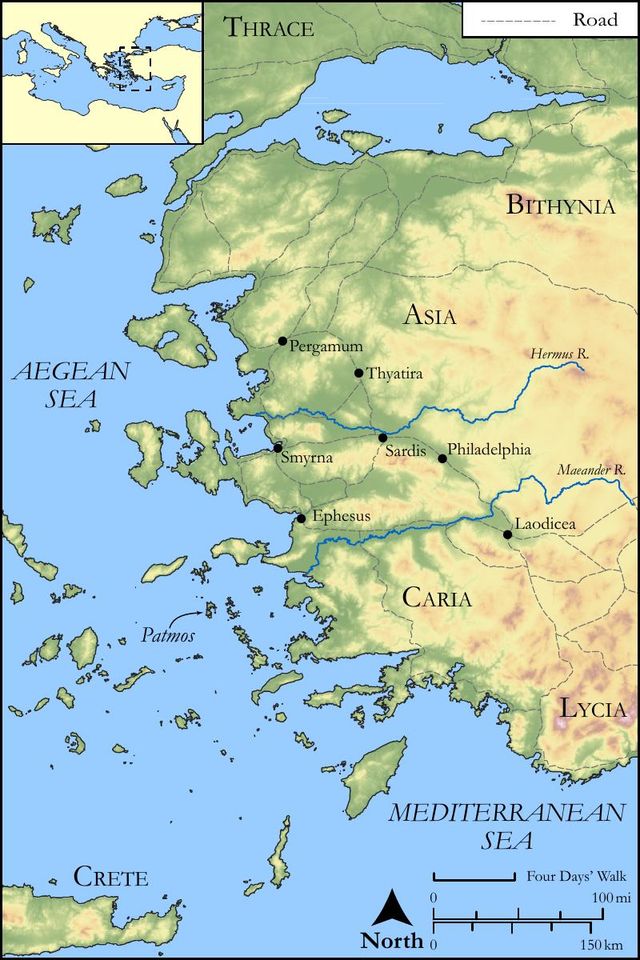
See on the biblical-era maps

Study this verse
Public-domain commentary
Matthew Henry
From his Commentary on the Whole Bible. Henry comments on passages, not single verses — this entry covers Revelation 17:1–6.
Here we have a new vision, not as to the matter of it, for that is contemporary with what came under the three last vials; but as to the manner of description, etc. Observe, 1. The invitation given to the apostle to take a view of what was here to be represented: Come hither, and I will show thee the judgment of the great whore, etc., Rev 17:1. This is a name of great infamy. A whore [in this passage] is one that is married, and has been false to her husband's bed, has forsaken the guide of her youth, and broken the covenant of God. She had been a prostitute to the kings of the earth, whom she had intoxicated with the wine of her fornication. 2. The appearance she made: it was gay and gaudy, like such sort of creatures: She was arrayed in purple, and scarlet colour, and decked with gold, and precious stones, and pearls, Rev 17:4. Here were all the allurements of worldly honour and riches, pomp and pride, suited to sensual and worldly minds. 3. Her principal seat and residence - upon the beast that had seven heads and ten horns; that is to say, Rome, the city on seven hills, infamous for idolatry, tyranny, and blasphemy. 4. Her name, which was written on her forehead. It was the custom of impudent harlots to hang out signs, with their names, that all might know what they were. Now in this observe, (1.) She is named from her place of residence - Babylon the great. But, that we might not take it for the old Babylon literally so called, we are told there is a mystery in the name; it is some other great city resembling the old Babylon. (2.) She is named from her infamous way and practice; not only a harlot, but a mother of harlots, breeding up harlots, and nursing and training them up to idolatry, and all sorts of lewdness and wickedness - the parent and nurse of all false religion and filthy conversation. 5. Her diet: she satiated herself with the blood of the saints and martyrs of Jesus. She drank their blood with such greediness that she intoxicated herself with it; it was so pleasant to her that she could not tell when she had had enough of it: she was satiated, but never satisfied.
Historical interpretation
Eight Centuries of Reception
7 surviving comments on this verse. Each one is dated, so this reads as a timeline rather than a list.
Select a marker to jump to its quote. Markers stagger vertically where authors wrote within a few decades of each other.
When great Babylon likewise is represented as drunk with the blood of the saints, doubtless the supplies needful for her drunkenness are furnished by the cups of martyrdoms; and what suffering the fear of martyrdoms will entail, is in like manner shown.
"There came one of the seven angels, which have the seven bowls, and spake with me, saying, Come, I will show thee the judgment of that great whore who sitteth upon many waters. And I saw the woman drunk with the blood of the saints, and with the blood of the martyrs." The decrees of that senate are always accomplished against all, contrary to the preaching of the true faith; and now already mercy being cast aside, itself here gave the decree among all nations.
There is one body that opposes the church within and without. For within the church there are false Christians, and outside the church there are heretics and pagans. And although this body might seem to be separated in terms of place, yet when it persecutes the church there is working a unity of spirit. For it is impossible that a prophet perish away from Jerusalem, which persecutes the prophets. That is to say, it is impossible for good Christians to suffer any persecution without evil Christians. And so the descendants of their ancestors are accused of consenting to the stoning of Zachariah, even though they themselves did not do it.
From many examples we learn that descriptive names can be ascribed to cities because of their reputations. Ancient Babylon is named in this way and is called a “pleasant harlot, skilled in sorcery,” and ancient Jerusalem is named “you had a whore’s face,” and in the letter of Peter the older Rome is called “Babylon.” More recently, she who held power among the Persians is called “Babylon” and a “harlot,” as well as any other city that rejoices in murder and blood. And so, when the Evangelist saw one of these cities polluted with the blood of the saints, he was perplexed and learned about it from the angel, inasmuch as one who bears the power of the earthly kingdom at the end of time must suffer for its trespasses. And this is so whether one believes it to be the power of the Persians, or old Rome or new Rome, or whether the kingdom is taken generically as in one body. For we know that in each of these there are different sins and the shedding of innocent blood, sometimes more, sometimes less. Indeed, who could reckon the blood of the martyrs shed until Diocletian, or the torments of these at the hands of the Persians? Moreover, for those who read them, the histories relate the perfidies done secretly under Julian and those done in new Rome against the orthodox during the time of the Arians.
And I saw the woman drunk with the blood of the saints, etc. It is one body, opposing within and without: although it seems separated by place, it nevertheless operates in common by the unity of the spirit. Thus, the descendants of the wicked are accused of stoning Zechariah by the same spirit, although they themselves did not do it.
And I wondered when I saw her, with great admiration. And the angel said to me: Why do you marvel? etc. That is, the devil once ruled in the world, who, after the Lord was crucified, was cast out; but at the end of the world, he is released from the prison of his confinement and will perish forever by the spirit of the Lord's mouth (2 Thess. 2). Tyconius refers the beast to the entire body of the devil, which is replenished by the succession of departing and following generations. Especially, because he promised to show the woman sitting upon many waters, that is, peoples, he shows her sitting upon the beast.
For the prostitute not only was full with the "blood" of the saints, but she was also "drunk." The kings who reigned over her had such different natures.
Continue studying Revelation 17:6 across the web’s major study libraries — every link below opens this exact verse, chapter, or book on the destination site.
Read & Compare
 BibleGatewayThis verse in more than 200 translations and 70 languages.
 Bible.comThe YouVersion reader — hundreds of translations, reading plans, and highlights.
 ESV.orgCrossway's official English Standard Version reader.
 NET BibleThe NET translation with 60,000+ translators' notes on every rendering decision.
 STEP BibleTyndale House's free study tool — original text, vocabulary, and scholarly resources.
 BibliaLogos Bible Software's free web reader.
 USCCBThe New American Bible (Revised Edition) with the U.S. bishops' study notes.
Commentaries
 BibleHub CommentariesDozens of classic commentaries on this verse, gathered on one page.
 StudyLightMore than 100 commentary sets — the largest collection on the web.
 BibleRefPlain-English commentary on what this verse means, verse by verse.
 Enduring WordDavid Guzik's free commentary on this chapter, widely used by Bible teachers.
 Bible Study ToolsVerse commentary alongside Greek and Hebrew study aids.
Original Language & Research
- BibleHub InterlinearThe verse word by word — original language, transliteration, and English.
- BibleHub LexiconEvery word's original-language definition and Strong's entry.
 Blue Letter BibleDeep-study tools — Strong's numbers, concordance, and word studies.
 CNTR CollationThe earliest Greek manuscripts of this verse, collated letter by letter.
Sermons, Hymns & Audio


TrulyRandomVerse is not affiliated with these sites and doesn’t control their content. They’re linked because they’re genuinely useful.
Summary
Revelation 17:6 presents a profoundly disturbing image within John's apocalyptic vision: a symbolic "woman," identified as Babylon the Great, is depicted as being intoxicated by the blood of God's faithful people. This vivid portrayal underscores the extreme and relentless persecution suffered by true believers throughout history, culminating in John's own astonished reaction to the horrifying spectacle of such profound wickedness and its devastating impact.
Context
ShowHideLiterary Context
This verse is situated within a pivotal vision in Revelation 17, where one of the seven angels who had the bowls invites John to witness the judgment of the "great harlot that sitteth upon many waters" (Revelation 17:1). The description of the woman in Revelation 17:3-5 immediately precedes this verse, setting the stage for her characterization as an opulent, blasphemous, and persecuting entity. John's reaction of "great admiration" (or wonder) in this verse then prompts the angel to provide a detailed explanation of the woman and the beast in the subsequent verses of Revelation 17:7-18, linking this vision directly to the broader narrative of divine judgment against oppressive world powers that culminates in the fall of Babylon described in Revelation 18.
Historical & Cultural Context
The imagery of a "harlot" and "Babylon" would have resonated deeply with John's original audience, who were likely experiencing persecution under the Roman Empire. Rome, with its imperial cult, economic power, and military might, was seen by many Christians as a modern "Babylon"—a successor to the ancient oppressor of God's people. The concept of a nation or system "drunken with blood" evokes the historical reality of empires that built their power through violence and the suppression of dissent, often targeting religious minorities. The term "martyrs" (witnesses) directly reflects the early Christian experience, where bearing testimony to Jesus often led to imprisonment, torture, and execution, particularly during periods of intense imperial persecution under emperors like Nero and Domitian.
Key Themes
ShowHideThe central theme in Revelation 17:6 is the persecution and martyrdom of God's faithful people. The graphic depiction of the woman "drunken with the blood of the saints, and with the blood of the martyrs of Jesus" powerfully conveys the insatiable and almost celebratory nature of this persecution, highlighting the severe cost of discipleship and fulfilling prophecies that "all that will live godly in Christ Jesus shall suffer persecution" as stated in 2 Timothy 3:12. This verse also contributes to the theme of the nature of "Babylon," portraying her as the epitome of rebellion against God, utterly consumed by her opposition to Christ and His followers. Her guilt is further emphasized in Revelation 18:24, where the blood of prophets and saints is found within her. Finally, John's reaction underscores the theme of divine revelation and human response, as his "great admiration" (better translated as "great wonder" or "astonishment") reflects profound shock and bewilderment at the depth of wickedness revealed, rather than approval.
Exposition and Analysis
ShowHideKey Word Analysis
ShowHideMeaning "to drink to intoxication, i.e., get drunk." In this context, it is used metaphorically to describe the woman's complete saturation and overwhelming indulgence in the shedding of innocent blood. It implies an excessive, almost perverse, consumption, suggesting a deep, ingrained pleasure or obsession with the suffering and death of God's people, rather than a mere consequence of her actions.
Referring to literal blood, but here it powerfully symbolizes the life violently taken. The repeated mention of "blood" emphasizes the sheer volume and brutality of the persecution, signifying the lives of countless believers who have been sacrificed for their faith. It is the very essence of their lives poured out.
Meaning "a witness." By analogy, it refers to one who bears testimony to Christ, often to the point of death. The inclusion of "martyrs of Jesus" specifies that the persecution is directed at those who bear witness to Jesus, highlighting the ultimate cost of their faithfulness and their unwavering allegiance to Him, even unto death.
Verse Breakdown
ShowHide"And I saw the woman drunken with the blood of the saints"
John, in his prophetic vision, observes a symbolic female figure—later identified as "Babylon the Great"—who is depicted as being completely intoxicated, not with wine, but with the lifeblood of God's consecrated people. This imagery conveys her profound guilt and her active, insatiable participation in the violent persecution of those set apart by God.
"and with the blood of the martyrs of Jesus"
This clause further specifies and intensifies the nature of the "blood" with which the woman is drunken. It clarifies that the victims are not merely "saints" in a general sense, but specifically "martyrs"—those who have borne courageous witness to Jesus Christ, even to the point of death. This highlights the direct targeting of Christ's followers due to their testimony.
"and when I saw her, I wondered with great admiration"
Upon witnessing this horrific and shocking sight, John's immediate reaction is one of profound astonishment and awe. The KJV's "admiration" here uses an older sense of the word, meaning intense wonder, perplexity, or amazement, rather than approval. John is utterly bewildered by the sheer magnitude of the woman's wickedness and the suffering she has inflicted upon God's people.
Literary Devices
ShowHideRevelation 17:6 employs several powerful literary devices to convey its stark message. The most prominent is Personification, where the abstract concept of an oppressive rule is embodied by "the woman," giving it a tangible and terrifying presence. This woman is then described using a vivid Metaphor: she is "drunken with the blood of the saints and with the blood of the martyrs of Jesus." This is not a literal intoxication but a powerful image signifying her complete saturation, enjoyment, and insatiable thirst for the violent persecution and death of God's people. It implies an excessive, almost perverse, indulgence in bloodshed. Furthermore, the entire passage is rich in Symbolism: "the woman" symbolizes the ultimate anti-God system (whether political, economic, or religious) that opposes God's kingdom, while "blood" is a potent symbol of violent death, martyrdom, and the life essence poured out. The phrase "great admiration" on John's part is an example of Archaism in the KJV, as the word's meaning has shifted; in its original context, it conveyed profound wonder or astonishment, not approval, at the terrifying spectacle.
Theological and Thematic Connections
ShowHideRevelation 17:6 serves as a stark theological commentary on the enduring conflict between God's kingdom and the forces of evil in the world. It reveals the depth of spiritual depravity inherent in systems that oppose Christ, demonstrating their insatiable appetite for the destruction of God's people. The "blood of the saints and martyrs" is a testament to the cost of faithfulness in a fallen world, but it also underscores divine justice, assuring believers that their suffering is not unnoticed and that their persecutors will face ultimate judgment. This verse connects the suffering of believers throughout history to a singular, pervasive evil, emphasizing that the persecution of God's people is a direct assault on God Himself, and that the blood shed by martyrs cries out for divine vindication, which will ultimately be realized in Christ's triumph.
Reflection and Application
ShowHideRevelation 17:6, while depicting a grim reality, offers profound lessons for contemporary believers. It serves as a sobering reminder that opposition to God's truth and His people is an enduring feature of human history, manifesting in various forms, from overt persecution to subtle cultural pressures. This verse calls us to spiritual discernment, enabling us to recognize and resist "Babylonian" influences—any system, ideology, or cultural current that seeks to compromise our allegiance to Christ or silence our witness. It encourages steadfastness in faith, reminding us that suffering for righteousness' sake is not an anomaly but a potential reality for those who follow Christ, as evidenced by the "blood of the saints and martyrs." Ultimately, this passage, though dark, points to God's sovereign control and His ultimate justice, strengthening our hope that though evil may rage, its triumph is temporary, and God's kingdom will prevail. We are called to remain faithful, trusting in the Lord's vindication and the promise of eternal life, even when faced with the world's hostility.
Questions for Reflection
ShowHideFAQ
ShowHideIs "admiration" in the KJV's "I wondered with great admiration" a positive emotion?
ShowHideNo, in the context of Revelation 17:6, the King James Version's use of "admiration" (from the Greek thaûma, G2295) does not signify approval or praise. Instead, it reflects an older, now archaic, meaning of the word: profound wonder, astonishment, awe, or perplexity. John is not admiring the woman's wickedness; rather, he is utterly bewildered and shocked by the horrific sight of her being saturated with the blood of God's people. This sense of astonishment is a common reaction to overwhelming divine revelations in apocalyptic literature, underscoring the gravity and disturbing nature of the vision presented to him.
Who is the "woman" described as "drunken with the blood of the saints"?
ShowHideThe "woman" in Revelation 17 is a highly symbolic figure, explicitly identified in Revelation 17:5 as "MYSTERY, BABYLON THE GREAT, THE MOTHER OF HARLOTS AND ABOMINATIONS OF THE EARTH." She represents a powerful, corrupt, and oppressive rule that stands in opposition to God and persecutes His people throughout history. While interpretations vary, she is often understood as symbolizing a global, anti-God religious, political, or economic power—or a combination thereof—that embodies spiritual harlotry (idolatry, unfaithfulness to God) and is responsible for immense suffering and bloodshed among God's faithful. Her identity is further elaborated by the angel in Revelation 17:18, stating, "The woman whom you saw is the great city that has dominion over the kings of the earth."
Christ-Centered Fulfillment
ShowHideRevelation 17:6, though a grim depiction of the world's hostility towards God's people, finds its ultimate Christ-centered fulfillment in the stark contrast between the blood shed by Babylon and the precious, atoning blood of Jesus Christ. The "blood of the saints and martyrs" is a testament to their faithfulness unto death, mirroring the ultimate witness of Christ Himself, who "suffered outside the gate" (Hebrews 13:12) and whose own blood was shed as the perfect sacrifice "for the remission of sins" (Matthew 26:28). While Babylon is "drunken" with the blood of the innocent, Christ's blood cleanses and redeems. The persecution faced by the saints is a participation in the sufferings of Christ (Philippians 3:10), and their ultimate vindication is guaranteed by His resurrection and triumph over sin, death, and all opposing powers. The judgment of Babylon, described vividly in Revelation 18, is an act of Christ's sovereign justice, ensuring that every drop of martyr's blood will be avenged by the Lamb who is worthy to open the scroll (Revelation 5:6-10). Thus, the suffering depicted in this verse ultimately points to the unwavering power and ultimate victory of Christ, who will finally establish His kingdom where "God shall wipe away all tears from their eyes" (Revelation 21:4).