


Revelation 17:7
Bible text: King James Version (1769 Blayney text) · Public domain
Bible text: King James Version with Strong's numbers · Public domain
Bible text: Berean Standard Bible · Public domain
Bible text: American Standard Version (1901) · Public domain
Bible text: World English Bible, Messianic edition · Public domain
Bible text: Geneva Bible (1599) · Public domain
Bible text: Young's Literal Translation · Public domain
- καὶkaiAndG2532CONJConjunction
- εἶπένeipensaidG2036V-2AAI-3SVerb 2nd Aorist Active Indicative 3rd Singular
- μοιmoito meG3165P-1DSPersonal pronoun Dative 1st Singular
- ὁhotheG3588T-NSMDefinite article Nominative Singular Masculine
- ἄγγελος·angelosangelG32N-NSMNoun Nominative Singular Masculine
- διὰdiaBecause ofG1223PREPPreposition
- τίtiwhyG5101I-ASNInterrogative pronoun Accusative Singular Neuter
- ἐθαύμασας;ethaumasasdid you marvel?G2296V-AAI-2SVerb Aorist Active Indicative 2nd Singular
- ἐγὼegōI myselfG1473P-1NSPersonal pronoun Nominative 1st Singular
- ἐρῶerōwill tellG4483V-FAI-1SVerb Future Active Indicative 1st Singular
- σοιsoiyouG4771P-2DSPersonal pronoun Dative 2nd Singular
- τὸtotheG3588T-ASNDefinite article Accusative Singular Neuter
- μυστήριονmustērionmysteryG3466N-ASNNoun Accusative Singular Neuter
- τῆςtēsof theG3588T-GSFDefinite article Genitive Singular Feminine
- γυναικὸςgunaikoswomanG1135N-GSFNoun Genitive Singular Feminine
- καὶkaiandG2532CONJConjunction
- τοῦtouof theG3588T-GSNDefinite article Genitive Singular Neuter
- θηρίουthērioubeastG2342N-GSNNoun Genitive Singular Neuter
- τοῦtouwhoG3588T-GSNDefinite article Genitive Singular Neuter
- βαστάζοντοςbastazontosis carryingG941V-PAP-GSNVerb Present Active Participle Genitive Singular Neuter
- αὐτὴνautēnherG846P-ASFPersonal pronoun Accusative Singular Feminine
- τοῦtouwhoG3588T-GSNDefinite article Genitive Singular Neuter
- ἔχοντοςechontosis havingG2192V-PAP-GSNVerb Present Active Participle Genitive Singular Neuter
- τὰςtastheG3588T-APFDefinite article Accusative Plural Feminine
- ἑπτὰheptasevenG2033A-NUIAdjective
- κεφαλὰςkephalasheadsG2776N-APFNoun Accusative Plural Feminine
- καὶkaiandG2532CONJConjunction
- τὰtatheG3588T-APNDefinite article Accusative Plural Neuter
- δέκαdekatenG1176A-NUIAdjective
- κέραταkeratahornsG2768N-APNNoun Accusative Plural Neuter
English is a literal word-by-word gloss of the Greek, not the KJV's wording. Why?
This is the original text the KJV's translators worked from — each Greek word with its own literal English meaning in this verse, prepared by scholars at Tyndale House, Cambridge. The KJV translates whole sentences, not word by word, so its wording differs: one Greek word can become several English words, and the KJV may choose “charity” where the gloss reads “love”. Both are faithful — they answer different questions. For the KJV's own rendering, switch to the KJV text.
Details
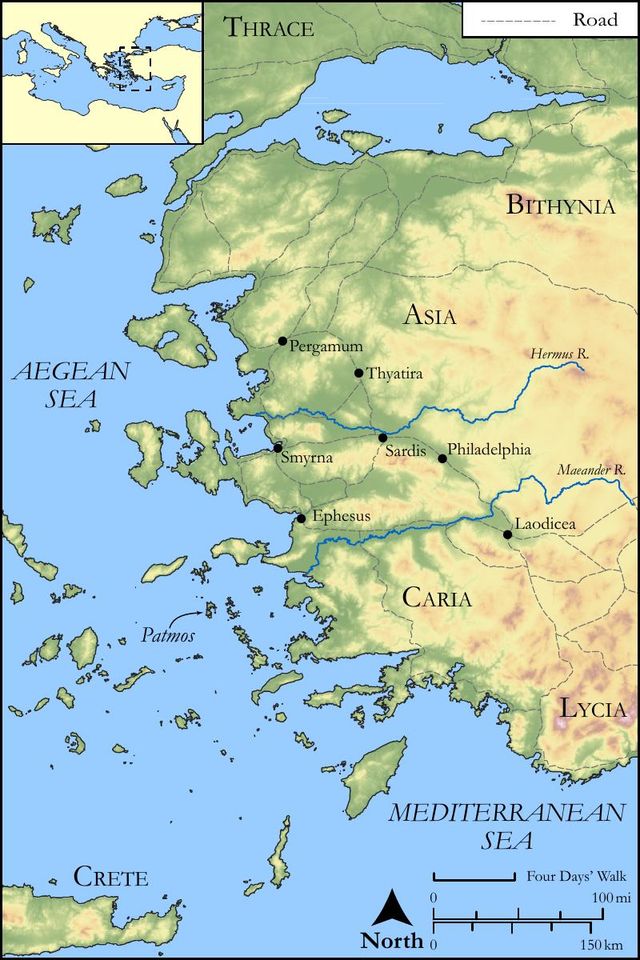
See on the biblical-era maps

Study this verse
Public-domain commentary
Matthew Henry
From his Commentary on the Whole Bible. Henry comments on passages, not single verses — this entry covers Revelation 17:7–13.
Here we have the mystery of this vision explained. The apostle wonders at the sight of this woman: the angel undertakes to open this vision to him, it being the key of the former visions; and he tells the apostle what was meant by the beast on which the woman sat; but it is so explained as still to need further explanation. 1. This beast was, and is not, and yet is; that is, it was a seat of idolatry and persecution; and is not, that is, not in the ancient form, which was pagan; and yet it is, it is truly the seat of idolatry and tyranny, though of another sort and form. It ascends out of the bottomless pit (idolatry and cruelty are the issue and product of hell), and it shall return thither and go into perdition. 2. This beast has seven heads, which have a double signification. (1.) Seven mountains - the seven hills on which Rome stands; and (2.) Seven kings - seven sorts of government. Rome was governed by kings, consuls, tribunes, decemviri, dictators, emperors who were pagan, and emperors who were Christian. Five of these were extinct when this prophecy was written; one was then in being, that is, the pagan emperor; and the other, that is, the Christian emperor, was yet to come, Rev 17:10. This beast, the papacy, makes an eighth governor, and sets up idolatry again. 3. This beast had ten horns; which are said to be ten kings which have as yet received no kingdoms; as yet, that is, as some, shall not rise up till the Roman empire be broken in pieces; or, as others, shall not rise up till near the end of antichrist's reign, and so shall reign but as it were one hour with her, but shall for that time be very unanimous and very zealous in that interest, and entirely devoted to it, divesting themselves of their prerogatives and revenues (things so dear to princes), out of an unaccountable fondness for the papacy.
Historical interpretation
Four Centuries of Reception
4 surviving comments on this verse. Each one is dated, so this reads as a timeline rather than a list.
Select a marker to jump to its quote. Markers stagger vertically where authors wrote within a few decades of each other.
There is one body that opposes the church within and without. For within the church there are false Christians, and outside the church there are heretics and pagans. And although this body might seem to be separated in terms of place, yet when it persecutes the church there is working a unity of spirit. For it is impossible that a prophet perish away from Jerusalem, which persecutes the prophets. That is to say, it is impossible for good Christians to suffer any persecution without evil Christians. And so the descendants of their ancestors are accused of consenting to the stoning of Zachariah, even though they themselves did not do it.
From many examples we learn that descriptive names can be ascribed to cities because of their reputations. Ancient Babylon is named in this way and is called a “pleasant harlot, skilled in sorcery,” and ancient Jerusalem is named “you had a whore’s face,” and in the letter of Peter the older Rome is called “Babylon.” More recently, she who held power among the Persians is called “Babylon” and a “harlot,” as well as any other city that rejoices in murder and blood. And so, when the Evangelist saw one of these cities polluted with the blood of the saints, he was perplexed and learned about it from the angel, inasmuch as one who bears the power of the earthly kingdom at the end of time must suffer for its trespasses. And this is so whether one believes it to be the power of the Persians, or old Rome or new Rome, or whether the kingdom is taken generically as in one body. For we know that in each of these there are different sins and the shedding of innocent blood, sometimes more, sometimes less. Indeed, who could reckon the blood of the martyrs shed until Diocletian, or the torments of these at the hands of the Persians? Moreover, for those who read them, the histories relate the perfidies done secretly under Julian and those done in new Rome against the orthodox during the time of the Arians.
And I wondered when I saw her, with great admiration. And the angel said to me: Why do you marvel? etc. That is, the devil once ruled in the world, who, after the Lord was crucified, was cast out; but at the end of the world, he is released from the prison of his confinement and will perish forever by the spirit of the Lord's mouth (2 Thess. 2). Tyconius refers the beast to the entire body of the devil, which is replenished by the succession of departing and following generations. Especially, because he promised to show the woman sitting upon many waters, that is, peoples, he shows her sitting upon the beast.
"I will tell you what the mystery of the woman and the beast is": that is, in a mystical way these things which are written to you as in a figure are revealed through the Revelation.
Continue studying Revelation 17:7 across the web’s major study libraries — every link below opens this exact verse, chapter, or book on the destination site.
Read & Compare
 BibleGatewayThis verse in more than 200 translations and 70 languages.
 Bible.comThe YouVersion reader — hundreds of translations, reading plans, and highlights.
 ESV.orgCrossway's official English Standard Version reader.
 NET BibleThe NET translation with 60,000+ translators' notes on every rendering decision.
 STEP BibleTyndale House's free study tool — original text, vocabulary, and scholarly resources.
 BibliaLogos Bible Software's free web reader.
 USCCBThe New American Bible (Revised Edition) with the U.S. bishops' study notes.
Commentaries
 BibleHub CommentariesDozens of classic commentaries on this verse, gathered on one page.
 StudyLightMore than 100 commentary sets — the largest collection on the web.
 BibleRefPlain-English commentary on what this verse means, verse by verse.
 Enduring WordDavid Guzik's free commentary on this chapter, widely used by Bible teachers.
 Bible Study ToolsVerse commentary alongside Greek and Hebrew study aids.
Original Language & Research
- BibleHub InterlinearThe verse word by word — original language, transliteration, and English.
- BibleHub LexiconEvery word's original-language definition and Strong's entry.
 Blue Letter BibleDeep-study tools — Strong's numbers, concordance, and word studies.
 CNTR CollationThe earliest Greek manuscripts of this verse, collated letter by letter.
Sermons, Hymns & Audio


TrulyRandomVerse is not affiliated with these sites and doesn’t control their content. They’re linked because they’re genuinely useful.
Summary
Revelation 17:7 marks a pivotal moment in John's apocalyptic vision, as an angel addresses his astonishment at the sight of the woman riding the scarlet beast. The angel's question, "Wherefore didst thou marvel?", serves as a prelude to a divine revelation. This verse initiates a profound explanation of the "mystery" surrounding the enigmatic woman and the multi-headed, horned beast that carries her, promising to unveil the symbolic identities and roles of these powerful entities within God's unfolding prophetic narrative.
Context
ShowHideLiterary Context
Revelation 17:7 directly follows John's initial encounter with "Babylon the Great, the Mother of Harlots and Abominations of the Earth," whom he observes "drunken with the blood of the saints, and with the blood of the martyrs of Jesus" (Revelation 17:6). John's profound "marveling" at this sight prompts the angel's intervention, setting the stage for the detailed interpretation that occupies the remainder of Revelation 17. This verse transitions the narrative from observation and emotional reaction to divine exposition, providing the necessary interpretive key for the complex symbolism introduced in the preceding verses. The angel's explanation is crucial for understanding the nature and ultimate fate of the anti-God forces at play in the end times.
Historical & Cultural Context
The imagery in Revelation, including the beast with multiple heads and horns, draws heavily on Old Testament prophetic traditions, particularly those found in Daniel 7, which describes successive world empires as beasts. The concept of a "mystery" (Greek: mystērion) in the New Testament often refers to a truth previously hidden but now revealed by God, not something inherently unknowable. John's audience, living under Roman imperial power, would have been familiar with the concept of powerful, oppressive empires. The "woman" riding the beast likely alludes to a city or system that dominates and controls, much like a queen or a harlot who exerts influence. The "seven heads" could historically point to the seven hills of Rome, a common ancient association, or to a succession of world powers. The "ten horns" typically symbolize kings or kingdoms, often signifying complete power or a confederation of powers.
Key Themes
ShowHideThis verse contributes significantly to several major themes within Revelation. Firstly, it underscores the theme of Divine Revelation and Interpretation, as God, through His angel, actively provides understanding for seemingly impenetrable prophetic visions, ensuring His servants are not left in confusion. Secondly, it highlights the Nature of Anti-God Powers, personified by the "woman" and the "beast," which represent systems of spiritual apostasy, political oppression, and economic corruption that oppose God and persecute His people. This theme is further developed as the angel explains their origin, power, and ultimate destruction, as seen in the beast's rise and fall in Revelation 13 and the woman's judgment in Revelation 18. Thirdly, the angel's authoritative tone reinforces the theme of God's Sovereignty and Control, even over the most formidable earthly powers, assuring believers that these events are part of God's predetermined plan and not random chaos.
Exposition and Analysis
ShowHideKey Word Analysis
ShowHideFrom thauma, meaning "to wonder" or "to admire." Here, it denotes John's profound astonishment, awe, or even bewilderment at the sight of the woman and beast, particularly the woman's state of being "drunken with the blood of the saints" (Revelation 17:6). This reaction highlights the shocking and disturbing nature of the vision, prompting the angel's immediate interpretive response.
Derived from a word implying "to shut the mouth," suggesting a secret or a truth revealed only to initiates. In the New Testament, mystērion refers not to something inherently incomprehensible, but to a divine truth previously hidden or veiled, now revealed by God's disclosure. The angel's promise to "tell thee the mystery" signifies that the complex symbolism of the woman and beast is not meant to remain obscure but will be divinely illuminated for John and, by extension, for God's people.
This verb means "to lift," "to bear," or "to carry." In this context, it describes the beast physically supporting the woman. This imagery signifies a close, symbiotic relationship between the political-economic power (the beast) and the corrupt religious-economic system (the woman). The beast provides the power and platform for the woman's influence, though this relationship is ultimately temporary and will end in the woman's destruction by the beast itself (Revelation 17:16).
Verse Breakdown
ShowHide"And the angel said unto me, Wherefore didst thou marvel?"
This opening clause establishes the divine initiative in providing understanding. The angel, acting as God's messenger, perceives John's profound astonishment and directly addresses it, signaling that the vision's complexity is about to be clarified. The question is rhetorical, designed to draw John's attention to the impending explanation.
"I will tell thee the mystery of the woman, and of the beast that carrieth her"
This is the core promise of the verse. The angel declares his intent to reveal the "mystery" – the divinely hidden truth now to be unveiled – concerning the two central figures of John's vision: the "woman" (Babylon the Great) and the "beast" (the final anti-God empire). This statement assures John (and the reader) that the symbolic meaning of these entities will be disclosed.
"which hath the seven heads and ten horns"
This final clause specifically identifies the beast, reiterating its distinctive features previously mentioned in Revelation 17:3. These features are crucial symbolic elements that will be further explained by the angel in the subsequent verses (Revelation 17:9-12), representing a succession of kingdoms and a confederation of kings, respectively.
Literary Devices
ShowHideRevelation 17:7 employs several significant literary devices. Dialogue is central, as the angel directly addresses John, shifting the narrative from passive observation to interactive revelation. This direct address creates a sense of immediacy and personal instruction. Symbolism is paramount, with "the woman" and "the beast" serving as complex, multi-layered representations of spiritual and political powers. The angel's promise to "tell thee the mystery" underscores that these are not literal figures but require divine interpretation, typical of apocalyptic literature where earthly realities are veiled in supernatural imagery. The phrase "Wherefore didst thou marvel?" functions as a rhetorical question, not seeking an answer from John, but rather serving to transition the narrative and highlight the significance of the impending explanation. This question also emphasizes John's human reaction to the terrifying and perplexing vision, making the divine intervention all the more impactful.
Theological and Thematic Connections
ShowHideRevelation 17:7 is profoundly theological, underscoring God's commitment to revealing His truth to His servants, especially concerning the forces that oppose His kingdom. The angel's declaration that he "will tell thee the mystery" highlights that God does not leave His people in the dark regarding the nature of evil and its ultimate defeat. This divine disclosure is a testament to God's sovereignty, demonstrating that even the most formidable and deceptive earthly powers operate within the bounds of His predetermined plan. It assures believers that understanding, discernment, and ultimately, victory, are available through divine revelation, fostering trust in God's control over history.
Reflection and Application
ShowHideRevelation 17:7 serves as a powerful reminder that while the world's spiritual and political landscape may appear bewildering and even terrifying, God is not silent. He actively reveals His plans and the nature of the forces at work, both good and evil. For believers today, this verse encourages a posture of humble receptivity to God's Word, particularly its prophetic truths. It challenges us to move beyond mere astonishment at global events to seek divine understanding, trusting that God will illuminate what is necessary for our discernment and faithfulness. Understanding these "mysteries" equips us to stand firm against deception, to recognize the transient nature of worldly power, and to live with hope in God's ultimate victory. It calls us to discern the spiritual realities behind the headlines, to pray for wisdom, and to remain vigilant in our witness, knowing that God's sovereign hand guides all things to their appointed end.
Questions for Reflection
ShowHideFAQ
ShowHideWhat is the "mystery" the angel promises to reveal in Revelation 17:7?
ShowHideThe "mystery" (Greek: mystērion) is not something inherently unknowable, but a divine truth previously hidden or veiled, which God now chooses to disclose. In Revelation 17:7, the angel promises to reveal the symbolic meaning and identity of the "woman" (Babylon the Great) and the "beast that carrieth her." This revelation explains their nature, their relationship, and their ultimate destiny within God's prophetic plan, providing crucial understanding for John and for all believers. The subsequent verses in Revelation 17 elaborate on this mystery, identifying the woman as the great city that reigns over the kings of the earth and the beast as a succession of kingdoms culminating in a final, powerful, anti-God empire.
Christ-Centered Fulfillment
ShowHideRevelation 17:7, though focusing on the unveiling of anti-God powers, ultimately points to the supreme authority and redemptive work of Christ. The "mystery" revealed by the angel is part of God's overarching plan, a plan that culminates in the triumph of the Lamb. While John marvels at the beast and the harlot, the New Testament consistently directs our gaze to Christ as the one who "hath the key of David, he that openeth, and no man shutteth; and shutteth, and no man openeth" (Revelation 3:7). The beast's power, despite its terrifying appearance, is temporary and ultimately subservient to the divine purpose, for Christ is "King of kings, and Lord of lords" (Revelation 19:16). The revelation of these end-time enemies serves to highlight the necessity and glory of Christ's return, when He will judge the great harlot and conquer the beast, establishing His eternal kingdom (Revelation 19:11-21). Thus, the angel's explanation of the "mystery" is not merely about understanding evil, but about affirming the certainty of Christ's victorious reign and the ultimate vindication of His saints.