


Revelation 17:1
Bible text: King James Version (1769 Blayney text) · Public domain
Bible text: King James Version with Strong's numbers · Public domain
Bible text: Berean Standard Bible · Public domain
Bible text: American Standard Version (1901) · Public domain
Bible text: World English Bible, Messianic edition · Public domain
Bible text: Geneva Bible (1599) · Public domain
Bible text: Young's Literal Translation · Public domain
- ΚαὶKaiAndG2532CONJConjunction
- ἦλθενēlthencameG2064V-2AAI-3SVerb 2nd Aorist Active Indicative 3rd Singular
- εἷςheisoneG1520A-NSMAdjective Nominative Singular Masculine
- ἐκekofG1537PREPPreposition
- τῶνtōntheG3588T-GPMDefinite article Genitive Plural Masculine
- ἑπτὰheptasevenG2033A-NUIAdjective
- ἀγγέλωνangelōnangelsG32N-GPMNoun Genitive Plural Masculine
- τῶνtōnthoseG3588T-GPMDefinite article Genitive Plural Masculine
- ἐχόντωνechontōnhavingG2192V-PAP-GPMVerb Present Active Participle Genitive Plural Masculine
- τὰςtastheG3588T-APFDefinite article Accusative Plural Feminine
- ἑπτὰheptasevenG2033A-NUIAdjective
- φιάλαςphialasbowlsG5357N-APFNoun Accusative Plural Feminine
- καὶkaiandG2532CONJConjunction
- ἐλάλησενelalēsenspokeG2980V-AAI-3SVerb Aorist Active Indicative 3rd Singular
- μετ᾽met᾽withG3326PREPPreposition
- ἐμοῦemoumeG1473S-1SGSNPossessive pronoun Genitive 1st Person Singular Neuter
- λέγωνlegōnsayingG3004V-PAP-NSMVerb Present Active Participle Nominative Singular Masculine
- μοι·moito meG3165P-1DSPersonal pronoun Dative 1st Singular
- δεῦροdeuroCome hereG1204INJInterjection
- δείξωdeixōI will showG1166V-FAI-1SVerb Future Active Indicative 1st Singular
- σοιsoiyouG4771P-2DSPersonal pronoun Dative 2nd Singular
- τὸtotheG3588T-ASNDefinite article Accusative Singular Neuter
- κρίμαkrimapunishmentG2917N-ASNNoun Accusative Singular Neuter
- τῆςtēsof theG3588T-GSFDefinite article Genitive Singular Feminine
- πόρνηςpornēsprostituteG4204N-GSFNoun Genitive Singular Feminine
- τῆςtēs<the>G3588T-GSFDefinite article Genitive Singular Feminine
- μεγάληςmegalēsgreatG3173A-GSFAdjective Genitive Singular Feminine
- τῆςtēswhoG3588T-GSFDefinite article Genitive Singular Feminine
- καθημένηςkathēmenēsis sittingG2521V-PNP-GSFVerb Present Middle Or Passive Deponent Participle Genitive Singular Feminine
- ἐπὶepiuponG1909PREPPreposition
- τῶνtōn<the>G3588T-GPNDefinite article Genitive Plural Neuter
- ὑδάτωνhudatōnwatersG5204N-GPNNoun Genitive Plural Neuter
- τῶνtōn<the>G3588T-GPNDefinite article Genitive Plural Neuter
- πολλῶνpollōnmanyG4183A-GPNAdjective Genitive Plural Neuter
English is a literal word-by-word gloss of the Greek, not the KJV's wording. Why?
This is the original text the KJV's translators worked from — each Greek word with its own literal English meaning in this verse, prepared by scholars at Tyndale House, Cambridge. The KJV translates whole sentences, not word by word, so its wording differs: one Greek word can become several English words, and the KJV may choose “charity” where the gloss reads “love”. Both are faithful — they answer different questions. For the KJV's own rendering, switch to the KJV text.
Details
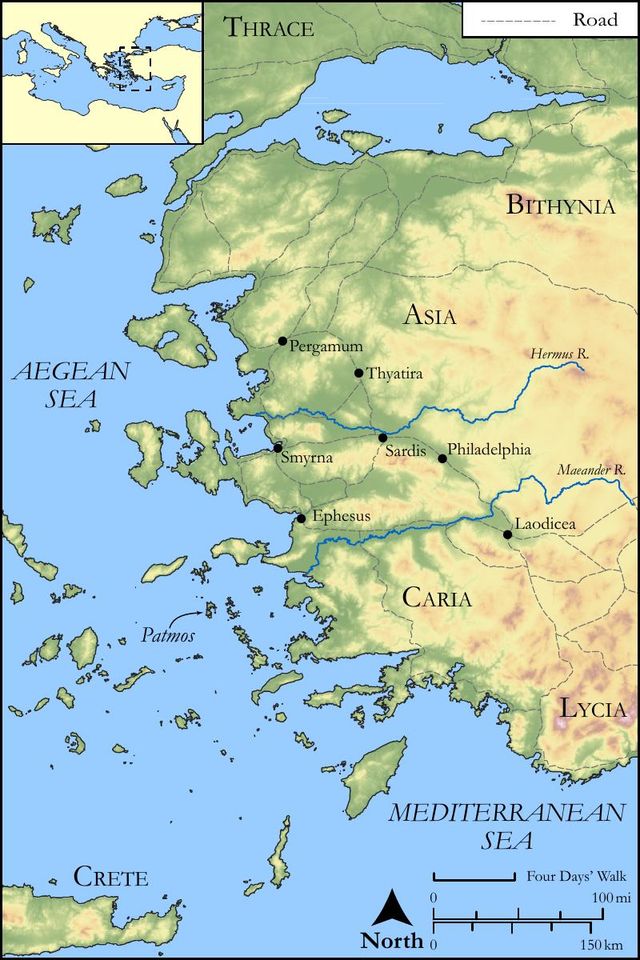
See on the biblical-era maps

Study this verse
Public-domain commentary
Matthew Henry
From his Commentary on the Whole Bible. Henry comments on passages, not single verses — this entry covers Revelation 17:1–6.
Here we have a new vision, not as to the matter of it, for that is contemporary with what came under the three last vials; but as to the manner of description, etc. Observe, 1. The invitation given to the apostle to take a view of what was here to be represented: Come hither, and I will show thee the judgment of the great whore, etc., Rev 17:1. This is a name of great infamy. A whore [in this passage] is one that is married, and has been false to her husband's bed, has forsaken the guide of her youth, and broken the covenant of God. She had been a prostitute to the kings of the earth, whom she had intoxicated with the wine of her fornication. 2. The appearance she made: it was gay and gaudy, like such sort of creatures: She was arrayed in purple, and scarlet colour, and decked with gold, and precious stones, and pearls, Rev 17:4. Here were all the allurements of worldly honour and riches, pomp and pride, suited to sensual and worldly minds. 3. Her principal seat and residence - upon the beast that had seven heads and ten horns; that is to say, Rome, the city on seven hills, infamous for idolatry, tyranny, and blasphemy. 4. Her name, which was written on her forehead. It was the custom of impudent harlots to hang out signs, with their names, that all might know what they were. Now in this observe, (1.) She is named from her place of residence - Babylon the great. But, that we might not take it for the old Babylon literally so called, we are told there is a mystery in the name; it is some other great city resembling the old Babylon. (2.) She is named from her infamous way and practice; not only a harlot, but a mother of harlots, breeding up harlots, and nursing and training them up to idolatry, and all sorts of lewdness and wickedness - the parent and nurse of all false religion and filthy conversation. 5. Her diet: she satiated herself with the blood of the saints and martyrs of Jesus. She drank their blood with such greediness that she intoxicated herself with it; it was so pleasant to her that she could not tell when she had had enough of it: she was satiated, but never satisfied.
Historical interpretation
Seven Centuries of Reception
6 surviving comments on this verse. Each one is dated, so this reads as a timeline rather than a list.
Select a marker to jump to its quote. Markers stagger vertically where authors wrote within a few decades of each other.
That a woman ought not to be adorned in a worldly fashion. In the Apocalypse: "And there came one of the seven angels having vials, and approached me, saying, Come, I will show thee the condemnation of the great whore, who sitteth upon many waters, with whom the kings of the earth have committed fornication. And I saw a woman who sate upon a beast. And that woman was clothed with a purple and scarlet robe; and she was adorned with gold, and precious stones, and pearls, holding a golden cup in her hand full of curses, and impurity, and fornication of the whole earth." Also to Timothy: "Let your women be such as adorn themselves with shamefacedness and modesty, not with twisted hair, nor with gold, nor with pearls, or precious garments, but as becometh women professing chastity, with a good conversation." Of this same thing in the Epistle of Peter to the people at Pontus: "Let there be in a woman not the outward adorning of ornament, or of gold, or of apparel, but the adorning of the heart." Also in Genesis: "Thamar covered herself with a cloak, and adorned herself; and when Judah beheld her, she appeared to him to be a harlot."
"There came one of the seven angels, which have the seven bowls, and spake with me, saying, Come, I will show thee the judgment of that great whore who sitteth upon many waters. And I saw the woman drunk with the blood of the saints, and with the blood of the martyrs." The decrees of that senate are always accomplished against all, contrary to the preaching of the true faith; and now already mercy being cast aside, itself here gave the decree among all nations.
Isaiah speaks of the devil in a similar manner when he foretells the fall [of the devil] under the figure of the leader of Babylon. “How you are fallen from heaven, O Lucifer, who has risen in the morning.” Speaking of the body of all the lost, which he often calls by various yet suitable names, the Holy Spirit considers that it always moves to a greater variety of excesses and is corrupted by its wickedness and is hooked on its errors and is made mad by such a level of impiety that it is opposed by the gentle. And so [the Holy Spirit] depicts this body which is perishing with a suitable description, calling it a “harlot.” For being forsaken by the Creator, she has given herself over to prostitution, allowing herself to be ravished by demons. She is called “great” because of the enormity of her transgressions through which she has offended the saints for a long time. She sits upon many waters, that is, upon many nations.
Some consider this harlot to be old Rome, since she sits on seven hills, and the seven heads of the beast that carries [the harlot] to be the more ungodly kings from Domitian to Diocletian who persecuted the church. However, we are guided as much as possible by the sequence of events and think that she is either the earthly kingdom generally, depicted as in one body, or that city that is ruled until the arrival of the antichrist. For old Rome lost the power of dominion a long time ago, and we do not suppose that the ancient status will again return to it. But should we grant this, the power that governs today will have been destroyed beforehand. For the Revelation says, “The woman that you saw is the great city that has dominion over the kings of the earth.”
Come, I will show you the condemnation of the great harlot, etc. The multitude of the lost, who, forsaking the Creator, surrendered themselves to demons to be defiled, is remembered as sitting on the waters, that is, in the discord of the peoples. Conversely, the multitude of believers was of one heart and one soul. Whom the Apostle betrothed to one man to present a chaste virgin to Christ.
Having fulfilled the matters concerning the end of the present age, the vision turns to another thing, wishing to show the evangelist the matters concerning Rome. And he says, "Come, I will show you the judgment of the great prostitute who sits on many waters" speaking of "judgment", meaning her conduct and her society, in which she has been judged to be and how she pursues it.
And he calls her a "prostitute", as one prostituting herself and apostatizing from God; for this too is called prostitution in divine Scripture according to what was said by the prophet to the God of all: "You have destroyed everyone that commits fornication against you.." (Ps. 72:27)
And he says there are "many waters", over which she rules and which are governed, as he himself says.
Continue studying Revelation 17:1 across the web’s major study libraries — every link below opens this exact verse, chapter, or book on the destination site.
Read & Compare
 BibleGatewayThis verse in more than 200 translations and 70 languages.
 Bible.comThe YouVersion reader — hundreds of translations, reading plans, and highlights.
 ESV.orgCrossway's official English Standard Version reader.
 NET BibleThe NET translation with 60,000+ translators' notes on every rendering decision.
 STEP BibleTyndale House's free study tool — original text, vocabulary, and scholarly resources.
 BibliaLogos Bible Software's free web reader.
 USCCBThe New American Bible (Revised Edition) with the U.S. bishops' study notes.
Commentaries
 BibleHub CommentariesDozens of classic commentaries on this verse, gathered on one page.
 StudyLightMore than 100 commentary sets — the largest collection on the web.
 BibleRefPlain-English commentary on what this verse means, verse by verse.
 Enduring WordDavid Guzik's free commentary on this chapter, widely used by Bible teachers.
 Bible Study ToolsVerse commentary alongside Greek and Hebrew study aids.
Original Language & Research
- BibleHub InterlinearThe verse word by word — original language, transliteration, and English.
- BibleHub LexiconEvery word's original-language definition and Strong's entry.
 Blue Letter BibleDeep-study tools — Strong's numbers, concordance, and word studies.
 CNTR CollationThe earliest Greek manuscripts of this verse, collated letter by letter.
Sermons, Hymns & Audio


TrulyRandomVerse is not affiliated with these sites and doesn’t control their content. They’re linked because they’re genuinely useful.
Summary
Revelation 17:1 initiates a profound new phase in John's apocalyptic vision, transitioning from the final outpouring of divine wrath to a detailed revelation concerning the ultimate judgment of a highly symbolic entity: "the great whore." This verse serves as an angelic invitation to witness the eschatological downfall of a powerful, corrupt system that has exerted vast influence over the nations, setting the stage for a deeper understanding of God's righteous justice against spiritual apostasy and worldly rebellion.
Context
ShowHideLiterary Context
This verse immediately follows the climactic pouring out of the seven bowls of God's wrath in Revelation 16, which concludes the sequence of divine judgments. The appearance of "one of the seven angels which had the seven vials" directly links this new vision to the preceding judgments, indicating that the revelation of the "great whore" is not a digression but an essential explanation of the target and nature of God's final wrath. It serves as a narrative bridge, providing the theological rationale and identity of the entity upon whom these judgments are executed, leading directly into the detailed description of "Babylon the Great" in Revelation 17:3-18.
Historical & Cultural Context
The imagery of a "whore" or "harlot" in prophetic literature, particularly in the Old Testament, frequently symbolized a nation or city that had committed spiritual adultery against God through idolatry, unfaithfulness to covenant, and illicit alliances with pagan powers. Cities like Jerusalem were often depicted as harlots due to their apostasy (e.g., Ezekiel 16). The phrase "sitteth upon many waters" would evoke Babylon, to which Jeremiah said, "O thou that dwellest upon many waters," and which was known for its location on the Euphrates River and its vast dominion over many peoples. This imagery would resonate with John's original audience, who were facing persecution from the Roman Empire, a power that similarly exerted global influence and demanded worship, thus embodying characteristics of the "great whore."
Key Themes
ShowHideRevelation 17:1 introduces and reinforces several critical themes. The overarching theme is Divine Judgment, as the angel explicitly states his purpose is to "shew unto thee the judgment of the great whore." This underscores God's sovereignty and His unwavering commitment to bringing justice upon all forms of evil and rebellion, a theme consistently highlighted throughout the book, from the opening vision of Christ in Revelation 1 to the final consummation in Revelation 21-22. Another significant theme is the Unveiling of Evil, as John is invited to "Come hither" to receive a deeper understanding of the spiritual forces opposing God. This revelation exposes the true nature and ultimate destiny of the "great whore," a figure of profound spiritual and political corruption. Finally, the imagery of "the great whore that sitteth upon many waters" introduces the theme of Global Apostasy and Influence, foreshadowing the extensive reach and corrupting power of this anti-God entity over "peoples, and multitudes, and nations, and tongues" as later explained in Revelation 17:15.
Exposition and Analysis
ShowHideKey Word Analysis
ShowHideThis term denotes a decision, specifically the function or effect of a judicial sentence, whether for or against. In this context, it signifies a definitive, punitive sentence from God. It is not merely an observation but the execution of a divine decree against the "great whore," emphasizing the finality and righteousness of God's verdict.
While literally referring to a prostitute, in biblical prophecy, particularly in the Old Testament, "harlot" or "whore" is a powerful metaphor for spiritual unfaithfulness, idolatry, and apostasy. It describes a betrayal of one's covenant relationship with God by pursuing illicit alliances with worldly powers or false gods. The addition of "great" (G3173, mégas') emphasizes the unparalleled scale and severity of this spiritual corruption.
This word, meaning "water" literally, is used here symbolically. As clarified in Revelation 17:15, "the waters which thou sawest, where the whore sitteth, are peoples, and multitudes, and nations, and tongues." Thus, "many waters" signifies the vast, global dominion and influence of the "great whore" over diverse populations.
Verse Breakdown
ShowHide"And there came one of the seven angels which had the seven vials,"
This clause establishes the authority and significance of the messenger. The angel is not just any angel, but one of those who had just poured out the final plagues of God's wrath, directly linking this new revelation to the preceding judgments. This connection underscores that the "judgment" about to be revealed is part of God's ongoing, culminating justice.
"and talked with me, saying unto me, Come hither;"
This signifies a direct, personal invitation from the angel to John, the visionary. The phrase "Come hither" (G1204, deûro') is an imperative, indicating an urgent and privileged summons to a closer vantage point, enabling John (and by extension, the reader) to receive a profound and crucial revelation. It marks a deliberate shift in the narrative focus.
"I will shew unto thee the judgment of the great whore that sitteth upon many waters:"
This is the core declaration of the verse, stating the purpose of the angelic invitation. The angel promises to "shew" (G1166, deiknýō') John the divine "judgment" (G2917, kríma') of a highly symbolic figure. "The great whore" (G4204, pórnē') represents an entity characterized by immense spiritual corruption and unfaithfulness to God. Her position, "that sitteth upon many waters" (G5204, hýdōr'), immediately conveys her widespread influence and dominion over vast populations and nations, setting the stage for the detailed exposition of "Babylon the Great" in the subsequent verses.
Literary Devices
ShowHideRevelation 17:1 is rich in Symbolism. The "great whore" is a potent symbol, not of a literal prostitute, but of a system or entity characterized by spiritual apostasy, idolatry, and corrupt alliances with worldly powers. This imagery draws heavily from Old Testament prophetic tradition where harlotry often depicted Israel's unfaithfulness to God. The phrase "sitteth upon many waters" is also highly Symbolic, representing the vast global reach and dominion of this corrupt entity over "peoples, and multitudes, and nations, and tongues," as later explicitly interpreted in Revelation 17:15. The angel's invitation, "Come hither," functions as a Literary Hook, drawing the reader into a deeper, more focused revelation about the nature of evil and God's response to it. The entire passage employs Apocalyptic Imagery, using vivid, often disturbing, symbols to convey profound spiritual truths about the conflict between God and the forces of evil, and the certainty of divine justice.
Theological and Thematic Connections
ShowHideRevelation 17:1 serves as a crucial theological pivot, emphasizing God's active and righteous judgment against all forms of spiritual rebellion and worldly corruption. It assures believers that no matter how powerful or pervasive evil may seem, it is ultimately subject to God's sovereign decree. The "great whore" represents the epitome of anti-God systems—whether religious, political, or economic—that lure humanity away from true worship and into idolatry and moral depravity. This verse highlights the certainty of divine retribution, providing comfort to the persecuted and a warning to those who align themselves with the world's corrupt systems. It underscores the biblical principle that unfaithfulness to God, especially when manifested in widespread societal corruption, will inevitably face His just condemnation.
Reflection and Application
ShowHideRevelation 17:1 calls believers to a profound level of discernment and faithfulness in a world saturated with competing loyalties and deceptive influences. The "great whore" symbolizes any system, ideology, or cultural current that seeks to usurp God's rightful place, encouraging spiritual adultery through materialism, power-worship, or moral compromise. This verse reminds us that God sees and will judge all such corruption. For us today, this means actively identifying and resisting the subtle and overt ways the world attempts to draw our allegiance away from Christ. It compels us to examine our own hearts for any areas of spiritual compromise or idolatry, urging us to maintain purity and singular devotion to God. The coming judgment should not instill fear in the faithful, but rather strengthen our resolve, knowing that our God is just and will ultimately triumph over all wickedness, bringing about a new heaven and new earth where righteousness dwells.
Questions for Reflection
ShowHideFAQ
ShowHideWhat does "the great whore that sitteth upon many waters" symbolize?
ShowHideThis powerful imagery is highly symbolic. "The great whore" (G4204, pórnē') represents a vast, influential, and utterly corrupt system or entity that has committed spiritual adultery against God. This "harlotry" involves idolatry, unfaithfulness to God's covenant, and illicit alliances with worldly powers for gain or control. Historically, this has been interpreted in various ways, often pointing to a corrupt religious-political system that opposes God and persecutes His people. "Sitteth upon many waters" (G5204, hýdōr') signifies her widespread dominion and influence over vast populations and nations, as explicitly stated later in Revelation 17:15, where the waters are identified as "peoples, and multitudes, and nations, and tongues."
Christ-Centered Fulfillment
ShowHideWhile Revelation 17:1 focuses on the judgment of the "great whore," its ultimate Christ-centered fulfillment lies in the vindication of God's righteousness through the Lamb, Jesus Christ. The "judgment" (G2917, kríma') promised here is executed by the One who holds all authority in heaven and on earth, the resurrected Lord. Just as Christ triumphed over sin and death on the cross, His final return will bring about the complete overthrow of all opposing powers, including the spiritual harlotry represented by the "great whore." This judgment is not merely destructive but redemptive, clearing the way for the establishment of His eternal kingdom and the marriage supper of the Lamb, where the true Bride, the Church, will be united with Christ (as anticipated in Revelation 19:7-9). Thus, the judgment of the "great whore" is a necessary prelude to the full realization of Christ's reign and the glorification of His faithful people, demonstrating that His victory on Calvary (as described in Colossians 2:15) will culminate in the final eradication of all evil and the establishment of His perfect, righteous rule (foretold in Philippians 2:9-11).