


Nahum 3:4
Bible text: King James Version (1769 Blayney text) · Public domain
Bible text: King James Version with Strong's numbers · Public domain
Bible text: Berean Standard Bible · Public domain
Bible text: American Standard Version (1901) · Public domain
Bible text: World English Bible, Messianic edition · Public domain
Bible text: Geneva Bible (1599) · Public domain
Bible text: Young's Literal Translation · Public domain
- מֵרֹבme·Rofrom [the] abundance ofH7230Prep-m ¦ N-mscNoun Singular Masculine Constructמֵfromרֹב[the] abundance of
- זְנוּנֵיze·nu·Nei[the] prostitution<s> ofH2183N-mpcNoun Plural Masculine Construct
- זוֹנָהzo·Naha prostituteH2181V-Qal-Prtcpl-fsVerb Qal Participle Singular Feminine Absolute
- טוֹבַתToatgood ofH2896Adj-fscAdjective Singular Feminine Construct
- חֵןchengraceH2580N-msNoun Singular Masculine Absolute
- בַּעֲלַתba·'a·Lata mistress ofH1172N-fscNoun Singular Feminine Construct
- כְּשָׁפִיםke·sha·FimsorceriesH3785N-mpNoun Plural Masculine Absolute
- הַמֹּכֶרֶתha·mo·Khe·retwho sellsH4376Art ¦ V-Qal-Prtcpl-fsVerb Qal Participle Singular Feminine Absoluteהַwhoמֹּכֶרֶתsells
- גּוֹיִםgo·YimnationsH1471N-mpNoun Plural Masculine Absolute
- בִּזְנוּנֶיהָbiz·nu·Nei·haby her prostitution<s>H2183Prep-b ¦ N-mpc ¦ 3fsNoun Plural Masculine Constructבִּbyזְנוּנֶיprostitution<s>הָher
- וּמִשְׁפָּחוֹתu·mish·pa·Chotand clansH4940Conj-w ¦ N-fpNoun Plural Feminine Absoluteוּandמִשְׁפָּחוֹתclans
- בִּכְשָׁפֶיהָbikh·sha·Fei·haby her sorceriesH3785Prep-b ¦ N-mpc ¦ 3fsNoun Plural Masculine Constructבִּbyכְשָׁפֶיsorceriesהָher
English is a literal word-by-word gloss of the Hebrew, not the KJV's wording. Why?
This is the original text the KJV's translators worked from — each Hebrew word with its own literal English meaning in this verse, prepared by scholars at Tyndale House, Cambridge. The KJV translates whole sentences, not word by word, so its wording differs: one Hebrew word can become several English words, and the KJV may choose “the LORD” where the gloss reads “Yahweh”. Both are faithful — they answer different questions. For the KJV's own rendering, switch to the KJV text.
Details
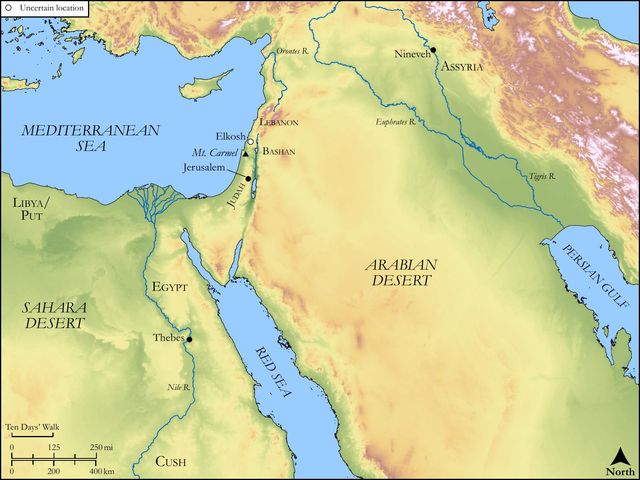
See on the biblical-era map
Study this verse
Public-domain commentary
Matthew Henry
From his Commentary on the Whole Bible. Henry comments on passages, not single verses — this entry covers Nahum 3:1–7. His three-level outline is real structure in the source text, so it is rendered as structure.
Here is, I. Nineveh arraigned and indicted. It is a high charge that is here drawn up against that great city, and neither her numbers nor her grandeur shall secure her from prosecution. 1. It is a city of blood, in which a great deal of innocent blood is shed by unrighteous war, or under colour and pretence of public justice, or by suffering barbarous murders to go unpunished; for this the righteous God will make inquisition. 2. It is all full of lies; truth is banished from among them; there is no such thing as honesty; one knows not whom to believe nor whom to trust. 3. It is all full of robbery and rapine; no man cares what mischief he does, nor to whom he does it: The prey departs not, that is, they never know when they have got enough by spoil and oppression. They shed blood, and told lies, in pursuit of the prey, that they might enrich themselves. 4. There is a multitude of whoredoms in it, that is, idolatries, spiritual whoredoms, by which she defiled herself, and to which she seduced the neighbouring nations, as a well-favoured harlot, and sold and ruined nations through her whoredoms. 5. She is a mistress of witchcrafts, and by them she sells families, Nah 3:4. That which Nineveh aimed at was a universal monarchy, to be the metropolis of the world, and to have all her neighbours under her feet; to compass this, she used not only arms, but arts, compelling some, deluding others, into subjection to her, and wheedling them as a harlot by her charms to lay their necks under her yoke, suggesting to them that it would be for their advantage. She courted them to join with her in her idolatrous rites, to tie them the faster to her interests, and made use of her wealth, power, and greatness, to draw people into alliances with her, by which she gained advantages over them, and made a hand of them. These were her whoredoms, like those of Tyre, Isa 23:15, Isa 23:17. These were her witchcrafts, with which she unaccountably gained dominion. And for this that God has a quarrel with her who, having made of one blood all nations of men, never designed one to be a nation of tyrants and another of slaves, and who claims it as his own prerogative to be universal Monarch.
II.Nineveh condemned to ruin upon this indictment. Woe to this bloody city! Nah 3:1. See what this woe is.
1.Nineveh had with her cruelties been a terror and destruction to others, and therefore destruction and terror shall be brought upon her. Those that are for overthrowing all that come in their way will, sooner or later, meet with their match.
(1.)Hear the alarm with which Nineveh shall be terrified, Nah 3:2. It is a formidable army that advances against it; you may hear them at a distance, the noise of the whip, driving the chariot-horses with fury; you may hear the noise of the rattling of the wheels, the prancing horses, and the jumping chariots; the very noise is frightful, but much more so when they know that all this force is coming with all this speed against them, and they are not able to make head against it.
(2.)See the slaughter with which Nineveh shall be laid waste (Nah 3:3), the sword drawn with which execution shall be done, the bright sword lifted up and the glittering spear, the dazzling brightness of which is very terrible to those whom they are lifted up against. See what havoc these make when they are commissioned to slay: There is a great number of carcases, for the slain of the land shall be many; there is no end of their corpses; there is such a multitude of slain that it is in vain to go about to take the number of them; they lie so thick that passengers are ready to stumble upon their corpses at every step. The destruction of Sennacherib's army, which, in the morning, were all dead corpses, is perhaps looked upon here as a figure of the like destruction that should afterwards be in Nineveh; for those that will not take warning by judgments at a distance shall have them come nearer.
2.Nineveh had with her whoredoms and witchcrafts drawn others to shameful wickedness, and therefore God will load her with shame and contempt (Nah 3:5-7): The Lord of hosts is against her, and then she shall be exposed to the highest degree of disgrace and ignominy, shall not only lose all her charms, but shall be made to appear very odious. When it shall be seen that while she courted her neighbours it was with design to ruin their liberty and property, when all her wicked artifices shall be brought to light, then her shame is discovered to the nations. When her proud pretensions are baffled, and her vain towering hopes of an absolute and universal dominion brought to nought, and she appears not to have been so strong and considerable as she would have been thought to be, then to see the nakedness of the land do they come, and it appears ridiculous. Then do they cast abominable filth upon her, as upon a carted strumpet, and make her vile as the offscouring of all things; that great city, which all nations had made court to and coveted an alliance with, has become a gazing-stock, a laughing stock. Those that formerly looked upon her, and fled to her, in hopes of protection from her, now look upon her and flee from her, for fear of being ruined with her. Note, Those that abuse their honour and interest will justly be disgraced and abandoned, and, because miserable, will be made contemptible, and thereby be made more miserable. When Nineveh is laid waste who will bemoan her? Her trouble will be so great, and her sense of it so deep, as not to admit relief from sympathy, or any comforting considerations; or, if it would, none shall do any such good office: When shall I seek comforters for thee? Note, Those that showed no pity in the day of their power can expect to find no pity in the day of their fall. When those about Nineveh, that had been deceived by her wiles, come to be undeceived in her ruin, every one shall insult over her, and none bemoan her. This was Nineveh's fate, when she was made a spectacle, or gazing-stock. Note, The greater men's show was in the day of their abused prosperity the greater will their shame be in the day of their deserved destruction. I will make thee an example; so Drusus reads it. Note, When proud sinners are humbled and brought down it is designed that others should take example by them not to lift up themselves in security and insolence when they prosper in the world.
Historical interpretation
Historical reception
1 surviving comment on this verse from the historical church.
(Chapter 3, verses 1 and following) Woe to the city of blood, full of deceit and torn apart. The plunder will not cease. The sound of the whip, the sound of the rattling wheel, the galloping horses and the blazing chariots, the ascending knight and the flashing sword, the gleaming spear and the multitude of the slain, and the weighty destruction. There is no end to the corpses. They will stumble over their own bodies because of the multitude of the prostitute's charming and enticing acts of fornication, and her sorceries which she sold to the nations through her acts of fornication, and her enchantments which she used to deceive the families. LXX: O city of blood, completely deceitful, full of wickedness, the hunting will not touch you: the sound of scourges, and the sound of turning wheels, and of pursuing horses, and of a blazing chariot, of a rider ascending, and a gleaming sword, and of shining armor, and of a multitude of wounded, and of a heavy downfall, and there will be no end to its nations, and they will be weakened in their bodies by the multitude of their fornication. A beautiful and pleasing harlot, leader of wickedness, who sells nations in her fornication, and tribes in her wickedness. Where we have been placed, full of laceration, is called Pherec Malea in Hebrew, which Aquila interpreted as 'full of decapitation', that is, full of excision. Symmachus, on the other hand, interpreted it as 'full of amputation', which we can say is full of cruelty or severity. In another edition of his work, I found 'full of dismemberment', that is, with the sections of flesh and pieces torn through the limbs: finally, he immediately added, where there is uninterrupted prey. The Hebrew scholar Pherec does not interpret it as 'exervicationem', which we find in the edition of Aquila, but as 'gubernaculum', that is, 'governance': to show that the city was royal, and as if it held the governance of all nations like a ship. Its power, that is, Nineveh, is described, and it is condemned under the lamentation of cruelty. Woe, city of blood, in which there is no truth, but all falsehood, full of plunder and tearing of prey. The voice of a cruel whip always and of a raging empire, and the voice of the wheel's momentum. Let us understand the voice as a sound: the roaring wheel, racing through different places, and the snorting horses, and the fiery chariot, are heard in all. However, the description of an army preparing for battle, so beautiful and resembling the Hebrew and the pictures, is worthy of all my speech being considered cheap. For what is said: And heavy is the downfall, and there is no end to the corpses, let us understand it as referring to the adversaries who were killed by them. And they will fall in their own bodies, or they will fall from their multitude, while they crowd themselves together: or they will fall on the corpses of the slain; for it signifies both their own and others'. Because of the multitude, he says, of the harlot's fornications: because she has fornicated with many nations and has cultivated idols of the whole world, which she had subjected to herself. It signifies the beautiful and pleasing, and those having evil deeds, the magicians: who have sold nations in their own fornications, and families in their own evil deeds, that is, those whom she had power over all nations. These things about Nineveh are said simply. But if we understand the name 'world' in a rational manner, because of its beauty, rightly the world, which is situated in evil, is called the city of blood because of the multitude of archers and those who kill people with their tongues like swords. Therefore, consequently, the whole world is a liar, which pertains to the perversity of teachings, not having the word of God, where it should find its foundation, when all perverse doctrines possess it. There is none that understandeth, or seeketh after God: they are all gone out of the way; they are together become unprofitable; there is none that doeth good, no, not one. (Psalm 14:2-3). Although these things are partly done even now, they will be more completely fulfilled in the end, when charity of many shall cool because of the multiplied iniquity. (Matthew 24). How many are caught by the giant Nimrod, the most cruel hunter, who, being proud against God, has ensnared many with the snare of his own vices, of whom many will not touch as prey or game. For he has many followers, and likewise hunters who delight in his hunt, and they stand around him like captives. But the sound of whips is also heard in the world, for there are many tribulations of the just (Psalms 33), to which those who are whipped cry out and testify to the magnitude of their pain with a mournful voice: when one is seized by a demon, another by anger, which is similar to madness, another by desire, hatred, envy, and pride, the whip of the king of Assyria sound in them. But even in bodily ailments, we understand the whip of the devil, concerning which it is said to the just: And the whip will not approach your tent (Ps. XC, 10); when we see this royal disease decay, and its corpse still remaining: one cut open from water, and the body floating while swollen, with the limbs growing, the form of the former man diminishing, which we recently saw in the dissecting room: him expelling certain purulences and the wounds suffered by the damaged lung: him experiencing the dryness of the moisture turned to stones, the bitterness of the urine, and the torments of the bladder, let us not hesitate to say that the voice of the whips is in Nineveh: although some suspect that these things happen either from the corrupted air or from the variety of food and bodies. Let us who read and tremble at the feverishness (Luke IV), and the woman who had been bound by the devil for eighteen years (Ibid., XIII), healed by the Lord, know that all these are scourges for Nineveh. Hence it follows: And the voice of the wheels; while here and there the human race is carried away, uncertainly wandering in all directions, where there is danger, where there is safety, we do not know; concerning which wheel it is also written at the beginning of Ezekiel (Ezek. I): in the seventy-sixth psalm we read: The voice of your thunder is in the wheel (Psalm LXXVI, 19). But Nineveh also has a pursuing horse, whose neighing and hooves digging into the ground and chest boiling, always desires war, while the Lord speaks against the devil. From afar, war can be smelled: it does not spare those who flee with a leap and a cry; it does not allow those who turn their backs to escape; but it pursues in order to overthrow, kill, trample, and crush them. There is also in Nineveh the sound of a steaming chariot, like I imagine Pharaoh had, which were submerged by the Lord (Exodus 14). To this team are harnessed four horses, namely the four disturbances, about which both philosophers argue and Virgil does not remain silent, saying (Virg., VI Aeneid.):
They desire, fear, grieve, and rejoice... With these horses and this chariot, he disturbs all of Nineveh. But also the voice of the mounting knight resounds in it, who, prepared by a certain skill and a circuit, advances to battle not without danger against the one fighting against himself. This knight has a sword of speech, sharpened with the blade of dialectic and smoothed with the oil of rhetorical art: he has shining weapons, Satan transforming himself into an angel of light (II Cor. XI), which are contrary to the arms of apostolic armor. It is not surprising if there is a multitude of wounded in Nineveh, since there is a multitude of arrows. And just as we have four shields with which we fight and protect ourselves, they are the virtues of wisdom, justice, temperance, and courage; similarly, there are four vices: foolishness, injustice, luxury, and fear, with which we are struck by the enemy. Each of these vices contains numerous kinds of arrows that cause wounds. If these wounds are not immediately healed by medicine, they become a heavy burden and, I wish, as heavy as they are in Nineveh, falling lightly and being lightly wounded, they are so great in their weight of ruin that they sink down to the depths of hell. And there is no end to their nations' groaning: their wickedness has no end. As there are so many forms of sins, there are as many nations as Nineveh, which will be weakened in their bodies by the multitude of fornication. Although it can also be understood about those who, due to sexual desires, are also weakened in their bodies, and with the destruction of their soul, they also break the flesh they serve: nevertheless, these nations, of which we have spoken, do not fall, according to the Hebrew, except in their bodies, and do not offend (as Symmachus interpreted) except in the corpses of the dead, which are laid low by the multiplication of fornication. In this place, the 70 interpreters, when we have followed the Hebrew, because of the multitude of the harlot's fornications, wanted there to be another beginning, so that they would say: Before the multitude of fornication; and up to this point is the end of the sentence, afterwards they would begin, a beautiful and pleasing harlot, leader of evils. Aquila and Symmachus translated leader of evils, having evils. And it will not be surprising if Nineveh is now the most pleasing of harlots, who has seen such a great multitude of people fornicate with her, and is almost able to lead everyone to love her through her evils and certain enchantments. These sell nations in their fornications, which take away the members of Christ, and make them the members of a harlot; and they delight in their evil deeds. For they make themselves love those that they ought to hate, and hate those that they ought to love, so that when they are deceived, according to what is written: 'Evil communications corrupt good manners' (1 Corinthians 15:33), they may also overthrow others by their wicked arts. I have read in the Holy Scriptures that even malefactors can be taken in a good sense: 'The wise malefactor enchants' (Psalm 57). But this sorcerer uses such incantations that he can bring back those captivated by the love of a harlot of Nineveh to their right mind.
Continue studying Nahum 3:4 across the web’s major study libraries — every link below opens this exact verse, chapter, or book on the destination site.
Read & Compare
 BibleGatewayThis verse in more than 200 translations and 70 languages.
 Bible.comThe YouVersion reader — hundreds of translations, reading plans, and highlights.
 ESV.orgCrossway's official English Standard Version reader.
 NET BibleThe NET translation with 60,000+ translators' notes on every rendering decision.
 STEP BibleTyndale House's free study tool — original text, vocabulary, and scholarly resources.
 BibliaLogos Bible Software's free web reader.
 USCCBThe New American Bible (Revised Edition) with the U.S. bishops' study notes.
Commentaries
 BibleHub CommentariesDozens of classic commentaries on this verse, gathered on one page.
 StudyLightMore than 100 commentary sets — the largest collection on the web.
 BibleRefPlain-English commentary on what this verse means, verse by verse.
 Enduring WordDavid Guzik's free commentary on this chapter, widely used by Bible teachers.
 Bible Study ToolsVerse commentary alongside Greek and Hebrew study aids.
Original Language & Research
- BibleHub InterlinearThe verse word by word — original language, transliteration, and English.
- BibleHub LexiconEvery word's original-language definition and Strong's entry.
 Blue Letter BibleDeep-study tools — Strong's numbers, concordance, and word studies.
 SefariaThe Hebrew text with Rashi and centuries of Jewish commentary.
Sermons, Hymns & Audio


TrulyRandomVerse is not affiliated with these sites and doesn’t control their content. They’re linked because they’re genuinely useful.
Summary
Nahum 3:4 delivers a scathing indictment against Nineveh, the capital of the Assyrian Empire, portraying it as a "wellfavoured harlot" and "mistress of witchcrafts." This verse vividly describes how Nineveh, through its deceptive allure, spiritual depravity, and manipulative political strategies, enslaved and exploited nations and families, ultimately incurring the righteous judgment of God due to its pervasive wickedness and oppressive practices.
Context
ShowHideLiterary Context
This verse is situated within the book of Nahum, a prophetic oracle almost entirely dedicated to announcing the complete and irreversible destruction of Nineveh. Unlike Nineveh's earlier repentance in the time of Jonah, Nahum's prophecy reveals a city that has returned to its former wickedness, demonstrating no lasting change of heart. Chapter 3, specifically, details the reasons for Nineveh's impending doom, opening with "Woe to the bloody city!" (Nahum 3:1). Verse 4 serves as a foundational explanation for this woe, attributing the city's downfall to its moral and spiritual corruption, particularly its "whoredoms" and "witchcrafts," which are then elaborated upon as instruments of its imperialistic conquest and exploitation. The subsequent verses continue to describe Nineveh's humiliation and desolation as a direct consequence of these actions.
Historical & Cultural Context
Nineveh was the formidable capital of the Neo-Assyrian Empire, a dominant power among the nations from the 9th to the 7th centuries BCE. The Assyrians were notorious for their military might, brutal conquests, and cruel treatment of conquered peoples, including mass deportations, torture, and public displays of severed heads. Their empire was built on a foundation of fear and exploitation. In the biblical context, "whoredom" (or harlotry) often extends beyond literal prostitution to signify spiritual unfaithfulness, idolatry, and treacherous political alliances with foreign powers, which were seen as a betrayal of the covenant with Yahweh. "Witchcrafts" or sorcery, prevalent among the nations, were associated with deceptive practices, manipulation, and seeking power through illicit spiritual means, often involving idolatrous rituals. Nahum's portrayal of Nineveh as a "wellfavoured harlot" speaks to its deceptive charm and apparent prosperity, which masked its inherent depravity and its use of cunning diplomacy, economic exploitation, and perhaps even literal occult practices to dominate and enslave other nations.
Key Themes
ShowHideNahum 3:4 contributes significantly to several major themes within the book and broader biblical theology. Firstly, it underscores the theme of Divine Judgment on Wickedness. God's righteous anger is directed against nations characterized by severe moral depravity, oppression, and spiritual corruption. Nineveh's persistent evil, as detailed in this verse, highlights the principle that unchecked wickedness will inevitably face divine retribution, demonstrating God's righteous judgment against all ungodliness. Secondly, the verse develops the theme of Spiritual Harlotry and Deception. The metaphor of the "wellfavoured harlot" signifies Nineveh's seductive political and spiritual influence. In prophetic literature, "whoredom" frequently denotes spiritual adultery and idolatry—unfaithfulness to God—and treacherous alliances. Nineveh, though not in covenant with God, is condemned for its pervasive spiritual darkness and deceptive practices that lured and then exploited other nations, a theme later echoed in the portrayal of Babylon in Revelation. Finally, the verse powerfully illustrates Exploitation and Oppression. The phrase "selleth nations through her whoredoms, and families through her witchcrafts" vividly depicts Nineveh's modus operandi. It used its allure, cunning, and manipulative tactics (political alliances, deceptive treaties, and perhaps literal sorcery or dark arts) to conquer, enslave, and dismantle entire societies, reflecting the Assyrian Empire's historical reputation for extreme brutality and forced relocation of conquered peoples.
Exposition and Analysis
ShowHideKey Word Analysis
ShowHideA primitive root meaning "to commit adultery," often of the female, and figuratively "to commit idolatry." In this context, it powerfully personifies Nineveh as morally corrupt and spiritually unfaithful, even though not in covenant with Yahweh. It emphasizes the city's treacherous and seductive nature in its dealings with other nations, akin to a prostitute who entices for gain.
A combination of H2896 (ṭôwb) "good, beautiful, pleasant" and H2580 (chên) "graciousness, favor, beauty." This phrase highlights Nineveh's outward appearance of splendor, power, and attractiveness. It suggests that the city presented itself as appealing and desirable, masking its true, destructive, and morally repugnant character. This beauty was a deceptive façade for its inherent evil.
Meaning "magic" or "sorcery." This term points to the deceptive and manipulative spiritual practices employed by Nineveh. It can refer to literal sorcery and enchantments, which were common among the nations, but also, more broadly, to cunning political schemes, manipulative diplomacy, and deceptive tactics that disarmed, entrapped, and exploited its victims. It underscores the spiritual darkness and illicit means by which Nineveh achieved its imperialistic aims.
Verse Breakdown
ShowHide"Because of the multitude of the whoredoms of the wellfavoured harlot,"
This opening clause immediately establishes the primary reason for Nineveh's impending judgment: its overwhelming and pervasive "whoredoms." The term "multitude" (H7230, rôb) emphasizes the sheer abundance and widespread nature of this corruption. By calling Nineveh a "wellfavoured harlot," the prophet personifies the city as a seductive, outwardly appealing, yet morally depraved entity. This harlotry signifies not just sexual immorality, but more profoundly, spiritual unfaithfulness, idolatry, and treacherous political alliances that betray trust and lead others astray for selfish gain. Nineveh's attractive facade (its wealth, power, and cultural influence) served as a lure for its destructive intentions.
"the mistress of witchcrafts,"
This phrase further defines the character of the "harlot," identifying her as one who masters and employs "witchcrafts" (H3785, kesheph). This suggests a deep involvement in deceptive, manipulative, and perhaps even occult practices. "Mistress" (H1172, baʻălâh) indicates a possessor or master, implying that Nineveh was not merely dabbling in such practices but was proficient and dominant in their application. These "witchcrafts" could range from literal sorcery to cunning political stratagems, psychological manipulation, and insidious propaganda designed to disarm and control other nations.
"that selleth nations through her whoredoms,"
Here, the destructive consequence of Nineveh's "whoredoms" is explicitly stated. The "harlot" "sells" (H4376, mâkar) nations, implying that through its seductive and treacherous policies, it effectively enslaved, subjugated, and profited from entire peoples. This "selling" speaks to economic exploitation, political subjugation, and the breaking down of national sovereignty, all achieved under the guise of alluring alliances or false promises. The "whoredoms" were the means by which Nineveh enticed and then exploited its victims, leading them into a state of bondage.
"and families through her witchcrafts."
This final clause reiterates and intensifies the accusation, showing the depth of Nineveh's destructive reach. Not only nations but even "families" (H4940, mishpâchâh), the fundamental units of society, were broken down and exploited through its "witchcrafts." This highlights the insidious and pervasive nature of Nineveh's evil, affecting individuals and the most intimate social structures. The "witchcrafts" here underscore the manipulative, deceptive, and spiritually dark means employed to achieve this profound level of societal destruction and enslavement.
Literary Devices
ShowHideNahum 3:4 is rich in literary devices that amplify its powerful message of indictment. The most prominent device is Personification, where the city of Nineveh is vividly portrayed as a "wellfavoured harlot" and "mistress of witchcrafts." This gives the abstract entity of the city human characteristics, making its moral depravity and deceptive nature more tangible and visceral. Closely related is the use of Metaphor, as "whoredoms" and "witchcrafts" are not merely literal acts but serve as powerful metaphors for Nineveh's spiritual idolatry, treacherous political alliances, and manipulative strategies. These terms encapsulate the city's pervasive moral corruption and its methods of imperialistic control. The phrase "multitude of the whoredoms" also employs Hyperbole, emphasizing the overwhelming and excessive nature of Nineveh's sin, suggesting a level of depravity that is beyond measure and fully warrants divine judgment. Together, these devices create a vivid, condemnatory image of Nineveh as a seductive yet utterly destructive force, whose beauty masks profound evil and whose cunning leads to the enslavement of others.
Theological and Thematic Connections
ShowHideNahum 3:4 stands as a profound theological statement on the nature of divine justice and the consequences of national sin. It asserts God's unwavering opposition to wickedness, particularly when it manifests as pervasive oppression, spiritual deception, and the exploitation of the vulnerable. The "whoredoms" and "witchcrafts" of Nineveh represent a deliberate turning away from truth and righteousness, embracing instead a path of self-exaltation and dominion achieved through illicit means. This verse underscores that no nation, however powerful or outwardly impressive, can escape God's scrutiny and ultimate judgment if its foundation is built upon injustice and spiritual depravity. It serves as a timeless warning that apparent success gained through deception and exploitation is ultimately fleeting and will be met with divine retribution, demonstrating God's sovereignty over all earthly powers and His commitment to justice for the oppressed.
This theme resonates throughout scripture:
Reflection and Application
ShowHideNahum 3:4 serves as a timeless and sobering warning for both nations and individuals in every era. It challenges us to look beyond superficial appearances and discern the true nature of power, influence, and prosperity. What seems "wellfavoured" on the surface—whether it be a charismatic leader, a booming economy, or a popular ideology—may conceal deep-seated corruption, manipulative intentions, and destructive practices. This verse calls us to be vigilant against systems and philosophies that promise allure or gain but are built on deception, exploitation, or spiritual darkness. It reminds us that God is a God of justice who sees the hidden "whoredoms" and "witchcrafts" that enslave and harm others, and He will ultimately hold all accountable. For believers, this means cultivating discernment, standing for truth and righteousness, and refusing to participate in or condone practices that exploit or deceive, knowing that true flourishing comes from integrity and faithfulness to God, not from cunning or oppression.
Questions for Reflection
ShowHideFAQ
ShowHideWhat does "whoredoms" mean in this context, and is it literal?
ShowHideWhile "whoredoms" (Hebrew: zânûwn) can refer to literal sexual immorality, in prophetic literature, especially when applied to cities or nations, it primarily signifies spiritual unfaithfulness, idolatry, and treacherous political alliances. Nineveh's "whoredoms" were its enticing yet destructive foreign policies, its pervasive idolatrous practices, and its willingness to betray trust and exploit others for imperialistic ambitions. It's a powerful metaphor for the city's moral and spiritual corruption, not necessarily a direct accusation of widespread literal prostitution, though such practices might have been present.
Was Nineveh literally involved in "witchcrafts," or is that also a metaphor?
ShowHideThe term "witchcrafts" (Hebrew: kesheph) refers to magic, sorcery, or enchantments. Among the nations, such practices were common, and it's plausible that Nineveh, like other pagan nations, engaged in literal sorcery or divination as part of its religious and political life. However, like "whoredoms," it also functions metaphorically. It describes Nineveh's cunning, manipulative, and deceptive strategies used to disarm, entrap, and control other nations. These "witchcrafts" were the insidious means by which Nineveh "selleth nations" and "families," reflecting a deep spiritual darkness and reliance on means contrary to God's truth.
How can a city be "wellfavoured" yet be a "harlot" and "mistress of witchcrafts"?
ShowHideThis highlights the deceptive nature of Nineveh. "Wellfavoured" (Hebrew: ṭôwb chên) speaks to its outward appearance of grandeur, power, wealth, and perhaps even cultural sophistication. Nineveh was indeed a magnificent city, a center of empire. However, this outward beauty and strength masked a rotten core of moral depravity, spiritual corruption, and ruthless exploitation. The prophet uses this contrast to expose the hypocrisy and danger of a nation that appears attractive but is fundamentally evil and destructive, luring others into its sphere only to dominate and oppress them. It's a warning that appearances can be deeply deceiving, and true character is revealed by actions and underlying spiritual condition.
Christ-Centered Fulfillment
ShowHideNahum 3:4, with its vivid portrayal of a seductive yet destructive power built on "whoredoms" and "witchcrafts," finds its ultimate antithesis and fulfillment in Jesus Christ. While Nineveh "selleth nations through her whoredoms, and families through her witchcrafts," Christ is the one who buys back and redeems nations and families, not through deception but through His atoning sacrifice. He is the Lamb of God who takes away the sin of the world, contrasting sharply with the harlot who traffics in sin. The "wellfavoured harlot" represents a false and destructive allure, whereas Christ is the true Bridegroom who lovingly gave Himself for the Church, His pure bride, to present her without stain or blemish Ephesians 5:25-27. He is the one who exposes the darkness and deception of the "prince of this world" John 12:31 and disarms the spiritual forces of wickedness through the power of the cross. In His kingdom, which is not of this world John 18:36-37, there is no "whoredom" or "witchcraft," but truth, righteousness, and genuine freedom. Ultimately, Nineveh's judgment foreshadows Christ's ultimate victory over all powers of darkness and deception, as He is the one who makes all things new.