


Ezekiel 16:25
Bible text: King James Version (1769 Blayney text) · Public domain
Bible text: King James Version with Strong's numbers · Public domain
Bible text: Berean Standard Bible · Public domain
Bible text: American Standard Version (1901) · Public domain
Bible text: World English Bible, Messianic edition · Public domain
Bible text: Geneva Bible (1599) · Public domain
Bible text: Young's Literal Translation · Public domain
- אֶל'eltoH413PrepPreposition
- כָּלkoleveryH3605N-mscNoun Singular Masculine Construct
- רֹאשׁroshhead ofH7218N-mscNoun Singular Masculine Construct
- דֶּרֶךְDe·rekha roadH1870N-csNoun Singular common gender Absolute
- בָּנִיתba·Nityou builtH1129V-Qal-Perf-2fsVerb Qal Perfect 2nd Singular Feminine
- רָמָתֵךְra·ma·Tekhyour high placeH7413N-fsc ¦ 2fsNoun Singular Feminine Constructרָמָתֵhigh placeךְyour
- וַתְּתַעֲבִיva·te·ta·'a·Viand you made abominableH8581Conj-w ¦ V-Piel-ConsecImperf-2fsVerb Piel Consecutive Imperfect 2nd Singular Feminineוַandתְּתַעֲבִיyou made abominable
- אֶת'et<obj.>H853DirObjMParticle Object Indicator
- יָפְיֵךְya·fe·Yekhyour beautyH3308N-msc ¦ 2fsNoun Singular Masculine Constructיָפְיֵbeautyךְyour
- וַתְּפַשְּׂקִיva·te·fa·se·Kiand you opened wideH6589Conj-w ¦ V-Piel-ConsecImperf-2fsVerb Piel Consecutive Imperfect 2nd Singular Feminineוַandתְּפַשְּׂקִיyou opened wide
- אֶת'et<obj.>H853DirObjMParticle Object Indicator
- רַגְלַיִךְrag·La·yikhyour feetH7272N-fdc ¦ 2fsNoun Dual Feminine Constructרַגְלַיִfeetךְyour
- לְכָלle·kholfor everyH3605Prep-l ¦ N-msNoun Singular Masculine Absoluteלְforכָלevery
- עוֹבֵרo·Ver[one who] passed byH5674V-Qal-Prtcpl-msVerb Qal Participle Singular Masculine Absolute
- וַתַּרְבִּיva·tar·Biand you increasedH7235Conj-w ¦ V-Hiphil-ConsecImperf-2fsVerb Hiphil Consecutive Imperfect 2nd Singular Feminineוַandתַּרְבִּיyou increased
- אֶת'et<obj.>H853DirObjMParticle Object Indicator
- תַּזְנוּתָיִךְtaz·nu·tekhyour prostitution<s>H8457N-mpc ¦ 2fsNoun Plural Masculine Constructתַּזְנוּתָיִprostitution<s>ךְyour
English is a literal word-by-word gloss of the Hebrew, not the KJV's wording. Why?
This is the original text the KJV's translators worked from — each Hebrew word with its own literal English meaning in this verse, prepared by scholars at Tyndale House, Cambridge. The KJV translates whole sentences, not word by word, so its wording differs: one Hebrew word can become several English words, and the KJV may choose “the LORD” where the gloss reads “Yahweh”. Both are faithful — they answer different questions. For the KJV's own rendering, switch to the KJV text.
Details
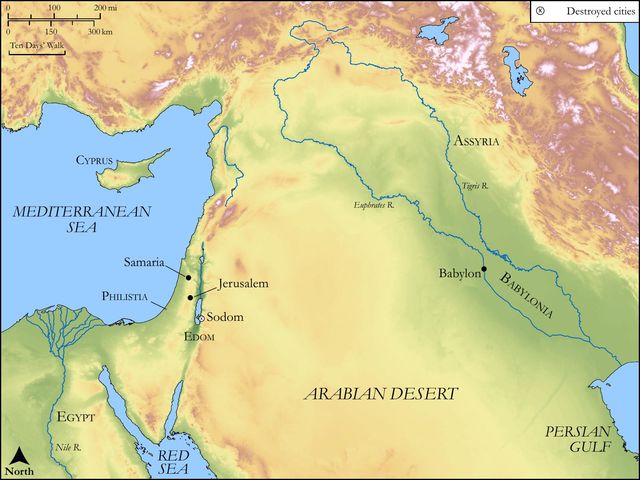
See on the biblical-era map
Study this verse
Public-domain commentary
Matthew Henry
From his Commentary on the Whole Bible. Henry comments on passages, not single verses — this entry covers Ezekiel 16:15–34. His three-level outline is real structure in the source text, so it is rendered as structure.
In these verses we have an account of the great wickedness of the people of Israel, especially in worshipping idols, notwithstanding the great favours that God had conferred upon them, by which, one would think, they should have been for ever engaged to him. This wickedness of theirs is here represented by the lewd and scandalous conversation of that beautiful maid which was rescued from ruin, brought up and well provided for by a kind friend and benefactor, that had been in all respects as a father and a husband to her. Their idolatry was the great provoking sin that they were guilty of; it began in the latter end of Solomon's time (for from Samuel's till then I do not remember that we read any thing of it), and thenceforward continued more or less the crying sin of that nation till the captivity; and, though it now and then met with some check from the reforming kings, yet it was never totally suppressed, and for the most part appeared to a high degree impudent and barefaced. They not only worshipped the true God by images, as the ten tribes by the calves at Dan and Bethel, but they worshipped false gods, Baal and Moloch, and all the senseless rabble of the pagan deities.
This is that which is here all along represented (as often elsewhere) under the similitude of whoredom and adultery, 1. Because it is the violation of a marriage-covenant with God, forsaking him and embracing the bosom of a stranger; it is giving that affection and that service to his rivals which are due to him alone. 2. Because it is the corrupting and defiling of the mind, and the enslaving of the spiritual part of the man, and subjecting it to the power and dominion of sense, as whoredom is. 3. Because it debauches the conscience, sears and hardens it; and those who by their idolatries dishonour the divine nature, and change the truth of God into a lie and his glory into shame, God justly punishes by giving them over to a reprobate mind, to dishonour the human nature with vile affections, Rom 1:23, etc. It is a besotting bewitching sin; and, when men are given up to it, they seldom recover themselves out of the snare. 4. Because it is a shameful scandalous sin for those that have joined themselves to the Lord to join themselves to an idol. Now observe here,
I.What were the causes of this sin.
How came the people of God to be drawn away to the service of idols? How came a virgin so well taught, so well educated, to be debauched? Who would have thought it? But, 1. They grew proud (Eze 16:15): "Thou trustedst to thy beauty, and didst expect that that should make thee an interest, and didst play the harlot because of thy renown." They thought, because they were so complimented and admired by their neighbours, that, further to ingratiate themselves with them and return their compliments, they must join with them in their worship and conform to their usages. Solomon admitted idolatry, to gratify his wives and their relations. Note, Abundance of young people are ruined by pride and particularly pride in their beauty. Rara est concordia formae atque pudicitiae - Beauty and chastity are seldom associated 2. They forgot their beginning (Eze 16:22) "Thou hast not remembered the days of thy youth, how poor, and mean, and despicable thou wast, and what great things God did for thee and what lasting obligations he laid upon thee thereby." Note, It should be an effectual check to our pride and sensuality to consider what we are and how much we are beholden to the free grace of God. 3. They were weak in understanding and in resolution (Eze 16:30): How weak is thy heart, seeing thou dost all these things. Note, The strength of men's lusts is an evidence of the weakness of their hearts; they have no acquaintance with themselves, nor government of themselves. She is weak, and yet an imperious whorish woman. Note, Those that are most foolish are commonly most imperious, and think themselves fit to manage others when they are far from being able to manage themselves.
II.What were the particulars of it.
1.They worshipped all the idols that came in their way, all that they were ever courted to the worship of; they were at the beck of all their neighbours (Eze 16:15): Thou pouredst out thy fornications on every one that passed by; his it was. They were ready to close with every temptation of this kind, though ever so absurd. No foreign idol could be imported, no new god invented, but they were ready to catch at it, as a common trumpet that prostitutes herself to all comers and multiplies her whoredoms, Eze 16:25. Thus some common drunkards will be company for every one that puts up the finger to them; how weak are the hearts of such!
2.They adorned their idol-temples, and groves, and high places, with the fine rich clothing that God had given them (Eze 16:16, Eze 16:18): Thou deckedst thy high places with divers colours, with the coats of divers colours, like Joseph's, which God had given them as particular marks of his favour, and hast played the harlot (that is, worshipped idols) thereupon. Of this he saith, "The like things shall not come, neither shall it be so; that is, this is a thing by no means to be suffered; I will never endure such practices as these without showing my resentments." 3. They made images for worship of the jewels which God had given them (Eze 16:17): The jewels of my gold and my silver which I had given thee. Note, It is God that gives us our gold and silver; the products of trade, of art and industry, are the gifts of God's providence to us, as well as the fruits of the earth. And what God gives us the use of he still retains a property in. "It is my silver and my gold, though I have given it to thee." It is his still, so that we ought to serve and honour him with it, and are accountable to him for the disposal of it. Every penny has God's image upon it as well as Caesar's. Should we make our silver and gold, our plate, money, and jewels, the matter of our pride and contention, our covetousness and prodigality, if we duly considered that they were God's silver and his gold? The Israelites began betimes to turn their jewels into idols, when Aaron made the golden calf of their earrings. 4. They served their idols with the good things which God gave them for their own use and to serve him with (Eze 16:18): "Thou hast set my oil and my incense before the, upon their altars, as perfumes to these dunghill-deities; my meat, and fine flour, and oil, and that honey which Canaan flowed with, and wherewith I fed thee, thou hast regaled them and their hungry priests with, hast made an offering of it to them for a sweet savour, to purify them, and procure acceptance with them: and thus it was, saith the Lord God; it is too plain to be denied, too bad to be excused. These things thou hast done. He that knows all things knows it." See how fond they were of their idols, that they would part with that which was given them for the necessary subsistence of themselves and their families to honour them with, which may shame our niggardliness and strait-handedness in the service of the true and living God. 5. They had sacrificed their children to their idols. This is insisted upon here, and often elsewhere, as one of the worst instances of their idolatry, as indeed there was none in which the devil triumphed so much over the children of men, both their natural reason and their natural affection, as in this (see Jer 7:31; Jer 19:5; Jer 32:35): Thou hast taken thy sons and thy daughters, and not only made them to pass through the fire, or between two fires, in token of their being dedicated to Moloch, but thou hast sacrificed them to be devoured, Eze 16:20. Never was there such an instance of the degenerating of the paternal authority into the most barbarous tyranny as this was. Yet that was not the worst of it: it was an irreparable wrong to God himself, who challenged a special property in their children more than in their gold and silver and their meat: They are my children (Eze 16:21), the sons and daughters which thou hast borne unto me, Eze 16:20. He is the Father of spirits, and rational souls are in a particular manner his; and therefore the taking away of life, human life, unjustly, is a high affront to the God of life. But the children of Israelites were his by a further right; they were the children of the covenant, born in God's house. He had said to Abraham, I will be a God to thee and to thy seed; they had the seal of the covenant in their flesh from eight days old; they were to bear God's name, and keep up his church; to murder them was in the highest degree inhuman, but to murder them in honour of an idol was in the highest degree impious. One cannot think of it without the utmost indignation: to see the pitiless hands of the parents shedding the guiltless blood of their own children, and by offering those pieces of themselves to the devil for buying sacrifices openly avowing the offering up of themselves to him for living sacrifices! How absurd was this, that the children which were born to God should be sacrificed to devils! Note, The children of parents that are members of the visible church are to be looked upon as born unto God, and his children,; as such, and under that character, we are to love them, and pray for them, bring them up for him, and, if he calls for them, cheerfully part with them to him; for may he not do what he will with his own? Upon this instance of their idolatry, which indeed ought not to pass without a particular brand, this remark is made (Eze 16:20), Is this of thy whoredoms a small matter? which intimates that there were those who made a small matter of it, and turned it into a jest. Note, There is no sin so heinous, so apparently heinous, which men of profligate consciences will not make a mock at. But is whoredom, is spiritual whoredom, a small matter? Is it a small matter for men to make their children brutes and the devil their god? It will be a great matter shortly. 6. They built temples in honour of their idols, that others might be invited to resort thither and join with them in the worship of their idols: "After all thy wickedness of this kind committed in private, for which, woe, woe, unto thee" (that comes in in a sad parenthesis, denoting those to be in a woeful condition who are going on in sin, and giving them warning in time, if they would but take it), "thou hast at length arrived at such a pitch of impudence as to proclaim it; thou hast long had a whore's heart, but now thou hast come to have a whore's forehead, and canst not blush," Eze 16:23-35. Thou hast built there an eminent place, a brothel-house (so the margin reads it), and such their idol temples were. Thou hast made for thyself a high place, for one idol or other, in every street, and at every head of the way; and again Eze 16:31. They did all they could to seduce and debauch others, and to spread the contagion, by making the temptations to idolatry as strong as possibly they could; and hereby the ringleaders in idolatry did but make themselves vile, and even those that had courted them to it, finding themselves outdone by them, began to be surfeited with the abundance and violence of their idolatries: Thou hast made thy beauty to be abhorred, even by those that had admired it. The Jewish nation, by leaving their own God, and doting on the gods of the nations round about them, had made themselves mean and despicable in the eyes even of their heathen neighbours; much more was their beauty abhorred by all that were wise and good, and had any concern for the honour of God and religion. Note, Those shame themselves that bring a reproach on their profession. And justly will that beauty, that excellency, at length be made the object of the loathing of others which men have made the matter of their own pride.
III.What were the aggravations of this sin.
1.They were fond of the idols of those nations which had been their oppressors and persecutors. As,
(1.)The Egyptians. They were a people notorious for idolatry, and for the most sottish senseless idolatries; they had of old abused Israel by their barbarous dealings, and of late by their treacherous dealings - were always either cruel or false to them; and yet so infatuated were they that they committed fornication with the Egyptians their neighbours, not only by joining with them in their idolatries, but by entering into leagues and alliances with them, and depending upon them for help in their straits, which was an adulterous departure from God.
(2.)The Assyrians. They had also been vexatious to Israel: "And yet thou hast played the whore with them (Eze 16:28); though they lived at a greater distance, yet thou hast entertained their idols and their superstitious usages, and so hast multiplied thy fornications unto Chaldea, hast borrowed images of gods, patterns of altars, rites of sacrificing, and one foolery or other of that kind, from that remote country, that enemy's country, and hast imported them into the land of Canaan, enfranchised and established them there." Thus Mr. George Herbert long since foretold, or feared at least,
That Seine shall swallow Tiber, and the Thames
By letting in them both pollute her streams.
2.They had been under the rebukes of Providence for their sins, and yet they persisted in them (Eze 16:27): I have stretched out my hand over thee, to threaten and frighten thee. So God did before he laid his hand upon them to ruin and destroy them; and that is his usual method, to try to bring men to repentance first by less judgments. He did so here. Before he brought such a famine upon them as broke the staff of bread he diminished their ordinary food, but them short before he cut them off. When the overplus is abused, it is just with God to diminish that which is for necessity. Before he delivered them to the Chaldeans to be destroyed he delivered them to the daughters of the Philistines to be ridiculed for their idolatries; for they hated them, and, though they were idolaters themselves, yet were ashamed of the lewd way of the Israelites, who had grown more profane in their idolatries than any of their neighbours, who changed their gods, whereas other nations did not change theirs, Jer 2:10, Jer 2:11. For this they were justly chastised by the Philistines. Or it may refer to the inroads which the Philistines made upon the south of Judah in the reign of Ahaz, by which it was weakened and impoverished, and which was the beginning of sorrows to them (Ch2 28:18); but they did not take warning by those judgments, and therefore were justly abandoned to ruin at last. Note, In the account which impenitent sinners shall be called to they will be told not only of the mercies for which they have been ungrateful, but of the afflictions under which they have been incorrigible, Amo 4:11.
3.They were insatiable in their spiritual whoredom: Thou couldst not be satisfied, Eze 16:28 and again Eze 16:29. When they had multiplied their idols and superstitious usages beyond measure, yet still they were enquiring after new gods and new fashions in worship. Those that in sincerity join themselves to the true God find enough in him for their satisfaction; and, though they still desire more of God, yet they never desire more than God. But those that forsake this living fountain for broken cisterns will find themselves soon surfeited, but never satisfied; they have soon enough of the gods they have, and are still enquiring after more.
4.They were at great expense with their idolatry, and laid out a great deal of wealth in purchasing patterns of images and altars, and hiring priests to attend upon them from other countries. Harlots generally had their hire; but this impudent adulteress, instead of being hired to serve idols, hired idols to protect her and accept her homage. This is much insisted on, Eze 16:31-34. "In this respect the contrary is in thee from other women in thy whoredoms: others are courted, but thou makest court to those that do not follow thee, art fond of making leagues and alliances with those heathen nations that despise thee; others have gifts given them, but thou givest thy gifts, the gifts which God had graciously given thee, to thy idols; herein thou art like a wife that commits adultery, not for gain, as harlots do, but entirely for the sin's sake." Note, Spiritual lusts, those of the mind, such as theirs after idols were, are often as strong and impetuous as any carnal lusts are. And it is a great aggravation of sin when men are their own tempters, and, instead of proposing to themselves any worldly advantage by their sin, are at great expense with it; such are transgressors without cause (Psa 25:3), wicked transgressors indeed.
And now is not Jerusalem in all this made to know her abominations? For what greater abominations could she be guilty of than these? Here we may see with wonder and horror what the corrupt nature of men is when God leaves them to themselves, yea, though they have the greatest advantages to be better and do better. And the way of sin is down-hill. Nitimur in vetitum - We incline to what is forbidden.
Historical interpretation
Two Centuries of Reception
6 surviving comments on this verse. Each one is dated, so this reads as a timeline rather than a list.
Select a marker to jump to its quote. Markers stagger vertically where authors wrote within a few decades of each other.
Possessing these things, she is of great beauty, but she is corrupted by the divisions of heretics and foreign religious systems.
What then has persuaded you to contradict each other and to procure to yourselves so great a disgrace? You cannot give any good account of it; this supposition only remains, that all you do is but outward profession and pretense.… And you make nothing of accusing the Fathers, and you complain outright of the expressions as being unscriptural; and, as it is written, “opened your legs to every one that passed by;” so as to change as often as they wish, in whose pay and keep you are. Yet, though a person uses terms not in Scripture, it makes no difference, so that his meaning is religious. But the heretic, though he uses scriptural terms, because he is equally dangerous and depraved, will be asked in the words of the Spirit, “Why do you preach my laws and take my covenant in your mouth?”
She will sit by the waters of loneliness, her pitcher laid aside, and open her legs to every one who passes by and be polluted to the crown of her head. It would have been better for her to have submitted to the yoke of marriage, to have walked in level places, than to aspire to loftier heights and fall into the depths of hell.
A noble alternative only to be embraced in preference to Satan! In the old days even Jerusalem went whoring and opened her legs to everyone that passed by. It was in Egypt that she was first deflowered and there that her teats were bruised.
(Verse 23 and following) And it came to pass after all your wickedness: woe, woe to you, says the Lord God. And you built yourself a brothel, and made for yourself a prostitute in all the streets. At every head of the road you built a sign of your prostitution, and you made your abominable beauty, and you spread your feet to everyone passing by, and multiplied your fornications. And you fornicated with the sons of Egypt, your neighbors with great flesh, and you multiplied your fornication to provoke me. LXX: And it came to pass after all your evils, woe, woe to you, says the Lord God. And you built for yourself a dwelling of prostitution, and you made for yourself prostitution in every street. And in the beginning of every way you built your prostitution: and you corrupted your beauty, and spread your legs to every passerby, and multiplied your prostitution: and you committed adultery with the sons of Egypt your neighbors, who are of great flesh, and you committed adultery in many ways, to provoke me to anger. What is said second, woe to you, the Vulgate edition does not have, but it has been added from the edition of Theodotion. And again, where we said: And you built for yourself a brothel, which the Seventy translated as: And you built for yourself a dwelling place of fornication, Symmachus and Theodotion interpreted as πορνεῖον; Aquila, wishing to express the etymology of the Hebrew word Gob (), put βάθυνον, which we can say means pit: to indicate a foul and deep den where the lust of prostitutes dwells. And what follows: And you have made for yourself a brothel in every street, for which Seventy translated ἔκθεμα, in Hebrew it is called Rama: and both Aquila and Symmachus and Theodotio have interpreted it as high or lofty. Finally, in the following passages, where it is written: To every head of the road you have erected a sign of your prostitution, as a sign and fornication, again in Hebrew it is called Rama (), which we have interpreted as either brothel or sign, since among the Hebrews it is one word. However, this is stated because it is lofty; so that for those who desire to fornicate, the place of fornication may be far away and there is no need to search for it. What we have said once and again and again, let it suffice to have said it forever, that under the guise of a woman, after many benefits from her husband, describing the fornication of Jerusalem, how she has departed from God and joined with idols, and was not satisfied with hidden fornication; but rather built herself a brothel and placed a sign on every street for those passing by, so they would come to the prostitute and satisfy their lust, not only their own, but also the one who has spread her legs for every passerby, and has defiled the greatness of beauty with the greatness of fornication: and among other things, she has also been bowing down to the Egyptians, her neighbors, in a love of great flesh. And in order to demonstrate every kind of ugliness, it was deformed by various forms of filth. But there is no doubt that Palestine is near Egypt, as the Lord said to Abraham: I will give you all the land from the river of Egypt to the great river Euphrates (Gen. XV, 18), so that on one side it includes the Egyptians, and on the other side it includes the Assyrians, with whom it is said to have committed fornication in later times. But the fornication of Jerusalem with the Egyptians is an imitation of their idolatry. But against our Jerusalem, whether the Church or the souls of the believers, if they are negligent and exposed to all vices, a double curse is pronounced, so that they may hear: Woe, woe to you, says the Lord God, according to what is written in the Apocalypse of John: Woe to all the inhabitants of the earth (Apoc. 8:13). For if the holy one says: I am a stranger and a sojourner like all my fathers (Psalm 38:13): why is it not said that the sinner is an inhabitant of the earth? However, he builds for himself a brothel, who sins with complete freedom of the forehead; according to what is written: When the sinner comes into the depths of wickedness, he despises (Prov. XVIII, 3). And he constructs the highest place in all the streets: For wide and spacious is the way that leads to death. And at every head of the street he builds; so that he leaves behind no types of sins; but imitating the prostitute of Proverbs, he openly invites foolish young men into his embraces in the streets and in the corners of the streets, and pollutes the beauty of their souls, which they obtained as a benefit from God the creator (Prov. V and VII). And all his journeys are full of filthiness, and he opens his heart to all thoughts that supply the incentives of vices, and he spreads his legs and fornicates with his Egyptian neighbors, whose examples he follows, namely the pagans, who glory in their filthiness, and it is so wicked that it even surpasses them in filthiness. And he does all these things to provoke God to anger. Moreover, the Egyptians are said to have large genitals, either because of the magnitude of their filthiness or because of the deformity of their sins. Wherefore the saint says, 'The flesh of little children, which daily decreases in it, and is attenuated by virtues, so that it is not called flesh, but spirit, and speaks in the psalm: My soul has thirsted for you, O God, how many ways does my flesh long for you (Psalm 62:2): or (as some copies have) how my flesh has been consumed: in a desert and impassable and waterless land, I have appeared to you in the saint (1 Corinthians 5).' Therefore, the Corinthian fornicator is condemned to the destruction of the flesh, so that the spirit may be saved. Concerning this flesh, it is written: All flesh is grass, and all its glory is like the flower of the field. The grass withers, and the flower falls, but the word of the Lord remains forever (Isa. XL, 6, 7). The Apostle also spoke about this: Flesh and blood cannot inherit the kingdom of God (I Cor. XV, 50). And in Genesis, God speaks: My spirit shall not abide in man forever, for he is flesh (Gen. VI, 3). And it is said to the believers: Those who are in the flesh cannot please God. But you are not in the flesh, but in the spirit (Romans VIII, 8, 9). But there is another flesh of the saints, of which it is written: All flesh shall see the salvation of God (Isaiah XL, 5).
Our Zion, in which at times there are Philistines and Tyre and Ethiopia; that watchtower, that meretrix, that harlot, that Rahab, that Babylon, that one who, according to Ezekiel, has prostituted herself to everyone on the crossroads; that meretrix, if she wills it, suddenly becomes a virgin. A virgin she becomes, conceives the Son of God and brings him forth. “From your fear, O Lord, we conceived and suffered the pangs of childbirth, bringing forth the spirit of your salvation on the earth.” Understand, therefore, that [Jerusalem], who was a prostitute, conceives of God and is in labor and brings forth the Savior.
Continue studying Ezekiel 16:25 across the web’s major study libraries — every link below opens this exact verse, chapter, or book on the destination site.
Read & Compare
 BibleGatewayThis verse in more than 200 translations and 70 languages.
 Bible.comThe YouVersion reader — hundreds of translations, reading plans, and highlights.
 ESV.orgCrossway's official English Standard Version reader.
 NET BibleThe NET translation with 60,000+ translators' notes on every rendering decision.
 STEP BibleTyndale House's free study tool — original text, vocabulary, and scholarly resources.
 BibliaLogos Bible Software's free web reader.
 USCCBThe New American Bible (Revised Edition) with the U.S. bishops' study notes.
Commentaries
 BibleHub CommentariesDozens of classic commentaries on this verse, gathered on one page.
 StudyLightMore than 100 commentary sets — the largest collection on the web.
 BibleRefPlain-English commentary on what this verse means, verse by verse.
 Enduring WordDavid Guzik's free commentary on this chapter, widely used by Bible teachers.
 Bible Study ToolsVerse commentary alongside Greek and Hebrew study aids.
Original Language & Research
- BibleHub InterlinearThe verse word by word — original language, transliteration, and English.
- BibleHub LexiconEvery word's original-language definition and Strong's entry.
 Blue Letter BibleDeep-study tools — Strong's numbers, concordance, and word studies.
 SefariaThe Hebrew text with Rashi and centuries of Jewish commentary.
Sermons, Hymns & Audio


TrulyRandomVerse is not affiliated with these sites and doesn’t control their content. They’re linked because they’re genuinely useful.
Summary
Ezekiel 16:25 delivers a searing indictment of Jerusalem's profound spiritual apostasy, employing the graphic metaphor of a harlot. The verse condemns the city for its widespread and brazen idolatry, symbolized by the construction of "high places" at every public intersection. This overt unfaithfulness defiled Jerusalem's divinely bestowed beauty and led to open engagement in spiritual promiscuity with foreign gods and nations. The multiplication of "whoredoms" underscores the depth of its betrayal against the sacred covenant relationship with God, who had nurtured and adorned it from its humble beginnings.
Context
ShowHideLiterary Context
Ezekiel 16 unfolds as an extended, powerful allegory, meticulously tracing Jerusalem's history from its abandoned infancy to its eventual, catastrophic betrayal of God. The chapter commences with a poignant depiction of God's compassionate rescue, lavish provision, and covenantal betrothal to Jerusalem, likening her to a beloved and beautiful bride (verses 1-14). However, as Jerusalem prospered and grew proud, she turned away from God, prostituting herself to foreign idols and nations. Verse 25 serves as a specific and damning indictment within this escalating narrative of unfaithfulness, following descriptions of God's immense grace and setting the stage for the severe judgment that their actions warrant, as seen in the declaration of God's fury and jealousy in Ezekiel 16:38. This verse particularly emphasizes the public, pervasive, and unashamed nature of Jerusalem's spiritual harlotry, moving beyond secret dalliances to open, widespread rebellion against her divine Husband.
Historical & Cultural Context
The historical backdrop for Ezekiel 16 is the tumultuous period leading up to and during the Babylonian exile (6th century BCE), a time when the kingdom of Judah had repeatedly abandoned its covenant with Yahweh to worship the deities of surrounding nations. "High places" (Hebrew: bamah) were elevated altars or shrines, intrinsically linked with Canaanite fertility cults and other pagan worship practices, which Israel was explicitly commanded to destroy but instead adopted and proliferated. The phrase "at every head of the way" vividly illustrates that these idolatrous practices were not concealed but were public, pervasive, and easily accessible, mirroring the brazen conduct of a prostitute openly soliciting. Jerusalem's political alliances with powerful pagan empires like Egypt and Assyria, seeking security and prosperity from them rather than trusting in God's protection and provision, are consistently interpreted by the prophets as spiritual adultery—a profound betrayal of the exclusive covenant relationship. This verse powerfully encapsulates the deep syncretism and moral decay that characterized Judah's final decades before its destruction.
Key Themes
ShowHideThis verse profoundly contributes to several critical themes found throughout Ezekiel and the broader prophetic literature. Firstly, it starkly underscores the theme of Spiritual Adultery and Idolatry, portraying Jerusalem's deviation from its covenant with God as a profound act of unfaithfulness, where "whoredoms" symbolize the worship of foreign gods and reliance on pagan alliances rather than Yahweh. Secondly, it highlights Profound Ingratitude and Betrayal; despite being chosen, blessed, and adorned by God, as meticulously described in Ezekiel 16:10-14, Jerusalem engaged in actions that defiled its spiritual beauty and egregiously betrayed its divine spouse. Thirdly, the verse emphasizes Public Shame and Abhorrence, as by building "high places at every head of the way," Jerusalem made its sin overt and pervasive, transforming its God-given beauty into something utterly detestable in God's eyes. Finally, it speaks directly to Covenant Breaking, as the actions described are a direct and flagrant violation of the exclusive covenant relationship God established with Israel, particularly the first two commandments against having other gods and making idols, as found in Exodus 20:3-5. The vivid imagery of "opening thy feet" is also employed elsewhere to describe Israel's spiritual harlotry, such as in Jeremiah 3:2.
Exposition and Analysis
ShowHideKey Word Analysis
ShowHideFrom a root meaning "to be high," this term refers to an elevated place, specifically a cultic site often associated with idolatry. In the Old Testament, "high places" were illicit altars or shrines used for pagan worship, particularly of Baal and Asherah, which God commanded Israel to destroy. Their construction "at every head of the way" signifies the widespread, public, and pervasive nature of Jerusalem's idolatry, indicating a complete abandonment of exclusive devotion to Yahweh for syncretistic practices.
This word denotes physical attractiveness, splendor, or glory. In the context of Ezekiel 16, it refers to the spiritual glory, dignity, and adornment that God had graciously bestowed upon Jerusalem, making her a "perfect beauty" (Ezekiel 16:14). The phrase "made thy beauty to be abhorred" indicates that Jerusalem's actions of spiritual harlotry profoundly defiled this divine gift, transforming what was once pleasing and glorious in God's sight into something utterly detestable and abominable in His eyes.
Derived from the verb "to commit harlotry" (זָנָה, zanah), this noun literally means "fornication" or "prostitution." Throughout the prophetic books, it is consistently used metaphorically to describe Israel's spiritual unfaithfulness to God, specifically through idolatry (worship of other gods) and seeking alliances with pagan nations (relying on human strength and protection instead of divine providence). The multiplication of "whoredoms" signifies the escalating, pervasive, and unrestrained nature of Jerusalem's apostasy.
Verse Breakdown
ShowHide"Thou hast built thy high place at every head of the way"
This clause graphically describes the physical manifestation of Jerusalem's spiritual unfaithfulness. "High places" were centers of illicit, idolatrous worship, and their construction "at every head of the way" (i.e., at every street corner, intersection, or public thoroughfare) emphasizes the brazen, public, and pervasive nature of Jerusalem's idolatry. It signifies that idolatry was not a hidden sin but an overt, easily accessible, and widespread practice, akin to a prostitute openly soliciting clients in public spaces.
"and hast made thy beauty to be abhorred"
Jerusalem, once adorned by God with splendor, dignity, and covenant blessings (as elaborated in Ezekiel 16:10-14), had, through its actions of spiritual harlotry, rendered itself utterly repulsive and detestable to God. What was once beautiful, pure, and pleasing in His sight became an abomination, a source of profound disgust and loathing, due to its deep defilement through idolatry and unfaithfulness.
"and hast opened thy feet to every one that passed by"
This is a vivid and explicit idiom for the posture of a prostitute, indicating an eager, unrestrained, and indiscriminate readiness to engage in sexual activity. Metaphorically, it underscores Jerusalem's unrestrained and promiscuous pursuit of spiritual alliances with any "passing" pagan nation or idol. This demonstrates a complete lack of fidelity to Yahweh and an insatiable appetite for foreign gods and human security, abandoning divine trust for worldly enticements.
"and multiplied thy whoredoms"
This final clause summarizes the cumulative and escalating effect of Jerusalem's actions, emphasizing the sheer volume, increasing intensity, and pervasive nature of its spiritual unfaithfulness. It signifies not just isolated acts of idolatry but a continuous, escalating pattern of spiritual prostitution, demonstrating a deep-seated rebellion and a complete abandonment of its covenant obligations and exclusive devotion to God.
Literary Devices
ShowHideEzekiel 16:25 is exceptionally rich in literary devices that amplify its powerful and condemnatory message. The entire chapter functions as an extended Allegory, where the city of Jerusalem is personified as a woman, meticulously illustrating its history and relationship with God from abandonment to betrayal. Within this overarching allegory, Personification is central, as Jerusalem is consistently depicted with human attributes and actions, specifically those of a harlot. The verse employs strong and consistent Metaphor throughout: "high place" is a metaphor for illicit idolatrous worship sites, "beauty" represents God's bestowed glory, covenant blessings, and spiritual purity, and "whoredoms" is a pervasive metaphor for spiritual unfaithfulness, idolatry, and illicit political alliances. The phrase "opened thy feet" is a highly graphic and explicit Idiom that functions as a powerful metaphor for promiscuity and indiscriminate spiritual unfaithfulness. The use of "every head of the way" and "every one that passed by" employs Hyperbole to emphasize the extreme, pervasive, and indiscriminate nature of Jerusalem's spiritual harlotry. The verse is also characterized by vivid and often repulsive Imagery, evoking the public, brazen, and shameful actions of a prostitute, thereby conveying the depth of God's disgust and the profound defilement of His chosen people.
Theological and Thematic Connections
ShowHideEzekiel 16:25 stands as a stark theological statement on the nature of idolatry as spiritual adultery and the profound consequences of covenant unfaithfulness. It underscores God's absolute demand for exclusive devotion from His people, viewing any turning to other gods, reliance on human systems, or pursuit of worldly alliances as a betrayal of the sacred marriage covenant He initiated. The verse highlights the tragic transformation of God's chosen and adorned people into an object of abhorrence due to their persistent and blatant sin, revealing the unyielding holiness of God who cannot tolerate such defilement in His presence. It serves as a powerful reminder that true beauty, dignity, and purpose are found only in faithful, exclusive relationship with the divine spouse, Yahweh, and that spiritual compromise inevitably leads to degradation, shame, and divine judgment.
Reflection and Application
ShowHideEzekiel 16:25 offers a profound and challenging mirror for contemporary believers, urging us to deeply examine the nature of our own devotion and fidelity to God. While we may not literally build physical "high places" for pagan gods, the spiritual principle remains powerfully relevant: anything that takes priority over God in our lives, anything we trust in, seek fulfillment from, or derive our identity from more than Him, becomes a modern idol. This could manifest as the relentless pursuit of wealth, status, pleasure, self-validation through social media, or even an excessive reliance on human wisdom and strength rather than divine guidance and provision. The "opening of feet to every one that passed by" can symbolize our willingness to compromise our spiritual integrity, to embrace worldly values uncritically, or to seek fleeting satisfaction and security from sources outside of God's covenant love and truth. This passage calls us to a radical, exclusive, and unwavering devotion to Christ, reminding us that our spiritual beauty, dignity, and purpose are maintained only through faithfulness and purity in our relationship with Him. It challenges us to identify and dismantle any "high places" in our hearts and lives, guarding diligently against spiritual compromise that would render our God-given identity abhorrent in His holy sight.
Questions for Reflection
ShowHideFAQ
ShowHideWhat is the significance of "high places" in this context?
ShowHideIn Ezekiel 16:25, "high places" (Hebrew: râmâh) refer to elevated altars or shrines that were historically used for pagan worship, particularly of Canaanite deities like Baal and Asherah. While God commanded Israel to destroy these sites and their associated idolatry (e.g., Deuteronomy 12:2), they often adopted and incorporated such practices into their religious life, leading to syncretism. The phrase "at every head of the way" emphasizes that these idolatrous sites were not hidden but were constructed in public, prominent locations, signifying Jerusalem's blatant, widespread, and unashamed embrace of spiritual unfaithfulness. It illustrates a complete abandonment of exclusive devotion to Yahweh for open, pervasive syncretism.
How does "opened thy feet" relate to spiritual unfaithfulness?
ShowHideThe phrase "opened thy feet" (Hebrew: pâsaq regel) is a vivid and explicit idiom for the posture of a prostitute, indicating an eager, unrestrained, and indiscriminate readiness to engage in sexual activity. In the context of Ezekiel 16, it serves as a powerful and shocking metaphor for Jerusalem's spiritual unfaithfulness. It symbolizes the city's brazen, unrestrained, and promiscuous pursuit of foreign gods and alliances with pagan nations. Instead of trusting solely in God and remaining faithful to the covenant, Jerusalem eagerly "opened itself" to any "passing" idol or political power, betraying its sacred relationship with Yahweh. This graphic imagery is also used in other prophetic books, such as Jeremiah 3:2, to depict Israel's spiritual harlotry and unfaithfulness.
Christ-Centered Fulfillment
ShowHideEzekiel 16:25, with its graphic portrayal of Jerusalem's spiritual harlotry and God's profound abhorrence of it, finds its ultimate resolution and reversal in the person and work of Jesus Christ. While ancient Israel, symbolized by Jerusalem, proved utterly unfaithful to its covenant spouse, God, Jesus embodies the perfectly faithful Israelite, fulfilling all righteousness and maintaining unwavering, exclusive devotion to the Father (Philippians 2:8). He is the true Bridegroom who comes not to condemn the harlot but to redeem her. Through His atoning sacrifice on the cross, Christ takes upon Himself the "abhorred beauty" of humanity's sin and spiritual prostitution, cleansing us from our "whoredoms" and transforming us into a pure and spotless bride (Ephesians 5:25-27). The Church, as the Bride of Christ, is called to a radical, exclusive devotion to Him, a stark contrast to the unfaithfulness of ancient Jerusalem. Where Israel multiplied its whoredoms, Christ's grace multiplies mercy and forgiveness, enabling believers to live in faithful communion, betrothed to one husband, Christ. The future vision of the marriage supper of the Lamb celebrates this perfected union, where the redeemed bride, adorned in the righteousness of Christ, stands pure and beautiful before her faithful Groom, Jesus Christ, forever free from the stain and shame of spiritual harlotry.