


Nahum 3:5
Bible text: King James Version (1769 Blayney text) · Public domain
Bible text: King James Version with Strong's numbers · Public domain
Bible text: Berean Standard Bible · Public domain
Bible text: American Standard Version (1901) · Public domain
Bible text: World English Bible, Messianic edition · Public domain
Bible text: Geneva Bible (1599) · Public domain
Bible text: Young's Literal Translation · Public domain
- הִנְנִיhi·Nihere IH2005Prt ¦ 1csParticle InterjectionהִנְhereנִיI
- אֵלַיִךְ'e·La·yikh[am] against youH413Prep ¦ 2fsPrepositionאֵלַיִ[am] againstךְyou
- נְאֻםne·'Um[the] utterance ofH5002N-mscNoun Singular Masculine Construct
- יְהוָהYah·wehYahwehH3068N-properNoun Proper Title
- צְבָאוֹתtze·va·'otof hostsH6635N-fpNoun Plural Feminine Absolute
- וְגִלֵּיתִיve·gi·lei·Tiand I will uncoverH1540Conj-w ¦ V-Piel-ConsecPerf-1csVerb Piel Consecutive Perfect 1st Singular common genderוְandגִלֵּיתִיI will uncover
- שׁוּלַיִךְshu·La·yikhyour skirtsH7757N-mpc ¦ 2fsNoun Plural Masculine Constructשׁוּלַיִskirtsךְyour
- עַל'alonH5921PrepPreposition
- פָּנָיִךְpa·Na·yikhyour faceH6440N-mpc ¦ 2fsNoun Plural Masculine Constructפָּנָיִfaceךְyour
- וְהַרְאֵיתִיve·har·'ei·Tiand I will showH7200Conj-w ¦ V-Hiphil-ConsecPerf-1csVerb Hiphil Consecutive Perfect 1st Singular common genderוְandהַרְאֵיתִיI will show
- גוֹיִםgo·YimnationsH1471N-mpNoun Plural Masculine Absolute
- מַעְרֵךְma'·Rekhyour nakednessH4626N-msc ¦ 2fsNoun Singular Masculine Constructמַעְרֵnakednessךְyour
- וּמַמְלָכוֹתu·mam·la·Khotand kingdomsH4467Conj-w ¦ N-fpNoun Plural Feminine Absoluteוּandמַמְלָכוֹתkingdoms
- קְלוֹנֵךְke·lo·Nekhyour shameH7036N-msc ¦ 2fsNoun Singular Masculine Constructקְלוֹנֵshameךְyour
English is a literal word-by-word gloss of the Hebrew, not the KJV's wording. Why?
This is the original text the KJV's translators worked from — each Hebrew word with its own literal English meaning in this verse, prepared by scholars at Tyndale House, Cambridge. The KJV translates whole sentences, not word by word, so its wording differs: one Hebrew word can become several English words, and the KJV may choose “the LORD” where the gloss reads “Yahweh”. Both are faithful — they answer different questions. For the KJV's own rendering, switch to the KJV text.
Details
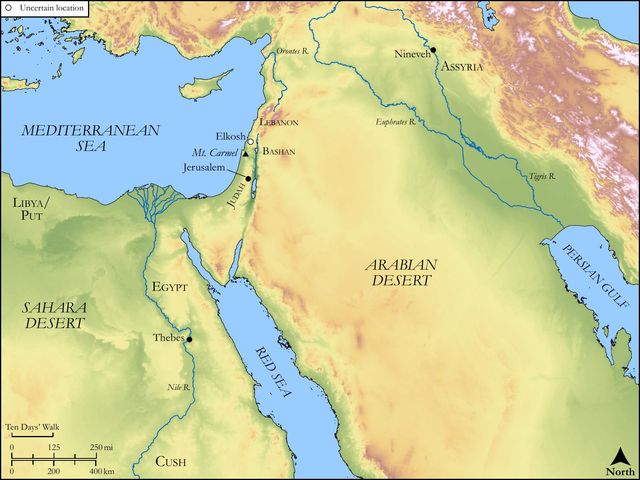
See on the biblical-era map
Study this verse
Public-domain commentary
Matthew Henry
From his Commentary on the Whole Bible. Henry comments on passages, not single verses — this entry covers Nahum 3:1–7. His three-level outline is real structure in the source text, so it is rendered as structure.
Here is, I. Nineveh arraigned and indicted. It is a high charge that is here drawn up against that great city, and neither her numbers nor her grandeur shall secure her from prosecution. 1. It is a city of blood, in which a great deal of innocent blood is shed by unrighteous war, or under colour and pretence of public justice, or by suffering barbarous murders to go unpunished; for this the righteous God will make inquisition. 2. It is all full of lies; truth is banished from among them; there is no such thing as honesty; one knows not whom to believe nor whom to trust. 3. It is all full of robbery and rapine; no man cares what mischief he does, nor to whom he does it: The prey departs not, that is, they never know when they have got enough by spoil and oppression. They shed blood, and told lies, in pursuit of the prey, that they might enrich themselves. 4. There is a multitude of whoredoms in it, that is, idolatries, spiritual whoredoms, by which she defiled herself, and to which she seduced the neighbouring nations, as a well-favoured harlot, and sold and ruined nations through her whoredoms. 5. She is a mistress of witchcrafts, and by them she sells families, Nah 3:4. That which Nineveh aimed at was a universal monarchy, to be the metropolis of the world, and to have all her neighbours under her feet; to compass this, she used not only arms, but arts, compelling some, deluding others, into subjection to her, and wheedling them as a harlot by her charms to lay their necks under her yoke, suggesting to them that it would be for their advantage. She courted them to join with her in her idolatrous rites, to tie them the faster to her interests, and made use of her wealth, power, and greatness, to draw people into alliances with her, by which she gained advantages over them, and made a hand of them. These were her whoredoms, like those of Tyre, Isa 23:15, Isa 23:17. These were her witchcrafts, with which she unaccountably gained dominion. And for this that God has a quarrel with her who, having made of one blood all nations of men, never designed one to be a nation of tyrants and another of slaves, and who claims it as his own prerogative to be universal Monarch.
II.Nineveh condemned to ruin upon this indictment. Woe to this bloody city! Nah 3:1. See what this woe is.
1.Nineveh had with her cruelties been a terror and destruction to others, and therefore destruction and terror shall be brought upon her. Those that are for overthrowing all that come in their way will, sooner or later, meet with their match.
(1.)Hear the alarm with which Nineveh shall be terrified, Nah 3:2. It is a formidable army that advances against it; you may hear them at a distance, the noise of the whip, driving the chariot-horses with fury; you may hear the noise of the rattling of the wheels, the prancing horses, and the jumping chariots; the very noise is frightful, but much more so when they know that all this force is coming with all this speed against them, and they are not able to make head against it.
(2.)See the slaughter with which Nineveh shall be laid waste (Nah 3:3), the sword drawn with which execution shall be done, the bright sword lifted up and the glittering spear, the dazzling brightness of which is very terrible to those whom they are lifted up against. See what havoc these make when they are commissioned to slay: There is a great number of carcases, for the slain of the land shall be many; there is no end of their corpses; there is such a multitude of slain that it is in vain to go about to take the number of them; they lie so thick that passengers are ready to stumble upon their corpses at every step. The destruction of Sennacherib's army, which, in the morning, were all dead corpses, is perhaps looked upon here as a figure of the like destruction that should afterwards be in Nineveh; for those that will not take warning by judgments at a distance shall have them come nearer.
2.Nineveh had with her whoredoms and witchcrafts drawn others to shameful wickedness, and therefore God will load her with shame and contempt (Nah 3:5-7): The Lord of hosts is against her, and then she shall be exposed to the highest degree of disgrace and ignominy, shall not only lose all her charms, but shall be made to appear very odious. When it shall be seen that while she courted her neighbours it was with design to ruin their liberty and property, when all her wicked artifices shall be brought to light, then her shame is discovered to the nations. When her proud pretensions are baffled, and her vain towering hopes of an absolute and universal dominion brought to nought, and she appears not to have been so strong and considerable as she would have been thought to be, then to see the nakedness of the land do they come, and it appears ridiculous. Then do they cast abominable filth upon her, as upon a carted strumpet, and make her vile as the offscouring of all things; that great city, which all nations had made court to and coveted an alliance with, has become a gazing-stock, a laughing stock. Those that formerly looked upon her, and fled to her, in hopes of protection from her, now look upon her and flee from her, for fear of being ruined with her. Note, Those that abuse their honour and interest will justly be disgraced and abandoned, and, because miserable, will be made contemptible, and thereby be made more miserable. When Nineveh is laid waste who will bemoan her? Her trouble will be so great, and her sense of it so deep, as not to admit relief from sympathy, or any comforting considerations; or, if it would, none shall do any such good office: When shall I seek comforters for thee? Note, Those that showed no pity in the day of their power can expect to find no pity in the day of their fall. When those about Nineveh, that had been deceived by her wiles, come to be undeceived in her ruin, every one shall insult over her, and none bemoan her. This was Nineveh's fate, when she was made a spectacle, or gazing-stock. Note, The greater men's show was in the day of their abused prosperity the greater will their shame be in the day of their deserved destruction. I will make thee an example; so Drusus reads it. Note, When proud sinners are humbled and brought down it is designed that others should take example by them not to lift up themselves in security and insolence when they prosper in the world.
Historical interpretation
Historical reception
1 surviving comment on this verse from the historical church.
(Verse 5, 6.) Behold, I am coming to you, says the Lord of hosts, and I will reveal your shame before your face, and I will show your nakedness to the nations, and your disgrace to the kingdoms. And I will cast abominations upon you, and afflict you with insults, and make you an example. LXX: Behold, I am coming to you, says the Lord Almighty, and I will uncover your backside over your face, and I will show your confusion to the nations, and your disgrace to the kingdoms, and I will cast abomination upon you according to your uncleanness, and make you an example. Because you have sold, O Nineveh, nations in your fornications, and families in your sorceries, and have spread your feet as a public whore to all divided lands: therefore I myself will come to you to overthrow you, I will not send an angel, I will not trust others to judge you. I will uncover your private parts before your face, so that what you did not see before will be placed before your eyes. I will show your nakedness to the nations, and your shame to the kingdoms, so that those who fornicated with you will despise you, mock you, and treat you with contempt, and you will be an example to all who see you. But all these things are narrated under the metaphor of the adulterous woman, who, when she is caught, is brought into the middle and exposed before the eyes of all. Indeed, this is fully described through a prophetic sermon in the Book of Ezekiel, also concerning Jerusalem. However, they are more truly and usefully said about the world, to which the true doctor came from heaven, both to cut off and to heal. Behold, I am your Lord almighty, and because I am almighty, I can heal all diseases. And what is impossible for others is possible for me. I will reveal your behind on your face, that is, my virtues, precepts, and teachings, which you have cast behind your back. Although you do not deserve it, I will make you see. For I had commanded you concerning my teachings, that they should always be moved before your eyes, bound and hanging. But you, despising the command of the one who orders, left them behind your tracks, so that not only did you not do them, but you did not even deign to see what I had commanded. Indeed, I will make you see and understand your errors, which before, when you were blind and reckless, you thought were virtues. After this, I will also reveal your nakedness to the nations you have sold yourself to in your prostitution, so that they are not captivated by your love, but rather see your dirty and shameful body from within, which they were initially drawn to by its surface. With you, they will cease to prostitute themselves. I will also show the dishonor that you have brought upon kingdoms that are greater than nations, which you yourself created in order to have. And I will cast upon you the abomination according to your uncleanness, so that as you are unclean, you may appear unclean; and do not deceive many who were once united with you, who became one body with you. And I will make you an example, so that the terrifying likeness of punishment may prevent the likeness of wrongdoing (II Cor. V).
Continue studying Nahum 3:5 across the web’s major study libraries — every link below opens this exact verse, chapter, or book on the destination site.
Read & Compare
 BibleGatewayThis verse in more than 200 translations and 70 languages.
 Bible.comThe YouVersion reader — hundreds of translations, reading plans, and highlights.
 ESV.orgCrossway's official English Standard Version reader.
 NET BibleThe NET translation with 60,000+ translators' notes on every rendering decision.
 STEP BibleTyndale House's free study tool — original text, vocabulary, and scholarly resources.
 BibliaLogos Bible Software's free web reader.
 USCCBThe New American Bible (Revised Edition) with the U.S. bishops' study notes.
Commentaries
 BibleHub CommentariesDozens of classic commentaries on this verse, gathered on one page.
 StudyLightMore than 100 commentary sets — the largest collection on the web.
 BibleRefPlain-English commentary on what this verse means, verse by verse.
 Enduring WordDavid Guzik's free commentary on this chapter, widely used by Bible teachers.
 Bible Study ToolsVerse commentary alongside Greek and Hebrew study aids.
Original Language & Research
- BibleHub InterlinearThe verse word by word — original language, transliteration, and English.
- BibleHub LexiconEvery word's original-language definition and Strong's entry.
 Blue Letter BibleDeep-study tools — Strong's numbers, concordance, and word studies.
 SefariaThe Hebrew text with Rashi and centuries of Jewish commentary.
Sermons, Hymns & Audio


TrulyRandomVerse is not affiliated with these sites and doesn’t control their content. They’re linked because they’re genuinely useful.
Summary
Nahum 3:5 delivers a stark and graphic declaration of divine judgment against Nineveh, the capital of the Assyrian Empire. In this powerful oracle, the Lord of hosts proclaims His direct opposition to the city, vowing to publicly expose its moral depravity, military weakness, and utter shame before all the nations and kingdoms it once oppressed. This verse vividly portrays Nineveh's impending humiliation as a direct, righteous consequence of its pervasive wickedness, brutality, and idolatry.
Context
ShowHideLiterary Context
Nahum 3:5 is situated within the latter half of the book, which shifts from a general declaration of God's character and impending judgment (Nahum 1) to specific pronouncements of woe against Nineveh (Nahum 2-3). Chapter 3, in particular, details the reasons for Nineveh's downfall, focusing on its bloodguilt, idolatry, and oppressive harlotry (Nahum 3:1-4). Verse 5 serves as a direct, personal address from Yahweh, intensifying the judgment with vivid, shaming imagery that sets the stage for the subsequent descriptions of Nineveh's utter destruction and lack of mourners (Nahum 3:6-19). It marks a pivotal moment where the divine "I" directly confronts the arrogant city.
Historical & Cultural Context
The prophecy of Nahum is set against the backdrop of the late Assyrian Empire, a period marked by its unparalleled military might, brutal conquest, and oppressive rule over the nations. Nineveh, the capital, was infamous for its cruelty, depicted in its own reliefs showing impaled captives and piles of heads. By Nahum's time (likely late 7th century BCE), Assyria had ravaged Judah and other nations, carrying out deportations and exacting heavy tribute. The imagery of stripping and public exposure in Nahum 3:5 was a common practice in warfare among the nations, used to humiliate conquered peoples, particularly women, as a symbol of utter defeat, loss of honor, and the subjugation of a city or nation. This cultural understanding amplifies the severity of God's promised judgment, as Nineveh would suffer the very humiliation it inflicted on others.
Key Themes
ShowHideThis verse powerfully contributes to several overarching themes in Nahum and broader biblical prophecy. It underscores the theme of Divine Sovereignty and Justice, demonstrating that no earthly power, however formidable, can withstand the righteous judgment of the LORD of hosts. The graphic imagery emphasizes the theme of Public Humiliation and Retribution, where Nineveh's hidden depravity and arrogance are brought into the light for all to see, mirroring the shame it inflicted upon others. This is a common prophetic motif, seen also in Isaiah's prophecy against Babylon and Jeremiah's warning to Jerusalem. Finally, it highlights the Consequences of Wickedness, illustrating that persistent sin, violence, and idolatry inevitably lead to divine reckoning, affirming God's commitment to upholding moral order in the world.
Exposition and Analysis
ShowHideKey Word Analysis
ShowHideAn oracle; (hath) said, saith. This word signifies a formal, authoritative declaration, often used for divine pronouncements. Its inclusion here emphasizes that the judgment against Nineveh is not merely a prophetic prediction but a direct, divinely decreed word from God Himself, carrying absolute authority and certainty.
To denude (especially in a disgraceful sense); by implication, to exile (captives being usually stripped); figuratively, to reveal. This verb carries the strong connotation of uncovering or exposing, often in a shameful or humiliating manner. In this context, it speaks to the forced revelation of Nineveh's hidden depravity and vulnerability, stripping away its facade of power and respectability.
A nude place, i.e. (literally) the pudenda, or (figuratively) a vacant space; nakedness, proportion. This word denotes utter exposure and vulnerability, specifically referring to the most private and shameful parts. Its use here underscores the depth of Nineveh's humiliation, portraying it as completely stripped of dignity, honor, and protection, laid bare for public scorn.
Verse Breakdown
ShowHide"Behold, I [am] against thee, saith the LORD of hosts"
This opening declaration establishes the divine antagonist and protagonist. "Behold" (הִנֵּה, hinnēh) draws immediate attention to a momentous pronouncement. The "I" is Yahweh Himself, the sovereign God of Israel, who declares His direct, personal, and active opposition ("against thee") to Nineveh. The title "LORD of hosts" (יְהוָה צְבָאוֹת, Yᵉhôvâh tsâbâʼ) emphasizes His omnipotence as the commander of heavenly armies and the supreme ruler over all creation, including earthly nations and their military might. This is not a human conflict but a divine one.
"and I will discover thy skirts upon thy face"
This is a highly graphic and culturally specific image of profound public humiliation. "Skirts" (שּׁוּל, shûwl) refers to the lower part of a garment, and to "discover" or "uncover" them "upon thy face" signifies a complete stripping away of modesty and honor, exposing the most private parts. This action was a common punishment for harlots or defeated captives, symbolizing utter disgrace, loss of protection, and sexual violation, as Jeremiah says to Judah, "Therefore will I discover thy skirts upon thy face, that thy shame may appear." It means Nineveh's moral depravity and hidden shame will be fully exposed for all to see.
"and I will shew the nations thy nakedness, and the kingdoms thy shame"
This clause reiterates and expands upon the previous image, emphasizing the public and widespread nature of Nineveh's humiliation. Yahweh declares He will be the one to "shew" (רָאָה, râʼâh - to see, to make to see) Nineveh's "nakedness" (מַעַר, maʻar) and "shame" (קָלוֹן, qâlôwn - disgrace, ignominy) to all the "nations" (גּוֹי, gôwy - foreign nations/Gentiles) and "kingdoms" (מַמְלָכָה, mamlâkâh - dominion, realm). This signifies that Nineveh, which once terrorized and oppressed these very entities, will now be utterly disgraced and made an object lesson before them, its true character and vulnerability laid bare.
Literary Devices
ShowHideNahum 3:5 is rich in Imagery, employing vivid and visceral pictures of public humiliation. The central image of "discovering thy skirts upon thy face" and "shewing the nations thy nakedness" creates a powerful, shocking visual that immediately conveys the depth of Nineveh's impending disgrace. This is a form of Anthropomorphism, where God is depicted as actively performing the stripping and exposing, emphasizing His direct involvement in the judgment. The use of Parallelism in "I will shew the nations thy nakedness, and the kingdoms thy shame" reinforces the message through repetition with slight variation, amplifying the scope and intensity of Nineveh's public disgrace. The verse also employs Metaphor, as Nineveh, a city and empire, is personified as a woman being stripped and shamed, a common prophetic device to convey the vulnerability and dishonor of a defeated entity. The entire verse functions as a Pronouncement of Judgment, a direct, authoritative declaration of divine wrath.
Theological and Thematic Connections
ShowHideNahum 3:5 is a profound theological statement on God's unwavering justice and His active governance over human history. It reveals a God who is not indifferent to the suffering of the oppressed or the arrogance of the oppressor. The Lord of hosts, who commands all creation, intervenes decisively to dismantle wicked empires that defy His moral order and inflict widespread cruelty. This judgment is not arbitrary but a righteous retribution, demonstrating that sin, particularly pervasive oppression and violence, will ultimately lead to public disgrace and divine reckoning. It serves as a powerful reminder that God's sovereignty extends to all nations, holding them accountable for their actions and ensuring that justice, though sometimes delayed, will ultimately prevail.
Reflection and Application
ShowHideNahum 3:5, though a severe prophecy against an ancient empire, carries timeless lessons for believers today. It reminds us that God is actively involved in the affairs of nations and individuals, and His justice will ultimately prevail. For those who feel oppressed or witness rampant injustice, this verse offers solace and hope: God sees, He knows, and He will act. It underscores that no power, human or institutional, can hide its wickedness from the all-seeing eyes of the Lord. Conversely, for those in positions of power or influence, it serves as a sobering warning against arrogance, cruelty, and the abuse of authority. True security and honor come not from human might or worldly possessions, but from aligning oneself with God's righteous character and living justly. We are called to live with integrity, knowing that all things will ultimately be laid bare before God, and to trust in His perfect timing for justice.
Questions for Reflection
ShowHideFAQ
ShowHideWhat was Nineveh's "shame" that God promised to expose?
ShowHideNineveh's "shame" (Hebrew: qâlôwn) refers to its deep moral depravity, its history of brutal warfare, its idolatry, and its oppressive treatment of conquered nations. The prophet Nahum describes Nineveh as a "bloody city, all full of lies and robbery" (Nahum 3:1). Its "shame" was its hidden cruelties, its arrogant self-reliance, and its spiritual prostitution (Nahum 3:4). God's judgment would publicly reveal this true character, stripping away its facade of invincibility and exposing its moral bankruptcy to the very nations it had terrorized. This public exposure of its true nature would be the ultimate humiliation, a just retribution for its unrepentant wickedness.
Christ-Centered Fulfillment
ShowHideWhile Nahum 3:5 directly prophesies the judgment of Nineveh, its underlying principles find profound Christ-centered fulfillment. The verse declares God's righteous opposition to sin and His determination to expose and judge all wickedness. In Christ, this judgment is perfectly executed. Jesus, the Lamb of God, bore the "shame" and "nakedness" of humanity's sin on the cross, becoming a public spectacle of humiliation (Hebrews 12:2; Philippians 2:8). He, the sinless one, was "made sin for us" (2 Corinthians 5:21), enduring the ultimate exposure and disgrace so that those who believe in Him might be clothed in His righteousness and escape the divine judgment that Nahum 3:5 graphically portrays. Furthermore, the "LORD of hosts" who judges Nineveh is the same God who, through Christ, will ultimately bring all hidden things to light at the final judgment (Luke 12:2-3; Romans 2:16). Thus, Nahum 3:5 foreshadows the comprehensive and public nature of God's justice, which is both satisfied in Christ's atoning sacrifice and will be fully revealed at His glorious return.