


Nahum 2:13
- הִנְנִיhi·Nihere IH2005Prt ¦ 1csParticle InterjectionהִנְhereנִיI
- אֵלַיִךְ'e·La·yikh[am] against youH413Prep ¦ 2fsPrepositionאֵלַיִ[am] againstךְyou
- נְאֻםne·'Um[the] utterance ofH5002N-mscNoun Singular Masculine Construct
- יְהוָהYah·wehYahwehH3068N-properNoun Proper Title
- צְבָאוֹתtze·va·'otof hostsH6635N-fpNoun Plural Feminine Absolute
- וְהִבְעַרְתִּיve·hiv·'ar·Tiand I will burnH1197Conj-w ¦ V-Hiphil-ConsecPerf-1csVerb Hiphil Consecutive Perfect 1st Singular common genderוְandהִבְעַרְתִּיI will burn
- בֶעָשָׁןve·'a·Shanin <the> smokeH6227Prep-b ¦ N-msNoun Singular Masculine Absoluteבֶin <the>עָשָׁןsmoke
- רִכְבָּהּrikh·Bahits chariotryH7393N-msc ¦ 3fsNoun Singular Masculine Constructרִכְבָּchariotryהּits
- וּכְפִירַיִךְu·khe·fi·Ra·yikhand your young lionsH3715Conj-w ¦ N-mpc ¦ 2fsNoun Plural Masculine Constructוּandכְפִירַיִyoung lionsךְyour
- תֹּאכַלTo·khalit will consumeH398V-Qal-Imperf-3fsVerb Qal Imperfect 3rd Singular Feminine
- חָרֶבCha·rev[the] swordH2719N-fsNoun Singular Feminine Absolute
- וְהִכְרַתִּיve·hikh·ra·Tiand I will cut offH3772Conj-w ¦ V-Hiphil-ConsecPerf-1csVerb Hiphil Consecutive Perfect 1st Singular common genderוְandהִכְרַתִּיI will cut off
- מֵאֶרֶץme·'E·retzfrom [the] earthH776Prep-m ¦ N-fsNoun Singular Feminine Absoluteמֵfromאֶרֶץ[the] earth
- טַרְפֵּךְtar·Pekhyour preyH2964N-msc ¦ 2fsNoun Singular Masculine Constructטַרְפֵּpreyךְyour
- וְלֹאve·lo'and notH3808Conj-w ¦ NegParticle Negativeוְandלֹאnot
- יִשָּׁמַעyi·sha·Ma'it will be heardH8085V-Niphal-Imperf-3msVerb Niphal Imperfect 3rd Singular Masculine
- עוֹדodagainH5750Adj-msAdjective Numerical Singular Masculine Absolute
- קוֹלKol[the] voice ofH6963N-mscNoun Singular Masculine Construct
- מַלְאָכֵכֵהmal·'a·Khe·khehyour messengersH4397N-msc ¦ 2fsNoun Singular Masculine Constructמַלְאָכֵmessengersכֵהyour
English is a literal word-by-word gloss of the Hebrew, not the KJV's wording. Why?
This is the original text the KJV's translators worked from — each Hebrew word with its own literal English meaning in this verse, prepared by scholars at Tyndale House, Cambridge. The KJV translates whole sentences, not word by word, so its wording differs: one Hebrew word can become several English words, and the KJV may choose “the LORD” where the gloss reads “Yahweh”. Both are faithful — they answer different questions. For the KJV's own rendering, switch to the KJV text.
Details
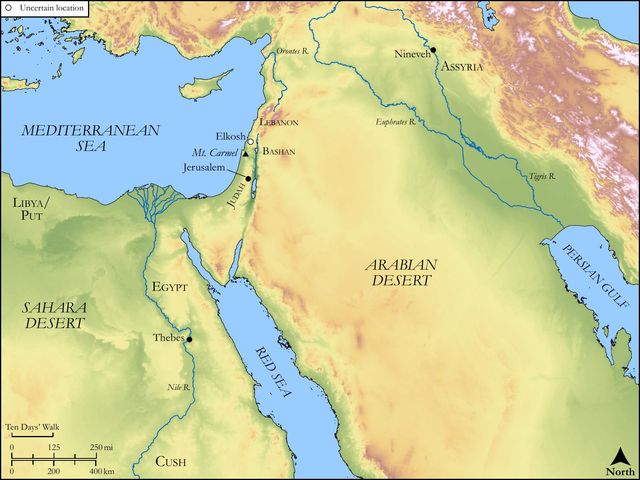
See on the biblical-era map
Study this verse
Public-domain commentary
Matthew Henry
From his Commentary on the Whole Bible. Henry comments on passages, not single verses — this entry covers Nahum 2:11–13.
Here we have Nineveh's ruin, 1. Triumphed in by its neighbours, who now remember against it all the oppressions and abuse of power it had been guilty of in its pomp and prosperity (Nah 2:11, Nah 2:12): Where is the dwelling of the lions? It is gone; there appear no remnants, no footsteps, of it. Where is the feeding place of the young lions, where they glutted themselves with prey? The princes of Nineveh had been as lions, as beasts of prey; cruel tyrants are no better, nay, in this respect much worse - that, being men, humanity is expected from them; nay, if they were indeed lions, they would not prey upon those of their own kind. Savis inter se convenit ursae - Fierce bears agree together. But in the shape of men they had the cruelty of lions: they walked in Nineveh as a lion in the woods, and none made them afraid; every one stood in awe of them, and they were under no apprehensions of danger from any; though nobody loved them, every body feared them, and that was all they desired. Oderint, dum metuant - Let them hate, so that they do but fear. The king himself, as well as every prince, made it his business, by all the arts of violence and extortion, to enrich himself and raise his family; he did tear in pieces enough for his whelps (and no little would be enough for them) and he strangled for his lioness, killed all that came near him, and seized what they had for his children, for his wives and concubines, and filled his holes with prey and his dens with ravin, as lions are wont to do. Note, Many make it an excuse for their rapine and injustice that they have wives and children to provide for, whereas what is so got will never do them any good; those that fear the Lord, and get what they have honestly, shall not want a competency for themselves and theirs; verily they shall be fed, when the young lions, though dens and holes were filled with prey and ravin for them, shall lack, and suffer hunger, Psa 34:10. 2. It is avowed by the righteous Judge of heaven and earth; it is his doing, and let all the world take notice that it is so (Nah 2:13): Behold, I am against thee, saith the Lord of hosts. And what good can hosts do for her in her defence, when the Lord of hosts is against her for her destruction? The oppressors in Nineveh thought they only set their neighbours against them, who were not a match for them, and whom they could easily overpower; but it proved they set God against them, who is, and will be, the asserter of right and the avenger of wrong. God is against the princes of Nineveh, and then, (1.) These military preparations will stand them in no stead: I will burn their chariots in the smoke; he does not say in the fire, but, in contempt of them, the very smoke of God's indignation shall serve to burn their chariots; they shall be consumed as soon as the fire of his indignation is kindled, while as yet it does but smoke, and not flame out. Or, The drivers of the chariots shall be smothered and stifled with the smoke; then the chariots of their glory shall be the shame of their families, Isa 22:18. (2.) Their children, the hopes of their families, shall be cut off: The sword shall devour the young lions, whom they were so solicitous to provide for by oppression and extortion. Note, It is just with God to deprive those of their children, or (which is all one) of comfort in them, that take sinful courses to enrich them, and (as has been said of some) damn their souls to make their sons gentlemen. (3.) The wealth they have heaped up by fraud and violence shall neither be enjoyed by them nor employed for them: I will cut off thy prey from the earth; not only thou shalt not be the better for it, but no one else shall. Some understand it of the disabling of them for the future to prey upon their neighbours. (4.) Their agents abroad shall not have that respect from their neighbours and that influence upon them which sometimes they had had: The voice of thy messengers shall no more be heard, no more be heeded, which some think refers to Rabshakeh, one of Nineveh's messengers, that had blasphemed the living God, an iniquity which was remembered against Nineveh long after. Those are not worthy to be heard again that have once spoken reproachfully of God.
Historical interpretation
Historical reception
1 surviving comment on this verse from the historical church.
(v. 13) Behold, I am coming to you, says the Lord of hosts, and I will set fire to your chariots until they are smoking, and the sword will devour your young lions, and I will eliminate your plunder from the land, and the voice of your messengers will no longer be heard. (LXX: Behold, I am coming to you, says the Almighty Lord, and I will set fire to your multitude until it is smoke, and the sword will devour your lions, and I will take away your plunder from the land, and your works will no longer be heard.) O Nineveh, all that has been said, with me as the author, you will suffer. I, the Lord, will set fire to your chariots until they are smoking and consumed, and I will make even your nobles and officials be devoured by the sword. You will no longer ravage the lands, nor demand tribute, and your messengers will not be heard throughout your provinces. Even if I do not hear the angels, who are your guardians, praying continuously for your protection. But these same words are also spoken to the world, where there is a multitude that travels along a broad and spacious road leading to death (Matthew 7), which the Lord threatens to set ablaze, suffocating in the smoke of its own wickedness (or excessive goodness). The sword will also devour lions, the living word of God, sharp and polished on all sides. It promises to take away its prey from the land, so that no one in Nineveh will be captured, and like a merciful one, it removes evil deeds and suppresses them, so that the sound of their voice and noise can no longer be heard. Hence it says: And your deeds will no longer be heard.
Continue studying Nahum 2:13 across the web’s major study libraries — every link below opens this exact verse, chapter, or book on the destination site.
Read & Compare
 BibleGatewayThis verse in more than 200 translations and 70 languages.
 Bible.comThe YouVersion reader — hundreds of translations, reading plans, and highlights.
 ESV.orgCrossway's official English Standard Version reader.
 NET BibleThe NET translation with 60,000+ translators' notes on every rendering decision.
 STEP BibleTyndale House's free study tool — original text, vocabulary, and scholarly resources.
 BibliaLogos Bible Software's free web reader.
 USCCBThe New American Bible (Revised Edition) with the U.S. bishops' study notes.
Commentaries
 BibleHub CommentariesDozens of classic commentaries on this verse, gathered on one page.
 StudyLightMore than 100 commentary sets — the largest collection on the web.
 BibleRefPlain-English commentary on what this verse means, verse by verse.
 Enduring WordDavid Guzik's free commentary on this chapter, widely used by Bible teachers.
 Bible Study ToolsVerse commentary alongside Greek and Hebrew study aids.
Original Language & Research
- BibleHub InterlinearThe verse word by word — original language, transliteration, and English.
- BibleHub LexiconEvery word's original-language definition and Strong's entry.
 Blue Letter BibleDeep-study tools — Strong's numbers, concordance, and word studies.
 SefariaThe Hebrew text with Rashi and centuries of Jewish commentary.
Sermons, Hymns & Audio


TrulyRandomVerse is not affiliated with these sites and doesn’t control their content. They’re linked because they’re genuinely useful.
Summary
Nahum 2:13 delivers a chilling and definitive declaration of divine judgment against Nineveh, the formidable capital of the Assyrian Empire. It is a direct and personal pronouncement from the Lord, emphasizing His sovereign intent to utterly dismantle this cruel superpower, bringing an end to its military might, its predatory exploitation of other nations, and its global influence. This verse serves as a climactic statement of God's righteous opposition to Nineveh's long history of brutality and idolatry, assuring its complete and irreversible downfall.
Context
ShowHideLiterary Context
The book of Nahum is a prophetic oracle focused almost exclusively on the impending destruction of Nineveh, the capital of Assyria, a nation renowned for its cruelty and oppression. Unlike the prophet Jonah, whose message led to Nineveh's temporary repentance and averted judgment (as seen in Jonah 3:10), Nahum prophesies a final and irreversible downfall. This particular verse, Nahum 2:13, stands as the climax of a series of vivid descriptions of Nineveh's siege and impending doom that begin in Nahum 2:1. It follows detailed imagery of the city's defenses being breached, its warriors fleeing, and its treasures plundered, culminating in God's direct and personal declaration of war against the city. The preceding verses paint a picture of chaos and destruction, setting the stage for this ultimate divine pronouncement that underscores the source and certainty of Nineveh's demise.
Historical & Cultural Context
At the time of Nahum's prophecy (likely late 7th century BC), Assyria was the dominant superpower in the Near East, known for its brutal military campaigns, forced deportations, and ruthless suppression of conquered peoples. Nineveh, its capital, was a magnificent and heavily fortified city, symbolizing Assyrian might and pride. The Assyrians had subjected Israel and Judah to immense suffering, including the destruction of the Northern Kingdom of Israel in 722 BC and the siege of Jerusalem in 701 BC. Their military relied heavily on chariots, a formidable weapon of ancient warfare, and their warriors were likened to fierce lions, preying on weaker nations. The phrase "the LORD of hosts" (Yahweh Sabaoth) would have been particularly potent in this context, contrasting the perceived invincibility of Assyria's earthly armies with the true, ultimate commander of all armies—God Himself. The prophecy of Nineveh's fall would have brought immense hope and vindication to the nations oppressed by Assyria, particularly Judah.
Key Themes
ShowHideNahum 2:13 powerfully contributes to several overarching themes within the book and broader biblical theology. Foremost is the theme of Divine Sovereignty and Judgment, where God's absolute authority over human empires is unequivocally declared. The repeated phrase, "Behold, I [am] against thee, saith the LORD of hosts," underscores God's active, personal involvement in executing judgment, demonstrating that Nineveh's fall is not merely a political or military defeat but a divinely orchestrated act of justice. This aligns with the broader biblical principle that God judges nations for their wickedness, as seen in passages like Isaiah 10:5-19. Another key theme is the Annihilation of Military Might, vividly portrayed by the burning of chariots and the devouring of "young lions," symbolizing the complete destruction of Assyria's renowned military power and its predatory warriors. This illustrates the futility of relying on human strength against divine decree. Furthermore, the verse highlights the End of Exploitation and Plunder, as God declares He will "cut off thy prey from the earth," signifying the cessation of Nineveh's reign of terror and its practice of plundering conquered nations. This emphasizes God's justice in ending oppressive dominance and illicit gains. Finally, the Silencing of Influence is conveyed by the voice of messengers no longer being heard, pointing to the complete collapse of Nineveh's communication, diplomatic power, and ability to spread fear or issue commands, marking the end of their authority and presence on the world stage, a common theme in prophecies of national downfall (e.g., Jeremiah 51:63-64).
Exposition and Analysis
ShowHideKey Word Analysis
ShowHideThis divine title, combining H3068 (Jehovah, the self-existent or eternal God) and H6635 (a mass of persons organized for war, an army, host), is profoundly significant. It identifies God as the sovereign commander of all heavenly and earthly armies, emphasizing His omnipotence and His ability to bring about His will, even against the most powerful human empires. In this context, it reinforces the certainty and irresistible nature of the judgment against Nineveh, contrasting the limited power of Assyria's "hosts" with the limitless power of the "LORD of hosts."
A primitive root meaning to kindle or consume by fire or by eating. This word conveys a sense of complete destruction, not just damage. When applied to chariots, it implies their utter incineration, rendering them useless. The choice of "burn" suggests a destructive, purifying, and irreversible act, emphasizing the finality of God's judgment on Nineveh's military strength.
A primitive root meaning to cut (off, down, or asunder); by implication, to destroy or consume; specifically, to covenant (by cutting flesh). While often used in the context of making covenants, here it signifies a complete severance and destruction. God will "cut off" Nineveh's "prey," meaning He will definitively end their predatory activities and the source of their ill-gotten gains, severing their ability to oppress and plunder. This implies a permanent cessation of their power and sustenance derived from violence.
Meaning a young lion (perhaps as covered with a mane) or a village. In this context, "young lions" is a powerful metaphor for the fierce, predatory warriors of Assyria. Just as young lions are known for their strength, aggression, and hunting prowess, so too were the Assyrian soldiers. The declaration that the sword will "devour thy young lions" signifies the utter destruction of their elite fighting force, turning their own predatory nature against them.
Verse Breakdown
ShowHide"Behold, I [am] against thee, saith the LORD of hosts,"
This opening clause is a direct, personal, and emphatic divine declaration. "Behold" (הִנֵּה) calls for immediate attention, highlighting the gravity of the pronouncement. The phrase "I [am] against thee" signifies God's active, personal opposition to Nineveh, leaving no doubt about the source of the impending judgment. The divine title "LORD of hosts" (Yahweh Sabaoth) underscores God's supreme authority as the commander of all heavenly and earthly armies, asserting His irresistible power over even the mightiest human empire. This is not merely a prophecy of future events but a direct challenge and declaration of war from the Almighty.
"and I will burn her chariots in the smoke,"
This clause immediately details the initial act of divine judgment against Nineveh's military might. Chariots were the cutting edge of ancient warfare, symbols of power and speed. God declares He will "burn" them, implying their complete incineration and rendering them useless. The phrase "in the smoke" suggests the intensity and totality of the destruction, perhaps even hinting at the chaos and confusion that would accompany Nineveh's fall. This action directly targets the very instruments of Assyria's military dominance.
"and the sword shall devour thy young lions:"
Following the destruction of their chariots, God's judgment extends to Nineveh's elite warriors. "Young lions" is a potent metaphor for the fierce, predatory, and seemingly invincible Assyrian soldiers who had terrorized nations. The personification of the "sword" devouring them emphasizes the brutal and comprehensive nature of their defeat. This signifies that the very instruments of their aggression—their warriors—will be consumed by the violence they themselves inflicted, indicating a reversal of their predatory role.
"and I will cut off thy prey from the earth,"
This clause addresses Nineveh's economic and political power, which was built upon plunder and exploitation. "Prey" refers to the spoils and resources taken from conquered nations. God declares He will "cut off" this source of sustenance and power "from the earth," implying a complete and permanent cessation of their ability to oppress and enrich themselves through violence. This highlights God's justice in ending their reign of terror and illicit gains, ensuring they can no longer exploit others.
"and the voice of thy messengers shall no more be heard."
The final clause signifies the complete collapse of Nineveh's influence, communication, and authority. "Messengers" were vital for diplomacy, issuing commands, spreading propaganda, and instilling fear in subjugated territories. The silencing of their voice means the end of Nineveh's diplomatic power, its ability to command or threaten, and its very presence on the world stage. This is the ultimate sign of its utter downfall and irrelevance, marking the end of its global dominion and its ability to project power or fear.
Literary Devices
ShowHideNahum 2:13 is rich in powerful literary devices that amplify its message of divine judgment. The most prominent is Metaphor, particularly in the phrase "thy young lions." This vivid imagery transforms the fierce Assyrian warriors into predatory animals, emphasizing their brutal and rapacious nature. The declaration that "the sword shall devour thy young lions" employs Personification, giving the inanimate sword the active, consuming power of a beast, which underscores the relentless and insatiable nature of the impending destruction. The entire verse functions as a powerful Divine Pronouncement or oracle, marked by the authoritative "saith the LORD of hosts," which lends absolute certainty and gravity to the prophecy. The cumulative effect of the listed destructions—burning chariots, devouring warriors, cutting off prey, silencing messengers—creates a sense of Hyperbole and Total Annihilation, suggesting a judgment so complete that no aspect of Nineveh's power or influence will remain. This comprehensive destruction also exhibits a form of Parallelism, where each clause builds upon the previous one to illustrate the multifaceted and absolute nature of God's judgment against every facet of Nineveh's strength.
Theological and Thematic Connections
ShowHideNahum 2:13 is a profound theological statement on God's character and His interaction with human history. It unequivocally declares God's active involvement in the affairs of nations, demonstrating His righteous indignation against injustice, oppression, and pride. The fall of Nineveh, a seemingly invincible empire, serves as a powerful testament to God's ultimate sovereignty over all earthly powers. It assures believers that no empire, no matter how strong or cruel, can ultimately defy the just and holy will of the Almighty. God sees the suffering of the oppressed and will, in His perfect timing, execute judgment, bringing an end to tyranny and establishing His justice. This verse reinforces the biblical truth that while God is patient and merciful, His justice is inevitable for those who persist in wickedness and refuse to repent.
Reflection and Application
ShowHideNahum 2:13, while a prophecy of ancient judgment, carries timeless truths for contemporary reflection and application. It serves as a stark reminder that God is not a passive observer of human history but an active, sovereign Lord who holds all nations and individuals accountable for their actions. For those in positions of power, it is a solemn warning against arrogance, oppression, and reliance on military might or material wealth rather than righteousness and justice. The fate of Nineveh underscores that pride precedes a fall, and God opposes the proud, as affirmed in James 4:6. Conversely, for those who are oppressed, overlooked, or suffering under tyrannical systems, this verse offers profound hope and comfort. It affirms that God sees their plight, hears their cries, and will ultimately act to bring justice and vindication. It reminds us that even when evil seems to triumph, God's righteous judgment will prevail, and His kingdom of justice will ultimately be established. Therefore, our trust should not be in human institutions or fleeting power, but in the unchanging character and sovereign power of the LORD of hosts.
Questions for Reflection
ShowHideFAQ
ShowHideWhy did God condemn Nineveh so severely, especially after He had shown mercy to them through Jonah?
ShowHideGod's severe condemnation of Nineveh in Nahum 2:13 and throughout the book stems from their persistent wickedness and their return to brutal oppression after a period of repentance. While Nineveh did repent under Jonah's preaching (as recorded in Jonah 3:5-10), this was a temporary reprieve. Over a century later, the Assyrian Empire, with Nineveh as its capital, had reverted to its notorious cruelty, idolatry, and relentless expansionism, becoming a terror to surrounding nations, including God's people, Israel and Judah. Nahum's prophecy reveals that God's patience has limits, and His justice ultimately demands accountability for unrepentant sin and pervasive evil. The severity of the judgment reflects the depth of their depravity and the long history of their crimes against humanity and against God's moral order. It demonstrates that God's mercy is offered, but if continually spurned, His righteous judgment will inevitably fall.
Christ-Centered Fulfillment
ShowHideNahum 2:13, while a prophecy of historical judgment against Nineveh, finds its ultimate Christ-centered fulfillment in the person and work of Jesus Christ, who embodies God's righteous judgment and ultimate victory over all forces of evil. Just as God declared Himself "against" Nineveh, Christ, as the Son of God, stands against all sin, injustice, and rebellion against God's holy rule. The burning of chariots and devouring of "young lions" foreshadows Christ's decisive triumph over all spiritual and earthly powers that oppose God. In His death and resurrection, Christ disarmed the principalities and powers, triumphing over them (as seen in Colossians 2:15). He is the true "LORD of hosts" who will ultimately "cut off" all "prey" from the earth, meaning He will bring an end to all exploitation, oppression, and the reign of sin. The silencing of Nineveh's messengers points to the future silencing of all voices that defy God, as every knee will one day bow and every tongue confess that Jesus Christ is Lord (Philippians 2:10-11). Ultimately, the judgment on Nineveh prefigures the final judgment when Christ returns as the righteous King and Judge (as described in Revelation 19:11-16), bringing complete and eternal justice, establishing His kingdom where righteousness dwells, and ensuring that the voice of His truth alone will prevail forever.