


Nahum 2:1
- עָלָה'a·Lahhe has come upH5927V-Qal-Perf-3msVerb Qal Perfect 3rd Singular Masculine
- מֵפִיץme·Fitz[one who] scattersH6327V-Hiphil-Prtcpl-msVerb Hiphil Participle Singular Masculine Absolute
- עַל'alonH5921PrepPreposition
- פָּנַיִךְpa·Na·yikhyour faceH6440N-mpc ¦ 2fsNoun Plural Masculine Constructפָּנַיִfaceךְyour
- נָצוֹרna·TzorguardH5341V-Qal-InfAbsVerb Qal Infinitive Absolute
- מְצֻרָהme·tzu·Rah[the] fortificationH4694N-fsNoun Singular Feminine Absolute
- צַפֵּהtza·pehwatchH6822V-Piel-Imp-2msVerb Piel Imperative 2nd Singular Masculine
- דֶרֶךְde·rekh[the] roadH1870N-csNoun Singular common gender Absolute
- חַזֵּקcha·ZekstrengthenH2388V-Piel-Imp-2msVerb Piel Imperative 2nd Singular Masculine
- מָתְנַיִםma·te·Na·yim[the] loinsH4975N-mdNoun Dual Masculine Absolute
- אַמֵּץ'a·Metzmake strongH553V-Piel-Imp-2msVerb Piel Imperative 2nd Singular Masculine
- כֹּחַKo·achstrengthH3581N-msNoun Singular Masculine Absolute
- מְאֹדme·'OdexceedinglyH3966Adj-msAdjective Numerical Singular Masculine Absolute
English is a literal word-by-word gloss of the Hebrew, not the KJV's wording. Why?
This is the original text the KJV's translators worked from — each Hebrew word with its own literal English meaning in this verse, prepared by scholars at Tyndale House, Cambridge. The KJV translates whole sentences, not word by word, so its wording differs: one Hebrew word can become several English words, and the KJV may choose “the LORD” where the gloss reads “Yahweh”. Both are faithful — they answer different questions. For the KJV's own rendering, switch to the KJV text.
Details
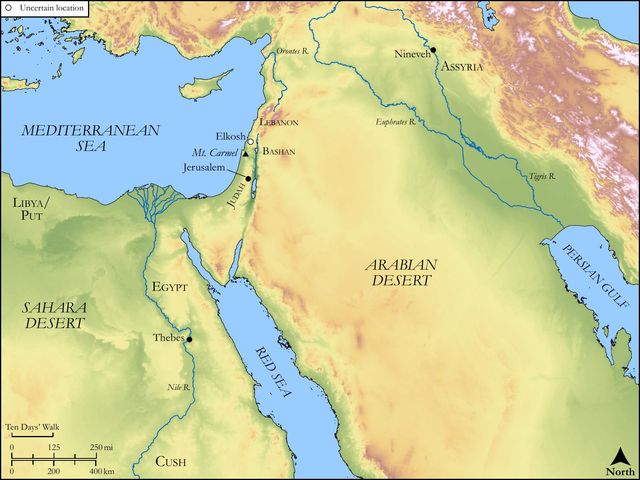
See on the biblical-era map
Study this verse
Public-domain commentary
Matthew Henry
From his Commentary on the Whole Bible. Henry comments on passages, not single verses — this entry covers Nahum 2:1–10. His two-level outline is real structure in the source text, so it is rendered as structure.
Here is, I. An alarm of war sent to Nineveh, Nah 2:1. The prophet speaks of it as just at hand, for it is neither doubtful nor far distant: "Look about thee, and see, he that dashes in pieces has come up before thy face. Nebuchadnezzar, who is noted, and will be yet more so, for dashing nations in pieces, begins with thee, and will dissipate and disperse thee;" so some render the word. Babylon is called the hammer of the whole earth, Jer. 1:23. The attempt of Nebuchadnezzar upon Nineveh is public, bold, and daring: "He has come up before thy face, avowing his design to ruin thee; and therefore stand to thy arms, O Nineveh! keep the munition; secure thy towers and magazines: watch the way; set guards upon all the avenues to the city; make thy loins strong; encourage thy soldiers; animate thyself and them; fortify thy power mightily, as cities do when an enemy is advancing against them" (this is spoken ironically); "do the utmost thou canst, yet thou shalt not be able to put by the stroke of this judgment, for there is no counsel or strength against the Lord."
II.A manifesto published, showing the causes of the war (Nah 2:2):
The Lord has turned away the excellency of Jacob, as the excellency of Israel, that is, 1. The Assyrians have been abusive to Jacob, the two tribes (have humbled and mortified them), as well as to Israel, the ten tribes, have emptied them, and marred their vine-branches. For this God will reckon with them; though done long since, it shall come into the account now against that kingdom, and Nineveh the head-city of it. God's quarrel with them is for the violence done to Jacob. Or, (2.) God is now by Nebuchadnezzar about to turn away the pride of Jacob by the captivity of the two tribes, as he did the pride of Israel by their captivity; He has determined to do it, to bring emptiers upon them, and the enemy that is to do it must begin with Nineveh, and reduce that first, and humble the pride of that. God is looking upon proud cities, and abasing them, even those that are nearest to him. Samaria is humbled, and Jerusalem is to be humbled, and their pride brought low; and shall not Nineveh, that proud city, be brought down too? Emptiers have emptied the cities, and marred the vine-branches in the country of Jacob and Israel; and must not the excellency of Nineveh, that is so much her pride, be turned away too?
III.A particular account given in of the terrors wherein the invading enemy shall appear against Nineveh; every thing shall contribute to make him formidable.
1.The shields of his mighty men are made red, and probably their other arms and array, as if they were already tinctured with the blood they had shed, or intended hereby to signify they would put all to the sword; they hung out a red flag, in token that they would give no quarter.
2.The valiant men are in scarlet; not only red clothes, to intimate what bloody work they designed to make, but rich clothes, to intimate the wealth of the army, and that is the sinews of war.
3.The chariots shall be with flaming torches in the day of his preparation; when they are making their approaches, they shall fly as swiftly as lightning; the wheels shall strike fire upon the stones, and those that drive them shall drive furiously with a flaming indignation, as Jehu drove. Or they carried flaming torches with them in the open chariots, when they made their approach in the night, as Gideon's soldiers carried lamps in their pitchers, to be both a guide to themselves and a terror to their enemies, and with them to set all on fire wherever they went.
4.The fir-trees shall be terribly shaken; the great men of Nineveh, that overtop their neighbours, as the stately firs do the shrubs; or the very standing trees shall be made to shake by the violent concussions of the earth, which that great army shall cause.
5.The chariots of war shall be very terrible (Nah 2:4): They shall rage in the streets, that is, those that drive them shall rage; you would think the chariots themselves raged; they shall be so numerous, and drive with so much fury, that even in the broad ways, where, one would think, there should be room enough, they shall jostle one another; and these iron chariots shall be made so bright that in the beams of the sun they shall seem like torches in the night; they shall run like the lightnings, so swiftly, so furiously. Nebuchadnezzar's commanders are here called his worthies, his gallants (so the margin reads it), his heroes; those he shall recount, and order them immediately and without fail to render themselves at their respective posts, for he is entering upon action, is resolved to take the field immediately, and to open the campaign with the siege of Nineveh. His worthies shall remember (so some read it); they shall be mindful of the duty of their place, and the charge they have received, and shall thereby be made so intent upon their business that they shall stumble in their walks, shall make more haste than good speed; they stumble, but shall not fall; for they shall make haste to the wall thereof, shall open the trenches; and the defence, or the covered way, shall be prepared (something to shelter them from the darts of the besieged), and they shall so closely carry on the siege, and with so much vigour, that at length the gates of the rivers shall be opened (Nah 2:6); those gates of Nineveh which open upon the river Tigris (on which Nineveh was built) shall be first forced by, or betrayed to, the enemy, and by those gates they shall enter. And then the palace shall be dissolved, either the king's house or the house of Nisroch his god; the same word signifies both a palace and a temple. When the God of heaven goes forth to contend with a people, neither the palaces nor their kings, neither the temples nor their gods, can protect and shelter them, but must all inevitably fall with them.
IV.A prediction of the consequences of this; and it is easy to guess how dismal those will be.
1.The queen shall fall into the hands of the enemy (Nah 2:7): Huzzab shall be led away captive; she that was established (so some read it), thought herself safe because she was concealed and shut up in secret, shall be discovered (so the margin reads it) and shall be led away captive, in greater disgrace than that of common prisoners; she shall be brought up in a mock state, and her maids of honour shall lead her, because she is weak and faint, not able to bear such frights and hardships, which are doubly hard and frightful to those that have not been used to them; they shall attend her, not to speak cheerfully to her and to encourage her, but murmuring and moaning themselves, as with the voice of doves, the doves of the valleys (Eze 7:16), noted for their mourning, Isa 38:14; Isa 59:11. They shall be tabering upon their breasts, beating their own breasts in grief and vexation, as if they were drumming upon them, for so the word signifies.
2.The inhabitants, though numerous, shall none of them be able to make head against the invaders, or stand their ground (Nah 2:8): Nineveh is of old like a pool of water, replenished with people as a pool with water (and waters signify multitudes, Rev 17:15), or as those waters with fish; it was long ago a populous city; in Jonah's time there were 120,000 little children in it (Jon 4:11), and, ordinarily, cities and countries are increasing in their number every year; but, though they have so many hands to be employed in the public service, yet they shall not be able to inspire one another with courage, but they shall flee away like cowards. Their commanders shall do what they can to animate them; they shall cry, "Stand, stand, have a good heart on it, and we shall do well enough;" but none shall so much as look back; they shall not have the least spark of courage remaining, but every one shall think it is his wisest course to make his best of the opportunity to escape; they shall not so much as look back to see who calls for them. Note, God can dispirit the strongest and boldest, in the day of distress, so that they shall not be what one would expect from them, but like a pool of water, the water whereof is dried up and gone.
3.The wealth of the city shall become a prey, and all its rich furniture shall fall into the hands of the victorious enemy (Nah 2:9); they shall thus animate and excite one another to plunder: Take the spoil of silver; take the spoil of gold; thus the officers shall stir up the soldiers to improve their opportunity; here are silver and gold enough for them, for there is no end of the store of money and plate. Nineveh, having been of old like a pool of water, has gathered a vast deal of mud; and abundance of glory it has out of all the pleasant furniture, all the vessels of desire, which they have gloried in and which shall now be a prey and a pride to the conquerors. Note, Those who prepare raiment as the clay, and heap up silver as the dust, know not who may put on the raiment and divide the silver, Job 27:16, Job 27:17. Thus this rich city is empty, and void, and waste, Nah 2:10. See the vanity of worldly wealth; instead of defending its owners, it does but expose them, and enable their enemies to do them so much the more mischief.
4.The soldiers and people shall have no heart to appear for the defence of the city. Their spirits shall melt away like wax before the fire; their knees shall smite together (as Belshazzar's did, in his agony, Dan 5:6), so that they shall not be able to stand their ground, no, nor to make their escape; much pain shall be in all loins, as is the case in extreme frights, so that they shall not be able to hold up their backs. And the faces of them all shall gather blackness, like that of a pot that is every day over the fire; so the word signifies. Note, Guilt in the conscience will fill men with terror in an evil day, and those who place their happiness in the wealth of this world and set their hearts upon it think themselves undone when their silver, and their gold, and their pleasant furniture are taken from them.
Historical interpretation
Historical reception
4 surviving comments on this verse. Each one is dated, so this reads as a timeline rather than a list.
Select a marker to jump to its quote. Markers stagger vertically where authors wrote within a few decades of each other.
He imparted the fellowship of this Holy Spirit to the apostles, for it is written, “When he had said that, he breathed upon them, and said to them, ‘Receive the Holy Spirit; whose sins you shall forgive, they are forgiven them; and whose sins you shall retain, they are retained.’ ” This was the second breathing (the first had been impaired by willful sins)2 to fulfill the Scripture: “One who has been delivered from affliction has come up panting into your presence.” He has been delivered from Hades. For it was after his resurrection, according to the gospel, that he breathed on them. He gives the grace at this time, and he will lavish it more abundantly. He says to them, “I am ready to give it to you even now, but the vessel cannot yet hold it. Accept for the time the grace of which you are capable, but look forward to yet more.” “But wait here in the city” of Jerusalem “until you are clothed with power from on high.” Receive it in part now; then you will be clad in its fullness. For he who receives often has the gift only in part, but he who is clothed is entirely covered by his garment. Fear not, he says, the weapons and darts of the devil, for you will possess the power of the Holy Spirit. But be mindful of our recent admonition, that the Holy Spirit is not divided, but only the grace he bestows.
Chapter 2, verses 1 and 2: He who scatters has ascended before your face, guarding the siege: consider the way, strengthen your loins, greatly fortify your strength. For just as the Lord has repaid the pride of Jacob, so He will repay the pride of Israel. Because the desolators have scattered them and spoiled their branches. I am compelled by necessity to turn my course between the rocks and the cliffs, with imminent shipwreck, so as to navigate between the history and allegory of my discourse, and to be cautious lest it suddenly collide. Indeed, according to the fables of the poets:
Scylla threatens on the right side, Charybdis on the left, unrelenting. If we flee the rocks, we plunge into the deep; if we avoid the swirling whirlpools, we are thrown onto the rocks. The Lord is my witness that in all I have said according to the Hebrew, I am not speaking in my own sense, which is an argument used against false prophets, but rather following the interpretation of the Hebrews, from whom I have learned a great deal over a considerable time, and I must simply indicate what I have learned to my own people. Certainly, it will be at the discretion of the reader, when he goes through both, to judge which one he should follow more. Now, the speech is turned to Nineveh (and hence the prophets are especially obscure because suddenly, while something else is being discussed, the person is changed to others) and it is said to her: Nebuchadnezzar, who will besiege you, is coming to you, who will devastate the fields in front of your mouth, pursue the farmers, plunder the countryside, and also keep you enclosed herself. Therefore, because war is imminent for you, behold, the joyful prophet now predicts: carefully consider and behold what may happen to you. Strengthen your loins, that is, prepare yourself: gather strength greatly, that is, gather an army: just as the Lord avenged Judah from the pride of Sennacherib, with his army being killed in Judah, and he himself being slain by his own sons: so will he avenge Israel, that is, the ten tribes that are possessed by Nineveh. For both the Assyrians devastated and destroyed both Judah and Israel, and under the metaphor of the vine, they corrupted the offspring of both (or 'of both trees').
LXX: Contemplate the way, hold your loins, strengthen yourself vigorously, because the Lord has turned away the disgrace of Jacob, as the disgrace of Israel: for those who shook them off have shaken themselves off, and their branches have been demolished. Three things are commanded to the Jews. First, that they contemplate the way, and diligently look at the path by which they will walk, according to what is written in Jeremiah: Stand in the ways, and ask for the eternal paths, and see what the good way is; And walk in it (Jeremiah 6:16): so that when we stand in many ways, we may come to that way which says: I am the way (John 14:6). Then it is said to him, to hold his loins, that is, to mortify his body after the election of the way, and to subject himself to servitude, lest, preaching to others as a king and master, he himself be found reprobate (1 Corinthians IX). It is now too long to say how the virtue of the devil is chiefly in the loins, and how the promise is made to David: I will set the fruit of thy loin upon thy throne (Psalms CXXXI, 11). And that of the Apostle: For as yet Levi, who received tithes, paid tithes in Abraham: For he was yet in the loins of his father, when Melchisedech met him (Hebrews VII, 10). And that John is girded with a leather belt (Matth. III), and that the disciples are commanded by the Savior: Let your loins be girded (Luke XII, 35). And the Apostle to the Ephesians: Stand therefore, having your loins girt about with truth (Ephes. VI, 14): for although exercise is very beneficial, and a life of self-control is superior to the mortification of the loins, yet nothing mortifies them so much as the knowledge of the truth. Hence it is said: Gird your loins with truth. For if the truth is Christ, he who believes with his whole mind in Christ has mortified his desires in Christ. Thirdly, it is commanded to be strengthened exceedingly: 'You have chosen,' he says, 'the way, you have held tight to your desire, take on virtue, so that you may be able to fight against your enemies.' And lest perhaps you doubt, a reason is given to you why you should hope: 'The Lord has turned away the disgrace of Jacob, just as he has turned away the disgrace of Israel,' which is ambiguous: either he has turned away the disgrace of Jacob himself, which he was inflicting on others, or he has turned away the disgrace which Jacob was enduring from others. But it seems to me better that the insult which Jacob used to do to others should be turned away from the Lord. For it is not of such great virtue to endure injury done by others, as it is of the grace of the Lord to be unable to do injury, being gentle, meek, and tranquil. It is asked, how injury is turned away from Jacob, just as it had been turned away from Israel. After Jacob wrestled with the angel, he deserved to receive the name Israel (Genesis XXXII), and because he saw God, he ceased to do injury. Just as Israel, the understanding or man who sees God, and always thinking about God, does not know how to do wrong, so every insolence and outrage is turned away from Jacob, that is, from the supplanter, from him who is still in the struggle and supplants enemies. But in order that we may know how wrong is taken in a bad sense, Solomon is witness, saying: Eyes full of contempt, a wicked tongue (Prov. 6). But how according to both interpretations wrong is turned away from Jacob, which was first turned away from Israel, the following passage makes clear: Because they shook them off, and demolished, or corrupted, their scourges. The angels, he says, of each one who daily behold the face of the Father (Matthew XV, 10), shook off whatever dust had adhered to Jacob and Israel. Hence also the feet of Peter are washed (John XIII). And through the prophet it is said: Shake off the dust, and arise, Jerusalem (Isaiah LII, 2). It is also commanded to the disciples by the Savior: Shake off the dust from your feet (Matthew X, 14). And in the Psalms it is written: Like arrows in the hand of a mighty one, so are the children of the shaken off (Psalm CXXVI, 4). Therefore, the mind is inclined towards insult, not only by Jacob, but also by Israel: because whatever was earthly in them and formed from the lower elements, this was shaken off and purified by the ministering angels, or rather by the guardians and teachers, who not only expelled them, but also scattered the vices which temporarily satisfy the senses and are like whips and branches devoid of fruit, as the Lord says: Every branch that abides in me and bears fruit, my Father cleanses, that it may bear more fruit; but what does not abide in me and does not bear fruit, my Father cuts off and throws into the fire (Matthew 15).
It is finished, it is taken away; he has come up breathing into your face, delivering from affliction. As it was already fixed, and in every way and altogether about to happen that Nineveh must be destroyed, he says that it is finished, indicating by this its coming to an end, as it were. And indeed also that it is taken away, that is, that it has been cut off completely and utterly destroyed. And very well indeed he says "he has come up" concerning Cyrus, signifying something emphatic, I think, such as the prophet Jeremiah also said about him, foretelling what would happen in due time to Nineveh: "A lion has come up from his den, a destroyer of nations has set out, and has gone forth from his place, to make your land a desolation, and your cities shall be laid waste, so that none shall dwell in them." For like a wild beast leaping upon Nineveh, he devoured those in it. But to them he was a terrible and relentless enemy, and became unyielding in his wrath, but to those of Israel he was breathing into their face and delivering from affliction, that is, releasing them from their unusual servitude, loosing their bonds, recovering them as captives, by sending them home, and also commanding that the divine temple be rebuilt for them.
“One has come up blowing in your face, rescuing you from tribulation.” God is the cause of this for you by his decision as though by some kind of blowing, destroying them but freeing you from their power. Just as by blowing a breath of life into Adam he made him a living being, so he provided you with salvation by the blowing of life. This is also what Christ the Lord gave the sacred apostles after the resurrection. Since Adam lost what he had received by way of image through the divine blowing, it was right that Christ the Lord should renew the image and restore it to the sacred apostles and through them to all the believers, blowing on them and saying, “Receive the Holy Spirit.” Since former things are a type of the new, therefore, let us take the Assyrians’ kingdom that was destroyed as the devil’s tyranny brought to an end through Christ the Lord.
Continue studying Nahum 2:1 across the web’s major study libraries — every link below opens this exact verse, chapter, or book on the destination site.
Read & Compare
 BibleGatewayThis verse in more than 200 translations and 70 languages.
 Bible.comThe YouVersion reader — hundreds of translations, reading plans, and highlights.
 ESV.orgCrossway's official English Standard Version reader.
 NET BibleThe NET translation with 60,000+ translators' notes on every rendering decision.
 STEP BibleTyndale House's free study tool — original text, vocabulary, and scholarly resources.
 BibliaLogos Bible Software's free web reader.
 USCCBThe New American Bible (Revised Edition) with the U.S. bishops' study notes.
Commentaries
 BibleHub CommentariesDozens of classic commentaries on this verse, gathered on one page.
 StudyLightMore than 100 commentary sets — the largest collection on the web.
 BibleRefPlain-English commentary on what this verse means, verse by verse.
 Enduring WordDavid Guzik's free commentary on this chapter, widely used by Bible teachers.
 Bible Study ToolsVerse commentary alongside Greek and Hebrew study aids.
Original Language & Research
- BibleHub InterlinearThe verse word by word — original language, transliteration, and English.
- BibleHub LexiconEvery word's original-language definition and Strong's entry.
 Blue Letter BibleDeep-study tools — Strong's numbers, concordance, and word studies.
 SefariaThe Hebrew text with Rashi and centuries of Jewish commentary.
Sermons, Hymns & Audio


TrulyRandomVerse is not affiliated with these sites and doesn’t control their content. They’re linked because they’re genuinely useful.
Summary
Nahum 2:1 dramatically announces the imminent and certain judgment upon Nineveh, the capital of Assyria. The verse opens with the declaration that "He that dasheth in pieces" – a powerful, destructive force, likely referring to the Babylonian and Mede armies – has already arrived at Nineveh's gates. In a tone laden with divine irony, the verse then issues a series of urgent commands to the city, urging it to prepare its defenses, guard its strongholds, watch for the enemy, and muster all its strength, implicitly highlighting the futility of such efforts against God's determined decree.
Context
ShowHideLiterary Context
Nahum 2:1 marks a pivotal transition in the book of Nahum. Chapter 1 establishes the character of God as a righteous avenger, slow to anger but certain in judgment against His enemies, particularly Nineveh, which is described as a city of bloodshed and idolatry. Verses like Nahum 1:2-3 lay the theological groundwork for the impending destruction. Chapter 2 then shifts from general pronouncements to a vivid, almost cinematic, description of Nineveh's siege and fall. Verse 1 serves as the opening scene, immediately introducing the destructive agent and setting the stage for the detailed account of the city's demise that follows in the rest of the chapter. The transition from the "burden" (prophetic oracle) against Nineveh in Nahum 1:1 to the direct address in 2:1 signals the commencement of the fulfillment of that burden.
Historical & Cultural Context
Nineveh was the formidable capital of the Neo-Assyrian Empire, renowned for its military might, brutal conquests, and extensive fortifications. Its walls were legendary, reportedly over 100 feet high and thick enough for chariots to drive on, making it seem impregnable. The Assyrians were notorious for their cruelty, deporting conquered peoples, flaying captives, and boasting of their atrocities, which made them a terror to the ancient Near East. This historical context is crucial for understanding the divine judgment pronounced against them. The "dasher in pieces" refers to the coalition of Babylonian and Mede forces that besieged and ultimately destroyed Nineveh in 612 BC, a significant historical event that marked the end of the Assyrian Empire. The commands to "keep the munition" and "watch the way" reflect the typical defensive strategies of a besieged city, emphasizing Nineveh's reliance on its physical strength and military preparedness, which would ultimately prove insufficient against God's decree.
Key Themes
ShowHideNahum 2:1 contributes significantly to several key themes within the book and broader biblical theology. Firstly, it underscores the theme of Divine Justice and Sovereignty over Nations. God, as the sovereign Lord of history, holds even the most powerful empires accountable for their wickedness and oppression, as seen in His judgment on Assyria, a theme echoed in passages like Jeremiah 25:15-29. Secondly, there is the theme of the Futility of Human Strength and Self-Reliance when pitted against God's will. The ironic commands to Nineveh to fortify itself highlight that no human might, no matter how great, can withstand God's determined judgment. This resonates with the psalmist's declaration in Psalm 33:16-17. Finally, the verse powerfully conveys Prophetic Certainty. The declaration "He that dasheth in pieces is come up" speaks of a future event as if it has already happened, emphasizing the absolute certainty and inevitability of God's word being fulfilled, a characteristic of prophetic literature that assures readers of God's faithfulness to His promises and warnings.
Exposition and Analysis
ShowHideKey Word Analysis
ShowHideThis primitive root conveys the violent action of breaking or dashing into fragments, either literally or figuratively. It implies a complete and devastating destruction, scattering something abroad. In Nahum 2:1, it vividly portrays the invading force as one that will utterly shatter Nineveh, leaving nothing intact.
Derived from a root meaning "to hem in," this word refers to a fortification, stronghold, or rampart. It denotes the physical defenses of a city, such as walls, towers, and siege mounds. The command to "keep the munition" ironically highlights Nineveh's reliance on its massive, seemingly impregnable fortifications, which will ultimately fail to protect it.
A versatile primitive root meaning "to fasten upon," and by extension, "to seize," "be strong," "courageous," "strengthen," or "fortify." When paired with "loins" (H4975, môthen), the phrase "make thy loins strong" (an idiom) implies preparing for strenuous effort, battle, or a difficult task by gathering all one's physical and mental resolve. This command, like the others, is delivered with a tone of grim irony, as Nineveh's efforts to strengthen itself will be in vain.
Verse Breakdown
ShowHide"He that dasheth in pieces is come up before thy face"
This opening clause immediately establishes the dramatic tension. The "dasher in pieces" (likely referring to the Babylonian and Mede armies) is presented not as a distant threat, but as an immediate, present reality, "come up before thy face." This vivid imagery conveys the suddenness and inevitability of the attack, suggesting that the enemy is already at the city gates, ready to unleash utter destruction upon Nineveh. The perfect tense of "is come up" emphasizes the certainty of the event, as good as done in God's prophetic sight.
"keep the munition"
This is the first of several imperative commands issued to Nineveh. It instructs the city to guard its fortifications, strongholds, and defensive structures. Given Nineveh's reputation for massive walls, this command seems to acknowledge its physical defenses, yet it is delivered with an underlying tone of futility, as if to say, "Do your best, but it won't matter."
"watch the way"
This command urges Nineveh to maintain vigilance, to keep a lookout on the roads and approaches leading to the city. It implies the need to detect the enemy's movements and prepare for their arrival. This reflects a standard military precaution, but in this context, it underscores the overwhelming nature of the coming assault, which no amount of watching can ultimately avert.
"make [thy] loins strong"
This is an ancient idiom, referring to the practice of girding one's loins (tightening the belt around the waist) to prepare for strenuous physical activity, such as running, working, or fighting. It signifies gathering one's full strength, resolve, and readiness for battle. The command is a call for Nineveh to muster all its internal and external might for the impending conflict.
"fortify [thy] power mightily"
This final imperative reinforces the previous commands, urging Nineveh to strengthen its military force and overall capability to the utmost degree. The adverb "mightily" (H3966, mᵉʼôd) emphasizes the extreme effort required. Together, these commands paint a picture of a city desperately trying to prepare for an unstoppable force, highlighting the tragic irony that all its efforts will ultimately be insufficient against the divine decree.
Literary Devices
ShowHideNahum 2:1 employs several powerful literary devices to convey its message. The most prominent is Irony. The prophet issues commands to Nineveh to prepare its defenses, "keep the munition, watch the way, make thy loins strong, fortify thy power mightily," knowing full well that these efforts will be utterly in vain. This creates a sense of grim sarcasm, highlighting the futility of human strength against divine judgment. There is also strong Vivid Imagery, particularly in the phrase "He that dasheth in pieces," which conjures a powerful visual of shattering destruction. The use of Imperative Mood in the commands ("keep," "watch," "make strong," "fortify") creates a sense of urgent, direct address, drawing the reader into the immediacy of the impending doom, even as it underscores the hopelessness of Nineveh's situation. Finally, the opening phrase, "He that dasheth in pieces is come up before thy face," uses Prophetic Perfect tense, presenting a future event as if it has already happened, emphasizing the absolute certainty and inevitability of the prophecy's fulfillment.
Theological and Thematic Connections
ShowHideNahum 2:1 powerfully articulates the biblical truth that God is sovereign over all nations and that His justice will ultimately prevail against wickedness and oppression. Nineveh, the epitome of a cruel and arrogant empire, is here shown to be utterly helpless before the divine decree. This verse serves as a stark reminder that no human empire, no matter how powerful or fortified, can escape accountability for its actions when they defy God's moral order. It underscores the principle that while God is patient, His justice is certain and will be executed upon those who persist in unrepentant evil. The apparent futility of Nineveh's defensive preparations highlights that true security and lasting peace are not found in military might or impenetrable walls, but in righteousness and humble submission to God's will.
Reflection and Application
ShowHideNahum 2:1, though a prophecy of judgment against an ancient empire, holds profound relevance for contemporary reflection and application. It reminds us that God's justice is not an abstract concept but an active force in history. For individuals and nations alike, it serves as a sobering warning against the dangers of pride, oppression, and self-reliance. We are called to examine where we place our ultimate trust and security. Do we rely on our own strength, resources, or societal structures, or do we place our faith in the sovereign God who alone holds the power to "dash in pieces" and to build up? The futility of Nineveh's defenses encourages us to seek true spiritual fortification, building our lives on the unchanging principles of God's Word rather than on fleeting worldly power. It also prompts us to consider our own response to injustice and suffering in the world, knowing that God sees and will act.
Questions for Reflection
ShowHideFAQ
ShowHideWho is "He that dasheth in pieces" in Nahum 2:1?
ShowHideWhile the text does not explicitly name the "dasher in pieces," biblical scholars widely interpret this phrase as referring to the invading armies that would destroy Nineveh. Historically, this was the coalition of Babylonian and Mede forces that besieged and conquered the Assyrian capital in 612 BC. The phrase vividly describes their destructive power and the complete devastation they would inflict upon the city, acting as instruments of God's judgment.
Is God's judgment always inevitable, or is there room for repentance?
ShowHideNahum 2:1 emphasizes the certainty of judgment for Nineveh, in stark contrast to its earlier reprieve recorded in the book of Jonah. In Jonah's time, Nineveh repented in response to God's warning, and judgment was averted (Jonah 3:10). However, by Nahum's time, Nineveh had reverted to its wicked ways and persisted in oppression and idolatry, ignoring repeated opportunities for true and lasting repentance. Thus, for a people or nation that continually rejects God's warnings and persists in sin, judgment becomes inevitable. This highlights that God is patient and merciful, but there is a limit to His forbearance when repentance is consistently rejected.
Christ-Centered Fulfillment
ShowHideNahum 2:1, with its pronouncement of judgment and the arrival of the "dasher in pieces," finds its ultimate Christ-centered fulfillment in several profound ways. Firstly, Jesus Christ is the ultimate "dasher in pieces" of sin, death, and the works of the devil. His crucifixion and resurrection were the decisive blow against the powers of darkness, shattering their dominion and offering liberation to humanity (Colossians 2:15). He came not only to save but also to judge, and His return will be as a mighty warrior who will "dash them in pieces like a potter's vessel" (Psalm 2:9) those who oppose Him and His kingdom (Revelation 19:11-16). The futility of Nineveh's defenses against God's decree foreshadows the utter inability of humanity to stand against Christ's righteous judgment on the last day; no human strength or fortification can withstand His coming (Revelation 6:15-17). Therefore, the call to "make thy loins strong" for battle in Nahum 2:1 is transformed in the New Testament into a spiritual imperative to be "strong in the Lord and in the strength of His might" (Ephesians 6:10), preparing for His return not with earthly weapons, but with faith, righteousness, and the gospel of peace. The ultimate security is found not in human walls, but in Christ, the "Rock of Ages" (Isaiah 26:4).