


Nahum 2:11
- אַיֵּה'ai·Yehwhere?H346InterrogParticle Interrogative
- מְעוֹןme·'on[is the] dwelling place ofH4583N-mscNoun Singular Masculine Construct
- אֲרָיוֹת'a·ra·YotlionsH738N-fpNoun Plural Feminine Absolute
- וּמִרְעֶהu·mir·'Ehand [is] pastureH4829Conj-w ¦ N-msNoun Singular Masculine Absoluteוּandמִרְעֶה[is] pasture
- הוּאhu'itH1931Pro-3msPronoun Personal 3rd Singular Masculine
- לַכְּפִרִיםla·ke·fi·Rimfor <the> young lionsH3715Prep-l ¦ N-mpNoun Plural Masculine Absoluteלַfor <the>כְּפִרִיםyoung lions
- אֲשֶׁר'a·SherwhereH834RelParticle Relative
- הָלַךְha·laKhit walkedH1980V-Qal-Perf-3msVerb Qal Perfect 3rd Singular Masculine
- אַרְיֵה'ar·YehlionH738N-msNoun Singular Masculine Absolute
- לָבִיאla·Vi'lionessH3833N-msNoun Singular Masculine Absolute
- שָׁםshamthereH8033AdvAdverb
- גּוּרgurcub ofH1482N-mscNoun Singular Masculine Construct
- אַרְיֵה'ar·YehlionH738N-msNoun Singular Masculine Absolute
- וְאֵיןve·'Einand there notH369Conj-w ¦ N-mscNoun Singular Masculine Constructוְandאֵיןthere not
- מַחֲרִידma·cha·Rid[was one who] disturbed [them]H2729V-Hiphil-Prtcpl-msVerb Hiphil Participle Singular Masculine Absolute
English is a literal word-by-word gloss of the Hebrew, not the KJV's wording. Why?
This is the original text the KJV's translators worked from — each Hebrew word with its own literal English meaning in this verse, prepared by scholars at Tyndale House, Cambridge. The KJV translates whole sentences, not word by word, so its wording differs: one Hebrew word can become several English words, and the KJV may choose “the LORD” where the gloss reads “Yahweh”. Both are faithful — they answer different questions. For the KJV's own rendering, switch to the KJV text.
Details
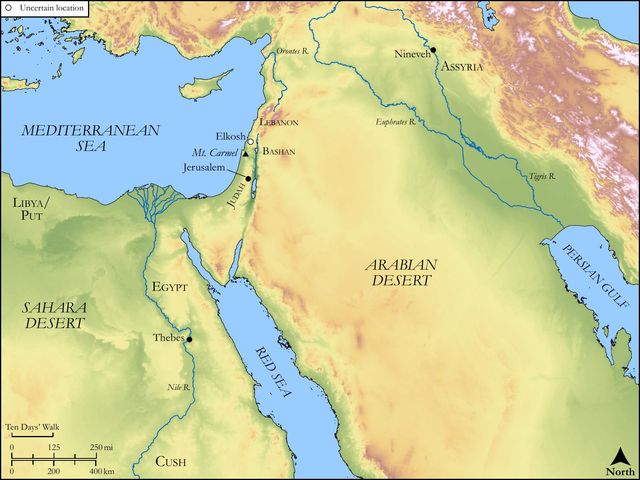
See on the biblical-era map
Study this verse
Public-domain commentary
Matthew Henry
From his Commentary on the Whole Bible. Henry comments on passages, not single verses — this entry covers Nahum 2:11–13.
Here we have Nineveh's ruin, 1. Triumphed in by its neighbours, who now remember against it all the oppressions and abuse of power it had been guilty of in its pomp and prosperity (Nah 2:11, Nah 2:12): Where is the dwelling of the lions? It is gone; there appear no remnants, no footsteps, of it. Where is the feeding place of the young lions, where they glutted themselves with prey? The princes of Nineveh had been as lions, as beasts of prey; cruel tyrants are no better, nay, in this respect much worse - that, being men, humanity is expected from them; nay, if they were indeed lions, they would not prey upon those of their own kind. Savis inter se convenit ursae - Fierce bears agree together. But in the shape of men they had the cruelty of lions: they walked in Nineveh as a lion in the woods, and none made them afraid; every one stood in awe of them, and they were under no apprehensions of danger from any; though nobody loved them, every body feared them, and that was all they desired. Oderint, dum metuant - Let them hate, so that they do but fear. The king himself, as well as every prince, made it his business, by all the arts of violence and extortion, to enrich himself and raise his family; he did tear in pieces enough for his whelps (and no little would be enough for them) and he strangled for his lioness, killed all that came near him, and seized what they had for his children, for his wives and concubines, and filled his holes with prey and his dens with ravin, as lions are wont to do. Note, Many make it an excuse for their rapine and injustice that they have wives and children to provide for, whereas what is so got will never do them any good; those that fear the Lord, and get what they have honestly, shall not want a competency for themselves and theirs; verily they shall be fed, when the young lions, though dens and holes were filled with prey and ravin for them, shall lack, and suffer hunger, Psa 34:10. 2. It is avowed by the righteous Judge of heaven and earth; it is his doing, and let all the world take notice that it is so (Nah 2:13): Behold, I am against thee, saith the Lord of hosts. And what good can hosts do for her in her defence, when the Lord of hosts is against her for her destruction? The oppressors in Nineveh thought they only set their neighbours against them, who were not a match for them, and whom they could easily overpower; but it proved they set God against them, who is, and will be, the asserter of right and the avenger of wrong. God is against the princes of Nineveh, and then, (1.) These military preparations will stand them in no stead: I will burn their chariots in the smoke; he does not say in the fire, but, in contempt of them, the very smoke of God's indignation shall serve to burn their chariots; they shall be consumed as soon as the fire of his indignation is kindled, while as yet it does but smoke, and not flame out. Or, The drivers of the chariots shall be smothered and stifled with the smoke; then the chariots of their glory shall be the shame of their families, Isa 22:18. (2.) Their children, the hopes of their families, shall be cut off: The sword shall devour the young lions, whom they were so solicitous to provide for by oppression and extortion. Note, It is just with God to deprive those of their children, or (which is all one) of comfort in them, that take sinful courses to enrich them, and (as has been said of some) damn their souls to make their sons gentlemen. (3.) The wealth they have heaped up by fraud and violence shall neither be enjoyed by them nor employed for them: I will cut off thy prey from the earth; not only thou shalt not be the better for it, but no one else shall. Some understand it of the disabling of them for the future to prey upon their neighbours. (4.) Their agents abroad shall not have that respect from their neighbours and that influence upon them which sometimes they had had: The voice of thy messengers shall no more be heard, no more be heeded, which some think refers to Rabshakeh, one of Nineveh's messengers, that had blasphemed the living God, an iniquity which was remembered against Nineveh long after. Those are not worthy to be heard again that have once spoken reproachfully of God.
Historical interpretation
Historical reception
1 surviving comment on this verse from the historical church.
(Verse 11) Where is the den of the lions, and the feeding ground of the lion cubs, to which the lion went to enter there with its lion cub, and there is no one to drive them away? The lion has taken enough for its cubs, and has killed for its lionesses; and it has filled its dens with prey and its lair with the spoils. Concerning dens and lionesses, seventy are carried off in translation, and the same meaning holds for the rest. However, it is still said about Nineveh: that it was the dwelling place of kings and the court of nobles; to which the Babylonian lion king, that is, Nebuchadnezzar, went, along with his lion cub, his sub-rulers, and there was no one to resist them. The lion captured its own cubs sufficiently, and killed its own lionesses. Likewise, Nabuchodonosor rightfully possessed all the spoils of victory, and he delivered the captured captives into slavery to his free cities or certainly to his wives, and he filled his caves with booty, or as it is said in Hebrew, his pits, and his den with plunder, fully enriching it with treasures, cities, gold, silver, clothes, and all kinds of ornaments, so that he would possess what he had in Nineveh, and conquered Babylon. But according to the ἀναγωγή (i.e., interpretation), both in Jonah and in this Prophet, we have interpreted the world as Nineveh; and according to John: The whole world is set in the evil one (1 John 5:18); after the world has passed through the dwelling place of beasts, and in which lions were fed, then amazed and rejoicing we will say: Where is the dwelling place of the lions that the devil went to, about which Peter speaks: Your adversary (or our adversary) the devil is like a roaring lion, prowling around, seeking whom he may devour (1 Peter 5:8). And the lion's cub, the Antichrist, and all perverse teachings, a contrary word. You have heard, says John, the Antichrist will come: but now there are many Antichrists (I John 2): for as many false doctrines as there are, there are as many Antichrists. And before the coming of Christ there was no one who expelled; but after our Lord came and entered Nineveh, he saw Satan falling from heaven like lightning (Luke 10): and Lucifer, who rose in the morning, fell from heaven (Isaiah 14). For the true Samson came to the Philistines; and while he was going to Thamna, which means his consummation, to take as his wife the poor girl from the nations, Delilah, he killed a lion to whom his consummation had come, and when it was dead, he ate the sweet honey. And the true David, keeping his father's sheep, seized the lion and killed it (1 Samuel 17); and Banias, which means the builder of the Lord (1 Chronicles 11), went down into the lake of this age, which is accustomed to refresh the hot waters, and killed the lion. And in the vision of Isaiah, which is seen against quadrupeds, first the distress of these beasts is mentioned: In tribulation and distress, a lion and the whelp of a lion (Isa. XXXV). This lion, before being killed by Christ, captured many as prey for his cubs: and he killed his lion cubs, his attendants, that is, demons. See the assemblies of the heretics and you will not find many captured by the lion. Consider the dead who have left life, and you will not call their churches the shepherd's flock, but rather the lion's dens, which are filled with corpses and the blood of the dead. You have set darkness (says David), and it became night: in it all the beasts of the forests will pass by. Lion's whelps roar and seek food from God. The lion is difficult to find during the day, but he always prowls at night, in order to snatch from the Church of Christ, in order to be satiated with the chosen ones, according to Habakkuk's foods. Finally, Judas was from the sheepfold of Christ, and he was snatched by the lion and suffocated by hanging. But that prophet, to whom the Lord had commanded not to eat bread in that region where the golden calves were, and who falsely claimed that he did not eat, was struck by a lion (3 Kings 13). Jeremiah also speaks about sinners: The lion has struck them from the forest, and the wolf has dispersed them even to their houses, and the leopard has watched over their cities. Everyone who goes out from them shall be caught (Jeremiah 5:6). Take note that no one shall be caught except those who have gone out from the cities of God. In the fourth book of Kings (verse 17), the inhabitants of the cities of Samaria, not knowing the judgment of God, were being killed by lions until they learned to worship God and were freed from the lions. For this reason, I believe and whatever is captured by beasts should not be offered in the sacrifices to God (Leviticus 22:8), and it is said by the prophet: 'Unclean and captured by a beast has not entered into my mouth' (Ezekiel 4:14). Therefore, the lion was slain, and the false doctrines were refuted, the food came out of the one who was eating, and the sweet came out of the strong (Judges 14).
Continue studying Nahum 2:11 across the web’s major study libraries — every link below opens this exact verse, chapter, or book on the destination site.
Read & Compare
 BibleGatewayThis verse in more than 200 translations and 70 languages.
 Bible.comThe YouVersion reader — hundreds of translations, reading plans, and highlights.
 ESV.orgCrossway's official English Standard Version reader.
 NET BibleThe NET translation with 60,000+ translators' notes on every rendering decision.
 STEP BibleTyndale House's free study tool — original text, vocabulary, and scholarly resources.
 BibliaLogos Bible Software's free web reader.
 USCCBThe New American Bible (Revised Edition) with the U.S. bishops' study notes.
Commentaries
 BibleHub CommentariesDozens of classic commentaries on this verse, gathered on one page.
 StudyLightMore than 100 commentary sets — the largest collection on the web.
 BibleRefPlain-English commentary on what this verse means, verse by verse.
 Enduring WordDavid Guzik's free commentary on this chapter, widely used by Bible teachers.
 Bible Study ToolsVerse commentary alongside Greek and Hebrew study aids.
Original Language & Research
- BibleHub InterlinearThe verse word by word — original language, transliteration, and English.
- BibleHub LexiconEvery word's original-language definition and Strong's entry.
 Blue Letter BibleDeep-study tools — Strong's numbers, concordance, and word studies.
 SefariaThe Hebrew text with Rashi and centuries of Jewish commentary.
Sermons, Hymns & Audio


TrulyRandomVerse is not affiliated with these sites and doesn’t control their content. They’re linked because they’re genuinely useful.
Summary
Nahum 2:11 is a potent rhetorical question within the prophet Nahum's oracle, dramatically questioning the fate of Nineveh, the capital of the Assyrian Empire. Through the vivid metaphor of a lion's den, the verse laments the sudden and complete disappearance of Assyria's once-unrivaled power, predatory dominance, and the security it enjoyed, implying its utter desolation and the irreversible end of its reign of terror.
Context
ShowHideLiterary Context
Nahum 2:11 is situated in the heart of Nahum's prophecy, specifically within a detailed description of Nineveh's impending siege and destruction. Chapter 1 introduces Yahweh as a jealous, avenging God who is slow to anger but great in power, promising judgment upon His enemies, particularly Nineveh. Chapter 2 vividly portrays the chaos, military assault, and ultimate downfall of the city, using graphic imagery of chariots, swords, and fire. Verse 11, therefore, serves as a poignant rhetorical climax, reflecting on the profound reversal of fortune for a city that once terrorized the ancient world. It follows descriptions of the city's defenses being breached and its treasures plundered, setting the stage for the complete annihilation implied by the question.
Historical & Cultural Context
The book of Nahum prophesies the fall of Nineveh, which occurred in 612 BC when a coalition of Babylonians and Medes sacked the city. For centuries, the Assyrian Empire had been the dominant superpower in the Near East, notorious for its brutal military campaigns, forced deportations, and cruel treatment of conquered peoples. Nineveh, its capital, was a symbol of this might, famed for its formidable walls and military prowess. In ancient Near Eastern cultures, the lion was a powerful symbol of strength, ferocity, and royal authority, often depicted in art and literature as a representation of kings and empires. Assyrian kings, in particular, frequently boasted of their lion-like strength and hunting prowess. Nahum's use of the lion metaphor would have been immediately understood by his audience as a direct reference to Assyria's predatory nature and unchallenged power.
Key Themes
ShowHideThis verse contributes significantly to several major theological and narrative themes within Nahum and the broader prophetic tradition. Foremost is the theme of Divine Judgment on Oppression, underscoring God's absolute sovereignty and His commitment to justice. Even the most formidable and feared empires, like Assyria, are not beyond His righteous wrath, a truth echoed in passages like Isaiah 10:5-19. Another key theme is The Transient Nature of Earthly Power, highlighting the inevitable collapse of human kingdoms that defy God and oppress others. Nineveh, once the terror of the world, would become a desolate ruin, illustrating the principle that all human might is ultimately subject to divine will, as seen in Daniel 2:20-21. Finally, the verse powerfully illustrates the Reversal of Fortune, where the once-feared predator is utterly vanquished, signifying a dramatic shift where the oppressor faces its own demise. This reversal is a recurring motif in prophetic literature, emphasizing God's ability to humble the proud and exalt the lowly, a concept found in 1 Samuel 2:7-8.
Exposition and Analysis
ShowHideKey Word Analysis
ShowHideThis word refers to an abode, a place of habitation, which can be for God (like the Tabernacle or Temple), for humans (their home), or for animals (their lair or den). In Nahum 2:11, it specifically denotes the secure and established lair of the lions, metaphorically representing Nineveh as the secure, dominant, and unchallenged stronghold of the Assyrian Empire. Its disappearance signifies the complete eradication of their former security and power.
This term, often referring to a lioness (which is typically fiercer), or a great, stout lion, emphasizes the mature, most formidable, and experienced aspect of the predatory power. It represents the peak of Assyrian military might, its seasoned leaders, and its long-standing reign of terror. The question "where... walked" implies that this once-dominant force has vanished without a trace.
This root means to shudder with terror, to fear, or to hasten with anxiety. In the context of Nahum 2:11, "none made them afraid" highlights the absolute and unchallenged dominance of the Assyrian "lions." They operated without fear of reprisal or opposition from any external force. The rhetorical question thus emphasizes the dramatic reversal: the once-fearless predators are now themselves subject to a terror that has utterly annihilated their presence.
Verse Breakdown
ShowHide"Where [is] the dwelling of the lions,"
This opening rhetorical question immediately sets the tone of lament and astonishment. It challenges the very existence of what was once the secure and formidable lair of the Assyrian "lions," implying its utter destruction and disappearance.
"and the feedingplace of the young lions,"
This clause extends the metaphor, referring to the place where the next generation of Assyrian power, represented by "young lions," was nurtured and sustained. It signifies the complete eradication of their future strength and capacity for plunder, leaving no successor to their predatory legacy.
"where the lion, [even] the old lion, walked,"
This phrase emphasizes the unchallenged authority and freedom of movement enjoyed by the most powerful and experienced "lions" (Assyrian leaders and warriors). Their ability to roam freely and confidently, without threat, highlights their past dominance, now contrasted with their complete absence.
"[and] the lion's whelp,"
This further illustrates the comprehensive nature of Nineveh's destruction, indicating that even the smallest, most vulnerable, and future potential of the Assyrian "lion" family has vanished. No part of their predatory lineage or future generation remains.
"and none made [them] afraid?"
This concluding rhetorical question underscores the absolute security and terror-inducing power Assyria once wielded. They were the ones who instilled fear, and no one dared to challenge them. The question's implication is that this era of unchallenged dominance is definitively over, replaced by a desolation so complete that the very memory of their fear-inducing presence is now a haunting query.
Literary Devices
ShowHideNahum 2:11 masterfully employs several literary devices to convey its powerful message. The most prominent is Metaphor, where Assyria is consistently depicted as a "lion" in various stages of life—"lions," "young lions," "old lion," and "lion's whelp." This sustained metaphor vividly portrays Assyria's predatory nature, its ferocity, its unchallenged dominance, and its generational continuity of cruelty. The repeated use of "lion" (Hebrew: 'aryeh, kᵉphîyr, lâbîyʼ, gûwr) reinforces this imagery. The entire verse is framed as a Rhetorical Question ("Where is...?"), which is not intended to elicit an answer but to express profound lament, astonishment, and the certainty of Nineveh's utter desolation. It highlights the dramatic reversal of fortune. Furthermore, Parallelism is evident in the repeated structure of "the dwelling of the lions" and "the feedingplace of the young lions," and the progression from "lion" to "old lion" to "lion's whelp," emphasizing the comprehensive scope of the destruction across all aspects and generations of Assyrian power. This creates a rhythmic and emphatic declaration of their demise.
Theological and Thematic Connections
ShowHideNahum 2:11 powerfully articulates God's unwavering commitment to justice and His sovereignty over all nations, even the most formidable. It serves as a stark reminder that no earthly power, no matter how great its military might or how extensive its reign of terror, can ultimately escape the righteous judgment of the Almighty. The demise of Nineveh, once the epitome of unchecked aggression and pride, demonstrates that God observes the oppression of His people and will act decisively to bring about justice. This divine intervention is not merely punitive but redemptive, clearing the way for His people's liberation and the establishment of His righteous order. The verse thus offers a profound message of hope to the oppressed and a solemn warning to the arrogant, affirming that God's purposes will prevail over all human defiance.
Reflection and Application
ShowHideNahum 2:11, though a prophecy of ancient judgment, holds enduring relevance for contemporary believers. It confronts us with the sobering truth that all earthly powers are transient and ultimately accountable to God. In a world often dominated by seemingly invincible systems, oppressive regimes, or even personal strongholds of pride and self-reliance, this verse reminds us that true security and lasting power reside only in God. It calls us to trust in His justice when faced with injustice, to pray for the downfall of oppressive practices, and to never place our ultimate hope in human institutions or might. For those who feel overlooked or oppressed, it offers comfort, assuring them that God sees their suffering and will ultimately vindicate His people. For those in positions of influence, it serves as a powerful warning against the dangers of arrogance, the abuse of power, and the temptation to rely on one's own strength rather than on divine wisdom and righteousness. We are reminded that humility before God is the only path to true and lasting flourishing, both individually and corporately.
Questions for Reflection
ShowHideFAQ
ShowHideWhy is Nineveh, a city, described as a "lion" and its dwelling a "lion's den" in this verse?
ShowHideIn Nahum 2:11, Nineveh, the capital of the Assyrian Empire, is described metaphorically as a "lion" and its "dwelling" or "feedingplace" as a "lion's den" to vividly portray its character and actions. The lion was a widely recognized symbol in the ancient Near East for ferocity, strength, and predatory power. Assyria, through its brutal military campaigns, plundering, and subjugation of nations, acted like a ravenous lion, devouring its prey without fear. The "dwelling" and "feedingplace" refer to Nineveh as the secure base from which this predatory empire operated, where it stored its plunder and nurtured its next generation of warriors. The rhetorical question, "Where is the dwelling of the lions... and none made them afraid?" emphasizes that this once-unrivaled, terrifying power has vanished, highlighting the completeness of its destruction and the end of its reign of terror. This imagery is consistent with other prophetic condemnations of oppressive empires, such as Babylon being depicted as a devouring lion in Jeremiah 50:17.
Christ-Centered Fulfillment
ShowHideNahum's prophecy of Nineveh's destruction, particularly the rhetorical question in Nahum 2:11, finds its ultimate Christ-centered fulfillment not in the physical fall of an earthly city, but in the triumph of God's righteous kingdom over all forms of spiritual and earthly oppression through Jesus Christ. The "lion" metaphor, once applied to a cruel empire, is powerfully reappropriated in the New Testament to describe Christ Himself as the "Lion of the tribe of Judah" in Revelation 5:5. Unlike Assyria, whose power was for destruction and self-aggrandizement, Christ's lion-like strength is for salvation, justice, and the establishment of an eternal kingdom. The "dwelling of the lions" that vanished in Nahum points to the transient nature of all earthly kingdoms built on human pride and violence, contrasting sharply with the enduring and unshakable kingdom of God inaugurated by Christ. Through His death and resurrection, Jesus conquered the ultimate oppressor, sin and death, rendering their "dwelling" desolate and their power to make us "afraid" nullified, as celebrated in Hebrews 2:14-15. The final judgment described in Nahum foreshadows the ultimate judgment Christ will execute upon all unrighteousness and every oppressive rule that stands against God, culminating in the new heavens and new earth where righteousness dwells and there is no more fear or oppression (Revelation 21:1-4).