


Nahum 2:10
- בּוּקָהbu·KahemptinessH950N-fsNoun Singular Feminine Absolute
- וּמְבוּקָהu·me·vu·Kahand emptinessH4003Conj-w ¦ N-fsNoun Singular Feminine Absoluteוּandמְבוּקָהemptiness
- וּמְבֻלָּקָהu·me·vu·la·Kahand devastationH1110Conj-w ¦ V-Pual-PassPrtcpl-fsVerb Pual Participle Passive Singular Feminine Absoluteוּandמְבֻלָּקָהdevastation
- וְלֵבve·Levand heartH3820Conj-w ¦ N-msNoun Singular Masculine Absoluteוְandלֵבheart
- נָמֵסna·Mes[is] meltingH4549V-Niphal-Perf-3msVerb Niphal Perfect 3rd Singular Masculine
- וּפִקu·Fikand [are] totteringH6375Conj-w ¦ N-msNoun Singular Masculine Absoluteוּandפִק[are] tottering
- בִּרְכַּיִםbir·Ka·yimkneesH1290N-fdNoun Dual Feminine Absolute
- וְחַלְחָלָהve·chal·cha·Lahand anguishH2479Conj-w ¦ N-fsNoun Singular Feminine Absoluteוְandחַלְחָלָהanguish
- בְּכָלbe·khol[is] in allH3605Prep-b ¦ N-mscNoun Singular Masculine Constructבְּ[is] inכָלall
- מָתְנַיִםma·te·Na·yimloinsH4975N-mdNoun Dual Masculine Absolute
- וּפְנֵיu·fe·Neiand [the] faces ofH6440Conj-w ¦ N-mpcNoun Plural Masculine Constructוּandפְנֵי[the] faces of
- כֻלָּםkhu·Lamall of themH3605N-msc ¦ 3mpNoun Singular Masculine Constructכֻלָּall ofםthem
- קִבְּצוּki·be·Tzuthey have gatheredH6908V-Piel-Perf-3cpVerb Piel Perfect 3rd Plural common gender
- פָארוּרfa·Rura glowH6289N-msNoun Singular Masculine Absolute
English is a literal word-by-word gloss of the Hebrew, not the KJV's wording. Why?
This is the original text the KJV's translators worked from — each Hebrew word with its own literal English meaning in this verse, prepared by scholars at Tyndale House, Cambridge. The KJV translates whole sentences, not word by word, so its wording differs: one Hebrew word can become several English words, and the KJV may choose “the LORD” where the gloss reads “Yahweh”. Both are faithful — they answer different questions. For the KJV's own rendering, switch to the KJV text.
Details
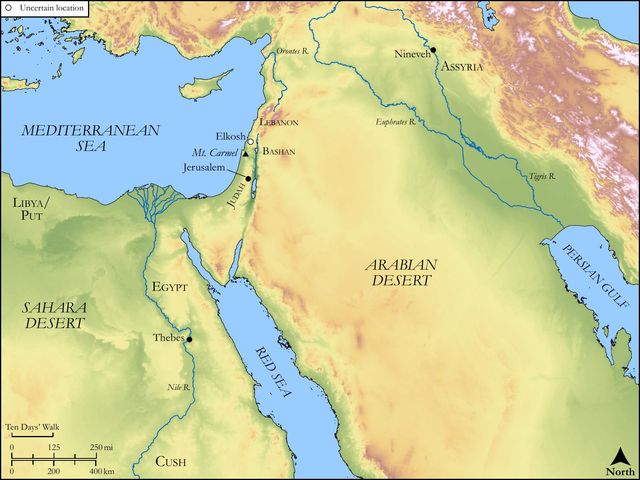
See on the biblical-era map
Study this verse
Public-domain commentary
Matthew Henry
From his Commentary on the Whole Bible. Henry comments on passages, not single verses — this entry covers Nahum 2:1–10. His two-level outline is real structure in the source text, so it is rendered as structure.
Here is, I. An alarm of war sent to Nineveh, Nah 2:1. The prophet speaks of it as just at hand, for it is neither doubtful nor far distant: "Look about thee, and see, he that dashes in pieces has come up before thy face. Nebuchadnezzar, who is noted, and will be yet more so, for dashing nations in pieces, begins with thee, and will dissipate and disperse thee;" so some render the word. Babylon is called the hammer of the whole earth, Jer. 1:23. The attempt of Nebuchadnezzar upon Nineveh is public, bold, and daring: "He has come up before thy face, avowing his design to ruin thee; and therefore stand to thy arms, O Nineveh! keep the munition; secure thy towers and magazines: watch the way; set guards upon all the avenues to the city; make thy loins strong; encourage thy soldiers; animate thyself and them; fortify thy power mightily, as cities do when an enemy is advancing against them" (this is spoken ironically); "do the utmost thou canst, yet thou shalt not be able to put by the stroke of this judgment, for there is no counsel or strength against the Lord."
II.A manifesto published, showing the causes of the war (Nah 2:2):
The Lord has turned away the excellency of Jacob, as the excellency of Israel, that is, 1. The Assyrians have been abusive to Jacob, the two tribes (have humbled and mortified them), as well as to Israel, the ten tribes, have emptied them, and marred their vine-branches. For this God will reckon with them; though done long since, it shall come into the account now against that kingdom, and Nineveh the head-city of it. God's quarrel with them is for the violence done to Jacob. Or, (2.) God is now by Nebuchadnezzar about to turn away the pride of Jacob by the captivity of the two tribes, as he did the pride of Israel by their captivity; He has determined to do it, to bring emptiers upon them, and the enemy that is to do it must begin with Nineveh, and reduce that first, and humble the pride of that. God is looking upon proud cities, and abasing them, even those that are nearest to him. Samaria is humbled, and Jerusalem is to be humbled, and their pride brought low; and shall not Nineveh, that proud city, be brought down too? Emptiers have emptied the cities, and marred the vine-branches in the country of Jacob and Israel; and must not the excellency of Nineveh, that is so much her pride, be turned away too?
III.A particular account given in of the terrors wherein the invading enemy shall appear against Nineveh; every thing shall contribute to make him formidable.
1.The shields of his mighty men are made red, and probably their other arms and array, as if they were already tinctured with the blood they had shed, or intended hereby to signify they would put all to the sword; they hung out a red flag, in token that they would give no quarter.
2.The valiant men are in scarlet; not only red clothes, to intimate what bloody work they designed to make, but rich clothes, to intimate the wealth of the army, and that is the sinews of war.
3.The chariots shall be with flaming torches in the day of his preparation; when they are making their approaches, they shall fly as swiftly as lightning; the wheels shall strike fire upon the stones, and those that drive them shall drive furiously with a flaming indignation, as Jehu drove. Or they carried flaming torches with them in the open chariots, when they made their approach in the night, as Gideon's soldiers carried lamps in their pitchers, to be both a guide to themselves and a terror to their enemies, and with them to set all on fire wherever they went.
4.The fir-trees shall be terribly shaken; the great men of Nineveh, that overtop their neighbours, as the stately firs do the shrubs; or the very standing trees shall be made to shake by the violent concussions of the earth, which that great army shall cause.
5.The chariots of war shall be very terrible (Nah 2:4): They shall rage in the streets, that is, those that drive them shall rage; you would think the chariots themselves raged; they shall be so numerous, and drive with so much fury, that even in the broad ways, where, one would think, there should be room enough, they shall jostle one another; and these iron chariots shall be made so bright that in the beams of the sun they shall seem like torches in the night; they shall run like the lightnings, so swiftly, so furiously. Nebuchadnezzar's commanders are here called his worthies, his gallants (so the margin reads it), his heroes; those he shall recount, and order them immediately and without fail to render themselves at their respective posts, for he is entering upon action, is resolved to take the field immediately, and to open the campaign with the siege of Nineveh. His worthies shall remember (so some read it); they shall be mindful of the duty of their place, and the charge they have received, and shall thereby be made so intent upon their business that they shall stumble in their walks, shall make more haste than good speed; they stumble, but shall not fall; for they shall make haste to the wall thereof, shall open the trenches; and the defence, or the covered way, shall be prepared (something to shelter them from the darts of the besieged), and they shall so closely carry on the siege, and with so much vigour, that at length the gates of the rivers shall be opened (Nah 2:6); those gates of Nineveh which open upon the river Tigris (on which Nineveh was built) shall be first forced by, or betrayed to, the enemy, and by those gates they shall enter. And then the palace shall be dissolved, either the king's house or the house of Nisroch his god; the same word signifies both a palace and a temple. When the God of heaven goes forth to contend with a people, neither the palaces nor their kings, neither the temples nor their gods, can protect and shelter them, but must all inevitably fall with them.
IV.A prediction of the consequences of this; and it is easy to guess how dismal those will be.
1.The queen shall fall into the hands of the enemy (Nah 2:7): Huzzab shall be led away captive; she that was established (so some read it), thought herself safe because she was concealed and shut up in secret, shall be discovered (so the margin reads it) and shall be led away captive, in greater disgrace than that of common prisoners; she shall be brought up in a mock state, and her maids of honour shall lead her, because she is weak and faint, not able to bear such frights and hardships, which are doubly hard and frightful to those that have not been used to them; they shall attend her, not to speak cheerfully to her and to encourage her, but murmuring and moaning themselves, as with the voice of doves, the doves of the valleys (Eze 7:16), noted for their mourning, Isa 38:14; Isa 59:11. They shall be tabering upon their breasts, beating their own breasts in grief and vexation, as if they were drumming upon them, for so the word signifies.
2.The inhabitants, though numerous, shall none of them be able to make head against the invaders, or stand their ground (Nah 2:8): Nineveh is of old like a pool of water, replenished with people as a pool with water (and waters signify multitudes, Rev 17:15), or as those waters with fish; it was long ago a populous city; in Jonah's time there were 120,000 little children in it (Jon 4:11), and, ordinarily, cities and countries are increasing in their number every year; but, though they have so many hands to be employed in the public service, yet they shall not be able to inspire one another with courage, but they shall flee away like cowards. Their commanders shall do what they can to animate them; they shall cry, "Stand, stand, have a good heart on it, and we shall do well enough;" but none shall so much as look back; they shall not have the least spark of courage remaining, but every one shall think it is his wisest course to make his best of the opportunity to escape; they shall not so much as look back to see who calls for them. Note, God can dispirit the strongest and boldest, in the day of distress, so that they shall not be what one would expect from them, but like a pool of water, the water whereof is dried up and gone.
3.The wealth of the city shall become a prey, and all its rich furniture shall fall into the hands of the victorious enemy (Nah 2:9); they shall thus animate and excite one another to plunder: Take the spoil of silver; take the spoil of gold; thus the officers shall stir up the soldiers to improve their opportunity; here are silver and gold enough for them, for there is no end of the store of money and plate. Nineveh, having been of old like a pool of water, has gathered a vast deal of mud; and abundance of glory it has out of all the pleasant furniture, all the vessels of desire, which they have gloried in and which shall now be a prey and a pride to the conquerors. Note, Those who prepare raiment as the clay, and heap up silver as the dust, know not who may put on the raiment and divide the silver, Job 27:16, Job 27:17. Thus this rich city is empty, and void, and waste, Nah 2:10. See the vanity of worldly wealth; instead of defending its owners, it does but expose them, and enable their enemies to do them so much the more mischief.
4.The soldiers and people shall have no heart to appear for the defence of the city. Their spirits shall melt away like wax before the fire; their knees shall smite together (as Belshazzar's did, in his agony, Dan 5:6), so that they shall not be able to stand their ground, no, nor to make their escape; much pain shall be in all loins, as is the case in extreme frights, so that they shall not be able to hold up their backs. And the faces of them all shall gather blackness, like that of a pot that is every day over the fire; so the word signifies. Note, Guilt in the conscience will fill men with terror in an evil day, and those who place their happiness in the wealth of this world and set their hearts upon it think themselves undone when their silver, and their gold, and their pleasant furniture are taken from them.
Historical interpretation
Historical reception
1 surviving comment on this verse from the historical church.
(Verse 10) She is scattered and torn and ripped apart, with a wasting heart, and knees loosened, and weakness in all the kidneys, and the faces of all like the darkness of a pot. LXX: Shaking, trembling, and bubbling, and the breaking of the heart, and knees loosened, and pains over every loin, and the faces of all like the burning of a pot. Under the metaphor of a captive woman, Nineveh is described as scattered, torn, and ripped apart: with a wasting heart, loosened knees, and broken kidneys, and the faces of all its inhabitants, due to the terror of the enemies and the magnitude of fear, appear burnt, wasted, and deformed with paleness. Furthermore, according to the Septuagint, a higher understanding is needed of what the terms 'excussio' and 'rediscussio' signify. As for the people of God, it is as if a person has sinned at some point and returns to their previous state, as Jerusalem is said to them: Shake off the dust from your feet and arise, Jerusalem (Isaiah 52:2). And for someone who is such, that after being shaken off, they may deserve to pass into the arrows of God and be aimed against the enemies by the Lord, it is sung about them: Like arrows in the hand of a mighty one, so are the children of those who are shaken off (Psalm 127:4). And when his footsteps, as though entering upon the earth, are sprinkled with dust, we hear from the Savior: Shake off the dust from your feet as a testimony to them (Mk. 6:11): doubtless he speaks of those who refuse to receive the preachers. But as for Nineveh, which was burdened with all the vessels of its desires, it is not merely shaken off once, but frequently. And after it has been shaken off again, and its surface has been cleaned (so that no impurity remains inside), there is even a boiling, which is more significantly called ἐκβρασμὸς in Greek: for properly speaking, ἐκβρασμὸς is used in such cases, when what was hidden inside erupts to the surface. And the pimples that also arise on the lips after an illness are called ἐκβράσματα, and it seems to indicate health, that the disease has erupted on the surface. But not only is this remedy applied in Nineveh, so that it is frequently shaken off and the hidden illness within its vital organs is forced to leave; but also the breaking and dissolution of the heart and knees ((or kidneys)) is proclaimed, just as the hard and stony heart of Pharaoh was broken, which as long as he had it, he did not let the people of God go (Exodus VII and thereafter): so too the broken heart of Nineveh is softened and transformed into flesh, and the stiff knees that were not previously bowed to God are dissolved, and bend to God: from which all fatherhood in heaven and on earth is named: and at the name of Jesus every knee should bow, of those in heaven, and of those on earth, and of those under the earth (Philippians II, 10). So after they come to know their creator, let them hear: Strengthen the weak hands, and make firm the feeble knees (Isaiah 35:3). And he says, 'Pain upon every loin.' We have already said that intercourse is signified by the loin, and that all works related to mingling are designated by the term 'loins.' Therefore, in the consummation, there will be great pains in the loins, because all the power of the dragon is in the loins (Job 40:11). And for all these things, because of which there is shaking, shaking again, bubbling, and breaking of the heart, dissolving of the knees, pains of the loins, the faces of all will be like the scorching of a pot, so that it either becomes close to fire and heat, or loses the shine of oil and turns black like coal, and is covered with eternal confusion, from which the saint is far off, saying, 'The light of your face has shone upon us, Lord' (Psalm 4:7). For when the face of God is revealed, He is contemplated in His glory (2 Corinthians III). And I think, just as the glory of the sun is different from the glory of the moon and from the glory of the stars, and one star differs from another in brightness (1 Corinthians XV, 41), so in the resurrection of the dead, there will be a great distance between the glory of the saints and the darkness of sinners.
Continue studying Nahum 2:10 across the web’s major study libraries — every link below opens this exact verse, chapter, or book on the destination site.
Read & Compare
 BibleGatewayThis verse in more than 200 translations and 70 languages.
 Bible.comThe YouVersion reader — hundreds of translations, reading plans, and highlights.
 ESV.orgCrossway's official English Standard Version reader.
 NET BibleThe NET translation with 60,000+ translators' notes on every rendering decision.
 STEP BibleTyndale House's free study tool — original text, vocabulary, and scholarly resources.
 BibliaLogos Bible Software's free web reader.
 USCCBThe New American Bible (Revised Edition) with the U.S. bishops' study notes.
Commentaries
 BibleHub CommentariesDozens of classic commentaries on this verse, gathered on one page.
 StudyLightMore than 100 commentary sets — the largest collection on the web.
 BibleRefPlain-English commentary on what this verse means, verse by verse.
 Enduring WordDavid Guzik's free commentary on this chapter, widely used by Bible teachers.
 Bible Study ToolsVerse commentary alongside Greek and Hebrew study aids.
Original Language & Research
- BibleHub InterlinearThe verse word by word — original language, transliteration, and English.
- BibleHub LexiconEvery word's original-language definition and Strong's entry.
 Blue Letter BibleDeep-study tools — Strong's numbers, concordance, and word studies.
 SefariaThe Hebrew text with Rashi and centuries of Jewish commentary.
Sermons, Hymns & Audio


TrulyRandomVerse is not affiliated with these sites and doesn’t control their content. They’re linked because they’re genuinely useful.
Summary
Nahum 2:10 vividly portrays the utter desolation and profound terror that grips Nineveh, the capital of Assyria, as a consequence of divine judgment. The verse employs a series of stark images describing the city's complete emptiness and the physical manifestations of extreme fear among its inhabitants, whose hearts melt, knees tremble, bodies are racked with pain, and faces grow dark with despair, signaling the catastrophic fulfillment of God's prophetic word against a wicked empire.
Context
ShowHideLiterary Context
This verse is situated within Nahum's prophecy of Nineveh's destruction, specifically in Chapter 2, which graphically details the siege and fall of the city. Preceding verses (Nahum 2:1-9) describe the formidable invading army, the preparations for battle, the clatter of chariots, the flashing of spears, and the initial breach of Nineveh's defenses. Verse 10 serves as the culmination of this destructive process, shifting from the actions of the invaders to the resulting state of the city and its people. It paints a picture of the aftermath of the conquest, emphasizing the complete ruin and the psychological and physical collapse of the Ninevites, acting as a stark contrast to the city's former might and arrogance described elsewhere in the book. The subsequent verses (Nahum 2:11-13) continue to lament Nineveh's downfall, likening it to a den of lions that has been utterly destroyed, reinforcing the finality of its judgment.
Historical & Cultural Context
The book of Nahum prophesies against Nineveh, the capital of the Neo-Assyrian Empire, a dominant and notoriously brutal power in the ancient Near East from the 9th to the 7th centuries BC. Assyria was known for its military might, ruthless conquest, and cruel treatment of conquered peoples, including Israel and Judah. Nineveh itself was a massive, fortified city, considered impregnable by its inhabitants. The prophecy of Nahum, likely delivered in the late 7th century BC, foretold its complete destruction, a seemingly improbable event given Assyria's power. This prophecy was dramatically fulfilled in 612 BC when a coalition of Babylonian and Median forces besieged and utterly destroyed Nineveh, leaving it largely uninhabited for centuries. The cultural context includes the common understanding of divine retribution for national sins, especially oppression and idolatry, and the use of vivid, often hyperbolic, language to describe the horrors of war and conquest. The physical reactions described in the verse—melting heart, trembling knees, pain, and darkened faces—were universally recognized signs of extreme terror and despair in the ancient world.
Key Themes
ShowHideNahum 2:10 contributes significantly to several major themes found throughout the book of Nahum and the broader prophetic literature. Foremost is the theme of Divine Judgment, where God, as the sovereign ruler of nations, executes justice against those who defy Him and oppress His people, as declared in Nahum 1:2-3. The verse underscores the Total Desolation that results from this judgment, emphasizing the complete ruin of a once-mighty city, a theme echoed in Nahum 3:7. It also highlights the Fall of Human Power, demonstrating that even the most formidable earthly empires are ultimately transient and subject to God's will, a concept often seen in prophecies against other great cities like Babylon in Isaiah 13. Finally, the detailed physical descriptions in the verse powerfully convey the Physical Manifestation of Terror and Despair, illustrating the overwhelming fear and anguish experienced by those facing God's wrath, a common motif in biblical accounts of divine visitation and judgment.
Exposition and Analysis
ShowHideKey Word Analysis
ShowHide(bâlaq), a primitive root meaning "to annihilate; (make) waste." This word, used in conjunction with "empty" and "void," emphasizes the absolute and irreversible destruction of Nineveh. It signifies not just abandonment, but a deliberate act of making something desolate, utterly destroying its former state and purpose. The city is not merely deserted; it has been reduced to nothingness, a direct result of divine judgment.
(lêb), referring to "the heart; also used (figuratively) very widely for the feelings, the will and even the intellect." In this context, "the heart melteth" signifies not just emotional fear but a complete collapse of courage, will, and inner strength. It portrays a profound psychological and spiritual breakdown, indicating that the Ninevites are utterly demoralized and without hope, their very core dissolving under the weight of terror.
(pânîym), meaning "the face (as the part that turns); used in a great variety of applications (literally and figuratively)." The phrase "faces... gather blackness" vividly describes the physical manifestation of extreme distress. It can imply a pallor or darkness due to shock, despair, or the accumulation of grime and soot from the destruction, symbolizing the complete loss of dignity, vitality, and hope. It is a public display of their inner devastation.
Verse Breakdown
ShowHide"She is empty, and void, and waste:"
This opening clause immediately establishes the complete and utter desolation of Nineveh. The repetition of terms for emptiness and destruction (Hebrew: bûqâh ûmbûqâh ûmbûllâqâh) is highly emphatic, underscoring the absolute ruin of the once-mighty city. It signifies that Nineveh has been plundered, depopulated, and rendered uninhabitable, stripped of all its former glory and inhabitants.
"and the heart melteth,"
This phrase vividly describes the psychological impact of the destruction on the Ninevites. A "melting heart" is a common biblical idiom for extreme fear, loss of courage, and utter despair. It suggests a complete collapse of morale and inner strength, rendering the people powerless and paralyzed by terror in the face of overwhelming catastrophe.
"and the knees smite together,"
This continues the description of physical manifestations of terror. Trembling or "smiting together" knees is a classic sign of intense fear, weakness, and uncontrollable shaking. It portrays a loss of physical control, indicating that the inhabitants are literally unable to stand firm, their bodies betraying their inner panic.
"and much pain [is] in all loins,"
The "loins" (the lower back and hip region) were often associated with strength, procreation, and the core of one's being. "Pain in all loins" signifies intense, agonizing physical distress, often likened to the writhing pain of childbirth (as seen in other prophetic texts describing national anguish). It conveys a widespread, visceral suffering that affects everyone, a deep-seated agony that permeates the entire population.
"and the faces of them all gather blackness."
This final clause provides a striking visual image of the Ninevites' despair. "Gathering blackness" can suggest a darkened countenance due to extreme pallor, the literal grime of destruction, or a metaphorical darkening of expression reflecting profound sorrow, shock, and the absence of hope. It is a public, visible sign of their overwhelming grief and the complete loss of their former pride and vitality.
Literary Devices
ShowHideNahum 2:10 is rich in powerful literary devices that amplify its message of destruction and despair. The opening phrase, Tricolon ("She is empty, and void, and waste"), uses three synonymous terms to create a cumulative effect, emphasizing the thoroughness and totality of Nineveh's desolation. This is further enhanced by Hyperbole, as the descriptions of physical reactions—a melting heart, knees smiting together, and faces gathering blackness—are exaggerated to convey the extreme and overwhelming nature of the terror. The verse employs vivid Imagery that appeals to the senses: the emptiness of the city, the sensation of a dissolving heart, the sound of knocking knees, and the visual of darkened faces. This imagery creates a visceral experience for the reader, allowing them to feel the horror of the Ninevites' plight. Furthermore, the rapid succession of clauses describing physical symptoms ("the heart melteth, and the knees smite together, and much pain [is] in all loins, and the faces of them all gather blackness") creates a strong sense of Parallelism and Anaphora (though less strict on the latter), building a relentless crescendo of despair and illustrating the widespread and pervasive nature of the anguish.
Theological and Thematic Connections
ShowHideNahum 2:10 serves as a profound theological statement on God's unwavering justice and sovereignty over all nations. It demonstrates that no earthly power, no matter how formidable or seemingly impregnable, can escape divine judgment when its actions are characterized by cruelty, oppression, and defiance of God's moral order. The utter desolation of Nineveh is a testament to the principle that God will indeed bring low the proud and will avenge the wrongs committed against His people and against humanity. This verse underscores the terrifying reality of facing God's wrath without repentance, highlighting that the consequences of persistent wickedness are not merely political or military defeat, but a complete existential collapse, marked by physical and psychological agony. It is a stark reminder that true security lies not in fortifications or military might, but in righteousness and submission to the Lord.
Reflection and Application
ShowHideNahum 2:10 offers a sobering reflection on the transient nature of earthly power and the inevitable consequences of unrepentant sin. For us today, it serves as a powerful reminder that human strength, wealth, and security are ultimately fleeting when not grounded in God's eternal truth and justice. We are called to examine where we place our trust: Is it in temporal achievements, material possessions, or societal influence, which can be rendered "empty, and void, and waste" in a moment? Or is it in the unchanging character of God, whose justice will ultimately prevail? This verse also challenges us to consider the impact of our actions on others. Just as Nineveh's cruelty brought about its downfall, so too do individual and corporate injustices accumulate consequences. It compels us to live justly, to seek mercy, and to walk humbly with our God, recognizing that true peace and security are found only in Him. Furthermore, for those who are tempted to despair in the face of widespread evil or injustice, Nahum 2:10 offers a profound reassurance that God sees, God judges, and God will ultimately set all things right, bringing comfort to the oppressed and accountability to the oppressor.
Questions for Reflection
ShowHideFAQ
ShowHideWhat does "She is empty, and void, and waste" signify about Nineveh's destruction?
ShowHideThis phrase signifies the absolute and comprehensive nature of Nineveh's destruction. "Empty," "void," and "waste" (from the Hebrew bûqâh ûmbûqâh ûmbûllâqâh) are highly emphatic terms that describe a city that has been thoroughly plundered, depopulated, and reduced to rubble. It means that Nineveh was not just conquered or occupied, but utterly annihilated, stripped of its inhabitants, wealth, and former glory, becoming a desolate ruin. This state of complete desolation underscores the finality and severity of God's judgment against the Assyrian capital, as prophesied throughout Nahum 2.
What do the physical reactions described in the verse (melting heart, trembling knees, pain, black faces) represent?
ShowHideThese vivid physical reactions are powerful metaphors representing the extreme psychological and emotional impact of Nineveh's downfall on its inhabitants. A "melting heart" (from H3820, lêb) signifies a complete loss of courage and utter despair, a dissolution of inner strength. "Knees smite together" (from H6375, pîyq) depicts uncontrollable trembling and weakness due to intense fear, indicating a physical inability to stand firm. "Much pain in all loins" (from H2479, chalchâlâh, often associated with childbirth pain) conveys widespread, agonizing, visceral suffering and anguish. Finally, "faces... gather blackness" (from H6289, pâʼrûwr, and H6440, pânîym) visually portrays profound shock, despair, and the complete absence of hope or vitality. Together, these images paint a picture of a populace utterly overwhelmed by terror and suffering, experiencing the full horror of divine judgment. Such descriptions are common in prophetic literature to convey the depth of national calamity, as seen in Isaiah 13:7-8.
Christ-Centered Fulfillment
ShowHideWhile Nahum 2:10 graphically depicts the judgment of a specific historical city, Nineveh, it also points to a broader theological truth that finds its ultimate fulfillment in Christ. The terror and desolation described here foreshadow the ultimate judgment against all sin and rebellion against God. Humanity, apart from Christ, stands condemned, facing a "melting heart" of despair and the "blackness" of eternal separation from God, as described in Romans 6:23. However, in Jesus Christ, this terrifying judgment is uniquely absorbed. He, the innocent Lamb of God, willingly endured the ultimate "pain in all loins" and the "melting heart" of agony in Gethsemane and on the cross, taking upon Himself the full wrath of God for sin (Isaiah 53:4-6). Through His sacrifice, those who believe in Him are spared the desolation of eternal judgment, finding refuge and peace in Him. The "empty, void, and waste" state of Nineveh serves as a stark reminder of the fate of all who reject God's grace, while simultaneously highlighting the glorious alternative offered in Christ, who makes all things new and offers a secure, eternal dwelling place for those who trust in Him, a dwelling that will never be "empty, and void, and waste" but filled with His glory (Revelation 21:1-4).