


Nahum 2:6
Bible text: King James Version (1769 Blayney text) · Public domain
Bible text: Berean Standard Bible · Public domain
Bible text: American Standard Version (1901) · Public domain
Bible text: World English Bible, Messianic edition · Public domain
Bible text: Geneva Bible (1599) · Public domain
Bible text: Young's Literal Translation · Public domain
- שַׁעֲרֵיsha·'a·Rei[the] gates ofH8179N-mpcNoun Plural Masculine Construct
- הַנְּהָרוֹתha·ne·ha·Rotthe riversH5104Art ¦ N-fpNoun Plural Feminine Absoluteהַtheנְּהָרוֹתrivers
- נִפְתָּחוּnif·Ta·chuthey have been openedH6605V-Niphal-Perf-3cpVerb Niphal Perfect 3rd Plural common gender
- וְהַהֵיכָלve·ha·hei·Khaland the palaceH1964Conj-w ¦ Art ¦ N-msNoun Singular Masculine Absoluteוְandהַtheהֵיכָלpalace
- נָמוֹגna·Mogit has melted awayH4127V-Niphal-Perf-3msVerb Niphal Perfect 3rd Singular Masculine
English is a literal word-by-word gloss of the Hebrew, not the KJV's wording. Why?
This is the original text the KJV's translators worked from — each Hebrew word with its own literal English meaning in this verse, prepared by scholars at Tyndale House, Cambridge. The KJV translates whole sentences, not word by word, so its wording differs: one Hebrew word can become several English words, and the KJV may choose “the LORD” where the gloss reads “Yahweh”. Both are faithful — they answer different questions. For the KJV's own rendering, switch to the KJV text.
Details
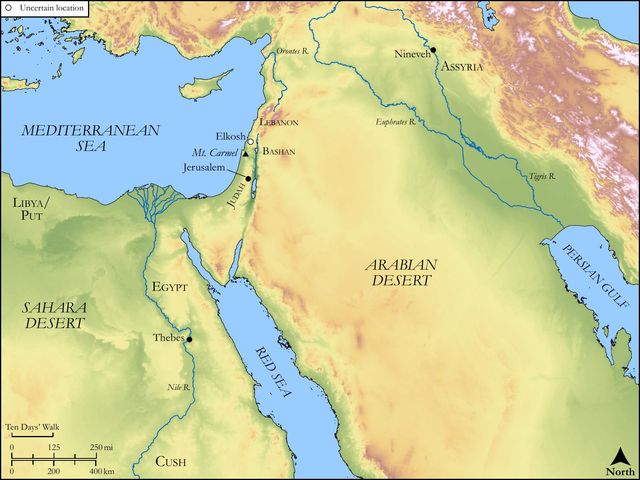
See on the biblical-era map
Study this verse
Public-domain commentary
Matthew Henry
From his Commentary on the Whole Bible. Henry comments on passages, not single verses — this entry covers Nahum 2:1–10. His two-level outline is real structure in the source text, so it is rendered as structure.
Here is, I. An alarm of war sent to Nineveh, Nah 2:1. The prophet speaks of it as just at hand, for it is neither doubtful nor far distant: "Look about thee, and see, he that dashes in pieces has come up before thy face. Nebuchadnezzar, who is noted, and will be yet more so, for dashing nations in pieces, begins with thee, and will dissipate and disperse thee;" so some render the word. Babylon is called the hammer of the whole earth, Jer. 1:23. The attempt of Nebuchadnezzar upon Nineveh is public, bold, and daring: "He has come up before thy face, avowing his design to ruin thee; and therefore stand to thy arms, O Nineveh! keep the munition; secure thy towers and magazines: watch the way; set guards upon all the avenues to the city; make thy loins strong; encourage thy soldiers; animate thyself and them; fortify thy power mightily, as cities do when an enemy is advancing against them" (this is spoken ironically); "do the utmost thou canst, yet thou shalt not be able to put by the stroke of this judgment, for there is no counsel or strength against the Lord."
II.A manifesto published, showing the causes of the war (Nah 2:2):
The Lord has turned away the excellency of Jacob, as the excellency of Israel, that is, 1. The Assyrians have been abusive to Jacob, the two tribes (have humbled and mortified them), as well as to Israel, the ten tribes, have emptied them, and marred their vine-branches. For this God will reckon with them; though done long since, it shall come into the account now against that kingdom, and Nineveh the head-city of it. God's quarrel with them is for the violence done to Jacob. Or, (2.) God is now by Nebuchadnezzar about to turn away the pride of Jacob by the captivity of the two tribes, as he did the pride of Israel by their captivity; He has determined to do it, to bring emptiers upon them, and the enemy that is to do it must begin with Nineveh, and reduce that first, and humble the pride of that. God is looking upon proud cities, and abasing them, even those that are nearest to him. Samaria is humbled, and Jerusalem is to be humbled, and their pride brought low; and shall not Nineveh, that proud city, be brought down too? Emptiers have emptied the cities, and marred the vine-branches in the country of Jacob and Israel; and must not the excellency of Nineveh, that is so much her pride, be turned away too?
III.A particular account given in of the terrors wherein the invading enemy shall appear against Nineveh; every thing shall contribute to make him formidable.
1.The shields of his mighty men are made red, and probably their other arms and array, as if they were already tinctured with the blood they had shed, or intended hereby to signify they would put all to the sword; they hung out a red flag, in token that they would give no quarter.
2.The valiant men are in scarlet; not only red clothes, to intimate what bloody work they designed to make, but rich clothes, to intimate the wealth of the army, and that is the sinews of war.
3.The chariots shall be with flaming torches in the day of his preparation; when they are making their approaches, they shall fly as swiftly as lightning; the wheels shall strike fire upon the stones, and those that drive them shall drive furiously with a flaming indignation, as Jehu drove. Or they carried flaming torches with them in the open chariots, when they made their approach in the night, as Gideon's soldiers carried lamps in their pitchers, to be both a guide to themselves and a terror to their enemies, and with them to set all on fire wherever they went.
4.The fir-trees shall be terribly shaken; the great men of Nineveh, that overtop their neighbours, as the stately firs do the shrubs; or the very standing trees shall be made to shake by the violent concussions of the earth, which that great army shall cause.
5.The chariots of war shall be very terrible (Nah 2:4): They shall rage in the streets, that is, those that drive them shall rage; you would think the chariots themselves raged; they shall be so numerous, and drive with so much fury, that even in the broad ways, where, one would think, there should be room enough, they shall jostle one another; and these iron chariots shall be made so bright that in the beams of the sun they shall seem like torches in the night; they shall run like the lightnings, so swiftly, so furiously. Nebuchadnezzar's commanders are here called his worthies, his gallants (so the margin reads it), his heroes; those he shall recount, and order them immediately and without fail to render themselves at their respective posts, for he is entering upon action, is resolved to take the field immediately, and to open the campaign with the siege of Nineveh. His worthies shall remember (so some read it); they shall be mindful of the duty of their place, and the charge they have received, and shall thereby be made so intent upon their business that they shall stumble in their walks, shall make more haste than good speed; they stumble, but shall not fall; for they shall make haste to the wall thereof, shall open the trenches; and the defence, or the covered way, shall be prepared (something to shelter them from the darts of the besieged), and they shall so closely carry on the siege, and with so much vigour, that at length the gates of the rivers shall be opened (Nah 2:6); those gates of Nineveh which open upon the river Tigris (on which Nineveh was built) shall be first forced by, or betrayed to, the enemy, and by those gates they shall enter. And then the palace shall be dissolved, either the king's house or the house of Nisroch his god; the same word signifies both a palace and a temple. When the God of heaven goes forth to contend with a people, neither the palaces nor their kings, neither the temples nor their gods, can protect and shelter them, but must all inevitably fall with them.
IV.A prediction of the consequences of this; and it is easy to guess how dismal those will be.
1.The queen shall fall into the hands of the enemy (Nah 2:7): Huzzab shall be led away captive; she that was established (so some read it), thought herself safe because she was concealed and shut up in secret, shall be discovered (so the margin reads it) and shall be led away captive, in greater disgrace than that of common prisoners; she shall be brought up in a mock state, and her maids of honour shall lead her, because she is weak and faint, not able to bear such frights and hardships, which are doubly hard and frightful to those that have not been used to them; they shall attend her, not to speak cheerfully to her and to encourage her, but murmuring and moaning themselves, as with the voice of doves, the doves of the valleys (Eze 7:16), noted for their mourning, Isa 38:14; Isa 59:11. They shall be tabering upon their breasts, beating their own breasts in grief and vexation, as if they were drumming upon them, for so the word signifies.
2.The inhabitants, though numerous, shall none of them be able to make head against the invaders, or stand their ground (Nah 2:8): Nineveh is of old like a pool of water, replenished with people as a pool with water (and waters signify multitudes, Rev 17:15), or as those waters with fish; it was long ago a populous city; in Jonah's time there were 120,000 little children in it (Jon 4:11), and, ordinarily, cities and countries are increasing in their number every year; but, though they have so many hands to be employed in the public service, yet they shall not be able to inspire one another with courage, but they shall flee away like cowards. Their commanders shall do what they can to animate them; they shall cry, "Stand, stand, have a good heart on it, and we shall do well enough;" but none shall so much as look back; they shall not have the least spark of courage remaining, but every one shall think it is his wisest course to make his best of the opportunity to escape; they shall not so much as look back to see who calls for them. Note, God can dispirit the strongest and boldest, in the day of distress, so that they shall not be what one would expect from them, but like a pool of water, the water whereof is dried up and gone.
3.The wealth of the city shall become a prey, and all its rich furniture shall fall into the hands of the victorious enemy (Nah 2:9); they shall thus animate and excite one another to plunder: Take the spoil of silver; take the spoil of gold; thus the officers shall stir up the soldiers to improve their opportunity; here are silver and gold enough for them, for there is no end of the store of money and plate. Nineveh, having been of old like a pool of water, has gathered a vast deal of mud; and abundance of glory it has out of all the pleasant furniture, all the vessels of desire, which they have gloried in and which shall now be a prey and a pride to the conquerors. Note, Those who prepare raiment as the clay, and heap up silver as the dust, know not who may put on the raiment and divide the silver, Job 27:16, Job 27:17. Thus this rich city is empty, and void, and waste, Nah 2:10. See the vanity of worldly wealth; instead of defending its owners, it does but expose them, and enable their enemies to do them so much the more mischief.
4.The soldiers and people shall have no heart to appear for the defence of the city. Their spirits shall melt away like wax before the fire; their knees shall smite together (as Belshazzar's did, in his agony, Dan 5:6), so that they shall not be able to stand their ground, no, nor to make their escape; much pain shall be in all loins, as is the case in extreme frights, so that they shall not be able to hold up their backs. And the faces of them all shall gather blackness, like that of a pot that is every day over the fire; so the word signifies. Note, Guilt in the conscience will fill men with terror in an evil day, and those who place their happiness in the wealth of this world and set their hearts upon it think themselves undone when their silver, and their gold, and their pleasant furniture are taken from them.
Historical interpretation
Historical reception
2 surviving comments on this verse. Each one is dated, so this reads as a timeline rather than a list.
Select a marker to jump to its quote. Markers stagger vertically where authors wrote within a few decades of each other.
But is this the only place we read of “substance”? Has it not also been said in another passage: “The gates of the cities are broken down, the mountains are fallen, and his substance is revealed”? What, does the word mean something created here also? Some, I know, are accustomed to say that the substance is substance in money. Then, if you give this meaning to the word, the mountains fell in order that someone’s possessions of money might be seen. But let us remember what mountains fell, those, namely, of which it has been said, “If you shall have faith as a grain of mustard seed you shall say to this mountain, ‘Be removed, and be cast into the sea!’ ” By mountains, then, are meant high things that exalt themselves.
(Verse 3 and following) The shield of the strong is ablaze, the men of the army in scarlet; the fiery chariots are on the day of its preparation; and the drivers are asleep, they are disturbed on the journey, the chariots collide in the streets. Their appearance is like torches, like lightning running to and fro. They will remember their mighty men, they will rush on their way, they will quickly climb its walls, and the shelter will be prepared. The gates of the rivers are opened, and the temple is laid waste to the ground, and the captive soldier is taken away, and her maidservants threatened, moaning like doves, murmuring in their hearts. LXX: The arms of his power are from men, strong men mocking in fire, the reins of their chariots on the day of his preparation, and the horsemen will fear in the exits: and the chariots will be confounded, and they will collide in the streets. Their appearance is like lamps of fire, and like running lightning, and their nobles will be remembered, and they will flee in the days, and they will be weakened on their journey, and they will hasten to the walls, and they will prepare their defenses: the gates of the cities are open, and the royal palaces have fallen, and the wealth has been revealed; and she herself ascended, and her maids were led like doves speaking in their hearts. According to the history, the order follows against Nineveh, and the army of the Babylonians coming against it is described. Moreover, what it says: fiery reins of chariots, in burning cords, signifies the preparedness of speed, and is narrated as the parade of those preparing for battle. And now the Scripture weaves together things that Israel once suffered, things that Assyria did, and things that the Babylonians practice against the Assyrians. Therefore, he says, it is not surprising that they come so quickly to devastate, since the charioteers and strong men, either before or after, have been put to sleep, either in Israel or in Assyria. And returning to the order of description: The multitude of those coming is so great, that the marching column is mixed together on the path, and cannot be distinguished. The chariots themselves, while not finding the way, collide with each other in the streets due to the multitude. The appearance of the Babylonians is like lamps, like lightning running around, so that they terrify their enemies before they defeat them with the sword. Then Assyria will remember its strong ones, and will seek out those who fell on the journeys, and will quickly climb the walls of Nineveh, and because of the very long siege will prepare tents to drive away the heat. But what does it profit to build a house, unless the Lord builds it? What does it profit to close the gates, which the Lord opens? The gates of Nineveh are open, which had a multitude of citizens like rivers, and its temple, that is, its kingdom, is destroyed, and its soldiers are taken captive, that is, they are all led into Babylon. But understand that the handmaids of Nineveh, by metaphor, are the smaller cities, villages, and castles. Indeed, even the captive women will threaten before the faces of the victors; and there will be so great a terror that not even a sob or a wail of pain will burst forth, but they will silently groan within themselves and, with a muffled murmur, swallow their tears in the manner of cooing doves. This is according to Hebrew tradition. Now let us come to the translators of the Septuagint. They examined, who shook off Jacob and Israel, and dispersed their scourges; they also broke the weapons which they had been accustomed to have in order to hurl insults, and with which they had oppressed the weak; and not only did they do this, but they also burned the strong men who were mocking in the fire. Consider if you can say that strong men deride in the fire, the opposite strengths that serve as burning darts of the devil, who once had strong men deriding in the fire Jacob and Israel, having chariots and horses on which they were carried swiftly into battle on the day of their preparation. Therefore, the reins of these chariots and the horsemen will be confused on their journeys, and they will collide in the streets, when the illumination of the Lord shines upon Jacob and Israel, both demons and those who serve their will, will be overthrown by the Lord. We can understand these things by his coming, when brave men and charioteers and horsemen were speaking: What have we to do with you, Son of David? Have you come here to torment us before the time? (Matth. VIII, 29) But since we have once received a prophecy against Nineveh concerning the end of the world, it is better that we say that the weapons of the power of the devil were then taken away from men, and his strong ministers, who deceived men in fire. For all those who adulterate, their hearts are like an oven; the chains by which they were led into vices and the chariot's wheels will be released. The horsemen will be fearful at the exits, which is at the end of the world, and they will be confused and the chariots will collide in the streets. For although there is a wide and spacious road that leads to death, they will not be able to find the right path due to the pressure of time. They will collide with each other and yet continue to breathe out their old fury, flashing here and there like lightning. I saw, said the Lord, Satan falling like lightning from heaven (Luke 10:18). When the devil and all his officials understand this, they will remember the end that was predicted in the past, and they will flee in those days. For they will not move about at night, but as the day dawns, darkness will be driven away, and they will be weakened on their journey, making no progress and not fulfilling their efforts, and they will hasten to the walls. Indeed, such a great terror of the coming Lord will invade them, and they will be so weak to resist that they will flee to the ends of the world, where the world is enclosed and surrounded like walls, and they will prepare themselves to resist. When someone flees from an enemy, not daring to resist them, and comes to a solitary place, if by chance the enemy pursues them, they are forced to fight back out of necessity. But as they ponder these things, everything they have obtained and possessed will be brought forth and the doors they had closed will be opened, and their kingdoms will fall, and their wealth, that is, their riches, will be revealed. However, the substance of the world itself and all its servants, after they submit themselves to Christ and begin to serve Him, will be led joyfully and with gladness, and from the depths of their hearts they will believe, so that they may be compared to the cleanliness of doves, and they will murmur or speak in their hearts. And then will be fulfilled what is said in the sixty-seventh psalm about the victory of the Savior: He ascended on high, he led captivity captive.
Continue studying Nahum 2:6 across the web’s major study libraries — every link below opens this exact verse, chapter, or book on the destination site.
Read & Compare
 BibleGatewayThis verse in more than 200 translations and 70 languages.
 Bible.comThe YouVersion reader — hundreds of translations, reading plans, and highlights.
 ESV.orgCrossway's official English Standard Version reader.
 NET BibleThe NET translation with 60,000+ translators' notes on every rendering decision.
 STEP BibleTyndale House's free study tool — original text, vocabulary, and scholarly resources.
 BibliaLogos Bible Software's free web reader.
 USCCBThe New American Bible (Revised Edition) with the U.S. bishops' study notes.
Commentaries
 BibleHub CommentariesDozens of classic commentaries on this verse, gathered on one page.
 StudyLightMore than 100 commentary sets — the largest collection on the web.
 BibleRefPlain-English commentary on what this verse means, verse by verse.
 Enduring WordDavid Guzik's free commentary on this chapter, widely used by Bible teachers.
 Bible Study ToolsVerse commentary alongside Greek and Hebrew study aids.
Original Language & Research
- BibleHub InterlinearThe verse word by word — original language, transliteration, and English.
- BibleHub LexiconEvery word's original-language definition and Strong's entry.
 Blue Letter BibleDeep-study tools — Strong's numbers, concordance, and word studies.
 SefariaThe Hebrew text with Rashi and centuries of Jewish commentary.
Sermons, Hymns & Audio


TrulyRandomVerse is not affiliated with these sites and doesn’t control their content. They’re linked because they’re genuinely useful.
Summary
Nahum 2:6 vividly prophesies the dramatic and inevitable downfall of Nineveh, the formidable capital of the Assyrian Empire. This verse describes how the city's seemingly impregnable defenses, particularly those connected to its waterways, would be breached, leading to the complete collapse and dissolution of its royal authority and physical structures. It underscores God's sovereign judgment against a city renowned for its cruelty and oppression, asserting that no earthly power can withstand His divine decree.
Context
ShowHideLiterary Context
Nahum's prophecy is a "burden" (Nahum 1:1) against Nineveh, a stark contrast to Jonah's earlier message of repentance. The book's three chapters systematically build towards the city's destruction, detailing the Lord's character as a jealous and avenging God (Nahum 1:2-3), the siege (Nahum 2:1-5), and the ultimate devastation. Nahum 2:6 specifically describes a pivotal moment in the siege, explaining how the city's defenses would fail, setting the stage for the subsequent scenes of plunder and desolation (Nahum 2:9-10). It highlights the unexpected vulnerability of Nineveh, a city thought to be invincible, by focusing on its strategic water defenses.
Historical & Cultural Context
Nineveh, located on the east bank of the Tigris River, was one of the largest and most fortified cities of that day. Its defenses included massive walls, in some places over 100 feet high and 50 feet thick, protected by moats and the rivers Tigris and Khosr. The city's reputation for military might and cruelty (Nahum 3:1-4) made its impending fall a shocking and significant event. Historically, Nineveh fell in 612 BC to a coalition of Babylonians and Medes. Ancient accounts, notably by Diodorus Siculus, corroborate Nahum's prophecy, stating that a great flood of the Tigris River undermined a portion of the city's walls, creating a breach that allowed the besieging forces to enter. This verse, therefore, speaks to a specific, divinely orchestrated event that exploited a perceived strength of the city.
Key Themes
ShowHideNahum 2:6 powerfully contributes to several overarching themes in the book of Nahum and broader biblical theology. It is a striking illustration of Divine Judgment, demonstrating God's righteous wrath against wickedness and oppression, affirming that no nation, however mighty, is beyond His justice. The "palace" dissolving signifies the Vulnerability of Earthly Power and the transience of human kingdoms before God's sovereignty, echoing the sentiment that "the Lord frustrates the plans of the nations" Psalm 33:10. Furthermore, the "gates of the rivers" being opened highlights God's Dominion Over Creation, showing His ability to use natural forces as instruments of His judgment, a theme seen repeatedly from the flood in Genesis to the plagues in Exodus. Finally, the declarative language of the verse reinforces the Certainty of Prophecy, assuring the reader that God's word, once spoken, will surely come to pass.
Exposition and Analysis
ShowHideKey Word Analysis
ShowHideMeaning "an opening, i.e., door or gate." In the context of a fortified city like Nineveh, these were not merely entrances but crucial points of defense. The mention of "gates of the rivers" suggests specific fortified points where rivers entered or exited the city, or perhaps floodgates designed to control water flow for defensive purposes. Their "opening" implies a catastrophic breach, either by natural force or enemy action facilitated by nature.
Referring to "a large public building, such as a palace or temple." In this context, it specifically denotes the royal residence and the seat of Assyrian power. Its dissolution signifies the complete collapse of the ruling authority, the destruction of the king's dominion, and the physical ruin of the structure itself, symbolizing the end of the Assyrian Empire's reign.
A primitive root meaning "to melt, i.e., literally (to soften, flow down, disappear), or figuratively (to fear, faint)." This powerful verb describes a process of disintegration, as if the very foundations of the palace were melting away. It conveys not just destruction, but a complete, irreversible disintegration, emphasizing the utter ruin and loss of substance.
Verse Breakdown
ShowHide"The gates of the rivers shall be opened"
This phrase points to the specific means of Nineveh's downfall. The "gates of the rivers" likely refers to the fortified points where the Tigris River or its tributary, the Khosr, flowed into or through the city. These were critical elements of Nineveh's defense, designed to protect against invasion. The declaration that they "shall be opened" indicates a catastrophic failure of these defenses, either through a divinely orchestrated flood that overwhelmed them, or through the enemy's exploitation of a flood-induced weakness, allowing access to the city. This opening signifies the breaching of the city's most secure points, rendering its massive walls useless.
"and the palace shall be dissolved"
This second clause describes the inevitable consequence of the breached defenses: the destruction of the very heart of Assyrian power. The "palace," representing the king, his authority, and the entire empire, is depicted as "dissolving." This imagery suggests a complete and utter disintegration, as if the structure itself were melting or crumbling into nothingness. It is a vivid picture of total ruin, symbolizing the end of Nineveh's tyrannical rule and the complete collapse of its political and military might. The use of "dissolved" emphasizes the irreversible and comprehensive nature of this destruction, leaving no remnant of its former glory.
Literary Devices
ShowHideNahum 2:6 employs several powerful literary devices to convey its prophetic message. Vivid Imagery is paramount, painting a dramatic picture of water breaching defenses and structures melting away, making the prophecy concrete and impactful. The phrase "gates of the rivers" uses Metonymy, where "gates" stands for the entire defensive system related to the waterways, and "rivers" represents the natural forces or strategic water features. The verb "dissolved" (mûwg) functions as Hyperbole and Metaphor, exaggerating the effect of destruction to convey total annihilation, as if the solid palace were literally melting like wax. This Prophetic Language is declarative and certain, using future tense verbs ("shall be opened," "shall be dissolved") to emphasize the inevitability and divine certainty of Nineveh's doom, reinforcing God's absolute control over history and the fate of nations.
Theological and Thematic Connections
ShowHideNahum 2:6 serves as a profound theological statement on God's unwavering justice and sovereignty over all earthly powers. It demonstrates that no human stronghold, no matter how formidable or seemingly impregnable, can ultimately withstand the righteous judgment of the Almighty. The fall of Nineveh, a city synonymous with oppression and cruelty, underscores the biblical principle that God will ultimately bring an end to injustice and wickedness. This verse reminds us that worldly power and security are transient and ultimately subject to divine decree, urging us to place our trust not in fleeting human achievements but in the eternal God who upholds justice.
Reflection and Application
ShowHideNahum 2:6 offers timeless lessons for believers today. Firstly, it stands as a powerful reminder that God is a God of justice who sees and responds to the suffering caused by oppression and wickedness. While His judgment may seem delayed, it is ultimately certain. This provides comfort and hope to those who feel overwhelmed by injustice in the world, assuring them that God will one day set all things right. Secondly, the dissolution of Nineveh's palace, a symbol of ultimate power and security, challenges us to examine where we place our ultimate trust. Do we rely on our financial stability, social status, national strength, or personal accomplishments for security? This verse calls us to recognize the transient nature of all earthly things and to anchor our hope and security in the unshakeable kingdom of God. Finally, it encourages us to live lives that reflect God's justice and compassion, knowing that He holds all nations and individuals accountable for their actions.
Questions for Reflection
ShowHideFAQ
ShowHideWhat is the historical evidence for the "gates of the rivers" being opened?
ShowHideHistorical accounts largely align with Nahum's prophecy. The Greek historian Diodorus Siculus, writing centuries after the event, recorded that Nineveh fell to the combined forces of the Babylonians and Medes in 612 BC. He specifically mentions that during a prolonged siege, heavy rains caused the Tigris River to flood, undermining a significant portion of Nineveh's massive walls. This breach, caused by the "opened" river, allowed the besieging armies to finally enter and conquer the city. While Diodorus's account is not a direct eyewitness report, it is the most detailed ancient historical narrative available and strongly corroborates the prophetic imagery of Nahum 2:6, highlighting the role of water in the city's downfall.
Why is the "palace" specifically mentioned as being "dissolved"?
ShowHideThe mention of the "palace" (Hebrew: hêykâl) is highly significant because it represents the very heart of the Assyrian Empire's power, authority, and identity. It was the seat of the king, the center of governance, and a symbol of Nineveh's might and splendor. Its "dissolution" (Hebrew: mûwg) signifies a complete and utter collapse, not just a defeat or capture. This powerful imagery conveys that the entire structure of Assyrian rule would disintegrate, its power melting away as if it never existed. It emphasizes the totality of God's judgment, targeting the very core of Nineveh's oppressive regime and ensuring its irreversible end.
Christ-Centered Fulfillment
ShowHideWhile Nahum 2:6 directly prophesies the historical fall of Nineveh, its deeper Christ-centered fulfillment lies in the ultimate triumph of God's justice and the establishment of His eternal kingdom through Jesus Christ. Nineveh's dissolution, brought about by divine decree, foreshadows the ultimate judgment that will be executed by Christ, who is appointed by God as the judge of the living and the dead Acts 10:42. Just as Nineveh's seemingly impregnable defenses crumbled before God's power, all earthly strongholds, human pride, and injustice will ultimately be dissolved at the coming of Christ's kingdom. Jesus Himself declared that "Heaven and earth will pass away, but my words will not pass away" Matthew 24:35, affirming the transient nature of all worldly powers in contrast to His eternal reign. The "palace" of Nineveh, a symbol of human dominion, gives way to the eternal "palace" of God's presence, where Christ reigns supreme. Ultimately, the judgment against Nineveh points forward to the day when Christ will bring all things to their just conclusion, establishing a new heaven and a new earth where righteousness dwells and there will be no more sorrow, crying, or pain Revelation 21:1-4. This is the ultimate fulfillment of God's promise to bring an end to all wickedness and usher in His perfect, eternal reign.