


Jeremiah 50:44
- הִנֵּהHi·nehthere!H2009PrtParticle Interjection
- כְּאַרְיֵהke·'ar·Yehlike a lionH738Prep-k ¦ N-msNoun Singular Masculine Absoluteכְּlikeאַרְיֵהa lion
- יַעֲלֶהya·'a·Leh[which] it goes upH5927V-Qal-Imperf-3msVerb Qal Imperfect 3rd Singular Masculine
- מִגְּאוֹןmi·ge·'onfrom [the] thicket[s] ofH1347Prep-m ¦ N-mscNoun Singular Masculine Constructמִfromגְּאוֹן[the] thicket[s] of
- הַיַּרְדֵּןhai·yar·Denthe JordanH3383Art ¦ N-properNoun Proper LocationהַtheיַּרְדֵּןJordan
- אֶל'eltoH413PrepPreposition
- נְוֵהne·Vehpastureland ofH5116N-mscNoun Singular Masculine Construct
- אֵיתָן'ei·Tanan ever-flowing [stream]H386Adj-msAdjective Singular Masculine Absolute
- כִּיkiforH3588PrtParticle Conditional
- אַרְגִּעָה'ar·Gi·'ahI will act in a momentH7280V-Hiphil-Imperf-1csVerb Hiphil Imperfect 1st Singular common gender
- אֲרִיצֵם'a·ru·tzemI will cause to run themH7323V-Hiphil-Imperf-1cs ¦ 3mpVerb Hiphil Imperfect 1st Singular common genderאֲרִיצֵI will cause to runםthem
- מֵעָלֶיהָme·'a·Lei·hafrom on <the> itH5921Prep-m ¦ Prep ¦ 3fsPreposition Definiteמֵfromעָלֶיon <the>הָit
- וּמִיu·Miand whoeverH4310Conj-w ¦ InterrogPronoun Interrogativeוּandמִיwhoever
- בָחוּרva·Chur[is] chosenH977V-Qal-PassPrtcpl-msVerb Qal Participle Passive Singular Masculine Absolute
- אֵלֶיהָ'e·Lei·hato itH413Prep ¦ 3fsPreposition Definiteאֵלֶיtoהָit
- אֶפְקֹד'ef·KodI will appointH6485V-Qal-Imperf-1csVerb Qal Imperfect 1st Singular common gender
- כִּיkiforH3588PrtParticle Conditional
- מִיmiwho?H4310InterrogPronoun Interrogative
- כָמוֹנִיkha·Mo·ni[is] like meH3644Prep ¦ 1csPreposition Definiteכָמוֹ[is] likeנִיme
- וּמִיu·Miand who?H4310Conj-w ¦ InterrogPronoun Interrogativeוּandמִיwho?
- יוֹעִדֶנִּיyo·'i·De·niwill he summon meH3259V-Hiphil-Imperf-3ms ¦ 1csVerb Hiphil Imperfect 3rd Singular Masculineיוֹעִדֶwill he summonנִּיme
- וּמִיu·miand who?H4310Conj-w ¦ InterrogPronoun Interrogativeוּandמִיwho?
- זֶהzehthisH2088PrtParticle Demonstrative
- רֹעֶהro·'Eh[is] a shepherdH7462V-Qal-Prtcpl-msVerb Qal Participle Singular Masculine Absolute
- אֲשֶׁר'a·SherwhoH834RelParticle Relative
- יַעֲמֹדya·'a·Modhe will standH5975V-Qal-Imperf-3msVerb Qal Imperfect 3rd Singular Masculine
- לְפָנָיle·fa·Nai<to> before meH6440Prep-l ¦ N-mpc ¦ 1csNoun Plural Masculine Constructלְ<to>פָנָbeforeיme
English is a literal word-by-word gloss of the Hebrew, not the KJV's wording. Why?
This is the original text the KJV's translators worked from — each Hebrew word with its own literal English meaning in this verse, prepared by scholars at Tyndale House, Cambridge. The KJV translates whole sentences, not word by word, so its wording differs: one Hebrew word can become several English words, and the KJV may choose “the LORD” where the gloss reads “Yahweh”. Both are faithful — they answer different questions. For the KJV's own rendering, switch to the KJV text.
Details
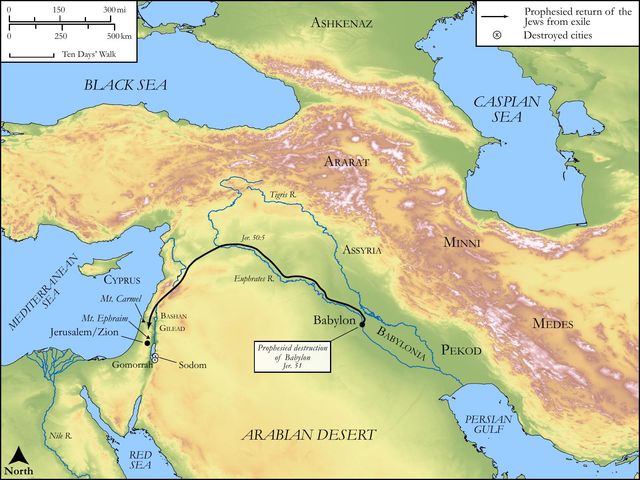
See on the biblical-era map
Study this verse
Public-domain commentary
Matthew Henry
From his Commentary on the Whole Bible. Henry comments on passages, not single verses — this entry covers Jeremiah 50:33–46. His four-level outline is real structure in the source text, so it is rendered as structure.
We have in these verses,
I.Israel's sufferings, and their deliverance out of those sufferings.
God takes notice of the bondage of his people in Babylon, as he did of their bondage in Egypt; he has surely seen it, and has heard their cry. Israel and Judah were oppressed together, Jer 50:33. Those that remained of the captives of the ten tribes, upon the uniting of the kingdoms of Assyria and Chaldea, seem to have come and mingled with t hose of the two tribes, and to have mingled tears with them, so that they were oppressed together. They were humble suppliants for their liberty, and that was all; they could not attempt any thing towards it, for all that took them captives held them fast, and were much too hard for them. But this is their comfort in distress, that, though they are weak, their Redeemer is strong (Jer 50:34), their Avenger (so the word signifies), he that has a right to them, and will claim his right and make good his claim. He is stronger than their enemies that hold them fast; he can overpower all the force that is against them, and put strength into his own people though they are very weak. The Lord of hosts is his name, and he will answer to his name, and make it to appear that he is what his people call him, and will be that to them for which they depend upon him. Note, It is the unspeakable comfort of the people of God that, though they have hosts against them, they have the Lord of hosts for them and he shall thoroughly plead their cause, pleading he shall plead it, plead it with jealousy, plead it effectually, plead it and carry it, that he may give rest to the land, and to his people's land, rest from all their enemies round about. This is applicable to all believers, who complain of the dominion of sin and corruption, and of their own weakness and manifold infirmities. Let them know that their Redeemer is strong; he is able to keep what they commit to him, and he will plead their cause. Sin shall not have dominion over them; he will make them free, and they shall be free indeed; he will give them rest, that rest which remains for the people of God.
II.Babylon's sin, and their punishment for that sin.
1.The sins they are here charged with are idolatry and persecution.
(1.)They oppressed the people of God; they held them fast, and would not let them go. They opened not the house of his prisoners, Isa 14:17. This was God's quarrel with them, as of old with Pharaoh; it cost him dear, and yet they would not take warning. The inhabitants of Babylon must be disquieted (Jer 50:34) because they have disquieted God's people, whose honour and comfort he is jealous for, and therefore will recompense tribulation to those that trouble them, as well as rest to those that are troubled, Th2 1:6, Th2 1:7.
(2.)They wronged God himself, and robbed him, giving that glory to others which is due to him alone; for (Jer 50:38) it is the land of graven images. All parts of the country abounded with idols, and they were mad upon them, were in love with them and doted on them, cared not what cost and pains they were at in the worship of them, were unwearied in paying their respects to them; and in all this they were wretchedly infatuated and acted like men out of their wits; they were carried on in their idolatry without reason or discretion, like men in a perfect fury. The word here used for idols properly signifies terrors - Enim, the name given to giants that were formidable, because they made the images of their gods to look frightful, to strike a terror upon fools and children. Their idols were scarecrows, yet they doted on them. Babylon was the mother of harlots (Rev 17:5), the source of idolatry. Note, It is the maddest thing in the world to make a god of any creature; and those who are proud against the Lord, the true God, are justly given up to strong delusions, to be mad upon idols that cannot profit. But this madness is wickedness, for which sinners will be certainly and severely reckoned with.
2.The judgments of God upon them for these sins are such as will quite lay them waste and ruin them.
(1.)All that should be their defence and support shall be cut off by the sword. The Chaldeans had long been God's sword, wherewith he had done execution upon the sinful nations round about: but now, they being as bad as any of them, or worse, a sword is brought upon them, even upon the inhabitants of Babylon (Jer 50:35), a sword of war; and, as it is in God's hand, sent and directed by him, it is a sword of justice. It shall be,
[1.]Upon their princes; they shall fall by it, and their dignity, wealth, and power, shall not secure them.
[2.]Upon their wise men, their philosophers, their statesmen, and privy-counsellors; their learning and policy shall neither secure them nor stand the public in any stead.
[3.]Upon their soothsayers and astrologers, here called the liars (Jer 50:36), for they cheated with their prognostications of peace and prosperity; the sword upon them shall make them dote, so that they shall talk like fools, and be as men that have lost all their wits. Note, God has a sword that can reach the soul and affect the mind, and bring men under spiritual plagues.
[4.]Upon their mighty men. A sword shall be upon their spirits; if they are not slain, yet they shall be dismayed, and shall be no longer mighty men; for what stead will their hands stand them in when their hearts fail them?
[5.]Upon their militia (Jer 50:37): The sword shall be upon their horses and chariots; the invaders shall make themselves masters of all their warlike stores, shall seize their horses and chariots for themselves, or destroy them. The troops of other nations that were in their service shall be quite disheartened: The mingled people shall become as weak and timorous as women.
[6.]Upon their exchequer: The sword shall be upon her treasures, which are the sinews of war, and they shall be robbed, and made use of by the enemy against them. See what universal destruction the sword makes when it comes with commission.
(2.)The country shall be made desolate (Jer 50:38): The waters shall be dried up, the water that secures the city. Cyrus drew the river Euphrates into so many channels as made it passable for his army, so that they got with ease to the walls of Babylon, which, if was thought, that river had rendered inaccessible. "The water likewise that made the country fruitful shall be dried up, so that it shall be turned into barrenness, and shall be no more inhabited by the children of men, but by the wild beasts of the desert," Jer 50:39. This was foretold concerning Babylon, Isa 13:19-22. It shall become like Sodom and Gomorrah, Jer 50:40. The same was foretold concerning Edom, Jer 49:18. As the Chaldeans had laid Edom waste, so they shall themselves be laid waste.
(3.)The king and kingdom shall be put into the utmost confusion and consternation by the enemies' invading them, Jer 50:41-43. All the expressions here used to denote the formidable power of the invaders, the terrors wherewith they should array themselves, and the great fright which both court and country should be put into thereby, we met with before (Jer 6:22-24) concerning the Chaldeans' invading the land of Judah. The battle which is there said to be against thee, O daughter of Zion! is here said to be against thee, O daughter of Babylon! to intimate that they should be paid in their own coin. God can find out such as shall be for terror and destruction to those that are for terror and destruction to others; and those who have dealt cruelly, and have shown no mercy, may expect to be cruelly dealt with, and to find no mercy. Only there is one difference between these passages; there it is said, We have heard the fame thereof and our hands wax feeble; here it is said, The king of Babylon has heard the report and his hands waxed feeble, which intimates that that proud and daring prince shall, in the day of his distress, be as weak and dispirited as the meanest Israelites were in the day of their distress.
(4.)That they shall be as much hurt as frightened, for the invader shall come up like a lion to tear and destroy (Jer 50:44) and shall make them and their habitation desolate (Jer 50:45), and the desolation shall be so astonishing that all the nations about shall be terrified by it, Jer 50:46. These three verses we had before (Jer 49:19-21) in the prophecy of the destruction of Edom, which was accomplished by the Chaldeans, and they are here repeated, mutatis mutandis - with a few necessary alterations, in the prophecy of the destruction of Babylon, which was to be accomplished upon the Chaldeans, to show that though the distributions of Providence may appear unequal for a time its retributions will be equal at last; when thou shalt make an end to spoil thou shalt be spoiled, Isa 33:1; Rev 13:10.
Continue studying Jeremiah 50:44 across the web’s major study libraries — every link below opens this exact verse, chapter, or book on the destination site.
Read & Compare
 BibleGatewayThis verse in more than 200 translations and 70 languages.
 Bible.comThe YouVersion reader — hundreds of translations, reading plans, and highlights.
 ESV.orgCrossway's official English Standard Version reader.
 NET BibleThe NET translation with 60,000+ translators' notes on every rendering decision.
 STEP BibleTyndale House's free study tool — original text, vocabulary, and scholarly resources.
 BibliaLogos Bible Software's free web reader.
 USCCBThe New American Bible (Revised Edition) with the U.S. bishops' study notes.
Commentaries
 BibleHub CommentariesDozens of classic commentaries on this verse, gathered on one page.
 StudyLightMore than 100 commentary sets — the largest collection on the web.
 BibleRefPlain-English commentary on what this verse means, verse by verse.
 Enduring WordDavid Guzik's free commentary on this chapter, widely used by Bible teachers.
 Bible Study ToolsVerse commentary alongside Greek and Hebrew study aids.
Original Language & Research
- BibleHub InterlinearThe verse word by word — original language, transliteration, and English.
- BibleHub LexiconEvery word's original-language definition and Strong's entry.
 Blue Letter BibleDeep-study tools — Strong's numbers, concordance, and word studies.
 SefariaThe Hebrew text with Rashi and centuries of Jewish commentary.
Sermons, Hymns & Audio


TrulyRandomVerse is not affiliated with these sites and doesn’t control their content. They’re linked because they’re genuinely useful.
Summary
Jeremiah 50:44 stands as a profound prophetic declaration regarding the inevitable and divinely orchestrated downfall of Babylon, a powerful empire that had brought Judah into exile. This verse vividly portrays God's absolute sovereignty and irresistible judgment, depicting an invading force, divinely appointed, rising with the ferocity of a lion from the dense thickets of the Jordan to devastate the seemingly impregnable "habitation of the strong." The passage culminates in a series of rhetorical questions that powerfully underscore Yahweh's unparalleled uniqueness, omnipotence, and ultimate authority over all nations and their leaders, asserting that no earthly power or human counsel can stand against His divine decree or dictate His timing.
Context
ShowHideLiterary Context
Jeremiah chapters 50-51 comprise a lengthy and comprehensive oracle against Babylon, the dominant world power of Jeremiah's era and the instrument of Judah's exile. This extensive prophecy serves as a crucial counterpoint to the earlier judgments pronounced against Judah and Jerusalem, offering assurance to the exiled Israelites that their oppressor, too, would face divine retribution. Within this larger oracle, Jeremiah 50:44 is part of a section (Jeremiah 50:41-46) that describes the terrifying and swift invasion of Babylon by a northern foe, most likely alluding to the Medes and Persians. The imagery of the lion emerging from the Jordan's thickets is a recurring motif in Jeremiah's prophecies of invasion and destruction, appearing also in the judgment against Edom in Jeremiah 49:19. This repetition emphasizes the consistent nature of God's judgment and the absolute inevitability of Babylon's fate.
Historical & Cultural Context
Babylon, under the formidable rule of Nebuchadnezzar II, was the reigning superpower, having conquered Judah and destroyed Jerusalem in 586 BC. Its capital city was renowned for its massive walls, the Euphrates River running through it, and its perceived impregnability, earning it the title of the "habitation of the strong." The imagery of a "lion from the swelling of Jordan" was deeply culturally resonant. Lions were indigenous to the Jordan River valley, particularly in the dense thickets (the "swelling" or "pride" of the Jordan) that lined its banks. When the river flooded (its "swelling"), these lions would be driven out of their lairs, often into populated areas, causing widespread terror and destruction. This was a well-understood metaphor for a sudden, ferocious, and overwhelming invasion. The "shepherd" (H7462) in ancient Near Eastern cultures was a common and powerful metaphor for a king or ruler, signifying leadership, protection, and provision. The rhetorical questions thus powerfully challenge the authority and efficacy of any human ruler or even false deity to stand against Yahweh's supreme will.
Key Themes
ShowHideThis verse powerfully contributes to several overarching themes prominent in Jeremiah and the broader prophetic literature. Foremost is the theme of Divine Sovereignty and Judgment, asserting that Yahweh is the ultimate ruler over all nations, capable of raising up and bringing down empires according to His righteous will. Babylon's immense might, though formidable, is shown to be utterly subservient to God's overarching plan, as seen throughout the comprehensive prophecies in Jeremiah 50 and Jeremiah 51. Another key theme is the Irresistible Nature of God's Word and Plan. The vivid imagery of the lion underscores the suddenness, ferocity, and unstoppable force of the impending judgment. Finally, the verse highlights God's Uniqueness and Incomparability. The rhetorical questions "who is like me?" and "who will appoint me the time?" echo similar declarations of God's singular nature found in books like Isaiah 40, emphasizing that no human leader, no idol, and no other god can challenge His supreme authority or alter His divine timetable.
Exposition and Analysis
ShowHideKey Word Analysis
ShowHideThis word means "arrogance or majesty; by implication, (concretely) ornament." While it concretely refers to the physical "swelling" or "pride" of the Jordan's thickets—the dense, overgrown banks where lions would hide—its deeper theological meaning of "arrogance" or "pride" adds a profound layer of irony. The very "pride" of the river that harbors the lion of destruction can be seen as a subtle parallel to Babylon's own "pride" and "arrogancy" that will inevitably lead to its downfall. The lion emerging from the gâʼôwn of Jordan thus symbolizes a judgment that arises from a place of perceived strength or natural power, yet is ultimately orchestrated by God as a direct response to human hubris.
Meaning "permanence; hence (concrete) permanent; specifically a chieftain; hard, mighty, rough, strength, strong." This word describes the "habitation of the strong," unequivocally referring to Babylon. It emphasizes the city's formidable defenses, its perceived invincibility, and the inherent power of its rulers and warriors. The use of ʼêythân highlights the stark contrast between Babylon's self-assured might and the sudden, overwhelming force God will unleash against it, demonstrating with divine clarity that even the most "permanent" or "strong" human constructs are transient and utterly vulnerable before the irresistible power of God.
Meaning "to tend a flock; i.e. pasture it; intransitively, to graze; generally to rule; by extension, to associate with (as a friend)." In this context, "shepherd" serves as a powerful metaphor for a ruler, a leader, or a king. The rhetorical question "who is that shepherd that will stand before me?" profoundly challenges the authority and efficacy of any human king, general, or even the false gods of Babylon. It asserts with absolute certainty that no earthly power, no matter how mighty, well-led, or seemingly invincible, can successfully oppose or withstand the sovereign will and righteous judgment of Yahweh.
Verse Breakdown
ShowHide"Behold, he shall come up like a lion from the swelling of Jordan unto the habitation of the strong:"
This opening clause introduces a sudden, terrifying, and divinely orchestrated invasion. "He" refers to the unspecified enemy (likely the Medes and Persians) whom God will raise up as His instrument of judgment. The vivid simile "like a lion from the swelling of Jordan" powerfully portrays the invading force as fierce, sudden, and utterly destructive, emerging from a place of hidden power to strike at the very heart of Babylon, the "habitation of the strong," a city renowned for its formidable fortifications and perceived invincibility.
"but I will make them suddenly run away from her:"
This is a direct, emphatic declaration of divine intervention and active agency. "I" explicitly refers to Yahweh. Despite Babylon's immense strength and fortified defenses, God explicitly states His intention to cause its inhabitants to flee in sudden panic and disarray. This clause underscores God's active and personal role in orchestrating the defeat, demonstrating that He is not merely predicting an event but actively bringing it to pass.
"and who is a chosen man, that I may appoint over her?"
This is the first of a series of profound rhetorical questions, asserting God's absolute and exclusive authority in choosing and appointing leaders and instruments of His divine will. It powerfully implies that no human can choose or dictate who will rule or conquer; only God possesses this sovereign prerogative, underscoring His ultimate control over human history and destiny.
"for who is like me?"
This question highlights God's unparalleled uniqueness, incomparability, and singular majesty. It challenges any notion of a rival deity or power that could possibly match His infinite might, boundless wisdom, or supreme sovereignty. It stands as a foundational statement of uncompromising monotheism in the face of polytheistic claims and human arrogance.
"and who will appoint me the time?"
This question profoundly underscores God's omniscient control over all time and events. It asserts that no one, whether human or divine, can dictate His schedule, alter His divine plan, or hasten or delay His purposes. His judgments and redemptions occur precisely when and how He, in His perfect wisdom, determines.
"and who is that shepherd that will stand before me?"
The final rhetorical question powerfully reinforces God's supreme authority over all human rulers ("shepherds") and earthly powers. It declares with absolute certainty that no king, general, or leader, no matter how powerful, esteemed, or strategically brilliant, can successfully oppose God's will or withstand His righteous judgment. All earthly authority is utterly subordinate to Him.
Literary Devices
ShowHideJeremiah 50:44 is exceptionally rich in literary devices that amplify its profound message of divine sovereignty and impending judgment. The most prominent is the Simile: "like a lion from the swelling of Jordan." This vivid comparison draws on a culturally understood and terrifying phenomenon—lions driven from their lairs by floodwaters, striking suddenly and ferociously—to illustrate the terrifying, unexpected, and utterly irresistible nature of the invading force God will unleash upon Babylon. This imagery powerfully evokes fear and highlights the overwhelming power of the divinely orchestrated attack. Another significant device is the pervasive use of Rhetorical Questions: "who is a chosen man...?", "for who is like me?", "and who will appoint me the time?", "and who is that shepherd that will stand before me?" These questions are not meant to elicit literal answers but to emphasize undeniable truths about God's unparalleled uniqueness, omnipotence, and ultimate authority. They serve as a powerful challenge to any human or perceived divine rival, asserting Yahweh's singular and unchallenged dominion over history, nations, and their leaders. Finally, there is a subtle yet powerful Personification of God as a supreme King, General, or Judge who actively "appoints," "makes," and orchestrates events, underscoring His personal, active, and decisive involvement in the judgment of Babylon.
Theological and Thematic Connections
ShowHideJeremiah 50:44 profoundly articulates the biblical doctrine of divine sovereignty, demonstrating with absolute clarity that God is the supreme ruler over all nations and events. Even the mightiest empires, like Babylon, are mere instruments or objects of His righteous judgment. This verse assures believers that no earthly power, no matter how oppressive or seemingly invincible, can ultimately thwart God's purposes or escape His justice. It underscores His uniqueness, asserting that there is no one like Him, no one who can dictate His timing, and no human leader who can stand against His will. This truth provides immense comfort and hope to those suffering under injustice, knowing that God will ultimately set all things right according to His perfect plan and timing.
Reflection and Application
ShowHideJeremiah 50:44 serves as a timeless and potent reminder of God's unassailable sovereignty and His ultimate control over all earthly affairs. In a world often characterized by political upheaval, economic instability, and the rise and fall of powerful nations, this verse grounds our hope and security in the unchanging character of God. It calls us to profound humility, recognizing that human pride, self-reliance, and perceived invincibility, much like Babylon's, inevitably lead to ruin and judgment. For believers, it fosters a deep and abiding trust in God's perfect justice, assuring us that even when evil seems to triumph or injustice prevails, God is actively working to bring about His perfect will and righteous judgment in His own time. This profound truth should inspire us to live with confident faith, knowing that our ultimate allegiance is to the King of Kings, whose reign is eternal, whose plans cannot be thwarted, and who holds all of history in His mighty hands.
Questions for Reflection
ShowHideFAQ
ShowHideWhat is the significance of the "lion from the swelling of Jordan" imagery?
ShowHideThe imagery of "a lion from the swelling of Jordan" is a powerful and recurring biblical metaphor for a sudden, terrifying, and overwhelming invasion or judgment. Lions were known to inhabit the dense thickets and overgrown areas along the Jordan River, often referred to as its "swelling" or "pride" (Hebrew: gâʼôwn). When the river would flood, these lions would be driven out of their lairs and into populated areas, causing widespread panic, terror, and destruction. In Jeremiah 50:44, this metaphor is used to describe the divinely appointed enemy that will come against Babylon, emphasizing the ferocity, unexpectedness, and irresistible nature of God's judgment. It signifies that even the "habitation of the strong" (Babylon), with all its fortifications and perceived invincibility, cannot withstand such a divinely orchestrated assault. Similar imagery is used elsewhere in Jeremiah, such as in Jeremiah 49:19, to depict invading forces and the swiftness of divine retribution.
Christ-Centered Fulfillment
ShowHideWhile Jeremiah 50:44 directly prophecies Babylon's historical downfall, its profound theological assertions about God's sovereignty, unique authority, and ultimate judgment find their ultimate and most complete fulfillment in the person and redemptive work of Jesus Christ. The rhetorical questions posed by Yahweh—"who is like me?", "who will appoint me the time?", and "who is that shepherd that will stand before me?"—are answered definitively and eternally in Christ. He is the one through whom all things were created and by whom all things are sustained (Colossians 1:16-17), demonstrating that truly "who is like Him?" He is the appointed King and supreme Judge, to whom all authority in heaven and on earth has been given (Matthew 28:18). No earthly "shepherd" (ruler) can ultimately stand before Him, for He is the Good Shepherd who lays down His life for His sheep and will ultimately shepherd the nations with a rod of iron, executing righteous judgment (Revelation 19:15). The sudden, irresistible judgment depicted against Babylon powerfully foreshadows the final, decisive judgment that Christ will execute upon all unrighteousness and every opposing power at His glorious return (2 Thessalonians 1:7-10). Thus, the ultimate "lion from the swelling of Jordan," the one who brings definitive judgment and establishes an eternal, unshakeable kingdom, is Christ Himself.