


Jeremiah 50:45
Bible text: King James Version (1769 Blayney text) · Public domain
Bible text: King James Version with Strong's numbers · Public domain
Bible text: Berean Standard Bible · Public domain
Bible text: American Standard Version (1901) · Public domain
Bible text: World English Bible, Messianic edition · Public domain
Bible text: Geneva Bible (1599) · Public domain
Bible text: Young's Literal Translation · Public domain
- לָכֵןla·Khen<to> thereforeH3651Prep-l ¦ AdvAdverbלָ<to>כֵןtherefore
- שִׁמְעוּshim·'UhearH8085V-Qal-Imp-2mpVerb Qal Imperative 2nd Plural Masculine
- עֲצַת'a·tzat[the] plan ofH6098N-fscNoun Singular Feminine Construct
- יְהוָהYah·wehYahwehH3068N-properNoun Proper Title
- אֲשֶׁר'a·SherwhichH834RelParticle Relative
- יָעַץya·'Atzhe has plannedH3289V-Qal-Perf-3msVerb Qal Perfect 3rd Singular Masculine
- אֶל'elagainstH413PrepPreposition
- בָּבֶלba·VelBabylonH894N-properNoun Proper Location
- וּמַחְשְׁבוֹתָיוu·Mach·she·vo·Tavand his purposesH4284Conj-w ¦ N-fpc ¦ 3msNoun Plural Feminine Constructוּandמַחְשְׁבוֹתָיpurposesוhis
- אֲשֶׁר'a·SherwhichH834RelParticle Relative
- חָשַׁבcha·Shavhe has purposedH2803V-Qal-Perf-3msVerb Qal Perfect 3rd Singular Masculine
- אֶל'elagainstH413PrepPreposition
- אֶרֶץ'E·retz[the] land ofH776N-fscNoun Singular Feminine Construct
- כַּשְׂדִּיםkas·Dim[the] ChaldeansH3778N-properNoun Proper Location
- אִם'imifH518PrtParticle Conditional
- לֹאlo'notH3808NegParticle Negative
- יִסְחָבוּםyis·cha·Vumpeople will drag away themH5498V-Qal-Imperf-3mp ¦ 3mpVerb Qal Imperfect 3rd Plural Masculineיִסְחָבוּpeople will drag awayםthem
- צְעִירֵיtze·'i·Rei[the] young [ones] ofH6810Adj-mpcAdjective Plural Masculine Construct
- הַצֹּאןha·Tzonthe flockH6629Art ¦ N-csNoun Singular common gender Absoluteהַtheצֹּאןflock
- אִם'imifH518PrtParticle Conditional
- לֹאlo'notH3808NegParticle Negative
- יַשִּׁיםya·Shimhe will devastateH8074V-Hiphil-Imperf-3msVerb Hiphil Imperfect 3rd Singular Masculine
- עֲלֵיהֶם'a·lei·Hemon themH5921Prep ¦ 3mpPreposition Definiteעֲלֵיonהֶםthem
- נָוֶהna·Veh[the] pasturelandH5116N-msNoun Singular Masculine Absolute
English is a literal word-by-word gloss of the Hebrew, not the KJV's wording. Why?
This is the original text the KJV's translators worked from — each Hebrew word with its own literal English meaning in this verse, prepared by scholars at Tyndale House, Cambridge. The KJV translates whole sentences, not word by word, so its wording differs: one Hebrew word can become several English words, and the KJV may choose “the LORD” where the gloss reads “Yahweh”. Both are faithful — they answer different questions. For the KJV's own rendering, switch to the KJV text.
Details
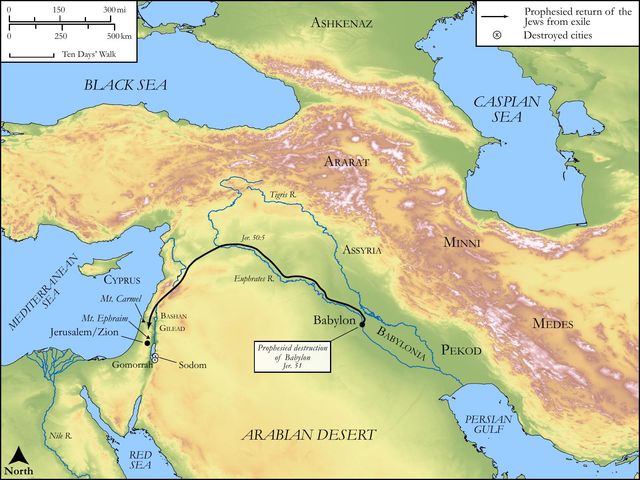
See on the biblical-era map
Study this verse
Public-domain commentary
Matthew Henry
From his Commentary on the Whole Bible. Henry comments on passages, not single verses — this entry covers Jeremiah 50:33–46. His four-level outline is real structure in the source text, so it is rendered as structure.
We have in these verses,
I.Israel's sufferings, and their deliverance out of those sufferings.
God takes notice of the bondage of his people in Babylon, as he did of their bondage in Egypt; he has surely seen it, and has heard their cry. Israel and Judah were oppressed together, Jer 50:33. Those that remained of the captives of the ten tribes, upon the uniting of the kingdoms of Assyria and Chaldea, seem to have come and mingled with t hose of the two tribes, and to have mingled tears with them, so that they were oppressed together. They were humble suppliants for their liberty, and that was all; they could not attempt any thing towards it, for all that took them captives held them fast, and were much too hard for them. But this is their comfort in distress, that, though they are weak, their Redeemer is strong (Jer 50:34), their Avenger (so the word signifies), he that has a right to them, and will claim his right and make good his claim. He is stronger than their enemies that hold them fast; he can overpower all the force that is against them, and put strength into his own people though they are very weak. The Lord of hosts is his name, and he will answer to his name, and make it to appear that he is what his people call him, and will be that to them for which they depend upon him. Note, It is the unspeakable comfort of the people of God that, though they have hosts against them, they have the Lord of hosts for them and he shall thoroughly plead their cause, pleading he shall plead it, plead it with jealousy, plead it effectually, plead it and carry it, that he may give rest to the land, and to his people's land, rest from all their enemies round about. This is applicable to all believers, who complain of the dominion of sin and corruption, and of their own weakness and manifold infirmities. Let them know that their Redeemer is strong; he is able to keep what they commit to him, and he will plead their cause. Sin shall not have dominion over them; he will make them free, and they shall be free indeed; he will give them rest, that rest which remains for the people of God.
II.Babylon's sin, and their punishment for that sin.
1.The sins they are here charged with are idolatry and persecution.
(1.)They oppressed the people of God; they held them fast, and would not let them go. They opened not the house of his prisoners, Isa 14:17. This was God's quarrel with them, as of old with Pharaoh; it cost him dear, and yet they would not take warning. The inhabitants of Babylon must be disquieted (Jer 50:34) because they have disquieted God's people, whose honour and comfort he is jealous for, and therefore will recompense tribulation to those that trouble them, as well as rest to those that are troubled, Th2 1:6, Th2 1:7.
(2.)They wronged God himself, and robbed him, giving that glory to others which is due to him alone; for (Jer 50:38) it is the land of graven images. All parts of the country abounded with idols, and they were mad upon them, were in love with them and doted on them, cared not what cost and pains they were at in the worship of them, were unwearied in paying their respects to them; and in all this they were wretchedly infatuated and acted like men out of their wits; they were carried on in their idolatry without reason or discretion, like men in a perfect fury. The word here used for idols properly signifies terrors - Enim, the name given to giants that were formidable, because they made the images of their gods to look frightful, to strike a terror upon fools and children. Their idols were scarecrows, yet they doted on them. Babylon was the mother of harlots (Rev 17:5), the source of idolatry. Note, It is the maddest thing in the world to make a god of any creature; and those who are proud against the Lord, the true God, are justly given up to strong delusions, to be mad upon idols that cannot profit. But this madness is wickedness, for which sinners will be certainly and severely reckoned with.
2.The judgments of God upon them for these sins are such as will quite lay them waste and ruin them.
(1.)All that should be their defence and support shall be cut off by the sword. The Chaldeans had long been God's sword, wherewith he had done execution upon the sinful nations round about: but now, they being as bad as any of them, or worse, a sword is brought upon them, even upon the inhabitants of Babylon (Jer 50:35), a sword of war; and, as it is in God's hand, sent and directed by him, it is a sword of justice. It shall be,
[1.]Upon their princes; they shall fall by it, and their dignity, wealth, and power, shall not secure them.
[2.]Upon their wise men, their philosophers, their statesmen, and privy-counsellors; their learning and policy shall neither secure them nor stand the public in any stead.
[3.]Upon their soothsayers and astrologers, here called the liars (Jer 50:36), for they cheated with their prognostications of peace and prosperity; the sword upon them shall make them dote, so that they shall talk like fools, and be as men that have lost all their wits. Note, God has a sword that can reach the soul and affect the mind, and bring men under spiritual plagues.
[4.]Upon their mighty men. A sword shall be upon their spirits; if they are not slain, yet they shall be dismayed, and shall be no longer mighty men; for what stead will their hands stand them in when their hearts fail them?
[5.]Upon their militia (Jer 50:37): The sword shall be upon their horses and chariots; the invaders shall make themselves masters of all their warlike stores, shall seize their horses and chariots for themselves, or destroy them. The troops of other nations that were in their service shall be quite disheartened: The mingled people shall become as weak and timorous as women.
[6.]Upon their exchequer: The sword shall be upon her treasures, which are the sinews of war, and they shall be robbed, and made use of by the enemy against them. See what universal destruction the sword makes when it comes with commission.
(2.)The country shall be made desolate (Jer 50:38): The waters shall be dried up, the water that secures the city. Cyrus drew the river Euphrates into so many channels as made it passable for his army, so that they got with ease to the walls of Babylon, which, if was thought, that river had rendered inaccessible. "The water likewise that made the country fruitful shall be dried up, so that it shall be turned into barrenness, and shall be no more inhabited by the children of men, but by the wild beasts of the desert," Jer 50:39. This was foretold concerning Babylon, Isa 13:19-22. It shall become like Sodom and Gomorrah, Jer 50:40. The same was foretold concerning Edom, Jer 49:18. As the Chaldeans had laid Edom waste, so they shall themselves be laid waste.
(3.)The king and kingdom shall be put into the utmost confusion and consternation by the enemies' invading them, Jer 50:41-43. All the expressions here used to denote the formidable power of the invaders, the terrors wherewith they should array themselves, and the great fright which both court and country should be put into thereby, we met with before (Jer 6:22-24) concerning the Chaldeans' invading the land of Judah. The battle which is there said to be against thee, O daughter of Zion! is here said to be against thee, O daughter of Babylon! to intimate that they should be paid in their own coin. God can find out such as shall be for terror and destruction to those that are for terror and destruction to others; and those who have dealt cruelly, and have shown no mercy, may expect to be cruelly dealt with, and to find no mercy. Only there is one difference between these passages; there it is said, We have heard the fame thereof and our hands wax feeble; here it is said, The king of Babylon has heard the report and his hands waxed feeble, which intimates that that proud and daring prince shall, in the day of his distress, be as weak and dispirited as the meanest Israelites were in the day of their distress.
(4.)That they shall be as much hurt as frightened, for the invader shall come up like a lion to tear and destroy (Jer 50:44) and shall make them and their habitation desolate (Jer 50:45), and the desolation shall be so astonishing that all the nations about shall be terrified by it, Jer 50:46. These three verses we had before (Jer 49:19-21) in the prophecy of the destruction of Edom, which was accomplished by the Chaldeans, and they are here repeated, mutatis mutandis - with a few necessary alterations, in the prophecy of the destruction of Babylon, which was to be accomplished upon the Chaldeans, to show that though the distributions of Providence may appear unequal for a time its retributions will be equal at last; when thou shalt make an end to spoil thou shalt be spoiled, Isa 33:1; Rev 13:10.
Continue studying Jeremiah 50:45 across the web’s major study libraries — every link below opens this exact verse, chapter, or book on the destination site.
Read & Compare
 BibleGatewayThis verse in more than 200 translations and 70 languages.
 Bible.comThe YouVersion reader — hundreds of translations, reading plans, and highlights.
 ESV.orgCrossway's official English Standard Version reader.
 NET BibleThe NET translation with 60,000+ translators' notes on every rendering decision.
 STEP BibleTyndale House's free study tool — original text, vocabulary, and scholarly resources.
 BibliaLogos Bible Software's free web reader.
 USCCBThe New American Bible (Revised Edition) with the U.S. bishops' study notes.
Commentaries
 BibleHub CommentariesDozens of classic commentaries on this verse, gathered on one page.
 StudyLightMore than 100 commentary sets — the largest collection on the web.
 BibleRefPlain-English commentary on what this verse means, verse by verse.
 Enduring WordDavid Guzik's free commentary on this chapter, widely used by Bible teachers.
 Bible Study ToolsVerse commentary alongside Greek and Hebrew study aids.
Original Language & Research
- BibleHub InterlinearThe verse word by word — original language, transliteration, and English.
- BibleHub LexiconEvery word's original-language definition and Strong's entry.
 Blue Letter BibleDeep-study tools — Strong's numbers, concordance, and word studies.
 SefariaThe Hebrew text with Rashi and centuries of Jewish commentary.
Sermons, Hymns & Audio


TrulyRandomVerse is not affiliated with these sites and doesn’t control their content. They’re linked because they’re genuinely useful.
Summary
Jeremiah 50:45 stands as a definitive and unalterable divine pronouncement against the Neo-Babylonian Empire, revealing Yahweh's pre-determined and sovereign plan for its complete desolation. This verse underscores that Babylon's impending judgment is not a random occurrence but flows directly from God's deliberate counsel and purposes, to be executed by seemingly insignificant agents, ensuring the utter destruction and uninhabitable state of the land of the Chaldeans. It profoundly emphasizes God's absolute sovereignty over all earthly powers and His unwavering commitment to righteous justice.
Context
ShowHideLiterary Context
Jeremiah 50:45 serves as a climactic and conclusive declaration within Jeremiah's extensive prophetic oracle against Babylon, which spans the entirety of chapters 50 and 51. These chapters are unique in their singular, comprehensive focus on the downfall of the Neo-Babylonian Empire, setting them apart from earlier prophecies primarily directed at Judah and surrounding nations. This particular verse concludes a vivid prophetic section (Jeremiah 50:41-46) that describes the invading force—likely the Medes and Persians—that God will employ to execute His judgment. The preceding verses detail the terror, panic, and widespread destruction these invaders will inflict upon Babylon. Verse 45 acts as a divine seal on these predictions, asserting that the impending catastrophe is not mere happenstance but the direct, deliberate "counsel of the LORD" and "his purposes," thereby reinforcing the profound theological truth that God is sovereign over all nations, using even pagan empires as instruments of His will, and then holding those instruments accountable for their own wickedness. It provides a final, unshakeable assurance of Babylon's inevitable doom.
Historical & Cultural Context
At the time Jeremiah delivered this prophecy, Babylon, under the Neo-Babylonian Empire led by King Nebuchadnezzar II, was the undisputed superpower among the nations. This empire had conquered Jerusalem, destroyed its temple, and exiled its people, fulfilling earlier prophecies of judgment against Judah. Babylon was globally renowned for its immense wealth, unparalleled military might, impressive fortifications (including its massive walls), and pervasive idolatry, particularly the worship of its chief deity, Marduk. The Chaldeans were the ruling elite of this formidable empire. The idea that such a dominant and seemingly impregnable empire could be overthrown, especially by "the least of the flock," would have appeared utterly preposterous from a human perspective. This prophecy, delivered while Babylon was at its zenith, powerfully underscores God's ability to humble the proud and reverse the fortunes of nations. It also served as a vital message of hope and assurance for the exiled Israelites, guaranteeing that their oppressor would not go unpunished and that God's justice would ultimately prevail.
Key Themes
ShowHideJeremiah 50:45 powerfully articulates several core themes prevalent throughout the book of Jeremiah and the broader Old Testament narrative. Firstly, it highlights Divine Sovereignty, emphasizing that God's "counsel" and "purposes" are the ultimate, unchallengeable drivers of history, not human power, ambition, or strategic brilliance. This theme resonates deeply with passages such as Proverbs 19:21 and Isaiah 14:27. Secondly, the verse underscores Retributive Justice, demonstrating that God holds even the most powerful nations accountable for their sin, particularly their pride, idolatry, and cruelty towards His people. Babylon, though used by God as an instrument, was not exempt from judgment for its own wickedness, as further elaborated in Jeremiah 51:24. Finally, the striking imagery of "the least of the flock" bringing down a mighty empire speaks to God's Unexpected Means of Judgment, often choosing the weak, humble, or overlooked to confound the strong, a recurring principle throughout biblical history (e.g., Judges 7:2-7). The promised complete desolation also points to the Finality of God's Judgment against those who persistently oppose Him.
Exposition and Analysis
ShowHideKey Word Analysis
ShowHideFrom the root yâʻats, meaning "advice" or "plan," and by implication, "prudence." In this context, it refers to God's deliberate, well-considered, and authoritative strategic plan. It signifies that Babylon's downfall is not a rash or impulsive decision but a sovereign decree, highlighting the intentionality and wisdom behind the divine action.
From the root châshab, meaning "to plait or interpenetrate," or "to fabricate." Abstractly, it refers to "intention" or "plan," whether good or bad. Here, it emphasizes God's intricate, pre-meditated design and thought process concerning Babylon's fate, underscoring the certainty, precision, and comprehensive nature of His decree.
A primitive root meaning "to stun" or "grow numb," leading to "devastate" or "stupefy." It describes a state of utter ruin, emptiness, and astonishment. Applied to Babylon's "habitation," it conveys the complete and irreversible destruction that would render the land uninhabitable and a source of shock to observers, signifying a permanent state of waste.
Verse Breakdown
ShowHide"Therefore hear ye the counsel of the LORD, that he hath taken against Babylon; and his purposes, that he hath purposed against the land of the Chaldeans:"
This opening clause serves as an urgent, authoritative summons to attention, demanding that all listen to the divine decree. It unequivocally states that Babylon's impending destruction is not a random event but the direct, intentional result of Yahweh's deliberate "counsel" (a well-thought-out, sovereign plan) and "purposes" (pre-determined, unchangeable designs). The repetition of "taken" and "purposed" emphasizes the absolute certainty, unalterable nature, and comprehensive scope of God's resolve against the dominant empire and its ruling people, the Chaldeans. This divine decision is firm and irreversible, highlighting God's meticulous governance of history.
"Surely the least of the flock shall draw them out:"
This striking imagery predicts the unexpected nature of Babylon's conquerors. "The least of the flock" (Hebrew: tsa'irei hatzon) typically refers to the young, small, or weakest members of a sheep or goat flock. Here, it metaphorically represents a seemingly insignificant, less powerful, or unexpected entity that God will use to overcome the mighty Babylonian empire. Historically, this could refer to the Medes and Persians, who, while formidable, might have been considered less established or imposing than Babylon at its peak. More broadly, it underscores that God's power is not dependent on human might or conventional military superiority, but that He can use any instrument, no matter how humble or unexpected, to accomplish His sovereign will. The verb "draw them out" implies dragging them forth, perhaps from their strongholds, or pulling them away from their place of security and safety.
"surely he shall make their habitation desolate with them."
This final clause pronounces the ultimate outcome: complete and utter devastation. "Habitation" refers to their dwelling places, cities, and the entire land itself. The phrase "desolate with them" signifies that not only will the people be destroyed or removed, but their very environment, their established places of living, will be laid waste and rendered uninhabitable. This foretells a comprehensive judgment that leaves nothing intact, ensuring Babylon's ruin is total and permanent, serving as a lasting monument to God's righteous judgment against pride and wickedness. The desolation is not merely a temporary setback but a permanent state of ruin.
Literary Devices
ShowHideJeremiah 50:45 employs several powerful literary devices to convey its message of divine judgment with dramatic impact. The most prominent is Metaphor, vividly illustrated by the phrase "the least of the flock." This image serves as a powerful metaphor for the seemingly insignificant or unexpected agents God will use to bring down the formidable Babylonian Empire, contrasting their perceived weakness with Babylon's immense strength. This creates a sense of divine irony, where God demonstrates His omnipotence by using unconventional means. The verse also utilizes Repetition and Emphasis through the parallel phrases "the counsel of the LORD, that he hath taken" and "his purposes, that he hath purposed." This linguistic doubling underscores the absolute certainty, intentionality, and unalterable nature of God's decree against Babylon, reinforcing its divine origin and inevitability. Furthermore, the declaration that God "shall make their habitation desolate with them" serves as a form of Hyperbole to emphasize the completeness and severity of the impending destruction, painting a picture of utter ruin that leaves nothing remaining. The overall tone is one of Prophetic Declaration, a solemn and authoritative pronouncement of future events as if they have already occurred, reinforcing God's ultimate sovereignty and the absolute certainty of His word.
Theological and Thematic Connections
ShowHideJeremiah 50:45 is a profound statement on God's absolute sovereignty over nations and His unwavering commitment to justice. It reveals that even when God uses a nation (like Babylon) as an instrument of His judgment against His own people, He holds that nation fully accountable for its pride, cruelty, and idolatry. This verse assures us that no earthly power, no matter how formidable, can ultimately thwart the divine will or escape divine reckoning. It speaks to the meticulous nature of God's plans, which are not reactive but pre-determined, demonstrating His comprehensive control over the course of human history. The "least of the flock" imagery further emphasizes that God is not limited by human strength or conventional power dynamics, often choosing the humble or unexpected to accomplish His grand purposes, thereby magnifying His glory. This serves as both a source of comfort for the oppressed and a stark warning for the arrogant, reminding all that God's justice is certain and His purposes will prevail.
Reflection and Application
ShowHideJeremiah 50:45 offers profound insights for contemporary life, reminding us that God remains sovereign over all human institutions, governments, and powers, regardless of their perceived strength or influence. In a world often dominated by seemingly insurmountable political, economic, or social forces, this verse provides a powerful anchor of hope and trust. It assures us that even when evil appears to triumph or oppressive practices seem invincible, God's ultimate counsel and purposes will prevail. We are called to cultivate humility, recognizing that pride and self-sufficiency, whether in individuals or nations, inevitably lead to a reckoning with divine justice. This passage encourages us to place our ultimate trust not in human might, strategic brilliance, or the stability of earthly empires, but solely in the Lord, whose plans are unassailable and whose justice is certain. It also challenges us to consider how God might use seemingly "least" or unexpected means to bring about His will, urging us to be open to His unconventional methods and to participate faithfully in His work, no matter how small or insignificant our perceived contribution may be.
Questions for Reflection
ShowHideFAQ
ShowHideQ: Who are "the least of the flock" mentioned in Jeremiah 50:45?
ShowHide"The least of the flock" is a powerful metaphorical expression referring to the seemingly insignificant or less powerful agents God would use to bring about Babylon's downfall. Historically, this is widely understood to refer to the Medes and Persians, who, though a formidable emerging power, might have been considered "lesser" or less established compared to the mighty, long-reigning Babylonian Empire at its zenith. The phrase emphasizes that God's power is not dependent on human might or conventional military superiority, but that He can use any instrument, no matter how humble or unexpected, to accomplish His sovereign will. This principle highlights God's ability to humble the proud and demonstrate His ultimate control over all nations, as vividly illustrated in Daniel 4:17.
Q: How was the prophecy of Babylon's desolation fulfilled?
ShowHideThe prophecy of Babylon's desolation was dramatically and precisely fulfilled over time. In 539 BC, Cyrus the Great, leading the combined forces of the Medes and Persians, conquered Babylon, famously diverting the Euphrates River to enter the city through its river gates. While the initial conquest was relatively bloodless, Babylon's decline was swift and irreversible. Subsequent rebellions against Persian rule led to further destruction by Persian kings, particularly Xerxes I. Over centuries, the once-glorious city gradually fell into ruin, its canals dried up, and its population dwindled, becoming uninhabited and a desolate wasteland, just as prophesied in Jeremiah 50-51 and Isaiah 13:19-22. Today, its ruins stand as a stark testament to the accuracy of biblical prophecy and the finality of God's judgment against those who oppose Him.
Christ-Centered Fulfillment
ShowHideWhile Jeremiah 50:45 directly prophesies the historical downfall of ancient Babylon, its deeper theological resonance finds profound Christ-centered fulfillment in the ultimate triumph of God's kingdom over all opposing powers and systems. Just as God used "the least of the flock"—seemingly insignificant agents—to bring down the formidable Babylonian Empire, so too did God accomplish the greatest victory in human history through the most unexpected and humble means: the crucifixion of Jesus Christ. The "Lamb of God," who appeared as weak and vulnerable, was in reality the King of Kings and Lord of Lords, whose sacrificial death and glorious resurrection utterly defeated the spiritual powers of darkness, sin, and death (Colossians 2:15). Furthermore, the "desolation" purposed against historical Babylon foreshadows the final judgment and complete overthrow of all anti-God systems and spiritual forces that set themselves against God and His Christ. The "Babylon" described in Revelation, representing the entirety of the anti-God world system, is ultimately cast down and made desolate forever, demonstrating that Christ's sovereign rule will culminate in the establishment of a new heavens and new earth where righteousness dwells and there is no more curse (Revelation 18:2-24 and Revelation 21:1-4). Thus, Jeremiah's prophecy points to the comprehensive and final victory achieved through Christ, where all earthly and spiritual opposition is ultimately brought to nothing by God's unyielding counsel and purposes.