


Jeremiah 49:20
Bible text: King James Version (1769 Blayney text) · Public domain
Bible text: King James Version with Strong's numbers · Public domain
Bible text: Berean Standard Bible · Public domain
Bible text: American Standard Version (1901) · Public domain
Bible text: World English Bible, Messianic edition · Public domain
Bible text: Geneva Bible (1599) · Public domain
Bible text: Young's Literal Translation · Public domain
- לָכֵןla·Khen<to> thereforeH3651Prep-l ¦ AdvAdverbלָ<to>כֵןtherefore
- שִׁמְעוּshim·'UhearH8085V-Qal-Imp-2mpVerb Qal Imperative 2nd Plural Masculine
- עֲצַת'a·tzat[the] plan ofH6098N-fscNoun Singular Feminine Construct
- יְהוָהYah·wehYahwehH3068N-properNoun Proper Title
- אֲשֶׁר'a·SherwhichH834RelParticle Relative
- יָעַץya·'Atzhe has plannedH3289V-Qal-Perf-3msVerb Qal Perfect 3rd Singular Masculine
- אֶל'elagainstH413PrepPreposition
- אֱדוֹם'e·DomEdomH123N-proper-mNoun Proper Masculine
- וּמַחְשְׁבוֹתָיוu·Mach·she·vo·Tavand his purposesH4284Conj-w ¦ N-fpc ¦ 3msNoun Plural Feminine Constructוּandמַחְשְׁבוֹתָיpurposesוhis
- אֲשֶׁר'a·SherwhichH834RelParticle Relative
- חָשַׁבcha·Shavhe has purposedH2803V-Qal-Perf-3msVerb Qal Perfect 3rd Singular Masculine
- אֶל'elagainstH413PrepPreposition
- יֹשְׁבֵיyo·she·Vei[the] inhabitants ofH3427V-Qal-Prtcpl-mpVerb Qal Participle Plural Masculine Construct
- תֵימָןtei·ManTemanH8487N-properNoun Proper Location
- אִם'imifH518PrtParticle Conditional
- לֹאlo'notH3808NegParticle Negative
- יִסְחָבוּםyis·cha·Vumpeople will drag away themH5498V-Qal-Imperf-3mp ¦ 3mpVerb Qal Imperfect 3rd Plural Masculineיִסְחָבוּpeople will drag awayםthem
- צְעִירֵיtze·'i·Rei[the] young [ones] ofH6810Adj-mpcAdjective Plural Masculine Construct
- הַצֹּאןha·Tzonthe flockH6629Art ¦ N-csNoun Singular common gender Absoluteהַtheצֹּאןflock
- אִם'imifH518PrtParticle Conditional
- לֹאlo'notH3808NegParticle Negative
- יַשִּׁיםya·Shimhe will devastateH8074V-Hiphil-Imperf-3msVerb Hiphil Imperfect 3rd Singular Masculine
- עֲלֵיהֶם'a·lei·Hemon themH5921Prep ¦ 3mpPreposition Definiteעֲלֵיonהֶםthem
- נְוֵהֶםne·ve·Hemtheir pasturelandH5116N-msc ¦ 3mpNoun Singular Masculine Constructנְוֵpasturelandהֶםtheir
English is a literal word-by-word gloss of the Hebrew, not the KJV's wording. Why?
This is the original text the KJV's translators worked from — each Hebrew word with its own literal English meaning in this verse, prepared by scholars at Tyndale House, Cambridge. The KJV translates whole sentences, not word by word, so its wording differs: one Hebrew word can become several English words, and the KJV may choose “the LORD” where the gloss reads “Yahweh”. Both are faithful — they answer different questions. For the KJV's own rendering, switch to the KJV text.
Details
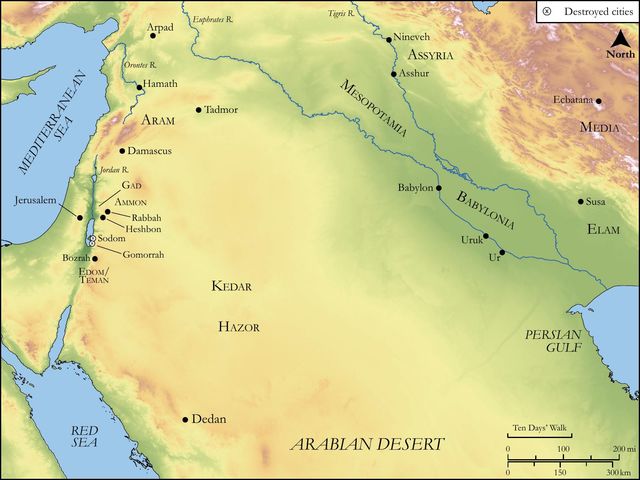
See on the biblical-era map
Study this verse
Public-domain commentary
Matthew Henry
From his Commentary on the Whole Bible. Henry comments on passages, not single verses — this entry covers Jeremiah 49:7–22. His two-level outline is real structure in the source text, so it is rendered as structure.
The Edomites come next to receive their doom from God, by the mouth of Jeremiah: they also were old enemies to the Israel of God; but their day will come to be reckoned with, and it is now at hand, and is foretold, not only for warning to them, but for comfort to the Israel of God, whose afflictions were very much aggravated by their triumphs over them and joy in their calamity, Psa 137:7. Many of the expressions used in this prophecy concerning Edom are borrowed from the prophecy of Obadiah, which is concerning Edom; for, all the prophets being inspired by one and the same Spirit, there must needs be a wonderful harmony and agreement in their predictions. Now here it is foretold,
I.That the country of Edom should be all wasted and made desolate, that the calamity of Esau should be brought upon him, the calamity he has deserved, and God has long designed him, for his old sins, Jer 49:8. The time is at hand when God will visit him, and call him to an account, and then they shall flee from the sword, turn back from the battle, and dwell deep in some close caverns, where they shall hide themselves. All they have shall be carried off by the conqueror; whereas grape-gatherers will leave some gleanings, and even thieves know when they have enough and will destroy no further, those that destroy them shall never be satiated, (Jer 49:9, Jer 49:10); they shall make Esau quite bare, shall strip the Edomites of all they have, shall find out ways and means to come at their most hidden treasure, shall discover even the secret places where they thought to secure their wealth, and rifle them, so that they shall none of them save their wealth, no, nor save themselves nor their children, that might be concealed in a little room: He shall not be able to hide himself, and his seed too is spoiled. His brethren the Moabites, and his neighbours the Philistines, whom he might have expected succours from, or at least shelter with, are spoiled as well as he and disabled to do him any service. And he is not, or there is not he, there is none to him, none left him, that may say what follows (Jer 49:11), Leave thy fatherless children, I will preserve them alive. When they are flying, or dying, there shall be none left, no relation, no friend, no, not so much as any parish officers to take care of their wives and children that they leave behind. Edom is not, he is cut off and gone; nor is there any to say, Leave me thy orphans. If the master of a family be cut off, or forced away, it is some comfort if he have a friend to leave his family with, whom he can confide in; but they shall have none such, for they shall all be involved in the same calamity. The Chaldee makes these to be the words of God to his people, distinguishing them from the Edomites in this calamity; and they read it, "But you, O house of Israel! you shall not leave your orphans; I will secure them, and let your widows rest on my word. Whatever becomes of the widows and fatherless of the Edomites, I will take care of yours." Note, it is an unspeakable comfort to the people of God, when they are dying, that they may leave their surviving relations with God, may, in faith, commit them to him and encourage them to trust in him; and, though they cannot promise themselves great things in the world for them, yet they may hope that he will preserve them alive, always, provided that they trust in him. Let the Edomites, for their part, count upon no other than to be made a desolation and a reproach; for the decree has gone forth; God hath sworn it by himself (Jer 49:13), that their cities shall be wasted, nay, they shall be perpetual wastes, they shall be made mean and despicable; they had made a mighty figure, but God will make them small among the heathen; and those that despised God's people shall themselves be despised among men (Jer 49:15, Oba 1:2), nay, they shall be made monstrous, and even a prodigy (Jer 49:17): Edom shall be such a desolation that every one who goes by shall be astonished; nay, worse yet, they shall be made a terror; Edom shall be made like Sodom and Gomorrah, none shall care for coming near the ruins of it, no man shall abide there (Jer 49:18), such a frightful place shall it be made.
II.That the instruments of this destruction should be very resolute and formidable.
They have their commission from God; he summons them into this service (Jer 49:14): I have heard a rumour, or report, from the Lord, heard it by the prophecy of Obadiah, heard it by a whisper to myself, that an ambassador, or herald, or messenger, is sent to the Gentiles, who are to lay Edom waste, saying, Gather you together, muster all the forces you can, and come against her; for (Jer 49:20) this is the counsel that he hath taken against Edom. The matter is settled, the decree has gone forth, and there is no resisting it. God has determined that Edom shall be laid waste, and then he that is to be employed in wasting it shall come swiftly and strongly. Nebuchadnezzar is he or whom it is here foretold,
1.That he shall come up like a lion, with fierceness and fury, like a lion enraged by the swelling of Jordan overflowing his banks, which forces him out of his covert by the water-side into the higher grounds, Jer 49:19. He shall come roaring, come to devour all that come in his way. He shall come against the habitation of the strong, the forts and castles; and I will cause him to come suddenly into the land (so the next words might well be read), so as to find them unprovided with necessaries for a defence; for I will look out a chosen man to appoint over her, to do this execution, a man fit for the purpose, one chosen out of the people; for when God has work to do he will find out the fittest instruments to be employed in doing it: "Who is like me for choosing the instruments, and spiriting them for the work? And who will appoint me the time? Who will challenge me, and fix a time and place to meet me? Who will join issue with me in battle? And, when I send a lion into the flock, who is that shepherd that can, or dare, stand before me, or against me, to oppose that lion, and think to rescue any of the flock?" Note, When God has work to do of any kind he will soon find those that are able to engage in it, and all the world cannot find those that are able to engage against it. Nay, if God will have Edom destroyed, and their peopled dislodged, there needs not a lion, a fierce lion to do it: Even the least of the flock shall draw them out (Jer 49:20); the meanest servant in Nebuchadnezzar's retinue, the weakest of all that follow his camp, shall draw them out for the slaughter, shall force them to flee, or to surrender, and make their habitations desolate with them. God can bring to pass the greatest works by instruments least likely. When the Chaldean army comes against the Edomites all hands shall be employed and the poorest soldier in it shall have a pluck at them.
2.Nebuchadnezzar shall come, not only like a lion, the king of beasts, but like an eagle, the king of birds (Jer 49:22): He shall fly as the eagle upon his prey, so swiftly, so strongly, shall clap his wings upon Bozrah, to secure it for himself (as before, Jer 48:40), and immediately the hearts of the mighty men shall fail them, for they shall see he is an enemy that it is in vain to struggle with.
III.That the Edomites' confidences should all fail them in the day of their distress.
1.They trusted to their wisdom, but that shall stand them in no stead. This is the first thing fastened upon in this prophecy against Edom, Jer 49:7. That nation used to be famous for wisdom, and their statesmen were thought to excel in politics; and yet now they shall take such wrong measures in all their counsels, and be so baffled in all their designs, that people shall ask, with wonder, What is the matter with the Edomites? Is wisdom no more in Teman? Have the wise men of the east country (Kg1 4:30) become fools? Are those at their wits' end that were thought to have the monopoly of prudence? Has counsel perished from the understanding men? It is so, when God is designing the ruin of a people; for whom he will destroy he infatuates. See Job 12:20. Has their wisdom vanished? Is it tired? (so some); is it worn out? (so others); has it become useless? so others. Yes, it will do them no service when God comes forth to contend with them.
2.They trusted to their strength, but neither shall that avail them, Jer 49:16. They had been a terror to all their neighbours; every body feared them and truckled to them, and this made them proud and conceited of themselves and their own strength, and very secure; because no neighbouring nation durst meddle with them, they thought no nation in the world durst. Their country was much of it mountainous, having many passes which they thought themselves able to make good against any invader; but this terribleness of theirs deceived them, and so did their imaginary inaccessibleness; they did not prove so strong as they were formidable, nor so safe as they were secure. High as they are, God will bring them down; for, as there is no wisdom, so there is no might against the Lord, See these expressions, Oba 1:3, Oba 1:4, Oba 1:8.
IV.That their destruction should be inevitable and very remarkable.
1.God hath determined it (Jer 49:12); he hath said it; nay (Jer 49:13), he hath sworn it, that the Edomites shall not go unpunished, but that they shall drink the cup of trembling, which is put into the hands of all their neighbours; even those whose judgment, or doom, was not to drink of the cup, who had not so well deserved it as they had done, nations that had not been such enemies to Israel as they had been, or Israel itself, that was God's peculiar people, and among whom there were many, very many, who kept his ordinances, upon which account they might have expected an exemption; and yet they had been made to drink of the bitter cup; and shall the Edomites think to pass it? No; they shall surely drink of it. Note, When God punishes the less guilty it is folly for the more guilty to promise themselves impunity; and when judgment begins at God's house it will reach the strangers.
2.All the world shall take notice of it (Jer 49:21): The earth is moved, and all the nations are put into a concern, at the noise of their fall; the news of it shall make them tremble. The noise of the outcry is heard to the Red Sea, which flowed upon the coasts of Edom. So loud shall be the shouts of the conquerors and the shrieks of the conquered, and such a mighty noise shall the news of this destruction of Idumea make in the nations, that is shall be heard among the ships that lie in the Red Sea to take in lading (Kg1 9:26), and then they shall carry the news of it to the remotest shore. Note, The fall of those who have affected to make a noise with their pomp and power will make so much the greater noise.
Continue studying Jeremiah 49:20 across the web’s major study libraries — every link below opens this exact verse, chapter, or book on the destination site.
Read & Compare
 BibleGatewayThis verse in more than 200 translations and 70 languages.
 Bible.comThe YouVersion reader — hundreds of translations, reading plans, and highlights.
 ESV.orgCrossway's official English Standard Version reader.
 NET BibleThe NET translation with 60,000+ translators' notes on every rendering decision.
 STEP BibleTyndale House's free study tool — original text, vocabulary, and scholarly resources.
 BibliaLogos Bible Software's free web reader.
 USCCBThe New American Bible (Revised Edition) with the U.S. bishops' study notes.
Commentaries
 BibleHub CommentariesDozens of classic commentaries on this verse, gathered on one page.
 StudyLightMore than 100 commentary sets — the largest collection on the web.
 BibleRefPlain-English commentary on what this verse means, verse by verse.
 Enduring WordDavid Guzik's free commentary on this chapter, widely used by Bible teachers.
 Bible Study ToolsVerse commentary alongside Greek and Hebrew study aids.
Original Language & Research
- BibleHub InterlinearThe verse word by word — original language, transliteration, and English.
- BibleHub LexiconEvery word's original-language definition and Strong's entry.
 Blue Letter BibleDeep-study tools — Strong's numbers, concordance, and word studies.
 SefariaThe Hebrew text with Rashi and centuries of Jewish commentary.
Sermons, Hymns & Audio


TrulyRandomVerse is not affiliated with these sites and doesn’t control their content. They’re linked because they’re genuinely useful.
Summary
Jeremiah 49:20 serves as a profound declaration of Yahweh's unyielding judgment against the proud nation of Edom, specifically targeting its inhabitants in the renowned city of Teman. The verse emphatically asserts the divine origin and unalterable certainty of this impending desolation, revealing that even the most insignificant and unexpected instrument will be sufficient to bring about Edom's utter ruin and the complete devastation of their seemingly impregnable habitations, thereby underscoring God's absolute and unchallenged sovereignty over all nations and their destinies.
Context
ShowHideLiterary Context
This verse is strategically placed within Jeremiah's extensive collection of oracles against foreign nations (Jeremiah 46-51), which collectively demonstrate Yahweh's universal dominion, extending His authority far beyond Israel and Judah to encompass all peoples. The specific oracle against Edom (Jeremiah 49:7-22) is a powerful indictment, following pronouncements against Egypt, Philistia, Moab, and Ammon, and preceding those against Damascus, Kedar, Hazor, and Babylon. Within this Edomite prophecy, Jeremiah 49:20 functions as a climactic and definitive statement, reinforcing earlier declarations of Edom's wisdom failing and their pride being brought low, as vividly portrayed in Jeremiah 49:7-11. It serves to underscore the divine resolve and the certainty of the promised destruction, leaving no doubt about the outcome.
Historical & Cultural Context
Edom, situated in the rugged, mountainous region southeast of the Dead Sea, was a nation descended from Esau, Jacob's twin brother, establishing a long-standing and often hostile relationship with Israel. Their history was marked by animosity, including their refusal to grant passage to the Israelites during the Exodus (Numbers 20:14-21) and their later rejoicing in Judah's downfall. Edom was renowned for its formidable natural defenses, particularly its rock-cut cities like Petra, which fostered a deep-seated sense of impregnability and immense national pride among its people. Teman, a prominent city within Edom, was particularly noted for its wise men (Job 2:11), making its specific mention in this prophecy a pointed challenge to Edom's intellectual and strategic self-assurance. The verse directly confronts a cultural context where nations boasted of their military might and geographical security, highlighting the ultimate futility of human defenses against the sovereign decree of God.
Key Themes
ShowHideThe central themes woven throughout Jeremiah 49:20 and the broader oracle against Edom are multifaceted. Foremost is Divine Sovereignty and Judgment, unequivocally asserting that God's authority extends over all nations, not merely Israel, and that He holds every people accountable for their actions. Edom's pervasive pride and arrogant self-reliance, famously depicted in Obadiah 1:3-4, are directly confronted and shattered by God's unyielding "counsel" and "purposes." Another crucial theme is Humiliation and Desolation, as the prophecy foretells Edom's complete and utter downfall, brought about by an unexpectedly weak or insignificant force ("the least of the flock"). This emphasizes the profound depth of their humiliation, contrasting sharply with their perceived strength and renowned wisdom, as highlighted in Jeremiah 49:7. The verse also subtly but powerfully conveys God's Justice, presenting the judgment on Edom as a righteous and inevitable consequence of their historical antagonism towards Israel and their general wickedness.
Exposition and Analysis
ShowHideKey Word Analysis
ShowHideFrom the root yâʻats (H3289), meaning to advise, deliberate, or resolve. This term signifies a well-considered, deliberate plan or purpose. When applied to the LORD, it profoundly emphasizes God's infinite wisdom, intentionality, and sovereign decision-making. It indicates that His actions are not impulsive or reactive but are the result of divine deliberation and an unchangeable, fixed resolve, guaranteeing the certainty of their execution.
From the root châshab (H2803), which means to think, contrive, or devise. This word denotes a concrete plan, intention, or scheme. In the context of God, it reinforces the idea of His deliberate and fixed intentions, highlighting the certainty and meticulous execution of His will. Unlike human plans, God's purposes are infallible and will inevitably come to pass, whether for the good of His people or for the judgment of the wicked.
tsâʻîyr (H6810) means "little," "small," or "insignificant," while tsôʼn (H6629) refers to a "flock" of sheep or goats, often used collectively. This phrase is a profoundly powerful metaphor, suggesting that even the weakest, most insignificant, or seemingly harmless element—perhaps a small, contemptible group or an unexpected, humble instrument—will be more than sufficient to utterly defeat and dislodge the mighty Edomites. This underscores the overwhelming power of God's judgment and the depth of Edom's impending humiliation, as their downfall will not come from a formidable foe but from something they would utterly disdain.
Verse Breakdown
ShowHide"Therefore hear the counsel of the LORD, that he hath taken against Edom;"
This opening imperative serves as an urgent summons to profound attention, immediately establishing the divine origin and absolute certainty of the message. The "counsel of the LORD" highlights God's deliberate, sovereign, and unalterable decision-making, indicating that the impending judgment against Edom is not arbitrary or impulsive but a well-considered, eternal decree from the Almighty, rooted in His perfect justice and knowledge.
"and his purposes, that he hath purposed against the inhabitants of Teman:"
This clause functions as a powerful reiteration and intensification of the preceding one, employing synonymous parallelism to underscore the fixed and unyielding intentions of God. The specific mention of "Teman," a city renowned for its wisdom and strategic importance within Edom, pointedly targets the very heart of Edomite strength and pride, emphatically declaring that even their celebrated wisdom and formidable strategic defenses will prove utterly powerless against God's determined and meticulously planned will.
"Surely the least of the flock shall draw them out: "
This striking and highly ironic declaration introduces the unexpected and seemingly insignificant instrument of Edom's catastrophic downfall. "The least of the flock" metaphorically suggests a force that is utterly contemptible, weak, or insignificant in human terms. The verb "draw them out" implies being forcibly dragged away from their secure strongholds, perhaps like sheep being pulled from a fold for slaughter, or even being led into exile, signifying their complete vulnerability, lack of resistance, and the ease with which their mighty defenses will be breached.
"surely he shall make their habitations desolate with them."
This concluding clause pronounces the ultimate and comprehensive outcome: total and irreversible desolation. "Habitations" refers not only to their personal dwellings but also to their secure fortresses, their cities, and their entire settled environment, all of which will be laid waste. The powerful phrase "with them" emphasizes that the destruction will encompass both the people themselves and their entire physical environment, leaving nothing untouched or spared. This serves as a stark testament to the completeness, severity, and finality of God's judgment.
Literary Devices
ShowHideJeremiah 49:20 masterfully employs several potent literary devices to convey its message of divine judgment with maximum impact. The most striking is Irony, particularly evident in the phrase "the least of the flock shall draw them out." Edom, a nation celebrated for its impregnable mountain fortresses and military prowess, is ironically depicted as being overcome by something utterly insignificant, highlighting the vast disparity between their perceived strength and their actual vulnerability before an omnipotent God. This also borders on Hyperbole, exaggerating the weakness of the instrument of judgment to emphasize the absolute and effortless power of God in executing His will. The repetition of the emphatic "surely" (implied by the Hebrew structure, though only once in KJV) serves as a powerful Asseveration or Affirmation, reinforcing the absolute certainty and inevitability of the prophecy's fulfillment. Furthermore, the portrayal of God having "counsel" and "purposes" is a form of Anthropomorphism, attributing human-like cognitive processes of planning and deliberation to God. This device makes His intentionality, wisdom, and deliberateness more comprehensible and relatable to the human audience, while simultaneously underscoring the unchangeable nature of His divine decrees.
Theological and Thematic Connections
ShowHideJeremiah 49:20 profoundly articulates the theological truth of God's absolute and unchallenged sovereignty over all nations, demonstrating unequivocally that no human power, no matter how fortified, wise, or prideful, can ultimately withstand His determined counsel and purposes. It underscores that God is not merely the covenant God of Israel but the Lord of all creation, holding every nation accountable for its actions, particularly its pride, self-reliance, and hostility towards His chosen people. The prophecy against Edom stands as a timeless and sobering warning against arrogance and trusting in one's own strength, illustrating that divine justice will ultimately prevail, often through unexpected or seemingly insignificant means, bringing low those who exalt themselves and challenging the very foundations of human presumption.
Reflection and Application
ShowHideJeremiah 49:20 calls us to a profound and necessary reflection on the majestic nature of God and our humble place before Him. It serves as a stark and enduring reminder that true security, lasting peace, and ultimate triumph lie not in human strength, strategic advantage, accumulated wealth, or even intellectual prowess, but solely in the sovereign and unassailable will of the Almighty. Edom's dramatic downfall, orchestrated by "the least of the flock," directly challenges our innate human tendency to trust in visible power, to rely on our own capabilities, and to dismiss or underestimate the seemingly insignificant. It powerfully teaches us that God, in His infinite wisdom, often chooses the humble, the weak, or the unexpected to accomplish His grand and eternal purposes, thereby confounding the wisdom of the proud and demonstrating His unparalleled might. This truth should cultivate within us a deep and abiding humility, fostering a radical reliance on God's power rather than our own, and instilling a firm conviction that His justice and His plans will ultimately prevail, even when circumstances appear to suggest otherwise. For those facing seemingly insurmountable opposition or feeling overwhelmed, this verse offers immense hope: God can indeed use the "least of the flock" to bring down the mightiest adversaries and accomplish His perfect will.
Questions for Reflection
ShowHideFAQ
ShowHideWho were Edom and Teman, and why were they targeted by God's judgment?
ShowHideEdom was an ancient nation located in the rugged, mountainous region southeast of the Dead Sea, descended from Esau, Jacob's twin brother (see Genesis 36). Their relationship with Israel was consistently marked by deep-seated hostility, a refusal to offer aid, and even malicious rejoicing in Israel's misfortunes, particularly during the Babylonian conquest of Judah (as lamented in Psalm 137:7). Teman was a significant and prominent city within Edom, renowned for its wisdom and strategic location. God's severe judgment against Edom, as extensively detailed in Jeremiah 49 and the entire book of Obadiah, was primarily due to their intense national pride, their perceived invincibility based on their formidable mountainous strongholds, and their persistent, malicious actions against their "brother" nation, Israel. This judgment served to powerfully demonstrate God's universal sovereignty and His unwavering commitment to justice for His people.
What is the profound significance of "the least of the flock" in this prophecy?
ShowHideThe phrase "the least of the flock" is a profoundly powerful and ironic metaphorical expression signifying an instrument that is utterly insignificant, weak, or contemptible in human terms. Its profound significance lies in highlighting the overwhelming and effortless power of God, as well as the depth of Edom's impending humiliation. It emphatically suggests that God does not require mighty armies, overwhelming force, or formidable human agents to accomplish His divine will; even the most humble, unexpected, or seemingly inconsequential means will be more than sufficient to dismantle the proudest and most secure nations. This vivid imagery underscores the ease and certainty with which God will execute His judgment, making Edom's defeat all the more humiliating precisely because it was not brought about by a formidable and respected foe, but by something they would have utterly disdained and overlooked.
Christ-Centered Fulfillment
ShowHideJeremiah 49:20, while a specific prophecy of judgment against the proud nation of Edom, finds its most profound Christ-centered fulfillment in the paradoxical nature of God's ultimate victory over sin and death, and the seemingly "insignificant" instrument He chose to achieve it. Just as "the least of the flock" was prophesied to draw out the arrogant Edomites from their secure strongholds, so too did God choose a seemingly "insignificant" and "despised" means to conquer the greatest adversaries of humanity: sin, death, and the devil. Jesus, the Lamb of God who takes away the sin of the world, came not in military might, earthly splendor, or kingly power, but in profound humility and apparent weakness, born in a humble manger and dying a criminal's death on a cross. He was, in the eyes of the world, the "least" and most unlikely of instruments, a "root out of dry ground" with "no beauty or majesty to attract us to him, nothing in his appearance that we should desire him" (Isaiah 53:2-3). Yet, through His sacrificial death and glorious resurrection, this "least" and most humble of instruments utterly "drew out" and decisively defeated the powers of darkness, making desolate the spiritual strongholds of evil and liberating humanity from its bondage. His victory, achieved through apparent weakness and humiliation, perfectly embodies the divine principle that God "has chosen the foolish things of the world to shame the wise, and God has chosen the weak things of the world to shame the things which are strong" (1 Corinthians 1:27). Thus, the judgment on Edom, executed by the "least of the flock," serves as a powerful Old Testament foreshadowing of the ultimate triumph of God's counsel and purposes through the unexpected humility and sacrificial love of Christ, who, by becoming the "least," secured the greatest and most eternal victory for all who believe and trust in Him.