


Jeremiah 49:21
- מִקּוֹלmi·Kolfrom [the] sound ofH6963Prep-m ¦ N-mscNoun Singular Masculine Constructמִfromקּוֹל[the] sound of
- נִפְלָםnif·Lamthey fallingH5307V-Qal-Inf ¦ 3mpVerb Qal Infinitive Constructנִפְלָfallingםthey
- רָעֲשָׁהra·'a·Shahit will shakeH7493V-Qal-Perf-3fsVerb Qal Perfect 3rd Singular Feminine
- הָאָרֶץha·'A·retzthe earth ofH776Art ¦ N-fscNoun Singular Feminine Constructהָtheאָרֶץearth of
- צְעָקָהtze·'a·Kah[the] calling outH6818N-fsNoun Singular Feminine Absolute
- בְּיַםbe·yamat [the] sea ofH3220Prep-b ¦ N-mscNoun Singular Masculine Constructבְּatיַם[the] sea of
- סוּףsufreed[s]H5488N-msNoun Title Singular Masculine Absolute
- נִשְׁמַעnish·Ma'it will be heardH8085V-Niphal-Perf-3msVerb Niphal Perfect 3rd Singular Masculine
- קוֹלָהּko·Lahits soundH6963N-msc ¦ 3fsNoun Singular Masculine Constructקוֹלָsoundהּits
English is a literal word-by-word gloss of the Hebrew, not the KJV's wording. Why?
This is the original text the KJV's translators worked from — each Hebrew word with its own literal English meaning in this verse, prepared by scholars at Tyndale House, Cambridge. The KJV translates whole sentences, not word by word, so its wording differs: one Hebrew word can become several English words, and the KJV may choose “the LORD” where the gloss reads “Yahweh”. Both are faithful — they answer different questions. For the KJV's own rendering, switch to the KJV text.
Details
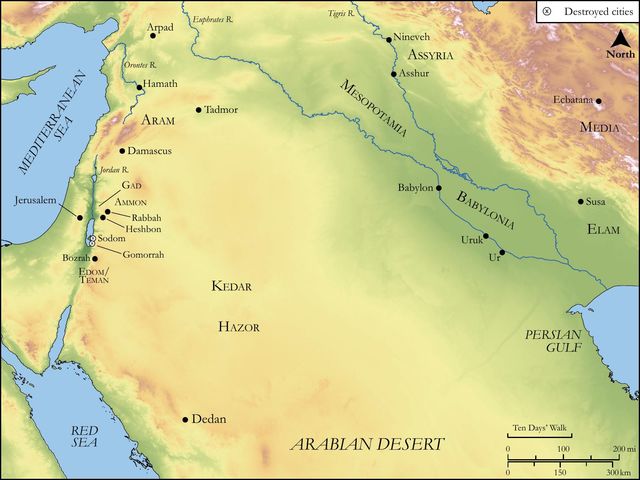
See on the biblical-era map
Study this verse
Public-domain commentary
Matthew Henry
From his Commentary on the Whole Bible. Henry comments on passages, not single verses — this entry covers Jeremiah 49:7–22. His two-level outline is real structure in the source text, so it is rendered as structure.
The Edomites come next to receive their doom from God, by the mouth of Jeremiah: they also were old enemies to the Israel of God; but their day will come to be reckoned with, and it is now at hand, and is foretold, not only for warning to them, but for comfort to the Israel of God, whose afflictions were very much aggravated by their triumphs over them and joy in their calamity, Psa 137:7. Many of the expressions used in this prophecy concerning Edom are borrowed from the prophecy of Obadiah, which is concerning Edom; for, all the prophets being inspired by one and the same Spirit, there must needs be a wonderful harmony and agreement in their predictions. Now here it is foretold,
I.That the country of Edom should be all wasted and made desolate, that the calamity of Esau should be brought upon him, the calamity he has deserved, and God has long designed him, for his old sins, Jer 49:8. The time is at hand when God will visit him, and call him to an account, and then they shall flee from the sword, turn back from the battle, and dwell deep in some close caverns, where they shall hide themselves. All they have shall be carried off by the conqueror; whereas grape-gatherers will leave some gleanings, and even thieves know when they have enough and will destroy no further, those that destroy them shall never be satiated, (Jer 49:9, Jer 49:10); they shall make Esau quite bare, shall strip the Edomites of all they have, shall find out ways and means to come at their most hidden treasure, shall discover even the secret places where they thought to secure their wealth, and rifle them, so that they shall none of them save their wealth, no, nor save themselves nor their children, that might be concealed in a little room: He shall not be able to hide himself, and his seed too is spoiled. His brethren the Moabites, and his neighbours the Philistines, whom he might have expected succours from, or at least shelter with, are spoiled as well as he and disabled to do him any service. And he is not, or there is not he, there is none to him, none left him, that may say what follows (Jer 49:11), Leave thy fatherless children, I will preserve them alive. When they are flying, or dying, there shall be none left, no relation, no friend, no, not so much as any parish officers to take care of their wives and children that they leave behind. Edom is not, he is cut off and gone; nor is there any to say, Leave me thy orphans. If the master of a family be cut off, or forced away, it is some comfort if he have a friend to leave his family with, whom he can confide in; but they shall have none such, for they shall all be involved in the same calamity. The Chaldee makes these to be the words of God to his people, distinguishing them from the Edomites in this calamity; and they read it, "But you, O house of Israel! you shall not leave your orphans; I will secure them, and let your widows rest on my word. Whatever becomes of the widows and fatherless of the Edomites, I will take care of yours." Note, it is an unspeakable comfort to the people of God, when they are dying, that they may leave their surviving relations with God, may, in faith, commit them to him and encourage them to trust in him; and, though they cannot promise themselves great things in the world for them, yet they may hope that he will preserve them alive, always, provided that they trust in him. Let the Edomites, for their part, count upon no other than to be made a desolation and a reproach; for the decree has gone forth; God hath sworn it by himself (Jer 49:13), that their cities shall be wasted, nay, they shall be perpetual wastes, they shall be made mean and despicable; they had made a mighty figure, but God will make them small among the heathen; and those that despised God's people shall themselves be despised among men (Jer 49:15, Oba 1:2), nay, they shall be made monstrous, and even a prodigy (Jer 49:17): Edom shall be such a desolation that every one who goes by shall be astonished; nay, worse yet, they shall be made a terror; Edom shall be made like Sodom and Gomorrah, none shall care for coming near the ruins of it, no man shall abide there (Jer 49:18), such a frightful place shall it be made.
II.That the instruments of this destruction should be very resolute and formidable.
They have their commission from God; he summons them into this service (Jer 49:14): I have heard a rumour, or report, from the Lord, heard it by the prophecy of Obadiah, heard it by a whisper to myself, that an ambassador, or herald, or messenger, is sent to the Gentiles, who are to lay Edom waste, saying, Gather you together, muster all the forces you can, and come against her; for (Jer 49:20) this is the counsel that he hath taken against Edom. The matter is settled, the decree has gone forth, and there is no resisting it. God has determined that Edom shall be laid waste, and then he that is to be employed in wasting it shall come swiftly and strongly. Nebuchadnezzar is he or whom it is here foretold,
1.That he shall come up like a lion, with fierceness and fury, like a lion enraged by the swelling of Jordan overflowing his banks, which forces him out of his covert by the water-side into the higher grounds, Jer 49:19. He shall come roaring, come to devour all that come in his way. He shall come against the habitation of the strong, the forts and castles; and I will cause him to come suddenly into the land (so the next words might well be read), so as to find them unprovided with necessaries for a defence; for I will look out a chosen man to appoint over her, to do this execution, a man fit for the purpose, one chosen out of the people; for when God has work to do he will find out the fittest instruments to be employed in doing it: "Who is like me for choosing the instruments, and spiriting them for the work? And who will appoint me the time? Who will challenge me, and fix a time and place to meet me? Who will join issue with me in battle? And, when I send a lion into the flock, who is that shepherd that can, or dare, stand before me, or against me, to oppose that lion, and think to rescue any of the flock?" Note, When God has work to do of any kind he will soon find those that are able to engage in it, and all the world cannot find those that are able to engage against it. Nay, if God will have Edom destroyed, and their peopled dislodged, there needs not a lion, a fierce lion to do it: Even the least of the flock shall draw them out (Jer 49:20); the meanest servant in Nebuchadnezzar's retinue, the weakest of all that follow his camp, shall draw them out for the slaughter, shall force them to flee, or to surrender, and make their habitations desolate with them. God can bring to pass the greatest works by instruments least likely. When the Chaldean army comes against the Edomites all hands shall be employed and the poorest soldier in it shall have a pluck at them.
2.Nebuchadnezzar shall come, not only like a lion, the king of beasts, but like an eagle, the king of birds (Jer 49:22): He shall fly as the eagle upon his prey, so swiftly, so strongly, shall clap his wings upon Bozrah, to secure it for himself (as before, Jer 48:40), and immediately the hearts of the mighty men shall fail them, for they shall see he is an enemy that it is in vain to struggle with.
III.That the Edomites' confidences should all fail them in the day of their distress.
1.They trusted to their wisdom, but that shall stand them in no stead. This is the first thing fastened upon in this prophecy against Edom, Jer 49:7. That nation used to be famous for wisdom, and their statesmen were thought to excel in politics; and yet now they shall take such wrong measures in all their counsels, and be so baffled in all their designs, that people shall ask, with wonder, What is the matter with the Edomites? Is wisdom no more in Teman? Have the wise men of the east country (Kg1 4:30) become fools? Are those at their wits' end that were thought to have the monopoly of prudence? Has counsel perished from the understanding men? It is so, when God is designing the ruin of a people; for whom he will destroy he infatuates. See Job 12:20. Has their wisdom vanished? Is it tired? (so some); is it worn out? (so others); has it become useless? so others. Yes, it will do them no service when God comes forth to contend with them.
2.They trusted to their strength, but neither shall that avail them, Jer 49:16. They had been a terror to all their neighbours; every body feared them and truckled to them, and this made them proud and conceited of themselves and their own strength, and very secure; because no neighbouring nation durst meddle with them, they thought no nation in the world durst. Their country was much of it mountainous, having many passes which they thought themselves able to make good against any invader; but this terribleness of theirs deceived them, and so did their imaginary inaccessibleness; they did not prove so strong as they were formidable, nor so safe as they were secure. High as they are, God will bring them down; for, as there is no wisdom, so there is no might against the Lord, See these expressions, Oba 1:3, Oba 1:4, Oba 1:8.
IV.That their destruction should be inevitable and very remarkable.
1.God hath determined it (Jer 49:12); he hath said it; nay (Jer 49:13), he hath sworn it, that the Edomites shall not go unpunished, but that they shall drink the cup of trembling, which is put into the hands of all their neighbours; even those whose judgment, or doom, was not to drink of the cup, who had not so well deserved it as they had done, nations that had not been such enemies to Israel as they had been, or Israel itself, that was God's peculiar people, and among whom there were many, very many, who kept his ordinances, upon which account they might have expected an exemption; and yet they had been made to drink of the bitter cup; and shall the Edomites think to pass it? No; they shall surely drink of it. Note, When God punishes the less guilty it is folly for the more guilty to promise themselves impunity; and when judgment begins at God's house it will reach the strangers.
2.All the world shall take notice of it (Jer 49:21): The earth is moved, and all the nations are put into a concern, at the noise of their fall; the news of it shall make them tremble. The noise of the outcry is heard to the Red Sea, which flowed upon the coasts of Edom. So loud shall be the shouts of the conquerors and the shrieks of the conquered, and such a mighty noise shall the news of this destruction of Idumea make in the nations, that is shall be heard among the ships that lie in the Red Sea to take in lading (Kg1 9:26), and then they shall carry the news of it to the remotest shore. Note, The fall of those who have affected to make a noise with their pomp and power will make so much the greater noise.
Continue studying Jeremiah 49:21 across the web’s major study libraries — every link below opens this exact verse, chapter, or book on the destination site.
Read & Compare
 BibleGatewayThis verse in more than 200 translations and 70 languages.
 Bible.comThe YouVersion reader — hundreds of translations, reading plans, and highlights.
 ESV.orgCrossway's official English Standard Version reader.
 NET BibleThe NET translation with 60,000+ translators' notes on every rendering decision.
 STEP BibleTyndale House's free study tool — original text, vocabulary, and scholarly resources.
 BibliaLogos Bible Software's free web reader.
 USCCBThe New American Bible (Revised Edition) with the U.S. bishops' study notes.
Commentaries
 BibleHub CommentariesDozens of classic commentaries on this verse, gathered on one page.
 StudyLightMore than 100 commentary sets — the largest collection on the web.
 BibleRefPlain-English commentary on what this verse means, verse by verse.
 Enduring WordDavid Guzik's free commentary on this chapter, widely used by Bible teachers.
 Bible Study ToolsVerse commentary alongside Greek and Hebrew study aids.
Original Language & Research
- BibleHub InterlinearThe verse word by word — original language, transliteration, and English.
- BibleHub LexiconEvery word's original-language definition and Strong's entry.
 Blue Letter BibleDeep-study tools — Strong's numbers, concordance, and word studies.
 SefariaThe Hebrew text with Rashi and centuries of Jewish commentary.
Sermons, Hymns & Audio


TrulyRandomVerse is not affiliated with these sites and doesn’t control their content. They’re linked because they’re genuinely useful.
Summary
Jeremiah 49:21 powerfully depicts the catastrophic downfall of Edom, a divine judgment so profound and far-reaching that its reverberations are felt across vast distances. The verse utilizes vivid auditory imagery—the "noise of their fall" and a desperate "cry"—to convey the utter devastation and widespread impact of God's retribution against this proud nation, signaling a collapse of epic proportions that even the distant Red Sea "hears."
Context
ShowHideLiterary Context
Jeremiah 49:21 is situated within a significant prophetic section of the book of Jeremiah (chapters 46-51) dedicated to pronouncements of judgment against foreign nations. Specifically, verses 7-22 of chapter 49 focus on the coming judgment against Edom, the descendants of Esau. This particular oracle follows prophecies against formidable nations such as Egypt, Philistia, Moab, and Ammon, and precedes those against Damascus, Kedar, Hazor, and Babylon. The inclusion of these foreign nation oracles serves a crucial theological purpose: to underscore Yahweh's universal sovereignty, demonstrating that He is not merely the God of Israel but the supreme ruler over all peoples and kingdoms, holding them accountable for their actions. The severity of the language in this specific verse against Edom highlights the deep-seated animosity and historical conflict between Israel and Edom, often portrayed as a perpetual sibling rivalry that devolved into bitter hostility and treachery.
Historical & Cultural Context
Edom, located southeast of Judah in the rugged, mountainous region of Seir, was a nation characterized by its seemingly impregnable fortresses (like Petra, often referred to as "Sela") and its reputation for wisdom, as noted in Jeremiah 49:7. As descendants of Esau, they shared a familial connection with Israel (descendants of Jacob) but were consistently hostile neighbors. Their pride and self-reliance, coupled with their opportunistic exploitation of Judah's misfortunes (e.g., during the Babylonian siege, vividly condemned in Obadiah 1:10-14), incurred severe divine wrath. The imagery of a "fall" and a "cry" would have resonated deeply with ancient Near Eastern audiences familiar with the dramatic collapses of empires and the lamentations that invariably followed military defeat and national destruction. The reference to the "Red Sea" (Yam Suph) emphasizes the extreme geographical distance, highlighting the widespread knowledge and profound impact of Edom's demise, extending far beyond its immediate borders and serving as a universal warning.
Key Themes
ShowHideThis verse powerfully contributes to several overarching themes present in Jeremiah and the broader prophetic literature. Firstly, it emphasizes the Magnitude of Divine Judgment, portraying God's retribution as a cataclysmic event of immense scale and severity, ensuring a complete and irreversible collapse for those who oppose His will and persecute His people. Secondly, it reinforces God's Universal Sovereignty, demonstrating unequivocally that His authority extends over all nations, holding them accountable for their actions, pride, and perceived strength or wisdom. The judgment on Edom, a nation that considered itself secure, serves as a stark reminder that no one is beyond God's reach, a theme echoed consistently in other prophecies against foreign nations found in Jeremiah 46-51. Finally, the verse powerfully illustrates the Far-Reaching Consequences of Sin, particularly the sins of pride, hostility, and treachery. Edom's downfall, marked by a "noise" heard far away, serves as a powerful testament to the widespread, undeniable, and enduring repercussions of defying God's purposes and actively persecuting His covenant people.
Exposition and Analysis
ShowHideKey Word Analysis
ShowHideFrom an unused root probably meaning to be firm, this word refers to the land or ground, but often, as here, to the entire earth or a specific country. In this context, it signifies the very ground beneath Edom, which is depicted as being physically affected by the magnitude of their fall. It underscores the profound, almost geological, impact of the judgment, suggesting a disturbance of the natural order.
A primitive root meaning "to fall," this verb carries a wide range of applications including to collapse, perish, be overthrown, or die. Here, it denotes the complete and utter destruction of Edom as a nation, a comprehensive collapse from their position of pride and strength. It implies a dramatic and irreversible descent from their former state of security and power.
Literally "sea of reeds," this refers to a large body of water, specifically the Red Sea. Its inclusion here is a powerful hyperbole, emphasizing the extreme geographical distance over which the sound of Edom's fall is heard. It signifies that the judgment is not a localized event but one of such immense magnitude that its echoes reach the farthest known boundaries, making it universally acknowledged and undeniable.
Verse Breakdown
ShowHide"The earth is moved at the noise of their fall"
This clause vividly portrays the immediate and profound impact of Edom's downfall. The "earth" (referring to the land of Edom, or perhaps even the world at large) is depicted as physically "moved" or trembling, as if in response to a seismic event. This movement is directly attributed to the "noise of their fall," suggesting that the collapse of Edom is not a quiet demise but a cataclysmic event accompanied by a thunderous sound, indicative of utter devastation and the shattering of their power and perceived invincibility.
"at the cry"
This short, impactful phrase adds another layer to the auditory imagery, focusing on the human element of suffering. The "cry" refers to a shriek or wail of distress, lamentation, or agony emanating from the Edomites themselves. It complements the "noise of their fall," indicating that the destruction is not impersonal but involves the widespread anguish and despair of the people as their nation is destroyed and their lives are shattered. This "cry" is an integral part of the overall soundscape of their judgment.
"the noise thereof was heard in the Red sea"
This final clause extends the reach of Edom's judgment to an extraordinary degree, employing powerful hyperbole. The "noise" (referring back to the combined sounds of their fall and cry) is so immense and far-reaching that it is heard all the way in the distant Red Sea. This signifies the unparalleled scale, notoriety, and undeniable nature of Edom's destruction, implying that the judgment will be widely known and serve as a stark, inescapable warning to other nations.
Literary Devices
ShowHideJeremiah 49:21 is rich in literary devices that amplify its message of overwhelming judgment and its far-reaching consequences. Hyperbole is prominently used, particularly in the assertion that the "noise" of Edom's fall is heard all the way in the "Red sea." This deliberate exaggeration underscores the immense scale and notoriety of the impending destruction, implying that its impact will be felt and known far beyond Edom's immediate borders, serving as a universal warning. The verse also employs powerful Auditory Imagery, focusing on the "noise" and "cry" of the fall. These vivid sounds evoke a sense of chaos, devastation, and widespread lamentation, allowing the reader to viscerally "hear" the catastrophe unfolding. Furthermore, there is an element of Personification in "The earth is moved," as if the land itself reacts with trembling or fear to the divine judgment unfolding upon it. This device imbues the natural world with a responsiveness to God's actions, highlighting the cosmic significance of Edom's downfall and the profound impact of God's righteous judgment.
Theological and Thematic Connections
ShowHideJeremiah 49:21 serves as a profound theological statement on God's absolute sovereignty and unwavering justice. It reveals that no nation, however proud, geographically secure, or historically significant, is beyond the reach of divine accountability. The catastrophic nature of Edom's fall underscores the seriousness with which God views national pride, hostility towards His people, and unrepentant sin. This judgment is not merely punitive but also revelatory, demonstrating that the Lord is the God of all the earth, executing righteous judgment according to His perfect will. The far-reaching sound of their demise ensures that this divine act will serve as a universal testimony to the consequences of opposing God's purposes and defying His authority.
Reflection and Application
ShowHideJeremiah 49:21 stands as a stark and enduring reminder of God's unyielding justice and the inevitable consequences of national and individual pride that sets itself against divine will. For us today, it prompts a sober reflection on the nature of our own hearts and societies. Are we prone to the same self-reliance and hostility that characterized Edom? Do we acknowledge God's sovereignty over all aspects of life, or do we build our own fortresses of perceived security and wisdom, apart from Him? The "noise" and "cry" of Edom's fall serve as a powerful warning: sin, especially pride, animosity, and the persecution of others, has far-reaching and devastating repercussions that cannot be hidden or ignored. This passage calls us to humility, repentance, and a deep, abiding trust in God's righteous governance over all things, knowing that while His patience is vast, His justice is certain. It encourages us to align our lives and our communities with His purposes, lest we too experience the shaking of the earth beneath our feet, not in judgment, but in a call to re-evaluate our foundations.
Questions for Reflection
ShowHideFAQ
ShowHideWhy is the Red Sea mentioned in relation to Edom's fall?
ShowHideThe mention of the Red Sea (Hebrew: Yam Suph) in Jeremiah 49:21 is a powerful literary device, specifically hyperbole. Edom was located in the mountainous region southeast of Judah, far from the Red Sea. The prophet uses this geographical exaggeration to emphasize the immense scale and notoriety of Edom's impending destruction. It signifies that the "noise of their fall" will be so catastrophic and widely known that its echoes will reach even the most distant and seemingly unrelated places, making the judgment undeniable and universally acknowledged. It underscores that God's judgment on Edom will be a public and profound event, serving as a warning to all nations about the consequences of pride and opposition to God.
What was Edom's primary sin that led to such a severe judgment?
ShowHideEdom's primary sin, as depicted throughout prophetic literature, was their pride and their hostility towards Israel, God's chosen people. Jeremiah 49:16 explicitly mentions their "presumption of your heart" and their dwelling in "the clefts of the rock," highlighting their arrogance in their perceived impregnability and wisdom (Jeremiah 49:7). Furthermore, they actively rejoiced in and even participated in the destruction of Judah by foreign invaders, as vividly described in Obadiah 1:10-14. This animosity towards God's people, despite their familial ties, provoked God's stern and comprehensive judgment, demonstrating that God holds nations accountable for their treatment of His covenant people.
Christ-Centered Fulfillment
ShowHideWhile Jeremiah 49:21 speaks specifically of God's judgment upon Edom, it ultimately points to the broader biblical narrative of divine justice and the ultimate triumph of God's kingdom, which finds its full realization in Jesus Christ. The "noise of their fall" and the "cry" of destruction foreshadow the ultimate judgment that will be meted out against all sin, pride, and opposition to God's reign. Yet, Christ does not merely bring judgment; He first bore it. The "fall" of humanity into sin brought a cry of despair across the earth, a condition that only the Lamb of God, who takes away the sin of the world could remedy. Jesus, through His crucifixion, took upon Himself the full weight of divine wrath, experiencing a "fall" into death that paradoxically led to the ultimate victory over sin and death (Colossians 2:15).
The "earth being moved" at the noise of Edom's fall finds its most profound echo in the New Testament when the earth literally shook at the death of Christ (Matthew 27:51) and again at His resurrection (Matthew 28:2). These seismic events signify not judgment, but the breaking of sin's power and the dawn of a new creation. Ultimately, the judgment prophesied against Edom points forward to the final, universal judgment where every knee will bow and every tongue confess that Jesus Christ is Lord (Philippians 2:10-11). For those who are in Christ, the "noise of their fall" is not a sound of dread but a reminder of the secure foundation they have in Him, the one who has already triumphed over all the forces of darkness and promises a future where there will be no more crying or pain (Revelation 21:4).