


Obadiah 1:8
Bible text: King James Version (1769 Blayney text) · Public domain
Bible text: Berean Standard Bible · Public domain
Bible text: American Standard Version (1901) · Public domain
Bible text: World English Bible, Messianic edition · Public domain
Bible text: Geneva Bible (1599) · Public domain
Bible text: Young's Literal Translation · Public domain
- הֲלוֹאha·Lo'¿ notH3808Interrog ¦ NegParticle Negativeהֲ¿לוֹאnot
- בַּיּוֹםbai·Yomon the dayH3117Prep-b ¦ N-msNoun Singular Masculine Absoluteבַּon theיּוֹםday
- הַהוּאha·Hu'<the> thatH1931Art ¦ Pro-3msPronoun Personal 3rd Singular Masculineהַ<the>הוּאthat
- נְאֻםne·'um[the] utterance ofH5002N-mscNoun Singular Masculine Construct
- יְהוָהYah·wehYahwehH3068N-properNoun Proper Title
- וְהַאֲבַדְתִּיve·ha·'a·vad·Tiand I will destroyH6Conj-w ¦ V-Hiphil-ConsecPerf-1csVerb Hiphil Consecutive Perfect 1st Singular common genderוְandהַאֲבַדְתִּיI will destroy
- חֲכָמִיםcha·kha·Mimwise [people]H2450Adj-mpAdjective Plural Masculine Absolute
- מֵאֱדוֹםme·'e·Domfrom EdomH123Prep-m ¦ N-proper-mNoun Proper MasculineמֵfromאֱדוֹםEdom
- וּתְבוּנָהu·te·vu·Nahand understandingH8394Conj-w ¦ N-fsNoun Singular Feminine Absoluteוּandתְבוּנָהunderstanding
- מֵהַרme·Harfrom [the] mountain ofH2022Prep-m ¦ N-mscNoun Singular Masculine Constructמֵfromהַר[the] mountain of
- עֵשָׂו'e·SavEsauH6215N-properNoun Proper Location
English is a literal word-by-word gloss of the Hebrew, not the KJV's wording. Why?
This is the original text the KJV's translators worked from — each Hebrew word with its own literal English meaning in this verse, prepared by scholars at Tyndale House, Cambridge. The KJV translates whole sentences, not word by word, so its wording differs: one Hebrew word can become several English words, and the KJV may choose “the LORD” where the gloss reads “Yahweh”. Both are faithful — they answer different questions. For the KJV's own rendering, switch to the KJV text.
Details
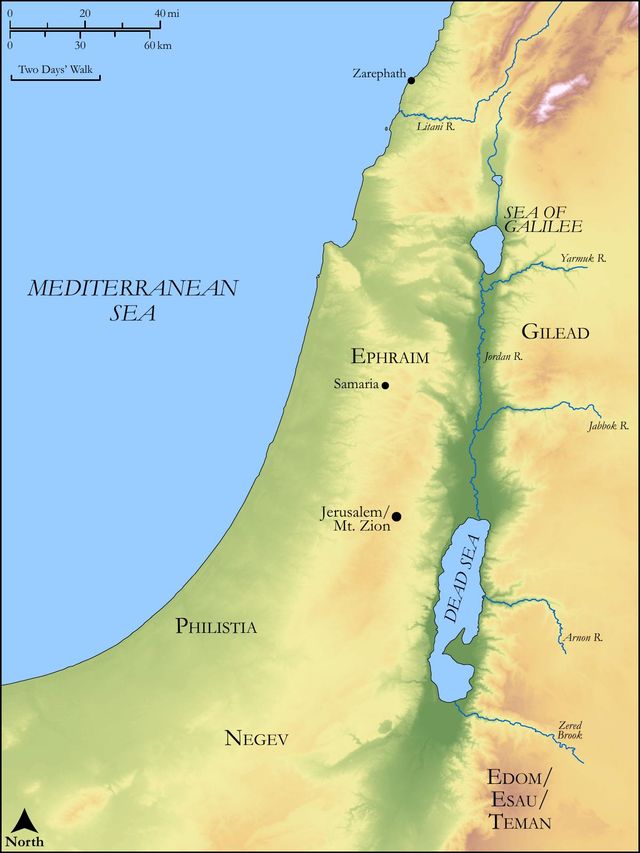
See on the biblical-era map
Study this verse
Historical interpretation
Historical reception
1 surviving comment on this verse from the historical church.
(Verse 8, 9.) Shall I not in that day, saith the Lord, destroy the wise out of Edom, and understanding out of the mount of Esau? And thy mighty men shall be dismayed, O Teman, to the end that every one of the mount of Esau may be cut off by slaughter. Septuagint: In that day, saith the Lord, I will destroy the wise out of Edom, and understanding out of the mount of Esau. And thy mighty men, O Theman, shall be afraid, that every one from the mount of Esau may be cut off by destruction. When thy despoilers have seized thy borders, and all the men of thy league have mocked thee and have acquired strength against thee: then shall wisdom perish out of Edom and his subtlety shall be made foolishness. Moreover, the Lord will also take away prudence from Mount Esau, that is, from the mountains of Seir, either because the city of Idumea is situated on the mountain, or because all that region which borders on the south is desert, situated high on the mountains. Hence it is also said: Your warriors will be afraid, O Theman, which we interpret as the south. However, as I said above, Esau is called by three names: and likewise, the region of his kingdom, which borders on the south, is called by three names, Darom, Theman, Nageb, which all, according to Ezekiel, signify the south, the west, and the south. But when the strong men of his kingdom who dwelt in the South shall truly fear, then a man from the mountain of Esau, who both used to fight for the city and to wisely give counsel, shall perish. Otherwise: After those who were previously deceived have been converted to the Church, then, with the Lord Himself fighting, the wise men of Edom, who had a taste for worldly and earthly things, shall perish, and wisdom shall be taken away from the mountain of Esau, which was exalted against the knowledge of God. And those who previously fought for Esau and the dialectical art of Edom, and were in the garrisons of Teman, which means completion, will cease to fight for their former masters. Whether those who had promised themselves the light of knowledge and thought they were at noon, will fear and be afraid, with a scholarly man mastering their sophistries: to such an extent that no one will remain who is able to fight, either with the counsel of the king or with warrior men, against the pride and false teaching of the heretics.
Continue studying Obadiah 1:8 across the web’s major study libraries — every link below opens this exact verse, chapter, or book on the destination site.
Read & Compare
 BibleGatewayThis verse in more than 200 translations and 70 languages.
 Bible.comThe YouVersion reader — hundreds of translations, reading plans, and highlights.
 ESV.orgCrossway's official English Standard Version reader.
 NET BibleThe NET translation with 60,000+ translators' notes on every rendering decision.
 STEP BibleTyndale House's free study tool — original text, vocabulary, and scholarly resources.
 BibliaLogos Bible Software's free web reader.
 USCCBThe New American Bible (Revised Edition) with the U.S. bishops' study notes.
Commentaries
 BibleHub CommentariesDozens of classic commentaries on this verse, gathered on one page.
 StudyLightMore than 100 commentary sets — the largest collection on the web.
 BibleRefPlain-English commentary on what this verse means, verse by verse.
 Enduring WordDavid Guzik's free commentary on this chapter, widely used by Bible teachers.
 Bible Study ToolsVerse commentary alongside Greek and Hebrew study aids.
Original Language & Research
- BibleHub InterlinearThe verse word by word — original language, transliteration, and English.
- BibleHub LexiconEvery word's original-language definition and Strong's entry.
 Blue Letter BibleDeep-study tools — Strong's numbers, concordance, and word studies.
 SefariaThe Hebrew text with Rashi and centuries of Jewish commentary.
Sermons, Hymns & Audio


TrulyRandomVerse is not affiliated with these sites and doesn’t control their content. They’re linked because they’re genuinely useful.
Summary
Obadiah 1:8 delivers a profound divine declaration of judgment against the nation of Edom. In this pivotal verse, the LORD Himself, speaking with absolute authority, promises to completely strip Edom of its most cherished and relied-upon assets: its renowned wisdom and understanding. This pronouncement reveals the ultimate futility and impotence of human intellect, strategic prowess, and self-reliance when arrayed against the sovereign will and righteous judgment of God, signaling Edom's inevitable and total downfall.
Context
ShowHideLiterary Context
Obadiah is the shortest book in the Old Testament, a concise prophetic oracle almost entirely dedicated to pronouncing judgment on Edom. Verse 8 follows a series of pronouncements detailing Edom's pride and the treachery of its allies. The preceding verses, particularly Obadiah 1:3-7, highlight Edom's arrogant self-security in its seemingly impregnable mountain fortresses and its misplaced trust in its alliances. Verse 8 directly addresses the intellectual pride and strategic wisdom that Edom also boasted, showing that even these perceived strengths will be utterly dismantled by divine decree. This specific judgment on their wisdom sets the stage for the complete devastation described in the subsequent verses, emphasizing that no aspect of Edom's perceived strength will save them.
Historical & Cultural Context
Edom, located southeast of Judah, was descended from Esau, the elder twin-brother of Jacob (Genesis 25:23). Despite this familial tie, a deep-seated and often violent animosity characterized the relationship between Edom and Israel throughout their history, frequently manifesting in opposition and betrayal. The specific historical offense precipitating this prophecy was Edom's malicious actions during Judah's time of extreme distress, particularly when Babylon besieged and plundered Jerusalem. Instead of offering aid or showing compassion, Edom gloated over Judah's downfall, participated in the looting, and even captured fleeing Israelites, handing them over to the enemy (Obadiah 1:11-14). Culturally, Edom, especially its region of Teman, was renowned among the nations for its wise men, skilled counselors, and strategic acumen, as evidenced in Jeremiah 49:7. This reputation made the divine promise to destroy their wisdom particularly devastating and ironic.
Key Themes
ShowHideObadiah 1:8 powerfully contributes to several overarching themes within the book and broader biblical narrative. Firstly, it underscores the theme of Divine Judgment and Sovereignty, asserting that God's justice will prevail against all who oppose His people and His righteous standards. The phrase "saith the LORD" highlights that this is not merely a human prediction but an unchallengeable decree from the self-existent God, demonstrating His absolute control over nations and His commitment to covenant justice. Secondly, the verse exposes The Folly of Earthly Wisdom Apart from God. Edom's wisdom was a source of national pride and perceived security, yet God declares He will "destroy" it, rendering it utterly useless. This serves as a stark reminder that human wisdom, no matter how profound or celebrated, is ultimately impotent when it conflicts with God's purposes or is wielded for evil and pride. Finally, it reinforces the theme of Consequences of Pride and Cruelty, showing that Edom's extreme arrogance and its cruel, unbrotherly actions against Judah will result in the removal of the very attributes they relied upon, leading to their complete and humiliating downfall.
Exposition and Analysis
ShowHideKey Word Analysis
ShowHideA primitive root meaning "to wander away, i.e., lose oneself; by implication to perish (causative, destroy)." This word signifies a complete and decisive removal, rendering something utterly ineffective or causing it to cease to exist. In the context of Obadiah 1:8, it indicates that Edom's wisdom and understanding will not merely diminish but will be utterly annihilated, leading to their strategic incapacitation and ultimate ruin.
Meaning "intelligent, skillful or artful." It refers to those who possess practical skill, discernment, prudence, and often, a reputation for sagacity. Edom was known for its wise men, particularly from Teman, who were consulted for counsel and strategy. God's destruction of this "wise" counsel means their most valued intellectual asset will become worthless.
Meaning "intelligence; by implication, an argument; by extension, caprice; discretion, reason, skilfulness, wisdom." This word denotes insight, intelligence, and skillful planning. Its destruction signifies the removal of Edom's capacity for strategic thought, sound judgment, and effective decision-making, leaving them bereft of internal guidance and direction.
Verse Breakdown
ShowHide"Shall I not in that day, saith the LORD"
This opening rhetorical question, immediately followed by the divine affirmation "saith the LORD" (from H5002, nᵉʼum, an oracle, and H3068, Yᵉhôvâh, the self-existent God), powerfully establishes the absolute certainty and divine origin of the impending judgment. "That day" (from H3117, yôwm, a day, often used figuratively for a specific time of judgment) refers to the appointed time of divine reckoning for Edom, underscoring that this is a predetermined event in God's sovereign plan. The question implies an emphatic "Indeed, I shall!"
"even destroy the wise [men] out of Edom"
This clause directly targets one of Edom's primary sources of national pride and security: its renowned wisdom and the wise individuals who embodied it. The verb "destroy" (H6, ʼâbad) signifies a complete and utter annihilation or rendering useless. God promises to eliminate the very intellectual capacity and astute counsel that Edom relied upon, stripping them of their strategic advantage and leaving them vulnerable and without guidance.
"and understanding out of the mount of Esau?"
This parallel clause reinforces the first, broadening the scope of the judgment to encompass all forms of Edomite intelligence, insight, and strategic planning (H8394, tâbûwn). "The mount of Esau" (H2022, har, a mountain, and H6215, ʻÊsâv, Esau, referring to the Edomite territory) emphasizes that this destruction of wisdom will permeate the entire nation, from its highest peaks to its deepest valleys, leaving no corner untouched by this divine incapacitation. The rhetorical question again demands an affirmative answer, confirming the totality of the judgment.
Literary Devices
ShowHideThe verse employs several potent literary devices to convey its message. The primary device is Rhetorical Question, "Shall I not in that day, saith the LORD...?" which serves not to elicit an answer but to emphasize the absolute certainty and inevitability of the divine judgment. It functions as a powerful affirmation, underscoring God's unwavering resolve. Parallelism is evident in the two clauses "destroy the wise [men] out of Edom" and "and understanding out of the mount of Esau," where "wise men" is paralleled with "understanding," and "Edom" with "the mount of Esau." This synonymous parallelism reinforces the totality of the judgment, showing that both the practitioners of wisdom and wisdom itself will be removed from the entire Edomite territory. The phrase "saith the LORD" acts as a Divine Oracle Formula, lending ultimate authority and gravity to the pronouncement. Furthermore, there is an element of Irony, as Edom, known for its wisdom, will have that very wisdom removed by divine decree, highlighting the futility of human strength when it opposes God.
Theological and Thematic Connections
ShowHideObadiah 1:8 stands as a powerful testament to God's sovereignty over human intellect and national strength. It reveals that true wisdom originates from God, and any wisdom used for pride, cruelty, or in opposition to His will is ultimately hollow and subject to divine dismantling. This verse underscores the biblical principle that human wisdom, when divorced from divine truth and righteousness, leads to folly and destruction. It serves as a stark warning against self-reliance and the arrogance that often accompanies perceived intellectual superiority, reminding us that God can, and will, render the counsel of the wise foolish when it stands against His purposes.
Reflection and Application
ShowHideObadiah 1:8 offers profound lessons for contemporary believers, urging us to examine the source and purpose of our own wisdom and understanding. In a world that often exalts human intellect, strategic prowess, and technological advancement, this verse serves as a sobering reminder that true wisdom begins with the fear of the LORD (Proverbs 9:10). When we rely solely on our own understanding, our plans, no matter how brilliant, can be rendered useless by God if they are not aligned with His will or if they are tainted by pride and self-interest. This passage calls us to humility, encouraging us to seek divine wisdom in all our endeavors, trusting that God's ways are higher than our ways and His thoughts higher than our thoughts (Isaiah 55:8-9). It also provides comfort, assuring us that God sees and will ultimately address injustices and the arrogance of those who oppress His people, demonstrating that no nation or individual can escape divine accountability.
Questions for Reflection
ShowHideFAQ
ShowHideWhat was Edom's "wisdom" known for, and why was its destruction significant?
ShowHideEdom, particularly its region of Teman, was renowned among the nations for its wise men, skilled counselors, and strategic acumen. This reputation is even mentioned in other prophetic books, such as Jeremiah 49:7. Their wisdom likely encompassed political strategy, military tactics, and perhaps even philosophical or legal insights. The destruction of this wisdom was highly significant because it targeted the very foundation of Edom's national pride, security, and perceived invincibility. By removing their understanding, God was not just punishing them but rendering them utterly helpless and unable to defend themselves or make sound decisions, ensuring their complete downfall.
Does this verse imply that all human wisdom is inherently bad or destined for destruction?
ShowHideNot at all. The Bible often commends wisdom, particularly wisdom that comes from God or is used for righteous purposes (e.g., Proverbs 2:6). Obadiah 1:8 specifically addresses Edom's wisdom, which was characterized by pride, self-reliance, and was used to plot against and gloat over God's people (Obadiah 1:10-14). The destruction of Edom's wisdom is a judgment against wisdom that is divorced from God, used for evil, or becomes a source of arrogant self-trust. It highlights that human intellect, when it stands in opposition to God's will or fuels unrighteousness, is ultimately futile and subject to divine judgment.
Christ-Centered Fulfillment
ShowHideObadiah 1:8, with its pronouncement of the destruction of human wisdom, finds its ultimate Christ-centered fulfillment in the New Testament's revelation of Jesus Christ as the true and ultimate wisdom of God. While Edom's earthly wisdom was a source of pride and led to their downfall, God's divine wisdom, embodied in Christ, is the path to salvation and true understanding. 1 Corinthians 1:18-25 powerfully declares that "the foolishness of God is wiser than human wisdom, and the weakness of God is stronger than human strength." The cross, which seemed foolishness to the Greeks and a stumbling block to the Jews, is revealed as the very power and wisdom of God for those who are being saved. In Christ, all the treasures of wisdom and knowledge are hidden (Colossians 2:3). Therefore, the judgment on Edom's self-reliant wisdom foreshadows the broader biblical truth that all human wisdom, apart from Christ, is ultimately vain and will be brought to nothing. Our reliance must shift from our own limited intellect to the infinite, saving wisdom found only in the person and work of Jesus, who became for us "wisdom from God—that is, our righteousness, holiness and redemption" (1 Corinthians 1:30).