


Genesis 25:23
Bible text: King James Version (1769 Blayney text) · Public domain
Bible text: King James Version with Strong's numbers · Public domain
Bible text: Berean Standard Bible · Public domain
Bible text: American Standard Version (1901) · Public domain
Bible text: World English Bible, Messianic edition · Public domain
Bible text: Geneva Bible (1599) · Public domain
Bible text: Young's Literal Translation · Public domain
- וַיֹּאמֶרvai·Yo·merand he saidH559Conj-w ¦ V-Qal-ConsecImperf-3msVerb Qal Consecutive Imperfect 3rd Singular Masculineוַandיֹּאמֶרhe said
- יְהוָהYah·wehYahwehH3068N-properNoun Proper Title
- לָהּLahto <the> herPrep-l ¦ 3fsSuffix Personal 3rd Singular Feminineלָto <the>הּher
- שְׁנֵיshe·NeitwoH8147Adj-cdcAdjective Numerical Dual common gender Construct
- גוֹיִםgo·yimnationsH1471N-mpNoun Plural Masculine Absolute
- בְּבִטְנֵךְbe·vit·Nekh[are] in your wombH990Prep-b ¦ N-fsc ¦ 2fsNoun Singular Feminine Constructבְּ[are] inבִטְנֵwombךְyour
- וּשְׁנֵיu·she·Neiand twoH8147Conj-w ¦ Adj-cdcAdjective Numerical Dual common gender Constructוּandשְׁנֵיtwo
- לְאֻמִּיםle·'u·MimpeoplesH3816N-mpNoun Plural Masculine Absolute
- מִמֵּעַיִךְmi·me·'A·yikhfrom your inward partsH4578Prep-m ¦ N-mpc ¦ 2fsNoun Plural Masculine Constructמִfromמֵּעַיִinward partsךְyour
- יִפָּרֵדוּyi·pa·Re·duthey will separateH6504V-Niphal-Imperf-3mpVerb Niphal Imperfect 3rd Plural Masculine
- וּלְאֹםu·le·'Omand a peopleH3816Conj-w ¦ N-msNoun Singular Masculine Absoluteוּandלְאֹםa people
- מִלְאֹםmil·'Ommore than a peopleH3816Prep-m ¦ N-msNoun Singular Masculine Absoluteמִmore thanלְאֹםa people
- יֶאֱמָץye·'e·Matzit will be strongH553V-Qal-Imperf-3msVerb Qal Imperfect 3rd Singular Masculine
- וְרַבve·Ravand [the] great [one]H7227Conj-w ¦ Adj-msAdjective Singular Masculine Absoluteוְandרַב[the] great [one]
- יַעֲבֹדya·'a·Vodit will serveH5647V-Qal-Imperf-3msVerb Qal Imperfect 3rd Singular Masculine
- צָעִירtza·'Ir[the] young [one]H6810Adj-msAdjective Singular Masculine Absolute
English is a literal word-by-word gloss of the Hebrew, not the KJV's wording. Why?
This is the original text the KJV's translators worked from — each Hebrew word with its own literal English meaning in this verse, prepared by scholars at Tyndale House, Cambridge. The KJV translates whole sentences, not word by word, so its wording differs: one Hebrew word can become several English words, and the KJV may choose “the LORD” where the gloss reads “Yahweh”. Both are faithful — they answer different questions. For the KJV's own rendering, switch to the KJV text.
Details
See on the biblical-era maps


Study this verse
Public-domain commentary
Matthew Henry
From his Commentary on the Whole Bible. Henry comments on passages, not single verses — this entry covers Genesis 25:19–28. His four-level outline is real structure in the source text, so it is rendered as structure.
We have here an account of the birth of Jacob and Esau, the twin sons of Isaac and Rebekah: their entrance into the world was (which is not usual) one of the most considerable parts of their story; nor is much related concerning Isaac but what had reference to his father while he lived and to his sons afterwards. For Isaac seems not to have been a man of action, nor much tried, but to have spent his days in quietness and silence. Now concerning Jacob and Esau we are here told,
I.That they were prayed for.
Their parents, after they had been long childless, obtained them by prayer, Gen 25:20, Gen 25:21. Isaac was forty years old when he was married; though he was an only son, and the person from whom the promised seed was to come, yet he made no haste to marry. He was sixty years old when his sons were born (Gen 25:26), so that, after he was married, he had no child for twenty years. Note, Though the accomplishment of God's promise is always sure, yet it is often slow, and seems to be crossed and contradicted by Providence, that the faith of believers may be tried, their patience exercised, and mercies long waited for may be the more welcome when they come. While this mercy was delayed, Isaac did not approach to a handmaid's bed, as Abraham had done, and Jacob afterwards; for he loved Rebekah, Gen 24:67. But,
1.He prayed: he entreated the Lord for his wife. Though God had promised to multiply his family, he prayed for its increase; for God's promises must not supersede, but encourage, our prayers, and be improved as the ground of our faith. Though he had prayed for this mercy very often, and had continued his supplication many years, and it was not granted, yet he did not leave off praying for it; for men ought always to pray, and not to faint (Luk 18:1), to pray without ceasing, and knock till the door be opened, He prayed for his wife; some read it with his wife. Note, Husbands and wives should pray together, which is intimated in the apostle's caution, that their prayers be not hindered, Pe1 3:7. The Jews have a tradition that Isaac, at length, took his wife with him to mount Moriah, where God had promised that he would multiply Abraham's seed (ch. 22:17), and there, in his prayer with her and for her, pleaded the promise made in that very place.
2.God heard his prayer, and was entreated of him. Note, Children are the gift of God. Those that continue instant in prayer, as Isaac did, shall find, at last, that they did not seek in vain, Isa 45:19.
II.That they were prophesied of before they were born, and great mysteries were wrapped up in the prophecies which went before of them, Gen 25:22, Gen 25:23. Long had Isaac prayed for a son; and now his wife is with child of two, to recompense him for his long waiting. Thus God often outdoes our prayers, and gives more than we are able to ask or think. Now Rebekah being with child of these two sons, observe here,
1.How she was perplexed in her mind concerning her present case: The children struggled together within her. The commotion she felt was altogether extraordinary and made her very uneasy. Whether she was apprehensive that the birth would be her death, or whether she was weary of the intestine tumult, or whether she suspected it to be an ill omen, it seems she was ready to wish that either she had not been with child or that she might die immediately, and not bring forth such a struggling brood: If it be so, or, since it is so, Why am I thus? Before, the want of children was her trouble, now, the struggle of the children is no loss so. Note,
(1.)The comforts we are most desirous of are sometimes found to bring along with them more occasion of trouble and uneasiness that we thought of; vanity being written upon all things under the sun, God thus teaches us to read it.
(2.)We are too apt to be discontented with our comforts, because of the uneasiness that attends them. We know not when we are pleased; we know neither how to want nor how to abound. This struggle between the kingdom of God and the kingdom of Satan,
[1.]In the world. The seed of the woman and the seed of the serpent have been contending ever since the enmity was put between them (Gen 3:15), and this has occasioned a constant uneasiness among men. Christ himself came to send fire on earth, and this division, Luk 12:49, Luk 12:51. But let not this be offence to us. A holy war is better than the peace of the devil's palace.
[2.]In the hearts of believers. No sooner is Christ formed in the soul than immediately there begins a conflict between the flesh and spirit, Gal 5:17. The stream is not turned without a mighty struggle, which yet ought not to discourage us. It is better to have a conflict with sin than tamely to submit to it.
2.What course she took for her relief: She went to enquire of the Lord. Some think Melchizedek was now consulted as an oracle, or perhaps some Urim or Teraphim were now used to enquire of God by, as afterwards in the breast-plate of judgment. Note, The word and prayer, by both which we now enquire of the Lord, give great relief to those that are upon any account perplexed. It is a great relief to the mind to spread our case before the Lord, and ask counsel at his mouth. Go into the sanctuary, Psa 73:17.
3.The information given her, upon her enquiry, which expounded the mystery: Two nations are in thy womb, Gen 25:23. She was now pregnant, not only with two children, but two nations, which should not only in their manners and dispositions greatly differ from each other, but in their interests clash and contend with each other; and the issue of the contest should be that the elder should serve the younger, which was fulfilled in the subjection of the Edomites, for many ages, to the house of David, till they revolted, Ch2 21:8. Observe here, (1.) God is a free agent in dispensing his grace; it is his prerogative to make a difference between those who have not as yet themselves done either good or evil. This the apostle infers hence, Rom 9:12 (2.) In the struggle between grace and corruption in the soul, grace, the younger, shall certainly get the upper hand at last.
III.That when they were born there was a great difference between them, which served to confirm what had been foretold (Gen 25:23), was presage of the accomplishment of it, and served greatly to illustrate the type.
1.There was a great difference in their bodies, Gen 25:25. Esau, when he was born, was rough and hairy, as if he had been already a grown man, whence he had his name Esau, made, reared already. This was an indication of a very strong constitution, and gave cause to expect that he would be a very robust, daring, active man. But Jacob was smooth and tender as other children. Note,
(1.)The difference of men's capacities, and consequently of their condition in the world, arises very much from the difference of their natural constitution; some are plainly designed by nature for activity and honour, others as manifestly marked for obscurity. This instance of the divine sovereignty in the kingdom of providence may perhaps help to reconcile us to the doctrine of the divine sovereignty in the kingdom of grace.
(2.)It is God's usual way to choose the weak things of the world, and to pass by the mighty, Co1 1:26, Co1 1:27.
2.There was a manifest contest in their births. Esau, the stronger, came forth first; but Jacob's hand took hold of his heel, Gen 25:26. This signified,
(1.)Jacob's pursuit of the birthright and blessing; from the first, he reached forth to catch hold of it, and, if possible, to prevent his brother.
(2.)His prevailing for it at last, that, in precess of time, he should undermine his brother, and gain his point. This passage is referred to (Hos 12:8), and hence he had his name, Jacob, a supplanter.
3.They were very unlike in the temper of their minds, and the way of living they chose, Gen 25:27. They soon appeared to be of very different dispositions.
(1.)Esau was a man for this world. He was a man addicted to his sports, for he was a hunter; and a man who knew how to live by his wits, for he was a cunning hunter. Recreation was his business; he studied the art of it, and spent all his time in it. He never loved a book, nor cared for being within doors; but he was a man of the field, like Nimrod and Ishmael, all for the game, and never well but when he was upon the stretch in pursuit of it: in short, he set up for a gentleman and a soldier.
(2.)Jacob was a man for the other world. He was not cut out for a statesman, nor did he affect to look great, but he was a plain man, dwelling in tents, an honest man that always meant well, and dealt fairly, that preferred the true delights of solitude and retirement to all the pretended pleasure of busy noisy sports: he dwelt in tents,
[1.]As a shepherd. he was attached to that safe and silent employment of keeping sheep, to which also he bred up his children, Gen 46:34. Or,
[2.]As a student. He frequented the tents of Melchizedek, or Heber, as some understand it, to be taught by them divine things. And this was that son of Isaac on whom the covenant was entailed.
4.Their interest in the affections of their parents was likewise different. They had but these two children, and, it seems, one was the father's darling and the other the mother's, Gen 25:28.
(1.)Isaac, though he was not a stirring man himself (for when he went into the fields he went to meditate and pray, not to hunt), yet loved to have his son active. Esau knew how to please him, and showed a great respect for him, by treating him often with venison, which gained him the affections of the good old man, and won upon him more than one would have thought.
(2.)Rebekah was mindful of the oracle of God, which had given the preference to Jacob, and therefore she preferred him in her love. And, if it be lawful for parents to make a difference between their children upon any account, doubtless Rebekah was in the right, that loved him whom God loved.
Historical interpretation
Five Centuries of Reception
6 surviving comments on this verse. Each one is dated, so this reads as a timeline rather than a list.
Select a marker to jump to its quote. Markers stagger vertically where authors wrote within a few decades of each other.
I say the truth in Christ, I lie not, my conscience also bearing me witness in the Holy Ghost, That I have great heaviness and continual sorrow in my heart. For I could wish that myself were accursed from Christ for my brethren, my kinsmen according to the flesh: Who are Israelites; to whom pertaineth the adoption, and the glory, and the covenants, and the giving of the law, and the service of God, and the promises; Whose are the fathers, and of whom as concerning the flesh Christ came, who is over all, God blessed for ever. Amen. Not as though the word of God hath taken none effect. For they are not all Israel, which are of Israel: Neither, because they are the seed of Abraham, are they all children: but, In Isaac shall thy seed be called. That is, They which are the children of the flesh, these are not the children of God: but the children of the promise are counted for the seed. For this is the word of promise, At this time will I come, and Sara shall have a son. And not only this; but when Rebecca also had conceived by one, even by our father Isaac; (For the children being not yet born, neither having done any good or evil, that the purpose of God according to election might stand, not of works, but of him that calleth;) It was said unto her, The elder shall serve the younger. [Genesis 25:23] As it is written, Jacob have I loved, but Esau have I hated. What shall we say then? Is there unrighteousness with God? God forbid. For he saith to Moses, I will have mercy on whom I will have mercy, and I will have compassion on whom I will have compassion. So then it is not of him that willeth, nor of him that runneth, but of God that showeth mercy. For the scripture saith unto Pharaoh, Even for this same purpose have I raised thee up, that I might show my power in thee, and that my name might be declared throughout all the earth. Therefore hath he mercy on whom he will have mercy, and whom he will he hardeneth.
I think that this can be said also of each of us as individuals that “two nations and two peoples are within you.” For there is a people of virtue within us, and there is no less a people of vice within us. “For from our heart proceed evil thoughts, adulteries, thefts, false testimonies” but also “deceits, contentions, heresies, jealousies, revelings and such like.” Do you see how great a people of evil is within us? But if we should deserve to utter that word of the saints, “From fear of you, Lord, we have conceived in the womb and have brought forth. We have wrought the spirit of your salvation on the earth.” Thus another people, begotten in the Spirit, is found within us. For “the fruit of the spirit is love, joy, peace, patience, goodness, gentleness, temperance, purity” and so forth. You see another people that is also itself within us. But this one is less; that one greater. For there are always more evil than good people, and vices are more numerous than virtues. But if we should be such as Rebekah and should deserve to conceive from Isaac, that is, from the Word of God, “one people shall overcome the other, and the elder shall serve the younger,” even in us, for the flesh shall serve the Spirit, and vices shall yield to virtues.
We must now take a look at the history of the city of God, as it takes its course from this point on among the descendants of Abraham. In the period from Isaac’s birth to his seventieth year, when his first children were born, there is one memorable fact: He asked God that his wife, who was barren, might bear him a child. God heard the prayer, and she conceived twins who leaped while still in her womb. She was troubled by the disturbance, and, asking the Lord, she received this answer: “Two nations are in your womb; two people shall stem from your body. One people shall be stronger than the other, and the elder shall serve the younger.”This is interpreted by the apostle Paul as an obvious proof of the working of grace: “For before the children had yet been born or had done anything of good or evil,” the younger was chosen, through no merits of his own, and the older rejected. So far as original sin goes, both were equal. As for personal sins, neither had any.
The fact that we read “One people shall be stronger than the other, and the elder shall serve the younger” we do not see fulfilled according to the letter in Esau and Jacob. For Scripture does not mention that Esau served blessed Jacob bodily. Therefore we ought to inquire how this is to be understood spiritually, or how the elder shall serve the younger, for if this were not to happen holy Scripture would not mention it. Therefore if one pays careful attention, one will know how the elder people shall serve the younger in the case of Christians and Jews. The greater and older people of the Jews are proved to serve the younger, that is, the Christian people, for like servants of the Christians they are known to carry the books of the divine law throughout the world for the instruction of all nations. Therefore the Jews were scattered in every land, so that when we want to invite some pagan to faith in Christ by testifying that Christ was announced by all the prophets, and he resists and says that the holy books of the divine law were written by us rather than the Holy Spirit, we may thus have a means of refuting him with positive arguments. To such a person we may say, “If a doubt arises in you concerning my books, behold the books of the Jews, apparently our enemies, which I certainly could neither have written nor changed. Read them over, and when you have found in them the same thing as in my books, ‘Be not unbelieving but believing.’ ” In this way the elder people is known to serve the younger, for through their books the people of the Gentiles are invited to belief in Christ.
Good souls want to win over the evil, but the wicked long to destroy the just. It is the desire of the good that those who are bad be corrected, while the destruction of the good is the pursuit of the wicked. There is one class of the pious, another of the impious. The class of the good are raised up to heaven through humility, while the class of the wicked are plunged into hell through pride. For all those members of the Catholic church belong to Esau who are inclined toward earthly possessions, love the earth, desire the earth and place all their hopes in the earth. Whoever wishes to serve God in order to increase in honors or receive material profits is known to belong to Esau, that is, to earthly happiness. For in Esau carnal souls are understood, while spiritual ones are truly in Jacob. These are the two people whom the apostle clearly mentions when he distinguishes the carnal and the spiritual. As he says, “Now the works of the flesh are manifest, which are immorality, uncleanness, licentiousness, idolatry, witchcrafts, enmities, contentions, jealousies, anger, quarrels, factions, parties, envies, drunkenness, carousing and suchlike.” Behold the fruits of the people who belong to Esau. In the following passage the same apostle adds the fruits of those who belong to Jacob, saying, “But the fruit of the Spirit is: charity, joy, peace, patience, goodness, kindness, faith, modesty, continence.” Behold the spiritual works belonging to blessed Jacob, that is, to people who are pious.
How then do the wicked serve the good? As persecutors serve the martyrs; as a file or hammer, gold; as a mill, wheat; as ovens, the baking of bread: those are consumed, so that these may be baked. How, I say, do the wicked serve the good? As chaff in the furnace of the goldsmith serves gold …. Therefore the wicked should not boast or extol themselves when they send tribulations to the good. For while they are persecuting the good in their bodies, they are killing themselves in their hearts. If the misfortune of an evil person affects a good person, the iniquity has already caused his own soul to decay. Therefore if in an evil spirit someone who is inflamed with the fury of wrath tries to stir up a good man, it is still doubtful whether the good man can be consumed with rage, but there is no doubt that the evil man is already glowing with anger. Perhaps that good man who is full of spiritual vigor and the refreshment of the Holy Spirit will not get excited, even if the fire of persecution is inflicted; but without any doubt the one who tried to arouse him cannot fail to burn with passion. Esau and Jacob were born of the one seed of Isaac, just as Christian people are begotten of our Lord and Savior’s one baptism and one womb of the church. However, just like Esau and Jacob, these people are divided into two parts because of their moral differences. For from the fruits of their works one part is known to be carnal, the other spiritual. For this reason, then, Scripture says, “The elder shall serve the younger,” because the number of the wicked is always greater than that of the good. So just like those two children in the womb of Rebekah, so these people will struggle in the womb of the church until judgment day, as we said above, while the proud resist the humble, while adulterers persecute the chaste, while drunkards whose number is infinite rail at the sober, while the envious rival the good, while robbers desire to destroy those who give alms like the irascible do the peaceable, and while the dissolute attempt to drag down to earth those who have a taste for heavenly things.
Continue studying Genesis 25:23 across the web’s major study libraries — every link below opens this exact verse, chapter, or book on the destination site.
Read & Compare
 BibleGatewayThis verse in more than 200 translations and 70 languages.
 Bible.comThe YouVersion reader — hundreds of translations, reading plans, and highlights.
 ESV.orgCrossway's official English Standard Version reader.
 NET BibleThe NET translation with 60,000+ translators' notes on every rendering decision.
 STEP BibleTyndale House's free study tool — original text, vocabulary, and scholarly resources.
 BibliaLogos Bible Software's free web reader.
 USCCBThe New American Bible (Revised Edition) with the U.S. bishops' study notes.
Commentaries
 BibleHub CommentariesDozens of classic commentaries on this verse, gathered on one page.
 StudyLightMore than 100 commentary sets — the largest collection on the web.
 BibleRefPlain-English commentary on what this verse means, verse by verse.
 Enduring WordDavid Guzik's free commentary on this chapter, widely used by Bible teachers.
 Bible Study ToolsVerse commentary alongside Greek and Hebrew study aids.
Original Language & Research
- BibleHub InterlinearThe verse word by word — original language, transliteration, and English.
- BibleHub LexiconEvery word's original-language definition and Strong's entry.
 Blue Letter BibleDeep-study tools — Strong's numbers, concordance, and word studies.
 SefariaThe Hebrew text with Rashi and centuries of Jewish commentary.
Sermons, Hymns & Audio


TrulyRandomVerse is not affiliated with these sites and doesn’t control their content. They’re linked because they’re genuinely useful.
Summary
Genesis 25:23 presents a profound divine oracle delivered to Rebekah concerning her unborn twin sons, Jacob and Esau. This pivotal prophecy reveals that two distinct nations will emerge from her womb, destined for a future of separation and conflict. Crucially, it foretells a reversal of the customary birth order, declaring that the elder son's lineage will ultimately serve the younger's, setting the stage for a dramatic unfolding of God's sovereign purposes in redemptive history.
Context
ShowHideLiterary Context
This verse is embedded within the patriarchal narratives of Genesis, specifically following the account of Isaac's marriage to Rebekah and their prolonged barrenness. Genesis 25:21 details Isaac's earnest prayer for Rebekah, after which "the LORD granted his plea, and Rebekah his wife conceived." The narrative immediately preceding verse 23 describes Rebekah's difficult pregnancy, marked by intense internal struggle as the twins "struggled together within her." This physical turmoil prompts her to "inquire of the LORD" (Genesis 25:22), indicating a direct divine response to her distress and confusion. The Lord's oracle in verse 23, therefore, serves as the divine explanation for her prenatal struggle, revealing its significance as a foreshadowing of future national conflict and a surprising reversal of societal norms regarding primogeniture. It sets the stage for the subsequent narratives of Jacob and Esau's lives, their rivalry, and the eventual formation of the nations of Israel and Edom.
Historical & Cultural Context
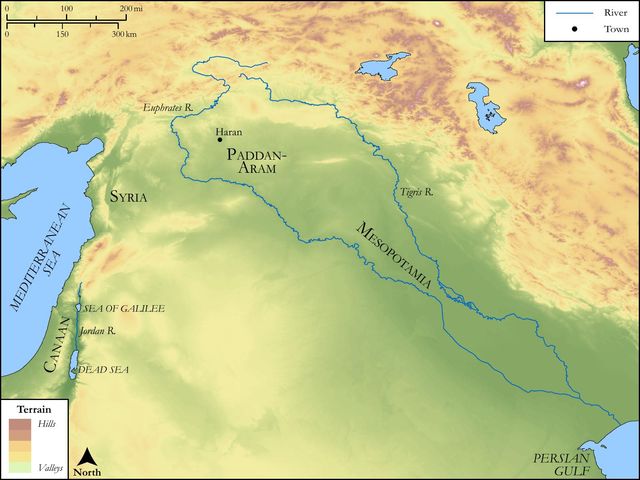
In the days of the patriarchs, primogeniture was a deeply ingrained cultural norm. The firstborn son typically held a privileged position, inheriting a double portion of the father's estate, leadership of the family, and the primary blessing. This cultural expectation made God's declaration in Genesis 25:23 profoundly counter-cultural and shocking. The concept of "nations" (Hebrew: goyim or le'omim) emerging from a single womb was also significant, pointing to the tribal and national identities that would later solidify. The geographical setting is Canaan, the promised land, where the patriarchs lived as sojourners. The future nations of Israel (descendants of Jacob) and Edom (descendants of Esau) would eventually occupy distinct territories in this region, with Edom settling in the mountainous region south of the Dead Sea. The prophecy's implications for their future relationship would play out over centuries, marked by periods of conflict and subservience.
Key Themes
ShowHideGenesis 25:23 powerfully contributes to several overarching themes in Genesis and the broader biblical narrative. Firstly, it highlights Divine Sovereignty and Election, demonstrating God's active involvement in human affairs and His freedom to choose individuals and nations for His purposes, irrespective of human merit or conventional expectations. This theme is further developed in passages like Romans 9:10-13. Secondly, it underscores the theme of Prophecy and Fulfillment, as God declares future events with precision, which are then meticulously fulfilled in the historical relationship between Israel and Edom. Thirdly, the prophecy of the "elder serving the younger" introduces the theme of Reversal of Natural Order, a recurring motif in scripture where God often chooses the weak, the overlooked, or the "younger" to accomplish His will, challenging human wisdom and societal norms. This motif is seen in figures like Abel over Cain (Genesis 4:4), David over his elder brothers (1 Samuel 16:6-13), and ultimately in the New Testament with the "last being first" (Matthew 19:30).
Exposition and Analysis
ShowHideThe Lord's oracle to Rebekah in Genesis 25:23 is a profound statement of divine foreknowledge and sovereign purpose, meticulously revealing the future of her unborn twins.
Key Word Analysis
ShowHideThis is the covenant name of God, H3068, emphasizing His self-existent, eternal nature and His active, personal involvement in the affairs of His people. The use of "LORD" here signifies that this is not a mere prediction but a divine decree from the sovereign God who orchestrates history and fulfills His promises. It underscores the authoritative and binding nature of the prophecy.
The verse uses two distinct Hebrew words for "nations" or "people": H1471 (gôwy) and H3816 (lᵉʼôm). Gôwy (H1471) often refers to foreign, non-Israelite nations or Gentiles, while lᵉʼôm (H3816) denotes a community or people. The use of both terms emphasizes the distinct national identities that would emerge from Rebekah's womb, highlighting their separate destinies and the future rivalry that would characterize their relationship. This is not just about two individuals, but two distinct peoples with unique trajectories.
The verb H5647 (ʻâbad) means "to work," "to serve," "to till," or "to enslave." In this context, "the elder shall serve the younger," it clearly implies a relationship of subordination or subservience. This is a direct reversal of the natural order of primogeniture, indicating that the descendants of the elder (Esau/Edom) would be subject to or subservient to the descendants of the younger (Jacob/Israel). This term highlights the power dynamic and the eventual subjugation of one people by the other, as seen in historical events.
Verse Breakdown
ShowHide"And the LORD said unto her, Two nations [are] in thy womb"
This opening clause immediately identifies the speaker as the sovereign God and the subject as Rebekah's pregnancy. The internal struggle she experienced is divinely interpreted not as a mere physical discomfort but as a symbolic representation of a future national rivalry. Her twin sons, Jacob and Esau, would indeed become the progenitors of two distinct peoples: Jacob, the father of Israel, and Esau, the father of Edom. This declaration clarifies the nature of her turmoil, elevating it to a matter of divine purpose and national destiny.
"and two manner of people shall be separated from thy bowels"
This phrase reiterates the distinctness of the two peoples, emphasizing their future separation and divergent paths. The "bowels" (H4578, mêʻeh), often referring to the womb or intestines, metaphorically represent the deepest parts of her being from which these distinct entities would emerge. This separation implies not just physical distance but also distinct cultures, destinies, and often, antagonistic relationships, fulfilling the prenatal struggle she experienced.
"and [the one] people shall be stronger than [the other] people"
This clause predicts the future power dynamic between the two emerging nations. While their relationship would fluctuate throughout history, this prophecy indicates an eventual supremacy of one over the other. Historically, Israel, the descendants of Jacob, would often hold a position of dominance or greater influence over Edom, the descendants of Esau, particularly during periods of Israel's strength, such as the reign of King David. This foretells a long history of conflict and shifting power, with Israel ultimately prevailing.
"and the elder shall serve the younger"
This is the most striking and counter-cultural element of the prophecy. In the patriarchal order, primogeniture dictated that the firstborn son (the elder, H7227, rab) held the position of honor, authority, and primary inheritance. God's declaration directly reverses this established order, signifying His freedom to choose and elevate whom He wills, irrespective of human custom or natural birth order. The Hebrew word ʻâbad (H5647), translated "serve," can also imply "subdue" or "be subject to," indicating a position of subservience. This prophecy foreshadows Jacob's eventual acquisition of the birthright and the blessing over Esau, though through human means that were not always righteous, and points to the eventual subjugation of Edom by Israel, demonstrating God's sovereign choice for His redemptive plan.
Literary Devices
ShowHideGenesis 25:23 is rich with literary devices that amplify its theological significance. The most prominent is Prophecy, as the verse contains a direct divine revelation of future events concerning the birth and destiny of two nations. This is a clear example of God's foreknowledge and His active role in shaping history. There is also significant Symbolism in Rebekah's internal struggle, which is not merely a physical discomfort but a symbolic representation of the future national conflict between Israel and Edom. The phrase "the elder shall serve the younger" employs Irony and Reversal, as it subverts the deeply entrenched cultural norm of primogeniture, highlighting God's freedom to operate outside human expectations and conventions. This reversal serves as a Foreshadowing of God's pattern throughout biblical history, where He often chooses the unexpected, the weak, or the "younger" to accomplish His purposes, demonstrating that His ways are higher than human ways.
Theological and Thematic Connections
ShowHideGenesis 25:23 is a foundational text for understanding God's sovereign election and His methods of working in human history. It powerfully illustrates that God's plans are not contingent on human merit, birth order, or societal customs, but on His own divine will and purpose. Before the twins had performed any good or bad deeds, God declared their future, demonstrating that His choice is based on His grace and not on works. This declaration sets a precedent for understanding God's unmerited favor and His freedom to choose individuals and nations for His specific redemptive purposes, challenging human notions of fairness and entitlement. It underscores that God's ways are often counter-intuitive to human wisdom, and His power is most clearly displayed when He works through the seemingly weaker or less likely candidates.
Reflection and Application
ShowHideGenesis 25:23 offers profound comfort and challenge for believers today. It assures us that God is intimately involved in human affairs, orchestrating events and destinies according to His perfect plan, even before birth. This divine foreknowledge and ultimate control provide a deep foundation for trust and peace, reminding us that God's purposes will prevail amidst personal struggles, national turmoil, or seemingly chaotic circumstances. We can rest in the knowledge that our lives, and indeed all of history, are held securely in His sovereign hands. Furthermore, the striking reversal of primogeniture reminds us that God's choices are based on His grace and sovereign wisdom, not on human merit, status, or traditional expectations. This truth fosters humility, encouraging us to depend entirely on His unmerited favor rather than our own efforts or perceived worth. It challenges us to look beyond conventional wisdom and societal norms to discern God's often surprising and counter-cultural ways of working, inspiring us to embrace His divine appointments, even when they defy our expectations.
Questions for Reflection
ShowHideFAQ
ShowHideDoes "the elder shall serve the younger" imply predestination for salvation?
ShowHideWhile this verse clearly demonstrates God's sovereign election regarding national destinies and roles within His redemptive plan, it does not directly address individual salvation in an eternal sense. The "serving" refers to the national and historical relationship between the descendants of Esau (Edom) and Jacob (Israel), not the eternal destiny of every individual from those nations. Paul later uses this passage in Romans 9 to illustrate God's sovereign right to choose whom He will for specific purposes within His covenant plan, emphasizing that God's promises are not bound by human lineage or works, but by His free choice. The primary focus remains on the corporate identity and role of the nations within the unfolding of God's redemptive history, rather than the individual's eternal fate.
How was the prophecy "the elder shall serve the younger" fulfilled historically?
ShowHideThis prophecy saw significant fulfillment throughout the history of Israel and Edom. While there were periods of conflict and even Edomite strength, Israel, particularly under kings like David, subjugated Edom (2 Samuel 8:14). Later, during the Hasmonean period (2nd-1st centuries BC), the Edomites (Idumeans) were forcibly converted to Judaism by John Hyrcanus, further illustrating a form of "serving" or subservience. The Edomites eventually lost their distinct national identity. The prophecy indicates a general pattern of Israel's ascendancy over Edom, affirming God's declared purpose for the two nations, even though the relationship was complex and not always one-sided throughout their entire history.
Christ-Centered Fulfillment
ShowHideThe striking reversal of primogeniture in Genesis 25:23, where "the elder shall serve the younger," finds its ultimate and profound Christ-centered fulfillment in the new covenant established through Jesus. Just as God chose Jacob, the younger and seemingly less deserving by human standards, to carry the covenant line, so too did God choose a new "younger" order—the church, composed of both Jew and Gentile, often the humble and overlooked—to inherit the promises over the "elder" order of the old covenant, which was limited to ethnic Israel. Christ Himself, though the eternal Son of God, humbled Himself to become the "younger" in humanity's fallen lineage, taking on human flesh and becoming "obedient to the point of death, even death on a cross" (Philippians 2:8). Yet, through His death and glorious resurrection, He became the "firstborn from the dead" (Colossians 1:18) and the "firstborn of all creation" (Colossians 1:15), inheriting all things and establishing a kingdom where the last are first (Matthew 19:30) and the weak are made strong (2 Corinthians 12:10). Thus, the principle of God's sovereign choice, overturning human expectations and elevating the unexpected, culminates in the person and work of Christ, through whom all who believe, regardless of their natural standing or human merit, are made heirs according to the promise and adopted into God's family (Galatians 3:29).