


2 Chronicles 21:8
Bible text: King James Version (1769 Blayney text) · Public domain
Bible text: Berean Standard Bible · Public domain
Bible text: American Standard Version (1901) · Public domain
Bible text: World English Bible, Messianic edition · Public domain
Bible text: Geneva Bible (1599) · Public domain
Bible text: Young's Literal Translation · Public domain
- בְּיָמָיוbe·ya·Mavin his daysH3117Prep-b ¦ N-mpc ¦ 3msNoun Plural Masculine Constructבְּinיָמָיdaysוhis
- פָּשַׁעpa·Sha'it rebelledH6586V-Qal-Perf-3msVerb Qal Perfect 3rd Singular Masculine
- אֱדוֹם'e·DomEdomH123N-proper-mNoun Proper Masculine
- מִתַּחַתmi·Ta·chatfrom underH8478Prep-m ¦ N-mscNoun Singular Masculine Constructמִfromתַּחַתunder
- יַדyad[the] hand ofH3027N-cscNoun Singular common gender Construct
- יְהוּדָהye·hu·DahJudahH3063N-properNoun Proper Location
- וַיַּמְלִיכוּvai·yam·Li·khuand they made kingH4427Conj-w ¦ V-Hiphil-ConsecImperf-3mpVerb Hiphil Consecutive Imperfect 3rd Plural Masculineוַandיַּמְלִיכוּthey made king
- עֲלֵיהֶם'a·lei·Hemover themH5921Prep ¦ 3mpPrepositionעֲלֵיoverהֶםthem
- מֶלֶךְMe·lekha kingH4428N-msNoun Singular Masculine Absolute
English is a literal word-by-word gloss of the Hebrew, not the KJV's wording. Why?
This is the original text the KJV's translators worked from — each Hebrew word with its own literal English meaning in this verse, prepared by scholars at Tyndale House, Cambridge. The KJV translates whole sentences, not word by word, so its wording differs: one Hebrew word can become several English words, and the KJV may choose “the LORD” where the gloss reads “Yahweh”. Both are faithful — they answer different questions. For the KJV's own rendering, switch to the KJV text.
Details
See on the biblical-era map
Study this verse
Public-domain commentary
Matthew Henry
From his Commentary on the Whole Bible. Henry comments on passages, not single verses — this entry covers 2 Chronicles 21:1–11. His two-level outline is real structure in the source text, so it is rendered as structure.
We find here,
I.That Jehoshaphat was a very careful indulgent father to Jehoram.
He had many sons, who are here named (Ch2 21:2), and it is said (Ch2 21:13) that they were better than Jehoram, had a great deal more wisdom and virtue, and lived up to their education, which he went counter to. They were very hopeful, and any of them more fit for the crown than he; and yet, because he was the first-born (Ch2 21:3), his father secured the kingdom to him, and portioned his brethren and disposed of them so as that they would be easy and give him no disturbance; as Abraham, when he made Isaac his heir, dismissed his other children with gifts. Herein Jehoshaphat was very kind and fair to his son, which might have obliged him to be respectful to him, and tread in the steps of so good a father. But it is no new thing for the children that have been most indulged by their parents to be least dutiful to them. Whether in doing this he acted wisely and well for his people, and was just to them, I cannot say. His birthright entitled him to a double portion of his father's estate, Deu 21:17. But if he appeared utterly unfit for government (the end of which is the good of the people), and likely to undo all that his father had done, it would have been better perhaps to have set him aside, and taken the next that was hopeful, and not inclined as he was to idolatry. Power is a sacred thing, with which men may either do much good or much hurt; and therefore Detur digniori - Let him that deserves it have it. Salus populi suprema lex - The security of the people is the first consideration.
II.That Jehoram was a most barbarous brother to his father's sons.
As soon as he had settled himself in the throne he slew all his brethren with the sword, either by false accusation, under colour of law, or rather by assassination. By some wicked hand or other he got them all murdered, pretending (it is likely) that he could not think himself safe in the government till they were taken out of the way. Those that mean ill themselves are commonly, without cause, jealous of those about them. The wicked fear where no fear is, or pretend to do so, in order to conceal their malice. Jehoram, it is likely, hated his brethren and slew them for the same reason that Cain hated Abel and slew him, because their piety condemned his impiety and won them that esteem with the people which he had lost. With them he slew divers of the princes of Israel, who adhered to them, or were likely to avenge their death. The princes of Judah, those who had taught the good knowledge of the Lord (Ch2 17:7), are here called princes of Israel, as before fathers of Israel (Ch2 19:8), because they were Israelites indeed, men of integrity. The sword which the good father had put into their hands this wicked son sheathed in their bowels. Woe unto him that thus foundeth a kingdom in blood (Hab 2:12); it will prove a foundation that will sink the superstructure.
III.That Jehoram was a most wicked king, who corrupted and debauched his kingdom, and ruined the reformation that his good father and grandfather had carried on: He walked in the way of the house of Ahab (Ch2 21:6), made high places, which the people were of themselves too forward to make, and did his utmost to set up idolatry again, Ch2 21:11.
1.As for the inhabitants of Jerusalem, where he kept his court, he easily drew them into his spiritual whoredom: He caused them to commit fornication, seducing them to eat things sacrificed to idols, Rev 2:20.
2.The country people seem to have been brought to it with more difficulty; but those that would not be corrupted by flatteries were driven by force to partake in his abominable idolatries: He compelled Judah thereto. He used that power for the destruction of the church which was given him for the edification of it.
IV.That when he forsook God and his worship his subjects withdrew from their allegiance to him.
1.Some of the provinces abroad that were tributaries to him did so. The Edomites revolted (Ch2 21:8), and, though he chastised them (Ch2 21:9), yet he could not reduce them, Ch2 21:10.
2.One of the cities of his own kingdom did so. Libnah revolted (Ch2 21:10) and set up for a free state, as of old it had a king of its own, Jos 12:15. And the reason is here given, not only why God permitted it, but why they did it; they shook off his government because he had forsaken the Lord God of his fathers, had become an idolater and a worshipper of false gods, and they could not continue subject to him without some danger of being themselves also drawn away from God and their duty. While he adhered to God they adhered to him; but, when he cast God off, they cast him off. Whether this reason will justify them in their revolt of no, it will justify God's providence which ordered it so.
V.That yet God was tender of his covenant with the house of David, and therefore would not destroy the royal family, though it was so wretchedly corrupted and degenerated, Ch2 21:7. These things we had before, Kg2 8:19-22. The tenour of the covenant was that David's seed should be visited for their transgressions, but the covenant should never be broken, Psa 89:30, etc.
Continue studying 2 Chronicles 21:8 across the web’s major study libraries — every link below opens this exact verse, chapter, or book on the destination site.
Read & Compare
 BibleGatewayThis verse in more than 200 translations and 70 languages.
 Bible.comThe YouVersion reader — hundreds of translations, reading plans, and highlights.
 ESV.orgCrossway's official English Standard Version reader.
 NET BibleThe NET translation with 60,000+ translators' notes on every rendering decision.
 STEP BibleTyndale House's free study tool — original text, vocabulary, and scholarly resources.
 BibliaLogos Bible Software's free web reader.
 USCCBThe New American Bible (Revised Edition) with the U.S. bishops' study notes.
Commentaries
 BibleHub CommentariesDozens of classic commentaries on this verse, gathered on one page.
 StudyLightMore than 100 commentary sets — the largest collection on the web.
 BibleRefPlain-English commentary on what this verse means, verse by verse.
 Enduring WordDavid Guzik's free commentary on this chapter, widely used by Bible teachers.
 Bible Study ToolsVerse commentary alongside Greek and Hebrew study aids.
Original Language & Research
- BibleHub InterlinearThe verse word by word — original language, transliteration, and English.
- BibleHub LexiconEvery word's original-language definition and Strong's entry.
 Blue Letter BibleDeep-study tools — Strong's numbers, concordance, and word studies.
 SefariaThe Hebrew text with Rashi and centuries of Jewish commentary.
Sermons, Hymns & Audio


TrulyRandomVerse is not affiliated with these sites and doesn’t control their content. They’re linked because they’re genuinely useful.
Summary
During the tumultuous and unfaithful reign of King Jehoram of Judah, 2 Chronicles 21:8 records a pivotal and consequential event: the successful revolt of the Edomites from under Judah's long-held dominion. This act of rebellion, culminating in the Edomites establishing their own monarchy, signaled a profound decline in the power, influence, and territorial control of the southern kingdom, serving as a direct and stark indicator of Jehoram's departure from the covenant ways of the Lord.
Context
ShowHideLiterary Context
This verse is strategically placed within the Chronicler's highly evaluative account of King Jehoram's reign, which is consistently portrayed as a stark and tragic contrast to the righteous and prosperous rule of his father, Jehoshaphat. Jehoram's accession to the throne was immediately marked by a ruthless consolidation of power through the murder of all his brothers (2 Chronicles 21:4). The text explicitly condemns his spiritual trajectory, stating that he "walked in the way of the kings of Israel, as did the house of Ahab: for he had the daughter of Ahab to wife: and he wrought that which was evil in the eyes of the LORD" (2 Chronicles 21:6). The Edomite revolt, detailed in this verse, immediately follows this summary of Jehoram's profound wickedness, highlighting it as a direct and divinely orchestrated consequence of his apostasy. It serves as the initial major national setback, setting the stage for further divine judgment and the subsequent decline of Judah's fortunes under his leadership, culminating in his painful death and ignominious burial.
Historical & Cultural Context
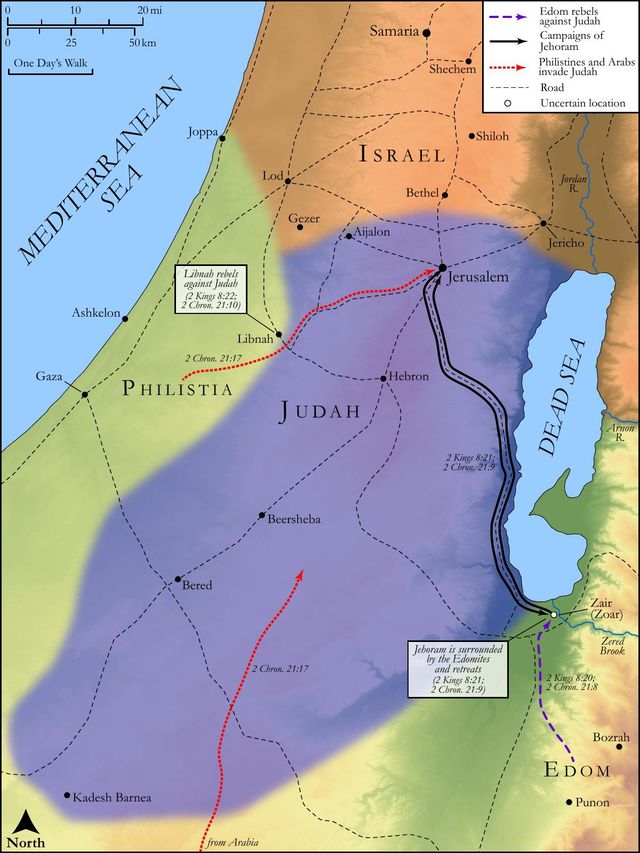
The Edomites, descendants of Esau and thus ancient kin to Israel, inhabited the rugged mountainous region south-east of the Dead Sea, a strategically important area controlling vital trade routes. They had been decisively subjugated by King David centuries earlier, becoming David's servants under Judah's dominion (2 Samuel 8:14; 1 Kings 11:15-16). Their status as a subjugated people meant they were obligated to pay tribute and were under the military and political authority of Judah. The act of "revolting from under the dominion of Judah" and "mak[ing] themselves a king" was a profound declaration of independence, signifying a complete and permanent break from their servitude to Judah. This was not merely a territorial loss but a significant blow to Judah's prestige, economic stability (loss of tribute and control over lucrative trade routes), and military strength, reflecting the severely weakened state of the kingdom under Jehoram's ungodly and incompetent rule.
Key Themes
ShowHideThe Edomite revolt in 2 Chronicles 21:8 powerfully illustrates several key themes central to the Chronicler's overarching theological agenda. Firstly, it underscores the Consequences of Disobedience and apostasy. Jehoram's wicked reign, characterized by idolatry, violence, and a blatant disregard for God's covenant, directly led to the weakening of Judah's political and military strength, allowing a long-subjugated nation to break free. This serves as a stark example of the Chronicler's consistent principle that faithfulness to God brings blessing, stability, and dominion, while unfaithfulness leads to decline, loss, and judgment. Secondly, the event highlights Divine Judgment and retribution. While not explicitly stated as God's direct action in this specific verse, the Chronicler consistently presents such national setbacks as consequences of the king's and the people's sin, demonstrating God's justice in allowing the natural repercussions of their actions to unfold. Lastly, it emphasizes the Loss of Dominion and Sovereignty. The Edomites' ability to "make themselves a king" signifies not just a territorial loss, but a complete and permanent secession, underscoring the diminishing control and influence of the Davidic monarchy when it strays from the Lord, even as God remains faithful to His covenant with David, as noted in the preceding verse (2 Chronicles 21:7).
Exposition and Analysis
ShowHideKey Word Analysis
ShowHideFrom the root meaning "red," referring to Esau's reddish appearance at birth (Genesis 25:25). This term identifies the specific people group, descendants of Esau, who inhabited the region of Edom (also known as Idumea). Their identity as a long-standing rival and now a successful rebel highlights the historical significance of their breaking free from Judah's control, a reversal of centuries of subjugation.
This verb signifies a strong, deliberate act of rebellion, transgression, or breaking away from an established authority. It implies a breach of loyalty, a forceful assertion of independence, and often carries a connotation of sin or trespass against a rightful ruler. In this context, it emphasizes the Edomites' successful and decisive rejection of Judah's rule, highlighting the profound weakness of Jehoram's reign that allowed such a significant and defiant rebellion to succeed.
While literally meaning "hand," in this context, yâd is used metaphorically to represent power, control, authority, or subjugation. To revolt "from under the dominion" means to break free from the "hand" or controlling power of Judah. This metaphor vividly portrays the complete severance of the Edomites from Judah's oversight and influence, underscoring the loss of Judah's once-firm grip on the lands that had served it and the erosion of its power.
This noun refers to a monarch, a royal ruler. The act of the Edomites making "themselves a king" (from the root mâlak, "to reign" or "to make king") signifies their full political autonomy and self-governance. It is the ultimate expression of their successful rebellion, establishing their own independent state and solidifying their permanent severance from Judah's control.
Verse Breakdown
ShowHide"In his days"
This opening phrase directly attributes the event of the Edomite revolt to the specific period of King Jehoram's reign. It implicitly links the timing of this significant loss of territory and power to the character and actions of the king, suggesting a causal relationship between Jehoram's ungodliness and the weakening of his kingdom. The Chronicler consistently connects national fortunes to the king's spiritual fidelity.
"the Edomites revolted from under the dominion of Judah"
This clause describes the core event: the Edomites, who had been subjugated by Judah for centuries (since David's time), successfully broke free from Judah's control. The term "revolted" implies an active, forceful, and successful rebellion, signifying a critical weakening of Judah's power and a major loss of territory, tribute, and strategic influence. It marks the decisive end of Judah's rule over Edom.
"and made themselves a king"
This final phrase underscores the completeness and permanence of the Edomite secession. By establishing their own monarchy, the Edomites asserted full political autonomy and self-governance, permanently severing their servitude to Judah. This act not only confirmed their independence but also presented a new, consolidated threat on Judah's southern border, highlighting the severe consequences of Jehoram's unrighteous and ineffective rule.
Literary Devices
ShowHideThe Chronicler effectively employs several literary devices in this concise verse to convey profound theological truths. Cause and Effect is a primary device, implicitly linking Jehoram's spiritual decline and wickedness (as described in the preceding verses) to the national setback of the Edomite revolt. This reinforces the Chronicler's theological message that a king's righteousness directly impacts the nation's well-being and stability. Contrast is also powerfully at play, as Jehoram's reign stands in stark opposition to the stability, expansion, and dominion experienced under his righteous father, Jehoshaphat, and his ancestor, David, who initially subjugated Edom. The loss of "dominion" serves as a potent Symbolism for Judah's spiritual and political decline under an ungodly king, representing the erosion of divine favor. The Edomites' successful rebellion functions as a Foreshadowing of further judgments and the eventual weakening and exile of Judah, demonstrating the inevitable consequences of persistent sin and departure from God's covenant.
Theological and Thematic Connections
ShowHideThe Edomite revolt under Jehoram serves as a profound theological statement within the Chronicler's narrative: the stability and prosperity of God's people are inextricably linked to their covenant faithfulness and the righteousness of their leadership. Jehoram's wicked reign directly invited national weakness and the loss of long-held dominion, illustrating that divine favor is not guaranteed but is contingent upon obedience. This event underscores God's justice, demonstrating that He allows the natural consequences of sin to unfold, even for His chosen people. It highlights the fragility of earthly power and security when severed from divine blessing, reinforcing the principle that true strength and lasting peace come from walking in the ways of the Lord.
Reflection and Application
ShowHideThe account of the Edomite revolt under King Jehoram offers timeless and sobering lessons for individuals, leaders, and communities today. It powerfully illustrates that compromise with sin, particularly in leadership, inevitably leads to detrimental outcomes, both personally and corporately. Just as Jehoram's ungodly choices led to the weakening of his kingdom and the loss of its "dominion," our own spiritual compromises can erode our influence, diminish our effectiveness, and lead to various forms of "revolt" in our lives—whether it be the loss of peace, fractured relationships, a diminished testimony, or a decline in spiritual vitality. This passage calls us to a rigorous self-examination, urging us to consider where we might be drifting from God's truth and to recognize the profound impact our spiritual state has on our spheres of influence. It reminds us that true security and lasting flourishing are found not in human strength, political maneuvering, or worldly alliances, but in unwavering faithfulness to God's covenant and His righteous ways.
Questions for Reflection
ShowHideFAQ
ShowHideWhy is the Edomite revolt highlighted as such a significant event in Jehoram's reign?
ShowHideThe Edomite revolt is highlighted as a significant event because it serves as a clear and tangible manifestation of divine judgment and the direct consequences of King Jehoram's ungodly rule. For the Chronicler, national prosperity and stability were directly linked to the king's faithfulness to God and adherence to the Davidic covenant. The Edomites had been under Judah's control since King David's time, making their successful rebellion a profound indicator of Judah's weakened state and a major blow to its regional power and prestige. It demonstrated that Jehoram's departure from God's ways led to the unraveling of the kingdom's strength, unlike the stability seen under righteous kings. This event is a critical turning point, marking the beginning of a period of decline for Judah under Jehoram, as further judgments follow, including a devastating plague and invasion (2 Chronicles 21:14-17).
What was the long-term impact of this revolt on the kingdom of Judah?
ShowHideThe long-term impact of the Edomite revolt on Judah was significant and multifaceted. Firstly, it represented a substantial loss of territory and strategic control. Edom was a key region for trade routes, and its independence meant Judah lost access to valuable revenue and military advantage, impacting its economic stability. Secondly, it created a new and permanent hostile neighbor on Judah's southern border, leading to ongoing conflicts and security concerns, as evidenced in later periods of Israelite history. Thirdly, and most importantly from the Chronicler's perspective, it served as a powerful symbol of Judah's diminishing power and divine disfavor under unrighteous kings. This event, along with other setbacks during Jehoram's reign, contributed to a period of instability and decline for the kingdom of Judah, contrasting sharply with the expansion and prosperity experienced under faithful kings like David and Jehoshaphat. It underscored the principle that a nation's strength is ultimately tied to its spiritual health, a pervasive theme throughout the books of Chronicles.
Christ-Centered Fulfillment
ShowHideThe narrative of the Edomite revolt under King Jehoram, a testament to the tragic consequences of unrighteous earthly dominion, powerfully points to the ultimate and perfect dominion of Jesus Christ. Jehoram's failure to maintain control over his kingdom due to his wickedness and spiritual infidelity highlights the inherent fragility and corruption of human kingship and earthly power. Unlike Jehoram, whose reign was marked by loss, judgment, and the rebellion of his subjects, Jesus is the King whose dominion is eternal, unshakeable, and founded on perfect righteousness and unwavering faithfulness. The Edomites' breaking free from Judah's "hand" foreshadows the glorious liberation from all forms of spiritual bondage that Christ accomplishes for His people. He does not merely lose dominion but actively establishes it, conquering sin and death, and drawing all who believe into His glorious kingdom (Colossians 1:13). While earthly kings like Jehoram falter and their kingdoms crumble, the Lamb of God reigns eternally, and "of the increase of his government and peace there shall be no end" (Isaiah 9:7). His is the true and everlasting kingdom, where all nations will ultimately bow, not out of forced subjugation, but willing adoration, fulfilling the prophetic promise that He will have dominion from sea to sea and from the River to the ends of the earth.