


2 Kings 8:22
Bible text: King James Version (1769 Blayney text) · Public domain
Bible text: Berean Standard Bible · Public domain
Bible text: American Standard Version (1901) · Public domain
Bible text: World English Bible, Messianic edition · Public domain
Bible text: Geneva Bible (1599) · Public domain
Bible text: Young's Literal Translation · Public domain
- וַיִּפְשַׁעvai·yif·Sha'and it has rebelledH6586Conj-w ¦ V-Qal-ConsecImperf-3msVerb Qal Consecutive Imperfect 3rd Singular Masculineוַandיִּפְשַׁעit has rebelled
- אֱדוֹם'e·DomEdomH123N-proper-mNoun Proper Masculine
- מִתַּחַתmi·Ta·chatfrom underH8478Prep-m ¦ N-mscNoun Singular Masculine Constructמִfromתַּחַתunder
- יַדyad[the] hand ofH3027N-cscNoun Singular common gender Construct
- יְהוּדָהye·hu·DahJudahH3063N-properNoun Proper Location
- עַד'aduntilH5704PrepPreposition
- הַיּוֹםhai·Yomthe dayH3117Art ¦ N-msNoun Singular Masculine Absoluteהַtheיּוֹםday
- הַזֶּהha·Zeh<the> thisH2088Art ¦ PrtParticle Demonstrativeהַ<the>זֶּהthis
- אָז'azthenH227AdvAdverb
- תִּפְשַׁעtif·Sha'it rebelledH6586V-Qal-Imperf-3fsVerb Qal Imperfect 3rd Singular Feminine
- לִבְנָהliv·NahLibnahH3841N-properNoun Proper Location
- בָּעֵתba·'Etat the timeH6256Prep-b ¦ N-csNoun Singular common gender Absoluteבָּat theעֵתtime
- הַהִיאha·Hi'<the> thatH1931Art ¦ Pro-3fsPronoun Personal 3rd Singular Feminineהַ<the>הִיאthat
English is a literal word-by-word gloss of the Hebrew, not the KJV's wording. Why?
This is the original text the KJV's translators worked from — each Hebrew word with its own literal English meaning in this verse, prepared by scholars at Tyndale House, Cambridge. The KJV translates whole sentences, not word by word, so its wording differs: one Hebrew word can become several English words, and the KJV may choose “the LORD” where the gloss reads “Yahweh”. Both are faithful — they answer different questions. For the KJV's own rendering, switch to the KJV text.
Details
See on the biblical-era maps
Study this verse
Public-domain commentary
Matthew Henry
From his Commentary on the Whole Bible. Henry comments on passages, not single verses — this entry covers 2 Kings 8:16–24. His two-level outline is real structure in the source text, so it is rendered as structure.
We have here a brief account of the life and reign of Jehoram (or Joram), one of the worst of the kings of Judah, but the son and successor of Jehoshaphat, one of the best. Note, 1. Parents cannot give grace to their children. Many that have themselves been godly have had the grief and shame of seeing those that came forth out of their bowels wicked and vile. Let not the families that are thus afflicted think it strange. 2. If the children of good parents prove wicked, commonly they are worse than others. The unclean spirit brings in seven others more wicked than himself, Luk 11:26. 3. A nation is sometimes justly punished with the miseries of a bad reign for not improving the blessings and advantages of a good one.
Concerning this Jehoram observe,
I.The general idea here given of his wickedness (Kg2 8:18):
He did as the house of Ahab, and worse he could not do. His character is taken from the bad example he followed, for men are according to the company they converse with and the copies they write after. No mistake is more fatal to young people than a mistake in the choice of those whom they would recommend themselves to and take their measures from, and whose good opinion they value themselves by. Jehoram chose the house of Ahab for his pattern rather than his father's house, and this choice was his ruin. We have a particular account of his wickedness (2 Chr. 21), murder, idolatry, persecution, everything that was bad.
II.The occasions of his wickedness.
His father was a very good man, and no doubt took care to have him taught the good knowledge of the Lord, but,
1.It is certain he did ill to marry him to the daughter of Ahab; no good could come of an alliance with an idolatrous family, but all mischief with such a daughter of such a mother as Athaliah the daughter of Jezebel. The degeneracy of the old world took rise from the unequal yoking of professors with profane. Those that are ill-matched are already half-ruined.
2.I doubt he did not do well to make him king in his own life-time. It is said here (Kg2 8:16) that he began to reign, Jehoshaphat being then king; hereby he gratified his pride (than which nothing is more pernicious to young people), indulged him in his ambition, in hopes to reform him by humouring him, and so brought a curse upon his family, as Eli did, whose sons made themselves vile and he restrained them not. Jehoshaphat had made this wicked son of his viceroy once when he went with Ahab to Ramoth-Gilead, from which Jehoshaphat's seventeenth year (Kg1 22:51) is made Jehoram's second (Kg2 1:17), but afterwards, in his twenty-second year, he made him partner in his government, and thence Joram's eight years are to be dated, three years before his father's death. It has been hurtful to many young men to come too soon to their estates. Samuel got nothing by making his sons judges.
III.The rebukes of Providence which he was under for his wickedness.
1.The Edomites revolted, who had been under the government of the kings of Judah ever since David's time, about 150 years, Kg2 8:20. He attempted to reduce them, and gave them a defeat (Kg2 8:21), but he could not improve the advantage he had got, so as to recover his dominion over them: Yet Edom revolted (Kg2 8:22), and the Edomites were, after this, bitter enemies to the Jews, as appears by the prophecy of Obadiah and Psa 137:7. Now Isaac's prophecy was fulfilled, that this Esau the elder should serve Jacob the younger; yet, in process of time, he should break that yoke from off his neck, Gen 27:40.
2.Libnah revolted. This was a city in Judah, in the heart of his country, a priests' city; the inhabitants of this city shook off his government because he had forsaken God, and would have compelled them to do so too, Ch2 21:10, Ch2 21:11. In order that they might preserve their religion they set up for a free state. Perhaps other cities did the same.
3.His reign was short. God cut him off in the midst of his days, when he was but forty years old, and had reigned but eight years. Bloody and deceitful men shall not live out half their days.
IV.The gracious care of Providence for the keeping up of the kingdom of Judah, and the house of David, notwithstanding the apostasies and calamities of Jehoram's reign (Kg2 8:19): Yet the Lord would not destroy Judah. He could easily have done it; he might justly have done it; it would have been no loss to him to have done it; yet he would not do it, for David's sake, not for the sake of any merit of his which could challenge this favour to his family as a debt, but for the sake of a promise made to him that he should always have a lamp (that is, a succession of kings from one generation to another, by which his name should be kept bright and illustrious, as a lamp is kept burning by a constant fresh supply of oil), that his family should never be extinct till it terminated in the Messiah, that Son of David on whom was to be hung all the glory of his Father's house and in whose everlasting kingdom that promise to David is fulfilled (Psa 132:17), I have ordained a lamp for my anointed.
V.The conclusion of this impious and inglorious reign, Kg2 8:23, Kg2 8:24.
Nothing peculiar is here said of him; but we are told (Ch2 21:19, Ch2 21:20) that he died of sore diseases and died without being desired.
Continue studying 2 Kings 8:22 across the web’s major study libraries — every link below opens this exact verse, chapter, or book on the destination site.
Read & Compare
 BibleGatewayThis verse in more than 200 translations and 70 languages.
 Bible.comThe YouVersion reader — hundreds of translations, reading plans, and highlights.
 ESV.orgCrossway's official English Standard Version reader.
 NET BibleThe NET translation with 60,000+ translators' notes on every rendering decision.
 STEP BibleTyndale House's free study tool — original text, vocabulary, and scholarly resources.
 BibliaLogos Bible Software's free web reader.
 USCCBThe New American Bible (Revised Edition) with the U.S. bishops' study notes.
Commentaries
 BibleHub CommentariesDozens of classic commentaries on this verse, gathered on one page.
 StudyLightMore than 100 commentary sets — the largest collection on the web.
 BibleRefPlain-English commentary on what this verse means, verse by verse.
 Enduring WordDavid Guzik's free commentary on this chapter, widely used by Bible teachers.
 Bible Study ToolsVerse commentary alongside Greek and Hebrew study aids.
Original Language & Research
- BibleHub InterlinearThe verse word by word — original language, transliteration, and English.
- BibleHub LexiconEvery word's original-language definition and Strong's entry.
 Blue Letter BibleDeep-study tools — Strong's numbers, concordance, and word studies.
 SefariaThe Hebrew text with Rashi and centuries of Jewish commentary.
Sermons, Hymns & Audio


TrulyRandomVerse is not affiliated with these sites and doesn’t control their content. They’re linked because they’re genuinely useful.
Summary
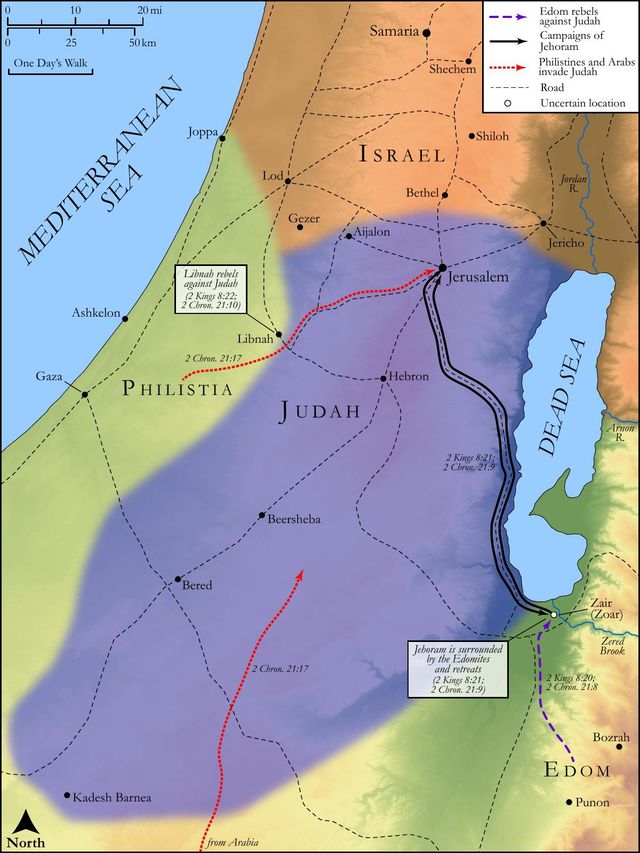
Second Kings 8:22 meticulously records two pivotal revolts during the tumultuous reign of King Jehoram of Judah: the long-subjugated nation of Edom successfully reasserted its independence, and, concurrently, the Judean city of Libnah also rebelled. These events serve as profound indicators of Judah's precipitous decline in power and severe internal instability, directly attributed within the broader narrative of Kings to Jehoram's unrighteous leadership and his stark departure from the covenant faithfulness that had characterized his father, Jehoshaphat. This verse powerfully underscores the severe and multifaceted consequences of ungodly rule, manifesting externally in lost dominion and internally in societal fragmentation and disunity.
Context
ShowHideLiterary Context
This verse is strategically placed within the narrative detailing the reign of King Jehoram of Judah (specifically 2 Kings 8:16-24), immediately following a series of miraculous and prophetic activities by Elisha. The preceding verses establish Jehoram's character in no uncertain terms, explicitly stating that he "walked in the way of the kings of Israel, as did the house of Ahab: for the daughter of Ahab was his wife: and he did evil in the sight of the Lord" (2 Kings 8:18). Despite his profound wickedness, the text highlights God's unwavering covenant faithfulness to David, which prevented Him from utterly destroying Judah (2 Kings 8:19). The revolts of Edom and Libnah are thus presented not as random occurrences, but as direct and tangible consequences of Jehoram's unfaithfulness, illustrating the immediate and devastating impact of his sin on the kingdom's stability, influence, and territorial integrity. The narrative then seamlessly transitions to detail Jehoram's death and the subsequent succession of his son Ahaziah.
Historical & Cultural Context
Edom, a long-standing rival nation situated southeast of the Dead Sea, had been brought under Israelite control by King David (2 Samuel 8:14) and remained subject to Judah, its people David's servants, for generations. Their successful revolt in this period signifies a major geopolitical shift, vividly highlighting Judah's weakening grip on its subjugated territories. The editorial note of Edom's continued independence "unto this day" emphasizes the enduring and irreversible nature of this significant loss of dominion. Libnah, conversely, was not a subject nation but an integral city within Judah's own territory, identified as a Levitical city (Joshua 21:13) and a fortified city in the strategic Shephelah region (2 Kings 19:8). Its revolt, therefore, speaks to a far deeper internal disarray, potentially stemming from oppressive policies, a severe breakdown of central authority, or widespread dissatisfaction directly attributable to Jehoram's ungodly and destabilizing rule. Such internal rebellion was a more severe and alarming indicator of national decline than the loss of a subject nation.
Key Themes
ShowHideThis verse powerfully encapsulates several key theological and narrative themes prevalent throughout the Books of Kings. Firstly, it emphatically illustrates the consequences of unrighteous leadership. Jehoram's wicked reign directly precipitates the erosion of Judah's power and stability, serving as a stark demonstration of the Deuteronomic principle that national prosperity and security are profoundly contingent upon the king's faithfulness to God's covenant (Deuteronomy 28:15). Secondly, it underscores the decline of the Davidic dynasty during this particular period, presenting a stark contrast to the strength, expansion, and divine favor seen under the reigns of David and Solomon. While God's covenant with David ensured the perpetuity of his royal line (2 Samuel 7:16), the unfaithfulness of individual kings brought severe temporal judgments and diminished the kingdom's standing. Thirdly, the dual nature of the revolts—both external (Edom) and internal (Libnah)—emphasizes the theme of national fragmentation and vulnerability, revealing how spiritual decay at the highest levels can manifest in both geopolitical losses and profound domestic unrest.
Exposition and Analysis
ShowHideKey Word Analysis
ShowHideThis verb (H6586) signifies "to break away (from just authority)," "to trespass," "to apostatize," or "to quarrel." In a political context, it denotes a deliberate act of rebellion, a breach of allegiance, and a rejection of an established ruler. The use of pâsha' here emphasizes the willful and decisive nature of the actions taken by Edom and Libnah against Judah's authority. The term also carries strong connotations of transgression, often used in a moral or theological sense for sin against God, subtly suggesting that the political rebellion is a direct consequence or reflection of spiritual transgression within Judah's leadership.
The noun yâd (H3027) literally means "hand," but is used extensively in a wide variety of applications, both literal and figurative. In the phrase "from under the hand of Judah," "hand" metaphorically represents power, authority, dominion, and control. Thus, Edom revolting "from under the hand of Judah" means they broke free from Judah's subjugation and control, no longer being subject to its rule or power. This emphasizes a loss of Judah's sovereign authority over a previously conquered territory.
The noun yôwm (H3117) refers to a "day" in a literal sense, but also figuratively as a "space of time." In the phrase "unto this day" ('ad hayyom hazzeh), it functions as a common editorial marker found throughout the historical books of the Old Testament. Its inclusion here signifies that the condition or event described (Edom's independence from Judah) persisted up to the time the historical record was compiled or edited. This emphasizes the long-term, lasting, and indeed permanent impact of Jehoram's reign, marking a significant and irreversible shift in the geopolitical landscape concerning Edom.
Verse Breakdown
ShowHide"Yet Edom revolted from under the hand of Judah unto this day."
This opening clause details a significant external loss for the kingdom of Judah. Edom, a nation that had been subjugated by King David and remained under Israelite control for generations, seized the opportunity presented by the weak and ungodly reign of King Jehoram to violently break free from Judah's dominion. The phrase "from under the hand of Judah" vividly portrays their previous subservience and the forceful nature of their liberation. The subsequent editorial note "unto this day" underscores the enduring and permanent nature of this independence, indicating that Edom remained free from Judah's control even at the time the Book of Kings was written, serving as a powerful testament to the long-lasting negative consequences of Jehoram's unrighteous rule.
"Then Libnah revolted at the same time."
This second clause describes an internal rebellion, which, from Judah's perspective, was arguably even more alarming than the external loss of Edom. Libnah was not a subject nation but an integral city within Judah's own territory, highlighting a profound internal weakness, disunity, and a severe breakdown of central authority. The phrase "at the same time" directly links this internal turmoil to the period of Jehoram's reign, suggesting that both the external geopolitical loss and the internal domestic unrest were symptomatic of the deep spiritual and political decay that permeated the kingdom under his leadership. This simultaneous rebellion underscores the comprehensive and pervasive nature of Judah's decline.
Literary Devices
ShowHideThe verse employs several significant literary devices to convey its powerful message. Juxtaposition is prominently featured in the immediate succession of Edom's external revolt and Libnah's internal rebellion. This pairing is not coincidental; it emphasizes the multi-faceted and comprehensive nature of Judah's decline under Jehoram, demonstrating that his unrighteousness led to both geopolitical losses and profound domestic instability. The narrative implicitly uses consequence and causality, presenting these revolts not as random occurrences but as direct and inevitable outcomes of Jehoram's wickedness, as meticulously established in the preceding verses. This aligns perfectly with the overarching Deuteronomic historical framework, where obedience to God brings blessing and disobedience invariably brings curses and judgment. Furthermore, the phrase "unto this day" functions as a crucial editorial comment, providing a historical anchor and emphasizing the enduring impact of these events, thereby transforming a mere historical report into a profound theological commentary on the lasting repercussions of ungodly leadership.
Theological and Thematic Connections
ShowHideThe revolts of Edom and Libnah during Jehoram's reign serve as a potent theological statement about the severe consequences of covenant unfaithfulness, particularly for those entrusted with positions of leadership. Within the Deuteronomic framework that profoundly shapes the historical books, the prosperity, security, and very existence of Israel and Judah were directly tied to their obedience to God's commands and covenant stipulations. Jehoram's wicked actions, meticulously detailed in the preceding verses, are presented as the direct and undeniable cause of these significant losses. This narrative powerfully demonstrates that deviation from God's ways leads not only to spiritual decay but also to tangible political and social instability, weakening the nation from both external pressures and internal fracturing. God's judgment, though mercifully tempered by His enduring covenant with David, manifested in the erosion of Judah's dominion and the fracturing of its internal unity. This passage serves as a solemn reminder that leadership carries immense spiritual responsibility, and a departure from divine principles can have far-reaching, detrimental effects on the entire community, echoing the warnings found in Deuteronomy 28:15 and illustrated in Psalm 78:56-64. The loss of Edom also reverses the earlier triumph of 2 Samuel 8:14, highlighting the cyclical nature of blessing and curse tied to obedience and disobedience.
Reflection and Application
ShowHideThe stark account of Edom and Libnah's revolts under King Jehoram offers profound and enduring lessons for contemporary believers and leaders alike. It powerfully underscores the vital biblical principle that actions, particularly those of individuals entrusted with influence and authority, inevitably carry significant consequences. Jehoram's unrighteous choices directly contributed to the weakening and eventual fragmentation of his kingdom, leading to both external losses of territory and internal disunity. This narrative challenges us to deeply consider the ripple effects of our own spiritual and moral integrity, recognizing that our choices impact not only our individual lives but also the families, communities, organizations, and even nations we are a part of. Just as Judah suffered from both external and internal strife due to ungodly leadership, so too can societies experience decline and instability when their moral and spiritual foundations are eroded. The passage calls for a sober reflection on how personal choices contribute to the collective good or ill, and how the enduring spiritual health of a nation or community profoundly impacts its worldly standing and internal cohesion. It is a compelling call for a renewed commitment to righteousness and faithfulness to God, recognizing that genuine stability, flourishing, and true freedom are ultimately rooted in divine principles, not human strength or political maneuvering.
Questions for Reflection
ShowHideFAQ
ShowHideWhy is the phrase "unto this day" important in this verse?
ShowHideThe phrase "unto this day" (עַד הַיּוֹם הַזֶּה, 'ad hayyom hazzeh) is a common editorial note in the Old Testament historical books. Its importance in 2 Kings 8:22 is twofold: firstly, it emphasizes the lasting and permanent nature of Edom's independence from Judah, indicating that this significant geopolitical shift, initiated during Jehoram's reign, persisted up to the time the Book of Kings was compiled or edited. Secondly, it highlights the severe and enduring consequences of Jehoram's unrighteous rule, underscoring that his unfaithfulness led to an irreversible loss of dominion for Judah, a significant blow to its regional power and prestige.
What was the significance of Libnah's revolt, given that it was a city within Judah?
ShowHideLibnah's revolt was profoundly significant precisely because it represented an internal rebellion, which was a far more alarming indicator of national decline than the external revolt of Edom. As a city within Judah's own territory, possibly even a Levitical city (Joshua 21:13), its rebellion pointed to deep internal weakness, profound disunity, and a severe breakdown of central authority. It suggested that the kingdom was not only losing its subject nations but was also fracturing from within, likely due to the oppressive or ungodly policies of King Jehoram, which alienated his own people. This internal strife underscored the comprehensive and pervasive nature of Judah's decay under his leadership, revealing a kingdom in profound spiritual and political disarray.
Christ-Centered Fulfillment
ShowHideThe revolts of Edom and Libnah in 2 Kings 8:22, symptomatic of Judah's precipitous decline under an unrighteous king, powerfully foreshadow the desperate and ultimate need for a perfect, righteous King whose reign would never falter or lead to fragmentation. King Jehoram's inherent inability to maintain Judah's dominion and internal unity highlights the profound limitations and inherent failures of all human leadership, even within the divinely established Davidic line. This narrative unequivocally points us to Jesus Christ, the true Son of David, whose kingdom is not merely of this world (John 18:36) but is eternal, unshakable, and transcends all earthly boundaries (Hebrews 12:28). Unlike Jehoram, whose sin led to fragmentation and loss, Christ's perfect obedience and atoning sacrifice on the cross overcome all forms of rebellion—both external (humanity's rebellion against God's law) and internal (the pervasive sin within the human heart). Through His victorious death and glorious resurrection, Jesus triumphed decisively over the spiritual powers that held humanity captive (Colossians 2:15), establishing a kingdom characterized by righteousness, peace, and joy in the Holy Spirit (Romans 14:17). He is the King who brings true freedom, not just from political subjugation, but from the ultimate dominion of sin and death, thereby fulfilling the Davidic covenant in a way no earthly king ever could, securing an eternal throne and an everlasting reign (Luke 1:32-33).