


2 Kings 8:21
Bible text: King James Version (1769 Blayney text) · Public domain
Bible text: King James Version with Strong's numbers · Public domain
Bible text: Berean Standard Bible · Public domain
Bible text: American Standard Version (1901) · Public domain
Bible text: World English Bible, Messianic edition · Public domain
Bible text: Geneva Bible (1599) · Public domain
Bible text: Young's Literal Translation · Public domain
- וַיַּעֲבֹרvai·ya·'a·Vorand he passed overH5674Conj-w ¦ V-Qal-ConsecImperf-3msVerb Qal Consecutive Imperfect 3rd Singular Masculineוַandיַּעֲבֹרhe passed over
- יוֹרָםyo·RamJoramH3141N-proper-mNoun Proper Masculine
- צָעִירָהtza·'I·rahZair towardsH6811N-proper ¦ SfxNoun Proper LocationצָעִירָZairהtowards
- וְכָלve·kholand allH3605Conj-w ¦ N-mscNoun Singular Masculine Constructוְandכָלall
- הָרֶכֶבha·Re·khevthe chariotryH7393Art ¦ N-msNoun Singular Masculine Absoluteהָtheרֶכֶבchariotry
- עִמּוֹi·Mo[was] with himH5973Prep ¦ 3msPrepositionעִמּ[was] withוֹhim
- וַיְהִיvay·hiand it wasH1961Conj-w ¦ V-Qal-ConsecImperf-3msVerb Qal Consecutive Imperfect 3rd Singular Masculineוַandיְהִיit was
- הוּאhu'heH1931Pro-3msPronoun Personal 3rd Singular Masculine
- קָםkamhe aroseH6965V-Qal-Prtcpl-msVerb Qal Participle Singular Masculine Absolute
- לַיְלָהLay·lahnightH3915N-msNoun Singular Masculine Absolute
- וַיַּכֶּהvai·ya·Kehand he struck downH5221Conj-w ¦ V-Hiphil-ConsecImperf-3msVerb Hiphil Consecutive Imperfect 3rd Singular Masculineוַandיַּכֶּהhe struck down
- אֶת'et<obj.>H853DirObjMParticle Object Indicator
- אֱדוֹם'e·DomEdomH123N-proper-mNoun Proper Masculine
- הַסֹּבֵיבha·so·Veivwhich was surroundingH5437Art ¦ V-Qal-Prtcpl-msVerb Qal Participle Singular Masculine Absoluteהַwhichסֹּבֵיבwas surrounding
- אֵלָיו'e·Lav<to> himH413Prep ¦ 3msPrepositionאֵלָי<to>וhim
- וְאֵתve·'Etand <obj.>H853Conj-w ¦ DirObjMParticle Object Indicatorוְandאֵת<obj.>
- שָׂרֵיsa·Rei[the] commanders ofH8269N-mpcNoun Plural Masculine Construct
- הָרֶכֶבha·Re·khevthe chariotryH7393Art ¦ N-msNoun Singular Masculine Absoluteהָtheרֶכֶבchariotry
- וַיָּנָסvai·Ya·nosand it fledH5127Conj-w ¦ V-Qal-ConsecImperf-3msVerb Qal Consecutive Imperfect 3rd Singular Masculineוַandיָּנָסit fled
- הָעָםha·'Amthe peopleH5971Art ¦ N-msNoun Singular Masculine Absoluteהָtheעָםpeople
- לְאֹהָלָיוle·'o·ha·Lavto its tentsH168Prep-l ¦ N-mpc ¦ 3msNoun Plural Masculine Constructלְtoאֹהָלָיtentsוits
English is a literal word-by-word gloss of the Hebrew, not the KJV's wording. Why?
This is the original text the KJV's translators worked from — each Hebrew word with its own literal English meaning in this verse, prepared by scholars at Tyndale House, Cambridge. The KJV translates whole sentences, not word by word, so its wording differs: one Hebrew word can become several English words, and the KJV may choose “the LORD” where the gloss reads “Yahweh”. Both are faithful — they answer different questions. For the KJV's own rendering, switch to the KJV text.
Details
See on the biblical-era maps
Study this verse
Public-domain commentary
Matthew Henry
From his Commentary on the Whole Bible. Henry comments on passages, not single verses — this entry covers 2 Kings 8:16–24. His two-level outline is real structure in the source text, so it is rendered as structure.
We have here a brief account of the life and reign of Jehoram (or Joram), one of the worst of the kings of Judah, but the son and successor of Jehoshaphat, one of the best. Note, 1. Parents cannot give grace to their children. Many that have themselves been godly have had the grief and shame of seeing those that came forth out of their bowels wicked and vile. Let not the families that are thus afflicted think it strange. 2. If the children of good parents prove wicked, commonly they are worse than others. The unclean spirit brings in seven others more wicked than himself, Luk 11:26. 3. A nation is sometimes justly punished with the miseries of a bad reign for not improving the blessings and advantages of a good one.
Concerning this Jehoram observe,
I.The general idea here given of his wickedness (Kg2 8:18):
He did as the house of Ahab, and worse he could not do. His character is taken from the bad example he followed, for men are according to the company they converse with and the copies they write after. No mistake is more fatal to young people than a mistake in the choice of those whom they would recommend themselves to and take their measures from, and whose good opinion they value themselves by. Jehoram chose the house of Ahab for his pattern rather than his father's house, and this choice was his ruin. We have a particular account of his wickedness (2 Chr. 21), murder, idolatry, persecution, everything that was bad.
II.The occasions of his wickedness.
His father was a very good man, and no doubt took care to have him taught the good knowledge of the Lord, but,
1.It is certain he did ill to marry him to the daughter of Ahab; no good could come of an alliance with an idolatrous family, but all mischief with such a daughter of such a mother as Athaliah the daughter of Jezebel. The degeneracy of the old world took rise from the unequal yoking of professors with profane. Those that are ill-matched are already half-ruined.
2.I doubt he did not do well to make him king in his own life-time. It is said here (Kg2 8:16) that he began to reign, Jehoshaphat being then king; hereby he gratified his pride (than which nothing is more pernicious to young people), indulged him in his ambition, in hopes to reform him by humouring him, and so brought a curse upon his family, as Eli did, whose sons made themselves vile and he restrained them not. Jehoshaphat had made this wicked son of his viceroy once when he went with Ahab to Ramoth-Gilead, from which Jehoshaphat's seventeenth year (Kg1 22:51) is made Jehoram's second (Kg2 1:17), but afterwards, in his twenty-second year, he made him partner in his government, and thence Joram's eight years are to be dated, three years before his father's death. It has been hurtful to many young men to come too soon to their estates. Samuel got nothing by making his sons judges.
III.The rebukes of Providence which he was under for his wickedness.
1.The Edomites revolted, who had been under the government of the kings of Judah ever since David's time, about 150 years, Kg2 8:20. He attempted to reduce them, and gave them a defeat (Kg2 8:21), but he could not improve the advantage he had got, so as to recover his dominion over them: Yet Edom revolted (Kg2 8:22), and the Edomites were, after this, bitter enemies to the Jews, as appears by the prophecy of Obadiah and Psa 137:7. Now Isaac's prophecy was fulfilled, that this Esau the elder should serve Jacob the younger; yet, in process of time, he should break that yoke from off his neck, Gen 27:40.
2.Libnah revolted. This was a city in Judah, in the heart of his country, a priests' city; the inhabitants of this city shook off his government because he had forsaken God, and would have compelled them to do so too, Ch2 21:10, Ch2 21:11. In order that they might preserve their religion they set up for a free state. Perhaps other cities did the same.
3.His reign was short. God cut him off in the midst of his days, when he was but forty years old, and had reigned but eight years. Bloody and deceitful men shall not live out half their days.
IV.The gracious care of Providence for the keeping up of the kingdom of Judah, and the house of David, notwithstanding the apostasies and calamities of Jehoram's reign (Kg2 8:19): Yet the Lord would not destroy Judah. He could easily have done it; he might justly have done it; it would have been no loss to him to have done it; yet he would not do it, for David's sake, not for the sake of any merit of his which could challenge this favour to his family as a debt, but for the sake of a promise made to him that he should always have a lamp (that is, a succession of kings from one generation to another, by which his name should be kept bright and illustrious, as a lamp is kept burning by a constant fresh supply of oil), that his family should never be extinct till it terminated in the Messiah, that Son of David on whom was to be hung all the glory of his Father's house and in whose everlasting kingdom that promise to David is fulfilled (Psa 132:17), I have ordained a lamp for my anointed.
V.The conclusion of this impious and inglorious reign, Kg2 8:23, Kg2 8:24.
Nothing peculiar is here said of him; but we are told (Ch2 21:19, Ch2 21:20) that he died of sore diseases and died without being desired.
Continue studying 2 Kings 8:21 across the web’s major study libraries — every link below opens this exact verse, chapter, or book on the destination site.
Read & Compare
 BibleGatewayThis verse in more than 200 translations and 70 languages.
 Bible.comThe YouVersion reader — hundreds of translations, reading plans, and highlights.
 ESV.orgCrossway's official English Standard Version reader.
 NET BibleThe NET translation with 60,000+ translators' notes on every rendering decision.
 STEP BibleTyndale House's free study tool — original text, vocabulary, and scholarly resources.
 BibliaLogos Bible Software's free web reader.
 USCCBThe New American Bible (Revised Edition) with the U.S. bishops' study notes.
Commentaries
 BibleHub CommentariesDozens of classic commentaries on this verse, gathered on one page.
 StudyLightMore than 100 commentary sets — the largest collection on the web.
 BibleRefPlain-English commentary on what this verse means, verse by verse.
 Enduring WordDavid Guzik's free commentary on this chapter, widely used by Bible teachers.
 Bible Study ToolsVerse commentary alongside Greek and Hebrew study aids.
Original Language & Research
- BibleHub InterlinearThe verse word by word — original language, transliteration, and English.
- BibleHub LexiconEvery word's original-language definition and Strong's entry.
 Blue Letter BibleDeep-study tools — Strong's numbers, concordance, and word studies.
 SefariaThe Hebrew text with Rashi and centuries of Jewish commentary.
Sermons, Hymns & Audio


TrulyRandomVerse is not affiliated with these sites and doesn’t control their content. They’re linked because they’re genuinely useful.
Summary
Second Kings 8:21 vividly recounts a critical military engagement during the reign of King Joram of Judah, detailing his swift and strategic night assault against the rebellious Edomites who had encircled his forces. This verse captures a moment of intense conflict and Joram's desperate but effective tactical maneuver to break the siege, highlighting the precarious nature of Judah's dominion over a nation long subject to it following Edom's declaration of independence.
Context
ShowHideLiterary Context
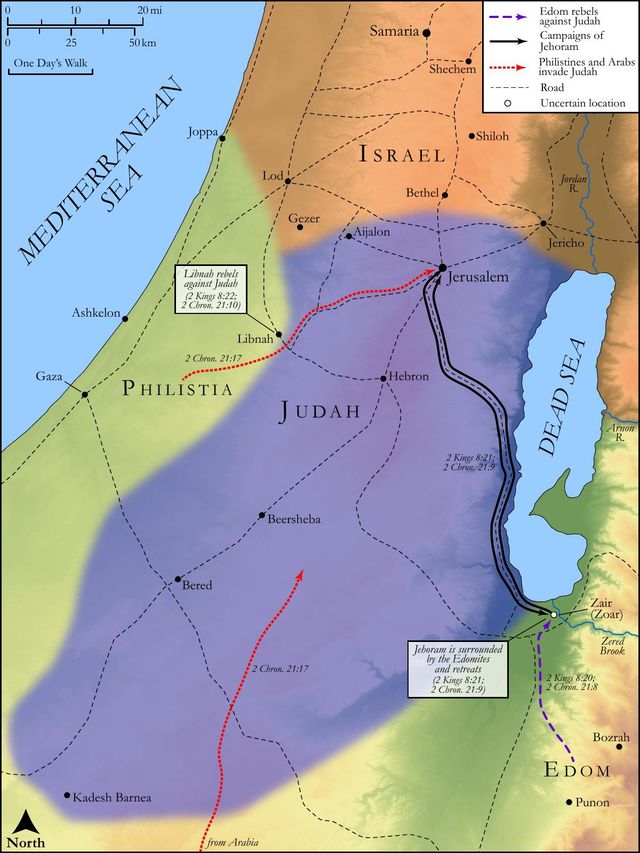
This verse immediately follows 2 Kings 8:20, which explicitly states that Edom revolted against Judah and established its own king. This rebellion marks a significant shift in the geopolitical landscape, as Edom had been subjugated by Judah since the time of King David, as recorded in 2 Samuel 8:14. Joram's expedition described in verse 21 is a direct and immediate response to this challenge to Judah's authority and economic interests, particularly control over trade routes to the Red Sea. The subsequent verse, 2 Kings 8:22, then reveals the ultimate outcome: Edom's independence was maintained, indicating that Joram's military action, while tactically successful in the moment, failed to achieve the strategic objective of re-subjugating Edom.
Historical & Cultural Context
Edom, located southeast of Judah, was a historically significant kingdom, often in conflict with Israel and Judah. Descended from Esau (Genesis 36), the Edomites had a long-standing rivalry with the Israelites, descendants of Jacob. Their rebellion in Joram's time (c. 848-841 BC) was not isolated; it was part of a broader period of instability and shifting allegiances among the nations round about. Subject nations often seized opportunities, such as a weak king over them or a change in leadership, to assert independence, as Moab rebelled against Israel after the death of Ahab. The mention of "Zair" is likely a geographical reference within Edomite territory, possibly a strategic location or a variant of Seir, the mountainous region synonymous with Edom. Chariots were elite military units, signifying a substantial force, and their encirclement ("compassed him about") indicates a dire situation for Joram, necessitating a decisive and risky counter-maneuver. Night operations, while dangerous, offered the advantage of surprise, a common military tactic in antiquity.
Key Themes
ShowHideThe passage contributes to several key themes within the Books of Kings. Firstly, it underscores the theme of rebellion and its consequences, illustrating the constant struggle for power and control among nations, often fueled by historical grievances and economic aspirations. Secondly, it highlights the fragility of human power and dominion, as Judah's long-held control over Edom is decisively broken, despite Joram's tactical prowess. This serves as a stark reminder of the transient nature of earthly kingdoms. Thirdly, the strategic "night attack" speaks to themes of military resourcefulness and survival in the face of overwhelming odds, showcasing Joram's leadership in a crisis. However, the ultimate failure to re-establish control, as seen in 2 Kings 8:22, also subtly points to the broader theme of divine sovereignty over the rise and fall of nations, even when human efforts are valiant.
Exposition and Analysis
ShowHideKey Word Analysis
ShowHideThis verb (H5221) is a common and versatile term in biblical Hebrew, meaning "to strike," "to hit," "to beat," or "to defeat." In military contexts, as here, it often implies a decisive blow or a successful assault. Its use in 2 Kings 8:21 emphasizes the forceful and effective nature of Joram's night attack, indicating that he inflicted significant damage or casualties upon the Edomites, at least enough to break their encirclement and secure his immediate survival.
This verb (H5437) means "to surround," "to encircle," or "to go around." When used in a military context, it vividly portrays a siege or an encirclement, placing the surrounded party in a highly vulnerable and perilous position. The phrase "compassed him about" clearly illustrates the dire predicament Joram and his chariot forces found themselves in, trapped by the Edomite army, underscoring the urgency and risk of his subsequent night maneuver.
This primitive root (H6965) means "to rise," "to stand up," or "to get up." When combined with "by night" (H3915, layil), as in this verse, it signifies initiating an action under the cover of darkness. This highlights a deliberate and strategic decision by Joram. Night operations were inherently risky due to limited visibility and potential for friendly fire, but they offered the crucial advantage of surprise, which Joram leveraged to break the Edomite encirclement. It speaks to his tactical acumen and the desperate nature of his situation.
Verse Breakdown
ShowHide"So Joram went over to Zair, and all the chariots with him"
This opening clause establishes the setting and the primary actors. King Joram (Jehoram) of Judah led a military expedition to Zair, a location within Edomite territory, likely to quell their rebellion. The inclusion of "all the chariots with him" emphasizes the significant military might Joram brought to bear, indicating the importance of this campaign and the elite nature of the forces involved.
"and he rose by night, and smote the Edomites which compassed him about, and the captains of the chariots"
This is the core action of the verse. Joram, finding himself and his forces encircled by the Edomites, executed a daring night assault. The phrase "smote the Edomites" indicates a successful strike, while specifically mentioning "the captains of the chariots" suggests that Joram targeted the leadership or the most formidable units of the Edomite army, aiming to disrupt their command and control. This tactical move was designed to break the siege.
"and the people fled into their tents"
This final clause describes the immediate outcome of Joram's night attack. The Edomite forces, disoriented and struck by the surprise assault, were routed and fled from the battlefield, retreating to their encampments. This signifies a tactical victory for Joram, allowing him to escape the encirclement and prevent a complete defeat, even if it did not lead to the re-subjugation of Edom.
Literary Devices
ShowHideThe narrative in 2 Kings 8:21 employs Narrative Economy, presenting a complex military engagement with remarkable brevity. The author efficiently conveys the dire situation (encirclement), Joram's strategic response (night attack), and the immediate tactical outcome (Edomite flight) in a single sentence. This conciseness emphasizes the decisive nature of the event without dwelling on unnecessary details. There is also a subtle Irony at play: despite Joram's courageous and tactically successful maneuver in breaking the siege and routing the Edomites, the subsequent verse reveals that Edom ultimately retained its independence. This highlights the limited scope of Joram's victory, showcasing that a tactical win does not always translate into a strategic triumph, and hinting at the broader decline of Judah's power.
Theological and Thematic Connections
ShowHideThis verse, while describing a military event, offers profound theological insights into the nature of power, rebellion, and divine oversight. Joram's desperate but successful night attack underscores the human capacity for strategic thinking and resilience in the face of overwhelming odds. However, the broader narrative, where Edom ultimately secures its independence, reminds us that human efforts, no matter how valiant, are ultimately subject to a larger divine purpose and the unfolding of history. It reflects the transient nature of earthly kingdoms and the futility of relying solely on military might for lasting dominion. The rebellion of Edom, a nation with a long history of animosity towards Israel, can be seen as part of the consequences of Judah's own spiritual decline, as God often used foreign nations as instruments of judgment or discipline.
Reflection and Application
ShowHideThe account of Joram's night attack, though set in ancient warfare, offers timeless lessons on leadership, resilience, and the nature of success. It teaches us that even when "compassed about" by challenges, whether personal, professional, or spiritual, strategic thinking and decisive action can lead to crucial breakthroughs or at least prevent complete defeat. Joram's willingness to "rise by night" speaks to the courage required to confront daunting situations head-on, even when the odds seem stacked against us. It also provides a sober reminder that not every "victory" results in a complete triumph over the original problem; sometimes, success is measured by survival, a tactical gain, or the ability to mitigate loss. For believers, this can translate into perseverance in faith, understanding that God's strength is made perfect in our weakness, and that even in partial victories, His hand can be seen. It encourages us to seek divine wisdom and act with courage, knowing that our ultimate hope rests not in our own strength but in God's sovereign plan.
Questions for Reflection
ShowHideFAQ
ShowHideWho was Joram (Jehoram) of Judah, and what was his reign like?
ShowHideJoram, also known as Jehoram, was the son of King Jehoshaphat and reigned over Judah for eight years (c. 848-841 BC). His reign is generally depicted negatively in the biblical narrative, largely due to his marriage to Athaliah, the daughter of Ahab and Jezebel of Israel. This marriage led to the introduction of Baal worship into Judah, a significant departure from the righteous path of his father, Jehoshaphat. As a result, the kingdom faced various troubles, including the successful rebellion of Edom mentioned in 2 Kings 8:20-22 and a revolt by Libnah. The prophet Elijah also sent him a letter prophesying his death by a severe illness, which came to pass, as recorded in 2 Chronicles 21:12-19.
What was the significance of Edom's rebellion against Judah?
ShowHideEdom's rebellion was highly significant for several reasons. Historically, Edom had been long subject to Judah since King David's conquest (e.g., 2 Samuel 8:14). Their independence meant a loss of tribute, resources, and, crucially, control over vital trade routes, particularly those leading to the Red Sea and the lucrative Arabian trade. Thematically, it signaled a weakening of Judah's power and influence, often interpreted as a consequence of Joram's unfaithfulness to God. The narrative in 2 Kings 8:22 explicitly states that Edom remained independent "to this day," underscoring the lasting impact of this event on Judah's geopolitical standing.
Where was Zair, and why was it important?
ShowHideThe exact location of "Zair" is debated among scholars. Some identify it with Zoar, a city mentioned in the region of the Dead Sea (e.g., Genesis 19:22). Others suggest it refers to Seir, the mountainous region that was the primary territory of Edom, or simply a strategic military outpost within Edomite territory. Regardless of its precise location, its importance lies in its role as the site of this critical confrontation. It was where Joram's forces found themselves encircled by the Edomites, necessitating his desperate night attack. The fact that the battle took place deep within Edomite territory indicates Joram's determination to reassert control over rebellious Edom.
Christ-Centered Fulfillment
ShowHideThe limited and ultimately unsuccessful military campaign of Joram against Edom, despite his tactical ingenuity, serves as a poignant Old Testament shadow pointing to the infinitely superior and eternally decisive victory of Jesus Christ. Joram's temporary triumph in breaking the encirclement contrasts sharply with Christ's ultimate and complete triumph over all spiritual enemies. While Joram fought for an earthly kingdom and its fleeting dominion, Jesus came to establish an eternal, spiritual kingdom, not of this world (John 18:36). The Edomites, though smitten, eventually retained their independence, symbolizing the persistent nature of sin and death under the Old Covenant. However, Christ, through His death and resurrection, "smote" sin and death decisively, disarming the powers and authorities and triumphing over them by the cross (Colossians 2:15). His "night attack" was not a desperate military maneuver but a purposeful descent into the darkness of sin and death, from which He rose victorious, securing not a temporary escape but eternal freedom for all who believe (Hebrews 2:14-15). Thus, Joram's partial success foreshadows the perfect and everlasting reign of the true King, Jesus, who will ultimately put all His enemies under His feet (1 Corinthians 15:25).