


2 Kings 8:20
- בְּיָמָיוbe·ya·Mavin his daysH3117Prep-b ¦ N-mpc ¦ 3msNoun Plural Masculine Constructבְּinיָמָיdaysוhis
- פָּשַׁעpa·Sha'it rebelledH6586V-Qal-Perf-3msVerb Qal Perfect 3rd Singular Masculine
- אֱדוֹם'e·DomEdomH123N-proper-mNoun Proper Masculine
- מִתַּחַתmi·Ta·chatfrom underH8478Prep-m ¦ N-mscNoun Singular Masculine Constructמִfromתַּחַתunder
- יַדyad[the] hand ofH3027N-cscNoun Singular common gender Construct
- יְהוּדָהye·hu·DahJudahH3063N-properNoun Proper Location
- וַיַּמְלִכוּvai·yam·Li·khuand they made kingH4427Conj-w ¦ V-Hiphil-ConsecImperf-3mpVerb Hiphil Consecutive Imperfect 3rd Plural Masculineוַandיַּמְלִכוּthey made king
- עֲלֵיהֶם'a·lei·Hemover themselvesH5921Prep ¦ 3mpPrepositionעֲלֵיoverהֶםthemselves
- מֶלֶךְMe·lekha kingH4428N-msNoun Singular Masculine Absolute
English is a literal word-by-word gloss of the Hebrew, not the KJV's wording. Why?
This is the original text the KJV's translators worked from — each Hebrew word with its own literal English meaning in this verse, prepared by scholars at Tyndale House, Cambridge. The KJV translates whole sentences, not word by word, so its wording differs: one Hebrew word can become several English words, and the KJV may choose “the LORD” where the gloss reads “Yahweh”. Both are faithful — they answer different questions. For the KJV's own rendering, switch to the KJV text.
Details
See on the biblical-era maps
Study this verse
Public-domain commentary
Matthew Henry
From his Commentary on the Whole Bible. Henry comments on passages, not single verses — this entry covers 2 Kings 8:16–24. His two-level outline is real structure in the source text, so it is rendered as structure.
We have here a brief account of the life and reign of Jehoram (or Joram), one of the worst of the kings of Judah, but the son and successor of Jehoshaphat, one of the best. Note, 1. Parents cannot give grace to their children. Many that have themselves been godly have had the grief and shame of seeing those that came forth out of their bowels wicked and vile. Let not the families that are thus afflicted think it strange. 2. If the children of good parents prove wicked, commonly they are worse than others. The unclean spirit brings in seven others more wicked than himself, Luk 11:26. 3. A nation is sometimes justly punished with the miseries of a bad reign for not improving the blessings and advantages of a good one.
Concerning this Jehoram observe,
I.The general idea here given of his wickedness (Kg2 8:18):
He did as the house of Ahab, and worse he could not do. His character is taken from the bad example he followed, for men are according to the company they converse with and the copies they write after. No mistake is more fatal to young people than a mistake in the choice of those whom they would recommend themselves to and take their measures from, and whose good opinion they value themselves by. Jehoram chose the house of Ahab for his pattern rather than his father's house, and this choice was his ruin. We have a particular account of his wickedness (2 Chr. 21), murder, idolatry, persecution, everything that was bad.
II.The occasions of his wickedness.
His father was a very good man, and no doubt took care to have him taught the good knowledge of the Lord, but,
1.It is certain he did ill to marry him to the daughter of Ahab; no good could come of an alliance with an idolatrous family, but all mischief with such a daughter of such a mother as Athaliah the daughter of Jezebel. The degeneracy of the old world took rise from the unequal yoking of professors with profane. Those that are ill-matched are already half-ruined.
2.I doubt he did not do well to make him king in his own life-time. It is said here (Kg2 8:16) that he began to reign, Jehoshaphat being then king; hereby he gratified his pride (than which nothing is more pernicious to young people), indulged him in his ambition, in hopes to reform him by humouring him, and so brought a curse upon his family, as Eli did, whose sons made themselves vile and he restrained them not. Jehoshaphat had made this wicked son of his viceroy once when he went with Ahab to Ramoth-Gilead, from which Jehoshaphat's seventeenth year (Kg1 22:51) is made Jehoram's second (Kg2 1:17), but afterwards, in his twenty-second year, he made him partner in his government, and thence Joram's eight years are to be dated, three years before his father's death. It has been hurtful to many young men to come too soon to their estates. Samuel got nothing by making his sons judges.
III.The rebukes of Providence which he was under for his wickedness.
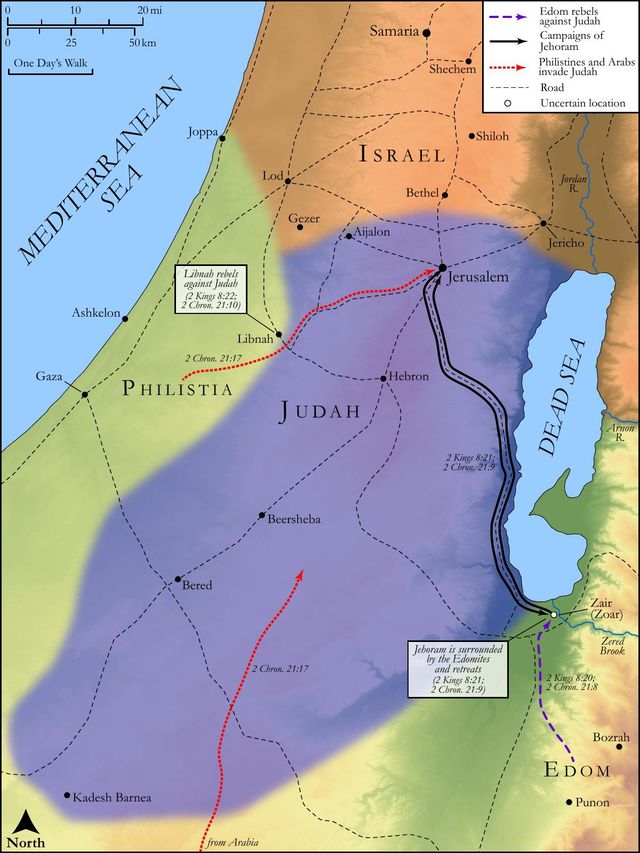
1.The Edomites revolted, who had been under the government of the kings of Judah ever since David's time, about 150 years, Kg2 8:20. He attempted to reduce them, and gave them a defeat (Kg2 8:21), but he could not improve the advantage he had got, so as to recover his dominion over them: Yet Edom revolted (Kg2 8:22), and the Edomites were, after this, bitter enemies to the Jews, as appears by the prophecy of Obadiah and Psa 137:7. Now Isaac's prophecy was fulfilled, that this Esau the elder should serve Jacob the younger; yet, in process of time, he should break that yoke from off his neck, Gen 27:40.
2.Libnah revolted. This was a city in Judah, in the heart of his country, a priests' city; the inhabitants of this city shook off his government because he had forsaken God, and would have compelled them to do so too, Ch2 21:10, Ch2 21:11. In order that they might preserve their religion they set up for a free state. Perhaps other cities did the same.
3.His reign was short. God cut him off in the midst of his days, when he was but forty years old, and had reigned but eight years. Bloody and deceitful men shall not live out half their days.
IV.The gracious care of Providence for the keeping up of the kingdom of Judah, and the house of David, notwithstanding the apostasies and calamities of Jehoram's reign (Kg2 8:19): Yet the Lord would not destroy Judah. He could easily have done it; he might justly have done it; it would have been no loss to him to have done it; yet he would not do it, for David's sake, not for the sake of any merit of his which could challenge this favour to his family as a debt, but for the sake of a promise made to him that he should always have a lamp (that is, a succession of kings from one generation to another, by which his name should be kept bright and illustrious, as a lamp is kept burning by a constant fresh supply of oil), that his family should never be extinct till it terminated in the Messiah, that Son of David on whom was to be hung all the glory of his Father's house and in whose everlasting kingdom that promise to David is fulfilled (Psa 132:17), I have ordained a lamp for my anointed.
V.The conclusion of this impious and inglorious reign, Kg2 8:23, Kg2 8:24.
Nothing peculiar is here said of him; but we are told (Ch2 21:19, Ch2 21:20) that he died of sore diseases and died without being desired.
Continue studying 2 Kings 8:20 across the web’s major study libraries — every link below opens this exact verse, chapter, or book on the destination site.
Read & Compare
 BibleGatewayThis verse in more than 200 translations and 70 languages.
 Bible.comThe YouVersion reader — hundreds of translations, reading plans, and highlights.
 ESV.orgCrossway's official English Standard Version reader.
 NET BibleThe NET translation with 60,000+ translators' notes on every rendering decision.
 STEP BibleTyndale House's free study tool — original text, vocabulary, and scholarly resources.
 BibliaLogos Bible Software's free web reader.
 USCCBThe New American Bible (Revised Edition) with the U.S. bishops' study notes.
Commentaries
 BibleHub CommentariesDozens of classic commentaries on this verse, gathered on one page.
 StudyLightMore than 100 commentary sets — the largest collection on the web.
 BibleRefPlain-English commentary on what this verse means, verse by verse.
 Enduring WordDavid Guzik's free commentary on this chapter, widely used by Bible teachers.
 Bible Study ToolsVerse commentary alongside Greek and Hebrew study aids.
Original Language & Research
- BibleHub InterlinearThe verse word by word — original language, transliteration, and English.
- BibleHub LexiconEvery word's original-language definition and Strong's entry.
 Blue Letter BibleDeep-study tools — Strong's numbers, concordance, and word studies.
 SefariaThe Hebrew text with Rashi and centuries of Jewish commentary.
Sermons, Hymns & Audio


TrulyRandomVerse is not affiliated with these sites and doesn’t control their content. They’re linked because they’re genuinely useful.
Summary
During the tumultuous and unrighteous reign of King Jehoram of Judah, 2 Kings 8:20 records a significant political and theological event: the successful revolt of Edom from under Judah's long-standing dominion. This act of self-determination, culminating in Edom establishing its own monarchy, signaled a profound weakening of Judah's regional power and influence, serving as a direct consequence of the southern kingdom's spiritual deviation and a manifestation of God's sovereign hand in the rise and fall of nations.
Context
ShowHideLiterary Context
This verse is strategically placed within the narrative detailing the reign of King Jehoram over Judah, which commences in 2 Kings 8:16. The preceding verses, particularly 2 Kings 8:18, explicitly condemn Jehoram for adopting the idolatrous practices of the kings of Israel and for marrying Ahab's daughter, indicating a profound spiritual apostasy. The Edomite revolt is thus presented not as an isolated political incident, but as a direct consequence and tangible manifestation of Judah's internal moral and spiritual decay under a wicked king. It immediately precedes further accounts of divine judgment, political instability, and the decline of the Judean monarchy, setting a somber tone for Jehoram's rule.
Historical & Cultural Context
Edom, located to the southeast of Judah, was a historically significant rival and, at various times, a subjugated territory of Israel. As descendants of Esau (Genesis 36), the Edomites shared a complex, often hostile, relationship with the Israelites. They had been decisively conquered by King David, who established garrisons throughout their land, effectively reducing them to a vassal state of Judah (2 Samuel 8:14). For centuries, Edom had been governed by a deputy or governor appointed by the Judean king, a clear sign of Judah's regional hegemony. The act of "making a king over themselves" was a powerful declaration of complete independence, a definitive severance of the vassal relationship, and a re-establishment of sovereign rule. This event would have been perceived as a significant blow to Judah's prestige, military strength, and economic interests, as Edom controlled vital trade routes, particularly those leading to the Red Sea.
Key Themes
ShowHideThe revolt of Edom powerfully illustrates several key themes prevalent within the book of Kings and the broader biblical narrative. Firstly, it highlights the consequences of unfaithfulness, demonstrating how a nation's spiritual health directly impacts its political stability, security, and strength. Jehoram's wickedness, explicitly detailed in 2 Kings 8:18, is implicitly linked to this loss of territory and control, serving as a divine judgment or a natural outcome of straying from God's covenant. Secondly, it underscores God's sovereignty in history, even amidst the rise and fall of earthly kingdoms. This event is seen as a fulfillment of ancient prophecy, specifically Isaac's blessing to Esau in Genesis 27:40, which foretold a time when Esau's descendants would "break his [Jacob's] yoke from off thy neck." This demonstrates God's long-term plan unfolding through human actions and political shifts. Thirdly, the verse touches on the theme of rebellion and self-determination, as Edom asserts its desire for autonomy, reflecting a recurring tension between vassal states and their overlords in the ancient Near East.
Exposition and Analysis
ShowHideKey Word Analysis
ShowHideThis verb (H6586) carries significant theological weight beyond mere political rebellion. While in a civil context it means to "rebel" or "revolt" against an authority, in a broader biblical sense, pāšaʻ often denotes "transgression," "sin," or "rebellion" against God's covenant or commands. In this verse, it signifies a deliberate and decisive breaking of allegiance by Edom from Judah's established control. The choice of this word implies not just a political maneuver but a fundamental rupture, mirroring the spiritual rebellion (transgression) of Judah's king, Jehoram, against God. It suggests a deep-seated rejection of the existing order.
The noun (H3027) "hand" is a primitive word with a vast array of applications, both literal and figurative. In the phrase "from under the hand of Judah," "hand" is used figuratively to denote authority, power, control, and dominion. It encapsulates the long-standing subjugation of Edom to Judah, signifying Judah's firm grip and sovereign power over the Edomite territory and people. The breaking away from this "hand" represents a profound loss of control and influence for Judah.
This noun (H4428) simply means "a king" or "royal." Its use here highlights the ultimate outcome of Edom's revolt: the re-establishment of their own sovereign monarchy. For Edom, having their own "king" symbolized complete autonomy and a return to national self-governance, free from foreign oversight. For Judah, it signified a complete loss of their vassal state, a symbol of their diminished power and prestige.
Verse Breakdown
ShowHide"In his days"
This opening phrase immediately anchors the event to the specific reign of King Jehoram of Judah, as introduced in 2 Kings 8:16-17. It emphasizes that this significant political setback occurred under his watch, implicitly linking it to his character and actions as king, which are explicitly described as unrighteous and idolatrous in 2 Kings 8:18. The timing suggests a causal relationship between the king's unfaithfulness and the kingdom's decline.
"Edom revolted from under the hand of Judah"
This clause describes the core action: Edom's successful secession. The phrase "from under the hand of Judah" denotes Judah's authority, control, and dominion over Edom, a status established centuries earlier by King David (2 Samuel 8:14). The "revolt" signifies a deliberate and successful breaking of this long-standing subjugation, a forceful and effective assertion of independence that Judah was unable to prevent or reverse.
"and made a king over themselves"
This final clause specifies the ultimate outcome and nature of the revolt. By establishing their own monarch, Edom declared full sovereignty and autonomy, permanently severing ties as a vassal state of Judah. This act solidified their independence and represented a significant and irreversible loss of political and economic power, prestige, and revenue for Judah, signaling a period of decline for the Judean kingdom.
Literary Devices
ShowHideThe verse effectively employs Foreshadowing and Symbolism. The Edomite revolt, occurring relatively early in Jehoram's reign, serves as a harbinger of the continued decline, instability, and divine judgment that will plague Judah throughout his rule and beyond. It is an early, tangible indication of the severe consequences of Jehoram's unrighteous leadership and the kingdom's spiritual apostasy, setting a precedent for further losses and judgments. Furthermore, the successful breaking of Edom's yoke of servitude from Judah can be seen as a powerful Symbolism of the weakening of Judah's own "yoke" of divine protection and blessing due to its unfaithfulness. Just as Edom casts off Judah's authority, Judah, through its king, is implicitly casting off God's authority, leading to a loss of its own strength, dominion, and ultimately, its security.
Theological and Thematic Connections
ShowHideThe revolt of Edom, while a seemingly political event, carries profound theological implications. It serves as a powerful reminder of the biblical principle that righteousness exalts a nation, but sin is a reproach to any people (Proverbs 14:34). Jehoram's unfaithfulness and idolatry directly correlate with Judah's diminished power and the loss of its long-held dominion, illustrating that a nation's spiritual health profoundly impacts its temporal well-being. Furthermore, this event highlights God's sovereign control over the rise and fall of nations, demonstrating His faithfulness to ancient prophecies, even those pronounced generations earlier. The breaking of Edom's yoke from Judah's neck fulfills Isaac's prophecy to Esau, underscoring that God's word will ultimately come to pass, regardless of human machinations or the passage of time. This narrative emphasizes that even in the midst of human rebellion and political upheaval, God's overarching plan for history continues to unfold.
Reflection and Application
ShowHideThe account of Edom's revolt under King Jehoram serves as a timeless lesson for individuals and communities alike, underscoring that spiritual health is inextricably linked to stability and flourishing, whether personal or corporate. Just as Judah's internal moral decay under Jehoram led to external vulnerability and loss of power, so too can unfaithfulness and rebellion against God's ways lead to instability, brokenness, and diminished influence in our own lives. This narrative challenges us to examine our allegiances: are we truly "under the hand" of God, submitting to His righteous rule, or are we, like Edom, seeking to "make a king over ourselves," pursuing autonomy apart from Him? True freedom and lasting strength are found not in rebellion against divine authority but in humble obedience and trust in the One who holds all power and whose plans ultimately prevail. This story calls us to consider the long-term consequences of our choices, recognizing that a departure from God's covenant often results in a loss of blessing and protection.
Questions for Reflection
ShowHideFAQ
ShowHideWhy was Edom's revolt particularly significant for Judah?
ShowHideEdom's revolt was highly significant for several reasons, impacting Judah militarily, economically, and spiritually. Historically, Edom had been a subjugated territory of Judah since King David's decisive conquests (2 Samuel 8:14), making their independence a direct challenge to Judah's regional hegemony and a profound loss of prestige. Economically, Edom controlled vital trade routes, particularly those leading to the Red Sea, which were crucial for Judah's commercial prosperity (e.g., 1 Kings 9:26-28). The loss of Edom meant a significant blow to Judah's economic power and access to lucrative trade. Theologically, it was seen as a direct consequence of King Jehoram's unrighteousness and idolatry (2 Kings 8:18) and a powerful fulfillment of ancient prophecy regarding Esau's descendants breaking free from Jacob's yoke (Genesis 27:40), underscoring the divine hand in historical events and the principle that national well-being is tied to covenant faithfulness.
Christ-Centered Fulfillment
ShowHideWhile 2 Kings 8:20 describes a political revolt against an earthly king, it profoundly points to Christ by highlighting themes of true kingship, rebellion, and the breaking of yokes. Humanity's fundamental problem is a spiritual "revolt" against God, seeking to "make a king over themselves" rather than submitting to the Creator's benevolent rule, a rebellion evident from the fall in Genesis 3. Jesus Christ, the true King of Kings and Lord of Lords (Revelation 19:16), comes not to establish an earthly dominion through military conquest, but to break the true yoke of sin and death that enslaves humanity (Matthew 11:28-30). Unlike Jehoram, whose unrighteousness led to the loss of his kingdom's dominion, Christ's perfect righteousness and sacrificial obedience establish an eternal kingdom that can never be shaken (Hebrews 12:28). He is the ultimate fulfillment of the prophetic promise of a King who would reign forever, bringing true freedom and peace to all who submit to His gentle and humble rule (Isaiah 9:6-7). The Edomite revolt, a breaking of an oppressive earthly yoke, foreshadows the far greater spiritual liberation accomplished by the Lamb of God, who takes away the sin of the world (John 1:29). Through Christ, those who were once in rebellion against God are reconciled and brought into His glorious, everlasting kingdom.