


2 Kings 3:27
- וַיִּקַּחvai·yi·Kachand he tookH3947Conj-w ¦ V-Qal-ConsecImperf-3msVerb Qal Consecutive Imperfect 3rd Singular Masculineוַandיִּקַּחhe took
- אֶת'et<obj.>H853DirObjMParticle Object Indicator
- בְּנוֹbe·Nohis sonH1121N-msc ¦ 3msNoun Singular Masculine Constructבְּנsonוֹhis
- הַבְּכוֹרha·be·Khorthe firstbornH1060Art ¦ N-msNoun Singular Masculine Absoluteהַtheבְּכוֹרfirstborn
- אֲשֶׁר'a·SherwhoH834RelParticle Relative
- יִמְלֹךְyim·Lokhhe will reignH4427V-Qal-Imperf-3msVerb Qal Imperfect 3rd Singular Masculine
- תַּחְתָּיוtach·Tavin place of himH8478N-mpc ¦ 3msNoun Plural Masculine Constructתַּחְתָּיin place ofוhim
- וַיַּעֲלֵהוּvai·ya·'a·Le·huand he offered up himH5927Conj-w ¦ V-Hiphil-ConsecImperf-3ms ¦ 3msVerb Hiphil Consecutive Imperfect 3rd Singular Masculineוַandיַּעֲלֵhe offered upהוּhim
- עֹלָה'o·Laha burnt offeringH5930N-fsNoun Singular Feminine Absolute
- עַל'alonH5921PrepPreposition
- הַחֹמָהha·cho·Mahthe wallH2346Art ¦ N-fsNoun Singular Feminine Absoluteהַtheחֹמָהwall
- וַיְהִיvay·Hiand it wasH1961Conj-w ¦ V-Qal-ConsecImperf-3msVerb Qal Consecutive Imperfect 3rd Singular Masculineוַandיְהִיit was
- קֶצֶףke·tzefwrathH7110N-msNoun Singular Masculine Absolute
- גָּדוֹלga·DolgreatH1419Adj-msAdjective Singular Masculine Absolute
- עַל'altowardsH5921PrepPreposition
- יִשְׂרָאֵלYis·ra·'ElIsraelH3478N-properNoun Proper Location
- וַיִּסְעוּvai·yis·'Uand they departedH5265Conj-w ¦ V-Qal-ConsecImperf-3mpVerb Qal Consecutive Imperfect 3rd Plural Masculineוַandיִּסְעוּthey departed
- מֵעָלָיוme·'a·Lavfrom on <the> himH5921Prep-m ¦ Prep ¦ 3msPreposition Definiteמֵfromעָלָיon <the>וhim
- וַיָּשֻׁבוּvai·ya·Shu·vuand they returnedH7725Conj-w ¦ V-Qal-ConsecImperf-3mpVerb Qal Consecutive Imperfect 3rd Plural Masculineוַandיָּשֻׁבוּthey returned
- לָאָרֶץla·'A·retzto the landH776Prep-l ¦ N-fsNoun Singular Feminine Absoluteלָto theאָרֶץland
English is a literal word-by-word gloss of the Hebrew, not the KJV's wording. Why?
This is the original text the KJV's translators worked from — each Hebrew word with its own literal English meaning in this verse, prepared by scholars at Tyndale House, Cambridge. The KJV translates whole sentences, not word by word, so its wording differs: one Hebrew word can become several English words, and the KJV may choose “the LORD” where the gloss reads “Yahweh”. Both are faithful — they answer different questions. For the KJV's own rendering, switch to the KJV text.
Details
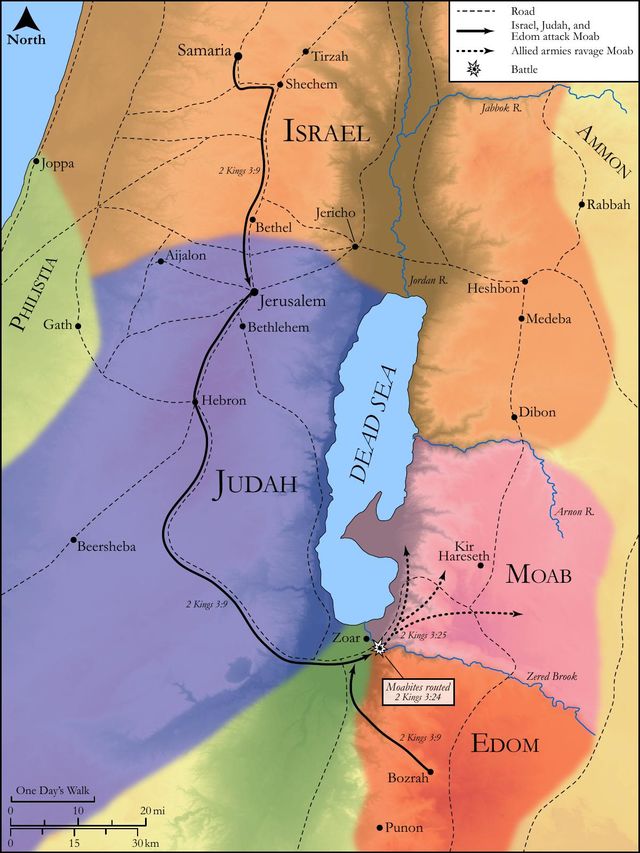
See on the biblical-era map
Study this verse
Public-domain commentary
Matthew Henry
From his Commentary on the Whole Bible. Henry comments on passages, not single verses — this entry covers 2 Kings 3:20–27. His four-level outline is real structure in the source text, so it is rendered as structure.
I.We have here the divine gift of both those things which God had promised by Elisha - water and victory, and the former not only a pledge of the latter, but a means of it. God, who created, and commands, all the waters, both above and beneath the firmament, sent them an abundance of water on a sudden, which did them double service.
1.It relieved their armies, which were ready to perish, Kg2 3:20. And, which was very observable, this relief came just at the time of the offering of the morning sacrifice upon the altar at Jerusalem, a certain time, and universally known. That time Elisha chose for his hour of prayer (it is likely looking towards the temple, for so there were to do in their prayers when they were going out to battle and encamped at a distance, Kg1 8:44), in token of his communion with the temple-service, and his expectation of success by virtue of the great sacrifice. We now cannot pitch upon any hour more acceptable than another, because our high priest is always appearing for us, to present and plead his sacrifice. That time God chose for the hour of mercy to put an honour upon the daily sacrifice, which had been despised. God answered Daniel's prayer just at the time of the evening sacrifice (Dan 9:21); for he will acknowledge his own institutions.
2.It deceived their enemies, who were ready to triumph, into the destruction. Notice was given to the Moabites of the advances of the confederate army, to oppose which all that were able to put on armour were posted upon the frontiers, where they were ready to give the Israelites a warm reception (v. 21), promising themselves that it would be easy dealing with an army fatigued by so long a march through the wilderness of Edom. But see here,
(1.)How easily they were drawn into their own delusions. Observe the steps of their self-deceit.
[1.]They saw the water in the valley where the army of Israel encamped, and conceited it was blood (Kg2 3:22), because they knew the valley to be dry, and (there having been no rain) could not imagine it should be water. The sun shone upon it, and probably the sky was red and lowering, a presage of foul weather that day (Mat 16:3), and so it proved to them. But, this making the water look red, their own fancies, which made them willing to believe what made for them, suggested, This is blood, God permitting them thus to impose upon themselves.
[2.]If their camp was thus full of blood, they conclude, "Certainly the kings have fallen out (as confederates of different interests are apt to do) and they have slain one another (Kg2 3:23), for who else should slay them?" And, [3.] "If the armies have slain one another, we have nothing to do but to divide the prey. Now therefore, Moab, to the spoil." These were the gradual suggestions of some sanguine spirits among them, that thought themselves wiser and happier in their conjectures than their neighbours; and the rest, being desirous it should be so, were forward to believe it was so. Quod volumus facile credimus - What we wish we readily believe. Thus those that are to be destroyed are first deceived (Rev 20:8), and none are so effectually deceived as those that deceive themselves.
(2.)How fatally they thereby ran upon their own destruction. They rushed carelessly into the camp of Israel, to plunder it, but were undeceived when it was too late. The Israelites, animated by the assurances Elisha had given them of victory, fell upon them with the utmost fury, routed them, and pursued them into their own country (Kg2 3:24), which they laid waste (Kg2 3:25), destroyed the cities, marred the ground, stopped up the wells, felled the timber, and left only the royal city standing, in the walls of which they made great breaches with their battering engines. This they got by rebelling against Israel. Who ever hardened his heart against God and prospered?
II.In the close of the chapter we are told what the king of Moab did when he found himself reduced to the last extremity by the besiegers, and that his capital city was likely to fall into their hands.
1.He attempted that which was bold and brave. he got together 700 choice men, and with them sallied out upon the intrenchments of the king of Edom, who, being but a mercenary in this expedition, would not, he hoped, make any great resistance if vigorously attacked, and so he might make his escape that way. But it would not do; even the king of Edom proved too hard for him, and obliged him to retire, Kg2 3:26.
2.This failing, he did that which was brutish and barbarous; he took his own son, his eldest son, that was to succeed him, than whom nothing could be more dear to himself and his people, and offered him for a burnt-offering upon the wall, Kg2 3:27. He designed by this,
(1.)To obtain the favour of Chemosh his god, which, being a devil, delighted in blood and murder, and the destruction of mankind. The dearer any thing was to them the more acceptable those idolaters thought it must needs be if offered in sacrifice to their gods, and therefore burnt their children in the fire to their honour.
(2.)To terrify the besiegers, and oblige them to retire. Therefore he did it upon the wall, in their sight, that they might see what desperate courses he resolved to take rather than surrender, and how dearly he would sell his city and life. He intended hereby to render them odious, and to exasperate and enrage his own subjects against them. This effect it had: There was great indignation against Israel for driving him to this extremity, whereupon they raised the siege and returned. Tender and generous spirits will not do that, though just, which will drive any man distracted, or make him desperate.
Historical interpretation
Historical reception
2 surviving comments on this verse. Each one is dated, so this reads as a timeline rather than a list.
People imitate those who do good deeds, therefore, not out of love for these good deeds but because of their usefulness. For Balaam also flattered [God], in that he had seven altars built because he had heard concerning these ancient ones that, with regard to the sacrifices they had offered to him, their prayers were accepted. The king of Moab took note of Jephthah. But, because it was his firstborn and a human being rather than an animal that he killed, God took pity on him, since it was in affliction that he did it and not through love. In the case of Jephthah, if it had been one of his servants who had been first to encounter him, he would have killed him. But, in order that people would not engage in the sacrifice of their fellow human beings, he caused his own daughter to meet him, so that others would be afraid, lest they offer human beings by vow to God.
Therefore Mesha, who had lost all his hope in his armies, made an about-face to ask the gods for help, because he had seen that no human being could help him. Certain wise men of his country said to him that it was necessary to implore the mercy of the God of Israel by means of an extraordinary sacrifice, for exactly the same reason which Abraham, the father of the Israelites, had made his offering, which had been quite pleasing to God, according to the tradition that is generally renowned among the Canaanites. But the power and the strength of God had already been recognized by all with great admiration for what he had done before all the Moabites. Indeed, no one but him had made the water flow on his people in the desert of Edom, and they had never heard of or known another God who granted his worshipers greater benefits. Therefore the king, who could not deny the miracle that he had seen with his own eyes, did not want to be deprived of sufficient aid in the difficulties that encircled him. He was confirmed [in his hope] and abandoned the worship of idols by taking refuge in the powerful God who had created a new sea in the desert. Therefore he was invited by the word of the wise men and nobles of Moab to make a great sacrifice and to offer his firstborn child, the pillar of his house and the hope of his kingdom, on the city walls, before the armies that besieged him. He wanted the Hebrew to see the sacrifice he was about to make to the God of Abraham according to the teaching of Abraham.And then the wrath against the Israelites increased, because the calamities, which the Scripture accurately relates after these events, happened to them again. They had seen how God protected them, and the abundance of water that he had made miraculously flow for them and the retreat of their enemies before them. Nevertheless, they persisted in their dishonor, and their hearts were still attached to their calf.
Continue studying 2 Kings 3:27 across the web’s major study libraries — every link below opens this exact verse, chapter, or book on the destination site.
Read & Compare
 BibleGatewayThis verse in more than 200 translations and 70 languages.
 Bible.comThe YouVersion reader — hundreds of translations, reading plans, and highlights.
 ESV.orgCrossway's official English Standard Version reader.
 NET BibleThe NET translation with 60,000+ translators' notes on every rendering decision.
 STEP BibleTyndale House's free study tool — original text, vocabulary, and scholarly resources.
 BibliaLogos Bible Software's free web reader.
 USCCBThe New American Bible (Revised Edition) with the U.S. bishops' study notes.
Commentaries
 BibleHub CommentariesDozens of classic commentaries on this verse, gathered on one page.
 StudyLightMore than 100 commentary sets — the largest collection on the web.
 BibleRefPlain-English commentary on what this verse means, verse by verse.
 Enduring WordDavid Guzik's free commentary on this chapter, widely used by Bible teachers.
 Bible Study ToolsVerse commentary alongside Greek and Hebrew study aids.
Original Language & Research
- BibleHub InterlinearThe verse word by word — original language, transliteration, and English.
- BibleHub LexiconEvery word's original-language definition and Strong's entry.
 Blue Letter BibleDeep-study tools — Strong's numbers, concordance, and word studies.
 SefariaThe Hebrew text with Rashi and centuries of Jewish commentary.
Sermons, Hymns & Audio


TrulyRandomVerse is not affiliated with these sites and doesn’t control their content. They’re linked because they’re genuinely useful.
Summary
2 Kings 3:27 encapsulates the horrific and climactic moment of the Moabite war, where King Mesha, facing utter annihilation by the combined forces of Israel, Judah, and Edom, offered his eldest son and heir as a burnt offering upon the city wall. This act of child sacrifice, an abomination in the eyes of Yahweh, provoked an overwhelming "great indignation" among the besieging armies, leading to their immediate and unexpected withdrawal and the abrupt cessation of the campaign.
Context
ShowHideLiterary Context
This verse serves as the shocking and pivotal conclusion to the military narrative detailed throughout 2 Kings 3. The chapter begins with the alliance of King Jehoram of Israel, King Jehoshaphat of Judah, and the king of Edom, formed to quell the rebellion of Mesha, king of Moab. The campaign is marked by divine intervention, specifically through the prophet Elisha, who miraculously provides water for the thirsty armies and prophesies their victory over Moab. The allied forces proceed to devastate Moabite territory, destroying cities and agricultural lands, pushing Mesha to the desperate final stand at his capital, Kir-haraseth. After a failed attempt to break through the siege lines with 700 swordsmen, Mesha resorts to the ultimate, abhorrent act described in 2 Kings 3:27, which abruptly halts the victorious advance of the Israelite-led coalition, leaving the reader to grapple with the profound implications of the "indignation" that follows.
Historical & Cultural Context
Child sacrifice, though vehemently condemned by the God of Israel, was a grim and deeply ingrained practice in certain ancient Near Eastern cultures, particularly among the Canaanites, Ammonites, and Moabites. The Moabites worshipped Chemosh as their national deity, and human sacrifice, especially of firstborn children, was considered the most potent and desperate form of appeasement or invocation in times of extreme national crisis, such as a devastating military siege. Mesha's act was thus a desperate, public ritual intended to invoke Chemosh's power to turn the tide of battle, protect his city, or perhaps even curse the invaders. This barbaric practice stood in stark opposition to the explicit laws given to Israel, which unequivocally prohibited child sacrifice as an abomination to Yahweh (Leviticus 18:21; Deuteronomy 12:31). This stark contrast highlights the moral and theological chasm between the covenant relationship with Yahweh and the cruel demands of pagan idolatry.
Key Themes
ShowHide2 Kings 3:27 powerfully illustrates several profound themes. Firstly, it underscores the extreme desperation and moral depravity to which those without the true God can descend, resorting to unimaginable acts in the face of crisis, believing such sacrifices can manipulate divine favor. Secondly, it highlights the absolute abhorrence of child sacrifice within the biblical narrative, serving as a stark contrast between the brutal demands of pagan deities and the character and law of Yahweh, who strictly forbids such practices. This act emphasizes the sanctity of human life, especially that of children, in God's eyes. Thirdly, the enigmatic phrase "great indignation" introduces a complex theme regarding the consequences of extreme evil. While interpretations vary, it fundamentally points to a profound reaction—whether divine wrath from Yahweh, the invoked wrath of Chemosh, or, most plausibly, the overwhelming moral outrage and horror felt by the allied armies—that was so potent it led to the immediate and unexpected cessation of a victorious military campaign. This demonstrates how a single, shocking act can profoundly alter the course of human events and reveal the deep spiritual realities at play.
Exposition and Analysis
ShowHideKey Word Analysis
ShowHideFrom the root meaning "firstborn," this term emphasizes the profound nature of Mesha's sacrifice. It was not merely a son, but the "firstborn," the "chief" heir, the one "that should have reigned in his stead." This highlights the ultimate value and significance of the offering from Mesha's perspective, underscoring his utter desperation and the depth of his commitment to his god, as he sacrificed his very lineage and the future of his kingdom.
This term, derived from a root meaning "to ascend," typically refers to a sacrifice entirely consumed by fire on an altar, symbolizing complete dedication or atonement, as prescribed in Yahweh worship. Here, however, it is applied to a human sacrifice offered to Chemosh, the Moabite deity. This application underscores the perversion of the sacrificial concept in pagan worship, where the sacred act is twisted into a horrific, life-destroying ritual. The public nature of the offering "upon the wall" was intended to be seen, likely to elicit a divine response or to demoralize the enemy.
Translated as "great indignation" (gâdôwl qetseph), this word carries a strong connotation of wrath, fury, or intense displeasure. Its ambiguity in this context is crucial for interpretation. While qetseph often refers to God's wrath in other biblical passages (e.g., Numbers 1:53, Joshua 9:20), here it could also signify the profound moral outrage, revulsion, and disgust felt by the allied armies upon witnessing such a barbaric act. The immediate effect—their departure—suggests a human reaction, but the underlying theological implication of such an act's impact on divine favor or the spiritual atmosphere remains a point of scholarly discussion.
Verse Breakdown
ShowHide"Then he took his eldest son that should have reigned in his stead"
This clause precisely identifies the victim of the sacrifice, emphasizing the immense personal and dynastic cost to King Mesha. By sacrificing his firstborn son and designated heir, Mesha demonstrates the ultimate measure of his desperation and the depth of his commitment to his pagan god, Chemosh, believing this act would secure divine intervention.
"and offered him [for] a burnt offering upon the wall"
This describes the horrifying act itself. The public execution of the sacrifice, performed "upon the wall" of the besieged capital city, Kir-haraseth, was a deliberate and visible act, likely intended as a desperate plea to Chemosh for deliverance, or perhaps to shock and demoralize the besieging armies. The term "burnt offering" highlights the complete consumption of the sacrifice, mirroring the total devotion associated with such rituals.
"And there was great indignation against Israel"
This is the pivotal and most debated clause of the verse. The "great indignation" (Hebrew: qetseph gadol) refers to an intense wrath or outrage. While some interpretations consider it divine wrath from Yahweh against Israel (perhaps for driving Moab to such an extreme or for their own spiritual failings), the more widely accepted view is that it represents the profound horror, moral outrage, and revulsion experienced by the allied armies (Israel, Judah, and Edom) upon witnessing such a barbaric act of child sacrifice. This revulsion was so overwhelming that it broke their resolve to continue the siege.
"and they departed from him, and returned to [their own] land."
This final clause details the immediate and unexpected consequence of the "great indignation." Regardless of its precise source, the shock, revulsion, or supernatural influence caused by Mesha's horrific act led the allied forces to abandon their successful siege and return home. This abrupt departure left Moab unconquered despite the overwhelming military advantage the coalition had achieved, highlighting the profound and unexpected impact of Mesha's desperate, depraved act.
Literary Devices
ShowHideThe passage employs several potent Literary Devices. The most prominent is Shock and Horror, as the narrative builds to a climax of military success only to be abruptly truncated by an act of unimaginable depravity. This sudden, gruesome turn is designed to elicit a strong emotional response from the reader, mirroring the "great indignation" felt by the armies. There is also a strong element of Contrast between the divine guidance and miraculous provision for Israel earlier in the chapter and the ultimate, horrific act of pagan desperation. The Climax of the siege is not a final victory for the allies, but a moral and psychological breaking point triggered by Mesha's sacrifice. Furthermore, the ambiguity surrounding the precise source of the "indignation" creates Dramatic Tension, leaving the reader to ponder whether it was divine wrath, human revulsion, or a combination, thereby deepening the theological implications of the passage and inviting reflection on the unseen forces at play.
Theological and Thematic Connections
ShowHide2 Kings 3:27 stands as a stark biblical testament to the profound depravity of human paganism and the vast, unbridgeable chasm between the worship of false gods and the worship of the true God of Israel. It vividly underscores the desperate, cruel, and ultimately futile demands of deities like Chemosh, who required the ultimate sacrifice of a child, contrasting sharply with Yahweh, who not only strictly forbade such abominations but ultimately provided the ultimate, perfect sacrifice for humanity's redemption in His own Son. This horrific event serves as a powerful reminder of the darkness from which God rescued His people, highlighting His holiness, justice, and the sanctity of human life, particularly that of children. It also implicitly points to the profound spiritual battle between the forces of life and death, light and darkness, that pervades the biblical narrative, emphasizing the destructive nature of idolatry.
Reflection and Application
ShowHideThis chilling account from 2 Kings 3:27 compels us to reflect deeply on the nature of ultimate desperation and the stark contrast between human depravity and divine grace. While we may not face the exact circumstances of ancient warfare or pagan child sacrifice, the underlying themes resonate profoundly in contemporary life. It reminds us of the lengths to which people will go when driven by fear, superstition, or a distorted understanding of the divine, seeking to manipulate spiritual forces or secure perceived salvation through self-destructive or morally abhorrent means. For believers, it serves as a powerful reminder of the immense privilege of knowing the God of Abraham, Isaac, and Jacob—a God who is merciful, just, and who gives His Son, rather than demanding ours. It calls us to profound gratitude for a God who values life, forbids cruelty, and offers redemption through self-sacrifice, not human sacrifice. This passage also challenges us to consider the profound impact of shocking acts of evil on human resolve and the unexpected ways in which events can unfold, sometimes without direct divine intervention, but as a consequence of human choices and their spiritual reverberations.
Questions for Reflection
ShowHideFAQ
ShowHideWhat was the "great indignation against Israel" mentioned in the verse?
ShowHideThe phrase "great indignation" (Hebrew: qetseph gadol) is a point of significant scholarly discussion, but the most common and textually immediate understanding is that it refers to the profound sense of horror, disgust, and moral outrage felt by the allied armies (Israel, Judah, and Edom) upon witnessing King Mesha's barbaric act of sacrificing his eldest son as a burnt offering on the city wall. This overwhelming revulsion broke their will to continue the siege of Kir-haraseth, leading them to withdraw. While some scholars suggest it could be divine wrath from God (Yahweh) against Israel for pushing Moab to such an extreme, or even the "indignation" of Moab's god Chemosh, the immediate narrative consequence points to the psychological and moral impact on the human participants. The act was so heinous and shocking that it effectively ended the military campaign, causing the allied forces to depart from Moab and return to their own land, as described in 2 Kings 3:27.
Christ-Centered Fulfillment
ShowHideThe horrific scene of 2 Kings 3:27, with King Mesha offering his son as a desperate, depraved sacrifice to a pagan deity, stands in stark and profound contrast to the ultimate, perfect sacrifice of God's own Son, Jesus Christ. While Mesha's act was a futile attempt to appease a false god and save his kingdom through human depravity, God the Father willingly gave His only Son, not to demand a sacrifice from humanity, but to be the sacrifice for humanity's redemption (John 3:16). The desperate cries of paganism for human blood are eternally silenced by the precious blood of the Lamb of God who takes away the sin of the world. Jesus' sacrifice on the cross was not an act of desperation, but of divine love and sovereign purpose, fulfilling the Law and the Prophets, and offering true and lasting salvation that no human sacrifice could ever achieve (Hebrews 9:22-28). Thus, the abomination of Mesha's offering highlights the immeasurable grace and perfect provision found in Christ, who, unlike the pagan gods, laid down His life to give us abundant and eternal life (John 10:11).