


Ezekiel 16:20
- וַתִּקְחִיva·tik·Chiand you tookH3947Conj-w ¦ V-Qal-ConsecImperf-2fsVerb Qal Consecutive Imperfect 2nd Singular Feminineוַandתִּקְחִיyou took
- אֶת'et<obj.>H853DirObjMParticle Object Indicator
- בָּנַיִךְba·Na·yikhyour sonsH1121N-mpc ¦ 2fsNoun Plural Masculine Constructבָּנַיִsonsךְyour
- וְאֶתve·'Etand <obj.>H853Conj-w ¦ DirObjMParticle Object Indicatorוְandאֶת<obj.>
- בְּנוֹתַיִךְbe·no·Ta·yikhyour daughtersH1323N-fpc ¦ 2fsNoun Plural Feminine Constructבְּנוֹתַיִdaughtersךְyour
- אֲשֶׁר'a·SherwhomH834RelParticle Relative
- יָלַדְתְּya·Ladtyou had borneH3205V-Qal-Perf-2fsVerb Qal Perfect 2nd Singular Feminine
- לִיLito mePrep-l ¦ 1csSuffix Personal 1st Singular common genderלִtoיme
- וַתִּזְבָּחִיםva·tiz·ba·Chimand you sacrificed themH2076Conj-w ¦ V-Qal-ConsecImperf-2fs ¦ 3mpVerb Qal Consecutive Imperfect 2nd Singular Feminineוַandתִּזְבָּחִיyou sacrificedםthem
- לָהֶםla·Hemto themPrep-l ¦ 3mpSuffix Personal 3rd Plural Masculineלָtoהֶםthem
- לֶאֱכוֹלle·'e·Kholto devourH398Prep-l ¦ V-Qal-InfVerb Qal Infinitive Constructלֶtoאֱכוֹלdevour
- הַמְעַטham·'At¿ littleH4592Interrog ¦ N-msNoun Singular Masculine Absoluteהַ¿מְעַטlittle
- מִתַּזְנוּתָיִךְmi·taz·nu·tekhfrom your prostitution<s>H8457Prep-m ¦ N-mpc ¦ 2fsNoun Plural Masculine Constructמִfromתַּזְנוּתָיִprostitution<s>ךְyour
English is a literal word-by-word gloss of the Hebrew, not the KJV's wording. Why?
This is the original text the KJV's translators worked from — each Hebrew word with its own literal English meaning in this verse, prepared by scholars at Tyndale House, Cambridge. The KJV translates whole sentences, not word by word, so its wording differs: one Hebrew word can become several English words, and the KJV may choose “the LORD” where the gloss reads “Yahweh”. Both are faithful — they answer different questions. For the KJV's own rendering, switch to the KJV text.
Details
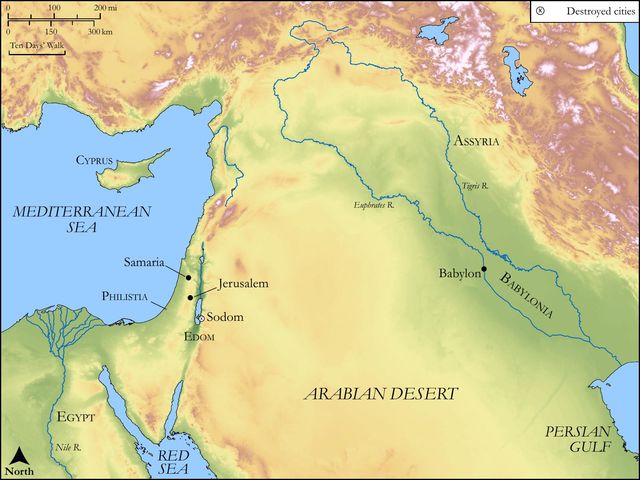
See on the biblical-era map
Study this verse
Public-domain commentary
Matthew Henry
From his Commentary on the Whole Bible. Henry comments on passages, not single verses — this entry covers Ezekiel 16:15–34. His three-level outline is real structure in the source text, so it is rendered as structure.
In these verses we have an account of the great wickedness of the people of Israel, especially in worshipping idols, notwithstanding the great favours that God had conferred upon them, by which, one would think, they should have been for ever engaged to him. This wickedness of theirs is here represented by the lewd and scandalous conversation of that beautiful maid which was rescued from ruin, brought up and well provided for by a kind friend and benefactor, that had been in all respects as a father and a husband to her. Their idolatry was the great provoking sin that they were guilty of; it began in the latter end of Solomon's time (for from Samuel's till then I do not remember that we read any thing of it), and thenceforward continued more or less the crying sin of that nation till the captivity; and, though it now and then met with some check from the reforming kings, yet it was never totally suppressed, and for the most part appeared to a high degree impudent and barefaced. They not only worshipped the true God by images, as the ten tribes by the calves at Dan and Bethel, but they worshipped false gods, Baal and Moloch, and all the senseless rabble of the pagan deities.
This is that which is here all along represented (as often elsewhere) under the similitude of whoredom and adultery, 1. Because it is the violation of a marriage-covenant with God, forsaking him and embracing the bosom of a stranger; it is giving that affection and that service to his rivals which are due to him alone. 2. Because it is the corrupting and defiling of the mind, and the enslaving of the spiritual part of the man, and subjecting it to the power and dominion of sense, as whoredom is. 3. Because it debauches the conscience, sears and hardens it; and those who by their idolatries dishonour the divine nature, and change the truth of God into a lie and his glory into shame, God justly punishes by giving them over to a reprobate mind, to dishonour the human nature with vile affections, Rom 1:23, etc. It is a besotting bewitching sin; and, when men are given up to it, they seldom recover themselves out of the snare. 4. Because it is a shameful scandalous sin for those that have joined themselves to the Lord to join themselves to an idol. Now observe here,
I.What were the causes of this sin.
How came the people of God to be drawn away to the service of idols? How came a virgin so well taught, so well educated, to be debauched? Who would have thought it? But, 1. They grew proud (Eze 16:15): "Thou trustedst to thy beauty, and didst expect that that should make thee an interest, and didst play the harlot because of thy renown." They thought, because they were so complimented and admired by their neighbours, that, further to ingratiate themselves with them and return their compliments, they must join with them in their worship and conform to their usages. Solomon admitted idolatry, to gratify his wives and their relations. Note, Abundance of young people are ruined by pride and particularly pride in their beauty. Rara est concordia formae atque pudicitiae - Beauty and chastity are seldom associated 2. They forgot their beginning (Eze 16:22) "Thou hast not remembered the days of thy youth, how poor, and mean, and despicable thou wast, and what great things God did for thee and what lasting obligations he laid upon thee thereby." Note, It should be an effectual check to our pride and sensuality to consider what we are and how much we are beholden to the free grace of God. 3. They were weak in understanding and in resolution (Eze 16:30): How weak is thy heart, seeing thou dost all these things. Note, The strength of men's lusts is an evidence of the weakness of their hearts; they have no acquaintance with themselves, nor government of themselves. She is weak, and yet an imperious whorish woman. Note, Those that are most foolish are commonly most imperious, and think themselves fit to manage others when they are far from being able to manage themselves.
II.What were the particulars of it.
1.They worshipped all the idols that came in their way, all that they were ever courted to the worship of; they were at the beck of all their neighbours (Eze 16:15): Thou pouredst out thy fornications on every one that passed by; his it was. They were ready to close with every temptation of this kind, though ever so absurd. No foreign idol could be imported, no new god invented, but they were ready to catch at it, as a common trumpet that prostitutes herself to all comers and multiplies her whoredoms, Eze 16:25. Thus some common drunkards will be company for every one that puts up the finger to them; how weak are the hearts of such!
2.They adorned their idol-temples, and groves, and high places, with the fine rich clothing that God had given them (Eze 16:16, Eze 16:18): Thou deckedst thy high places with divers colours, with the coats of divers colours, like Joseph's, which God had given them as particular marks of his favour, and hast played the harlot (that is, worshipped idols) thereupon. Of this he saith, "The like things shall not come, neither shall it be so; that is, this is a thing by no means to be suffered; I will never endure such practices as these without showing my resentments." 3. They made images for worship of the jewels which God had given them (Eze 16:17): The jewels of my gold and my silver which I had given thee. Note, It is God that gives us our gold and silver; the products of trade, of art and industry, are the gifts of God's providence to us, as well as the fruits of the earth. And what God gives us the use of he still retains a property in. "It is my silver and my gold, though I have given it to thee." It is his still, so that we ought to serve and honour him with it, and are accountable to him for the disposal of it. Every penny has God's image upon it as well as Caesar's. Should we make our silver and gold, our plate, money, and jewels, the matter of our pride and contention, our covetousness and prodigality, if we duly considered that they were God's silver and his gold? The Israelites began betimes to turn their jewels into idols, when Aaron made the golden calf of their earrings. 4. They served their idols with the good things which God gave them for their own use and to serve him with (Eze 16:18): "Thou hast set my oil and my incense before the, upon their altars, as perfumes to these dunghill-deities; my meat, and fine flour, and oil, and that honey which Canaan flowed with, and wherewith I fed thee, thou hast regaled them and their hungry priests with, hast made an offering of it to them for a sweet savour, to purify them, and procure acceptance with them: and thus it was, saith the Lord God; it is too plain to be denied, too bad to be excused. These things thou hast done. He that knows all things knows it." See how fond they were of their idols, that they would part with that which was given them for the necessary subsistence of themselves and their families to honour them with, which may shame our niggardliness and strait-handedness in the service of the true and living God. 5. They had sacrificed their children to their idols. This is insisted upon here, and often elsewhere, as one of the worst instances of their idolatry, as indeed there was none in which the devil triumphed so much over the children of men, both their natural reason and their natural affection, as in this (see Jer 7:31; Jer 19:5; Jer 32:35): Thou hast taken thy sons and thy daughters, and not only made them to pass through the fire, or between two fires, in token of their being dedicated to Moloch, but thou hast sacrificed them to be devoured, Eze 16:20. Never was there such an instance of the degenerating of the paternal authority into the most barbarous tyranny as this was. Yet that was not the worst of it: it was an irreparable wrong to God himself, who challenged a special property in their children more than in their gold and silver and their meat: They are my children (Eze 16:21), the sons and daughters which thou hast borne unto me, Eze 16:20. He is the Father of spirits, and rational souls are in a particular manner his; and therefore the taking away of life, human life, unjustly, is a high affront to the God of life. But the children of Israelites were his by a further right; they were the children of the covenant, born in God's house. He had said to Abraham, I will be a God to thee and to thy seed; they had the seal of the covenant in their flesh from eight days old; they were to bear God's name, and keep up his church; to murder them was in the highest degree inhuman, but to murder them in honour of an idol was in the highest degree impious. One cannot think of it without the utmost indignation: to see the pitiless hands of the parents shedding the guiltless blood of their own children, and by offering those pieces of themselves to the devil for buying sacrifices openly avowing the offering up of themselves to him for living sacrifices! How absurd was this, that the children which were born to God should be sacrificed to devils! Note, The children of parents that are members of the visible church are to be looked upon as born unto God, and his children,; as such, and under that character, we are to love them, and pray for them, bring them up for him, and, if he calls for them, cheerfully part with them to him; for may he not do what he will with his own? Upon this instance of their idolatry, which indeed ought not to pass without a particular brand, this remark is made (Eze 16:20), Is this of thy whoredoms a small matter? which intimates that there were those who made a small matter of it, and turned it into a jest. Note, There is no sin so heinous, so apparently heinous, which men of profligate consciences will not make a mock at. But is whoredom, is spiritual whoredom, a small matter? Is it a small matter for men to make their children brutes and the devil their god? It will be a great matter shortly. 6. They built temples in honour of their idols, that others might be invited to resort thither and join with them in the worship of their idols: "After all thy wickedness of this kind committed in private, for which, woe, woe, unto thee" (that comes in in a sad parenthesis, denoting those to be in a woeful condition who are going on in sin, and giving them warning in time, if they would but take it), "thou hast at length arrived at such a pitch of impudence as to proclaim it; thou hast long had a whore's heart, but now thou hast come to have a whore's forehead, and canst not blush," Eze 16:23-35. Thou hast built there an eminent place, a brothel-house (so the margin reads it), and such their idol temples were. Thou hast made for thyself a high place, for one idol or other, in every street, and at every head of the way; and again Eze 16:31. They did all they could to seduce and debauch others, and to spread the contagion, by making the temptations to idolatry as strong as possibly they could; and hereby the ringleaders in idolatry did but make themselves vile, and even those that had courted them to it, finding themselves outdone by them, began to be surfeited with the abundance and violence of their idolatries: Thou hast made thy beauty to be abhorred, even by those that had admired it. The Jewish nation, by leaving their own God, and doting on the gods of the nations round about them, had made themselves mean and despicable in the eyes even of their heathen neighbours; much more was their beauty abhorred by all that were wise and good, and had any concern for the honour of God and religion. Note, Those shame themselves that bring a reproach on their profession. And justly will that beauty, that excellency, at length be made the object of the loathing of others which men have made the matter of their own pride.
III.What were the aggravations of this sin.
1.They were fond of the idols of those nations which had been their oppressors and persecutors. As,
(1.)The Egyptians. They were a people notorious for idolatry, and for the most sottish senseless idolatries; they had of old abused Israel by their barbarous dealings, and of late by their treacherous dealings - were always either cruel or false to them; and yet so infatuated were they that they committed fornication with the Egyptians their neighbours, not only by joining with them in their idolatries, but by entering into leagues and alliances with them, and depending upon them for help in their straits, which was an adulterous departure from God.
(2.)The Assyrians. They had also been vexatious to Israel: "And yet thou hast played the whore with them (Eze 16:28); though they lived at a greater distance, yet thou hast entertained their idols and their superstitious usages, and so hast multiplied thy fornications unto Chaldea, hast borrowed images of gods, patterns of altars, rites of sacrificing, and one foolery or other of that kind, from that remote country, that enemy's country, and hast imported them into the land of Canaan, enfranchised and established them there." Thus Mr. George Herbert long since foretold, or feared at least,
That Seine shall swallow Tiber, and the Thames
By letting in them both pollute her streams.
2.They had been under the rebukes of Providence for their sins, and yet they persisted in them (Eze 16:27): I have stretched out my hand over thee, to threaten and frighten thee. So God did before he laid his hand upon them to ruin and destroy them; and that is his usual method, to try to bring men to repentance first by less judgments. He did so here. Before he brought such a famine upon them as broke the staff of bread he diminished their ordinary food, but them short before he cut them off. When the overplus is abused, it is just with God to diminish that which is for necessity. Before he delivered them to the Chaldeans to be destroyed he delivered them to the daughters of the Philistines to be ridiculed for their idolatries; for they hated them, and, though they were idolaters themselves, yet were ashamed of the lewd way of the Israelites, who had grown more profane in their idolatries than any of their neighbours, who changed their gods, whereas other nations did not change theirs, Jer 2:10, Jer 2:11. For this they were justly chastised by the Philistines. Or it may refer to the inroads which the Philistines made upon the south of Judah in the reign of Ahaz, by which it was weakened and impoverished, and which was the beginning of sorrows to them (Ch2 28:18); but they did not take warning by those judgments, and therefore were justly abandoned to ruin at last. Note, In the account which impenitent sinners shall be called to they will be told not only of the mercies for which they have been ungrateful, but of the afflictions under which they have been incorrigible, Amo 4:11.
3.They were insatiable in their spiritual whoredom: Thou couldst not be satisfied, Eze 16:28 and again Eze 16:29. When they had multiplied their idols and superstitious usages beyond measure, yet still they were enquiring after new gods and new fashions in worship. Those that in sincerity join themselves to the true God find enough in him for their satisfaction; and, though they still desire more of God, yet they never desire more than God. But those that forsake this living fountain for broken cisterns will find themselves soon surfeited, but never satisfied; they have soon enough of the gods they have, and are still enquiring after more.
4.They were at great expense with their idolatry, and laid out a great deal of wealth in purchasing patterns of images and altars, and hiring priests to attend upon them from other countries. Harlots generally had their hire; but this impudent adulteress, instead of being hired to serve idols, hired idols to protect her and accept her homage. This is much insisted on, Eze 16:31-34. "In this respect the contrary is in thee from other women in thy whoredoms: others are courted, but thou makest court to those that do not follow thee, art fond of making leagues and alliances with those heathen nations that despise thee; others have gifts given them, but thou givest thy gifts, the gifts which God had graciously given thee, to thy idols; herein thou art like a wife that commits adultery, not for gain, as harlots do, but entirely for the sin's sake." Note, Spiritual lusts, those of the mind, such as theirs after idols were, are often as strong and impetuous as any carnal lusts are. And it is a great aggravation of sin when men are their own tempters, and, instead of proposing to themselves any worldly advantage by their sin, are at great expense with it; such are transgressors without cause (Psa 25:3), wicked transgressors indeed.
And now is not Jerusalem in all this made to know her abominations? For what greater abominations could she be guilty of than these? Here we may see with wonder and horror what the corrupt nature of men is when God leaves them to themselves, yea, though they have the greatest advantages to be better and do better. And the way of sin is down-hill. Nitimur in vetitum - We incline to what is forbidden.
Historical interpretation
Historical reception
3 surviving comments on this verse. Each one is dated, so this reads as a timeline rather than a list.
Select a marker to jump to its quote. Markers stagger vertically where authors wrote within a few decades of each other.
(Vers. 20 seqq.) And it came to pass, says the Lord God, that you took your sons and your daughters, whom you bore to me, and you sacrificed them to be devoured. Is your fornication of little consequence, sacrificing my sons? And you gave them to consecrate them. And after all your abominations and fornications, you did not remember the days of your youth, when you were naked and full of confusion, trampled in your own blood. LXX: And it came to pass after these things, says the Lord God, that you took your sons and your daughters, whom you have borne, and sacrificed them to be consumed, as though you have acted like a whore in doing so. And you killed your sons and offered them up to them, that is, above all your whorings and abominations, and you did not remember the days of your youth, when you were naked and exposed; you lived in your own blood. That their sons and daughters of Jerusalem, of whom it is written, 'I have begotten and exalted sons,' they themselves have despised me (Isa. I, 2); the holy Scripture recounts that they have sacrificed their sons and daughters to idols (Ps. CV, 37). And again: 'They have shed innocent blood' (Ibid., 38), the blood of their sons and daughters, whom they sacrificed to the idols of Canaan (Exod. IV, 22). But he calls them according to the Hebrew. For he himself had said of them: My firstborn son Israel. Or according to the Seventy, your offspring which you conceived through fornication. But in that place where we have placed them, and you have given them by consecrating them, for which the Seventy have translated, and you have given them to appease, or to atone, Aquila, Symmachus, and Theodotion have placed, you have translated and led them: because the pagans either cause their children to pass through fire, or compel them to cross over, whether they are infants or adults. When you do these things, she said, you do not remember your infancy, when I carried you covered in blood and washed you, and after many things that prophetic speech narrated, I united myself to you. Also, our Jerusalem, if it is supplanted by heretical deception, takes away her sons, who are stronger in faith, and daughters who do not have such great strength of faith. Or indeed sons, who know mystical things: daughters who follow a simple history; and delivers them to be devoured by demons, and when she kills them, she believes she is giving them life, and appeasing the idols, with whose slaughter they are satiated. And what is said according to the Septuagint, that is, over all your fornication and abominations, it signifies that the doctrine of demons is worse than all sins and fornications: indeed, it will kill the ones whom it had begotten for God either with much effort or had made them its own sons, whom it had generated in fornication.
When the soul disregards the higher law by which it is governed and prostitutes itself as though for a price, then it corrupts itself.
By the name of such adulterers we are to understand every kind of carnal and lustful concupiscence. Indeed, since the Scriptures so constantly give to idolatry the name of fornication, and since the apostle Paul calls avarice idolatry, who can doubt that every evil concupiscence may be rightly called fornication?
Continue studying Ezekiel 16:20 across the web’s major study libraries — every link below opens this exact verse, chapter, or book on the destination site.
Read & Compare
 BibleGatewayThis verse in more than 200 translations and 70 languages.
 Bible.comThe YouVersion reader — hundreds of translations, reading plans, and highlights.
 ESV.orgCrossway's official English Standard Version reader.
 NET BibleThe NET translation with 60,000+ translators' notes on every rendering decision.
 STEP BibleTyndale House's free study tool — original text, vocabulary, and scholarly resources.
 BibliaLogos Bible Software's free web reader.
 USCCBThe New American Bible (Revised Edition) with the U.S. bishops' study notes.
Commentaries
 BibleHub CommentariesDozens of classic commentaries on this verse, gathered on one page.
 StudyLightMore than 100 commentary sets — the largest collection on the web.
 BibleRefPlain-English commentary on what this verse means, verse by verse.
 Enduring WordDavid Guzik's free commentary on this chapter, widely used by Bible teachers.
 Bible Study ToolsVerse commentary alongside Greek and Hebrew study aids.
Original Language & Research
- BibleHub InterlinearThe verse word by word — original language, transliteration, and English.
- BibleHub LexiconEvery word's original-language definition and Strong's entry.
 Blue Letter BibleDeep-study tools — Strong's numbers, concordance, and word studies.
 SefariaThe Hebrew text with Rashi and centuries of Jewish commentary.
Sermons, Hymns & Audio


TrulyRandomVerse is not affiliated with these sites and doesn’t control their content. They’re linked because they’re genuinely useful.
Summary
Ezekiel 16:20 delivers a harrowing indictment against Jerusalem, personified as an unfaithful bride, for her ultimate act of spiritual betrayal. This verse graphically depicts the abhorrent practice of child sacrifice, wherein the very sons and daughters whom God explicitly claimed as "borne unto me" were offered to pagan deities to be consumed by fire. It serves as a stark culmination of Israel's pervasive spiritual "whoredoms," underscoring the profound depth of their covenant infidelity and God's righteous declaration that such an abomination is far from a "small matter."
Context
ShowHideLiterary Context
Ezekiel chapter 16 unfolds as an extended, vivid, and often graphic allegory, portraying Jerusalem's history as an abandoned infant rescued, nurtured, and eventually married by Yahweh, only to become His unfaithful bride. The narrative commences with Jerusalem's desolate origins and God's compassionate intervention (Ezekiel 16:1-5), followed by His lavish provision and the establishment of a covenant relationship (Ezekiel 16:6-14). However, the allegory quickly shifts to Jerusalem's descent into spiritual prostitution and idolatry, detailing her misuse of God's gifts to adorn herself for other gods (Ezekiel 16:15-19). Verse 20 marks a horrifying escalation, moving beyond mere worship of false deities to the unspeakable act of child sacrifice. This climactic abomination represents the pinnacle of her betrayal against the divine husband, Yahweh, setting the stage for the severe and just judgment that God subsequently pronounces upon Jerusalem for her unparalleled wickedness throughout the remainder of Ezekiel 16.
Historical & Cultural Context
The practice of child sacrifice was a deeply abhorrent, yet tragically common, feature of various ancient Near Eastern pagan religions, most notably associated with the worship of Molech (or Milcom), a deity revered by the Ammonites and Canaanites. This ritual typically involved the burning alive of infants or young children as offerings, often in specific cultic sites such as Topheth in the Valley of Hinnom (Gehenna) outside Jerusalem, as explicitly condemned in passages like Jeremiah 32:35. The Mosaic Law unequivocally and repeatedly denounced this practice as an extreme abomination, a defilement of the land, and a direct affront to Yahweh's holiness, prescribing the death penalty for those who engaged in it (Leviticus 18:21, Leviticus 20:2-5, Deuteronomy 18:10). For Israel, a nation uniquely covenanted to Yahweh and called to be distinct, adopting such practices was not merely a cultural borrowing but a profound and egregious violation of their sacred relationship with God, signifying the ultimate spiritual and moral degradation.
Key Themes
ShowHideThis verse powerfully contributes to several overarching themes within Ezekiel 16 and the broader prophetic corpus. It vividly illustrates Israel's Extreme Idolatry and Abomination, showcasing the profound depths to which the nation had fallen in its rejection of Yahweh's exclusive claim. The act of sacrificing children, whom God explicitly claims as His own, underscores the grievous nature of Covenant Betrayal and the shattering of the sacred marital bond between God and Israel. This act also highlights God's absolute Holiness and Jealousy, revealing His righteous indignation against any rival deity or practice that defiles His name and His chosen people. Furthermore, the rhetorical question, "Is this of thy whoredoms a small matter," forcefully emphasizes the Gravity of Sin and the immense magnitude of Israel's offenses in God's eyes, unequivocally foreshadowing the inevitable and severe Divine Judgment that will follow such unspeakable acts of spiritual and moral depravity.
Exposition and Analysis
ShowHideKey Word Analysis
ShowHideThis primitive root signifies "to take (in the widest variety of applications)." In Ezekiel 16:20, it denotes Jerusalem's active, deliberate appropriation and seizure of what rightfully belongs to God—her own children. This "taking" is not a passive receipt but an act of perverse misdirection, where the very lives entrusted to her by God are seized for an abhorrent and sacrilegious purpose, highlighting her agency in the sin.
This primitive root means "to slaughter an animal (usually in sacrifice)." Its application here to human beings underscores the horrific perversion of the divinely ordained sacrificial system. Instead of offering prescribed animals to Yahweh in worship and atonement, Israel offered their own innocent offspring to pagan deities. This term emphasizes the ritualistic, deliberate, and utterly defiling nature of this act, transforming a sacred institution into an instrument of rebellion and abomination.
This noun derives from the root meaning "to commit fornication" and refers to "harlotry, i.e. (figuratively) idolatry." Throughout Ezekiel 16, this term is central to the allegory, depicting Israel's spiritual unfaithfulness as a profound act of prostitution and betrayal against her divine marriage covenant with Yahweh. In this verse, the practice of child sacrifice is presented as the abhorrent culmination and most egregious manifestation of these "whoredoms," demonstrating the ultimate depth of Israel's spiritual depravity and her complete abandonment of her divine husband.
Verse Breakdown
ShowHide"Moreover thou hast taken thy sons and thy daughters,"
This opening clause immediately confronts Jerusalem (representing Israel) with her direct and active culpability. The possessive "thy sons and thy daughters" emphasizes the intimate and personal nature of the betrayal—these are not strangers, but her own flesh and blood. The verb "taken" (H3947, lâqach) implies a deliberate, conscious appropriation, highlighting Jerusalem's agency and full responsibility for this horrific act.
"whom thou hast borne unto me,"
This crucial phrase reveals the profound theological offense and the depth of the covenant violation. God asserts His sovereign ownership and intimate claim over these children. They were not merely Jerusalem's biological offspring but were "borne unto me" (H3205, yâlad), signifying their birth into the covenant community, their belonging to Yahweh, and their intended purpose for His service and glory. This highlights the sacred trust that was shattered and the deeply personal affront to God's fatherhood and proprietorship over His people.
"and these hast thou sacrificed unto them to be devoured."
This clause exposes the horrific fate of the children and the nature of Jerusalem's "whoredoms." "Sacrificed" (H2076, zâbach) indicates a ritualistic offering, while "unto them" points directly to the pagan deities (e.g., Molech) to whom these abominations were made. The chilling phrase "to be devoured" (H398, ʼâkal) vividly describes the method—consumption by fire—emphasizing the brutal, inhumane, and utterly defiling nature of the act, a direct contradiction to the sanctity of life commanded by Yahweh.
"[Is this] of thy whoredoms a small matter,"
This concluding rhetorical question expresses God's utter revulsion, indignation, and incredulity. It is a powerful, emphatic declaration that this act of child sacrifice is not a minor transgression (H4592, mᵉʻaṭ) but an appalling, monstrous culmination of Jerusalem's spiritual "whoredoms" (H8457, taznûwth). The question demands a resounding "No!" from the listener, leaving no doubt about the immense gravity and unspeakable horror of the sin in God's eyes, and foreshadowing severe judgment.
Literary Devices
ShowHideEzekiel 16:20 is deeply imbued with literary devices that amplify its emotional and theological impact. The entire chapter operates as an extended Allegory, where Jerusalem is vividly personified as an unfaithful wife, and God as her betrayed husband. Within this verse, Personification is prominent, as human actions and moral failings—such as taking, bearing, and sacrificing children—are attributed to the city of Jerusalem, rendering the abstract concept of national sin concrete and visceral. The poignant phrase "whom thou hast borne unto me" employs Anthropomorphism, attributing to God a sense of parental claim, possession, and profound injury, thereby making His pain and indignation more relatable to the human experience. The chilling image of children being "devoured" creates powerful and disturbing Visual Imagery, designed to shock the audience and convey the extreme horror and brutality of the act. Finally, the concluding phrase, "Is this of thy whoredoms a small matter," functions as a potent Rhetorical Question. It is not posed to elicit an answer, but rather to underscore the undeniable magnitude, heinousness, and utter lack of excuse for Jerusalem's sin, leaving no ambiguity about God's righteous anger and impending judgment.
Theological and Thematic Connections
ShowHideEzekiel 16:20 serves as a profound theological statement on the insidious nature of idolatry and the paramount importance of covenant faithfulness. It reveals that idolatry is far more than a mere deviation in worship; it is depicted as a deep spiritual betrayal, akin to adultery against the divine husband. The act of child sacrifice, in particular, highlights the ultimate degradation and moral depravity that inevitably result from abandoning the one true God, leading to practices that violate the most fundamental human and divine laws, including the sanctity of innocent life. God's emphatic claim, "whom thou hast borne unto me," underscores His sovereign ownership over His people and their progeny, emphasizing the sacredness of human life, especially within the covenant community. This verse stands as a stark warning that spiritual unfaithfulness inevitably precipitates moral corruption, powerfully demonstrating God's righteous anger against sin and His unwavering commitment to justice.
Reflection and Application
ShowHideEzekiel 16:20, while describing a horrific ancient practice, carries profound and unsettling contemporary relevance. It compels us to critically examine what we, in our modern contexts, might be "sacrificing" on the altars of our own "idols." While literal child sacrifice is universally abhorrent, the principle of placing anything—be it career ambition, material wealth, fleeting pleasures, personal comfort, or even self-image and reputation—above our undivided devotion to God can subtly become a form of spiritual "whoredom." When we dedicate our most precious resources, our time, our energy, and even the upbringing and values of our children, to pursuits that are antithetical to God's revealed will, we are, in a spiritual sense, offering them to false gods. This verse calls us to a radical and honest re-evaluation of our deepest allegiances and priorities, reminding us that all we possess, especially our families and the lives entrusted to our care, are sacred gifts "borne unto" God. It compels us to live lives of uncompromising faithfulness, ensuring that our stewardship of these precious possessions and our deepest affections are solely directed towards the one true God, affirming the sanctity of all life and the purity of our worship.
Questions for Reflection
ShowHideFAQ
ShowHideWhat does "whom thou hast borne unto me" signify about God's relationship with Israel and her children?
ShowHideThis phrase is profoundly significant, underscoring God's unique and intimate relationship with Israel. It portrays Israel as His covenanted bride and her children as His own offspring, born into His covenant family. This means these children were not merely biological descendants but were consecrated to Yahweh, part of His chosen people, and intended for His service and glory. Therefore, sacrificing them to pagan gods was not just an act of murder or idolatry, but a direct, deeply personal, and egregious affront to God's ownership and fatherly claim over His people and their lineage. It highlights the profound betrayal of the covenant relationship described throughout Ezekiel 16.
What was the practice of child sacrifice, particularly to Molech, and why was it so abhorrent to God?
ShowHideChild sacrifice, often associated with the Ammonite deity Molech, involved the ritualistic burning alive of infants or young children as offerings. This horrific practice was a central feature of some Canaanite religions, considered an ultimate act of devotion. It was abhorrent to God for multiple, profound reasons: it violated the sanctity of human life, which is uniquely made in God's image (Genesis 1:27); it constituted a direct challenge to God's exclusive claim to worship, representing the pinnacle of idolatry and spiritual adultery; and it corrupted the land and utterly defiled the covenant people (Leviticus 18:21). God repeatedly condemned it as an "abomination" (Deuteronomy 18:10) because it inverted divine order, demanding the most precious gift (life) for false deities, rather than offering true worship to the Giver of all life.
Christ-Centered Fulfillment
ShowHideEzekiel 16:20, with its horrifying depiction of Israel's spiritual adultery culminating in the unspeakable act of child sacrifice, finds its ultimate Christ-centered fulfillment in the stark contrast between human depravity and divine faithfulness. Israel, as God's chosen bride, proved utterly unfaithful, offering what was "borne unto God" to detestable idols. Yet, in the person of Jesus Christ, we behold the perfect Son, the true Israel, who perfectly fulfilled the covenant and embodied absolute faithfulness. Instead of demanding human sacrifice from His people, God Himself provided the ultimate, perfect sacrifice in His own Son, Jesus Christ. The innocent Lamb of God, who was truly "borne unto" the Father and perfectly pleased Him, willingly offered Himself on the cross—not to pagan deities, but to God the Father—as a propitiation for the "whoredoms" and sins of all humanity (John 1:29, Hebrews 9:26). His perfect sacrifice cleanses us from the spiritual idolatry that defiles us, establishing a new covenant where true and undivided devotion is made possible through the indwelling Holy Spirit (Jeremiah 31:31-34). Through Christ, believers are redeemed from the bondage of sin and idolatry, becoming part of a new spiritual lineage, now truly "borne unto" God, called to offer themselves as living sacrifices, holy and pleasing to Him (Romans 12:1). The Church, as Christ's beloved bride, is called to a faithfulness that Israel failed to maintain, being purified and sanctified by His blood, awaiting His glorious return as a bride without blemish, spot, or wrinkle (Ephesians 5:25-27).