


Jeremiah 7:31
Bible text: King James Version (1769 Blayney text) · Public domain
Bible text: King James Version with Strong's numbers · Public domain
Bible text: Berean Standard Bible · Public domain
Bible text: American Standard Version (1901) · Public domain
Bible text: World English Bible, Messianic edition · Public domain
Bible text: Geneva Bible (1599) · Public domain
Bible text: Young's Literal Translation · Public domain
- וּבָנוּu·va·Nuand they have builtH1129Conj-w ¦ V-Qal-ConsecPerf-3cpVerb Qal Consecutive Perfect 3rd Plural common genderוּandבָנוּthey have built
- בָּמוֹתba·Mot[the] high places ofH1116N-fpcNoun Plural Feminine Construct
- הַתֹּפֶתha·To·fet<the> TophethH8612Art ¦ N-properNoun Proper Locationהַ<the>תֹּפֶתTopheth
- אֲשֶׁר'a·SherwhichH834RelParticle Relative
- בְּגֵיאbe·Gei'[is] in [the] valley ofH1516Prep-b ¦ N-cscNoun Singular common gender Constructבְּ[is] inגֵיא[the] valley of
- בֶןvenBenH1121N-properNoun Proper Location
- הִנֹּםhi·NomHinnomH2011N-properNoun Proper Location
- לִשְׂרֹףlis·Rofto burnH8313Prep-l ¦ V-Qal-InfVerb Qal Infinitive Constructלִtoשְׂרֹףburn
- אֶת'et<obj.>H853DirObjMParticle Object Indicator
- בְּנֵיהֶםbe·nei·Hemtheir sonsH1121N-mpc ¦ 3mpNoun Plural Masculine Constructבְּנֵיsonsהֶםtheir
- וְאֶתve·'Etand <obj.>H853Conj-w ¦ DirObjMParticle Object Indicatorוְandאֶת<obj.>
- בְּנֹתֵיהֶםbe·no·tei·Hemtheir daughtersH1323N-fpc ¦ 3mpNoun Plural Feminine Constructבְּנֹתֵיdaughtersהֶםtheir
- בָּאֵשׁba·'Eshin the fireH784Prep-b ¦ N-csNoun Singular common gender Absoluteבָּin theאֵשׁfire
- אֲשֶׁר'a·SherwhichH834RelParticle Relative
- לֹאlo'notH3808NegParticle Negative
- צִוִּיתִיtzi·Vi·tiI commandedH6680V-Piel-Perf-1csVerb Piel Perfect 1st Singular common gender
- וְלֹאve·Lo'and notH3808Conj-w ¦ NegParticle Negativeוְandלֹאnot
- עָלְתָה'al·Tahit came upH5927V-Qal-Perf-3fsVerb Qal Perfect 3rd Singular Feminine
- עַל'alonH5921PrepPreposition
- לִבִּיli·Bimy heartH3820N-msc ¦ 1csNoun Singular Masculine Constructלִבִּheartיmy
English is a literal word-by-word gloss of the Hebrew, not the KJV's wording. Why?
This is the original text the KJV's translators worked from — each Hebrew word with its own literal English meaning in this verse, prepared by scholars at Tyndale House, Cambridge. The KJV translates whole sentences, not word by word, so its wording differs: one Hebrew word can become several English words, and the KJV may choose “the LORD” where the gloss reads “Yahweh”. Both are faithful — they answer different questions. For the KJV's own rendering, switch to the KJV text.
Details
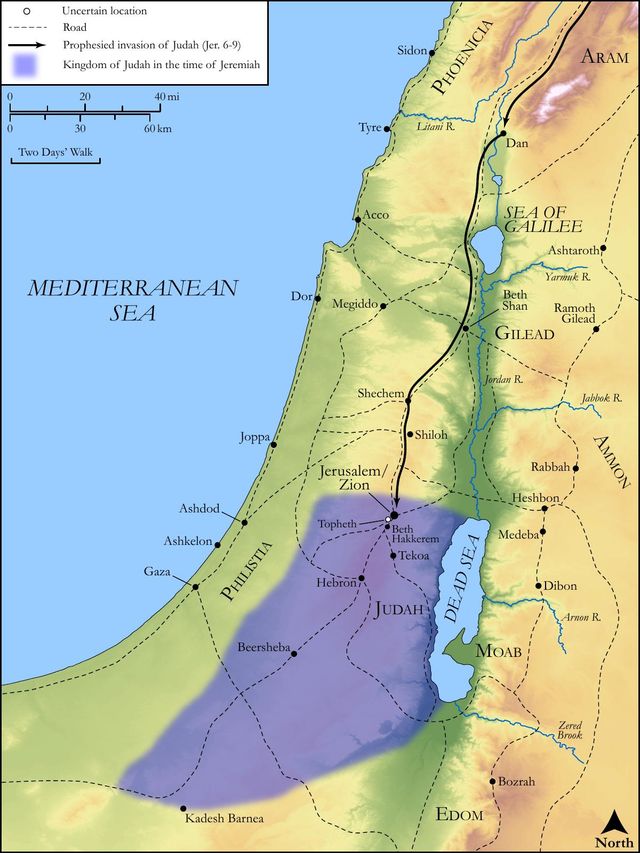
See on the biblical-era map
Study this verse
Public-domain commentary
Matthew Henry
From his Commentary on the Whole Bible. Henry comments on passages, not single verses — this entry covers Jeremiah 7:29–34. His three-level outline is real structure in the source text, so it is rendered as structure.
Here is, I. A loud call to weeping and mourning. Jerusalem, that had been a joyous city, the joy of the whole earth, must now take up a lamentation on high places (Jer 7:29), the high places where they had served their idols; there must they now bemoan their misery. In token both of sorrow and slavery, Jerusalem must now cut off her hair and cast it away; the word is peculiar to the hair of the Nazarites, which was the badge and token of their dedication to God, and it is called their crown. Jerusalem had been a city which was a Nazarite to God, but now must cut off her hair, must be profaned, degraded, and separated from God, as she had been separated to him. It is time for those that have lost their holiness to lay aside their joy.
II.Just cause given for this great lamentation.
1.The sin of Jerusalem appears here very heinous, nowhere worse, or more exceedingly sinful (Jer 7:30): "The children of Judah" (God's profession people, that came forth out of the waters of Judah, Isa 48:1) "have done evil in my sight, under my eye, in my presence; they have affronted me to my face, which very much aggravates the affront:" or, "They have done that which they know to be evil in my sight, and in the highest degree offensive to me." Idolatry was the sin which was above all other sins evil in God's sight. Now here are two things charged upon them in their idolatry, which were very provoking:
(1.)That they were very impudent in it towards God and set him at defiance: They have set their abominations (their abominable idols and the altars erected to them) in the house that is called by my name, in the very courts of the temple, to pollute it (Manasseh did so, Kg2 21:7, Kg2 23:12), as if they thought God would connive at it, or cared not though he was ever so much displeased with it, or as if they would reconcile heaven and hell, God and Baal. The heart is the place which God has chosen to put his name there; if sin have the innermost and uppermost place there, we pollute the temple of the Lord, and therefore he resents nothing more than setting up idols in the heart, Eze 14:4.
(2.)That they were very barbarous in it towards their own children, Jer 7:31. They have particularly built the high places of Tophet, where the image of Moloch was set up, in the valley of the son of Hinnom, adjoining to Jerusalem; and there they burnt their sons and their daughters in the fire, burnt them alive, killed them, and killed them in the most cruel manner imaginable, to honour or appease those idols that were devils and not gods. This was surely the greatest instance that ever was of the power of Satan in the children of disobedience, and of the degeneracy and corruption of the human nature. One would willingly hope that there were not many instances of such a barbarous idolatry; but it is amazing that there should be any, that men could be so perfectly void of natural affection as to do a thing so inhuman as to burn little innocent children, and their own too, that they should be so perfectly void of natural religion as to think it lawful to do this, nay, to think it acceptable. Surely it was in a way of righteous judgment, because they had changed the glory of God into the similitude of a beast, that God gave them up to such vile affections that changed them into worse than beasts. God says of this that it was what he commanded them not, neither cam it into his heart, which is not meant of his not commanding them thus to worship Moloch (this he had expressly forbidden them), but he had never commanded that his worshippers should be at such an expense, nor put such a force upon their natural affection, in honouring him; it never came into his heart to have children offered to him, yet they had forsaken his service for the service of such gods as, by commanding this, showed themselves to be indeed enemies to mankind.
2.The destruction of Jerusalem appears here very terrible. That speaks misery enough in general (Jer 7:29), The Lord hath rejected and forsaken the generation of his wrath. Sin makes those the generation of God's wrath that had ben the generation of his love. And God will reject and quite forsake those who have thus made themselves vessels of wrath fitted to destruction. He will disown them for his. "Verily, I say unto you, I know you not." And he will give them up to the terrors of their own guilt, and leave them in those hands.
(1.)Death shall triumph over them, Jer 7:32. 33. Sin reigns unto death; for that is the wages of it, the end of those things. Tophet, the valley adjoining to Jerusalem, shall be called the valley of slaughter, for there multitudes shall be slain, when, in their sallies out of the city and their attempts to escape, they fall into the hands of the besiegers. Or it shall be called the valley of slaughtered ones, because thither the corpses of those that are slain shall be brought to be buried, all other burying places being full; and there they shall bury until there be no more place to make a grave. This intimates the multitude of those that shall die by the sword, pestilence, and famine. Death shall ride on prosperously, with dreadful pomp and power, conquering and to conquer. The slain of the Lord shall be many. This valley of Tophet was a place where the citizens of Jerusalem walked to take the air; but it shall now be spoiled for that use, for it shall be so full of graves that there shall be no walking there, because of the danger of contracting a ceremonial pollution by the touch of a grave. There it was that they sacrificed some of their children, and dedicated others to Moloch, and there they should fall as victims to divine justice. Tophet had formerly been the burying place, or burning place, of the dead bodies of the besiegers, when the Assyrian army was routed by an angel; and for this it was ordained of old, Isa 30:33. But they having forgotten this mercy, and made it the place of their sin, God will now turn it into a burying place for the besieged. In allusion to this valley, hell is in the New Testament called Gehenna - the valley of Hinnom, for there were buried both the invading Assyrians and the revolting Jews; so hell is a receptacle after death both for infidels and hypocrites, the open enemies of God's church and its treacherous friends; it is the congregation of the dead; it is prepared for the generation of God's wrath. But so great shall that slaughter be that even the spacious valley of Tophet shall not be able to contain the slain; and at length there shall not be enough left alive to bury the dead, so that the carcases of the people shall be meat for the birds and beasts of prey, that shall feed upon them like carrion, and none shall have the concern or courage to frighten them away, as Rizpah did from the dead bodies of Saul's sons, 2 Sa. 28:26, Thy carcase shall be meat to the fowls and beasts, and no man shall drive them away. Thus do the law and the prophets agree, and the execution with both. The decent burying of the dead is a piece of humanity, in remembrance of what the dead body has been - the tabernacle of a reasonable soul. Nay, it is a piece of divinity, in expectation of what the dead body shall be at the resurrection. The want of it has sometimes been an instance of the rage of men against God's witnesses, Rev 11:9. Here it is threatened as an instance of the wrath of God against his enemies, and is an intimation that evil pursues sinners even after death.
(2.)Joy shall depart from them (Jer 7:34): Then will I cause to cease the voice of mirth. God had called by his prophets, and by less judgments, to weeping and mourning; but they walked contrary to him, and would hear of nothing but joy and gladness, Isa 22:12, Isa 22:13. And what came of it? Now God called to lamentation (Jer 7:29), and he made his call effectual, leaving them neither cause nor heart for joy and gladness. Those that will not weep shall weep; those that will not by the grace of God be cured of their vain mirth shall by the justice of God be deprived of all mirth; for when God judges he will overcome. It is threatened here that there shall be nothing to rejoice in. There shall be none of the joy of weddings; no mirth, for there shall be no marriages. The comforts of life shall be abandoned, and all care to keep up mankind upon earth cast off; there shall be none of the voice of the bridegroom and the bride, no music, no nuptial songs. Nor shall there be any more of the joy of the harvest, for the land shall be desolate, uncultivated and unimproved. Both the cities of Judah and the streets of Jerusalem shall look thus melancholy; and when they thus look about them, and see no cause to rejoice, no marvel if they retire into themselves and find no heart to rejoice. Note, God can soon mar the mirth of the most jovial, and make it to cease, which is a reason why we should always rejoice with trembling, be merry and wise.
Historical interpretation
Two Centuries of Reception
2 surviving comments on this verse. Each one is dated, so this reads as a timeline rather than a list.
Select a marker to jump to its quote. Markers stagger vertically where authors wrote within a few decades of each other.
Last of all he sent to those unbelievers his own Son, our Lord Jesus Christ, whom the wicked husbandmen cast out of the vineyard when they had killed him. For this reason, the Lord God gave it up (no longer hedged around but thrown open throughout all the world) to other tenants, who render the fruits in their seasons—the beautiful elect tower being also raised everywhere. For the illustrious church is now everywhere, and everywhere is the winepress dug. Those who do receive the Spirit are everywhere. Because the former tenants have rejected the Son of God and cast him out of the vineyard when they killed him, God has justly rejected them and given to the Gentiles outside the vineyard the fruits of its cultivation. This is in accordance with what Jeremiah says: “The Lord has rejected and cast off the nation that does these things. The children of Judah have done evil in my sight, says the Lord.”
(Verse 30, 31.) Because the sons of Judah have done evil in my sight, says the Lord: they have set up their stumbling blocks in the house where my name is invoked, to defile it. And they have built the high places (or altar) of Topheth, which is in the Valley of the Son of Hinnom, to burn their sons and their daughters in fire: which I did not command, nor did it come into my mind. We learn in the beginning of Ezekiel that the sons of Judah put a statue of Baal in the Temple of God. However, the high places, which are called Bamoth in Hebrew, or the altar of Topheth, which is in the Valley of the Sons of Hinnom, signify that place which is watered by the springs of Siloam; and it is pleasant and wooded, and even today offers delights of gardens. However, the error of paganism occupied all the provinces, so that they would sacrifice victims on the tops of mountains and in the most beautiful groves, and all the superstitions of corrupt religion would be observed. Topheth, in the Hebrew language, is interpreted as "width"; and it is reported in the book of Joshua the son of Nun concerning this place, which is in the Valley of the Sons of Hinnom, and in Hebrew it is called Gehenna (γέεννα), for it signifies a gorge, that is, a valley; and Hinnom either signifies a man's name or "favor". And the Hebrews report that this place is called Gehenna, because all the people of the Jews will perish there, offending God. In this place they also consecrated their sons with fire to the idols, or offered them as a burnt offering, which God did not command them, nor did the Law prescribe any such thing. If Jephthah offered his virgin daughter to God, it is not the sacrifice that pleases, but the intention of the offerer. And if a dog, or a donkey, or any unclean animal had come first to meet the father returning from the slaughter of the enemies, he should not have offered it to God.
Continue studying Jeremiah 7:31 across the web’s major study libraries — every link below opens this exact verse, chapter, or book on the destination site.
Read & Compare
 BibleGatewayThis verse in more than 200 translations and 70 languages.
 Bible.comThe YouVersion reader — hundreds of translations, reading plans, and highlights.
 ESV.orgCrossway's official English Standard Version reader.
 NET BibleThe NET translation with 60,000+ translators' notes on every rendering decision.
 STEP BibleTyndale House's free study tool — original text, vocabulary, and scholarly resources.
 BibliaLogos Bible Software's free web reader.
 USCCBThe New American Bible (Revised Edition) with the U.S. bishops' study notes.
Commentaries
 BibleHub CommentariesDozens of classic commentaries on this verse, gathered on one page.
 StudyLightMore than 100 commentary sets — the largest collection on the web.
 BibleRefPlain-English commentary on what this verse means, verse by verse.
 Enduring WordDavid Guzik's free commentary on this chapter, widely used by Bible teachers.
 Bible Study ToolsVerse commentary alongside Greek and Hebrew study aids.
Original Language & Research
- BibleHub InterlinearThe verse word by word — original language, transliteration, and English.
- BibleHub LexiconEvery word's original-language definition and Strong's entry.
 Blue Letter BibleDeep-study tools — Strong's numbers, concordance, and word studies.
 SefariaThe Hebrew text with Rashi and centuries of Jewish commentary.
Sermons, Hymns & Audio


TrulyRandomVerse is not affiliated with these sites and doesn’t control their content. They’re linked because they’re genuinely useful.
Summary
Jeremiah 7:31 serves as a stark indictment of Judah's profound spiritual apostasy, specifically condemning their abhorrent practice of child sacrifice. The verse vividly describes the construction of "high places" in Tophet, situated within the Valley of Hinnom, where sons and daughters were immolated in fire as offerings to pagan deities. This horrific act is met with God's unequivocal and absolute disavowal, powerfully declaring that such a practice was never commanded by Him nor ever conceived in His heart, thereby underscoring the extreme depth of Judah's rebellion against His divine character, His covenant, and the very sanctity of human life.
Context
ShowHideLiterary Context
Jeremiah 7:31 is a climactic and deeply disturbing verse within Jeremiah's "Temple Sermon" (Jeremiah 7:1-15), a powerful prophetic address delivered at the gate of the Jerusalem Temple. Jeremiah confronts the people's misplaced confidence in the Temple's presence as an automatic guarantee of divine protection, despite their pervasive idolatry, moral corruption, and covenant unfaithfulness. The preceding verses detail a litany of transgressions—theft, murder, adultery, false swearing, and the worship of other gods—all practiced even as the people defiantly chant, "The temple of the Lord, the temple of the Lord, the temple of the Lord are these!" This verse, specifically addressing the ultimate abomination of child sacrifice, stands as the most egregious demonstration of their spiritual depravity. It vividly illustrates why God's severe judgment is not only imminent but necessary, culminating in the prophesied destruction of the Temple itself and the exile of the nation, underscoring the profound disconnect between their outward religious observance and their inner spiritual rebellion.
Historical & Cultural Context
The "high places of Tophet" in the "valley of the son of Hinnom" (Hebrew: Ge Hinnom) refer to a specific, notorious site located just southwest of Jerusalem. This valley became infamous as a cultic center for the horrific practice of child sacrifice, primarily to the Ammonite deity Molech, and sometimes to Baal. This was a deliberate and widespread adoption of Canaanite religious customs, which were explicitly and repeatedly forbidden by God's Law, as seen in passages like Leviticus 18:21 and Deuteronomy 18:10. The construction of "high places" (bâmâh) indicates a formalized, institutionalized pagan worship, suggesting that this was not an isolated incident but a deeply entrenched and publicly sanctioned practice. Kings like Ahaz (2 Kings 16:3) and Manasseh (2 Kings 21:6) had previously engaged in and promoted such practices, deeply corrupting Judah's religious and moral life. This act was the ultimate defiance of God's covenant and a profound moral depravity, contrasting sharply with the sanctity of human life commanded by Yahweh.
Key Themes
ShowHideJeremiah 7:31 powerfully articulates several key themes pervasive in the book of Jeremiah and the broader prophetic tradition. Firstly, it highlights the Extreme Idolatry and Abomination of Judah's spiritual apostasy. Child sacrifice was not merely another form of idolatry but an act so heinous that it represented the ultimate betrayal of God and humanity, an act utterly contrary to God's character and commands. Secondly, the verse emphasizes Divine Condemnation and Disavowal. God's emphatic statement, "which I commanded [them] not, neither came it into my heart," underscores His absolute abhorrence of this practice. This phrase distinguishes Him sharply from the cruel pagan deities who supposedly demanded such sacrifices, testifying to His nature as a loving and righteous God who values life. Thirdly, it reveals the depth of Judah's Profound Disobedience and covenant infidelity. Their actions were a direct affront to God's sovereignty and holiness, demonstrating a radical departure from the covenant God made with Israel, particularly the specific prohibitions against child sacrifice found throughout the Law. This profound rebellion ultimately necessitated the severe judgment God would bring upon them, as seen in the broader narrative of Jeremiah's prophecies.
Exposition and Analysis
ShowHideKey Word Analysis
ShowHideFrom an unused root meaning "to be high," this term refers to an elevation or height. In the Old Testament, "high places" were elevated sites, natural or artificial, often used for worship. While some were initially used for legitimate Yahwistic worship, they predominantly became associated with illicit, syncretistic, or purely pagan cults, as seen here. Their construction for child sacrifice underscores the depth of Judah's apostasy, transforming sites meant for reverence into arenas of abomination.
This specific place name refers to a cultic site located within the Valley of the Son of Hinnom (Gehenna). Its etymology is debated, possibly related to a root meaning "to spit" (implying abhorrence) or referring to a drum (perhaps used to drown out the cries of children). Regardless, Tophet became synonymous with the horrific practice of child sacrifice, making it a place of extreme defilement and a symbol of divine judgment due to the abominable rituals performed there.
This word, often used figuratively, encompasses the feelings, will, intellect, and the very core or center of a being. When God declares that child sacrifice "neither came it into my heart," He is not merely stating a lack of command but expressing the absolute foreignness of such an act to His entire being, His character, His will, and His deepest affections. It conveys profound revulsion and an intrinsic opposition to such depravity, emphasizing that this act was utterly antithetical to His divine nature.
Verse Breakdown
ShowHide"And they have built the high places of Tophet"
This clause highlights the deliberate and organized nature of the people's idolatry. It wasn't a spontaneous act but a planned construction of dedicated sites for pagan worship, signifying a deep-seated commitment to practices explicitly forbidden by God. This indicates a societal embrace of the abominable.
"which [is] in the valley of the son of Hinnom"
This specifies the infamous geographical location of these abominable acts. The Valley of Hinnom, just outside Jerusalem, became a place of notoriety due to the child sacrifices performed there, later evolving into the New Testament concept of Gehenna, a symbol of eternal judgment and utter destruction.
"to burn their sons and their daughters in the fire"
This describes the horrific act itself—child sacrifice. The phrase "burn...in the fire" indicates immolation, a ritualistic offering of innocent human life to pagan deities. This was the ultimate violation of God's command to value life and a profound betrayal of the covenant relationship, turning the most precious gift (children) into an offering for false gods.
"which I commanded [them] not"
This is God's direct and authoritative disavowal. It asserts that this practice was not merely unapproved but explicitly contrary to His divine will and the Mosaic Law, which strictly prohibited such acts. It refutes any notion that these sacrifices could be considered legitimate worship of Yahweh, emphasizing their direct disobedience.
"neither came it into my heart"
This powerful declaration goes beyond simple prohibition. It expresses God's absolute abhorrence and profound disgust. It signifies that such a concept was utterly foreign to His nature, His character, and His divine plan. It was never a thought, never a desire, never a possibility within the heart of the righteous and loving God of Israel, distinguishing Him sharply from the cruel deities of the surrounding nations. This phrase reveals the depth of God's moral perfection and His intrinsic opposition to such depravity.
Literary Devices
ShowHideJeremiah 7:31 employs several potent literary devices to convey its message. There is profound Irony in the people building "high places" (implying closeness to deity) for an act that deeply offends the one true God, demonstrating their spiritual blindness and perversion of true worship. God's emphatic statement, "neither came it into my heart," serves as a powerful form of Hyperbole and Emphasis, conveying an absolute and intrinsic revulsion that goes far beyond a simple prohibition. This phrase also creates a stark Contrast between the people's heinous actions (burning their children) and God's character as a loving and life-affirming deity who values human life above all. Furthermore, the "valley of the son of Hinnom" (Gehenna) functions as potent Symbolism, evolving from a physical location of depravity and judgment into a metaphorical representation of ultimate spiritual destruction and eternal condemnation in later biblical and theological discourse.
Theological and Thematic Connections
ShowHideJeremiah 7:31 stands as a stark testament to the depths of human depravity when alienated from God, and simultaneously, to the absolute holiness and moral purity of God. Theologically, it underscores the sanctity of human life, particularly innocent life, as a core value of the Creator, directly opposing any practice that devalues or destroys it. It highlights the nature of true worship, which is characterized by obedience, love, and reverence for God's commands, rather than syncretistic rituals borrowed from paganism. The verse also reveals God's righteous indignation against sin, particularly against such heinous acts of idolatry and cruelty. His declaration that child sacrifice "neither came it into my heart" is a profound theological statement about His character: He is not a god who demands human sacrifice, but one who gives life and requires justice and mercy. This sets Him apart from the cruel deities of the surrounding nations, affirming His unique moral perfection and His unwavering commitment to His covenant people, even in their rebellion. The passage thus serves as a powerful reminder of God's unchanging nature and His unwavering demand for exclusive worship and moral purity.
Reflection and Application
ShowHideWhile literal child sacrifice is (thankfully) rare in most contemporary societies, the principles embedded in Jeremiah 7:31 remain profoundly relevant for personal and communal reflection. This verse serves as a stark warning against any form of idolatry that demands the sacrifice of what is most precious—whether it be our children, our integrity, our time, our moral compass, or our spiritual well-being—on the altar of worldly ambition, wealth, pleasure, or self-interest. It challenges us to examine what "high places" we might be building in our own lives, prioritizing anything over the one true God and His values. Furthermore, it calls us to a renewed commitment to the sanctity of human life, particularly the vulnerable and innocent, in all its forms. Any societal or personal action that devalues life, from conception to natural death, stands in opposition to the heart of God revealed in this passage. Finally, the verse warns against spiritual compromise and syncretism, urging us to guard against diluting our faith with worldly values that contradict God's commands. God demands wholehearted devotion, not partial obedience or a mixing of truth with error. We are called to ensure that our actions align with God's commands, not with the corrupting influences of the world, and to cultivate a heart that truly reflects His, actively rejecting anything that is "not in His heart."
Questions for Reflection
ShowHideFAQ
ShowHideWhat was the significance of "Tophet" and the "Valley of Hinnom"?
ShowHideTophet was a specific cultic site within the Valley of Hinnom (Hebrew: Ge Hinnom), a valley situated just southwest of Jerusalem. It became infamous as the primary location where the people of Judah engaged in the horrific practice of child sacrifice to pagan deities like Molech and Baal. This made the valley a place of extreme defilement and abomination in the eyes of God. Later, in the New Testament, the name Ge Hinnom was transliterated into Greek as Gehenna, which became a symbolic term for hell or eternal judgment, largely due to the abominable practices that occurred there, as well as its later use as a refuse dump where fires burned continuously outside Jerusalem. Thus, the Valley of Hinnom and Tophet became powerful symbols of divine condemnation and the ultimate consequence of profound sin, serving as a vivid backdrop for Jesus' warnings about judgment in passages like Matthew 10:28.
Why did God say "neither came it into my heart" if He had already commanded against child sacrifice?
ShowHideGod's statement "neither came it into my heart" is a profound and emphatic declaration that goes far beyond a simple prohibition. While the Mosaic Law already contained explicit commands against child sacrifice (e.g., Leviticus 18:21), this phrase emphasizes God's absolute abhorrence and utter disavowal of such an act. It signifies that this practice was not just forbidden, but intrinsically alien to His character, His nature, and His divine will. It was never conceived, desired, or even remotely considered by Him. This statement distinguishes the God of Israel sharply from the cruel pagan deities who supposedly demanded such atrocities, highlighting His moral perfection, His love for life, and the depth of the people's depravity in engaging in something so antithetical to His very being. It underscores that their actions were not merely disobedient but a radical perversion of true worship, a concept utterly foreign to the heart of the living God.
Christ-Centered Fulfillment
ShowHideJeremiah 7:31, with its grim depiction of child sacrifice and God's absolute disavowal, finds its ultimate fulfillment and profound contrast in the person and work of Jesus Christ. The verse highlights humanity's capacity for profound depravity and the just judgment it incurs, yet in Christ, we see God's perfect solution. While the people sacrificed their children to false gods, God, in His boundless love, sacrificed His only Son, Jesus, not to appease a cruel deity, but to atone for the sins of humanity, including the very sin of idolatry and rebellion exemplified in Jeremiah 7:31. The ultimate sacrifice of the Lamb of God, who takes away the sin of the world, fully satisfies divine justice and ends the need for any human offering. Jesus Himself often referred to Gehenna (the Valley of Hinnom), the very place of these abominations, as a symbol of eternal judgment (Matthew 5:22; Mark 9:43), validating the seriousness of sin while simultaneously offering a path to salvation from it through His redemptive work. Furthermore, Jesus' teachings consistently upheld the sanctity and value of children, welcoming them and affirming their place in the Kingdom of God (Matthew 19:14), a stark contrast to the horrific practices condemned in Jeremiah. Through Christ, the new covenant offers not merely a prohibition against such acts, but a transformed heart (Ezekiel 36:26) that desires to worship God in spirit and truth (John 4:24), fully aligning with His pure and loving heart, which never conceived of such atrocities.