


2 Kings 16:3
- וַיֵּלֶךְvai·Ye·lekhand he walkedH1980Conj-w ¦ V-Qal-ConsecImperf-3msVerb Qal Consecutive Imperfect 3rd Singular Masculineוַandיֵּלֶךְhe walked
- בְּדֶרֶךְbe·De·rekhin [the] way ofH1870Prep-b ¦ N-cscNoun Singular common gender Constructבְּinדֶרֶךְ[the] way of
- מַלְכֵיmal·Khei[the] kings ofH4428N-mpcNoun Plural Masculine Construct
- יִשְׂרָאֵלYis·ra·'ElIsraelH3478N-properNoun Proper Location
- וְגַםve·Gamand alsoH1571Conj-w ¦ AdvAdverbוְandגַםalso
- אֶת'et<obj.>H853DirObjMParticle Object Indicator
- בְּנוֹbe·Nohis sonH1121N-msc ¦ 3msNoun Singular Masculine Constructבְּנsonוֹhis
- הֶעֱבִירhe·'e·Virhe made passH5674V-Hiphil-Perf-3msVerb Hiphil Perfect 3rd Singular Masculine
- בָּאֵשׁba·'Eshin the fireH784Prep-b ¦ N-csNoun Singular common gender Absoluteבָּin theאֵשׁfire
- כְּתֹעֲבוֹתke·to·'a·Votaccording to [the] abominations ofH8441Prep-k ¦ N-fpcNoun Plural Feminine Constructכְּaccording toתֹעֲבוֹת[the] abominations of
- הַגּוֹיִםha·go·Yimthe nationsH1471Art ¦ N-mpNoun Plural Masculine Absoluteהַtheגּוֹיִםnations
- אֲשֶׁר'a·SherwhichH834RelParticle Relative
- הוֹרִישׁho·Rishhe had dispossessedH3423V-Hiphil-Perf-3msVerb Hiphil Perfect 3rd Singular Masculine
- יְהוָהYah·wehYahwehH3068N-properNoun Proper Title
- אֹתָם'o·Tam<obj.> themH853DirObjM ¦ 3mpParticle Object Indicatorאֹתָ<obj.>םthem
- מִפְּנֵיmi·pe·Neifrom beforeH6440Prep-m ¦ N-mpcNoun Plural Masculine Constructמִfromפְּנֵיbefore
- בְּנֵיbe·Nei[the] people ofH1121N-mpcNoun Plural Masculine Construct
- יִשְׂרָאֵלYis·ra·'ElIsraelH3478N-properNoun Proper Location
English is a literal word-by-word gloss of the Hebrew, not the KJV's wording. Why?
This is the original text the KJV's translators worked from — each Hebrew word with its own literal English meaning in this verse, prepared by scholars at Tyndale House, Cambridge. The KJV translates whole sentences, not word by word, so its wording differs: one Hebrew word can become several English words, and the KJV may choose “the LORD” where the gloss reads “Yahweh”. Both are faithful — they answer different questions. For the KJV's own rendering, switch to the KJV text.
Details
See on the biblical-era maps
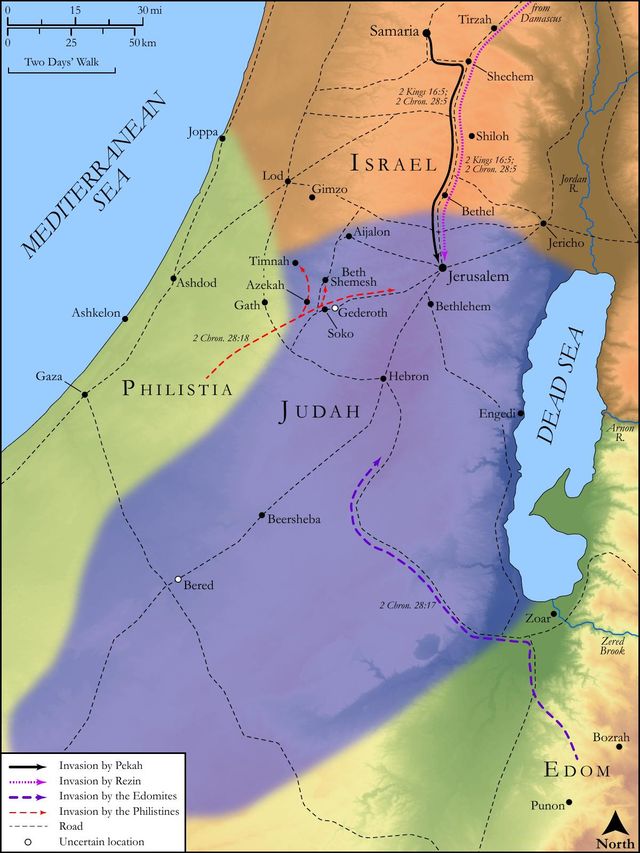
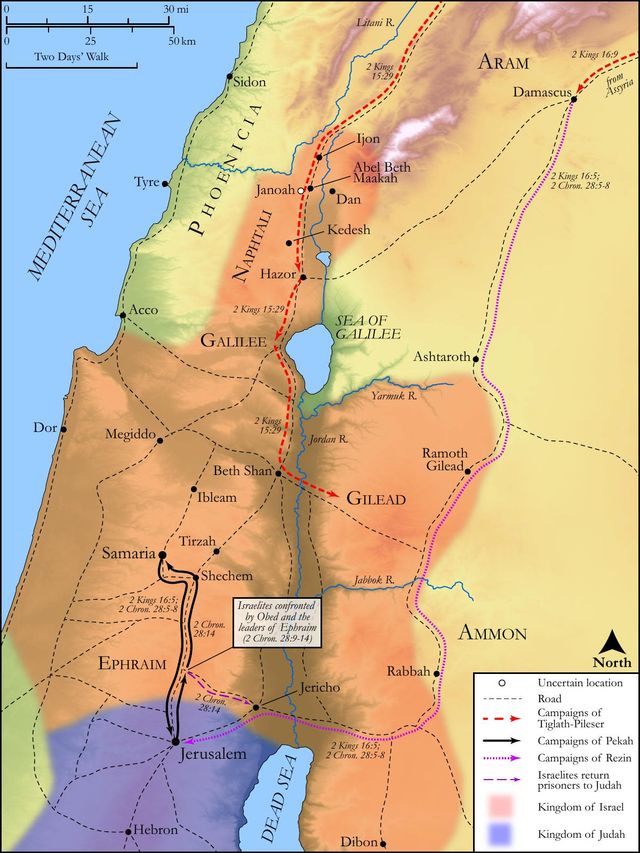
Study this verse
Public-domain commentary
Matthew Henry
From his Commentary on the Whole Bible. Henry comments on passages, not single verses — this entry covers 2 Kings 16:1–4.
We have here a general character of the reign of Ahaz. Few and evil were his days - few, for he died at thirty-six - evil, for we are here told, 1. That he did not that which was right like David (Kg2 16:2), that is, he had none of that concern and affection for the instituted service and worship of God for which David was celebrated. He had no love for the temple, made no conscience of his duty to God, nor had any regard to his law. Herein he was unlike David; it was his honour that he was of the house and lineage of David, and it was owing to God's ancient covenant with David that he was now upon the throne, which aggravated his wickedness; for he was a reproach to that honourable name and family, which therefore was really a reproach to him (Degeneranti genus opprobrium - A good extraction is a disgrace to him who degenerates from it), and though he enjoyed the benefit of David's piety he did not tread in the steps of it. 2. That he walked in the way of the kings of Israel (Kg2 16:3), who all worshipped the calves. He was not joined in any affinity with them, as Jehoram and Ahaziah were with the house of Ahab, but, ex mero motu - without any instigation, walked in their way. The kings of Israel pleaded policy and reasons of state for their idolatry, but Ahaz had no such pretence: in him it was the most unreasonable impolitic thing that could be. They were his enemies, and had proved enemies to themselves too by their idolatry; yet he walked in their way. 3. That he made his sons to pass through the fire, to the honour of his dunghill-deities. He burnt them, so it is expressly said of him (Ch2 28:3), burnt some of them, and perhaps made others of them (Hezekiah himself not excepted, though afterwards he was never the worse for it) to pass between two fires, or to be drawn through a flame, in token of their dedication to the idol. 4. That he did according to the abominations of the heathen whom the Lord had cast out. it was an instance of his great folly that he would be guided in his religion by those whom he saw fallen into the ditch before his eyes, and follow them; and it was an instance of his great impiety that he would conform to those usages which God had declared to be abominable to him, and set himself to write after the copy of those whom God had cast out, thus walking directly contrary to God. 5. That he sacrificed in the high places, Kg2 16:4. If his father had but had zeal enough to take them away, the debauching of his sons might have been prevented; but those that connive at sin know not what dangerous snares they lay for those that come after them. He forsook God's house, was weary of that place where, in his father's time, he had often been detained before the Lord, and performed his devotions on high hills, where he had a better prospect, and under green trees, where he had a more pleasant shade. It was a religion little worth, which was guided by fancy, not by faith.
Historical interpretation
Historical reception
1 surviving comment on this verse from the historical church.
Do you see that demons dwell in their souls and that these demons are more dangerous than the ones of old? And this is very reasonable. In the old days the Jews acted impiously toward the prophets; now they outrage the Master of the prophets. Tell me this. Do you not shudder to come into the same place with people possessed, who have so many unclean spirits, who have been reared amid slaughter and bloodshed? Must you share a greeting with them and exchange a bare word? Must you not turn away from them since they are the common disgrace and infection of the whole world? Have they not come to every form of wickedness? Have not all the prophets spent themselves making many and long speeches of accusation against them? What tragedy, what manner of lawlessness have they not eclipsed by their blood guilt? They sacrificed their own sons and daughters to demons. They refused to recognize nature, they forgot the pangs of birth, they trod underfoot the rearing of their children, they overturned from their foundations the laws of kinship, they became more savage than any wild beast.
Continue studying 2 Kings 16:3 across the web’s major study libraries — every link below opens this exact verse, chapter, or book on the destination site.
Read & Compare
 BibleGatewayThis verse in more than 200 translations and 70 languages.
 Bible.comThe YouVersion reader — hundreds of translations, reading plans, and highlights.
 ESV.orgCrossway's official English Standard Version reader.
 NET BibleThe NET translation with 60,000+ translators' notes on every rendering decision.
 STEP BibleTyndale House's free study tool — original text, vocabulary, and scholarly resources.
 BibliaLogos Bible Software's free web reader.
 USCCBThe New American Bible (Revised Edition) with the U.S. bishops' study notes.
Commentaries
 BibleHub CommentariesDozens of classic commentaries on this verse, gathered on one page.
 StudyLightMore than 100 commentary sets — the largest collection on the web.
 BibleRefPlain-English commentary on what this verse means, verse by verse.
 Enduring WordDavid Guzik's free commentary on this chapter, widely used by Bible teachers.
 Bible Study ToolsVerse commentary alongside Greek and Hebrew study aids.
Original Language & Research
- BibleHub InterlinearThe verse word by word — original language, transliteration, and English.
- BibleHub LexiconEvery word's original-language definition and Strong's entry.
 Blue Letter BibleDeep-study tools — Strong's numbers, concordance, and word studies.
 SefariaThe Hebrew text with Rashi and centuries of Jewish commentary.
Sermons, Hymns & Audio


TrulyRandomVerse is not affiliated with these sites and doesn’t control their content. They’re linked because they’re genuinely useful.
Summary
King Ahaz of Judah is presented as a monarch who deliberately and profoundly rejected the covenant with the LORD. This verse specifically condemns his adoption of the idolatrous practices characteristic of the northern kingdom of Israel and, most appallingly, his participation in child sacrifice, a detestable ritual of the pagan nations whom God had previously dispossessed from the land. It serves as a stark indictment of Ahaz's extreme apostasy and foreshadows the severe consequences of Judah's unfaithfulness, highlighting the depth of his moral and spiritual depravity.
Context
ShowHideLiterary Context
This verse is strategically placed within the book of 2 Kings, which meticulously chronicles the reigns of the kings of both Israel and Judah, consistently evaluating their leadership based on their fidelity to the Mosaic covenant. 2 Kings 16:1-2 immediately precedes this verse, introducing Ahaz's reign and establishing his wickedness by noting his failure to do "what was right in the sight of the LORD his God, like David his father." Verse 3 then provides the shocking details of his egregious sin, particularly the horrific act of child sacrifice, which is further elaborated upon in 2 Kings 16:4. This account of Ahaz's profound depravity serves as a stark contrast to the subsequent righteous reign of his son, Hezekiah, detailed in 2 Kings 18, thereby underscoring the cyclical nature of apostasy and reform in Judah's history. The narrative here powerfully emphasizes the theological principle that a king's spiritual orientation directly impacts the well-being and destiny of the entire nation.
Historical & Cultural Context
King Ahaz reigned over Judah from approximately 735 to 715 BC, a period marked by significant geopolitical instability among the nations. During his tenure, Judah faced immense pressure from the Syro-Ephraimite coalition (Syria and the northern kingdom of Israel), which prompted Ahaz to seek a controversial alliance with the powerful Assyrian Empire, a decision strongly condemned by the prophet Isaiah (Isaiah 7). Culturally, the phrase "the way of the kings of Israel" directly refers to the entrenched idolatry prevalent in the northern kingdom since its inception, particularly the worship of Baal and Asherah, alongside the golden calves established by Jeroboam I at Bethel and Dan (1 Kings 12:28-30). The most abhorrent act, "made his son to pass through the fire," is an unmistakable reference to child sacrifice, primarily associated with the Ammonite deity Molech. This detestable practice involved burning children as offerings, often conducted in the Valley of Hinnom (Gehenna) outside Jerusalem, a place that later became a symbol of divine judgment (Jeremiah 7:31). Such rituals were explicitly and repeatedly forbidden by the Mosaic Law and were characteristic of the Canaanite nations whom the LORD had driven out precisely because of these "abominations" (Deuteronomy 18:9-12).
Key Themes
ShowHide2 Kings 16:3 powerfully articulates several critical theological and narrative themes. First, it highlights Profound Apostasy, showcasing Ahaz's deliberate and radical departure from the covenant God of Israel. Unlike some kings who merely tolerated pagan practices, Ahaz actively embraced and participated in them, even introducing them into the very heart of Judah's religious life. Second, the verse underscores the Horror of Child Sacrifice, revealing the ultimate depths of human depravity and the profound wickedness of a practice that violated the sanctity of human life, the covenant, and God's very character as the Giver of life (Leviticus 18:21). Third, it illustrates the Consequences of Imitation, as Ahaz mimicked the "abominations of the heathen"—the very sins that led to the displacement of the Canaanites. This act powerfully foreshadows Judah's own eventual judgment and exile, demonstrating that God's standards for His covenant people were no less stringent than for the nations He dispossessed (Deuteronomy 12:29-31). Finally, the verse implicitly conveys Divine Displeasure and the breaking of the covenant relationship, as such practices were an ultimate affront to God's holiness and an act of spiritual adultery.
Exposition and Analysis
ShowHideKey Word Analysis
ShowHideThis term signifies a road (as trodden), but figuratively, it refers to a course of life or a mode of action. In this context, "the way of the kings of Israel" denotes not merely a physical path but a comprehensive pattern of behavior, a spiritual and ethical trajectory. Ahaz's "walking in this way" indicates his adoption of the idolatrous and unrighteous practices characteristic of the northern kingdom's rulers, signifying a deliberate moral and spiritual alignment with their apostasy.
This primitive root means "to cross over" and is used widely for any transition. In the phrase "made his son to pass through the fire," it is a euphemism for child sacrifice, specifically the ritual burning of children as offerings to pagan deities like Molech. While the verb itself implies movement, in this specific context, combined with "fire," it denotes the horrific act of causing a child to undergo fiery immolation, resulting in death, as a religious offering.
This feminine active participle describes something morally disgusting or an abhorrence. It is a strong term used throughout the Old Testament to denote practices, objects, or behaviors that are utterly detestable and deeply offensive to God, particularly in a religious or ethical sense. Here, it refers to the pagan rituals of the Canaanites, including child sacrifice, divination, and cultic prostitution, which God explicitly condemned and for which He dispossessed the previous inhabitants of the land.
Verse Breakdown
ShowHide"But he walked in the way of the kings of Israel,"
This opening clause immediately establishes King Ahaz's profound deviation from the righteous path expected of a Davidic king. Unlike his ancestor David, who sought to walk in the LORD's ways, Ahaz deliberately adopted the idolatrous and ungodly practices prevalent in the northern kingdom of Israel. This "way" encompassed the worship of foreign deities, the use of forbidden cultic objects, and a general disregard for the exclusive worship of Yahweh, signaling a complete spiritual apostasy.
"yea, and made his son to pass through the fire,"
The conjunction "yea" (or "even") emphasizes the extreme nature of Ahaz's sin, highlighting this act as the pinnacle of his wickedness and moral depravity. "Made his son to pass through the fire" refers to the abhorrent practice of child sacrifice, typically associated with the worship of Molech. This was an act of ultimate spiritual rebellion, a direct violation of God's law, and a horrific sacrifice of the most precious gift—one's own child—to a false god, revealing a heart utterly hardened against the LORD.
"according to the abominations of the heathen,"
This phrase clarifies the source and nature of Ahaz's detestable practices. The "heathen" refers to the surrounding pagan nations, particularly the Canaanites, whose religious practices were characterized by extreme immorality, cruelty, and spiritual perversion. The term "abominations" (Hebrew tôwʻêbah) underscores God's utter detestation of these rituals, which included not only child sacrifice but also various forms of divination, sorcery, and cultic prostitution, all of which were an affront to His holiness.
"whom the LORD cast out from before the children of Israel."
This final clause provides a crucial theological justification for God's judgment and serves as a severe warning for Judah. It explicitly reminds the reader that the very reason God had dispossessed the Canaanites from the land and given it to Israel was because of these detestable practices. By adopting these same "abominations," Ahaz and Judah were effectively inviting the same divine judgment that had befallen the previous inhabitants, foreshadowing their own eventual exile and loss of the promised land.
Literary Devices
ShowHide2 Kings 16:3 masterfully employs several potent literary devices to convey its message of condemnation and warning. The phrase "walked in the way of the kings of Israel" utilizes Metonymy, where "the way" metaphorically stands for the entire system of idolatrous practices, moral corruption, and political policies characteristic of the northern kingdom, thereby signifying Ahaz's complete spiritual and ethical alignment with their apostasy. The inclusion of "yea, and made his son to pass through the fire" functions as a powerful Climax or Hyperbole, intensifying the description of Ahaz's wickedness by highlighting the most egregious and shocking of his sins—child sacrifice—demonstrating the unparalleled depth of his depravity. Furthermore, the verse employs striking Foreshadowing by explicitly linking Ahaz's actions to the "abominations of the heathen, whom the LORD cast out." This connection subtly but powerfully warns the reader that Judah, by imitating these very sins, is setting itself on a path toward the same divine judgment and expulsion from the land that befell the Canaanites. The entire verse, concise yet devastating, functions as a formal Indictment, leaving no doubt about Ahaz's guilt and the severe nature of his actions in the eyes of God.
Theological and Thematic Connections
ShowHide2 Kings 16:3 serves as a profound theological statement on the nature of covenant fidelity, the sanctity of human life, and the dire consequences of apostasy. Ahaz's actions represent a deliberate and public breaking of the covenant God made with Israel, which demanded exclusive worship and abhorred the practices of the surrounding nations. The act of child sacrifice, in particular, was an ultimate affront to God's holiness and His character as the Giver of life, demonstrating the depths of spiritual blindness and moral depravity to which a people can sink when they abandon the one true God. This verse underscores that God's standards for His people are absolute and that syncretism or the adoption of pagan practices leads inevitably to divine judgment, mirroring the fate of those whom Israel was commanded to dispossess.
Reflection and Application
ShowHideThe chilling account of King Ahaz's reign in 2 Kings 16:3 offers timeless and sobering lessons for believers today. While literal child sacrifice is largely absent in contemporary society, the spiritual principles remain profoundly relevant. This verse challenges us to examine the "gods" we might implicitly serve in our modern lives—whether it be the relentless pursuit of wealth, power, comfort, or self-gratification—that subtly demand the sacrifice of our time, integrity, relationships, or even our spiritual well-being. It serves as a stark warning against syncretism, the insidious blending of biblical truth with worldly values, which can subtly erode our devotion to God and lead us down paths of spiritual compromise. We are called to exclusive worship, to love the LORD our God with all our heart, soul, mind, and strength, and to discern and reject any practice or ideology that stands in opposition to His holy character. Furthermore, Ahaz's actions underscore the profound value of human life, particularly the vulnerable, reminding us of our responsibility to protect and advocate for those who cannot defend themselves, reflecting God's own abhorrence of anything that diminishes human dignity and violates His sacred gift of life.
Questions for Reflection
ShowHideFAQ
ShowHideWhat does "made his son to pass through the fire" truly mean, and why was it so offensive to God?
ShowHideThe phrase "made his son to pass through the fire" (Hebrew: הֶעֱבִיר אֶת־בְּנוֹ בָּאֵשׁ, he'evir et-b'no ba'esh) refers to the horrific practice of child sacrifice, primarily associated with the worship of the Ammonite god Molech. While some ancient interpretations suggested a ritual of purification or dedication without death, the strong biblical condemnations and parallels with Canaanite practices confirm it was a literal act of burning children alive as offerings. This practice was profoundly offensive to God for several reasons: it violated the sanctity of human life, which is created in God's image (Genesis 1:27); it was an act of ultimate spiritual adultery, giving one's most precious possession to a false god (Deuteronomy 32:17); and it defiled God's holy name and His covenant with Israel (Leviticus 18:21). God had explicitly forbidden this practice and had driven out the Canaanites from the land precisely because of such "abominations" (Deuteronomy 18:9-12).
Christ-Centered Fulfillment
ShowHideThe dark account of Ahaz's reign and his egregious act of making his son "pass through the fire" in 2 Kings 16:3 powerfully underscores humanity's desperate need for a true and righteous King, one who would not lead His people into apostasy but into perfect communion with God. Ahaz's sin of child sacrifice, offering his own flesh to a false god, stands in stark contrast to the ultimate, perfect sacrifice of God's own Son, Jesus Christ. Unlike Ahaz, who sacrificed his son out of depravity and fear, God the Father, out of boundless love, "gave his only Son, that whoever believes in him should not perish but have eternal life" (John 3:16). Jesus, the Lamb of God, did not "pass through the fire" of Molech, but willingly endured the fiery judgment of God for our sins on the cross, becoming the perfect and final atonement (Hebrews 9:26). He is the true King who perfectly fulfilled the Davidic covenant, never deviating from God's will, and leading His people in righteousness, not idolatry (Luke 1:32-33). Through Christ, the "abominations" of our hearts—our idolatry and rebellion—are cleansed, and we are brought into a pure and exclusive worship of the one true God, no longer sacrificing to false gods but offering ourselves as living sacrifices to Him (Romans 12:1).