


2 Kings 16:4
Bible text: King James Version (1769 Blayney text) · Public domain
Bible text: Berean Standard Bible · Public domain
Bible text: American Standard Version (1901) · Public domain
Bible text: World English Bible, Messianic edition · Public domain
Bible text: Geneva Bible (1599) · Public domain
Bible text: Young's Literal Translation · Public domain
- וַיְזַבֵּחַvay·za·Be·achand he sacrificedH2076Conj-w ¦ V-Piel-ConsecImperf-3msVerb Piel Consecutive Imperfect 3rd Singular Masculineוַandיְזַבֵּחַhe sacrificed
- וַיְקַטֵּרvay·ka·Terand he made smokeH6999Conj-w ¦ V-Piel-ConsecImperf-3msVerb Piel Consecutive Imperfect 3rd Singular Masculineוַandיְקַטֵּרhe made smoke
- בַּבָּמוֹתba·ba·Motat the high placesH1116Prep-b ¦ N-fpNoun Plural Feminine Absoluteבַּat theבָּמוֹתhigh places
- וְעַלve·'aland onH5921Conj-w ¦ PrepPrepositionוְandעַלon
- הַגְּבָעוֹתha·ge·va·'otthe hillsH1389Art ¦ N-fpNoun Plural Feminine Absoluteהַtheגְּבָעוֹתhills
- וְתַחַתve·Ta·chatand underH8478Conj-w ¦ N-mscNoun Singular Masculine Constructוְandתַחַתunder
- כָּלkoleveryH3605N-mscNoun Singular Masculine Construct
- עֵץ'etztreeH6086N-msNoun Singular Masculine Absolute
- רַעֲנָןra·'a·NanluxuriantH7488Adj-msAdjective Singular Masculine Absolute
English is a literal word-by-word gloss of the Hebrew, not the KJV's wording. Why?
This is the original text the KJV's translators worked from — each Hebrew word with its own literal English meaning in this verse, prepared by scholars at Tyndale House, Cambridge. The KJV translates whole sentences, not word by word, so its wording differs: one Hebrew word can become several English words, and the KJV may choose “the LORD” where the gloss reads “Yahweh”. Both are faithful — they answer different questions. For the KJV's own rendering, switch to the KJV text.
Details
See on the biblical-era maps
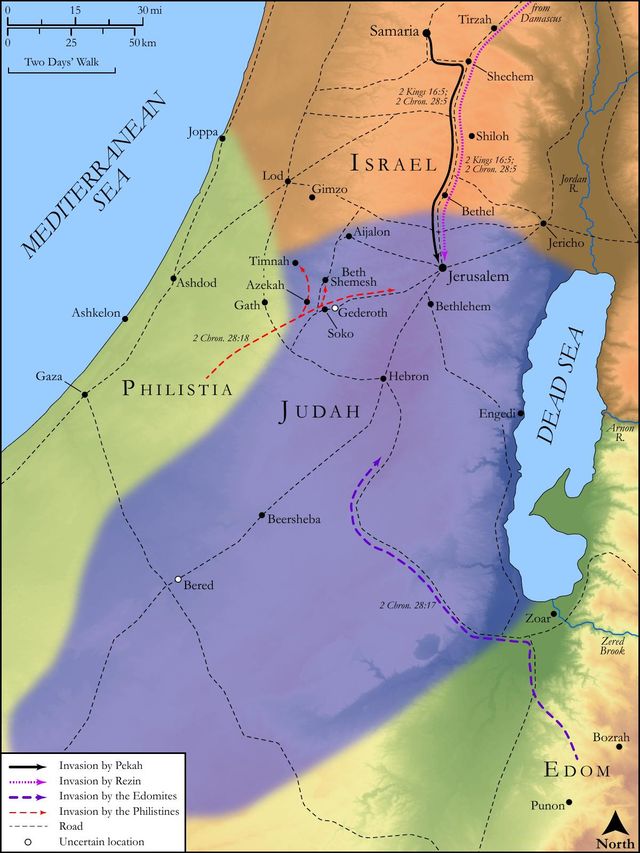
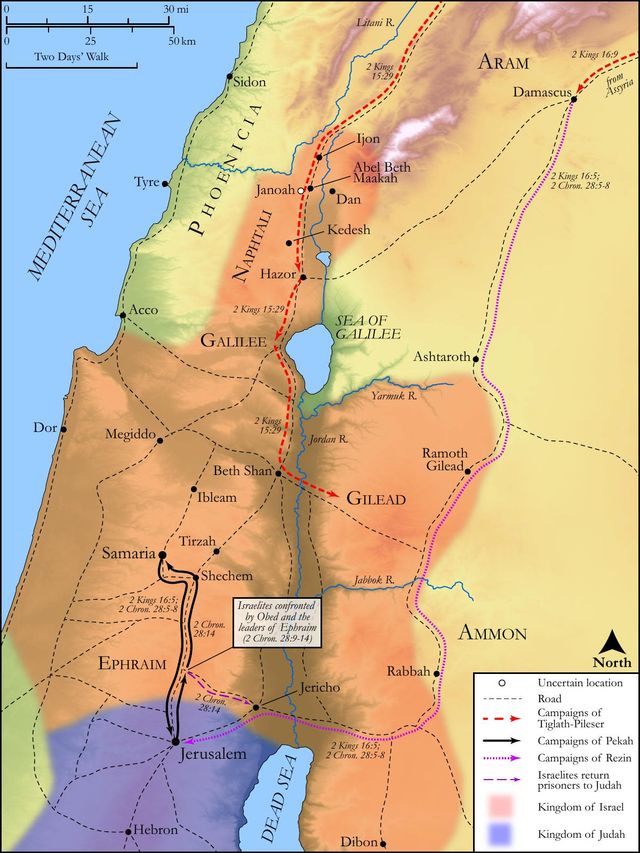
Study this verse
Public-domain commentary
Matthew Henry
From his Commentary on the Whole Bible. Henry comments on passages, not single verses — this entry covers 2 Kings 16:1–4.
We have here a general character of the reign of Ahaz. Few and evil were his days - few, for he died at thirty-six - evil, for we are here told, 1. That he did not that which was right like David (Kg2 16:2), that is, he had none of that concern and affection for the instituted service and worship of God for which David was celebrated. He had no love for the temple, made no conscience of his duty to God, nor had any regard to his law. Herein he was unlike David; it was his honour that he was of the house and lineage of David, and it was owing to God's ancient covenant with David that he was now upon the throne, which aggravated his wickedness; for he was a reproach to that honourable name and family, which therefore was really a reproach to him (Degeneranti genus opprobrium - A good extraction is a disgrace to him who degenerates from it), and though he enjoyed the benefit of David's piety he did not tread in the steps of it. 2. That he walked in the way of the kings of Israel (Kg2 16:3), who all worshipped the calves. He was not joined in any affinity with them, as Jehoram and Ahaziah were with the house of Ahab, but, ex mero motu - without any instigation, walked in their way. The kings of Israel pleaded policy and reasons of state for their idolatry, but Ahaz had no such pretence: in him it was the most unreasonable impolitic thing that could be. They were his enemies, and had proved enemies to themselves too by their idolatry; yet he walked in their way. 3. That he made his sons to pass through the fire, to the honour of his dunghill-deities. He burnt them, so it is expressly said of him (Ch2 28:3), burnt some of them, and perhaps made others of them (Hezekiah himself not excepted, though afterwards he was never the worse for it) to pass between two fires, or to be drawn through a flame, in token of their dedication to the idol. 4. That he did according to the abominations of the heathen whom the Lord had cast out. it was an instance of his great folly that he would be guided in his religion by those whom he saw fallen into the ditch before his eyes, and follow them; and it was an instance of his great impiety that he would conform to those usages which God had declared to be abominable to him, and set himself to write after the copy of those whom God had cast out, thus walking directly contrary to God. 5. That he sacrificed in the high places, Kg2 16:4. If his father had but had zeal enough to take them away, the debauching of his sons might have been prevented; but those that connive at sin know not what dangerous snares they lay for those that come after them. He forsook God's house, was weary of that place where, in his father's time, he had often been detained before the Lord, and performed his devotions on high hills, where he had a better prospect, and under green trees, where he had a more pleasant shade. It was a religion little worth, which was guided by fancy, not by faith.
Historical interpretation
Historical reception
1 surviving comment on this verse from the historical church.
Do you see that demons dwell in their souls and that these demons are more dangerous than the ones of old? And this is very reasonable. In the old days the Jews acted impiously toward the prophets; now they outrage the Master of the prophets. Tell me this. Do you not shudder to come into the same place with people possessed, who have so many unclean spirits, who have been reared amid slaughter and bloodshed? Must you share a greeting with them and exchange a bare word? Must you not turn away from them since they are the common disgrace and infection of the whole world? Have they not come to every form of wickedness? Have not all the prophets spent themselves making many and long speeches of accusation against them? What tragedy, what manner of lawlessness have they not eclipsed by their blood guilt? They sacrificed their own sons and daughters to demons. They refused to recognize nature, they forgot the pangs of birth, they trod underfoot the rearing of their children, they overturned from their foundations the laws of kinship, they became more savage than any wild beast.
Continue studying 2 Kings 16:4 across the web’s major study libraries — every link below opens this exact verse, chapter, or book on the destination site.
Read & Compare
 BibleGatewayThis verse in more than 200 translations and 70 languages.
 Bible.comThe YouVersion reader — hundreds of translations, reading plans, and highlights.
 ESV.orgCrossway's official English Standard Version reader.
 NET BibleThe NET translation with 60,000+ translators' notes on every rendering decision.
 STEP BibleTyndale House's free study tool — original text, vocabulary, and scholarly resources.
 BibliaLogos Bible Software's free web reader.
 USCCBThe New American Bible (Revised Edition) with the U.S. bishops' study notes.
Commentaries
 BibleHub CommentariesDozens of classic commentaries on this verse, gathered on one page.
 StudyLightMore than 100 commentary sets — the largest collection on the web.
 BibleRefPlain-English commentary on what this verse means, verse by verse.
 Enduring WordDavid Guzik's free commentary on this chapter, widely used by Bible teachers.
 Bible Study ToolsVerse commentary alongside Greek and Hebrew study aids.
Original Language & Research
- BibleHub InterlinearThe verse word by word — original language, transliteration, and English.
- BibleHub LexiconEvery word's original-language definition and Strong's entry.
 Blue Letter BibleDeep-study tools — Strong's numbers, concordance, and word studies.
 SefariaThe Hebrew text with Rashi and centuries of Jewish commentary.
Sermons, Hymns & Audio


TrulyRandomVerse is not affiliated with these sites and doesn’t control their content. They’re linked because they’re genuinely useful.
Summary
Second Kings 16:4 vividly depicts the profound apostasy of King Ahaz of Judah, detailing his deliberate engagement in forbidden pagan worship. This verse highlights his rejection of the exclusive covenant worship of Yahweh by sacrificing and burning incense at illicit sites—the high places, hills, and under every green tree—locations explicitly associated with Canaanite fertility cults and condemned by divine law. It serves as a stark illustration of Judah's spiritual decline under a wicked king who mirrored the idolatrous practices of the Northern Kingdom and the detestable customs of the surrounding nations.
Context
ShowHideLiterary Context
This verse is deeply embedded within the narrative of King Ahaz's reign, which begins in 2 Kings 16:1. The preceding verses establish Ahaz's character as one who "did not do what was right in the eyes of the LORD his God, as his father David had done" (2 Kings 16:2). Instead, he walked in the ways of the kings of Israel (the Northern Kingdom, notorious for their idolatry) and even imitated the detestable practices of the nations whom the LORD had driven out before the Israelites, going so far as to sacrifice his own son in the fire (2 Kings 16:3). Verse 4, therefore, serves as a specific enumeration of his widespread and public idolatry, setting the stage for the severe consequences that follow, including the Syro-Ephraimite War and Ahaz's disastrous alliance with Assyria, further illustrating his lack of faith and reliance on foreign powers rather than God.
Historical & Cultural Context
The period of King Ahaz (c. 735–715 BC) was one of intense political and spiritual turmoil for Judah. The "high places" (Hebrew: bamot) were ancient, elevated sites, often natural hills or constructed mounds, which had been used for centuries by Canaanite peoples for worshipping their deities, particularly Baal and Asherah. While some had been co-opted for Yahweh worship, they consistently represented a syncretistic threat and were condemned by the Mosaic Law, which commanded their destruction and centralized worship at a single divinely appointed sanctuary (Deuteronomy 12:2-7). The "hills" and "under every green tree" were common, evocative settings for pagan rituals, especially fertility cults. The "green tree" often symbolized the life-giving power attributed to these false gods, and illicit altars were frequently erected beneath them, reflecting a widespread cultural practice that Israel was explicitly forbidden to adopt (Jeremiah 2:20). Ahaz's actions were a deliberate embrace of these forbidden practices, signaling a deep cultural and religious assimilation into the pagan norms of the surrounding nations.
Key Themes
ShowHideThis verse powerfully contributes to several overarching themes within 2 Kings and the broader Deuteronomistic History. Firstly, it underscores the theme of Idolatry and Apostasy, portraying Ahaz's profound turning away from the one true God and his active participation in forms of worship explicitly forbidden by God's law. Secondly, it highlights Disobedience to God's Covenant, as the covenant at Sinai required exclusive worship of Yahweh and prohibited any other gods or images (Exodus 20:3-5). Ahaz's actions are a direct violation of these foundational commandments. Thirdly, it exemplifies the theme of Spiritual Compromise, demonstrating how a leader's choices can lead an entire nation into blending the worship of God with the detestable practices of surrounding nations, ultimately resulting in national judgment and decline. This narrative serves as a stark warning against syncretism and unfaithfulness.
Exposition and Analysis
ShowHideKey Word Analysis
ShowHideThis verb (H2076) typically refers to the act of slaughtering an animal for an offering, whether to Yahweh or to other gods. In the context of 2 Kings 16:4, its use in conjunction with "high places," "hills," and "green tree" unequivocally indicates illicit, pagan sacrifices offered to false deities, rather than legitimate offerings to the LORD. This term, therefore, highlights the perversion of a sacred act into an act of profound apostasy.
These were cultic sites (H1116), often elevated, where various deities were worshipped. While some bamot (the plural form of bâmâh) were used for Yahweh worship before the centralization of the cult in Jerusalem, they were consistently condemned by the Deuteronomistic authors as centers of syncretism and idolatry, representing a direct challenge to the exclusive worship of Yahweh. Their mention here emphasizes the illicit and widespread nature of Ahaz's pagan practices.
This phrase (H6086 for "tree" and H7488 for "green") literally means "fresh tree" or "flourishing tree." In biblical literature, particularly prophetic texts, "under every green tree" became a common idiom and symbolic motif for pagan worship sites, especially those associated with fertility cults (e.g., Baal and Asherah). The lushness of the tree was often seen as reflecting the life-giving power of the false gods. Its inclusion here underscores the deep entanglement of Ahaz's worship with nature-based paganism.
Verse Breakdown
ShowHide"And he sacrificed and burnt incense"
This clause immediately identifies the core actions of Ahaz's idolatry. "Sacrificed" (זָבַח, zāḇaḥ) refers to the offering of animals, while "burnt incense" (קָטַר, qāṭar) refers to the burning of aromatic substances, both of which were central rituals in ancient worship. The pairing of these actions emphasizes the comprehensive nature of Ahaz's pagan devotion, mimicking the full liturgical practices of the Canaanite cults rather than merely dabbling in them. These acts were reserved for the LORD alone in legitimate Israelite worship.
"in the high places"
This specifies the primary illicit location for Ahaz's worship. As discussed, the "high places" (bāmôt) were a persistent problem in Israelite history, representing a deviation from the centralized, pure worship of Yahweh commanded by the Law. Their mention signifies a widespread and institutionalized form of idolatry that Ahaz actively promoted.
"and on the hills"
This phrase further elaborates on the types of elevated locations used for pagan worship. While "high places" could refer to either natural or man-made cult sites, "hills" (גְּבָעוֹת, gəḇā‘ōṯ) specifically points to natural elevated terrain. This adds to the picture of pervasive idolatry, indicating that Ahaz's practices were not confined to established cultic centers but extended to any natural elevation suitable for pagan rites.
"and under every green tree"
This final phrase completes the description of the ubiquitous nature of Ahaz's idolatry. "Under every green tree" (táḥat kol-‘ēṣ ra‘ănān) is a well-known biblical idiom for pagan worship, particularly fertility cults. The lush, "green" tree symbolized life and fertility, making it a natural setting for rituals aimed at invoking agricultural or human fecundity from false gods. The use of "every" (כָּל, kol) emphasizes the comprehensive and pervasive extent of Ahaz's apostasy, suggesting that idolatry was practiced openly and widely throughout the land under his patronage.
Literary Devices
ShowHideThe verse employs several powerful literary devices to convey the depth of Ahaz's apostasy. Repetition and Parallelism are evident in the listing of the illicit worship locations: "in the high places, and on the hills, and under every green tree." This tripartite structure emphasizes the widespread and pervasive nature of Ahaz's idolatry, suggesting that no corner of the land was free from his pagan influence. The phrase "under every green tree" functions as a potent Symbolism for pagan fertility cults, evoking images of lush, natural settings where detestable rites were performed. This imagery is deeply rooted in prophetic condemnations of idolatry throughout the Old Testament. Furthermore, the verse uses Conciseness to deliver a devastating indictment; in a single sentence, it encapsulates the essence of Ahaz's spiritual rebellion, making his actions clear and unambiguous. The stark contrast between these actions and the expected worship of Yahweh underscores the severity of his sin.
Theological and Thematic Connections
ShowHide2 Kings 16:4 stands as a profound theological statement on the nature of idolatry and its consequences. It illustrates the human propensity to turn away from the true God and embrace false worship, often driven by a desire for perceived power, prosperity, or cultural conformity. Ahaz's actions represent a deliberate rejection of God's covenant, which demanded exclusive allegiance and centralized worship. The theological implication is clear: God demands wholehearted devotion, and any deviation, especially through the adoption of pagan practices, constitutes a grave offense that invites divine judgment. This verse serves as a timeless warning against spiritual syncretism, reminding believers that true worship is not merely about outward rituals but about the purity of the heart and unwavering faithfulness to the one who is truly worthy of all praise.
Reflection and Application
ShowHideThe stark portrayal of King Ahaz's idolatry in 2 Kings 16:4 offers profound lessons for contemporary believers. It challenges us to examine the "high places," "hills," and "green trees" in our own lives—those areas where we might be tempted to offer our devotion, time, or trust to anything other than God. Modern idolatry may not involve physical altars or incense, but it can manifest in subtle forms: the worship of success, material possessions, personal comfort, social media validation, or even self-reliance. This verse calls us to an exclusive and uncompromised devotion to God, urging us to dismantle any spiritual "high places" that compete for His rightful place in our hearts. It reminds us that true worship is not just about avoiding overt sin but about actively aligning our entire lives—our thoughts, desires, actions, and allegiances—with God's revealed will, ensuring that He alone receives our ultimate adoration and trust.
Questions for Reflection
ShowHideFAQ
ShowHideWhy were "high places" so problematic in ancient Israel?
ShowHide"High places" (Hebrew: bamot) were problematic because they represented a direct violation of God's command for centralized worship and exclusive devotion. While some may have initially been used for legitimate worship of Yahweh before the Temple was built, they quickly became centers of syncretism, blending Yahweh worship with the detestable practices of Canaanite fertility cults, such as Baal and Asherah worship. God had explicitly commanded Israel to destroy these sites and worship Him only at the place He would choose (Deuteronomy 12:2-7). By allowing or participating in worship at high places, kings like Ahaz facilitated a compromise that corrupted the purity of Israel's faith and led the people into idolatry, breaking the first two commandments (Exodus 20:3-5).
Christ-Centered Fulfillment
ShowHideWhile 2 Kings 16:4 starkly portrays the depths of human sin and idolatry, it also implicitly points to the ultimate solution found in Christ. Ahaz's sacrifices in forbidden places underscore humanity's futile attempts to connect with the divine through self-devised means, leading only to further alienation. In contrast, Jesus Christ is the true and perfect sacrifice, offered once for all, rendering all other sacrifices obsolete and ineffective (Hebrews 10:10-14). He is the ultimate High Priest, who entered the true heavenly sanctuary, not one made with human hands, to secure eternal redemption (Hebrews 9:11-12). The idolatry under "every green tree" represents a worship of creation rather than the Creator; yet, in Christ, all creation finds its purpose and redemption, as He is the one through whom all things were made and in whom all things hold together (Colossians 1:16-17). Furthermore, the call to exclusive worship of Yahweh, violated by Ahaz, is fulfilled in the New Covenant's call to worship God in spirit and truth through Jesus, who is the Way, the Truth, and the Life (John 4:23-24; John 14:6). Thus, Ahaz's sin serves as a dark backdrop against which the glorious light of Christ's perfect obedience, atoning sacrifice, and ultimate Lordship shines even brighter, offering true reconciliation and uncompromised worship.