


2 Kings 16:1
- בִּשְׁנַתbish·Natin yearH8141Prep-b ¦ N-fscNoun Singular Feminine Constructבִּinשְׁנַתyear
- שְׁבַעshe·va'seven-H7651N-cscNoun Singular common gender Construct
- עֶשְׂרֵה'es·RehteenH6240N-csNoun Singular common gender Absolute
- שָׁנָהsha·NahyearH8141N-fsNoun Singular Feminine Absolute
- לְפֶקַחle·Fe·kachof PekahH6492Prep-l ¦ N-proper-mNoun Proper MasculineלְofפֶקַחPekah
- בֶּןben[the] son ofH1121N-mscNoun Singular Masculine Construct
- רְמַלְיָהוּre·mal·Ya·huRemaliahH7425N-proper-mNoun Proper Masculine
- מָלַךְma·Lakhhe became kingH4427V-Qal-Perf-3msVerb Qal Perfect 3rd Singular Masculine
- אָחָז'a·ChazAhazH271N-proper-mNoun Proper Masculine
- בֶּןben[the] son ofH1121N-mscNoun Singular Masculine Construct
- יוֹתָםyo·TamJothamH3147N-proper-mNoun Proper Masculine
- מֶלֶךְMe·lekh[the] king ofH4428N-mscNoun Singular Masculine Construct
- יְהוּדָהye·hu·DahJudahH3063N-properNoun Proper Location
English is a literal word-by-word gloss of the Hebrew, not the KJV's wording. Why?
This is the original text the KJV's translators worked from — each Hebrew word with its own literal English meaning in this verse, prepared by scholars at Tyndale House, Cambridge. The KJV translates whole sentences, not word by word, so its wording differs: one Hebrew word can become several English words, and the KJV may choose “the LORD” where the gloss reads “Yahweh”. Both are faithful — they answer different questions. For the KJV's own rendering, switch to the KJV text.
Details
See on the biblical-era maps
Study this verse
Public-domain commentary
Matthew Henry
From his Commentary on the Whole Bible. Henry comments on passages, not single verses — this entry covers 2 Kings 16:1–4.
We have here a general character of the reign of Ahaz. Few and evil were his days - few, for he died at thirty-six - evil, for we are here told, 1. That he did not that which was right like David (Kg2 16:2), that is, he had none of that concern and affection for the instituted service and worship of God for which David was celebrated. He had no love for the temple, made no conscience of his duty to God, nor had any regard to his law. Herein he was unlike David; it was his honour that he was of the house and lineage of David, and it was owing to God's ancient covenant with David that he was now upon the throne, which aggravated his wickedness; for he was a reproach to that honourable name and family, which therefore was really a reproach to him (Degeneranti genus opprobrium - A good extraction is a disgrace to him who degenerates from it), and though he enjoyed the benefit of David's piety he did not tread in the steps of it. 2. That he walked in the way of the kings of Israel (Kg2 16:3), who all worshipped the calves. He was not joined in any affinity with them, as Jehoram and Ahaziah were with the house of Ahab, but, ex mero motu - without any instigation, walked in their way. The kings of Israel pleaded policy and reasons of state for their idolatry, but Ahaz had no such pretence: in him it was the most unreasonable impolitic thing that could be. They were his enemies, and had proved enemies to themselves too by their idolatry; yet he walked in their way. 3. That he made his sons to pass through the fire, to the honour of his dunghill-deities. He burnt them, so it is expressly said of him (Ch2 28:3), burnt some of them, and perhaps made others of them (Hezekiah himself not excepted, though afterwards he was never the worse for it) to pass between two fires, or to be drawn through a flame, in token of their dedication to the idol. 4. That he did according to the abominations of the heathen whom the Lord had cast out. it was an instance of his great folly that he would be guided in his religion by those whom he saw fallen into the ditch before his eyes, and follow them; and it was an instance of his great impiety that he would conform to those usages which God had declared to be abominable to him, and set himself to write after the copy of those whom God had cast out, thus walking directly contrary to God. 5. That he sacrificed in the high places, Kg2 16:4. If his father had but had zeal enough to take them away, the debauching of his sons might have been prevented; but those that connive at sin know not what dangerous snares they lay for those that come after them. He forsook God's house, was weary of that place where, in his father's time, he had often been detained before the Lord, and performed his devotions on high hills, where he had a better prospect, and under green trees, where he had a more pleasant shade. It was a religion little worth, which was guided by fancy, not by faith.
Historical interpretation
Historical reception
1 surviving comment on this verse from the historical church.
Do you see that demons dwell in their souls and that these demons are more dangerous than the ones of old? And this is very reasonable. In the old days the Jews acted impiously toward the prophets; now they outrage the Master of the prophets. Tell me this. Do you not shudder to come into the same place with people possessed, who have so many unclean spirits, who have been reared amid slaughter and bloodshed? Must you share a greeting with them and exchange a bare word? Must you not turn away from them since they are the common disgrace and infection of the whole world? Have they not come to every form of wickedness? Have not all the prophets spent themselves making many and long speeches of accusation against them? What tragedy, what manner of lawlessness have they not eclipsed by their blood guilt? They sacrificed their own sons and daughters to demons. They refused to recognize nature, they forgot the pangs of birth, they trod underfoot the rearing of their children, they overturned from their foundations the laws of kinship, they became more savage than any wild beast.
Continue studying 2 Kings 16:1 across the web’s major study libraries — every link below opens this exact verse, chapter, or book on the destination site.
Read & Compare
 BibleGatewayThis verse in more than 200 translations and 70 languages.
 Bible.comThe YouVersion reader — hundreds of translations, reading plans, and highlights.
 ESV.orgCrossway's official English Standard Version reader.
 NET BibleThe NET translation with 60,000+ translators' notes on every rendering decision.
 STEP BibleTyndale House's free study tool — original text, vocabulary, and scholarly resources.
 BibliaLogos Bible Software's free web reader.
 USCCBThe New American Bible (Revised Edition) with the U.S. bishops' study notes.
Commentaries
 BibleHub CommentariesDozens of classic commentaries on this verse, gathered on one page.
 StudyLightMore than 100 commentary sets — the largest collection on the web.
 BibleRefPlain-English commentary on what this verse means, verse by verse.
 Enduring WordDavid Guzik's free commentary on this chapter, widely used by Bible teachers.
 Bible Study ToolsVerse commentary alongside Greek and Hebrew study aids.
Original Language & Research
- BibleHub InterlinearThe verse word by word — original language, transliteration, and English.
- BibleHub LexiconEvery word's original-language definition and Strong's entry.
 Blue Letter BibleDeep-study tools — Strong's numbers, concordance, and word studies.
 SefariaThe Hebrew text with Rashi and centuries of Jewish commentary.
Sermons, Hymns & Audio


TrulyRandomVerse is not affiliated with these sites and doesn’t control their content. They’re linked because they’re genuinely useful.
Summary
This verse serves as a precise chronological anchor, marking the commencement of King Ahaz's reign in Judah. It meticulously synchronizes his accession with the seventeenth regnal year of Pekah, the son of Remaliah, king of Israel. This seemingly simple statement is foundational, linking the intertwined histories of the Northern and Southern Kingdoms and setting the stage for a period of profound political turmoil and spiritual decline in Judah under Ahaz's leadership, which would have lasting repercussions.
Context
ShowHideLiterary Context
2 Kings 16:1 functions as a standard accession formula, a recurring literary device throughout the book of Kings. It immediately follows the conclusion of King Jotham's reign in 2 Kings 15:38 and directly precedes the detailed, often somber, account of Ahaz's wicked rule and his dramatic departure from the ways of the Lord, which begins in 2 Kings 16:2. This verse acts as a crucial narrative transition, shifting the focus from a king generally described as righteous (Jotham, albeit with the caveat of not removing the high places, as noted in 2 Kings 15:35) to one who would lead Judah into deep apostasy and political subjugation. The precise dating also prepares the reader for the complex, intertwining narratives of Judah, Israel, and the rising Neo-Assyrian Empire that dominate the subsequent chapters, highlighting the interconnectedness of their destinies.
Historical & Cultural Context
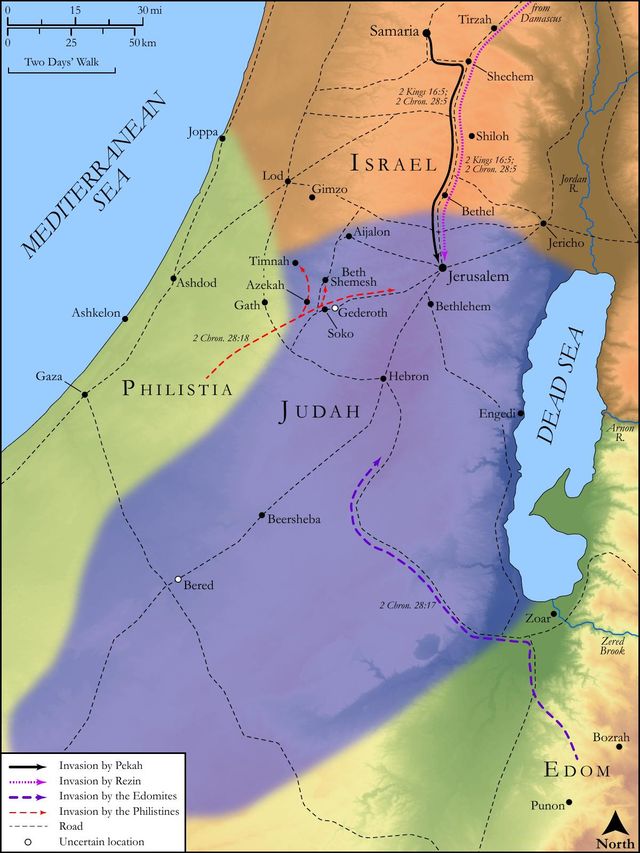
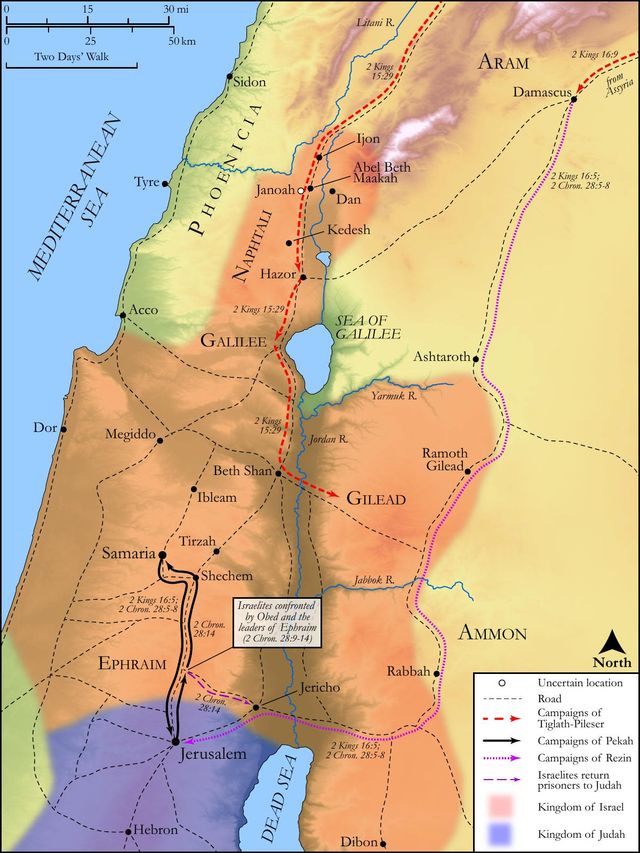
The mid-8th century BCE was a period of immense geopolitical instability in the ancient Near East, primarily driven by the relentless expansion of the Neo-Assyrian Empire under Tiglath-Pileser III. Both Israel (the Northern Kingdom) and Judah (the Southern Kingdom) faced escalating pressure to either form anti-Assyrian coalitions or submit as vassal states. Pekah, the king of Israel mentioned in this verse, was a key player in such a coalition alongside Rezin, king of Aram (Syria). This alliance initiated the Syro-Ephraimite War (c. 735-734 BCE), a major conflict that directly impacted Ahaz's early reign, as vividly recounted in Isaiah 7. The mention of Pekah's seventeenth year is vital for synchronizing the biblical narrative with external historical records of Assyrian campaigns, providing a firm historical grounding. Culturally, the "son of" designation was crucial for establishing legitimate royal lineage and succession, while the act of "beginning to reign" signified the formal assumption of monarchical power, often accompanied by specific rituals, pronouncements, and the establishment of a new regnal year.
Key Themes
ShowHideThis seemingly simple chronological statement contributes significantly to several overarching themes within the book of Kings and the broader biblical narrative. Firstly, it underscores the chronological precision and historical reliability of the biblical record, demonstrating God's meticulous sovereignty over the unfolding of human history and the reigns of kings, even those who defy Him. Secondly, it highlights the enduring theme of royal succession and the Davidic covenant, as Ahaz is part of the divinely promised lineage through which the Messiah would eventually come, despite his personal wickedness and unfaithfulness. Thirdly, and perhaps most significantly, this verse serves as a foreboding introduction to a period of profound spiritual decline for Judah. The subsequent narrative of Ahaz's reign, particularly his widespread idolatry and his disastrous reliance on Assyria rather than God (2 Kings 16:7-9), stands in stark contrast to the ideal of a faithful Davidic king. This sets the stage for crucial themes of divine judgment, the devastating consequences of idolatry, and the testing of faith in the face of overwhelming geopolitical threats, themes deeply explored by contemporary prophets like Isaiah (Isaiah 7:1-17) and Micah.
Exposition and Analysis
ShowHideKey Word Analysis
ShowHideFrom the root אָחַז, meaning "to grasp" or "possess." This name, meaning "possessor," ironically contrasts with Ahaz's reign, where Judah would lose much of its autonomy and spiritual integrity, becoming possessed by foreign influences and idol worship rather than possessing God's favor. His rule would be marked by a grasping for human alliances over divine trust.
From the root יָדָה, meaning "to praise" or "celebrate." Judah was the Southern Kingdom, the remnant of the twelve tribes, and the tribe from which the Davidic line of kings descended. The name "Judah" itself carries theological significance, pointing to the lineage chosen by God, yet under Ahaz, this kingdom would stray far from its calling to praise and worship the Lord alone.
A primitive root meaning "to reign" or "to ascend the throne." This verb signifies the formal and official assumption of royal power and authority. While a standard phrase in royal accession accounts, its use here marks the commencement of a particularly significant and spiritually disastrous period for the Southern Kingdom, highlighting the moment a new era, for better or worse, commenced for Judah.
Verse Breakdown
ShowHide"In the seventeenth year of Pekah the son of Remaliah"
This initial clause provides the crucial synchronism, dating the beginning of Ahaz's reign by referencing the regnal year of Pekah, the king of the Northern Kingdom of Israel. Pekah's reign, though lengthy, was marked by internal instability and external pressures, ultimately ending in his assassination. This chronological anchor is vital for historians, allowing them to align the biblical narrative with extra-biblical sources and understand the broader geopolitical context of the era, particularly the escalating threat from Assyria.
"Ahaz the son of Jotham king of Judah"
This identifies the new monarch of the Southern Kingdom. Ahaz's lineage is clearly stated, emphasizing his legitimate claim to the Davidic throne as the son of King Jotham. Jotham's reign, while generally righteous in the eyes of the biblical author, did not fully eradicate the high places, hinting at existing spiritual vulnerabilities that Ahaz would tragically exploit and exacerbate, leading Judah further into apostasy.
"began to reign."
This simple declarative statement formally announces Ahaz's accession to the throne. While seemingly straightforward, it carries immense weight, marking the start of a new, turbulent, and ultimately tragic chapter in Judah's history. This reign would be characterized by profound spiritual apostasy, the introduction of foreign cults, and a disastrous foreign policy that led to Judah's subjugation to the Assyrian Empire, setting the stage for future divine judgment.
Literary Devices
ShowHideThe primary literary devices employed in 2 Kings 16:1 are Chronological Marker and Synchronism. The verse functions as a precise historical anchor, meticulously linking the timeline of Judah's monarchy with that of Israel's. This careful dating is a characteristic feature of the book of Kings, underscoring the historical grounding of the narrative and allowing for the interweaving of the two kingdoms' histories within a broader ancient Near Eastern context. Furthermore, the verse subtly employs Juxtaposition, setting the stage for the stark contrast between the relatively righteous reign of Jotham (Ahaz's father, concluded in the preceding chapter) and the profound wickedness that will immediately characterize Ahaz's rule, as detailed from 2 Kings 16:2 onwards. This seemingly neutral introduction thus serves as a powerful Foreshadowing of the spiritual and political turmoil, the idolatry, and the national decline that would define Ahaz's reign.
Theological and Thematic Connections
ShowHideThis verse, though dry in its historical precision, profoundly underscores God's sovereignty over human history. The meticulous dating of royal reigns, even those of wicked kings like Ahaz, demonstrates that all human events unfold within God's overarching divine plan and timeline. It highlights the biblical worldview where history is not random but purposeful, guided by God's hand, even when human choices lead to dire consequences. The transition from Jotham to Ahaz also emphasizes the individual accountability of leaders and the profound impact their spiritual choices have on a nation's destiny and its relationship with God. Ahaz's reign, introduced here, serves as a stark warning about the dangers of spiritual compromise and trusting in human alliances over divine faithfulness, a theme powerfully articulated by the prophet Isaiah during this very period.
Reflection and Application
ShowHideEven a seemingly simple chronological marker like 2 Kings 16:1 carries significant weight for reflection and application. It reminds us that every life, and indeed every historical epoch, unfolds within God's sovereign timeline. Just as Ahaz's reign, though wicked, was part of a larger divine narrative, so too are our lives and the eras we inhabit. This verse challenges us to consider our own "reign" – the sphere of influence God has given us, whether in our families, workplaces, or communities – and the choices we make within it. Ahaz's story, which this verse introduces, is a stark warning against spiritual compromise, idolatry, and reliance on human strength or political maneuvering over divine faithfulness. It compels us to discern the spiritual trajectory of our own lives and communities, asking whether we are walking in the ways of the Lord, seeking His counsel, and trusting in His provision, or if we are veering into self-reliance and compromise with the idols of our age. Our choices, like those of kings, have far-reaching and often generational consequences.
Questions for Reflection
ShowHideFAQ
ShowHideWhy is the Bible so precise with dates and synchronisms like this?
ShowHideThe biblical authors, particularly in historical books like Kings, demonstrate a meticulous concern for chronological precision to establish the historical veracity of their accounts. These synchronisms, linking the reigns of kings in Israel and Judah (and sometimes with foreign powers), serve several critical purposes. First, they affirm the historical reality of the events described, grounding the theological narrative in verifiable history. Second, they allow for the integration of prophetic messages (e.g., Isaiah's prophecies to Ahaz) into their specific historical contexts, demonstrating God's active involvement in specific historical moments. Third, they underscore God's sovereignty over all nations and their rulers, demonstrating that even the most powerful kings operate within His ordained timeline and purposes. This precision reinforces the trustworthiness of God's Word as a reliable historical record and a comprehensive guide for faith and life.
What was the "Syro-Ephraimite War" and how does it relate to Ahaz's reign?
ShowHideThe Syro-Ephraimite War was a significant conflict that occurred early in Ahaz's reign (around 735-734 BCE). It involved an alliance between King Rezin of Aram (Syria) and King Pekah of Israel (often called Ephraim in prophetic texts), who sought to pressure Judah into joining their anti-Assyrian coalition against the rising power of the Neo-Assyrian Empire. When Ahaz refused to join, they attacked Jerusalem with the intent of deposing him and installing a puppet king, the "son of Tabeel" (Isaiah 7:6). Instead of trusting God's promise of deliverance through the prophet Isaiah (Isaiah 7:4-9), Ahaz chose to appeal to Tiglath-Pileser III, the king of Assyria, for help (2 Kings 16:7-9). This decision, though it temporarily saved Judah from Aram and Israel, ultimately led to Judah becoming a vassal state of Assyria, ushering in a period of severe spiritual compromise, national decline, and the introduction of pagan worship into Jerusalem.
Christ-Centered Fulfillment
ShowHideWhile 2 Kings 16:1 is a seemingly dry chronological marker, it introduces a king, Ahaz, whose reign starkly illustrates the profound human need for a perfect King and points forward to the ultimate fulfillment in Jesus Christ. Ahaz's profound failure to trust God during the Syro-Ephraimite War, choosing instead to rely on the formidable power of Assyria, stands in stark contrast to the perfect faithfulness and divine reliance of the ultimate King. Ahaz's lineage, though deeply flawed and marked by significant spiritual failings, is nonetheless part of the Davidic line through which the Messiah would ultimately come, as meticulously recorded in the genealogy of Jesus (Matthew 1:9). The spiritual darkness, widespread idolatry, and abhorrent practices like child sacrifice that characterized Ahaz's rule (2 Kings 16:3) highlight humanity's desperate need for a righteous ruler who would not lead His people astray but would perfectly embody divine faithfulness and uphold God's covenant. Christ, as the true Son of David and the Lamb of God, perfectly fulfills the covenant promises that were repeatedly broken by earthly kings. Unlike Ahaz, who compromised with paganism and offered up his own son, Christ offered Himself as the perfect, once-for-all sacrifice for sin (Hebrews 9:26) and perfectly upheld God's law. His reign is not marked by human weakness, political maneuvering, or spiritual decline, but by eternal righteousness, peace, and an everlasting kingdom (Isaiah 9:6-7). Thus, Ahaz's story, beginning with this verse, ultimately points to the necessity and glory of Christ's perfect and eternal reign.