


2 Chronicles 28:4
Bible text: King James Version (1769 Blayney text) · Public domain
Bible text: Berean Standard Bible · Public domain
Bible text: American Standard Version (1901) · Public domain
Bible text: World English Bible, Messianic edition · Public domain
Bible text: Geneva Bible (1599) · Public domain
Bible text: Young's Literal Translation · Public domain
- וַיְזַבֵּחַvay·za·Be·achand he sacrificedH2076Conj-w ¦ V-Piel-ConsecImperf-3msVerb Piel Consecutive Imperfect 3rd Singular Masculineוַandיְזַבֵּחַhe sacrificed
- וַיְקַטֵּרvay·ka·Terand he made smokeH6999Conj-w ¦ V-Piel-ConsecImperf-3msVerb Piel Consecutive Imperfect 3rd Singular Masculineוַandיְקַטֵּרhe made smoke
- בַּבָּמוֹתba·ba·Motat the high placesH1116Prep-b ¦ N-fpNoun Plural Feminine Absoluteבַּat theבָּמוֹתhigh places
- וְעַלve·'aland onH5921Conj-w ¦ PrepPrepositionוְandעַלon
- הַגְּבָעוֹתha·ge·va·'otthe hillsH1389Art ¦ N-fpNoun Plural Feminine Absoluteהַtheגְּבָעוֹתhills
- וְתַחַתve·Ta·chatand underH8478Conj-w ¦ N-mscNoun Singular Masculine Constructוְandתַחַתunder
- כָּלkoleveryH3605N-mscNoun Singular Masculine Construct
- עֵץ'etztreeH6086N-msNoun Singular Masculine Absolute
- רַעֲנָןra·'a·NanluxuriantH7488Adj-msAdjective Singular Masculine Absolute
English is a literal word-by-word gloss of the Hebrew, not the KJV's wording. Why?
This is the original text the KJV's translators worked from — each Hebrew word with its own literal English meaning in this verse, prepared by scholars at Tyndale House, Cambridge. The KJV translates whole sentences, not word by word, so its wording differs: one Hebrew word can become several English words, and the KJV may choose “the LORD” where the gloss reads “Yahweh”. Both are faithful — they answer different questions. For the KJV's own rendering, switch to the KJV text.
Details
See on the biblical-era maps
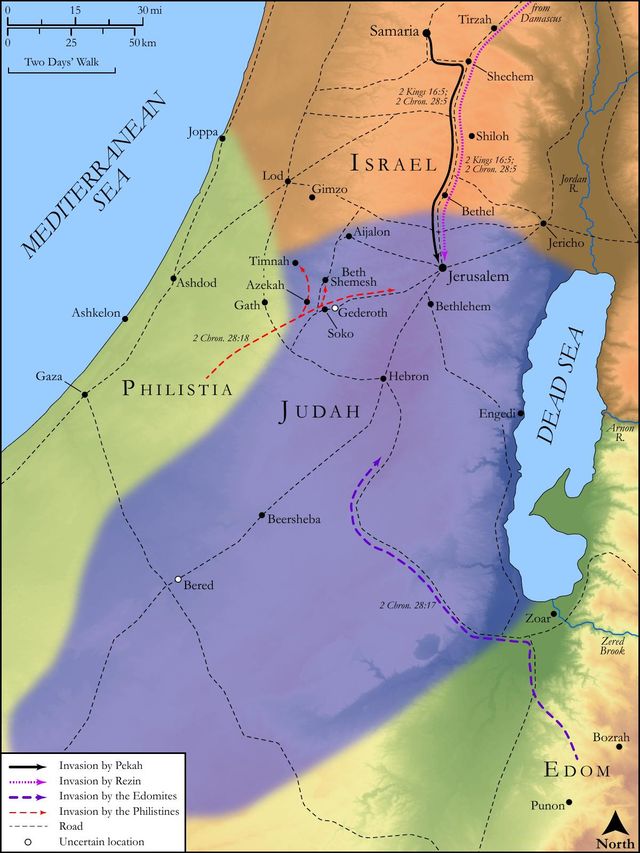
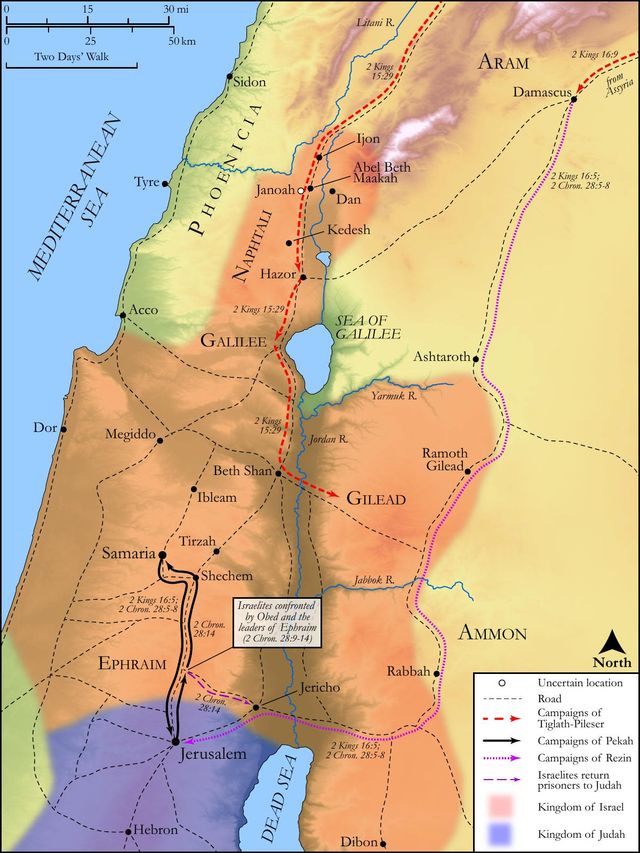
Study this verse
Public-domain commentary
Matthew Henry
From his Commentary on the Whole Bible. Henry comments on passages, not single verses — this entry covers 2 Chronicles 28:1–5.
Never surely had a man greater opportunity of doing well than Ahaz had, finding things in a good posture, the kingdom rich and strong and religion established; and yet here we have him in these few verses, 1. Wretchedly corrupted and debauched. He had had a good education given him and a good example set him: but parents cannot give grace to their children. All the instructions he had were lost upon him: He did not that which was right in the sight of the Lord (Ch2 28:1), nay, he did a great deal that was wrong, a wrong to God, to his own soul, and to his people; he walked in the way of the revolted Israelites and the devoted Canaanites, made molten images and worshipped them, contrary to the second commandment; nay, he made them for Baalim, contrary to the first commandment. he forsook the temple of the Lord and sacrificed and burnt incense on the hills, as if they would place him nearer heaven, and under every green tree, as if they would signify the protection and influence of heaven by their shade and dropping. To complete his wickedness, as one perfectly divested of all natural affection as well as religion and perfectly devoted to the service and interest of the great enemy of mankind, he burnt his children in the fire to Moloch (Ch2 28:3), not thinking it enough to dedicate them to that infernal fiend by causing them to pass through the fire. See what an absolute sway the prince of the power of the air bears among the children of disobedience. 2. Wretchedly spoiled and made a prey of. When he forsook God, and at a vast expense put himself under the protection of false gods, God, who of right was his God, delivered him into the hands of his enemies, Ch2 28:5. (1.) The Syrians insulted him and triumphed over him, beat him in the field and carried away a great many of his people into captivity. (2.) The king of Israel, though an idolater too, was made a scourge to him, and smote him with a great slaughter. The people suffered by these judgments: their blood was shed, their country wasted, their families ruined; for when they had a good king, though they did corruptly (Ch2 27:2), yet then his goodness sheltered them; but now that they had a bad one all the defence had departed from them and an inundation of judgments broke in upon them. Those that knew not their happiness in the foregoing reign were taught to value it by the miseries of this reign.
Continue studying 2 Chronicles 28:4 across the web’s major study libraries — every link below opens this exact verse, chapter, or book on the destination site.
Read & Compare
 BibleGatewayThis verse in more than 200 translations and 70 languages.
 Bible.comThe YouVersion reader — hundreds of translations, reading plans, and highlights.
 ESV.orgCrossway's official English Standard Version reader.
 NET BibleThe NET translation with 60,000+ translators' notes on every rendering decision.
 STEP BibleTyndale House's free study tool — original text, vocabulary, and scholarly resources.
 BibliaLogos Bible Software's free web reader.
 USCCBThe New American Bible (Revised Edition) with the U.S. bishops' study notes.
Commentaries
 BibleHub CommentariesDozens of classic commentaries on this verse, gathered on one page.
 StudyLightMore than 100 commentary sets — the largest collection on the web.
 BibleRefPlain-English commentary on what this verse means, verse by verse.
 Enduring WordDavid Guzik's free commentary on this chapter, widely used by Bible teachers.
 Bible Study ToolsVerse commentary alongside Greek and Hebrew study aids.
Original Language & Research
- BibleHub InterlinearThe verse word by word — original language, transliteration, and English.
- BibleHub LexiconEvery word's original-language definition and Strong's entry.
 Blue Letter BibleDeep-study tools — Strong's numbers, concordance, and word studies.
 SefariaThe Hebrew text with Rashi and centuries of Jewish commentary.
Sermons, Hymns & Audio


TrulyRandomVerse is not affiliated with these sites and doesn’t control their content. They’re linked because they’re genuinely useful.
Summary
Second Chronicles 28:4 vividly details the profound apostasy of King Ahaz of Judah, portraying his deliberate and widespread engagement in forbidden idolatrous practices. This verse serves as a stark indictment of a monarch who not only tolerated but actively promoted the worship of false gods, performing sacrifices and burning incense at locations explicitly condemned by the Mosaic Law—namely, "high places," "hills," and "under every green tree." It underscores Ahaz's complete defiance of Yahweh's covenant and sets the stage for the severe divine judgment and national distress that characterized his wicked reign, illustrating the devastating consequences of spiritual rebellion.
Context
ShowHideLiterary Context
This verse immediately follows the introduction of King Ahaz in 2 Chronicles 28:1-3, which establishes his character as one who "did not that which was right in the sight of the LORD, like David his father." The preceding verses already condemn his making of "molten images for Baalim" and the horrific act of "burnt his children in the fire" as sacrifices, practices abhorrent to Yahweh. Verse 4 expands upon this by specifying the widespread nature and locations of his idolatry, reinforcing the depth of his spiritual rebellion and highlighting its pervasive impact across the land. It is part of a broader narrative in Chronicles that consistently evaluates kings based on their faithfulness to the Mosaic covenant and their commitment to the exclusive worship of Yahweh, often contrasting wicked kings like Ahaz with righteous ones such as his son, Hezekiah. This detailed description of Ahaz's sin sets the stage for the severe consequences and divine judgment that follow, as seen in 2 Chronicles 28:5-8. The Chronicler emphasizes the direct correlation between the king's spiritual state and the nation's well-being.
Historical & Cultural Context
King Ahaz reigned over Judah from approximately 735-715 BC, a period marked by significant political instability and the looming threat of the Assyrian Empire, which was rapidly expanding its dominion. Culturally, the lands round about Judah were saturated with polytheistic religions, particularly Canaanite fertility cults that worshipped deities like Baal and Asherah. These cults often involved ritual prostitution, child sacrifice (as Ahaz himself practiced, according to 2 Chronicles 28:3), and the use of sacred groves and elevated shrines. The "high places" (Hebrew: bamot) were elevated cultic sites, sometimes natural hills, sometimes man-made mounds, which, despite early Israelite use for Yahweh worship, became overwhelmingly associated with pagan practices and were consistently condemned by God's Law. "Under every green tree" refers to the common practice of conducting pagan rites in lush groves, symbolizing fertility and often involving immoral rituals. Ahaz's embrace of these practices was not merely syncretism but a wholesale adoption of the very idolatry God had commanded Israel to eradicate from the land, as outlined in Deuteronomy 12:2-4. His actions reflect a deliberate alignment with the surrounding pagan nations rather than adherence to the covenant with Yahweh.
Key Themes
ShowHideThe central theme in 2 Chronicles 28:4 is Idolatry and Apostasy, highlighting Ahaz's complete abandonment of Yahweh worship in favor of false gods. His actions represent a blatant rejection of the First and Second Commandments, which demand exclusive worship of God and forbid the making of images (Exodus 20:3-5). This verse also underscores the theme of Covenant Violation, as Ahaz's sacrifices in forbidden locations directly broke the covenant God had established with Israel, which stipulated exclusive devotion and obedience. Furthermore, it illustrates Spiritual Degeneration, showing how the king's unfaithfulness led to widespread moral decay and national distress, serving as a cautionary tale of the Consequences of Disobedience. The emphasis on specific locations like "high places" and "green trees" also highlights the theme of Purity of Worship, emphasizing God's demand for unadulterated devotion, free from syncretism or pagan influences. Ahaz's actions directly contradict the Chronicler's theological agenda, which consistently links national prosperity and security to faithfulness to Yahweh, and national disaster to idolatry.
Exposition and Analysis
ShowHideKey Word Analysis
ShowHideFrom a primitive root; to slaughter an animal (usually in sacrifice); kill, offer, (do) sacrifice, slay. This word denotes the act of offering an animal, typically as a ritualistic act of worship to a deity. In the context of Ahaz, it signifies his formal and deliberate engagement in pagan cultic practices, directing his worship away from Yahweh.
From a primitive root (identical with through the idea of fumigation in a close place and perhaps thus driving out the occupants); to smoke, i.e., turn into fragrance by fire (especially as an act of worship); burn (incense, sacrifice) (upon), (altar for) incense, kindle, offer (incense, a sacrifice). This refers to the burning of aromatic substances, a common form of reverence and devotion in ancient worship. Ahaz's burning of incense to false gods signifies a profound act of spiritual rebellion, as incense was specifically prescribed for Yahweh's worship in the Tabernacle and Temple.
From an unused root (meaning to be high); an elevation; height, high place, wave. These were elevated cultic sites, either natural hills or man-made mounds, which became notorious for pagan worship throughout Israel's history. While some early Israelites used them, albeit improperly, for Yahweh worship, they were consistently condemned by prophets and righteous kings due to their association with Canaanite fertility cults, child sacrifice, and other abominable practices. Their persistent presence and use, especially by kings, symbolized a national failure to fully purge idolatry and centralize worship at the Jerusalem Temple as commanded by God.
Verse Breakdown
ShowHide"He sacrificed also and burnt incense"
This phrase describes two primary, formal acts of worship. "Sacrificed" refers to the offering of animals, typically as a communal meal or propitiation, while "burnt incense" involved the burning of aromatic substances, a common act of reverence and devotion to deities. By performing these acts, King Ahaz was engaging in formal, ritualistic worship, but critically, he was directing them towards false gods, thereby committing profound idolatry and rejecting the exclusive worship of Yahweh. The "also" indicates that these actions were in addition to the other abominations mentioned in the preceding verses, highlighting the comprehensive nature of his apostasy.
"in the high places"
This specifies the first type of forbidden location for Ahaz's idolatrous worship. "High places" were elevated shrines that, despite their potential for legitimate (though unauthorized) Yahweh worship in earlier periods, had become synonymous with paganism and were explicitly condemned by God's law. Ahaz's active use of them signifies his embrace of pagan practices, directly violating the divine command to destroy such sites.
"and on the hills"
This phrase reinforces and expands upon the mention of "high places." Hills were natural elevated locations often chosen for cultic sites due to their prominence and perceived proximity to the divine. This detail further emphasizes the widespread nature of Ahaz's apostasy, indicating that he was not only using established "high places" but also any natural elevated ground suitable for pagan worship, demonstrating a pervasive commitment to idolatry.
"and under every green tree"
This final phrase completes the description of Ahaz's pervasive idolatry, pointing to the use of sacred groves or individual lush trees as sites for pagan rituals. These locations were deeply associated with fertility cults and often involved immoral rites. The use of "every" ("all" in some translations) underscores the comprehensive and unreserved nature of Ahaz's commitment to idolatry, implying that he sought out and utilized every conceivable pagan worship site, demonstrating a thorough rejection of Yahweh's commands.
Literary Devices
ShowHideThe verse employs several literary devices to convey the depth of King Ahaz's apostasy and the pervasive nature of his sin. Repetition is evident in the listing of the forbidden worship sites: "high places," "hills," and "under every green tree." This cumulative enumeration emphasizes the pervasive and widespread nature of Ahaz's idolatry, suggesting that his rebellion against Yahweh was not an isolated incident but a comprehensive and deliberate policy that infected the entire land. The choice of these specific locations also employs Symbolism, as "high places" and "green trees" were universally recognized symbols of pagan worship and rebellion against Yahweh's exclusive claim. They represent a deliberate turning away from the pure, centralized worship commanded at the Jerusalem Temple, embodying the spiritual adultery of the nation. Furthermore, the verse implicitly uses Contrast by juxtaposing Ahaz's actions with the righteous worship of Yahweh commanded in the Law and exemplified by faithful kings like David. This highlights the profound spiritual decline and moral depravity that characterized Ahaz's reign, setting the stage for the divine judgment that would inevitably follow, thus serving as a form of Foreshadowing for the subsequent national disasters described in the chapter.
Theological and Thematic Connections
ShowHideThe profound idolatry of King Ahaz, as depicted in 2 Chronicles 28:4, stands as a stark theological warning against the dangers of syncretism and the absolute necessity of exclusive worship of the one true God. His actions directly violate the foundational commands of the Mosaic covenant, particularly the First and Second Commandments, which forbid having other gods before Yahweh and the making of idols. The detailed description of his worship at "high places," "hills," and "under every green tree" highlights the insidious nature of pagan influences and the constant temptation for God's people to compromise their devotion by adopting the practices of the heathen. This narrative underscores God's unwavering demand for purity in worship and His severe judgment against those who turn from Him to pursue false deities. It serves as a timeless reminder that true worship must be directed solely to God, according to His revealed will, and that any deviation constitutes spiritual adultery, leading to spiritual and often national decline.
Reflection and Application
ShowHideThe account of King Ahaz's idolatry in 2 Chronicles 28:4 offers profound lessons for contemporary believers. While we may not literally burn incense on physical high places or under green trees, the human heart remains prone to idolatry. Anything that takes God's rightful place of supremacy in our lives—be it career, wealth, relationships, self-image, comfort, or even good causes—can become a modern "high place" where we offer our devotion, time, and energy. This verse calls us to a rigorous self-examination, challenging us to identify and dismantle these subtle idols that compete for our ultimate allegiance. It reminds us that true worship is not merely about avoiding overt sin, but about cultivating an undivided heart that seeks God alone, worshipping Him in spirit and truth. Our choices, like Ahaz's, have ripple effects, influencing not only our own spiritual well-being but also the spiritual climate of our families, communities, and even nations. The purity of our worship directly impacts the vitality of our faith and our experience of God's blessing, urging us to constantly re-evaluate where our deepest affections and loyalties truly lie.
Questions for Reflection
ShowHideFAQ
ShowHideWhy were "high places" so problematic if some Israelites used them to worship Yahweh?
ShowHideWhile some early Israelites did use elevated sites for Yahweh worship, these "high places" (Hebrew: bamot) became problematic for several reasons. Firstly, they often incorporated pagan elements, leading to syncretism where Yahweh was worshipped alongside or in the manner of false gods. Secondly, they were frequently associated with immoral practices, including cultic prostitution and child sacrifice, which were abhorrent to Yahweh. Most importantly, God commanded a centralized worship system at the Tabernacle and later the Temple in Jerusalem (Deuteronomy 12:5-14), to ensure purity of worship and prevent the very syncretism that plagued Israel. Kings like Ahaz actively promoted these sites for pagan worship, rather than merely tolerating existing ones for Yahweh, thus deepening their offense and leading the nation further into apostasy.
What was the significance of "green trees" in Canaanite pagan worship?
ShowHide"Green trees" or sacred groves were significant in pagan worship, particularly in Canaanite fertility cults. These lush, often evergreen trees symbolized life, growth, and fertility, and were believed to be dwelling places for deities or spirits. Rituals performed "under every green tree" were often associated with Baal and Asherah worship, involving practices intended to ensure agricultural abundance and human fertility. These rituals frequently included cultic prostitution and other immoral acts, making them an abomination to the God of Israel, who demanded moral purity and exclusive devotion (Jeremiah 3:13). The widespread nature of these sites, as indicated by "every green tree," highlights the pervasive nature of idolatry that Ahaz embraced.
Christ-Centered Fulfillment
ShowHideThe idolatry of King Ahaz, epitomized by his sacrifices in forbidden places, powerfully illustrates humanity's inherent propensity to worship creation rather than the Creator, a theme echoed in Romans 1:25. In stark contrast to Ahaz's apostasy, Jesus Christ stands as the perfect worshipper, the ultimate sacrifice, and the true Temple. He perfectly fulfilled the Law's demands for exclusive worship, embodying the purity and devotion that Ahaz so tragically lacked. Through His atoning death on the cross, Jesus offered the one true sacrifice that cleanses us from all forms of idolatry, whether overt or subtle (Hebrews 10:10-14). He declared Himself to be the new and living Temple (John 2:19-21), rendering all physical "high places" and man-made shrines obsolete. Now, true worship is not confined to specific locations or rituals but is offered "in spirit and truth" (John 4:23-24), through the indwelling Holy Spirit and in conformity to the reality of Christ. Jesus, the King of kings, provides the only path to genuine freedom from spiritual bondage and the restoration of a right relationship with God, calling us to cast down every idol and enthrone Him alone in our hearts (Colossians 3:5). He is the true object of our worship, the one who perfectly mediates between God and humanity, and in whom all true devotion finds its ultimate expression.