


2 Chronicles 28:5
Bible text: King James Version (1769 Blayney text) · Public domain
Bible text: King James Version with Strong's numbers · Public domain
Bible text: Berean Standard Bible · Public domain
Bible text: American Standard Version (1901) · Public domain
Bible text: World English Bible, Messianic edition · Public domain
Bible text: Geneva Bible (1599) · Public domain
Bible text: Young's Literal Translation · Public domain
- וַיִּתְּנֵהוּvai·yi·te·Ne·huand he gave himH5414Conj-w ¦ V-Qal-ConsecImperf-3ms ¦ 3msVerb Qal Consecutive Imperfect 3rd Singular Masculineוַandיִּתְּנֵhe gaveהוּhim
- יְהוָהYah·wehYahwehH3068N-properNoun Proper Title
- אֱלֹהָיו'e·lo·Havhis GodH430N-mpc ¦ 3msNoun Plural Masculine ConstructאֱלֹהָיGodוhis
- בְּיַדbe·Yadin [the] hand ofH3027Prep-b ¦ N-cscNoun Singular common gender Constructבְּinיַד[the] hand of
- מֶלֶךְMe·lekh[the] king ofH4428N-mscNoun Singular Masculine Construct
- אֲרָם'a·RamAramH758N-properNoun Proper Location
- וַיַּכּוּvai·Ya·kuand they defeatedH5221Conj-w ¦ V-Hiphil-ConsecImperf-3mpVerb Hiphil Consecutive Imperfect 3rd Plural Masculineוַandיַּכּוּthey defeated
- בוֹvo<in> himPrep-b ¦ 3msSuffix Personal 3rd Singular Masculineב<in>וֹhim
- וַיִּשְׁבּוּvai·yish·Buand they took captiveH7617Conj-w ¦ V-Qal-ConsecImperf-3mpVerb Qal Consecutive Imperfect 3rd Plural Masculineוַandיִּשְׁבּוּthey took captive
- מִמֶּנּוּmi·Me·nufrom himH4480Prep ¦ 3msPrepositionמִמֶּfromנּוּhim
- שִׁבְיָהshiv·Yaha group of captivesH7633N-fsNoun Singular Feminine Absolute
- גְדוֹלָהge·do·LahlargeH1419Adj-fsAdjective Singular Feminine Absolute
- וַיָּבִיאוּvai·ya·Vi·'uand they brought [them]H935Conj-w ¦ V-Hiphil-ConsecImperf-3mpVerb Hiphil Consecutive Imperfect 3rd Plural Masculineוַandיָּבִיאוּthey brought [them]
- דַּרְמָשֶׂקdar·Ma·sekDamascusH1834N-properNoun Proper Location
- וְגַםVe·gamand alsoH1571Conj-w ¦ AdvAdverbוְandגַםalso
- בְּיַדbe·yadin [the] hand ofH3027Prep-b ¦ N-cscNoun Singular common gender Constructבְּinיַד[the] hand of
- מֶלֶךְMe·lekh[the] king ofH4428N-mscNoun Singular Masculine Construct
- יִשְׂרָאֵלYis·ra·'ElIsraelH3478N-properNoun Proper Location
- נִתָּןni·Tanhe was givenH5414V-Niphal-Prtcpl-msVerb Niphal Participle Singular Masculine Absolute
- וַיַּךְvai·yakhand he defeatedH5221Conj-w ¦ V-Hiphil-ConsecImperf-3msVerb Hiphil Consecutive Imperfect 3rd Singular Masculineוַandיַּךְhe defeated
- בּוֹbo<in> himPrep-b ¦ 3msSuffix Personal 3rd Singular Masculineבּ<in>וֹhim
- מַכָּהma·Kaha defeatH4347N-fsNoun Singular Feminine Absolute
- גְדוֹלָהge·do·LahgreatH1419Adj-fsAdjective Singular Feminine Absolute
English is a literal word-by-word gloss of the Hebrew, not the KJV's wording. Why?
This is the original text the KJV's translators worked from — each Hebrew word with its own literal English meaning in this verse, prepared by scholars at Tyndale House, Cambridge. The KJV translates whole sentences, not word by word, so its wording differs: one Hebrew word can become several English words, and the KJV may choose “the LORD” where the gloss reads “Yahweh”. Both are faithful — they answer different questions. For the KJV's own rendering, switch to the KJV text.
Details
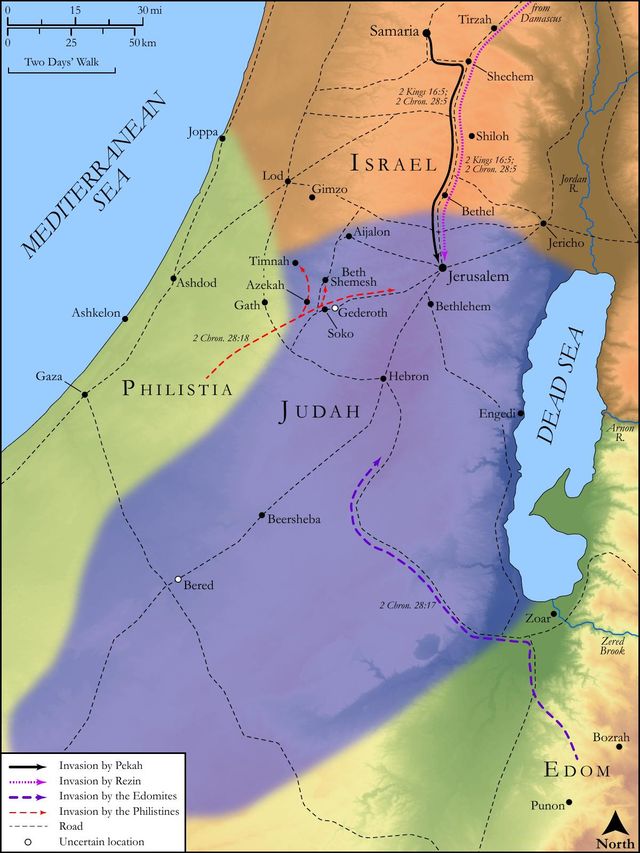
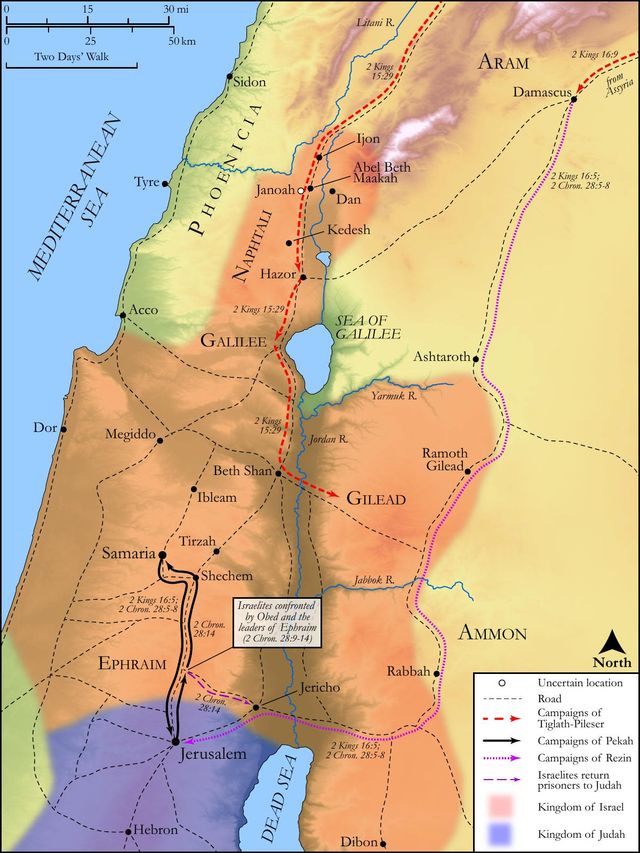
See on the biblical-era maps
Study this verse
Public-domain commentary
Matthew Henry
From his Commentary on the Whole Bible. Henry comments on passages, not single verses — this entry covers 2 Chronicles 28:1–5.
Never surely had a man greater opportunity of doing well than Ahaz had, finding things in a good posture, the kingdom rich and strong and religion established; and yet here we have him in these few verses, 1. Wretchedly corrupted and debauched. He had had a good education given him and a good example set him: but parents cannot give grace to their children. All the instructions he had were lost upon him: He did not that which was right in the sight of the Lord (Ch2 28:1), nay, he did a great deal that was wrong, a wrong to God, to his own soul, and to his people; he walked in the way of the revolted Israelites and the devoted Canaanites, made molten images and worshipped them, contrary to the second commandment; nay, he made them for Baalim, contrary to the first commandment. he forsook the temple of the Lord and sacrificed and burnt incense on the hills, as if they would place him nearer heaven, and under every green tree, as if they would signify the protection and influence of heaven by their shade and dropping. To complete his wickedness, as one perfectly divested of all natural affection as well as religion and perfectly devoted to the service and interest of the great enemy of mankind, he burnt his children in the fire to Moloch (Ch2 28:3), not thinking it enough to dedicate them to that infernal fiend by causing them to pass through the fire. See what an absolute sway the prince of the power of the air bears among the children of disobedience. 2. Wretchedly spoiled and made a prey of. When he forsook God, and at a vast expense put himself under the protection of false gods, God, who of right was his God, delivered him into the hands of his enemies, Ch2 28:5. (1.) The Syrians insulted him and triumphed over him, beat him in the field and carried away a great many of his people into captivity. (2.) The king of Israel, though an idolater too, was made a scourge to him, and smote him with a great slaughter. The people suffered by these judgments: their blood was shed, their country wasted, their families ruined; for when they had a good king, though they did corruptly (Ch2 27:2), yet then his goodness sheltered them; but now that they had a bad one all the defence had departed from them and an inundation of judgments broke in upon them. Those that knew not their happiness in the foregoing reign were taught to value it by the miseries of this reign.
Continue studying 2 Chronicles 28:5 across the web’s major study libraries — every link below opens this exact verse, chapter, or book on the destination site.
Read & Compare
 BibleGatewayThis verse in more than 200 translations and 70 languages.
 Bible.comThe YouVersion reader — hundreds of translations, reading plans, and highlights.
 ESV.orgCrossway's official English Standard Version reader.
 NET BibleThe NET translation with 60,000+ translators' notes on every rendering decision.
 STEP BibleTyndale House's free study tool — original text, vocabulary, and scholarly resources.
 BibliaLogos Bible Software's free web reader.
 USCCBThe New American Bible (Revised Edition) with the U.S. bishops' study notes.
Commentaries
 BibleHub CommentariesDozens of classic commentaries on this verse, gathered on one page.
 StudyLightMore than 100 commentary sets — the largest collection on the web.
 BibleRefPlain-English commentary on what this verse means, verse by verse.
 Enduring WordDavid Guzik's free commentary on this chapter, widely used by Bible teachers.
 Bible Study ToolsVerse commentary alongside Greek and Hebrew study aids.
Original Language & Research
- BibleHub InterlinearThe verse word by word — original language, transliteration, and English.
- BibleHub LexiconEvery word's original-language definition and Strong's entry.
 Blue Letter BibleDeep-study tools — Strong's numbers, concordance, and word studies.
 SefariaThe Hebrew text with Rashi and centuries of Jewish commentary.
Sermons, Hymns & Audio


TrulyRandomVerse is not affiliated with these sites and doesn’t control their content. They’re linked because they’re genuinely useful.
Summary
2 Chronicles 28:5 vividly narrates the immediate and severe divine judgment upon King Ahaz of Judah, whose profound wickedness and widespread idolatry provoked the Lord's righteous wrath. As a direct consequence of his apostasy and covenant unfaithfulness, God actively delivered Ahaz and his kingdom into the hands of two hostile powers: first, the king of Syria, who inflicted a significant military defeat and carried away a large multitude of captives to Damascus, and then, even more devastatingly, into the hand of the king of Israel, who wrought a great slaughter upon Judah. This verse starkly illustrates the principle of divine retribution for national and leadership unfaithfulness, emphasizing God's sovereignty over historical events and the direct correlation between obedience and blessing, or disobedience and curse.
Context
ShowHideLiterary Context
This verse serves as the immediate and direct consequence of King Ahaz's egregious spiritual rebellion, as detailed in the preceding verses of 2 Chronicles 28. The Chronicler meticulously portrays Ahaz as one of Judah's most wicked kings, who "did not do what was right in the eyes of the LORD, as David his father had done" (2 Chronicles 28:1). His offenses were grave and widespread, including making molten images for Baalim, burning his children as offerings in the horrific ritual of child sacrifice in the Valley of Ben Hinnom, and offering sacrifices and burning incense on the high places, on the hills, and under every green tree (2 Chronicles 28:2-4). The explicit statement in verse 5, "Wherefore the LORD his God delivered him," directly links these severe military defeats to God's righteous judgment against Ahaz's profound apostasy. This connection emphasizes divine sovereignty over historical events and reinforces the Chronicler's overarching theological agenda: demonstrating the direct correlation between national obedience and blessing, or disobedience and curse, a recurring theme throughout the books of Chronicles.
Historical & Cultural Context
King Ahaz reigned over Judah from approximately 735-715 BC, a period marked by significant geopolitical instability round about Judah. The attacks described in 2 Chronicles 28:5 are part of the Syro-Ephraimite War (c. 734-732 BC). At this time, King Rezin of Syria and King Pekah of Israel formed an anti-Assyrian coalition and sought to compel Judah to join their alliance against the burgeoning Assyrian Empire. When Ahaz refused to participate, they invaded Judah with the explicit intention of replacing him with a puppet king, the "son of Tabeel" (Isaiah 7:6). Culturally, Ahaz's embrace of pagan practices, including the abhorrent act of child sacrifice, represented a direct adoption of the abominable customs of the Canaanite nations that God had explicitly commanded Israel to dispossess and avoid. This period also witnessed the rising dominance of the Assyrian Empire under Tiglath-Pileser III, to whom Ahaz would later appeal for help, further demonstrating his profound lack of faith in the Lord and his reliance on foreign powers rather than divine protection (2 Kings 16:7-9). The Chronicler highlights that even these regional conflicts and the actions of foreign kings were instruments in God's hand for disciplining His unfaithful people.
Key Themes
ShowHideThe central theme powerfully articulated in 2 Chronicles 28:5 is Divine Judgment for Disobedience. The explicit declaration that "the LORD his God delivered him" underscores God's active, sovereign involvement in history, demonstrating that the calamities befalling Judah were not random misfortunes but direct, sovereign acts of divine retribution for Ahaz's profound unfaithfulness and rampant idolatry. This aligns perfectly with the covenant curses outlined in Deuteronomy 28, where disobedience leads to defeat by enemies, plague, and captivity. Closely related is the theme of Consequences of Idolatry and Apostasy. Ahaz's embrace of pagan worship, including the abhorrent practice of child sacrifice, directly provoked God's wrath, bringing devastating punishment upon Judah in the form of military defeat, mass casualties, and the captivity of a "great multitude." This highlights the destructive impact of a leader's spiritual rebellion on an entire nation. Furthermore, the verse illustrates God's Sovereignty over Nations, showing that even the actions of foreign kings and geopolitical conflicts are under God's ultimate control and can be used as instruments of His discipline against His own people when they stray from His covenant.
Exposition and Analysis
ShowHideKey Word Analysis
ShowHideThe Hebrew verb נָתַן (nâthan, H5414), meaning "to give," "to place," or "to hand over," is crucial here. In this context, it signifies an active and intentional handing over by God. It is not merely a passive allowance of events but a deliberate act of divine judgment. This emphasizes God's direct agency and sovereignty over the unfolding calamities, making it clear that these defeats were not accidental but divinely orchestrated consequences of Ahaz's profound sin and covenant breaking.
The verb נָכָה (nâkâh, H5221), meaning "to strike (lightly or severely, literally or figuratively)," "to beat," "to kill," or "to slay," conveys a decisive and often violent act of inflicting defeat or injury. Its repetition in relation to both the Syrian and Israelite attacks underscores the severity, brutality, and finality of the military actions against Judah, indicating a comprehensive and painful defeat.
This powerful phrase (מַכָּה גְדוֹלָה, makkâh H4347, gᵉdôlāh H1419) literally means "a great blow" or "a great striking." Makkâh denotes a blow, wound, or figurative carnage, while gᵉdôlāh intensifies it, meaning "great" in any sense, "exceeding," or "mighty." Together, they denote an immense loss of life, a devastating military rout, and a severe, catastrophic defeat. The use of "great" (גְדוֹלָה) intensifies the impact, highlighting the immense human cost of Ahaz's wickedness and God's severe judgment.
Verse Breakdown
ShowHide"Wherefore the LORD his God delivered him into the hand of the king of Syria;"
The opening "Wherefore" (לָכֵן, lākēn) establishes a direct and undeniable cause-and-effect relationship between Ahaz's egregious wickedness (detailed in verses 2-4) and the ensuing divine judgment. The phrase "the LORD his God" is profoundly significant; despite Ahaz's profound apostasy and rejection of God, God is still identified as Judah's covenant God, underscoring that the judgment comes from the very One who had chosen, blessed, and established a covenant relationship with them. "Delivered him into the hand" signifies God's active, sovereign role in empowering Judah's enemies, using them as instruments of His righteous discipline.
"and they smote him, and carried away a great multitude of them captives, and brought [them] to Damascus."
This clause meticulously details the specific, devastating consequences of the Syrian attack. "Smote him" indicates a decisive military defeat inflicted upon Judah. The carrying away of a "great multitude" as captives to Damascus, the capital of Syria, highlights the significant human, demographic, and economic toll of this initial judgment, severely weakening Judah's population and resources. This act of captivity was a direct fulfillment of covenant curses for disobedience.
"And he was also delivered into the hand of the king of Israel, who smote him with a great slaughter."
This second part of the verse describes a subsequent, and seemingly even more devastating, attack from the Northern Kingdom of Israel. The repetition of "delivered into the hand" powerfully reinforces God's continued and active agency in orchestrating these calamitous events. The phrase "smote him with a great slaughter" emphasizes the immense loss of life and the catastrophic nature of this particular defeat, indicating a more severe and deadly blow than the initial Syrian assault, underscoring the comprehensive and unrelenting nature of God's judgment.
Literary Devices
ShowHideThe Chronicler employs several potent literary devices in 2 Chronicles 28:5 to convey the gravity and theological significance of God's judgment. The most prominent is Divine Agency, explicitly stated and reinforced through the repeated phrase "the LORD his God delivered him." This direct attribution of the military defeats to God's action removes any ambiguity, establishing beyond doubt that these were not random misfortunes but divinely orchestrated consequences of Ahaz's profound sin. There is a clear Cause and Effect relationship, powerfully signaled by the opening "Wherefore" (לָכֵן, lākēn), which directly links Ahaz's preceding wickedness to the subsequent divine punishment. Parallelism is evident in the structure, presenting two distinct but similar acts of divine delivery into the hands of two different enemies (Syria and Israel), reinforcing the comprehensive and inescapable nature of the judgment. Furthermore, the use of Intensification through phrases like "great multitude" and especially "great slaughter" serves to emphasize the severe and devastating impact of these defeats, highlighting the immense human cost of Ahaz's unfaithfulness and the severity of God's righteous wrath.
Theological and Thematic Connections
ShowHide2 Chronicles 28:5 powerfully articulates the biblical principle of divine justice and the direct consequences of covenant unfaithfulness. It reveals a God who is not passive in the face of rampant sin, particularly idolatry and the desecration of His covenant, even when committed by His chosen people and their leaders. The explicit statement that "the LORD his God delivered him" underscores God's active sovereignty over history and His willingness to use foreign nations as instruments of His righteous judgment. This verse serves as a stark reminder that spiritual rebellion, especially from those in positions of authority, has devastating repercussions not only for the individual but for the entire community. It highlights the serious nature of breaking faith with God and the reality that His discipline, though painful, is a just response to persistent sin, intended to call His people back to repentance and obedience.
Reflection and Application
ShowHide2 Chronicles 28:5 offers profound and enduring lessons for contemporary believers, emphasizing the timeless truth that choices have consequences, and spiritual rebellion invites divine discipline. For those in leadership, whether in the church, family, or society, Ahaz's tragic example serves as a sobering warning: a leader's spiritual posture profoundly impacts those under their care. Compromise with sin, especially idolatry in any form (whether literal pagan worship or the modern worship of self, power, possessions, or ideologies), can lead to devastating outcomes for individuals, families, and entire communities. For all believers, this verse underscores the importance of unwavering faithfulness and the dangers of spiritual apathy or syncretism. God's character as a just and holy God means He will not tolerate persistent unfaithfulness. While His discipline is painful and severe, it is ultimately an act of His righteous governance and often His love, designed to call His people to repentance and to restore them to a right relationship with Him. We are called to examine our own lives for areas of compromise and to actively pursue genuine worship and obedience, trusting in God's steadfast love and His righteous governance over all things.
Questions for Reflection
ShowHideFAQ
ShowHideWhy is God referred to as "the LORD his God" when Ahaz was so wicked?
ShowHideThe phrase "the LORD his God" (יְהוָה אֱלֹהָיו, Yᵉhôvâh ʼĕlôhîym) is profoundly significant because it highlights God's enduring covenant relationship with Judah, even when the king himself is profoundly unfaithful. It underscores that the judgment comes from the very God who had chosen and blessed Israel and Judah, establishing a covenant with them at Sinai and promising to be their God (Exodus 19:5-6). This makes Ahaz's apostasy even more egregious—he was rebelling against the God who had faithfully sustained his people for centuries and to whom he, as king, was uniquely accountable. It also emphasizes God's sovereign ownership and authority over Judah, despite Ahaz's rebellion. The judgment is not from an arbitrary deity, but from the faithful, covenant-keeping God who holds His people accountable to the terms of their relationship. This language reminds the reader that God's actions are always rooted in His character and His covenant promises, whether in blessing or in discipline (Deuteronomy 28).
Who were the "king of Syria" and "king of Israel" mentioned here?
ShowHideThe "king of Syria" was Rezin, and the "king of Israel" was Pekah, son of Remaliah. These attacks were part of the historical conflict known as the Syro-Ephraimite War (c. 734-732 BC). Rezin and Pekah formed an anti-Assyrian coalition and sought to compel Judah, under King Ahaz, to join them against the rising power of Assyria. When Ahaz refused, they invaded Judah with the intention of deposing him and installing a more compliant ruler, the "son of Tabeel" (Isaiah 7:1-6). While 2 Chronicles 28:5 does not explicitly name them, the subsequent verse, 2 Chronicles 28:6, explicitly names Pekah as the one who "slew in Judah an hundred and twenty thousand in one day, all valiant men; because they had forsaken the LORD God of their fathers."
Christ-Centered Fulfillment
ShowHideThe devastating judgment upon King Ahaz in 2 Chronicles 28:5 for his profound unfaithfulness and rampant idolatry powerfully foreshadows the ultimate consequences of sin, while simultaneously highlighting the radical contrast with the perfect obedience and redemptive work of Jesus Christ. Ahaz, as a king, was meant to be a faithful steward of God's covenant, but his rebellion brought curses and devastation upon his people. In stark contrast, Jesus, the true and eternal King, perfectly fulfilled all righteousness and perfectly obeyed the Father, even to the point of death on a cross (Philippians 2:8). The "great slaughter" and captivity experienced by Judah under Ahaz's leadership illustrate the destructive power of sin and the just wrath of God against it. Yet, Christ, the Lamb of God, willingly became sin for us, bearing the full weight of God's judgment and the curse of the law, so that we might be delivered from spiritual captivity and receive righteousness (2 Corinthians 5:21; Galatians 3:13). Where Ahaz led his people into judgment and death, Christ, through His atoning sacrifice, leads His people into reconciliation and eternal life, offering a deliverance far greater than any physical rescue from enemies (Romans 5:8). He is the faithful King who secures blessing, not judgment, for all who trust in Him, perfectly fulfilling the covenant that Ahaz so tragically broke and ushering in an everlasting kingdom of peace and righteousness (Isaiah 9:6-7).