


2 Chronicles 24:24
Bible text: King James Version (1769 Blayney text) · Public domain
Bible text: King James Version with Strong's numbers · Public domain
Bible text: Berean Standard Bible · Public domain
Bible text: American Standard Version (1901) · Public domain
Bible text: World English Bible, Messianic edition · Public domain
Bible text: Geneva Bible (1599) · Public domain
Bible text: Young's Literal Translation · Public domain
- כִּיkiforH3588PrtParticle Conditional
- בְמִצְעַרve·mitz·'Arwith smallness ofH4705Prep-b ¦ N-mscNoun Singular Masculine Constructבְwithמִצְעַרsmallness of
- אֲנָשִׁים'a·na·ShimmenH582N-mpNoun Plural Masculine Absolute
- בָּאוּBa·'uthey cameH935V-Qal-Perf-3cpVerb Qal Perfect 3rd Plural common gender
- חֵילcheil[the] army ofH2428N-mscNoun Singular Masculine Construct
- אֲרָם'a·RamAramH758N-properNoun Proper Location
- וַיהוָהva·Yah·wehand YahwehH3068Conj-w ¦ N-properNoun Proper TitleוַandיהוָהYahweh
- נָתַןna·Tanhe gaveH5414V-Qal-Perf-3msVerb Qal Perfect 3rd Singular Masculine
- בְּיָדָםbe·ya·Damin their handH3027Prep-b ¦ N-csc ¦ 3mpNoun Singular common gender Constructבְּinיָדָhandםtheir
- חַיִלcha·yilan armyH2428N-msNoun Singular Masculine Absolute
- לָרֹבla·Rofor multitudeH7230Prep-l ¦ N-msNoun Singular Masculine Absoluteלָforרֹבmultitude
- מְאֹדme·'OdexceedinglyH3966Adj-msAdjective Numerical Singular Masculine Absolute
- כִּיkiforH3588PrtParticle Conditional
- עָזְבוּ'a·ze·Vuthey had forsakenH5800V-Qal-Perf-3cpVerb Qal Perfect 3rd Plural common gender
- אֶת'et<obj.>H853DirObjMParticle Object Indicator
- יְהוָהYah·wehYahwehH3068N-properNoun Proper Title
- אֱלֹהֵי'e·lo·Hei[the] God ofH430N-mpcNoun Plural Masculine Construct
- אֲבוֹתֵיהֶם'a·vo·tei·Hemtheir ancestorsH1N-fpc ¦ 3mpNoun Plural Feminine Constructאֲבוֹתֵיancestorsהֶםtheir
- וְאֶתve·'Etand withH854Conj-w ¦ PrepPrepositionוְandאֶתwith
- יוֹאָשׁyo·'AshJoashH3101N-proper-mNoun Proper Masculine
- עָשׂוּ'a·Suthey didH6213V-Qal-Perf-3cpVerb Qal Perfect 3rd Plural common gender
- שְׁפָטִיםshe·fa·Timjudgment<s>H8201N-mpNoun Plural Masculine Absolute
English is a literal word-by-word gloss of the Hebrew, not the KJV's wording. Why?
This is the original text the KJV's translators worked from — each Hebrew word with its own literal English meaning in this verse, prepared by scholars at Tyndale House, Cambridge. The KJV translates whole sentences, not word by word, so its wording differs: one Hebrew word can become several English words, and the KJV may choose “the LORD” where the gloss reads “Yahweh”. Both are faithful — they answer different questions. For the KJV's own rendering, switch to the KJV text.
Details
See on the biblical-era map
Study this verse
Public-domain commentary
Matthew Henry
From his Commentary on the Whole Bible. Henry comments on passages, not single verses — this entry covers 2 Chronicles 24:15–27. His three-level outline is real structure in the source text, so it is rendered as structure.
We have here a sad account of the degeneracy and apostasy of Joash. God had done great things for him; he had done something for God; but now he proved ungrateful to his God and false to the engagements he had laid himself under to him. How has the gold become dim, and the most fine gold changed! Here we find,
I.The occasions of his apostasy.
When he did that which was right it was not with a perfect heart. He never was sincere, never acted from principle, but in compliance to Jehoiada, who had helped him to the crown, and because he had been protected in the temple and rose upon the ruins of idolatry; and therefore, when the wind turned, he turned with it.
1.His good counsellor left him, and was by death removed from him. It was a mercy to him and his kingdom that Jehoiada lived so long-130 years (Ch2 24:15), by which it appears that he was born in Solomon's time, and had lived six entire reigns before this. It was an encouragement to him to go on in that good way which Jehoiada had trained him up in to see what honour was done to Jehoiada at his death: They buried him among the kings, with this honourable encomium (perhaps it was part of the inscription on his grave-stone), that he had done good in Israel. Judah is called Israel, because, the other tribes having revolted from God, they only were Israelites indeed. Note, It is the greatest honour to do good in our generations, and those who do that which is good shall have praise of the same. He had done good towards God; not that any man's goodness can extend unto him, but he had done good towards his house, in reviving the temple service, Ch2 23:8. Note, Those do the greatest good to their country that lay out themselves in their places to promote religion. Well, Jehoiada finished his course with honour; but the little religion that Joash had was all buried in his grave, and, after his death, both king and kingdom miserably degenerated. See how much one head may sustain, and what a great judgment to any prince or people the death of godly, zealous, useful men is. See how necessary it is that, as our Saviour speaks, we have salt in ourselves, that we act in religion from an inward principle, which will carry us on through all changes. Then the loss of a parent, a minister, a friend, will not involve the loss of our religion.
2.Bad counsellors got about him, insinuated themselves into his affections, wheedled him, flattered him, made obeisance to him, and, instead of condoling, congratulated him upon the death of his old tutor, as his release from the discipline he had been so long under, unworthy a man, a king. They tell him he must be priest-ridden no longer, he is now discharged from grave lessons and restraints, he may do as he pleases: and (would you think it?) the princes of Judah were the men that were so industrious to debauch him, Ch2 24:17. His father and grandfather were corrupted by the house of Ahab, from whom no better could be expected. But that the princes of Judah should be seducers to their king was very sad. But those that incline to the counsels of the ungodly will never want ungodly counsellors. They made obeisance to the king, flattered him into an opinion of his absolute power, promised to stand by him in making his royal will and pleasure pass for a law, any divine precept or institution to the contrary in any wise notwithstanding. And he hearkened to them: their discourse pleased him, and was more agreeable than Jehoiada's dictates used to be. Princes and inferior people have been many a time thus flattered into their ruin by those who have promised them liberty and dignity, but who have really brought them into the greatest servitude and disgrace.
II.The apostasy itself:
They left the house of God, and served groves and idols, Ch2 24:18. The princes, it is likely, had a request to the king, which they tell him they durst not offer while Jehoiada lived; but now they hope it will give no offence: it is that they may set up the groves and idols again which were thrown down in the beginning of his reign, for they hate to be always confined to the dull old-fashioned service of the temple. And he not only gave them leave to do it themselves, but he joined with them. The king and princes, who, a little while ago, were repairing the temple, now forsook the temple; those who had pulled down groves and idols now themselves served them. So inconstant a thing is man and so little confidence is to be put in him!
III.The aggravations of this apostasy and the additions of guilt to it.
God sent prophets to them (Ch2 24:19) to reprove them for their wickedness, and to tell them what would be in the end thereof, and so to bring them again unto the Lord. It is the work of ministers to bring people, not to themselves, but to God - to bring those again to him who have gone a whoring from him. In the most degenerate times God left not himself without witness; though they had dealt very disingenuously with God, yet he sent prophets to them to convince and instruct them, and to assure them that they should find favour with him if yet they would return; for he would rather sinners should turn and live than go on and die, and those that perish shall be left inexcusable. The prophets did their part: they testified against them; but, few or none received their testimony.
1.They slighted all the prophets; they would not give ear, were so strangely wedded to their idols that no reproofs, warnings, threatenings, nor any of the various methods which the prophets took to convince them would reclaim them. Few would hear them, fewer would heed them, but fewest of all would believe them or be governed by them.
2.They slew one of the most eminent, Zechariah the son of Jehoiada, and perhaps others. Concerning him observe,
(1.)The message which he delivered to them in the name of God, Ch2 24:20. The people were assembled in the court of the temple (for they had not quite left it), probably on occasion of some solemn feast, when this Zechariah, being filled with the spirit of prophecy, and known (it is likely) to be a prophet, stood up in some of the desks that were in the court of the priests, and very plainly, but without any provoking language, told the people of their sin and what would be the consequences of it. He did not impeach any particular persons, nor predict any particular judgments, as sometimes the prophets did, but as inoffensively as possible reminded them of what was written in the law. Let them but look into their Bibles, and there they would find, [1.] The precept they broke: "You transgress the commandments of the Lord, you know you do so, in serving groves and idols: and why will you so offend God and wrong yourselves?" [2.] The penalty they incurred: "You know, if the word of God be true, you cannot prosper in this evil way; never expect to do ill and fare well. Nay, you find already that because you have forsaken the Lord he hath forsaken you, as he told you he would," Deu 29:25; Deu 31:16, Deu 31:17. This is the work of ministers, by the word of God, as a lamp and a light, to expose the sin of men and expound the providences of God.
(2.)The barbarous treatment they gave him for his kindness and faithfulness in delivering this message to them, Ch2 24:21. By the conspiracy of the princes, or some of their party, and by the commandment of the king, who thought himself affronted by this fair warning, they stoned him to death immediately, not under colour of law, accusing him as a blasphemer, a traitor, or a false prophet, but in a popular tumult, in the court of the house of the Lord - as horrid a piece of wickedness as perhaps any we read of in all the history of the kings. The person was sacred - a priest, the place sacred - the court of the temple (the inner court, between the porch and the altar), the message yet more sacred, and we have reason to think that they knew it came from the spirit of prophecy. The reproof was just, the warning fair, both backed with scripture, and the delivery very gentle and tender; and yet so impudently and daringly do they defy God himself that nothing less than the blood of the prophet can satisfy their indignation at the prophecy. Be astonished, O heavens! at this, and tremble, O earth! that ever such villany should be committed by men, by Israelites, in contempt and violation of every thing that is just, honourable, and sacred - that a king, a king in covenant with God, should command the murder of one whom it was his office to protect and countenance! The Jews say there were seven transgressions in this; for they killed a priest, a prophet, a judge, they shed innocent blood, and polluted the court of the temple, the sabbath, and the day of expiation: for on that day, their tradition says, this happened.
(3.)The aggravation of this sin, that this Zechariah, who suffered martyrdom for his faithfulness to God and his country, was the son of Jehoiada, who had done so much good in Israel, and particularly had been as a father to Joash, Ch2 24:22. The affront done by it to God, and the contempt put on religion, are not so particularly taken notice of as the ingratitude there was in it to the memory of Jehoiada. He remembered not the kindness of the father, but slew the son for doing his duty, and what the father would have done if he had been there. Call a man ungrateful, and you can call him no worse.
(4.)The dying martyr's prophetic imprecation of vengeance upon his murderers: The Lord look upon it, and require it! This came not from a spirit of revenge, but a spirit of prophecy: He will require it. This would be the continual cry of the blood they shed, as Abel's blood cried against Cain: "Let the God to whom vengeance belongs demand blood for blood. He will do it, for he is righteous." This precious blood was quickly reckoned for in the judgments that came upon this apostate prince; it came into the account afterwards in the destruction of Jerusalem by the Chaldeans - their misusing the prophets was that which brought upon them ruin without remedy (Ch2 36:16); nay, our Saviour makes the persecutors of him and his gospel answerable for the blood of this Zechariah; so loud, so long, does the blood of the martyrs cry. See Mat 23:35. Such as this is the cry of the souls under the altar (Rev 6:10), How long ere thou avenge our blood? For it shall not always go unrevenged.
IV.The judgments of God which came upon Joash for this aggravated wickedness of his.
1.A small army of Syrians made themselves masters of Jerusalem, destroyed the princes, plundered the city, and sent the spoil of it to Damascus, Ch2 24:23, Ch2 24:24. God's people, while they kept in with God, had often been conquerors when the enemy had the advantage of the greater number; but now, on the contrary, an inconsiderable handful of Syrians routed a very great host of Israelites, because they had forsaken the Lord God of their fathers, and then they were not only put upon the level with their enemies, but opposed them with the utmost disadvantage; for their God not only departed from them, but turned to be their enemy and fought against them. The Syrians were employed as instruments in God's hand to execute judgments against Joash, though they little thought so, Isa 10:6, Isa 10:7, and see Deu 32:30.
2.God smote him with great diseases, of body, or mind, or both, either like his grandfather (Ch2 21:18), or, like Saul, an evil spirit from God troubling him. While he was plagued with the Syrians he thought that, if he could but get clear of them, he should do well enough. But, before they departed from him, God smote him with diseases. If vengeance pursue men, the end of one trouble will but be the beginning of another.
3.His own servants conspired against him. Perhaps he began to hope his disease would be cured - he was but a middle-aged man and might recover it; but he that cometh up out of the pit shall fall into the snare. When he thought he should escape death by sickness he met it by the sword. They slew him in his bed for the blood of the sons of Jehoiada, by which it should seem that he did not only slay Zechariah, but others of the sons of Jehoiada for his sake. Perhaps those that slew him intended to take vengeance for that blood; but, whether they did or not, this was what God intended in permitting them to slay him. Those that drink the blood of the saints shall have their own blood given them to drink, for they are worthy. The regicides are here named (Ch2 24:26), and it is observable that the mothers of them both were foreigners, one an Ammonitess and the other a Moabitess. The idolatrous kings, it is likely, countenanced those marriages which the law prohibited for the prevention of idolatry; and see how they resulted in their own destruction.
4.His people would not bury him in the sepulchres of the kings because he had stained his honour by his mal-administration. Let him not be written with the righteous, Psa 69:28. These judgments are called the burdens laid upon him (Ch2 24:27), for the wrath of God is a heavy burden, too heavy for any man to bear. Or it may be meant of the threatenings denounced against him by the prophets, for those are called burdens. Usually God sets some special marks of his displeasure upon apostates in this life, for warning to all to remember Lot's wife.
Historical interpretation
Five Centuries of Reception
3 surviving comments on this verse. Each one is dated, so this reads as a timeline rather than a list.
Select a marker to jump to its quote. Markers stagger vertically where authors wrote within a few decades of each other.
But if there are some who think that they can return to the Church not with prayers but with threats, or suppose that they can make a way for themselves, not with lamentation and atonements, but with terrors, let them take it for certain that against such the Church of the Lord stands closed; nor does the camp of Christ, unconquered and firm with the Lord's protection, yield to threats. The priest of God holding fast the Gospel and keeping Christ's precepts may be slain; he cannot be conquered. Zacharias, God's priest, suggests and furnishes to us examples of courage and faith, who, when he could not be terrified with threats and stoning, was slain in the temple of God, at the same time crying out and saying, what we also cry out and say against the heretics, "Thus saith the Lord, Ye have forsaken the ways of the Lord, and the Lord will forsake you."
Some such thing we read of in the book of Chronicles. For Joash the king of Judah at the age of seven was summoned by Jehoiada the priest to the kingdom and by the witness of Scripture is commended for all his actions as long as the aforesaid priest lived. But hear what Scripture relates of him after Jehoiada’s death and how he was puffed up with pride and given over to a most disgraceful state. “But after the death of Jehoiada the princes went in and worshiped the king: and he was soothed by their services and hearkened to them. And they forsook the temple of the Lord, the God of their fathers, and served groves and idols, and great wrath came on Judah and Jerusalem because of this sin.” And after a little: “When a year was come about, the army of Syria came up against him: and they came to Judah and Jerusalem and killed all the princes of the people, and they sent all the spoils to the king to Damascus. And whereas there came a very small number of the Syrians, the Lord delivered into their hands an infinite multitude, because they had forsaken the Lord the God of their fathers; and on Joash they executed shameful judgments. And departing they left him in great diseases.” You see how the consequence of pride was that he was given over to shocking and filthy passions. For he who is puffed up with pride and has permitted himself to be worshiped as God, is (as the apostle says) “given over to shameful passions and a reprobate mind to do those things that are not convenient.” And because, as Scripture says, “everyone who exalts his heart is unclean before God,” he who is puffed up with swelling pride of heart is given over to most shameful confusion to be deluded by it, that when thus humbled he may know that he is unclean through impurity of the flesh and knowledge of impure desires, a thing that he had refused to recognize in the pride of his heart; and also that the shameful infection of the flesh may disclose the hidden impurity of the heart, which he contracted through the sin of pride, and that through the patent pollution of his body he may be proved to be impure, who did not formerly see that he had become unclean through the pride of his spirit.
Zechariah was son of high priest Jehoiada, a man who was likewise very holy. They stoned Zechariah between the temple and the altar, as the Lord himself bore witness when he made mention of the blessed martyrs in the Gospel.
Continue studying 2 Chronicles 24:24 across the web’s major study libraries — every link below opens this exact verse, chapter, or book on the destination site.
Read & Compare
 BibleGatewayThis verse in more than 200 translations and 70 languages.
 Bible.comThe YouVersion reader — hundreds of translations, reading plans, and highlights.
 ESV.orgCrossway's official English Standard Version reader.
 NET BibleThe NET translation with 60,000+ translators' notes on every rendering decision.
 STEP BibleTyndale House's free study tool — original text, vocabulary, and scholarly resources.
 BibliaLogos Bible Software's free web reader.
 USCCBThe New American Bible (Revised Edition) with the U.S. bishops' study notes.
Commentaries
 BibleHub CommentariesDozens of classic commentaries on this verse, gathered on one page.
 StudyLightMore than 100 commentary sets — the largest collection on the web.
 BibleRefPlain-English commentary on what this verse means, verse by verse.
 Enduring WordDavid Guzik's free commentary on this chapter, widely used by Bible teachers.
 Bible Study ToolsVerse commentary alongside Greek and Hebrew study aids.
Original Language & Research
- BibleHub InterlinearThe verse word by word — original language, transliteration, and English.
- BibleHub LexiconEvery word's original-language definition and Strong's entry.
 Blue Letter BibleDeep-study tools — Strong's numbers, concordance, and word studies.
 SefariaThe Hebrew text with Rashi and centuries of Jewish commentary.
Sermons, Hymns & Audio


TrulyRandomVerse is not affiliated with these sites and doesn’t control their content. They’re linked because they’re genuinely useful.
Summary
Second Chronicles 24:24 starkly illustrates divine judgment against King Joash and the people of Judah. Despite Judah's overwhelming numerical superiority in military strength, the Lord sovereignly orchestrated their devastating defeat at the hands of a small Syrian contingent. This catastrophic military loss was not a mere misfortune but a direct, righteous consequence of Judah's profound apostasy, specifically because they had "forsaken the LORD God of their fathers," leading to the execution of God's righteous judgment upon Joash and his kingdom.
Context
ShowHideLiterary Context
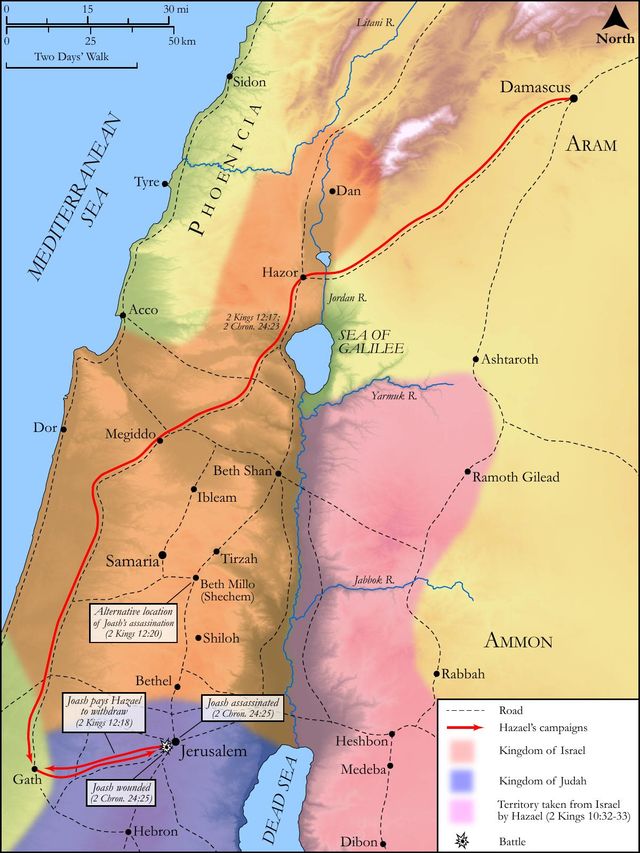
This verse marks a tragic turning point in the latter half of King Joash's reign, from initial faithfulness to profound apostasy. Joash began his rule at a very young age, guided by the righteous high priest Jehoiada, under whose influence he repaired the temple and led Judah in a period of spiritual renewal, as detailed in 2 Chronicles 24:1-16. However, after Jehoiada's death, Joash succumbed to the influence of corrupt officials, abandoning the worship of the Lord and embracing idolatry, a pivotal moment described in 2 Chronicles 24:17-19. This spiritual rebellion culminated in the heinous murder of Zechariah, Jehoiada's son, who courageously confronted Joash and the people with God's prophetic message of judgment, as recorded in 2 Chronicles 24:20-22. The Syrian invasion, led by Hazael, serves as the immediate and direct divine retribution for Judah's collective apostasy and Joash's personal wickedness, setting the stage for the devastating outcome described in verse 24.
Historical & Cultural Context
The period of Joash's reign (c. 835-796 BC) was one of shifting regional powers. Syria (Aram-Damascus), under King Hazael, was a formidable force, frequently clashing with both Israel and Judah. Military engagements among the nations of that day often involved significant numerical disparities, and the outcome was frequently attributed to the favor or disfavor of their national deities, whereas here Scripture attributes it to the LORD, who delivered a very great host into the hand of a small company because Judah had forsaken him. For ancient Israel, the covenant with Yahweh explicitly linked national prosperity and military success to obedience, and defeat and subjugation to disobedience, as outlined in the blessings and curses of Deuteronomy 28. The cultural understanding of "forsaking the God of their fathers" would have resonated deeply, signifying a betrayal of foundational national identity and covenantal obligations, which was understood to inevitably invite divine wrath and judgment.
Key Themes
ShowHideSeveral major theological and narrative themes converge in 2 Chronicles 24:24. Foremost is the theme of Divine Judgment, where God actively intervenes in human affairs, delivering a specific and severe judgment against Judah for their unfaithfulness. The Lord's direct action in "delivering a very great host into their hand" underscores His absolute sovereignty over military outcomes, demonstrating that victory or defeat is ultimately determined by His will, not by human strength or numbers. This highlights the Consequences of Apostasy, vividly illustrating that turning away from God, especially after a period of faithfulness, leads directly to severe repercussions, including military defeat and personal suffering for the king. This narrative also reinforces the principle of Covenant Faithfulness, reminding the reader of the conditional nature of God's covenant with Israel, where blessings were contingent upon obedience and curses upon disobedience, as seen throughout the Deuteronomic history and particularly in Deuteronomy 28:15-68. The stark Contrast Between Human Strength and Divine Power is also prominent, as the "small company of men" from Syria utterly defeats Judah's "very great host," emphasizing that true power and security reside only in God's favor and not in military might.
Exposition and Analysis
ShowHideKey Word Analysis
ShowHideThis verb (H5800, עָזַב) means to loosen, relinquish, abandon, or neglect. In this context, it carries profound theological weight, implying a deliberate and conscious turning away from a relationship or obligation. It signifies more than passive drifting; it is an active rejection of the covenantal relationship with the LORD God of their fathers. This word underscores the intentionality of Joash's and Judah's rebellion, highlighting their culpability in breaking faith with God.
The verb (H5414, נָתַן) means to give, put, place, or deliver. Here, it emphasizes God's active and purposeful role in the military defeat. It was not a random misfortune or a mere military accident, but a direct, sovereign act of divine judgment. God "gave" Judah's great army into the hands of the smaller Syrian force, demonstrating His absolute control over the outcomes of battles and His use of foreign nations as instruments of His righteous judgment, even against His own people when they stray.
Verse Breakdown
ShowHide"For the army of the Syrians came with a small company of men,"
This clause establishes the seemingly insurmountable odds from a human perspective. The Syrian force was numerically insignificant compared to Judah's army, setting up a dramatic contrast that immediately points to a supernatural intervention. This detail highlights the unexpected and humanly inexplicable nature of the impending defeat, underscoring that the outcome was not due to conventional military superiority.
"and the LORD delivered a very great host into their hand,"
This is the pivotal theological statement of the verse. It explicitly attributes the victory of the small Syrian force not to their military prowess, but to the direct, sovereign action of Yahweh (H3068, Yᵉhôvâh). The "very great host" (H2428, chayil; H7230, rôb; H3966, mᵉʼôd) refers to Judah's army, emphasizing the magnitude of their defeat and the power of the divine hand (H3027, yâd) that orchestrated it. This phrase unequivocally declares that God was the active agent in Judah's downfall.
"because they had forsaken the LORD God of their fathers."
This clause provides the divine rationale for the judgment. The military defeat was not arbitrary but a direct consequence of Judah's spiritual apostasy. "Forsaken" (H5800, ʻâzab) implies a conscious and deliberate abandonment of their covenant relationship with God (H430, ʼĕlôhîym), a turning away from the God who had historically delivered and blessed their ancestors (H1, ʼâb). This highlights the principle of divine justice: disobedience brings judgment.
"So they executed judgment against Joash."
This final clause states the immediate outcome and target of God's judgment. The "they" refers to the Syrians, who, as instruments of God's wrath, carried out the divine decree of judgment (H8201, shepheṭ) against King Joash (H3101, Yôwʼâsh). This judgment was not just against the nation, but specifically against the king who had led them into idolatry and even murdered God's prophet. It foreshadows Joash's subsequent assassination, completing the cycle of divine retribution.
Literary Devices
ShowHideThe verse employs several powerful Literary Devices to convey its message. Most prominently, there is a stark Contrast between the "small company of men" of the Syrians and Judah's "very great host," which serves to magnify the divine intervention. This numerical disparity creates a profound sense of Irony, as the militarily superior force is utterly vanquished by the inferior one, underscoring that human strength is futile without God's favor. The entire verse functions as a clear example of Divine Retribution, where a specific act of national sin (forsaking the Lord) is met with an immediate and devastating divine punishment (military defeat). The phrase "the LORD God of their fathers" is an appeal to Covenant Language, reminding the reader of the historical and ancestral relationship between God and Israel, and thus emphasizing the gravity of Judah's betrayal of this sacred bond. The narrative also uses Foreshadowing, as the execution of judgment by the Syrians against Joash hints at his ultimate demise, which occurs shortly after this event.
Theological and Thematic Connections
ShowHide2 Chronicles 24:24 serves as a profound theological statement on God's active sovereignty in history and His unwavering commitment to covenantal justice. It powerfully illustrates that God is not a passive observer but an engaged ruler who holds nations and their leaders accountable for their faithfulness. The defeat of Judah, despite their numerical superiority, underscores the biblical principle that true strength and security do not lie in human might or resources, but in a right relationship with God. This passage resonates with the broader biblical narrative of conditional covenant, where blessings are promised for obedience and curses for disobedience, emphasizing the serious consequences of spiritual apostasy and the divine prerogative to use even foreign nations as instruments of judgment against His own people when they turn away from Him.
Reflection and Application
ShowHideThe tragic narrative of Joash in 2 Chronicles 24:24 offers a timeless and sobering lesson for believers today. It serves as a powerful reminder that spiritual complacency and apostasy carry severe consequences, even for those who began their walk with God commendably. Joash's initial faithfulness under Jehoiada's guidance highlights the importance of consistent spiritual discipline and the dangers of succumbing to negative influences once accountability is removed. Our ultimate security and success, both individually and corporately, are not found in our own strength, resources, or numbers, but in our unwavering obedience and trust in God. This passage challenges us to cultivate a deep, personal relationship with the Lord that is not dependent on external influences, and to remain steadfast in our commitment to Him, recognizing that God is just and will hold His people accountable for their faithfulness to His covenant. It calls us to vigilance against spiritual drifting and to a renewed commitment to the "God of our fathers," lest we experience the painful repercussions of forsaking Him.
Questions for Reflection
ShowHideFAQ
ShowHideWhy did God allow a small Syrian army to defeat Judah's "very great host"?
ShowHideGod allowed a small Syrian army to defeat Judah's numerically superior force as a direct act of divine judgment. The verse explicitly states this was "because they had forsaken the LORD God of their fathers." King Joash and the people of Judah had abandoned the covenant with Yahweh, turning to idolatry and even murdering Zechariah, the prophet who confronted them with God's message (2 Chronicles 24:17-22). This defeat demonstrated God's absolute sovereignty over military outcomes, proving that victory is not determined by human strength or numbers, but by divine favor or disfavor, and that He uses even foreign nations as instruments of His righteous judgment.
What does it mean that they "executed judgment against Joash"?
ShowHideThe phrase "So they executed judgment against Joash" means that the Syrian army, acting as instruments of God's will, brought about the divine punishment specifically upon King Joash. This judgment was both military defeat and personal suffering for the king. While the Syrians were the physical agents, the ultimate source of this "judgment" was the Lord, who was holding Joash accountable for his profound apostasy and the murder of Zechariah. This event directly precedes Joash's own assassination by his servants, which further completes the divine judgment against him for shedding innocent blood (2 Chronicles 24:25).
Christ-Centered Fulfillment
ShowHideThe judgment against Joash and Judah in 2 Chronicles 24:24, born from their forsaking the covenant God, powerfully foreshadows the ultimate judgment and the ultimate solution found in Christ. While Joash faced the consequences of his apostasy through a foreign army, humanity's far greater rebellion against God's perfect law required a more profound judgment. Yet, in Christ, we see God's justice met with His boundless mercy. The Old Testament judgments, like that against Joash, highlight the severity of sin and the righteousness of God, preparing us to understand the need for a perfect sacrifice. Jesus, the true King, did not forsake the Lord; rather, He perfectly obeyed, even to the point of death on a cross (Philippians 2:8). He became the Lamb of God who takes away the sin of the world, bearing the judgment that was due to us. Through His atoning work, the "very great host" of our sins is not delivered into the hands of an enemy for our destruction, but rather, our sin is taken away, and we are offered reconciliation and a new covenant, sealed by His blood (Hebrews 9:15). Thus, the narrative of Joash's judgment points us to the glorious truth that in Christ, God's judgment for sin was fully executed upon His Son, allowing those who trust in Him to escape eternal condemnation and receive everlasting life (Romans 8:1).