


2 Chronicles 24:25
Bible text: King James Version (1769 Blayney text) · Public domain
Bible text: King James Version with Strong's numbers · Public domain
Bible text: Berean Standard Bible · Public domain
Bible text: American Standard Version (1901) · Public domain
Bible text: World English Bible, Messianic edition · Public domain
Bible text: Geneva Bible (1599) · Public domain
Bible text: Young's Literal Translation · Public domain
- וּבְלֶכְתָּםu·ve·lekh·Tamand when they wentH1980Conj-w ¦ Prep-b ¦ V-Qal-Inf ¦ 3mpVerb Qal Infinitive Constructוּandבְwhenלֶכְתָּwentםthey
- מִמֶּנּוּmi·Me·nufrom himH4480Prep ¦ 3msPrepositionמִמֶּfromנּוּhim
- כִּיkiforH3588PrtParticle Conditional
- עָזְבוּ'a·ze·Vuthey had leftH5800V-Qal-Perf-3cpVerb Qal Perfect 3rd Plural common gender
- אֹתוֹ'o·To<obj.> himH853DirObjM ¦ 3msParticle Object Indicatorאֹת<obj.>וֹhim
- בְּמַחֲלוּיִםbe·ma·cha·li·yimwith sicknessesH4251Prep-b ¦ N-mpNoun Plural Masculine Absoluteבְּwithמַחֲלוּיִםsicknesses
- רַבִּיםra·BimgreatH7227Adj-mpAdjective Plural Masculine Absolute
- הִתְקַשְּׁרוּhit·ka·she·Ruthey conspiredH7194V-Hithpael-Perf-3cpVerb Hithpael Perfect 3rd Plural common gender
- עָלָיו'a·Lavon himH5921Prep ¦ 3msPrepositionעָלָיonוhim
- עֲבָדָיו'a·va·Davhis own servantsH5650N-mpc ¦ 3msNoun Plural Masculine Constructעֲבָדָיown servantsוhis
- בִּדְמֵיbid·Meiin [the] blood<s> ofH1818Prep-b ¦ N-mpcNoun Plural Masculine Constructבִּinדְמֵי[the] blood<s> of
- בְּנֵיbe·Nei[the] sons ofH1121N-mpcNoun Plural Masculine Construct
- יְהוֹיָדָעye·ho·ya·Da'JehoiadaH3077N-proper-mNoun Proper Masculine
- הַכֹּהֵןha·ko·Henthe priestH3548Art ¦ N-msNoun Singular Masculine Absoluteהַtheכֹּהֵןpriest
- וַיַּהַרְגֻהוּvai·ya·har·Gu·huand they killed himH2026Conj-w ¦ V-Qal-ConsecImperf-3mp ¦ 3msVerb Qal Consecutive Imperfect 3rd Plural Masculineוַandיַּהַרְגֻthey killedהוּhim
- עַל'alonH5921PrepPreposition
- מִטָּתוֹmi·ta·Tohis bedH4296N-fsc ¦ 3msNoun Singular Feminine Constructמִטָּתbedוֹhis
- וַיָּמֹתvai·ya·Motand he diedH4191Conj-w ¦ V-Qal-ConsecImperf-3msVerb Qal Consecutive Imperfect 3rd Singular Masculineוַandיָּמֹתhe died
- וַיִּקְבְּרֻהוּvai·yik·be·Ru·huand they buried himH6912Conj-w ¦ V-Qal-ConsecImperf-3mp ¦ 3msVerb Qal Consecutive Imperfect 3rd Plural Masculineוַandיִּקְבְּרֻthey buriedהוּhim
- בְּעִירbe·'Irin [the] city ofH5892Prep-b ¦ N-fscNoun Singular Feminine Constructבְּinעִיר[the] city of
- דָּוִידda·VidDavidH1732N-proper-mNoun Proper Masculine
- וְלֹאve·Lo'and notH3808Conj-w ¦ NegParticle Negativeוְandלֹאnot
- קְבָרֻהוּke·va·Ru·huthey buried himH6912V-Qal-Perf-3cp ¦ 3msVerb Qal Perfect 3rd Plural common genderקְבָרֻthey buriedהוּhim
- בְּקִבְרוֹתbe·kiv·Rotin [the] graves ofH6913Prep-b ¦ N-fpcNoun Plural Feminine Constructבְּinקִבְרוֹת[the] graves of
- הַמְּלָכִיםha·me·la·Khimthe kingsH4428Art ¦ N-mpNoun Plural Masculine Absoluteהַtheמְּלָכִיםkings
English is a literal word-by-word gloss of the Hebrew, not the KJV's wording. Why?
This is the original text the KJV's translators worked from — each Hebrew word with its own literal English meaning in this verse, prepared by scholars at Tyndale House, Cambridge. The KJV translates whole sentences, not word by word, so its wording differs: one Hebrew word can become several English words, and the KJV may choose “the LORD” where the gloss reads “Yahweh”. Both are faithful — they answer different questions. For the KJV's own rendering, switch to the KJV text.
Details
See on the biblical-era map
Study this verse
Public-domain commentary
Matthew Henry
From his Commentary on the Whole Bible. Henry comments on passages, not single verses — this entry covers 2 Chronicles 24:15–27. His three-level outline is real structure in the source text, so it is rendered as structure.
We have here a sad account of the degeneracy and apostasy of Joash. God had done great things for him; he had done something for God; but now he proved ungrateful to his God and false to the engagements he had laid himself under to him. How has the gold become dim, and the most fine gold changed! Here we find,
I.The occasions of his apostasy.
When he did that which was right it was not with a perfect heart. He never was sincere, never acted from principle, but in compliance to Jehoiada, who had helped him to the crown, and because he had been protected in the temple and rose upon the ruins of idolatry; and therefore, when the wind turned, he turned with it.
1.His good counsellor left him, and was by death removed from him. It was a mercy to him and his kingdom that Jehoiada lived so long-130 years (Ch2 24:15), by which it appears that he was born in Solomon's time, and had lived six entire reigns before this. It was an encouragement to him to go on in that good way which Jehoiada had trained him up in to see what honour was done to Jehoiada at his death: They buried him among the kings, with this honourable encomium (perhaps it was part of the inscription on his grave-stone), that he had done good in Israel. Judah is called Israel, because, the other tribes having revolted from God, they only were Israelites indeed. Note, It is the greatest honour to do good in our generations, and those who do that which is good shall have praise of the same. He had done good towards God; not that any man's goodness can extend unto him, but he had done good towards his house, in reviving the temple service, Ch2 23:8. Note, Those do the greatest good to their country that lay out themselves in their places to promote religion. Well, Jehoiada finished his course with honour; but the little religion that Joash had was all buried in his grave, and, after his death, both king and kingdom miserably degenerated. See how much one head may sustain, and what a great judgment to any prince or people the death of godly, zealous, useful men is. See how necessary it is that, as our Saviour speaks, we have salt in ourselves, that we act in religion from an inward principle, which will carry us on through all changes. Then the loss of a parent, a minister, a friend, will not involve the loss of our religion.
2.Bad counsellors got about him, insinuated themselves into his affections, wheedled him, flattered him, made obeisance to him, and, instead of condoling, congratulated him upon the death of his old tutor, as his release from the discipline he had been so long under, unworthy a man, a king. They tell him he must be priest-ridden no longer, he is now discharged from grave lessons and restraints, he may do as he pleases: and (would you think it?) the princes of Judah were the men that were so industrious to debauch him, Ch2 24:17. His father and grandfather were corrupted by the house of Ahab, from whom no better could be expected. But that the princes of Judah should be seducers to their king was very sad. But those that incline to the counsels of the ungodly will never want ungodly counsellors. They made obeisance to the king, flattered him into an opinion of his absolute power, promised to stand by him in making his royal will and pleasure pass for a law, any divine precept or institution to the contrary in any wise notwithstanding. And he hearkened to them: their discourse pleased him, and was more agreeable than Jehoiada's dictates used to be. Princes and inferior people have been many a time thus flattered into their ruin by those who have promised them liberty and dignity, but who have really brought them into the greatest servitude and disgrace.
II.The apostasy itself:
They left the house of God, and served groves and idols, Ch2 24:18. The princes, it is likely, had a request to the king, which they tell him they durst not offer while Jehoiada lived; but now they hope it will give no offence: it is that they may set up the groves and idols again which were thrown down in the beginning of his reign, for they hate to be always confined to the dull old-fashioned service of the temple. And he not only gave them leave to do it themselves, but he joined with them. The king and princes, who, a little while ago, were repairing the temple, now forsook the temple; those who had pulled down groves and idols now themselves served them. So inconstant a thing is man and so little confidence is to be put in him!
III.The aggravations of this apostasy and the additions of guilt to it.
God sent prophets to them (Ch2 24:19) to reprove them for their wickedness, and to tell them what would be in the end thereof, and so to bring them again unto the Lord. It is the work of ministers to bring people, not to themselves, but to God - to bring those again to him who have gone a whoring from him. In the most degenerate times God left not himself without witness; though they had dealt very disingenuously with God, yet he sent prophets to them to convince and instruct them, and to assure them that they should find favour with him if yet they would return; for he would rather sinners should turn and live than go on and die, and those that perish shall be left inexcusable. The prophets did their part: they testified against them; but, few or none received their testimony.
1.They slighted all the prophets; they would not give ear, were so strangely wedded to their idols that no reproofs, warnings, threatenings, nor any of the various methods which the prophets took to convince them would reclaim them. Few would hear them, fewer would heed them, but fewest of all would believe them or be governed by them.
2.They slew one of the most eminent, Zechariah the son of Jehoiada, and perhaps others. Concerning him observe,
(1.)The message which he delivered to them in the name of God, Ch2 24:20. The people were assembled in the court of the temple (for they had not quite left it), probably on occasion of some solemn feast, when this Zechariah, being filled with the spirit of prophecy, and known (it is likely) to be a prophet, stood up in some of the desks that were in the court of the priests, and very plainly, but without any provoking language, told the people of their sin and what would be the consequences of it. He did not impeach any particular persons, nor predict any particular judgments, as sometimes the prophets did, but as inoffensively as possible reminded them of what was written in the law. Let them but look into their Bibles, and there they would find, [1.] The precept they broke: "You transgress the commandments of the Lord, you know you do so, in serving groves and idols: and why will you so offend God and wrong yourselves?" [2.] The penalty they incurred: "You know, if the word of God be true, you cannot prosper in this evil way; never expect to do ill and fare well. Nay, you find already that because you have forsaken the Lord he hath forsaken you, as he told you he would," Deu 29:25; Deu 31:16, Deu 31:17. This is the work of ministers, by the word of God, as a lamp and a light, to expose the sin of men and expound the providences of God.
(2.)The barbarous treatment they gave him for his kindness and faithfulness in delivering this message to them, Ch2 24:21. By the conspiracy of the princes, or some of their party, and by the commandment of the king, who thought himself affronted by this fair warning, they stoned him to death immediately, not under colour of law, accusing him as a blasphemer, a traitor, or a false prophet, but in a popular tumult, in the court of the house of the Lord - as horrid a piece of wickedness as perhaps any we read of in all the history of the kings. The person was sacred - a priest, the place sacred - the court of the temple (the inner court, between the porch and the altar), the message yet more sacred, and we have reason to think that they knew it came from the spirit of prophecy. The reproof was just, the warning fair, both backed with scripture, and the delivery very gentle and tender; and yet so impudently and daringly do they defy God himself that nothing less than the blood of the prophet can satisfy their indignation at the prophecy. Be astonished, O heavens! at this, and tremble, O earth! that ever such villany should be committed by men, by Israelites, in contempt and violation of every thing that is just, honourable, and sacred - that a king, a king in covenant with God, should command the murder of one whom it was his office to protect and countenance! The Jews say there were seven transgressions in this; for they killed a priest, a prophet, a judge, they shed innocent blood, and polluted the court of the temple, the sabbath, and the day of expiation: for on that day, their tradition says, this happened.
(3.)The aggravation of this sin, that this Zechariah, who suffered martyrdom for his faithfulness to God and his country, was the son of Jehoiada, who had done so much good in Israel, and particularly had been as a father to Joash, Ch2 24:22. The affront done by it to God, and the contempt put on religion, are not so particularly taken notice of as the ingratitude there was in it to the memory of Jehoiada. He remembered not the kindness of the father, but slew the son for doing his duty, and what the father would have done if he had been there. Call a man ungrateful, and you can call him no worse.
(4.)The dying martyr's prophetic imprecation of vengeance upon his murderers: The Lord look upon it, and require it! This came not from a spirit of revenge, but a spirit of prophecy: He will require it. This would be the continual cry of the blood they shed, as Abel's blood cried against Cain: "Let the God to whom vengeance belongs demand blood for blood. He will do it, for he is righteous." This precious blood was quickly reckoned for in the judgments that came upon this apostate prince; it came into the account afterwards in the destruction of Jerusalem by the Chaldeans - their misusing the prophets was that which brought upon them ruin without remedy (Ch2 36:16); nay, our Saviour makes the persecutors of him and his gospel answerable for the blood of this Zechariah; so loud, so long, does the blood of the martyrs cry. See Mat 23:35. Such as this is the cry of the souls under the altar (Rev 6:10), How long ere thou avenge our blood? For it shall not always go unrevenged.
IV.The judgments of God which came upon Joash for this aggravated wickedness of his.
1.A small army of Syrians made themselves masters of Jerusalem, destroyed the princes, plundered the city, and sent the spoil of it to Damascus, Ch2 24:23, Ch2 24:24. God's people, while they kept in with God, had often been conquerors when the enemy had the advantage of the greater number; but now, on the contrary, an inconsiderable handful of Syrians routed a very great host of Israelites, because they had forsaken the Lord God of their fathers, and then they were not only put upon the level with their enemies, but opposed them with the utmost disadvantage; for their God not only departed from them, but turned to be their enemy and fought against them. The Syrians were employed as instruments in God's hand to execute judgments against Joash, though they little thought so, Isa 10:6, Isa 10:7, and see Deu 32:30.
2.God smote him with great diseases, of body, or mind, or both, either like his grandfather (Ch2 21:18), or, like Saul, an evil spirit from God troubling him. While he was plagued with the Syrians he thought that, if he could but get clear of them, he should do well enough. But, before they departed from him, God smote him with diseases. If vengeance pursue men, the end of one trouble will but be the beginning of another.
3.His own servants conspired against him. Perhaps he began to hope his disease would be cured - he was but a middle-aged man and might recover it; but he that cometh up out of the pit shall fall into the snare. When he thought he should escape death by sickness he met it by the sword. They slew him in his bed for the blood of the sons of Jehoiada, by which it should seem that he did not only slay Zechariah, but others of the sons of Jehoiada for his sake. Perhaps those that slew him intended to take vengeance for that blood; but, whether they did or not, this was what God intended in permitting them to slay him. Those that drink the blood of the saints shall have their own blood given them to drink, for they are worthy. The regicides are here named (Ch2 24:26), and it is observable that the mothers of them both were foreigners, one an Ammonitess and the other a Moabitess. The idolatrous kings, it is likely, countenanced those marriages which the law prohibited for the prevention of idolatry; and see how they resulted in their own destruction.
4.His people would not bury him in the sepulchres of the kings because he had stained his honour by his mal-administration. Let him not be written with the righteous, Psa 69:28. These judgments are called the burdens laid upon him (Ch2 24:27), for the wrath of God is a heavy burden, too heavy for any man to bear. Or it may be meant of the threatenings denounced against him by the prophets, for those are called burdens. Usually God sets some special marks of his displeasure upon apostates in this life, for warning to all to remember Lot's wife.
Historical interpretation
Five Centuries of Reception
3 surviving comments on this verse. Each one is dated, so this reads as a timeline rather than a list.
Select a marker to jump to its quote. Markers stagger vertically where authors wrote within a few decades of each other.
But if there are some who think that they can return to the Church not with prayers but with threats, or suppose that they can make a way for themselves, not with lamentation and atonements, but with terrors, let them take it for certain that against such the Church of the Lord stands closed; nor does the camp of Christ, unconquered and firm with the Lord's protection, yield to threats. The priest of God holding fast the Gospel and keeping Christ's precepts may be slain; he cannot be conquered. Zacharias, God's priest, suggests and furnishes to us examples of courage and faith, who, when he could not be terrified with threats and stoning, was slain in the temple of God, at the same time crying out and saying, what we also cry out and say against the heretics, "Thus saith the Lord, Ye have forsaken the ways of the Lord, and the Lord will forsake you."
Some such thing we read of in the book of Chronicles. For Joash the king of Judah at the age of seven was summoned by Jehoiada the priest to the kingdom and by the witness of Scripture is commended for all his actions as long as the aforesaid priest lived. But hear what Scripture relates of him after Jehoiada’s death and how he was puffed up with pride and given over to a most disgraceful state. “But after the death of Jehoiada the princes went in and worshiped the king: and he was soothed by their services and hearkened to them. And they forsook the temple of the Lord, the God of their fathers, and served groves and idols, and great wrath came on Judah and Jerusalem because of this sin.” And after a little: “When a year was come about, the army of Syria came up against him: and they came to Judah and Jerusalem and killed all the princes of the people, and they sent all the spoils to the king to Damascus. And whereas there came a very small number of the Syrians, the Lord delivered into their hands an infinite multitude, because they had forsaken the Lord the God of their fathers; and on Joash they executed shameful judgments. And departing they left him in great diseases.” You see how the consequence of pride was that he was given over to shocking and filthy passions. For he who is puffed up with pride and has permitted himself to be worshiped as God, is (as the apostle says) “given over to shameful passions and a reprobate mind to do those things that are not convenient.” And because, as Scripture says, “everyone who exalts his heart is unclean before God,” he who is puffed up with swelling pride of heart is given over to most shameful confusion to be deluded by it, that when thus humbled he may know that he is unclean through impurity of the flesh and knowledge of impure desires, a thing that he had refused to recognize in the pride of his heart; and also that the shameful infection of the flesh may disclose the hidden impurity of the heart, which he contracted through the sin of pride, and that through the patent pollution of his body he may be proved to be impure, who did not formerly see that he had become unclean through the pride of his spirit.
Zechariah was son of high priest Jehoiada, a man who was likewise very holy. They stoned Zechariah between the temple and the altar, as the Lord himself bore witness when he made mention of the blessed martyrs in the Gospel.
Continue studying 2 Chronicles 24:25 across the web’s major study libraries — every link below opens this exact verse, chapter, or book on the destination site.
Read & Compare
 BibleGatewayThis verse in more than 200 translations and 70 languages.
 Bible.comThe YouVersion reader — hundreds of translations, reading plans, and highlights.
 ESV.orgCrossway's official English Standard Version reader.
 NET BibleThe NET translation with 60,000+ translators' notes on every rendering decision.
 STEP BibleTyndale House's free study tool — original text, vocabulary, and scholarly resources.
 BibliaLogos Bible Software's free web reader.
 USCCBThe New American Bible (Revised Edition) with the U.S. bishops' study notes.
Commentaries
 BibleHub CommentariesDozens of classic commentaries on this verse, gathered on one page.
 StudyLightMore than 100 commentary sets — the largest collection on the web.
 BibleRefPlain-English commentary on what this verse means, verse by verse.
 Enduring WordDavid Guzik's free commentary on this chapter, widely used by Bible teachers.
 Bible Study ToolsVerse commentary alongside Greek and Hebrew study aids.
Original Language & Research
- BibleHub InterlinearThe verse word by word — original language, transliteration, and English.
- BibleHub LexiconEvery word's original-language definition and Strong's entry.
 Blue Letter BibleDeep-study tools — Strong's numbers, concordance, and word studies.
 SefariaThe Hebrew text with Rashi and centuries of Jewish commentary.
Sermons, Hymns & Audio


TrulyRandomVerse is not affiliated with these sites and doesn’t control their content. They’re linked because they’re genuinely useful.
Summary
The tragic reign of King Joash of Judah concludes in this verse with his ignominious assassination by his own servants. Left severely debilitated by a grave illness following a devastating Syrian invasion, Joash became vulnerable to a conspiracy. The explicit motivation for this regicide was retribution for his earlier, heinous act of ordering the murder of Zechariah, the son of Jehoiada the priest, whose family had once protected Joash and whose father had faithfully guided his early, righteous reign. Joash was slain in his own bed, a deeply personal and dishonorable death, and while he was interred within the City of David, he was pointedly denied burial in the hallowed sepulchres reserved for the kings, a final, public mark of disgrace and divine judgment on his apostate rule.
Context
ShowHideLiterary Context
This verse serves as the grim climax of King Joash's dramatic and ultimately tragic narrative arc within 2 Chronicles. The preceding chapters meticulously detail Joash's miraculous preservation as an infant from Athaliah's murderous purge, his installation as king by the faithful priest Jehoiada, and his initial period of righteous rule, highlighted by the significant restoration of the Temple (2 Chronicles 22:10-23:21). However, following Jehoiada's death, the narrative pivots sharply, revealing Joash's profound apostasy as he abandons the Lord, heeding wicked counsel and allowing the reintroduction of idolatry into Judah (2 Chronicles 24:17-19). This unfaithfulness precipitates divine judgment, manifested first through a devastatingly successful Syrian invasion, despite Judah's numerical and military superiority (2 Chronicles 24:23-24). The immediate catalyst for the assassination described in verse 25 was Joash's earlier, egregious act of ordering the stoning of Zechariah, Jehoiada's son, who had faithfully rebuked the king and the people for their unfaithfulness (2 Chronicles 24:20-21). Zechariah's dying imprecation, "The LORD look upon it, and require it" (2 Chronicles 24:22), directly foreshadows the retribution that now befalls Joash, underscoring the Chronicler's theological emphasis on divine justice.
Historical & Cultural Context
King Joash (also known as Jehoash) reigned over Judah in the 9th century BCE, a tumultuous period characterized by shifting alliances among the kings of that day. His reign began with an extraordinary act of preservation, as he was saved from the massacre of the royal seed by his aunt Jehoshabeath and the High Priest Jehoiada, an event that underscored the precariousness of the Davidic line and God's faithfulness to His covenant. The restoration of the Temple under Joash was a monumental cultural and religious undertaking, signaling a renewed national commitment to Yahwistic worship after the idolatrous and oppressive reign of Athaliah. Culturally, the denial of burial in the "sepulchres of the kings" was a profound and deeply significant posthumous disgrace in ancient Judah. This exclusion from the royal tombs, typically reserved for honored monarchs, communicated a public and lasting negative judgment on a king's reign, often reserved for those who died ignominiously or whose rule was deemed wicked and unfaithful to the covenant. Such a burial exclusion served as a powerful public statement, effectively stripping the deceased king of his full royal honor and communicating a divine and human rejection of his legacy, despite any initial good deeds. Conspiracies and assassinations were, unfortunately, not uncommon methods of regime change in the kingdoms of Judah and Israel, often reflecting internal strife, popular discontent, or a perceived divine judgment against a tyrannical or unfaithful ruler.
Key Themes
ShowHideThis verse powerfully encapsulates several major theological and narrative themes central to 2 Chronicles and the broader biblical narrative. Firstly, it starkly illustrates the Consequences of Apostasy, demonstrating how Joash's deliberate turning away from the Lord after Jehoiada's death led directly and inexorably to his downfall. This serves as a potent warning about the severe repercussions of disobedience and faithlessness, particularly for those in positions of leadership. Secondly, the account vividly portrays Divine Retribution and justice; Joash's murder is presented not merely as a political act but as a direct consequence and divine judgment for his sin, especially the shedding of innocent blood, thereby fulfilling Zechariah's prophetic curse. This emphasizes God's active involvement in human affairs, ensuring justice prevails. Thirdly, it underscores the theme of Leadership and Accountability, revealing that even a king, divinely appointed and initially blessed, is not exempt from God's righteous judgment for abusing power, betraying divine trust, and leading the nation astray. Finally, the narrative subtly touches upon the Fragility of Human Loyalty, as the king's own servants, those closest to him and presumably bound by duty, became his assassins, highlighting how even trusted relationships can fracture when justice or revenge is sought, or when a ruler loses divine favor.
Exposition and Analysis
ShowHideKey Word Analysis
ShowHideThis plural noun (H4251) signifies severe, debilitating illnesses or sicknesses. The text emphasizes that Joash was left in a state of extreme physical weakness and vulnerability after the Syrian army's departure. This condition rendered him incapable of defending himself, making him an easy target for the conspirators and underscoring his complete physical and political collapse, a direct consequence of divine judgment.
This verb (H7194) means "to tie," "to bind together," "to conspire," or "to plot." It indicates a deliberate, organized, and secret plot by Joash's own trusted officials. The use of this term highlights the profound betrayal from within his inner circle, emphasizing the depth of disaffection and the calculated, premeditated nature of the regicide.
In this context, "blood" (H1818) refers to the life of an individual, specifically the innocent blood of Zechariah that Joash had shed. The phrase "for the blood of the sons of Jehoiada the priest" explicitly states the motive for the assassination, linking it directly to the earlier injustice. It underscores the profound biblical principle that the shedding of innocent blood cries out for retribution and incurs severe divine judgment.
Verse Breakdown
ShowHide"And when they were departed from him, (for they left him in great diseases,)"
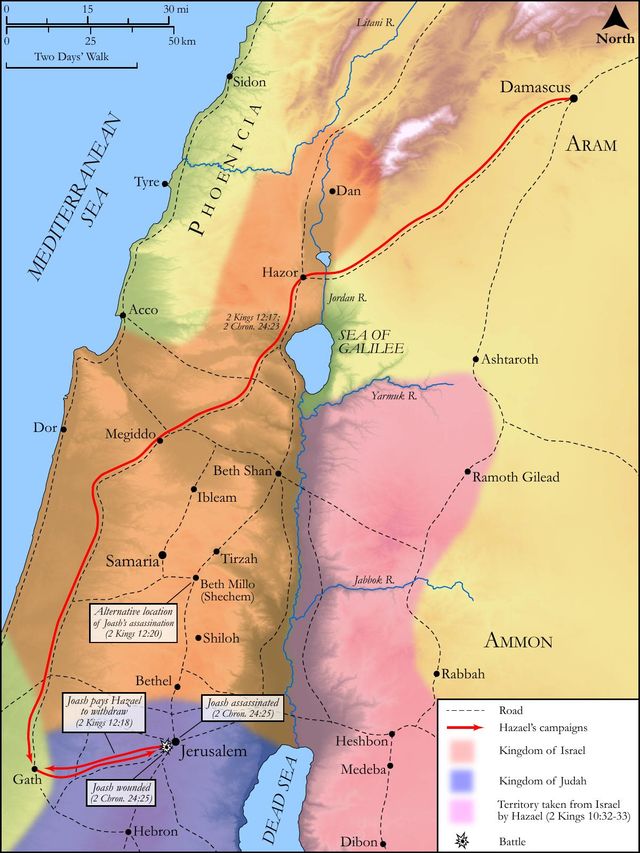
This opening clause establishes the immediate context for the assassination. "They" refers to the Syrian army under Hazael, who had just inflicted a humiliating defeat upon Judah, leaving Joash not only militarily vanquished but also physically broken. The parenthetical phrase "for they left him in great diseases" clarifies Joash's state: he was severely afflicted, likely with wounds from battle or a subsequent illness, rendering him profoundly weakened and vulnerable, a stark contrast to his earlier vitality and a sign of God's judgment.
"his own servants conspired against him for the blood of the sons of Jehoiada the priest, and slew him on his bed, and he died:"
This is the core action of the verse, detailing the regicide. The perpetrators are explicitly identified as "his own servants," indicating a profound betrayal from within his most trusted inner circle. The explicit motive, "for the blood of the sons of Jehoiada the priest," directly links the assassination to Joash's earlier command to stone Zechariah, Jehoiada's son, highlighting that the act was a direct retribution for the shedding of innocent blood. The method, "slew him on his bed," emphasizes the personal and intimate nature of the betrayal, occurring in a place of supposed security and rest, further underscoring his vulnerability and the ignominy of his end.
"and they buried him in the city of David, but they buried him not in the sepulchres of the kings."
This final clause describes Joash's burial and its significant qualification. While he was buried "in the city of David," signifying a degree of recognition as a king of Judah, the crucial qualification "but they buried him not in the sepulchres of the kings" conveys a profound mark of disgrace. This denial of burial in the royal tombs, reserved for honored monarchs, was a public and lasting condemnation of his reign, reflecting both human judgment and, more importantly, divine displeasure over his apostasy and the murder of Zechariah.
Literary Devices
ShowHideThe narrative of Joash's demise in 2 Chronicles 24:25 employs several potent literary devices to underscore its theological message. Irony is profoundly evident: Joash, whose life was miraculously preserved by Jehoiada and who initially reigned righteously under his guidance, ultimately orders the murder of Jehoiada's own son, Zechariah, and is then himself assassinated in retribution for that very act. This tragic reversal highlights the profound ingratitude and spiritual decline of the king. Foreshadowing is also clearly at play, as Zechariah's dying words, "The LORD look upon it, and require it" (2 Chronicles 24:22), directly anticipate the divine retribution that befalls Joash, demonstrating God's active hand in justice. The text also uses powerful Juxtaposition to emphasize Joash's precipitous fall: his initial glorious reign and diligent Temple restoration are starkly contrasted with his ignominious end, marked by betrayal, illness, and a dishonorable burial. Furthermore, the description of his burial—"in the city of David, but they buried him not in the sepulchres of the kings"—juxtaposes a partial honor with a definitive disgrace, powerfully communicating the negative assessment of his legacy. Finally, the entire account serves as a clear example of Cause and Effect, illustrating the direct link between Joash's apostasy and the shedding of innocent blood (the cause) and his violent death and dishonorable burial (the effect), reinforcing the Chronicler's theological framework of immediate divine recompense.
Theological and Thematic Connections
ShowHideThe account of Joash's demise in 2 Chronicles 24:25 serves as a powerful theological commentary on the principles of divine justice, the severe consequences of covenant unfaithfulness, and the sanctity of innocent life. Despite his initial righteous beginning, Joash's deliberate turning away from the Lord after the death of his spiritual mentor, Jehoiada, led to a rapid moral and spiritual decay. His command to murder Zechariah, a prophet who faithfully delivered God's rebuke, was not merely a political act but a profound act of rebellion against God Himself and a betrayal of the very family that had secured his throne. The assassination by his own servants, explicitly linked to "the blood of the sons of Jehoiada," demonstrates God's sovereign hand in bringing about retribution, even through human agents. This narrative underscores that God is a righteous judge who holds leaders accountable for their actions, particularly when they abuse their power and shed innocent blood. The denial of a full royal burial further emphasizes the divine verdict on his reign, signifying that his apostasy had negated his earlier good deeds in the eyes of God and the chronicler, serving as a lasting historical and theological condemnation.
Reflection and Application
ShowHideThe story of King Joash is a deeply sobering and vital reminder that a good beginning does not guarantee a good end. His life serves as a profound cautionary tale about the insidious dangers of spiritual complacency and the critical importance of sustained, personal faithfulness, independent of external influences or mentors. Joash's initial zeal for the Lord and his commendable efforts to restore the Temple were significant, yet his subsequent turning away from God after Jehoiada's death illustrates the profound fragility of a faith not deeply rooted in a personal conviction and relationship with God. This account challenges us to consider our own spiritual foundations: are we serving God out of genuine, heartfelt devotion, or are we merely following the lead of others, susceptible to drifting when those influences are removed? Furthermore, Joash's swift and violent end, explicitly tied to his act of injustice against Zechariah, powerfully underscores the biblical principle that actions have consequences, and God does not ignore the shedding of innocent blood or the betrayal of His covenant. It compels us to reflect on the sanctity of life, the profound weight of our decisions, and the ultimate accountability we have before God, especially for those of us in positions of leadership or influence within our families, communities, or churches.
Questions for Reflection
ShowHideFAQ
ShowHideWhy was Joash denied burial in the sepulchres of the kings?
ShowHideJoash was denied burial in the sepulchres of the kings as a profound mark of disgrace and a public condemnation of his reign. In ancient Judah, burial in the royal tombs within the City of David was a significant honor, reserved for kings whose reigns were considered righteous, successful, or at least not utterly wicked. It symbolized a positive posthumous assessment and an affirmation of their legitimate place in the Davidic dynasty. Joash's exclusion from these tombs, despite being buried within the City of David, signaled that his apostasy, particularly his command to murder Zechariah, the son of the very priest who had saved and guided him, had negated his earlier good deeds. This denial of full royal burial was a public declaration that his reign ended in dishonor and was under divine judgment, fulfilling the prophetic words of Zechariah (2 Chronicles 24:22). It served as a stark historical and theological verdict on a king who began well but ended in unfaithfulness and injustice, highlighting the Chronicler's emphasis on immediate divine retribution for disobedience.
Christ-Centered Fulfillment
ShowHideThe tragic narrative of King Joash, particularly his assassination for the shedding of innocent blood, finds profound Christ-centered fulfillment in the person and redemptive work of Jesus Christ. Joash's betrayal of Jehoiada's legacy and his murder of Zechariah, the righteous prophet who spoke God's truth, powerfully foreshadow the ultimate rejection and martyrdom of the true Prophet, Jesus, who came to His own but was not received (John 1:11). Jesus Himself references the blood of Zechariah, son of Berechiah (likely the same prophetic martyr as in 2 Chronicles), as part of the cumulative guilt of Israel for rejecting God's messengers throughout history, culminating in the rejection of Himself (Matthew 23:35; Luke 11:51). While Joash's death was a direct consequence of his own sin and the divine retribution for innocent blood, Christ, the truly innocent Lamb of God, willingly shed His blood not for His own sin, but as the ultimate, atoning sacrifice for the sins of humanity (John 1:29). Unlike Joash, who succumbed to temptation and failed to maintain faithfulness, Jesus remained perfectly obedient to the Father, even unto death on a cross (Philippians 2:8). His perfect righteousness and sacrificial death provide the means for forgiveness and reconciliation with God, a stark contrast to the cycle of retribution seen in Joash's story. Furthermore, Joash's ignominious burial, denied a place among the honored kings, stands in stark contrast to Christ's burial and glorious resurrection, which secured His eternal reign as King of kings and Lord of lords (Revelation 19:16), offering true and lasting hope and a spiritual inheritance far surpassing any earthly sepulcher for all who believe in Him (1 Peter 1:3-5).