


2 Kings 14:19
Bible text: King James Version (1769 Blayney text) · Public domain
Bible text: Berean Standard Bible · Public domain
Bible text: American Standard Version (1901) · Public domain
Bible text: World English Bible, Messianic edition · Public domain
Bible text: Geneva Bible (1599) · Public domain
Bible text: Young's Literal Translation · Public domain
- וַיִּקְשְׁרוּvai·yik·she·Ruand people conspiredH7194Conj-w ¦ V-Qal-ConsecImperf-3mpVerb Qal Consecutive Imperfect 3rd Plural Masculineוַandיִּקְשְׁרוּpeople conspired
- עָלָיו'a·Lavon himH5921Prep ¦ 3msPrepositionעָלָיonוhim
- קֶשֶׁרKe·shera conspiracyH7195N-msNoun Singular Masculine Absolute
- בִּירוּשָׁלִַםbi·ru·sha·Limin JerusalemH3389Prep-b ¦ N-properNoun Proper LocationבִּinירוּשָׁלִַםJerusalem
- וַיָּנָסvai·Ya·nosand he fledH5127Conj-w ¦ V-Qal-ConsecImperf-3msVerb Qal Consecutive Imperfect 3rd Singular Masculineוַandיָּנָסhe fled
- לָכִישָׁהla·Khi·shahLachish towardsH3923N-proper ¦ SfxNoun Proper LocationלָכִישָׁLachishהtowards
- וַיִּשְׁלְחוּvai·yish·le·Chuand they sentH7971Conj-w ¦ V-Qal-ConsecImperf-3mpVerb Qal Consecutive Imperfect 3rd Plural Masculineוַandיִּשְׁלְחוּthey sent
- אַחֲרָיו'a·cha·Ravafter himH310Adj-mpc ¦ 3msAdjective Numerical Plural Masculine Constructאַחֲרָיafterוhim
- לָכִישָׁהla·Khi·shahLachish towardsH3923N-proper ¦ SfxNoun Proper LocationלָכִישָׁLachishהtowards
- וַיְמִתֻהוּvay·mi·Tu·huand they put to death himH4191Conj-w ¦ V-Hiphil-ConsecImperf-3mp ¦ 3msVerb Hiphil Consecutive Imperfect 3rd Plural Masculineוַandיְמִתֻthey put to deathהוּhim
- שָׁםShamthereH8033AdvAdverb
English is a literal word-by-word gloss of the Hebrew, not the KJV's wording. Why?
This is the original text the KJV's translators worked from — each Hebrew word with its own literal English meaning in this verse, prepared by scholars at Tyndale House, Cambridge. The KJV translates whole sentences, not word by word, so its wording differs: one Hebrew word can become several English words, and the KJV may choose “the LORD” where the gloss reads “Yahweh”. Both are faithful — they answer different questions. For the KJV's own rendering, switch to the KJV text.
Details
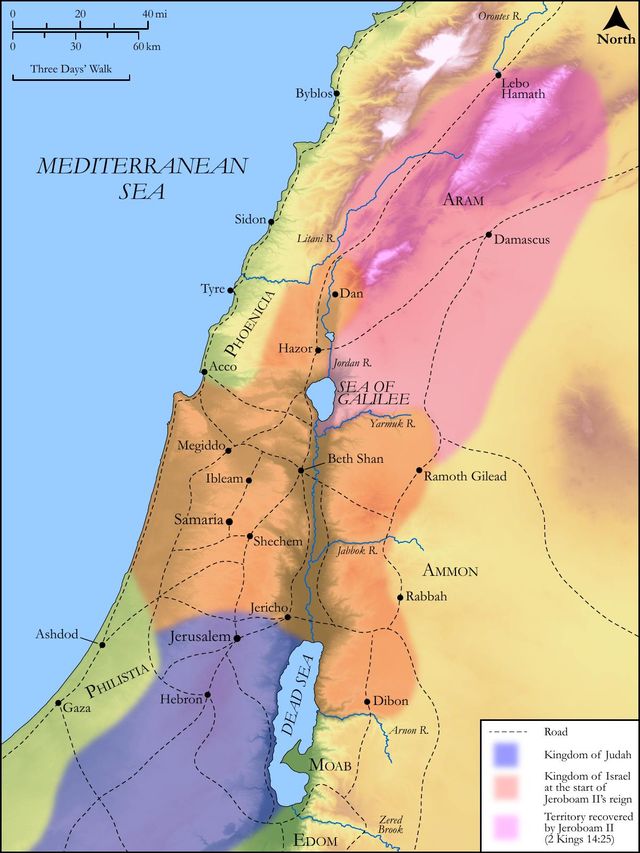
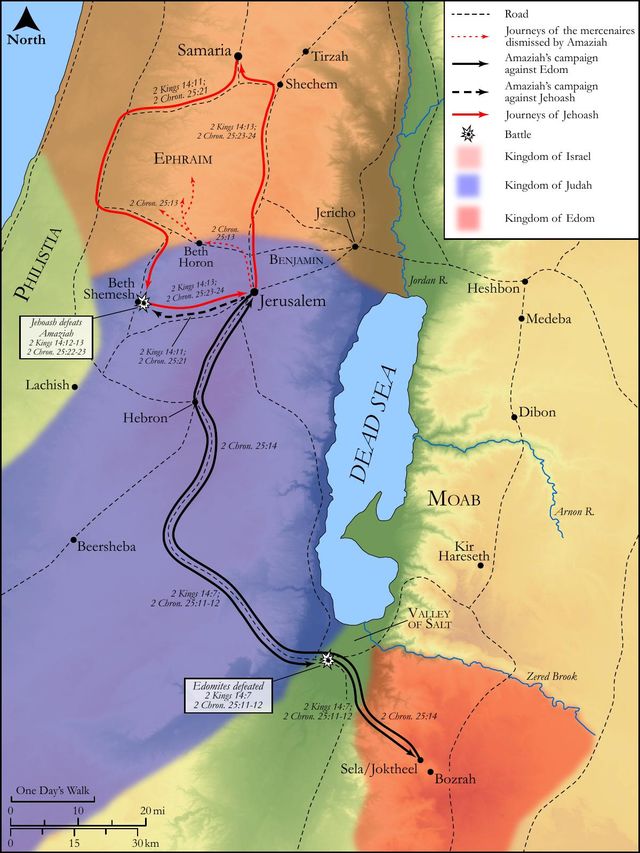
See on the biblical-era maps
Study this verse
Public-domain commentary
Matthew Henry
From his Commentary on the Whole Bible. Henry comments on passages, not single verses — this entry covers 2 Kings 14:15–22.
Here are three kings brought to their graves in these few verses: - 1. Joash king of Israel, Kg2 14:15, Kg2 14:16. We attended his funeral once before, Kg2 13:12, Kg2 13:13. But, because the historian had occasion to give a further account of his life and actions, he again mentions his death and burial. 2. Amaziah king of Judah. Fifteen years he survived his conqueror the king of Israel, Kg2 14:17. A man may live a great while after he has been shamed, may be thoroughly mortified (as Amaziah no doubt was) and yet not dead. His acts are said to be found written in his annals (Kg2 14:18), but not his might; for his cruelty when he was a conqueror over the Edomites, and his insolence when he challenged the king of Israel, showed him void of true courage. He was slain by his own subjects, who hated him for his maladministration (Kg2 14:19) and made Jerusalem too hot for him, the ignominious breach made in their walls being occasioned by his folly and presumption. He fled to Lachish. How long he continued concealed or sheltered there we are not told, but, at last, he was there murdered, Kg2 14:19. No further did the rage of the rebels extend, for they brought him in a chariot to Jerusalem, and buried him there among his ancestors. 3. Azariah succeeded Amaziah, but not till twelve years after his father's death, for Amaziah died in the fifteenth year of Jeroboam (as appears by comparing Kg2 14:23 with Kg2 14:2), but Azariah did not begin his reign till the twenty-seventh of Jeroboam (ch. 15:1), for he was but four years old at the death of his father, so that, for twelve years, till he came to be sixteen, the government was in the hands of protectors. He reigned very long (ch. 15:2) and yet the account of his reign is here industriously huddled up, and broken off abruptly (v. 22): He built Elath (which had belonged to the Edomites, but, it is probable, was recovered by his father, v. 7), after that the king slept with his fathers, as if that had been all he did that was worth mentioning, or rather it is meant of king Amaziah: he built it soon after Amaziah died.
Continue studying 2 Kings 14:19 across the web’s major study libraries — every link below opens this exact verse, chapter, or book on the destination site.
Read & Compare
 BibleGatewayThis verse in more than 200 translations and 70 languages.
 Bible.comThe YouVersion reader — hundreds of translations, reading plans, and highlights.
 ESV.orgCrossway's official English Standard Version reader.
 NET BibleThe NET translation with 60,000+ translators' notes on every rendering decision.
 STEP BibleTyndale House's free study tool — original text, vocabulary, and scholarly resources.
 BibliaLogos Bible Software's free web reader.
 USCCBThe New American Bible (Revised Edition) with the U.S. bishops' study notes.
Commentaries
 BibleHub CommentariesDozens of classic commentaries on this verse, gathered on one page.
 StudyLightMore than 100 commentary sets — the largest collection on the web.
 BibleRefPlain-English commentary on what this verse means, verse by verse.
 Enduring WordDavid Guzik's free commentary on this chapter, widely used by Bible teachers.
 Bible Study ToolsVerse commentary alongside Greek and Hebrew study aids.
Original Language & Research
- BibleHub InterlinearThe verse word by word — original language, transliteration, and English.
- BibleHub LexiconEvery word's original-language definition and Strong's entry.
 Blue Letter BibleDeep-study tools — Strong's numbers, concordance, and word studies.
 SefariaThe Hebrew text with Rashi and centuries of Jewish commentary.
Sermons, Hymns & Audio


TrulyRandomVerse is not affiliated with these sites and doesn’t control their content. They’re linked because they’re genuinely useful.
Summary
The narrative of 2 Kings 14:19 tragically recounts the violent culmination of King Amaziah's reign in Judah. It details a conspiracy orchestrated against him in Jerusalem, forcing his desperate flight to Lachish. Despite seeking refuge in this fortified city, his adversaries relentlessly pursued him, ultimately assassinating him there. This ignominious end brought a close to a kingship that began with initial faithfulness but was later marred by idolatry, pride, and military humiliation.
Context
ShowHideLiterary Context
This verse serves as the abrupt and violent climax to the account of Amaziah's forty-year reign, immediately following the mention of his prolonged life after King Jehoash of Israel's death in 2 Kings 14:17. The narrative of Amaziah's kingship commences in 2 Kings 14:1-7 with an assessment of his initial righteousness, though notably not "like David his father," and his significant military triumph over Edom. However, the parallel account in 2 Chronicles 25:14-16 critically reveals his catastrophic spiritual deviation into Edomite idolatry, leading to divine warnings that he defiantly ignored. His subsequent, ill-advised challenge to Jehoash of Israel resulted in a devastating defeat for Judah, the breaching of Jerusalem's walls, and the plundering of the Temple and royal treasury, as vividly recounted in 2 Kings 14:8-14. The conspiracy and assassination described in 2 Kings 14:19 are thus the inevitable culmination of a reign characterized by spiritual apostasy, political misjudgment, and profound instability, setting the stage for the succession of his son Azariah (Uzziah) in 2 Kings 14:21.
Historical & Cultural Context
The monarchies of that day were inherently volatile, frequently experiencing internal power struggles, coups, and assassinations, particularly when a king lost public favor or suffered significant military and political setbacks. Amaziah's reign was a prime example of such vulnerability: his adoption of Edomite idols would have deeply offended the faithful within Judah, while his humiliating defeat by Israel would have severely eroded his authority and prestige among his court officials and the general populace. Lachish, strategically situated in the Shephelah (the lowlands of Judah), was one of the kingdom's most crucial fortified cities, second only to Jerusalem in importance. Its formidable defenses and strategic location made it a logical sanctuary for a king seeking refuge. Yet, its relative accessibility also meant that a determined pursuit could track down a fugitive, as tragically demonstrated here. The phrase "they sent after him" strongly implies a well-coordinated and relentless pursuit by the conspirators, underscoring the profound depth of their resolve and the widespread nature of the discontent that had festered against Amaziah.
Key Themes
ShowHideAmaziah's tragic story, reaching its apex in this verse, powerfully illustrates the Consequences of Disobedience and spiritual compromise. Despite an initial period of obedience and divine favor, his fateful turn to idolatry and burgeoning pride directly precipitated his downfall, serving as a stark and enduring warning that even those in positions of supreme power are not exempt from divine judgment and the natural consequences of their choices. The verse also profoundly highlights the Fragility and Instability of Earthly Power, demonstrating with chilling clarity that human authority, even that of a divinely appointed king, is inherently vulnerable to internal dissent, betrayal, and the shifting loyalties of subjects. This narrative implicitly underscores the overarching Divine Sovereignty at play, as God often orchestrates or permits human agents and political upheavals to enact His will and judgment upon leaders who deviate from His covenantal path. Finally, the candid and unembellished reporting of Amaziah's assassination contributes significantly to the Bible's broader theme of Unvarnished Historical Record, presenting a realistic, often challenging, and morally complex view of human nature and leadership, consistently emphasizing accountability and the far-reaching impact of a leader's foundational choices.
Exposition and Analysis
ShowHideKey Word Analysis
ShowHideThe Hebrew word קֶשֶׁר (H7195), translated as "conspiracy," denotes an "unlawful alliance," "confederacy," or "treason." It carries a strong connotation of a treacherous, secretive plot, often involving a sworn agreement or binding together against an established authority. This term highlights a deliberate and organized effort to overthrow an existing ruler, underscoring the gravity of the internal threat Amaziah faced. It is consistently used in the Old Testament to describe similar revolts, such as those against King Pekah in 2 Kings 15:30 or King Zedekiah in Jeremiah 11:9.
The verb נוּס (H5127), meaning "to flit," "vanish away," or "escape," conveys the desperate and urgent nature of Amaziah's flight. It suggests a sudden, panicked departure in an attempt to evade capture or death. His flight to Lachish was not a strategic retreat but a desperate scramble for survival, underscoring his vulnerability and the immediate, life-threatening danger he perceived.
The verb מוּת (H4191), meaning "to die" or, causatively, "to kill" or "to slay," is a direct and unambiguous term for taking a life, often in a violent manner. Its use here emphasizes the brutal and definitive end of Amaziah's life, leaving no doubt about the conspirators' success in their mission and the finality of his demise.
Verse Breakdown
ShowHide"Now they made a conspiracy against him in Jerusalem:"
This opening clause immediately establishes the central conflict: an organized, clandestine plot against King Amaziah. The indefinite "they" refers to a group of his own officials or subjects, indicating deep internal disaffection within the capital city. The conspiracy likely stemmed from widespread discontent over his apostasy to idolatry, his humiliating military defeat by Israel, and the subsequent weakening of Judah's standing.
"and he fled to Lachish;"
Faced with the imminent and deadly threat of the conspiracy, Amaziah sought refuge outside the capital. His choice of Lachish, a heavily fortified city in the Shephelah, suggests an attempt to escape the immediate danger in Jerusalem and perhaps regroup or find a secure stronghold. This act underscores his desperation and the severity of the threat to his life and reign.
"but they sent after him to Lachish, and slew him there."
This final clause reveals the ultimate failure of Amaziah's escape attempt. The conspirators were relentless in their pursuit, demonstrating their unwavering determination to eliminate him. Their ability to track him to Lachish and carry out the assassination there signifies the pervasive extent of their power and organization, and the complete collapse of Amaziah's authority and protection, even in a strong city. His death in Lachish, far from his capital, marks a tragic and ignominious end to his reign.
Literary Devices
ShowHideThe narrative of 2 Kings 14:19 employs several potent literary devices to convey its tragic message. There is a strong sense of Irony in Amaziah's flight to Lachish. A fortified city, typically a symbol of security and strength, becomes the very place of his demise, transforming a potential refuge into a tomb. This highlights the futility of human efforts to escape a fate determined by the consequences of one's actions. The concise and direct reporting of the assassination ("and slew him there") demonstrates Narrative Economy, delivering a significant historical event with impactful brevity, allowing the reader to grasp the finality and brutality of the act without superfluous detail. Furthermore, the entire account of Amaziah's reign, culminating in this verse, functions as a Tragedy, depicting the downfall of a king whose initial promise is corrupted by pride and disobedience, leading to a predictable yet lamentable end that serves as a cautionary tale.
Theological and Thematic Connections
ShowHideThe assassination of King Amaziah serves as a stark biblical reminder that no one, regardless of their position, power, or initial standing, is immune to the profound consequences of spiritual compromise and disobedience. His story powerfully underscores the principle that turning away from God, embracing idolatry, and succumbing to pride can lead to severe personal and national decline. While human agents executed the conspiracy, the narrative implicitly points to God's sovereign hand in allowing such events to unfold as a form of judgment upon a king who largely abandoned His ways. This tragic end highlights the inherent instability of earthly power and the ultimate accountability of all leaders to a higher, divine authority. It is a sobering testament to the truth that divine judgment, though often delayed, is inevitable for those who persistently defy God's covenant.
Reflection and Application
ShowHideThe tragic end of King Amaziah's reign, as depicted in 2 Kings 14:19, offers profound and enduring lessons for all believers, particularly those entrusted with leadership responsibilities. His story is a powerful cautionary tale about the insidious dangers of spiritual drift, the corrosive nature of pride, and the critical importance of finishing well in one's faith journey. Amaziah began his reign doing "what was right in the sight of the LORD," but his subsequent embrace of idolatry, coupled with his arrogance and ill-advised military ventures, led inexorably to his undoing. This narrative serves as a poignant reminder that consistent integrity, genuine humility, and unwavering faithfulness to God are paramount, not merely at the outset of a calling or life stage, but throughout every season and until the very end. Leaders, whether in the church, family, community, or workplace, must profoundly recognize that their moral and spiritual choices have far-reaching and often ripple-effect impacts on those they influence and serve. The internal strife and conspiracy that culminated in Amaziah's death underscore the vital importance of fostering unity, cultivating trust, and maintaining accountability within any community or organization. Ultimately, this narrative calls each of us to a deep examination of our own hearts, urging us to vigilantly guard against the subtle creep of pride and compromise, and to earnestly seek to walk faithfully with God to the very last breath.
Questions for Reflection
ShowHideFAQ
ShowHideWhy did the conspiracy against King Amaziah happen?
ShowHideThe conspiracy against King Amaziah likely arose from deep-seated discontent among his officials and the people of Judah. While 2 Kings 14:19 does not explicitly state the reasons, the preceding narrative in 2 Kings 14 and 2 Chronicles 25 provides ample context. Amaziah's turn to idolatry after his victory over Edom (2 Chronicles 25:14) would have alienated the faithful within Judah and provoked divine displeasure. Furthermore, his disastrous decision to challenge King Jehoash of Israel resulted in a humiliating defeat for Judah, the breaching of Jerusalem's walls, and the plundering of the Temple and royal treasury (2 Kings 14:12-14). These significant failures likely led to a profound loss of public trust, respect, and support for his leadership, culminating in the assassination plot.
What was the significance of Lachish in this account?
ShowHideLachish was a strategically vital and heavily fortified city in the Shephelah (lowlands) of Judah, second only to Jerusalem in importance. It served as a key defensive stronghold and administrative center. Amaziah's flight to Lachish indicates his desperate attempt to find refuge and escape the immediate threat posed by the conspirators in Jerusalem. However, the fact that his enemies pursued him there and successfully assassinated him underscores the extent of their determination and the complete breakdown of Amaziah's authority and security, even in a well-defended city. Lachish thus became the tragic site of his demise, highlighting the futility of his escape and the pervasive reach of his adversaries.
Who succeeded King Amaziah after his death?
ShowHideAfter Amaziah's assassination, his sixteen-year-old son Azariah (who is also widely known as Uzziah) was made king by the people of Judah (2 Kings 14:21). Azariah's reign, detailed in 2 Kings 15:1-7 and more extensively in 2 Chronicles 26, was largely successful and prosperous for Judah, marked by significant military victories, extensive building projects, and a period of national flourishing. However, even Uzziah, despite his initial faithfulness, eventually succumbed to pride, leading to his own downfall (2 Chronicles 26:16-21).
Christ-Centered Fulfillment
ShowHideThe tragic and inglorious end of King Amaziah, a king who began his reign with a semblance of faithfulness but ultimately succumbed to pride and idolatry, stands in profound and striking contrast to the perfect, eternal, and unshakeable reign of Jesus Christ. Amaziah's desperate flight to Lachish in an attempt to escape his enemies, only to be caught and slain, vividly highlights the ultimate fragility and inherent vulnerability of all human kings and earthly power structures. His reign, like all Old Testament kingships, was marked by imperfection, sin, and eventual failure, underscoring humanity's desperate and enduring need for a truly righteous, sovereign, and unshakeable King. Jesus, however, is the King whose kingdom "shall never be destroyed" (Daniel 2:44), against whom no conspiracy, earthly or spiritual, can ultimately prevail. While earthly powers indeed conspired against Him, leading to His crucifixion, this was not an escape attempt but a deliberate, redemptive act of self-sacrifice, perfectly fulfilling God's eternal plan for the salvation of humanity (Acts 2:23). Unlike Amaziah, who died at the hands of his enemies as a consequence of his failures, Christ willingly laid down His life and then triumphed gloriously over death, rising again to establish an eternal kingdom where His subjects find true security, lasting peace, and eternal life, not fleeting refuge in a fortified city. His reign is characterized by perfect justice, unwavering faithfulness, and an ultimate, decisive victory over sin, death, and the grave, offering a stark and glorious contrast to the flawed and finite kingships of the Old Testament. He is the Lamb of God who takes away the sin of the world (John 1:29) and reigns forevermore (Revelation 11:15), the true King in whom all promises find their ultimate fulfillment.