


Joshua 10:31
Bible text: King James Version (1769 Blayney text) · Public domain
Bible text: Berean Standard Bible · Public domain
Bible text: American Standard Version (1901) · Public domain
Bible text: World English Bible, Messianic edition · Public domain
Bible text: Geneva Bible (1599) · Public domain
Bible text: Young's Literal Translation · Public domain
- וַיַּעֲבֹרvai·ya·'a·Vorand he passed onH5674Conj-w ¦ V-Qal-ConsecImperf-3msVerb Qal Consecutive Imperfect 3rd Singular Masculineוַandיַּעֲבֹרhe passed on
- יְהוֹשֻׁעַYe·ho·shu·a'JoshuaH3091N-proper-mNoun Proper Masculine
- וְכָלve·kholand allH3605Conj-w ¦ N-mscNoun Singular Masculine Constructוְandכָלall
- יִשְׂרָאֵלYis·ra·'ElIsraelH3478N-properNoun Proper Location
- עִמּוֹi·Mowith himH5973Prep ¦ 3msPreposition Definiteעִמּwithוֹhim
- מִלִּבְנָהmi·liv·Nahfrom LibnahH3841Prep-m ¦ N-properNoun Proper LocationמִfromלִּבְנָהLibnah
- לָכִישָׁהla·Khi·shahLachish towardsH3923N-proper ¦ SfxNoun Proper LocationלָכִישָׁLachishהtowards
- וַיִּחַןvai·Yi·chanand he encampedH2583Conj-w ¦ V-Qal-ConsecImperf-3msVerb Qal Consecutive Imperfect 3rd Singular Masculineוַandיִּחַןhe encamped
- עָלֶיהָ'a·Lei·haon itH5921Prep ¦ 3fsPreposition Definiteעָלֶיonהָit
- וַיִּלָּחֶםvai·yi·La·chemand he engaged in battleH3898Conj-w ¦ V-Niphal-ConsecImperf-3msVerb Niphal Consecutive Imperfect 3rd Singular Masculineוַandיִּלָּחֶםhe engaged in battle
- בָּהּBahagainst <the> itPrep-b ¦ 3fsSuffix Personal 3rd Singular Feminineבָּagainst <the>הּit
English is a literal word-by-word gloss of the Hebrew, not the KJV's wording. Why?
This is the original text the KJV's translators worked from — each Hebrew word with its own literal English meaning in this verse, prepared by scholars at Tyndale House, Cambridge. The KJV translates whole sentences, not word by word, so its wording differs: one Hebrew word can become several English words, and the KJV may choose “the LORD” where the gloss reads “Yahweh”. Both are faithful — they answer different questions. For the KJV's own rendering, switch to the KJV text.
Details
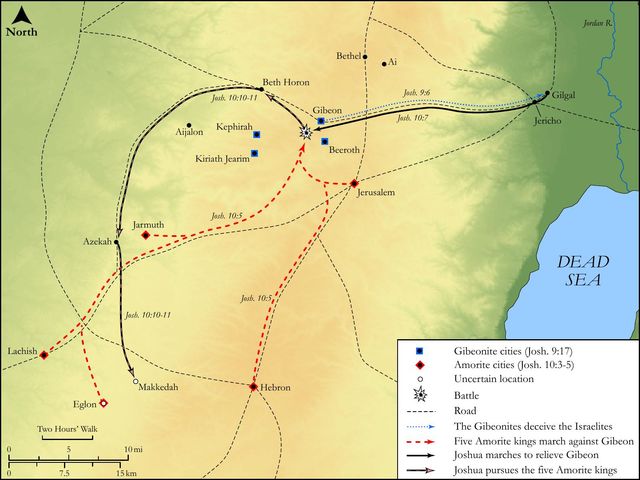
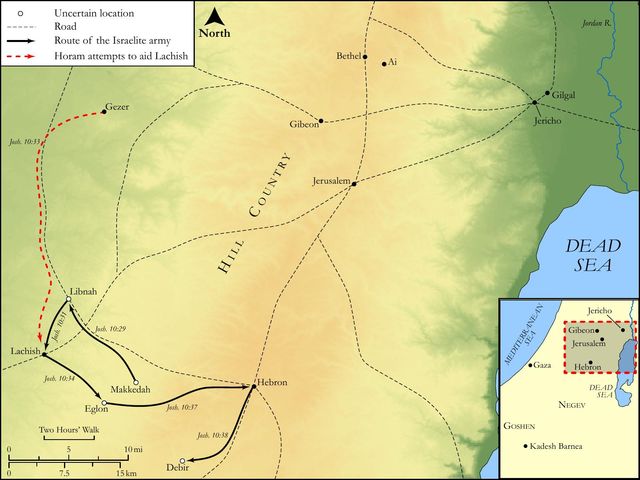
See on the biblical-era maps
Study this verse
Public-domain commentary
Matthew Henry
From his Commentary on the Whole Bible. Henry comments on passages, not single verses — this entry covers Joshua 10:28–43. His three-level outline is real structure in the source text, so it is rendered as structure.
We are here informed how Joshua improved the late glorious victory he had obtained and the advantages he had gained by it, and to do this well is a general's praise.
I.Here is a particular account of the several cities which he immediately made himself master of.
1.The cities of three of the kings whom he had conquered in the field he went and took possession of, Lachish (Jos 10:31, Jos 10:32), Eglon (Jos 10:34, Jos 10:35), and Hebron, Jos 10:36, Jos 10:37. The other two, Jerusalem and Jarmuth, were not taken at this time; perhaps his forces were either so much fatigued with what they had done or so well content with what they had got that they had no mind to attack those places, and so they let slip the fairest opportunity they could ever expect of reducing them with ease, which afterwards was not done without difficulty, Jdg 1:8; Sa2 5:6.
2.Three other cities, and royal cities too, he took: Makkedah, into the neighbourhood of which the five kings had fled, which brought Joshua and his forces thither in pursuit of them, and so hastened its ruin (Jos 10:28), Libnah (Jos 10:29, Jos 10:30), and Debir, Jos 10:38, Jos 10:39.
3.One king that brought in his forces for the relief of Lachish, that had lost its king, proved to meddle to his own hurt; it was Horam king of Gezer, who, either in friendship to his neighbours or for his own security, offered to stop the progress of Joshua's arms, and was cut off with all his forces, Jos 10:33. Thus wicked men are often snared in their counsels, and, by opposing God in the way of his judgments, bring them the sooner on their own heads.
II.A general account of the country which was hereby reduced and brought into Israel's hands (Jos 10:40-42), that part of the land of Canaan of which they first got possession, which lay south of Jerusalem, and afterwards fell, for the most part, to the lot of the tribe of Judah. Observe in this narrative,
1.The great speed Joshua made in taking these cities, which, some think, is intimated in the manner of relating it, which is quick and concise. He flew like lightning from place to place; and though they all stood it out to the last extremity, and none of these cities opened their gates to him, yet in a little time he got them all into his hands, summoned them, and seized them, the same day (Jos 10:28), or in two days, Jos 10:32. Now that they were struck with fear, by the defeat of their armies and the death of their kings, Joshua prudently followed his blow. See what a great deal of work may be done in a little time, if we will but be busy and improve our opportunities.
2.The great severity Joshua used towards those he conquered. He gave no quarter to man, woman, nor child, put to the sword all the souls (Jos 10:28, Jos 10:30, Jos 10:32, Jos 10:35, etc.), utterly destroyed all that breathed (Jos 10:40), and left none remaining. Nothing could justify this military execution but that herein they did as the Lord God of Israel commanded (Jos 10:40), which was sufficient not only to bear them out, and save them for the imputation of cruelty, but to sanctify what they did, and make it an acceptable piece of service to his justice. God would hereby,
(1.)Manifest his hatred of the idolatries and other abominations which the Canaanites had been guilty of, and leave us to judge how great the provocation was which they had given him by the greatness of the destruction which was brought upon them when the measure of their iniquity was full.
(2.)He would hereby magnify his love to his people Israel, in giving so many men for them, and people for their life, Isa 43:4. When the heathen are to be cast out to make room for this vine (Psa 80:8) divine justice appears more prodigal than ever of human blood, that the Israelites might find themselves for ever obliged to spend their lives to the glory of that God who had sacrificed so many of the lives of his creatures to their interest.
(3.)Hereby was typified the final and eternal destruction of all the impenitent implacable enemies of the Lord Jesus, who, having slighted the riches of his grace, must for ever feel the weight of his wrath, and shall have judgment without mercy. Nations that forget God shall be turned into hell, and no reproach at all to God's infinite goodness.
3.The great success of this expedition. The spoil of these cities was now divided among the men of war that plundered them; and the cities themselves, with the land about them, were shortly to be divided among the tribes, for the Lord fought for Israel, Jos 10:42. They could not have gotten the victory if God had not undertaken the battle; then we conquer when God fights for us; and, if he be for us, who can be against us?
Historical interpretation
Historical reception
1 surviving comment on this verse from the historical church.
And again, Lachish is interpreted "way." But in the Scriptures, a way is both a laudable and a culpable thing. That is not difficult to demonstrate, as it says in the psalms, "And the way of the impious will perish"; and in another place, on the contrary, "Make straight the way for your feet." Therefore it can also be understood here that the city of Lachish was at first the way of the impious, and afterwards, when it was destroyed and overthrown, it was won over to the right way with the Israelites reigning.
Continue studying Joshua 10:31 across the web’s major study libraries — every link below opens this exact verse, chapter, or book on the destination site.
Read & Compare
 BibleGatewayThis verse in more than 200 translations and 70 languages.
 Bible.comThe YouVersion reader — hundreds of translations, reading plans, and highlights.
 ESV.orgCrossway's official English Standard Version reader.
 NET BibleThe NET translation with 60,000+ translators' notes on every rendering decision.
 STEP BibleTyndale House's free study tool — original text, vocabulary, and scholarly resources.
 BibliaLogos Bible Software's free web reader.
 USCCBThe New American Bible (Revised Edition) with the U.S. bishops' study notes.
Commentaries
 BibleHub CommentariesDozens of classic commentaries on this verse, gathered on one page.
 StudyLightMore than 100 commentary sets — the largest collection on the web.
 BibleRefPlain-English commentary on what this verse means, verse by verse.
 Enduring WordDavid Guzik's free commentary on this chapter, widely used by Bible teachers.
 Bible Study ToolsVerse commentary alongside Greek and Hebrew study aids.
Original Language & Research
- BibleHub InterlinearThe verse word by word — original language, transliteration, and English.
- BibleHub LexiconEvery word's original-language definition and Strong's entry.
 Blue Letter BibleDeep-study tools — Strong's numbers, concordance, and word studies.
 SefariaThe Hebrew text with Rashi and centuries of Jewish commentary.
Sermons, Hymns & Audio


TrulyRandomVerse is not affiliated with these sites and doesn’t control their content. They’re linked because they’re genuinely useful.
Summary
Joshua 10:31 chronicles a critical phase in Israel's southern campaign, depicting Joshua's strategic and immediate advance from the recently conquered city of Libnah to the formidable Canaanite stronghold of Lachish. This verse succinctly captures the relentless momentum of the Israelite conquest, highlighting their disciplined movement, the establishment of a siege, and the initiation of combat, all under divine mandate, as they pressed deeper into the Promised Land to dispossess its inhabitants and fulfill God's covenant promises.
Context
ShowHideLiterary Context
This verse is strategically positioned within the rapid and decisive southern campaign of the Israelite conquest, immediately following the miraculous intervention at Gibeon, where God supernaturally aided Israel against the coalition of five Amorite kings, causing the sun and moon to stand still (Joshua 10:10-14). The preceding verses detail the swift and total destruction of Makkedah (Joshua 10:28) and Libnah (Joshua 10:29-30), establishing a consistent pattern of relentless pursuit and complete obedience to God's command for cherem (devotion to destruction). Joshua 10:31 thus serves as a pivotal transition point, setting the stage for the next major engagement against one of the most significant Canaanite city-states, demonstrating the unyielding momentum of the divinely empowered advance and the methodical nature of the conquest.
Historical & Cultural Context
Lachish was one of the most prominent and heavily fortified city-states in the Shephelah, the lowlands of Judah. Archaeological excavations at Tel Lachish confirm its immense size, formidable defenses (including a double wall system and a massive gate complex), and its strategic importance as a regional administrative and military center controlling vital trade routes connecting the coastal plain to the Judean hills. Its conquest was not merely another battle but a critical blow to Canaanite power in the south, demonstrating Israel's ability to overcome even the most formidable strongholds. The Israelite conquest itself was a unique historical event, understood biblically as the fulfillment of God's covenant promises to Abraham regarding the land (Genesis 12:7) and the execution of divine judgment against the idolatrous, morally corrupt, and violent Canaanite nations, whose "iniquity was not yet complete" until this time (Genesis 15:16).
Key Themes
ShowHideJoshua 10:31 powerfully contributes to several overarching themes in the book of Joshua and the broader Pentateuch. Firstly, it underscores the theme of Divine Mandate and Obedience, as Joshua's actions are in direct fulfillment of God's command to dispossess the Canaanite nations and take possession of the land, echoing the instructions given in Numbers 33:50-53. Secondly, the verse exemplifies the Relentless Conquest and the divinely empowered momentum of Israel's campaign; the rapid succession of victories (Makkedah, Libnah, now Lachish) highlights God's active hand in fighting for Israel, a promise reiterated throughout Joshua, such as in Joshua 23:10. Finally, the targeting of Lachish emphasizes its Strategic Importance and the sound military strategy guided by divine leading, crucial for securing Israel's hold on the southern territories and fulfilling the promise of a land flowing with milk and honey, a land of rest for God's people (Deuteronomy 12:10).
Exposition and Analysis
ShowHideKey Word Analysis
ShowHideThis verb signifies movement, transition, or crossing over. In this context, it denotes a deliberate, purposeful movement of the entire Israelite army from one location (Libnah) to another (Lachish). It indicates a strategic progression in the military campaign, emphasizing a continuation of the divinely ordained mission rather than a random or aimless wandering. It implies overcoming obstacles to reach the next objective.
This term is a military technical verb meaning "to pitch a tent," "to encamp," or "to lay siege." It implies a methodical and organized establishment of a military position, indicating that Israel was not merely passing through Lachish but was intentionally setting up a base of operations for a sustained assault or siege. This signals a prepared, determined, and disciplined engagement, characteristic of a professional army.
This verb means "to fight," "to wage war," or "to do battle." It conveys active, direct, and engaged conflict. Its inclusion emphasizes that the encounter with Lachish was not a passive occupation or a surrender, but a fierce, confrontational struggle. This highlights the physical effort, danger, and direct engagement involved in fulfilling the divine mandate, underscoring the reality of warfare.
Verse Breakdown
ShowHide"And Joshua passed from Libnah, and all Israel with him, unto Lachish"
This clause describes the strategic and unified movement of the entire Israelite army, under the direct and decisive leadership of Joshua. They transition from a recently conquered city (Libnah), where they had just achieved a significant victory, to a new, formidable target (Lachish). The phrase "all Israel with him" emphasizes the national unity and collective participation in the conquest, underscoring that this was a divinely led national endeavor, not merely a personal campaign by Joshua.
"and encamped against it"
Upon arrival at Lachish, the immediate and deliberate action taken was to establish a military camp around the city. This signifies the commencement of siege operations, a methodical and strategic approach to warfare against a fortified city. It indicates that the Israelites were prepared for a sustained engagement, not a quick skirmish, demonstrating their military discipline, strategic intent, and commitment to overcoming this significant stronghold.
"and fought against it"
This final clause indicates the initiation of direct combat or the active phase of the siege. It confirms that the encampment was not merely a defensive posture but a prelude to an offensive assault. This phrase underscores the physical reality of the conquest, where divine power worked in conjunction with Israel's active participation in battle, requiring courage, effort, and perseverance from the Israelite soldiers.
Literary Devices
ShowHideThe verse employs several literary devices to convey its message efficiently and powerfully. Conciseness is evident in the compact phrasing that packs significant action—movement, preparation, and engagement—into a single, declarative sentence. The consistent use of Military Terminology like "passed," "encamped," and "fought" immediately establishes the context of warfare and highlights the disciplined and strategic nature of Israel's campaign. There is a clear Progression in the actions described: moving to a location, then setting up camp, then initiating battle, which mirrors the systematic and relentless advance of the Israelite army. The repetition of the prepositional phrase "against it" in "encamped against it, and fought against it" creates a strong sense of Parallelism and reinforces the direct, confrontational nature of the encounter, emphasizing Israel's focused intent on conquering Lachish. This repetition also builds a sense of inevitability regarding the city's fate.
Theological and Thematic Connections
ShowHideJoshua 10:31 is a profound testament to God's unwavering faithfulness in fulfilling His covenant promises to Israel, demonstrating that the land promised to their forefathers was being progressively secured through divine empowerment and Israel's obedient action. The relentless pursuit of conquest, moving from one stronghold to the next, is not merely a military narrative but a theological one, illustrating God's active involvement in dispossessing the Canaanite nations as an act of righteous judgment against their pervasive wickedness and a means of establishing His chosen people in the land of promise. This verse underscores the crucial principle that God's sovereign promises often require human participation, diligent effort, and faithful obedience, as Joshua and Israel actively "passed," "encamped," and "fought" in direct response to God's clear command and leading.
Reflection and Application
ShowHideJoshua 10:31, while detailing an ancient military campaign, offers profound and enduring principles for contemporary spiritual life. Just as Joshua and Israel pressed on from one victory to the next, refusing to settle after partial successes, we are called to cultivate a spirit of perseverance and relentless pursuit in our faith journey. This means not becoming complacent after small victories but actively pressing forward into God's full purposes for our lives. The strategic movement and immediate engagement against Lachish remind us that spiritual growth and overcoming personal strongholds often require intentionality, disciplined effort, and direct confrontation rather than passive waiting or avoidance. We are called to "encamp against" and "fight" the spiritual battles we face—whether against temptation, doubt, or apathy—trusting that God's power enables us to overcome. This verse encourages us to combine unwavering faith in God's promises with diligent, strategic action in our pursuit of righteousness, holiness, and the fulfillment of our divine calling.
Questions for Reflection
ShowHideFAQ
ShowHideWhy was Lachish so important for Joshua to conquer?
ShowHideLachish was critically important for Joshua to conquer because it was one of the largest, most powerful, and heavily fortified Canaanite city-states in the Shephelah, the lowlands of Judah. Its strategic location controlled major trade routes and served as a regional administrative and military hub. Its fall would signify a major blow to Canaanite resistance in the southern region, effectively breaking their power base and securing Israel's strategic control over a vital part of the Promised Land. This was essential for fulfilling God's command to dispossess the inhabitants and establish Israel securely in the land, as outlined in passages like Deuteronomy 9:4-5.
Does this verse imply that Israel's conquest was easy or without resistance?
ShowHideNo, quite the opposite. The phrase "and fought against it" explicitly indicates that the conquest of Lachish involved direct, active, and likely fierce combat. While God miraculously intervened to grant victory (as seen in the earlier account of the sun standing still in Joshua 10:10-14), the Israelites were still required to engage in physical warfare, demonstrating courage, discipline, and perseverance. The subsequent verses detailing the intense siege and the complete destruction of Lachish (Joshua 10:32) further underscore that these were not effortless victories but hard-fought battles, with God empowering His people through their obedience and active participation.
Christ-Centered Fulfillment
ShowHideJoshua's relentless advance against the strongholds of Canaan, culminating in the strategic move against Lachish, powerfully foreshadows the ultimate conquest achieved by Jesus Christ. Just as Joshua led Israel into the physical land, overcoming formidable earthly enemies, Christ, our greater Joshua, leads His people into a spiritual inheritance and victory over far greater foes: sin, death, and the spiritual forces of evil (Colossians 2:15). The "rest" that Israel sought in the land, though imperfectly realized and temporary, points to the true and eternal rest found in Christ for all who believe and enter His finished work (Hebrews 4:8-10). Our spiritual warfare, unlike Israel's physical battles, is "not against flesh and blood, but against principalities, against powers, against the rulers of the darkness of this world, against spiritual wickedness in high places" (Ephesians 6:12). Yet, like Joshua, we are called to actively engage, not in our own strength, but by relying on the power of Christ, who has already disarmed these powers and made a public spectacle of them through His cross (Colossians 2:15). Thus, Joshua 10:31, with its depiction of strategic advance and decisive engagement, provides a rich Old Testament type of Christ's triumph over all spiritual strongholds, enabling believers to live in the freedom and victory secured by His finished work.