


2 Kings 14:18
Bible text: King James Version (1769 Blayney text) · Public domain
Bible text: Berean Standard Bible · Public domain
Bible text: American Standard Version (1901) · Public domain
Bible text: World English Bible, Messianic edition · Public domain
Bible text: Geneva Bible (1599) · Public domain
Bible text: Young's Literal Translation · Public domain
- וְיֶתֶרve·Ye·terand [the] rest ofH3499Conj-w ¦ N-mscNoun Singular Masculine Constructוְandיֶתֶר[the] rest of
- דִּבְרֵיdiv·Rei[the] matters ofH1697N-mpcNoun Plural Masculine Construct
- אֲמַצְיָהוּ'a·matz·Ya·huAmaziahH558N-proper-mNoun Proper Masculine
- הֲלֹאha·lo'¿ notH3808Interrog ¦ NegParticle Negativeהֲ¿לֹאnot
- הֵםhem[are] theyH1992Pro-3mpPronoun Personal 3rd Plural Masculine
- כְּתוּבִיםke·tu·VimwrittenH3789V-Qal-PassPrtcpl-mpVerb Qal Participle Passive Plural Masculine Absolute
- עַל'alonH5921PrepPreposition
- סֵפֶרSe·fer[the] scroll ofH5612N-mscNoun Singular Masculine Construct
- דִּבְרֵיdiv·Rei[the] matters ofH1697N-mpcNoun Title Plural Masculine Construct
- הַיָּמִיםhai·ya·Mimthe daysH3117Art ¦ N-mpNoun Plural Masculine Absoluteהַtheיָּמִיםdays
- לְמַלְכֵיle·mal·Kheiof [the] kings ofH4428Prep-l ¦ N-mpcNoun Plural Masculine Constructלְofמַלְכֵי[the] kings of
- יְהוּדָהye·hu·DahJudahH3063N-properNoun Proper Location
English is a literal word-by-word gloss of the Hebrew, not the KJV's wording. Why?
This is the original text the KJV's translators worked from — each Hebrew word with its own literal English meaning in this verse, prepared by scholars at Tyndale House, Cambridge. The KJV translates whole sentences, not word by word, so its wording differs: one Hebrew word can become several English words, and the KJV may choose “the LORD” where the gloss reads “Yahweh”. Both are faithful — they answer different questions. For the KJV's own rendering, switch to the KJV text.
Details
See on the biblical-era maps
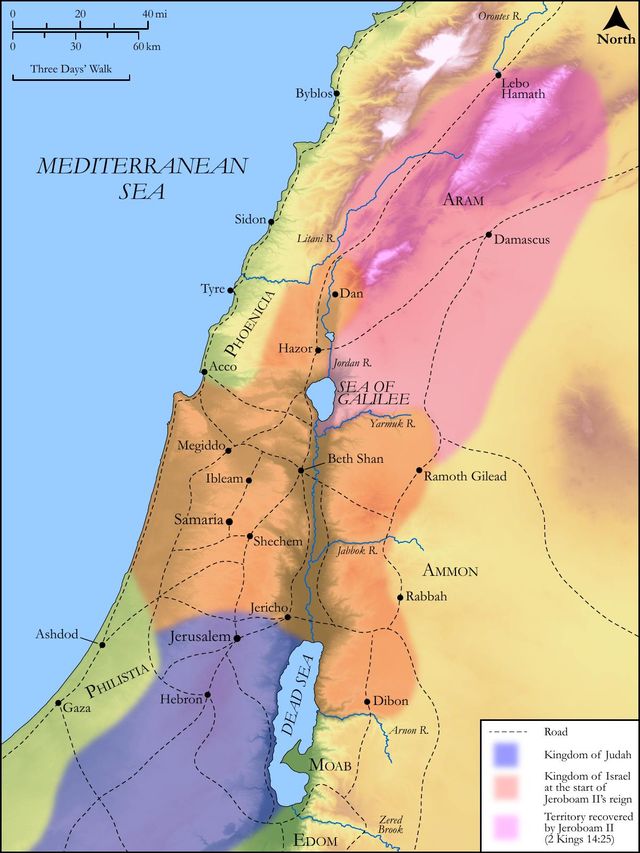
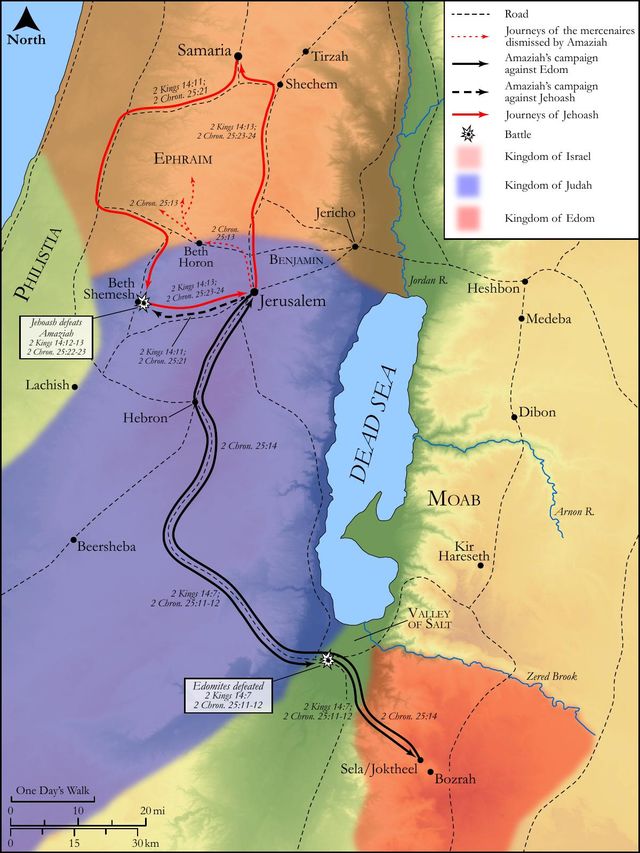
Study this verse
Public-domain commentary
Matthew Henry
From his Commentary on the Whole Bible. Henry comments on passages, not single verses — this entry covers 2 Kings 14:15–22.
Here are three kings brought to their graves in these few verses: - 1. Joash king of Israel, Kg2 14:15, Kg2 14:16. We attended his funeral once before, Kg2 13:12, Kg2 13:13. But, because the historian had occasion to give a further account of his life and actions, he again mentions his death and burial. 2. Amaziah king of Judah. Fifteen years he survived his conqueror the king of Israel, Kg2 14:17. A man may live a great while after he has been shamed, may be thoroughly mortified (as Amaziah no doubt was) and yet not dead. His acts are said to be found written in his annals (Kg2 14:18), but not his might; for his cruelty when he was a conqueror over the Edomites, and his insolence when he challenged the king of Israel, showed him void of true courage. He was slain by his own subjects, who hated him for his maladministration (Kg2 14:19) and made Jerusalem too hot for him, the ignominious breach made in their walls being occasioned by his folly and presumption. He fled to Lachish. How long he continued concealed or sheltered there we are not told, but, at last, he was there murdered, Kg2 14:19. No further did the rage of the rebels extend, for they brought him in a chariot to Jerusalem, and buried him there among his ancestors. 3. Azariah succeeded Amaziah, but not till twelve years after his father's death, for Amaziah died in the fifteenth year of Jeroboam (as appears by comparing Kg2 14:23 with Kg2 14:2), but Azariah did not begin his reign till the twenty-seventh of Jeroboam (ch. 15:1), for he was but four years old at the death of his father, so that, for twelve years, till he came to be sixteen, the government was in the hands of protectors. He reigned very long (ch. 15:2) and yet the account of his reign is here industriously huddled up, and broken off abruptly (v. 22): He built Elath (which had belonged to the Edomites, but, it is probable, was recovered by his father, v. 7), after that the king slept with his fathers, as if that had been all he did that was worth mentioning, or rather it is meant of king Amaziah: he built it soon after Amaziah died.
Continue studying 2 Kings 14:18 across the web’s major study libraries — every link below opens this exact verse, chapter, or book on the destination site.
Read & Compare
 BibleGatewayThis verse in more than 200 translations and 70 languages.
 Bible.comThe YouVersion reader — hundreds of translations, reading plans, and highlights.
 ESV.orgCrossway's official English Standard Version reader.
 NET BibleThe NET translation with 60,000+ translators' notes on every rendering decision.
 STEP BibleTyndale House's free study tool — original text, vocabulary, and scholarly resources.
 BibliaLogos Bible Software's free web reader.
 USCCBThe New American Bible (Revised Edition) with the U.S. bishops' study notes.
Commentaries
 BibleHub CommentariesDozens of classic commentaries on this verse, gathered on one page.
 StudyLightMore than 100 commentary sets — the largest collection on the web.
 BibleRefPlain-English commentary on what this verse means, verse by verse.
 Enduring WordDavid Guzik's free commentary on this chapter, widely used by Bible teachers.
 Bible Study ToolsVerse commentary alongside Greek and Hebrew study aids.
Original Language & Research
- BibleHub InterlinearThe verse word by word — original language, transliteration, and English.
- BibleHub LexiconEvery word's original-language definition and Strong's entry.
 Blue Letter BibleDeep-study tools — Strong's numbers, concordance, and word studies.
 SefariaThe Hebrew text with Rashi and centuries of Jewish commentary.
Sermons, Hymns & Audio


TrulyRandomVerse is not affiliated with these sites and doesn’t control their content. They’re linked because they’re genuinely useful.
Summary
2 Kings 14:18 serves as a standard concluding formula for the reign of King Amaziah of Judah, a common literary device throughout the Books of Kings. This verse indicates that the biblical narrative, while divinely inspired and entirely trustworthy, is a selective account of a king's rule, not an exhaustive historical record. It points to external, official state annals—"the book of the chronicles of the kings of Judah"—as the repository for the fuller details of Amaziah's "rest of the acts," thereby affirming the historical grounding of the biblical narrative while underscoring its profound theological purpose.
Context
ShowHideLiterary Context
This verse stands near the close of the account of Amaziah's reign in 2 Kings 14, immediately following a summary of his final, ill-fated challenge to King Jehoash of Israel and preceding the record of his assassination by conspirators in Lachish. The preceding verses detail Amaziah's initial righteous actions, such as punishing the murderers of his father, King Joash, and his decisive victory over Edom in the Valley of Salt. However, his later apostasy, including worshipping Edomite idols and his prideful challenge to Israel, led directly to his humiliating defeat and eventual demise. The formulaic question, "are they not written in the book of the chronicles of the kings of Judah?", is a standard concluding remark found for nearly every king of Judah and Israel in the Books of Kings. This consistent pattern signals the end of the biblical summary of their rule and directs the reader to more extensive, non-canonical historical records, highlighting the selective nature of the biblical narrative which prioritizes theological lessons over exhaustive historical detail.
Historical & Cultural Context
The mention of "the book of the chronicles of the kings of Judah" refers to official court annals or state records meticulously kept by royal scribes in ancient Judah. Such detailed record-keeping was a common administrative practice among the kingdoms of that day, which documented significant events, royal decrees, military campaigns, and the reigns of their rulers. These "chronicles" (Hebrew: divrei hayyamim, "the words of the days" or "daily records") were distinct from the canonical books of 1 and 2 Chronicles in our modern Bibles, though the biblical authors likely drew upon these official state archives, among other sources, when compiling their inspired accounts. The existence of these external records provides a historical anchor for the biblical narrative, demonstrating that the biblical authors were dealing with actual historical figures and events, even as they filtered and presented them through a theological lens. This practice underscores the historical reliability of the biblical text.
Key Themes
ShowHideThis verse contributes to several crucial themes within the Books of Kings and the broader biblical narrative. Firstly, it underscores the divine selectivity of Scripture, emphasizing that the Bible provides precisely what is necessary for understanding God's redemptive plan and His dealings with humanity, rather than an exhaustive historical account. The biblical authors, under divine inspiration, chose specific details to convey profound theological truths about obedience, disobedience, covenant faithfulness, and the consequences of sin. Secondly, it highlights the accountability of kings, as their actions were publicly recorded and would stand as a testimony to their rule, implicitly pointing to a greater divine judgment. Thirdly, it reinforces the reliability and historical grounding of the biblical narrative, by referencing verifiable external sources, even if those sources are not preserved for us today. This formulaic conclusion assures the reader that the events recounted are rooted in historical reality, as seen in similar references throughout Kings for figures like King Rehoboam or King Asa, validating the historical claims of the inspired text.
Exposition and Analysis
ShowHideKey Word Analysis
ShowHideThis term (H3499) signifies an "overhanging," "excess," "remainder," or "residue." In this context, it explicitly indicates that the biblical account of Amaziah's reign is not comprehensive but rather a summary. The authors acknowledge that more details about his rule existed in other records, implying a purposeful and divinely guided selection of material for the inspired narrative.
This word (H1697) is highly versatile, meaning "word," "matter," or "thing," and by implication, "deed" or "affair." Here, in conjunction with "rest," it refers to the totality of Amaziah's deeds, events, and matters of his reign that are not explicitly detailed in the biblical text. It encompasses the full scope of his administration, military campaigns, and personal life beyond what is recorded in 2 Kings.
This verb (H3789) means "to grave," "to inscribe," or "to write." Its use here confirms that the referenced "chronicles" were tangible, inscribed documents—official, permanent records. This emphasizes the historical nature of these external sources and the meticulous record-keeping practices of the ancient Judean monarchy, lending credibility to the biblical authors' claims.
Verse Breakdown
ShowHide"And the rest of the acts of Amaziah,"
This opening clause immediately informs the reader that the biblical narrative concerning King Amaziah is not exhaustive. It implies that there were many other events, decisions, and details of his reign that, while historically real and recorded elsewhere, were not deemed essential for the theological purposes of the Book of Kings. This sets the stage for understanding the selective nature of divine revelation.
"[are] they not written in the book of the chronicles of the kings of Judah?"
This rhetorical question serves multiple critical functions. Firstly, it confirms the actual existence of external, official historical records maintained by the Judean monarchy, thereby lending historical credibility and verifiability to the biblical account. Secondly, by posing it as a question with an undeniable affirmative answer, it implicitly directs the reader to these external sources for further historical information, while simultaneously highlighting the deliberate and selective nature of the inspired text. The biblical author is not concealing information but rather focusing on what is spiritually and theologically significant for the audience.
Literary Devices
ShowHideThe primary literary device employed in 2 Kings 14:18 is a Rhetorical Question. The question "are they not written...?" is not posed to elicit information but to make a declarative statement with an implied affirmative answer. It serves to confirm the existence of external records and to signal the conclusion of the biblical summary of Amaziah's reign, directing the reader's attention to the broader historical context. This verse also exemplifies Formulaic Language, as this exact phrase or a very similar one is used repeatedly throughout the Books of Kings to conclude the account of nearly every monarch's rule, both in Judah and Israel. This consistent formula provides structural cohesion to the narrative, aids reader comprehension, and reinforces the selective nature of the biblical record. Furthermore, the verse demonstrates Intertextuality by explicitly referencing an external, non-canonical historical source. This reference acknowledges a broader historical context beyond the immediate biblical narrative, validating its historical claims while maintaining its unique theological focus and purpose.
Theological and Thematic Connections
ShowHideThis seemingly simple archival reference carries profound theological weight, revealing much about the nature of divine inspiration and the purpose of Scripture. It underscores that the Bible is not an exhaustive historical encyclopedia but a divinely curated narrative designed to reveal God's character, His covenant faithfulness, and His unfolding redemptive plan for humanity. By pointing to external "chronicles," the biblical authors affirm the historical reality of the events while simultaneously asserting that the details preserved in Scripture are precisely those God intended for His people to know for their spiritual instruction, admonition, and growth. This highlights God's sovereign control over what is revealed and what is left unstated, ensuring that His Word is sufficient for faith and life, providing all necessary truth for salvation and godliness.
Reflection and Application
ShowHideThe reference to "the book of the chronicles" in 2 Kings 14:18 invites us to reflect deeply on the nature of our own lives and the divine record. Just as the kings' deeds were meticulously documented, so too are our lives lived before an omniscient God who sees, knows, and remembers all (Hebrews 4:13). This profound truth should inspire us to live with intentionality, integrity, and a keen awareness of our ultimate accountability to our Creator. Every action, word, and even thought contributes to the "chronicle" of our existence before Him. Furthermore, this verse reminds us that while God has revealed all that is necessary for salvation and spiritual growth in His inspired Word, He has not revealed every single detail of history, science, or future events. Our trust should be in the sufficiency and authority of Scripture for matters of faith and practice, rather than seeking exhaustive answers to every conceivable question outside of its divinely appointed scope. It encourages us to appreciate the selective wisdom of God's revelation, focusing our attention on what truly matters for our eternal well-being and our relationship with Him.
Questions for Reflection
ShowHideFAQ
ShowHideWhat exactly were "the book of the chronicles of the kings of Judah"?
ShowHide"The book of the chronicles of the kings of Judah" (Hebrew: sepher divrei hayyamim le-malkhei Yehudah) refers to official, non-biblical court records or state annals maintained by royal scribes in the kingdom of Judah. These were detailed historical documents that would have recorded the significant events, decrees, military campaigns, administrative details, and perhaps even daily occurrences of each king's reign. They were distinct from the canonical books of 1 and 2 Chronicles in our modern Bibles, though the biblical authors of Kings likely consulted these and other historical sources when compiling their inspired narratives. The mention of these chronicles validates the historical grounding of the biblical account, indicating that the biblical writers were drawing from real, verifiable historical records of their time.
Why does the Bible frequently refer to external sources like these chronicles instead of including all the details within its own narrative?
ShowHideThe Bible refers to external sources like "the book of the chronicles" to underscore its unique purpose: it is a divinely inspired theological narrative, not an exhaustive historical encyclopedia. By pointing to these external records, the biblical authors affirm the historical reality of the events and reigns they describe, providing a historical anchor for their accounts. However, their primary goal was to convey God's dealings with His people, their obedience or disobedience to the covenant, and the unfolding of His redemptive plan. Therefore, they selectively included only those details pertinent to their theological message, trusting that the "rest of the acts" could be found elsewhere for those interested in a more comprehensive historical record. This practice highlights the sufficiency of Scripture for faith and life, even as it acknowledges a broader historical context and God's sovereign choice in what He reveals.
Christ-Centered Fulfillment
ShowHideWhile 2 Kings 14:18 appears to be a mere historical footnote, it subtly points to the ultimate "chronicle" of God's redemptive work, which culminates in Jesus Christ. The reigns of the kings of Judah, with their successes and failures, their obedience and apostasy, are but individual chapters in God's grand narrative of salvation, a narrative that consistently foreshadows the coming of a perfect King. The "rest of the acts" of all human history, meticulously recorded or selectively presented, ultimately find their meaning and purpose in the person and work of Christ. He is the true King of Judah, the Son of David, whose "acts" are not merely written in earthly chronicles but are eternally inscribed in the heavens and proclaimed throughout the earth. The Gospels themselves are selective "chronicles" of Jesus' life, focusing on His birth, ministry, death, and resurrection—the essential "acts" that bring salvation to humanity (John 20:30-31). All the historical records, including those of Amaziah, ultimately serve to prepare the way for the one whose reign is eternal, whose kingdom is unshakable, and whose "acts" of redemption are the very foundation of our faith (Revelation 11:15).