


1 Kings 14:29
Bible text: King James Version (1769 Blayney text) · Public domain
Bible text: Berean Standard Bible · Public domain
Bible text: American Standard Version (1901) · Public domain
Bible text: World English Bible, Messianic edition · Public domain
Bible text: Geneva Bible (1599) · Public domain
Bible text: Young's Literal Translation · Public domain
- וְיֶתֶרve·Ye·terand [the] rest ofH3499Conj-w ¦ N-mscNoun Singular Masculine Constructוְandיֶתֶר[the] rest of
- דִּבְרֵיdiv·Rei[the] matters ofH1697N-mpcNoun Plural Masculine Construct
- רְחַבְעָםre·chav·'AmRehoboamH7346N-proper-mNoun Proper Masculine
- וְכָלve·kholand allH3605Conj-w ¦ N-msNoun Singular Masculine Absoluteוְandכָלall
- אֲשֶׁר'a·SherthatH834RelParticle Relative
- עָשָׂה'a·Sahhe didH6213V-Qal-Perf-3msVerb Qal Perfect 3rd Singular Masculine
- הֲלֹאha·lo'¿ notH3808Interrog ¦ NegParticle Negativeהֲ¿לֹאnot
- הֵמָּהHe·mah[are] theyH1992Pro-3mpPronoun Personal 3rd Plural Masculine
- כְתוּבִיםkhe·tu·VimwrittenH3789V-Qal-PassPrtcpl-mpVerb Qal Participle Passive Plural Masculine Absolute
- עַל'alonH5921PrepPreposition
- סֵפֶרSe·fer[the] scroll ofH5612N-mscNoun Singular Masculine Construct
- דִּבְרֵיdiv·Rei[the] matters ofH1697N-mpcNoun Title Plural Masculine Construct
- הַיָּמִיםhai·ya·Mimthe daysH3117Art ¦ N-mpNoun Plural Masculine Absoluteהַtheיָּמִיםdays
- לְמַלְכֵיle·mal·Kheiof [the] kings ofH4428Prep-l ¦ N-mpcNoun Plural Masculine Constructלְofמַלְכֵי[the] kings of
- יְהוּדָהye·hu·DahJudahH3063N-properNoun Proper Location
English is a literal word-by-word gloss of the Hebrew, not the KJV's wording. Why?
This is the original text the KJV's translators worked from — each Hebrew word with its own literal English meaning in this verse, prepared by scholars at Tyndale House, Cambridge. The KJV translates whole sentences, not word by word, so its wording differs: one Hebrew word can become several English words, and the KJV may choose “the LORD” where the gloss reads “Yahweh”. Both are faithful — they answer different questions. For the KJV's own rendering, switch to the KJV text.
Details
See on the biblical-era maps
Study this verse
Public-domain commentary
Matthew Henry
From his Commentary on the Whole Bible. Henry comments on passages, not single verses — this entry covers 1 Kings 14:21–31. His three-level outline is real structure in the source text, so it is rendered as structure.
Judah's story and Israel's are intermixed in this book. Jeroboam out-lived Rehoboam, four or five years, yet his history is despatched first, that the account of Rehoboam's reign may be laid together; and a sad account it is.
I.Here is no good said of the king. All the account we have of him here is,
1.That he was forty-one years old when he began to reign, by which reckoning he was born in the last year of David, and had his education, and the forming of his mind, in the best days of Solomon; yet he lived not up to these advantages. Solomon's defection at last did more to corrupt him than his wisdom and devotion had done to give him good principles.
2.That he reigned seventeen years in Jerusalem, the city where God put his name, where he had opportunity enough to know his duty, if he had but had a heart to do it.
3.That his mother was Naamah, an Ammonitess; this is twice mentioned, Kg1 14:21, Kg1 14:31. It was strange that David would marry his son Solomon to an Ammonitess (for it was done while he lived), but it is probable that Solomon was in love with her, because she was Naamah, a beauty (so it signifies), and his father was loth to cross him, but it proved to have a very bad influence upon posterity. Probably she was daughter to Shobi the Ammonite, who was kind to David (Sa2 17:27), and David was too willing to requite him by matching his son into his family. None can imagine how lasting and how fatal the consequences may be of being unequally yoked with unbelievers.
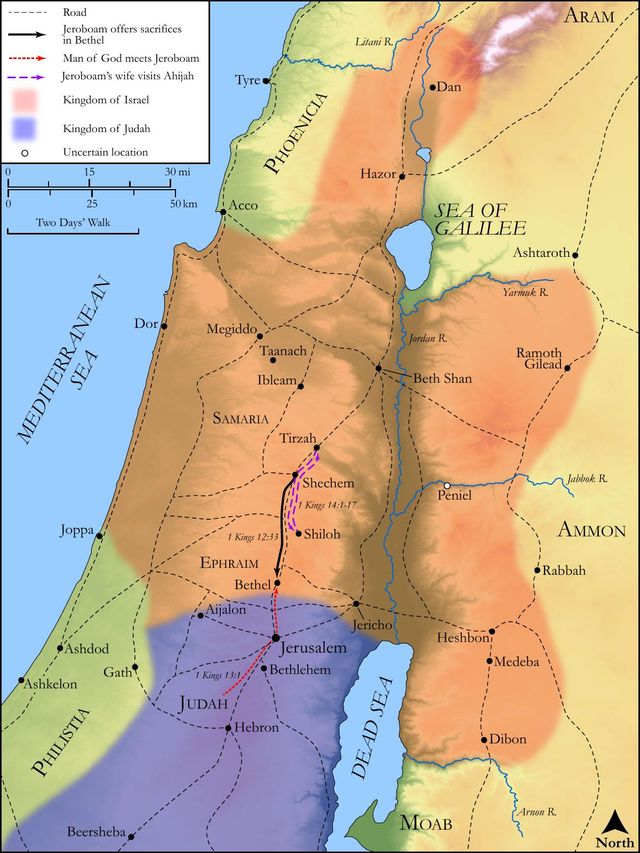
4.That he had continual war with Jeroboam (Kg1 14:30), which could not but be a perpetual uneasiness to him.
5.That when he had reigned but seventeen years he died, and left his throne to his son. His father, and grandfather, and grandson, that reigned well, reigned long, forty years apiece. But sin often shortens men's lives and comforts.
II.Here is much evil said of the subjects, both as to their character and their condition.
1.See here how wicked and profane they were. It is a most sad account that is here given of their apostasy from God, Kg1 14:22-24. Judah, the only professing people God had in the world, did evil in his sight, in contempt and defiance of him and the tokens of his special presence with them; they provoked him to jealousy, as the adulterous wife provokes her husband by breaking the marriage-covenant. Their fathers had been bad enough, especially in the times of the judges, but they did abominable things, above all that their fathers had done. The magnificence of their temple, the pomp of their priesthood, and all the secular advantages with which their religion was attended, could not prevail to keep them to it. Nothing less than the pouring out of the Spirit from on high will keep God's Israel in their allegiance to him. The account here given of the wickedness of the Jews agrees with that which the apostle gives of the wickedness of the Gentile world (Rom 1:21, Rom 1:24), so that both Jew and Gentile are alike under sin, Rom 3:9.
(1.)They became vain in their imaginations concerning God, and changed his glory into an image, for they built themselves high places, images, and groves (Kg1 14:23), profaning God's name by affixing to it their images, and God's ordinances by serving their idols with them. They foolishly fancies that they exalted God when they worshipped him on high hills and pleased him when they worshipped him under the pleasant shadow of green trees.
(2.)They were given up to vile affections (as those idolaters Rom 1:26, Rom 1:27), for there were sodomites in the land (Kg1 14:24), men with men working that which is unseemly, and not to be thought of, much less mentioned, without abhorrence and indignation. They dishonoured God by one sin and then God left them to dishonour themselves by another. They profaned the privileges of a holy nation, therefore God gave them up to their own hearts' lusts, to imitate the abominations of the accursed Canaanites; and herein the Lord was righteous. And, when they did like those that were cast out, how could they expect any other than to be cast out like them?
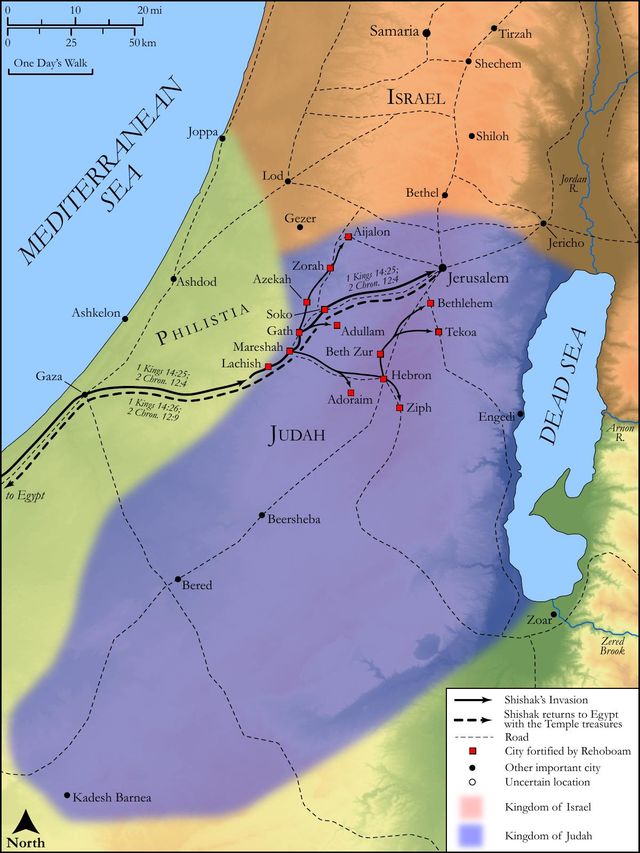
2.See here how weak and poor they were; and this was the consequence of the former. Sin exposes, impoverishes, and weakens any people. Shishak, king of Egypt, came against them, and so far, either by force or surrender, made himself master of Jerusalem itself that he took away the treasures both of the temple and of the exchequer, of the house of the Lord and of the king's house, which David and Solomon had amassed, Kg1 14:25, Kg1 14:26. These, it is likely, tempted him to make his descent; and, to save the rest, Rehoboam perhaps tamely surrendered them, as Ahab, Kg1 20:4. He also took away the golden shields that were made but in his father's time, Kg1 14:26. These the king of Egypt carried off as trophies of his victory; and, instead of them, Rehoboam made brazen shields, which the life-guard carried before him when he went to church in state, Kg1 14:27, Kg1 14:28. This was an emblem of the diminution of his glory. Sin makes the gold become dim, changes the most fine gold, and turns it into brass. We commend Rehoboam for going to the house of the Lord, perhaps the oftener for the rebuke he had been under, and do not condemn him for going in pomp. Great men should honour God with their honour, and then they are themselves most honoured by it.
Continue studying 1 Kings 14:29 across the web’s major study libraries — every link below opens this exact verse, chapter, or book on the destination site.
Read & Compare
 BibleGatewayThis verse in more than 200 translations and 70 languages.
 Bible.comThe YouVersion reader — hundreds of translations, reading plans, and highlights.
 ESV.orgCrossway's official English Standard Version reader.
 NET BibleThe NET translation with 60,000+ translators' notes on every rendering decision.
 STEP BibleTyndale House's free study tool — original text, vocabulary, and scholarly resources.
 BibliaLogos Bible Software's free web reader.
 USCCBThe New American Bible (Revised Edition) with the U.S. bishops' study notes.
Commentaries
 BibleHub CommentariesDozens of classic commentaries on this verse, gathered on one page.
 StudyLightMore than 100 commentary sets — the largest collection on the web.
 BibleRefPlain-English commentary on what this verse means, verse by verse.
 Enduring WordDavid Guzik's free commentary on this chapter, widely used by Bible teachers.
 Bible Study ToolsVerse commentary alongside Greek and Hebrew study aids.
Original Language & Research
- BibleHub InterlinearThe verse word by word — original language, transliteration, and English.
- BibleHub LexiconEvery word's original-language definition and Strong's entry.
 Blue Letter BibleDeep-study tools — Strong's numbers, concordance, and word studies.
 SefariaThe Hebrew text with Rashi and centuries of Jewish commentary.
Sermons, Hymns & Audio


TrulyRandomVerse is not affiliated with these sites and doesn’t control their content. They’re linked because they’re genuinely useful.
Summary
1 Kings 14:29 functions as a classic historiographical formula within the Deuteronomistic History, concluding the biblical summary of King Rehoboam's reign over Judah. This verse directs the reader to external, comprehensive royal annals—"the book of the chronicles of the kings of Judah"—for further details of his "acts" and "all that he did." It underscores the biblical author's selective, theologically driven approach to history, focusing on what is spiritually significant rather than providing an exhaustive historical record, while simultaneously affirming the historical grounding of the events described.
Context
ShowHideLiterary Context
This verse appears at the very end of the account of Rehoboam's reign (1 Kings 14:21-31), serving as a concluding colophon. It immediately follows the summary of his spiritual failures, the idolatry encouraged in Judah, the ongoing conflict with Jeroboam, and the devastating invasion by Shishak, king of Egypt. The formula "Now the rest of the acts of [King's Name], and all that he did, are they not written in the book of the chronicles of the kings of [Judah/Israel]?" is a recurring literary device found at the end of nearly every king's summary in 1 and 2 Kings. Its placement here signals the transition from Rehoboam's rule to that of his son, Abijam, whose reign is introduced in the following verses. This consistent formula provides structural cohesion to the narrative of the divided monarchy.
Historical & Cultural Context
Rehoboam's reign (c. 931-913 BCE) marked the beginning of the divided kingdom, following the death of his father, Solomon. The practice of keeping detailed royal annals was common among the kings of that day, as in the "book of records of the chronicles" read before the king of Persia, serving as official state records of a king's activities, building projects, wars, and decrees. These "chronicles" were distinct from the canonical books of the Bible, though biblical authors likely drew upon such sources. The mention of "the book of the chronicles of the kings of Judah" indicates that the scribes responsible for compiling the books of Kings had access to and selectively utilized these official court records. This practice lends historical credibility to the biblical narrative, demonstrating that the authors were not inventing stories but were engaging with existing historical documentation.
Key Themes
ShowHideThis verse contributes to several key themes prevalent in 1 Kings and the broader Deuteronomistic History. Firstly, it highlights Biblical Historiography, demonstrating the methodical and source-reliant approach of the biblical authors, who compiled and referenced existing historical documents rather than presenting an exhaustive account. Secondly, it subtly reinforces the theme of Divine Sovereignty over History, suggesting that even the preservation of these historical records was part of God's overarching plan to document His dealings with His people, particularly the Davidic line. Thirdly, the formula implicitly points to the Theological Selectivity of Scripture. While external chronicles contained "all that he did," the biblical narrative focuses on the spiritual and covenantal implications of Rehoboam's reign, such as his failure to uphold the covenant, the introduction of idolatry, and the consequences of his actions, which led to the invasion by Shishak (1 Kings 14:25-26). This selective presentation ensures that the reader grasps the spiritual lessons God intended.
Exposition and Analysis
ShowHideKey Word Analysis
ShowHideThis word signifies "remainder," "residue," or "excess." In this context, it refers to the portion of Rehoboam's reign and actions that are not detailed in the biblical account, indicating that the biblical narrative is not exhaustive but selective. It implies that there were many more events and activities in the king's life than what is presented in Scripture.
This versatile Hebrew term encompasses "word," "matter," "thing," or "affair." Here, in the plural, it refers to the deeds, events, or affairs of Rehoboam's reign. When combined with "of the days" (yôwm), it forms the phrase "chronicles" or "daily records," pointing to the comprehensive nature of official state annals that recorded the king's activities.
This primitive root means "to grave" or "to write." As a passive participle, "written" emphasizes that these records were already formally inscribed and accessible. The rhetorical question "are they not written?" serves as an emphatic affirmation of their existence and availability, lending factual authority to the biblical narrative by appealing to a wider body of historical evidence known to the original audience.
Verse Breakdown
ShowHide"Now the rest of the acts of Rehoboam, and all that he did,"
This opening clause serves as a clear indication that the biblical account of Rehoboam's reign is not exhaustive. It acknowledges that Rehoboam's life and rule involved many more events and actions than those detailed in the preceding verses. This immediately signals the selective nature of the biblical narrative, which prioritizes theological lessons and the unfolding of God's covenant purposes over a complete historical biography.
"[are] they not written"
This is a rhetorical question, a common literary device in Hebrew. It functions not as an inquiry but as a strong affirmative statement, asserting that these additional "acts" are indeed recorded. It serves to validate the historical basis of the biblical account by pointing to external, known sources, thereby enhancing the credibility of the narrative for its original audience.
"in the book of the chronicles of the kings of Judah?"
This specifies the precise location of these additional records. It refers to the official royal annals maintained by the kingdom of Judah, which would have contained a much more extensive and secularly focused account of Rehoboam's reign. The explicit mention of this external source underscores the historical grounding of the biblical narrative, even as it highlights the biblical author's theological purpose in selecting and presenting only certain aspects of the king's life.
Literary Devices
ShowHideThe verse employs several significant literary devices. The most prominent is the Rhetorical Question ("are they not written...?"), which functions as an emphatic affirmation rather than a genuine query. This device serves to underscore the historical veracity of the biblical account by appealing to a known, external body of records. Closely related is the use of Formulaic Language, as this exact structure appears repeatedly throughout the books of Kings (e.g., for Jeroboam in 1 Kings 14:19, for Abijam in 1 Kings 15:7, and for Asa in 1 Kings 15:23). This repetitive formula provides structural consistency to the narrative, marking the end of each king's reign and directing the reader to more comprehensive historical sources. Furthermore, the verse exemplifies the nature of Biblical Historiography, which is not merely a secular recounting of events but a theologically interpretative history, selectively presenting information to convey spiritual truths about God's covenant with Israel and the consequences of obedience or disobedience.
Theological and Thematic Connections
ShowHide1 Kings 14:29, though seemingly a mere historical footnote, carries significant theological weight. It affirms the historical rootedness of the biblical narrative, assuring the reader that the events described are not mythical but grounded in verifiable history, even if the external sources are no longer extant. This formulaic conclusion to each king's reign underscores the Deuteronomistic author's method of compiling a theologically selective history, drawing from broader national records to highlight God's interaction with His people. It reveals that the biblical account is precisely what God deemed necessary for His people to understand His purposes, His covenant faithfulness, and the consequences of their actions, particularly concerning the kingship and the Davidic line. The "rest of the acts" were perhaps politically or economically significant but not essential for the spiritual lessons God intended to convey.
Reflection and Application
ShowHideThis seemingly simple verse offers profound insights for the contemporary believer. It encourages a robust trust in the historical reliability of Scripture, reminding us that the biblical authors were meticulous in their work, drawing from and referencing historical sources that were known and accessible to their original audiences. This grounding in real history means that the lessons derived from the reigns of kings like Rehoboam—his spiritual failures, the consequences of his idolatry, and the impact of his choices on the nation—are not abstract fables but concrete examples from which we can learn. It prompts us to consider that God is sovereign over all history, meticulously overseeing the recording of events, both those included in Scripture and those preserved in external records, to accomplish His divine purposes. Our lives, too, are part of a larger divine narrative, and our "acts" are known to God, whether recorded in human annals or simply in the book of life. We are called to learn from the past, trusting in the God who faithfully preserves His truth.
Questions for Reflection
ShowHideFAQ
ShowHideIs "the book of the chronicles of the kings of Judah" the same as the biblical books of 1 and 2 Chronicles?
ShowHideNo, they are not the same. "The book of the chronicles of the kings of Judah" (and Israel) refers to official, non-canonical state annals or court records that were kept by scribes in the ancient kingdoms. These were comprehensive historical documents, likely much more detailed than what we find in the Bible. The biblical books of 1 and 2 Chronicles, while they may have drawn upon similar source material, are canonical Scripture written from a distinct theological perspective, often emphasizing the Davidic covenant, the temple, and the priesthood. The authors of Kings and Chronicles both used these older, external "chronicles" as sources, but they selected and interpreted the information for their specific theological purposes.
Why does the Bible refer to other books it doesn't include in its canon?
ShowHideThe Bible refers to external sources like "the book of the chronicles of the kings of Judah" for a few key reasons. Firstly, it provides historical validation, assuring the original audience that the events recounted were verifiable and widely known. Secondly, it highlights the selective nature of the biblical narrative. The biblical authors, guided by the Holy Spirit, were not writing exhaustive histories but rather theologically driven accounts. They included precisely what was necessary to convey God's character, His covenant dealings with humanity, and the spiritual lessons He intended. The "rest of the acts" were deemed less relevant to the divine message being communicated. This practice demonstrates the Bible's engagement with real-world history while maintaining its unique focus on God's redemptive plan.
What is the purpose of this recurring formula at the end of each king's reign?
ShowHideThe recurring formula serves several crucial purposes. Structurally, it provides a consistent framework for the narrative of the kings, marking the conclusion of one reign and preparing for the next. Historically, it acts as a reference point, indicating that more extensive records existed and were accessible, thus lending credibility to the biblical account. Theologically, it subtly reinforces the idea that the biblical narrative is a divinely curated history, not an exhaustive one. It emphasizes that the biblical author's primary concern was not simply to list every event but to interpret history through a covenantal lens, focusing on how each king's reign related to God's law and His ongoing plan for Israel and Judah.
Christ-Centered Fulfillment
ShowHideWhile 1 Kings 14:29 is a historiographical note about a flawed king, it subtly contributes to the overarching narrative that finds its ultimate fulfillment in Christ. Rehoboam, though a king from the Davidic line, failed significantly in his spiritual leadership, leading Judah into idolatry and weakness. Yet, the very act of meticulously recording his reign, and the reigns of subsequent kings, even those who were unfaithful, underscores God's unwavering commitment to His covenant with David. The "book of the chronicles of the kings of Judah" implicitly points to the divine preservation of a lineage—a royal family line—through which the promised Messiah would eventually come. Despite human failure and the division of the kingdom, God's sovereign hand was at work, ensuring the continuation of the Davidic dynasty, however imperfect its immediate representatives. This painstaking historical record-keeping, therefore, ultimately serves to trace the path to Jesus, the true and perfect King, the Son of David, whose coming was guaranteed by God's faithfulness, not human merit. He is the ultimate fulfillment of the Davidic covenant, the one whose "acts" are truly exhaustively and perfectly recorded in the Gospels, and whose reign is eternal and righteous, unlike any earthly king (Matthew 1:1); Luke 1:32-33; Acts 2:29-31). The very existence of these chronicles, and their selective use in Scripture, testifies to God's providential oversight of history to bring forth the Lamb of God.