


1 Kings 22:45
- וְיֶתֶרve·Ye·terand [the] rest ofH3499Conj-w ¦ N-mscNoun Singular Masculine Constructוְandיֶתֶר[the] rest of
- דִּבְרֵיdiv·Rei[the] matters ofH1697N-mpcNoun Plural Masculine Construct
- יְהוֹשָׁפָטye·ho·sha·FatJehoshaphatH3092N-proper-mNoun Proper Masculine
- וּגְבוּרָתוֹu·ge·vu·ra·Toand his mightH1369Conj-w ¦ N-fsc ¦ 3msNoun Singular Feminine Constructוּandגְבוּרָתmightוֹhis
- אֲשֶׁר'a·SherwhichH834RelParticle Relative
- עָשָׂה'a·Sahhe didH6213V-Qal-Perf-3msVerb Qal Perfect 3rd Singular Masculine
- וַאֲשֶׁרva·'a·Sherand whichH834Conj-w ¦ RelParticle Relativeוַandאֲשֶׁרwhich
- נִלְחָםnil·Chamhe waged warH3898V-Niphal-Perf-3msVerb Niphal Perfect 3rd Singular Masculine
- הֲלֹאha·lo'¿ notH3808Interrog ¦ NegParticle Negativeהֲ¿לֹאnot
- הֵםhem[are] theyH1992Pro-3mpPronoun Personal 3rd Plural Masculine
- כְּתוּבִיםke·tu·VimwrittenH3789V-Qal-PassPrtcpl-mpVerb Qal Participle Passive Plural Masculine Absolute
- עַל'alonH5921PrepPreposition
- סֵפֶרSe·fer[the] scroll ofH5612N-mscNoun Singular Masculine Construct
- דִּבְרֵיdiv·Rei[the] matters ofH1697N-mpcNoun Plural Masculine Construct
- הַיָּמִיםhai·ya·Mimthe daysH3117Art ¦ N-mpNoun Plural Masculine Absoluteהַtheיָּמִיםdays
- לְמַלְכֵיle·mal·Kheiof [the] kings ofH4428Prep-l ¦ N-mpcNoun Plural Masculine Constructלְofמַלְכֵי[the] kings of
- יְהוּדָהye·hu·DahJudahH3063N-properNoun Proper Location
English is a literal word-by-word gloss of the Hebrew, not the KJV's wording. Why?
This is the original text the KJV's translators worked from — each Hebrew word with its own literal English meaning in this verse, prepared by scholars at Tyndale House, Cambridge. The KJV translates whole sentences, not word by word, so its wording differs: one Hebrew word can become several English words, and the KJV may choose “the LORD” where the gloss reads “Yahweh”. Both are faithful — they answer different questions. For the KJV's own rendering, switch to the KJV text.
Details
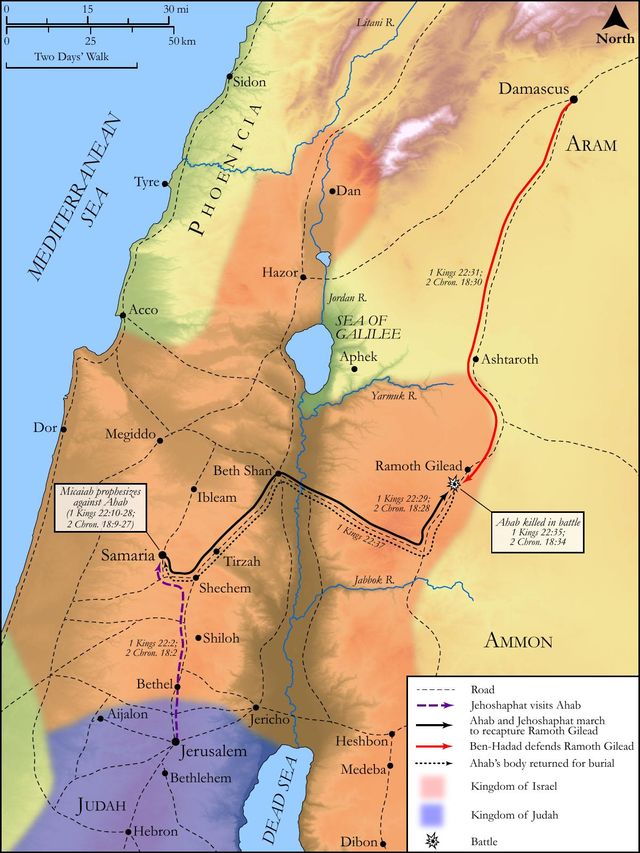
See on the biblical-era maps
Study this verse
Public-domain commentary
Matthew Henry
From his Commentary on the Whole Bible. Henry comments on passages, not single verses — this entry covers 1 Kings 22:41–53.
Here is, I. A short account of the reign of Jehoshaphat king of Judah, of which we shall have a much fuller narrative in the book of Chronicles, and of the greatness and goodness of that prince, neither of which was lessened or sullied by any thing but his intimacy with the house of Ahab, which, upon several accounts, was a diminution to him. His confederacy with Ahab in war we have already found dangerous to him, and his confederacy with Ahaziah his son in trade sped no better. He offered to go partner with him in a fleet of merchant-ships, that should fetch gold from Ophir, as Solomon's navy did, Kg1 22:49. See Ch2 20:35, Ch2 20:36. But, while they were preparing to set sail, they were exceedingly damaged and disabled by a storm (broken at Ezion-geber), which a prophet gave Jehoshaphat to understand was a rebuke to him for his league with wicked Ahaziah (Ch2 20:37); and therefore, as we are told here (Kg1 22:49), when Ahaziah desired a second time to be a partner with him, or, if that could not be obtained, that he might but send his servants with some effects of board Jehoshaphat's ships, he refused: Jehoshaphat would not. The rod of God, expounded by the word of God, had effectually broken him off from his confederacy with that ungodly unhappy prince. Better buy wisdom dear than be without it; but experience is therefore said to be the mistress of fools because those are fools that will not learn till they are taught by experience, and particularly till they are taught the danger of associating with wicked people. Now Jehoshaphat's reign appears here to have been none of the longest, but one of the best. 1. It was none of the longest, for he reigned but twenty-five years (Kg1 22:42), but then it was in the prime of his time, between thirty-five and sixty, and these twenty-five, added to his father's happy forty-one, give us a grateful idea of the flourishing condition of the kingdom of Judah, and of religion in it, for a great while, even when things were very bad, upon all accounts, in the kingdom of Israel. If Jehoshaphat reigned not so long as his father, to balance this he had not those blemishes on the latter end of his reign that his father had (Ch2 16:9, Ch2 16:10, Ch2 16:12), and it is better for a man that has been in reputation for wisdom and honour to die in the midst of it than to outlive it. 2. Yet is was one of the best, both in respect of piety and prosperity. (1.) He did well: He did that which was right in the eyes of the Lord (Kg1 22:43), observed the commands of his God, and trod in the steps of his good father; and he persevered therein: He turned not aside from it. Yet every man's character has some but or other, so had his; the high places were not taken away, no not out of Judah and Benjamin, though those tribes lay so near Jerusalem that they might easily bring their offerings and incense to the altar there, and could not pretend, as some other of the tribes, the inconveniency of lying remote. But old corruptions are with difficulty rooted out, especially when they have formerly had the patronage of those that were good, as the high places had of Samuel, Solomon, and some others. (2.) His affairs did well. He prevented the mischiefs which had attended their wars with the kingdom of Israel, establishing a lasting peace (Kg1 22:44), which would have been a greater blessing if he had contented himself with a peace, and not carried it on to an affinity with Israel; he put a deputy, or viceroy, in Edom, so that the kingdom was tributary to him (Kg1 22:47), and therein the prophecy concerning Esau and Jacob was fulfilled, that the elder should serve the younger. And, in general, mention is made of his might and his wars, Kg1 22:45. He pleased God, and God blessed him with strength and success. His death is spoken of (Kg1 22:50), to shut up his story, yet, in the history of the kings of Israel, we find mention of him afterwards, Kg2 3:7.
II.The beginning of the story of Ahaziah the son of Ahab, Kg1 22:51-53.
His reign was very short, not two years. Some sinners God makes quick work with. It is a very bad character that is here given him. He not only kept up Jeroboam's idolatry, but the worship of Baal likewise; though he had heard of the ruin of Jeroboam's family, and had seen his own father drawn into destruction by the prophets of Baal, who had often been proved false prophets, yet he received no instruction, took no warning, but followed the example of his wicked father and the counsel of his more wicked mother Jezebel, who was still living. Miserable are the children that not only derive a stock of corruption from their parents, but are thus taught by them to trade with it; and unhappy, most unhappy parents, are those that help to damn their children's souls.
Continue studying 1 Kings 22:45 across the web’s major study libraries — every link below opens this exact verse, chapter, or book on the destination site.
Read & Compare
 BibleGatewayThis verse in more than 200 translations and 70 languages.
 Bible.comThe YouVersion reader — hundreds of translations, reading plans, and highlights.
 ESV.orgCrossway's official English Standard Version reader.
 NET BibleThe NET translation with 60,000+ translators' notes on every rendering decision.
 STEP BibleTyndale House's free study tool — original text, vocabulary, and scholarly resources.
 BibliaLogos Bible Software's free web reader.
 USCCBThe New American Bible (Revised Edition) with the U.S. bishops' study notes.
Commentaries
 BibleHub CommentariesDozens of classic commentaries on this verse, gathered on one page.
 StudyLightMore than 100 commentary sets — the largest collection on the web.
 BibleRefPlain-English commentary on what this verse means, verse by verse.
 Enduring WordDavid Guzik's free commentary on this chapter, widely used by Bible teachers.
 Bible Study ToolsVerse commentary alongside Greek and Hebrew study aids.
Original Language & Research
- BibleHub InterlinearThe verse word by word — original language, transliteration, and English.
- BibleHub LexiconEvery word's original-language definition and Strong's entry.
 Blue Letter BibleDeep-study tools — Strong's numbers, concordance, and word studies.
 SefariaThe Hebrew text with Rashi and centuries of Jewish commentary.
Sermons, Hymns & Audio


TrulyRandomVerse is not affiliated with these sites and doesn’t control their content. They’re linked because they’re genuinely useful.
Summary
1 Kings 22:45 serves as a conventional concluding formula for the reign of King Jehoshaphat of Judah, directing the reader to external, non-canonical historical records for a more comprehensive account of his "acts," "might," and military campaigns. This verse highlights the biblical authors' reliance on existing historical documentation while simultaneously underscoring the inspired narrative's selective and purposeful nature, which prioritizes theological truth and God's redemptive plan over exhaustive historical detail.
Context
ShowHideLiterary Context
This verse marks the formal conclusion of the narrative concerning King Jehoshaphat's reign within the Book of 1 Kings. It immediately follows the detailed account of his ill-advised alliance with King Ahab of Israel, culminating in the battle at Ramoth-Gilead where Ahab met his demise. The preceding verses (1 Kings 22:41-44) provide a brief summary of Jehoshaphat's generally positive rule, noting his faithfulness to the Lord, albeit with a lingering issue of the high places. The formulaic nature of 1 Kings 22:45 signals the end of the author's primary interest in Jehoshaphat's kingship within the specific theological framework of the Books of Kings, which often evaluates monarchs based on their adherence to the Mosaic covenant. While 1 Kings offers a concise overview, the canonical Book of 2 Chronicles provides a far more expansive and generally favorable portrayal of Jehoshaphat, detailing his religious reforms, administrative prowess, and military successes. This concluding verse thus serves as a literary bridge, acknowledging a broader historical record beyond the scope of this particular inspired narrative.
Historical & Cultural Context
The practice of referencing external historical documents was a well-established convention in ancient Near Eastern historiography, including the royal courts of Judah and Israel. Kings maintained official state annals, often referred to as "the book of the chronicles of the kings," which meticulously recorded significant events of their reigns: military campaigns, building projects, administrative decrees, and diplomatic relations. These records served multiple purposes, including legitimizing the king's rule, providing a historical archive, and sometimes even functioning as propaganda. The biblical authors, while divinely inspired, were not operating in a vacuum; they were part of a literate culture that valued record-keeping. By explicitly referencing these external chronicles, the biblical narrative grounds itself in verifiable historical reality, affirming that the events described were not mythical but rooted in actual historical occurrences known to their original audience. This practice lends credibility to the biblical account, even as the inspired authors selectively utilized and interpreted these sources through a theological lens.
Key Themes
ShowHide1 Kings 22:45 contributes significantly to several overarching themes found throughout the Books of Kings and the broader biblical narrative. Firstly, it underscores the historicity and documentation of the biblical account, demonstrating that the authors were engaging with and referencing verifiable historical records. This reinforces the reliability of the biblical narrative as a divinely inspired interpretation of actual events, rather than a fictional creation. Secondly, the verse highlights the crucial distinction between the completeness and exhaustiveness of Scripture. While the Bible is complete in its divine revelation—providing all necessary truth for faith, practice, and salvation, as affirmed in 2 Timothy 3:16-17—it is not an exhaustive historical textbook. It selectively presents information pertinent to God's covenant relationship with His people and His unfolding plan of redemption, often pointing to other sources for additional details, as seen in similar references like 1 Kings 11:41 regarding Solomon. Finally, it subtly touches upon the theme of legacy and accountability, reminding readers that the "acts" and "might" of kings were meticulously documented, serving as a testament to their rule and impact, a concept echoed in the broader biblical emphasis on divine remembrance and judgment, as suggested in passages like Malachi 3:16.
Exposition and Analysis
ShowHideKey Word Analysis
ShowHideDerived from H1697, dâbâr primarily means "word," but by implication, it extends to "matter," "thing," "affair," or "deed." In this context, "acts" (or "the words of") refers to the comprehensive range of King Jehoshaphat's public and private conduct, his administrative decisions, significant undertakings, and the events that transpired during his reign. It encompasses the totality of his royal activities and their impact.
gᵉbûwrâh signifies "force," "valor," "strength," or "mighty acts." When attributed to a king, it specifically denotes his military prowess, the strength and effectiveness of his army, his ability to defend the kingdom, and his capacity to assert and consolidate his royal authority. It speaks to the tangible demonstrations of his power and effectiveness in governance and warfare.
kâthab is a primitive root meaning "to grave" or "to write." In this verse, it refers to the act of inscribing or recording information in a document. The rhetorical question "[are] they not written?" confirms that these details about Jehoshaphat's reign were indeed recorded in official, accessible historical documents, underscoring the historical basis of the biblical narrative.
Verse Breakdown
ShowHide"Now the rest of the acts of Jehoshaphat"
This phrase serves as a standard concluding formula, used frequently in the Books of Kings (e.g., 1 Kings 14:29, 1 Kings 15:23) to signal the completion of a monarch's account within the biblical narrative. It implies that while the inspired text has provided a sufficient, divinely guided summary of the king's reign, a more exhaustive historical record exists elsewhere for those seeking further details.
"and his might that he shewed"
This clause specifically highlights Jehoshaphat's demonstrations of power, strength, and valor. This would encompass his military campaigns, the size and organization of his army, his success in fortifying cities, and his ability to maintain peace or wage war effectively, as more extensively detailed in 2 Chronicles 17:12-19. It refers to the tangible expressions of his kingly authority.
"and how he warred"
This phrase narrows the focus to Jehoshaphat's specific military engagements and strategies. While 1 Kings 22 primarily details his ill-fated alliance with Ahab against Aram, other conflicts and military preparations are mentioned in the broader historical record, such as his divinely-aided victory over the Moabite, Ammonite, and Meunite coalition in 2 Chronicles 20.
"[are] they not written in the book of the chronicles of the kings of Judah?"
This rhetorical question functions as an emphatic affirmative statement, confirming the existence and accessibility of these external royal records. It serves to validate the historical context of the biblical narrative by directing the reader to a known, authoritative source for additional information, while simultaneously maintaining the biblical author's focus on the divinely inspired theological lessons and the overarching narrative of God's covenant with His people.
Literary Devices
ShowHideThe verse employs several significant literary devices that contribute to its function and meaning. Foremost is Formulaic Language, specifically the "rest of the acts" formula, which is a hallmark of the Books of Kings. This repetitive structure provides a consistent framework for concluding the accounts of various monarchs, signaling the end of their individual narratives within the biblical text and pointing to external documentation for further details. The phrase "[are] they not written?" functions as a Rhetorical Question, which is not intended to elicit an answer but rather to affirm a known truth emphatically—that these records indeed exist and are accessible. This rhetorical device lends authority and historical credibility to the biblical account by implicitly referencing external, verifiable sources. Furthermore, the verse demonstrates Intertextuality by explicitly referring to an external, non-canonical historical work ("the book of the chronicles of the kings of Judah"). This direct reference highlights the biblical authors' engagement with existing historical records and their selective use of such material to construct a narrative focused on God's interaction with His people and the unfolding of His redemptive plan.
Theological and Thematic Connections
ShowHide1 Kings 22:45, though appearing as a simple concluding formula, carries profound theological implications. It firmly establishes the historical grounding of the biblical narrative, affirming that the events described are rooted in real-world occurrences and not mythical constructs. However, it simultaneously underscores the divine selectivity inherent in Scripture. The biblical authors, writing under the inspiration of the Holy Spirit, meticulously chose what to include and what to omit, not to deceive, but to serve God's ultimate purpose: to reveal His character, His unwavering covenant faithfulness, and His unfolding plan of salvation. The Bible is complete in its theological truth and sufficiency for faith and practice, even if it is not exhaustive in its historical detail. This verse implicitly teaches us to trust the Bible for what it claims to be—God's inspired Word—and to understand its unique purpose as a theological narrative that interprets history from God's perspective, rather than a comprehensive historical encyclopedia. It reminds us that God is sovereign over all of history, and His story, as told in Scripture, is the one that truly matters for our eternal destiny.
Reflection and Application
ShowHideThis seemingly mundane verse offers profound insights for contemporary believers. It encourages us to approach the Bible with a discerning eye, understanding that its primary purpose is not to satisfy every historical curiosity but to transform our lives through the revelation of God's truth. We are invited to trust its authority and sufficiency in matters of faith and doctrine, recognizing that its selective nature is part of God's wise design to focus our attention on what is eternally significant. Just as Jehoshaphat's "acts" were recorded for posterity, our own lives are a chronicle unfolding before the divine gaze. This verse subtly prompts us to consider what "acts," "might," and "how we warred" (our struggles and triumphs, our demonstrations of spiritual strength) are being recorded in the heavenly books. It challenges us to live lives that, when reviewed, reflect a steadfast commitment to God's will, a pursuit of righteousness, and a reliance on His power, knowing that ultimately, it is God's assessment of our stewardship that truly matters.
Questions for Reflection
ShowHideFAQ
ShowHideIs "the book of the chronicles of the kings of Judah" the same as the canonical books of 1 and 2 Chronicles in our modern Bibles?
ShowHideNo, they are distinct. "The book of the chronicles of the kings of Judah" (and similar references for the kings of Israel) refers to official royal annals or state records maintained by the scribes and historians of the ancient kingdoms. These were secular historical documents, likely serving as primary sources for various ancient writers. In contrast, the canonical books of 1 and 2 Chronicles, which are part of our modern Bible, are divinely inspired theological works. While they may have drawn upon such historical sources, they reinterpret and re-present the history of Israel and Judah from a specific theological perspective, emphasizing God's covenant faithfulness, the importance of the temple and worship, and the Davidic line. Their purpose, scope, and divine inspiration set them apart from the secular royal chronicles.
Why does the Bible frequently refer to other books or sources if it is God's complete Word?
ShowHideThe Bible refers to other sources, such as "the book of the chronicles of the kings of Judah," not because it is incomplete or lacking in its divine revelation, but to affirm its historical grounding and to highlight its specific, divinely intended purpose. The Bible is complete in its revelation of God's character, His plan of salvation through Christ, and all truth necessary for faith and life (2 Timothy 3:16-17). However, it is not designed to be an exhaustive historical encyclopedia covering every detail of ancient history. By referencing external records, the biblical authors implicitly state that the events they describe are historically verifiable, while simultaneously focusing the narrative on the theological lessons and redemptive arc God intends to convey. This selective approach ensures that the reader's attention remains on God's interaction with humanity and the unfolding of His divine plan, rather than on extraneous historical minutiae.
Christ-Centered Fulfillment
ShowHideWhile 1 Kings 22:45 concludes the earthly chronicle of King Jehoshaphat, pointing to external records for the full scope of his reign, it subtly directs our gaze to the ultimate King whose "acts" and "might" are not merely recorded in human annals but are eternally significant and fully revealed in the divine narrative of Scripture. Jehoshaphat, despite his generally righteous reign, was still a flawed human king whose "acts" included a regrettable alliance with wicked Ahab. His legacy, like all earthly kings, was incomplete and ultimately temporary. In contrast, Jesus Christ is the King whose "acts" of perfect obedience, miraculous power, sacrificial love, and triumphant resurrection are the very core of God's eternal plan. His "might" is not merely military or political, but the divine power that created and sustains the cosmos (Colossians 1:15-17) and conquered sin and death (Hebrews 2:14-15). The "book of the chronicles" of Jesus' life is not an external, supplemental record, but the very Gospels themselves, which, though selective, are perfectly sufficient to reveal Him as the Lamb of God who takes away the sin of the world and the Son of God who reigns forever. All human history, including the reigns of kings like Jehoshaphat, ultimately points forward to the comprehensive and eternally fulfilling "acts" of Christ, in whom all the promises of God find their "Yes" and "Amen" (2 Corinthians 1:20). Our own "chronicles" are ultimately judged by His perfect standard, and it is only through faith in His completed work that our names are written in the Lamb's book of life.