


1 Kings 22:44
- וַיַּשְׁלֵםvai·yash·Lemand he made peaceH7999Conj-w ¦ V-Hiphil-ConsecImperf-3msVerb Hiphil Consecutive Imperfect 3rd Singular Masculineוַandיַּשְׁלֵםhe made peace
- יְהוֹשָׁפָטye·ho·sha·FatJehoshaphatH3092N-proper-mNoun Proper Masculine
- עִם'imwithH5973PrepPreposition
- מֶלֶךְMe·lekh[the] king ofH4428N-mscNoun Singular Masculine Construct
- יִשְׂרָאֵלYis·ra·'ElIsraelH3478N-properNoun Proper Location
English is a literal word-by-word gloss of the Hebrew, not the KJV's wording. Why?
This is the original text the KJV's translators worked from — each Hebrew word with its own literal English meaning in this verse, prepared by scholars at Tyndale House, Cambridge. The KJV translates whole sentences, not word by word, so its wording differs: one Hebrew word can become several English words, and the KJV may choose “the LORD” where the gloss reads “Yahweh”. Both are faithful — they answer different questions. For the KJV's own rendering, switch to the KJV text.
Details
See on the biblical-era maps

Study this verse
Public-domain commentary
Matthew Henry
From his Commentary on the Whole Bible. Henry comments on passages, not single verses — this entry covers 1 Kings 22:41–53.
Here is, I. A short account of the reign of Jehoshaphat king of Judah, of which we shall have a much fuller narrative in the book of Chronicles, and of the greatness and goodness of that prince, neither of which was lessened or sullied by any thing but his intimacy with the house of Ahab, which, upon several accounts, was a diminution to him. His confederacy with Ahab in war we have already found dangerous to him, and his confederacy with Ahaziah his son in trade sped no better. He offered to go partner with him in a fleet of merchant-ships, that should fetch gold from Ophir, as Solomon's navy did, Kg1 22:49. See Ch2 20:35, Ch2 20:36. But, while they were preparing to set sail, they were exceedingly damaged and disabled by a storm (broken at Ezion-geber), which a prophet gave Jehoshaphat to understand was a rebuke to him for his league with wicked Ahaziah (Ch2 20:37); and therefore, as we are told here (Kg1 22:49), when Ahaziah desired a second time to be a partner with him, or, if that could not be obtained, that he might but send his servants with some effects of board Jehoshaphat's ships, he refused: Jehoshaphat would not. The rod of God, expounded by the word of God, had effectually broken him off from his confederacy with that ungodly unhappy prince. Better buy wisdom dear than be without it; but experience is therefore said to be the mistress of fools because those are fools that will not learn till they are taught by experience, and particularly till they are taught the danger of associating with wicked people. Now Jehoshaphat's reign appears here to have been none of the longest, but one of the best. 1. It was none of the longest, for he reigned but twenty-five years (Kg1 22:42), but then it was in the prime of his time, between thirty-five and sixty, and these twenty-five, added to his father's happy forty-one, give us a grateful idea of the flourishing condition of the kingdom of Judah, and of religion in it, for a great while, even when things were very bad, upon all accounts, in the kingdom of Israel. If Jehoshaphat reigned not so long as his father, to balance this he had not those blemishes on the latter end of his reign that his father had (Ch2 16:9, Ch2 16:10, Ch2 16:12), and it is better for a man that has been in reputation for wisdom and honour to die in the midst of it than to outlive it. 2. Yet is was one of the best, both in respect of piety and prosperity. (1.) He did well: He did that which was right in the eyes of the Lord (Kg1 22:43), observed the commands of his God, and trod in the steps of his good father; and he persevered therein: He turned not aside from it. Yet every man's character has some but or other, so had his; the high places were not taken away, no not out of Judah and Benjamin, though those tribes lay so near Jerusalem that they might easily bring their offerings and incense to the altar there, and could not pretend, as some other of the tribes, the inconveniency of lying remote. But old corruptions are with difficulty rooted out, especially when they have formerly had the patronage of those that were good, as the high places had of Samuel, Solomon, and some others. (2.) His affairs did well. He prevented the mischiefs which had attended their wars with the kingdom of Israel, establishing a lasting peace (Kg1 22:44), which would have been a greater blessing if he had contented himself with a peace, and not carried it on to an affinity with Israel; he put a deputy, or viceroy, in Edom, so that the kingdom was tributary to him (Kg1 22:47), and therein the prophecy concerning Esau and Jacob was fulfilled, that the elder should serve the younger. And, in general, mention is made of his might and his wars, Kg1 22:45. He pleased God, and God blessed him with strength and success. His death is spoken of (Kg1 22:50), to shut up his story, yet, in the history of the kings of Israel, we find mention of him afterwards, Kg2 3:7.
II.The beginning of the story of Ahaziah the son of Ahab, Kg1 22:51-53.
His reign was very short, not two years. Some sinners God makes quick work with. It is a very bad character that is here given him. He not only kept up Jeroboam's idolatry, but the worship of Baal likewise; though he had heard of the ruin of Jeroboam's family, and had seen his own father drawn into destruction by the prophets of Baal, who had often been proved false prophets, yet he received no instruction, took no warning, but followed the example of his wicked father and the counsel of his more wicked mother Jezebel, who was still living. Miserable are the children that not only derive a stock of corruption from their parents, but are thus taught by them to trade with it; and unhappy, most unhappy parents, are those that help to damn their children's souls.
Historical interpretation
Historical reception
1 surviving comment on this verse from the historical church.
He took not away: He left some of the high places, viz., those in which they worshipped the true God: but took away all others, 2 Par. 17. 6, and note ver. 14 of chap. 15. 3 Kings.
Continue studying 1 Kings 22:44 across the web’s major study libraries — every link below opens this exact verse, chapter, or book on the destination site.
Read & Compare
 BibleGatewayThis verse in more than 200 translations and 70 languages.
 Bible.comThe YouVersion reader — hundreds of translations, reading plans, and highlights.
 ESV.orgCrossway's official English Standard Version reader.
 NET BibleThe NET translation with 60,000+ translators' notes on every rendering decision.
 STEP BibleTyndale House's free study tool — original text, vocabulary, and scholarly resources.
 BibliaLogos Bible Software's free web reader.
 USCCBThe New American Bible (Revised Edition) with the U.S. bishops' study notes.
Commentaries
 BibleHub CommentariesDozens of classic commentaries on this verse, gathered on one page.
 StudyLightMore than 100 commentary sets — the largest collection on the web.
 BibleRefPlain-English commentary on what this verse means, verse by verse.
 Enduring WordDavid Guzik's free commentary on this chapter, widely used by Bible teachers.
 Bible Study ToolsVerse commentary alongside Greek and Hebrew study aids.
Original Language & Research
- BibleHub InterlinearThe verse word by word — original language, transliteration, and English.
- BibleHub LexiconEvery word's original-language definition and Strong's entry.
 Blue Letter BibleDeep-study tools — Strong's numbers, concordance, and word studies.
 SefariaThe Hebrew text with Rashi and centuries of Jewish commentary.
Sermons, Hymns & Audio


TrulyRandomVerse is not affiliated with these sites and doesn’t control their content. They’re linked because they’re genuinely useful.
Summary
First Kings 22:44 succinctly records a pivotal diplomatic development during the divided monarchy: the establishment of a formal peace treaty between King Jehoshaphat of Judah and the contemporary King of Israel, Ahab. This agreement marked a significant departure from decades of hostility between the two Hebrew kingdoms, initiating a period of alliance that, while offering apparent political stability and security, would ultimately lead to profound and negative spiritual consequences for the Southern Kingdom of Judah, setting the stage for future compromises and idolatry within its royal line.
Context
ShowHideLiterary Context
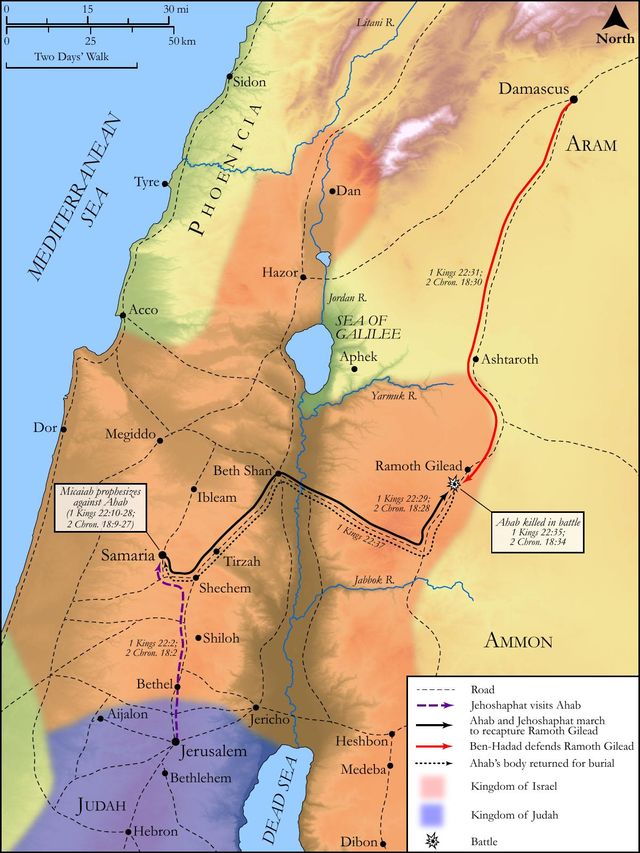
This verse appears near the conclusion of the summary of Jehoshaphat's reign in 1 Kings 22, immediately following the commendation of his general righteousness and adherence to the ways of his father Asa (who himself was largely faithful to the Lord). Crucially, the "peace" established here serves as the direct precursor and explanation for the subsequent narrative detailing Jehoshaphat's ill-fated military alliance with Ahab, the King of Israel, for a joint campaign against Ramoth-Gilead, as recounted in 1 Kings 22:1-40. The verse is not merely a statement of cessation of hostilities but a formal agreement that binds the two kingdoms, thereby providing the foundation for their military cooperation and, tragically, for the later intermarriage between their royal houses, which would plague Judah for generations to come with idolatry and moral decay.
Historical & Cultural Context
The period following the division of Solomon's kingdom (c. 931 BCE) was predominantly characterized by antagonism and frequent warfare between the Northern Kingdom of Israel and the Southern Kingdom of Judah. Kings like Rehoboam, Abijam, and Asa had engaged in open conflict. Jehoshaphat (reigned c. 870-845 BCE) was a contemporary of Ahab (reigned c. 874-853 BCE), a notoriously wicked king who, influenced by his Phoenician wife Jezebel, aggressively promoted Baal worship throughout Israel. In the ancient Near East, political alliances, often sealed by treaties and dynastic marriages, were common strategies for securing borders, gaining trade advantages, or forming coalitions against common external threats, such as the rising power of Aram (Syria). Jehoshaphat's decision to "make peace" with Ahab must be understood within this geopolitical framework, even as it dramatically contrasted with Judah's spiritual heritage and Jehoshaphat's own general fidelity to Yahweh.
Key Themes
ShowHideThe establishment of peace between Jehoshaphat and Ahab highlights several critical themes within the broader biblical narrative. Foremost among these is the inherent tension between political pragmatism and spiritual purity. While Jehoshaphat's intentions may have been to secure Judah's borders and foster regional stability, his alliance with the idolatrous house of Ahab represented a profound spiritual compromise. This decision starkly illustrates the theme of the consequences of unequal yoking, a principle later articulated in the New Testament, where alliances with those who do not share fundamental spiritual values can lead to moral and spiritual erosion. Indeed, this "peace" directly led to the marriage of Jehoshaphat's son Jehoram to Ahab's daughter Athaliah, introducing severe Baal worship into Judah's royal line, as detailed in 2 Kings 8:18. Furthermore, the verse underscores the complex and often fraught relationship within the divided kingdom, where shared heritage often battled against divergent theological and political paths, making periods of genuine peace rare and noteworthy, and often fraught with spiritual peril.
Exposition and Analysis
ShowHideKey Word Analysis
ShowHideThis root word signifies "to be safe (in mind, body or estate); figuratively, to be (causatively, make) completed; by implication, to be friendly; by extension, to reciprocate." The derived noun, shalom, encompasses a comprehensive sense of completeness, wholeness, well-being, prosperity, harmony, and reconciliation. In this context, it denotes the establishment of a formal, stable, and reconciled relationship between the two kingdoms, moving beyond a state of potential or active hostility to one of agreement and alliance. However, the spiritual context of this particular "peace" with an idolatrous king introduces a profound irony, as true shalom for God's people is rooted in covenant faithfulness, not compromise with unrighteousness.
This word simply means "a king" or "royal." Its use here, "the king of Israel," specifically refers to Ahab, one of the most wicked monarchs in Israel's history. The title itself, while descriptive, takes on significant theological weight in this context, highlighting the stark contrast between Jehoshaphat, a largely righteous king of Judah, and the ungodly ruler of the Northern Kingdom. The alliance with such a "king" underscores the spiritual danger inherent in Jehoshaphat's political maneuver.
Verse Breakdown
ShowHide"And Jehoshaphat made peace"
This clause emphasizes the active agency of King Jehoshaphat of Judah. Despite his generally righteous reign and his efforts to promote the worship of Yahweh throughout his kingdom, he deliberately pursued and entered into a diplomatic resolution and alliance with the Northern Kingdom. This decision reflects a pragmatic political calculation, likely aimed at securing Judah's northern border and potentially forming a united front against common external threats, such as Aram. It was a conscious, intentional act of forging a new relationship, signifying a strategic political decision on his part.
"with the king of Israel"
This phrase specifically identifies the recipient of Jehoshaphat's peace initiative as King Ahab, the notoriously wicked ruler of the Northern Kingdom. Ahab was infamous for his aggressive promotion of Baal worship, his persecution of Yahweh's prophets, and his overall disregard for God's law. The identity of "the king of Israel" is crucial, as it immediately signals the problematic nature of this alliance for a king of Judah who was otherwise commended for walking in the ways of David. The text implicitly contrasts Jehoshaphat's personal piety and his kingdom's spiritual heritage with this politically motivated, yet spiritually compromising, association.
Literary Devices
ShowHideThe profound brevity of 1 Kings 22:44 is a powerful example of Conciseness that belies a wealth of profound implications. The simple statement "And Jehoshaphat made peace with the king of Israel" encapsulates a significant geopolitical shift and subtly foreshadows a cascade of far-reaching consequences. This verse also employs potent Foreshadowing, subtly hinting at the future troubles that will stem directly from this alliance. The "peace" established here directly leads to the joint military campaign against Ramoth-Gilead (recounted immediately after this verse in 1 Kings 22), Ahab's death, and more critically, the subsequent intermarriage between the royal houses of Judah and Israel, which introduced severe idolatry and corruption into Judah's lineage (2 Kings 8:18). Furthermore, there is a striking element of Irony at play: a king largely praised for his righteousness (Jehoshaphat) makes "peace" with one of the most wicked kings in Israel's history (Ahab), and this very "peace" ultimately leads to greater spiritual turmoil and divine judgment for Judah rather than true shalom or lasting security.
Theological and Thematic Connections
ShowHideThe peace treaty between Jehoshaphat and Ahab serves as a potent theological lesson on the dangers of compromising spiritual principles for the sake of political expediency, worldly gain, or even perceived stability. While peace is a foundational biblical ideal and a mark of God's blessing, the nature of this particular alliance—between a king striving for righteousness and one steeped in idolatry and wickedness—demonstrates that not all "peace" is beneficial or blessed by God. It underscores the critical importance of discerning partnerships and the potential for even well-intentioned compromises to lead to spiritual erosion, divine displeasure, and long-term negative consequences for God's people. This narrative reminds believers that true security, prosperity, and shalom are found in unwavering faithfulness to God and His covenant, rather than in human alliances that necessitate a dilution of one's convictions or a compromise with unrighteousness.
Reflection and Application
ShowHideThe account of Jehoshaphat's peace with Ahab offers invaluable insights for contemporary believers navigating a complex and often compromising world. It challenges us to critically examine our alliances and partnerships, whether in personal relationships, professional endeavors, or ministry contexts. While unity, harmony, and the pursuit of peace are desirable and commanded by Scripture, the narrative of Jehoshaphat serves as a stark reminder that compromise on core spiritual values, even with seemingly good intentions like fostering peace or achieving stability, can lead to unforeseen and detrimental long-term consequences. We are called to be "in the world but not of the world" (John 17:14-16), maintaining our distinctiveness as followers of Christ. This means discerning with wisdom and prayer when collaboration is appropriate and when it might lead to an "unequal yoking" that compromises our fidelity to God and His truth. Our ultimate peace and security come from aligning fully with God's will and wisdom, not from human alliances that require spiritual dilution or a departure from righteous living.
Questions for Reflection
ShowHideFAQ
ShowHideWas this alliance a good decision for Jehoshaphat?
ShowHideFrom a purely political and military standpoint, the alliance might have appeared pragmatic, offering Judah security against northern threats and potentially strengthening both kingdoms against common enemies like Aram. However, from a biblical and theological perspective, it was a deeply flawed decision that brought divine displeasure and long-term negative consequences. Jehoshaphat, a king who largely "walked in the ways of David his father" (1 Kings 22:43), chose to ally himself with Ahab, a notoriously wicked king who aggressively promoted Baal worship throughout Israel. This "peace" led directly to a disastrous joint military campaign against Ramoth-Gilead (1 Kings 22:29-36), where Ahab died, and more significantly, it paved the way for the marriage of Jehoshaphat's son Jehoram to Ahab's daughter Athaliah, which introduced severe idolatry and corruption into the royal house of Judah (2 Kings 8:18). The prophet Jehu later rebuked Jehoshaphat directly for this alliance, asking, "Should you help the wicked and love those who hate the Lord? Therefore wrath is upon you from the Lord" (2 Chronicles 19:2). Thus, while it achieved a temporary political peace, it led to profound spiritual and dynastic turmoil for Judah.
Who was the "king of Israel" at this time?
ShowHideThe "king of Israel" with whom Jehoshaphat made peace was King Ahab. Ahab was one of the most wicked kings to rule the Northern Kingdom of Israel, infamous for his egregious idolatry, particularly his aggressive promotion of Baal worship under the influence of his Phoenician wife, Jezebel. His reign is characterized by a significant decline in Israel's spiritual fidelity, marked by the powerful prophetic ministries of Elijah and Elisha, who courageously confronted his wickedness and the widespread apostasy. The fact that Jehoshaphat, a king of Judah who largely sought to follow the Lord and remove idolatry from his own kingdom, entered into a peace treaty and military alliance with such an ungodly ruler highlights the profound spiritual compromise inherent in the arrangement recorded in 1 Kings 22:44.
Christ-Centered Fulfillment
ShowHideThe flawed peace forged by Jehoshaphat in 1 Kings 22:44, born of political necessity and leading to spiritual compromise, ultimately points to the perfect and lasting peace offered through Jesus Christ. While Jehoshaphat sought to secure his kingdom through human alliances and pragmatic agreements, Christ is the true Prince of Peace who establishes an eternal covenant of peace, not through political maneuvering or spiritual dilution, but through His atoning sacrifice on the cross. He is our Shalom, breaking down the dividing wall of hostility—not merely between warring nations or divided kingdoms, but fundamentally between humanity and God, and between Jew and Gentile (Ephesians 2:15-16). Unlike the temporary and corrupted peace of human treaties, Christ's peace brings genuine reconciliation and wholeness, transforming hearts and bringing us into right relationship with God and one another. His kingdom is not built on pragmatic compromises with unrighteousness, but on righteousness, justice, and the power of the Holy Spirit, offering a peace that surpasses all understanding and endures forever (Philippians 4:7). In Christ, believers find true security and an unshakeable peace that does not depend on worldly alliances but on divine faithfulness.