


1 Kings 22:50
- וַיִּשְׁכַּבvai·yish·Kavand he lay downH7901Conj-w ¦ V-Qal-ConsecImperf-3msVerb Qal Consecutive Imperfect 3rd Singular Masculineוַandיִּשְׁכַּבhe lay down
- יְהוֹשָׁפָטye·ho·sha·FatJehoshaphatH3092N-proper-mNoun Proper Masculine
- עִם'imwithH5973PrepPreposition
- אֲבֹתָיו'a·vo·Tavhis ancestorsH1N-fpc ¦ 3msNoun Plural Feminine Constructאֲבֹתָיancestorsוhis
- וַיִּקָּבֵרvai·yi·ka·Verand he was buriedH6912Conj-w ¦ V-Niphal-ConsecImperf-3msVerb Niphal Consecutive Imperfect 3rd Singular Masculineוַandיִּקָּבֵרhe was buried
- עִם'imwithH5973PrepPreposition
- אֲבֹתָיו'a·vo·Tavhis ancestorsH1N-fpc ¦ 3msNoun Plural Feminine Constructאֲבֹתָיancestorsוhis
- בְּעִירbe·'Irin [the] city ofH5892Prep-b ¦ N-fscNoun Singular Feminine Constructבְּinעִיר[the] city of
- דָּוִדda·VidDavidH1732N-proper-mNoun Proper Masculine
- אָבִיו'a·Vivhis ancestorH1N-msc ¦ 3msNoun Singular Masculine Constructאָבִיancestorוhis
- וַיִּמְלֹךְvai·yim·Lokhand he became kingH4427Conj-w ¦ V-Qal-ConsecImperf-3msVerb Qal Consecutive Imperfect 3rd Singular Masculineוַandיִּמְלֹךְhe became king
- יְהוֹרָםye·ho·RamJehoramH3088N-proper-mNoun Proper Masculine
- בְּנוֹbe·Nohis sonH1121N-msc ¦ 3msNoun Singular Masculine Constructבְּנsonוֹhis
- תַּחְתָּיוtach·Tavin place of himH8478N-mpc ¦ 3msNoun Plural Masculine Constructתַּחְתָּיin place ofוhim
English is a literal word-by-word gloss of the Hebrew, not the KJV's wording. Why?
This is the original text the KJV's translators worked from — each Hebrew word with its own literal English meaning in this verse, prepared by scholars at Tyndale House, Cambridge. The KJV translates whole sentences, not word by word, so its wording differs: one Hebrew word can become several English words, and the KJV may choose “the LORD” where the gloss reads “Yahweh”. Both are faithful — they answer different questions. For the KJV's own rendering, switch to the KJV text.
Details
See on the biblical-era maps

Study this verse
Public-domain commentary
Matthew Henry
From his Commentary on the Whole Bible. Henry comments on passages, not single verses — this entry covers 1 Kings 22:41–53.
Here is, I. A short account of the reign of Jehoshaphat king of Judah, of which we shall have a much fuller narrative in the book of Chronicles, and of the greatness and goodness of that prince, neither of which was lessened or sullied by any thing but his intimacy with the house of Ahab, which, upon several accounts, was a diminution to him. His confederacy with Ahab in war we have already found dangerous to him, and his confederacy with Ahaziah his son in trade sped no better. He offered to go partner with him in a fleet of merchant-ships, that should fetch gold from Ophir, as Solomon's navy did, Kg1 22:49. See Ch2 20:35, Ch2 20:36. But, while they were preparing to set sail, they were exceedingly damaged and disabled by a storm (broken at Ezion-geber), which a prophet gave Jehoshaphat to understand was a rebuke to him for his league with wicked Ahaziah (Ch2 20:37); and therefore, as we are told here (Kg1 22:49), when Ahaziah desired a second time to be a partner with him, or, if that could not be obtained, that he might but send his servants with some effects of board Jehoshaphat's ships, he refused: Jehoshaphat would not. The rod of God, expounded by the word of God, had effectually broken him off from his confederacy with that ungodly unhappy prince. Better buy wisdom dear than be without it; but experience is therefore said to be the mistress of fools because those are fools that will not learn till they are taught by experience, and particularly till they are taught the danger of associating with wicked people. Now Jehoshaphat's reign appears here to have been none of the longest, but one of the best. 1. It was none of the longest, for he reigned but twenty-five years (Kg1 22:42), but then it was in the prime of his time, between thirty-five and sixty, and these twenty-five, added to his father's happy forty-one, give us a grateful idea of the flourishing condition of the kingdom of Judah, and of religion in it, for a great while, even when things were very bad, upon all accounts, in the kingdom of Israel. If Jehoshaphat reigned not so long as his father, to balance this he had not those blemishes on the latter end of his reign that his father had (Ch2 16:9, Ch2 16:10, Ch2 16:12), and it is better for a man that has been in reputation for wisdom and honour to die in the midst of it than to outlive it. 2. Yet is was one of the best, both in respect of piety and prosperity. (1.) He did well: He did that which was right in the eyes of the Lord (Kg1 22:43), observed the commands of his God, and trod in the steps of his good father; and he persevered therein: He turned not aside from it. Yet every man's character has some but or other, so had his; the high places were not taken away, no not out of Judah and Benjamin, though those tribes lay so near Jerusalem that they might easily bring their offerings and incense to the altar there, and could not pretend, as some other of the tribes, the inconveniency of lying remote. But old corruptions are with difficulty rooted out, especially when they have formerly had the patronage of those that were good, as the high places had of Samuel, Solomon, and some others. (2.) His affairs did well. He prevented the mischiefs which had attended their wars with the kingdom of Israel, establishing a lasting peace (Kg1 22:44), which would have been a greater blessing if he had contented himself with a peace, and not carried it on to an affinity with Israel; he put a deputy, or viceroy, in Edom, so that the kingdom was tributary to him (Kg1 22:47), and therein the prophecy concerning Esau and Jacob was fulfilled, that the elder should serve the younger. And, in general, mention is made of his might and his wars, Kg1 22:45. He pleased God, and God blessed him with strength and success. His death is spoken of (Kg1 22:50), to shut up his story, yet, in the history of the kings of Israel, we find mention of him afterwards, Kg2 3:7.
II.The beginning of the story of Ahaziah the son of Ahab, Kg1 22:51-53.
His reign was very short, not two years. Some sinners God makes quick work with. It is a very bad character that is here given him. He not only kept up Jeroboam's idolatry, but the worship of Baal likewise; though he had heard of the ruin of Jeroboam's family, and had seen his own father drawn into destruction by the prophets of Baal, who had often been proved false prophets, yet he received no instruction, took no warning, but followed the example of his wicked father and the counsel of his more wicked mother Jezebel, who was still living. Miserable are the children that not only derive a stock of corruption from their parents, but are thus taught by them to trade with it; and unhappy, most unhappy parents, are those that help to damn their children's souls.
Historical interpretation
Historical reception
1 surviving comment on this verse from the historical church.
Would not: He had been reprehended before for admitting such a partner: and therefore would have no more to do with him.
Continue studying 1 Kings 22:50 across the web’s major study libraries — every link below opens this exact verse, chapter, or book on the destination site.
Read & Compare
 BibleGatewayThis verse in more than 200 translations and 70 languages.
 Bible.comThe YouVersion reader — hundreds of translations, reading plans, and highlights.
 ESV.orgCrossway's official English Standard Version reader.
 NET BibleThe NET translation with 60,000+ translators' notes on every rendering decision.
 STEP BibleTyndale House's free study tool — original text, vocabulary, and scholarly resources.
 BibliaLogos Bible Software's free web reader.
 USCCBThe New American Bible (Revised Edition) with the U.S. bishops' study notes.
Commentaries
 BibleHub CommentariesDozens of classic commentaries on this verse, gathered on one page.
 StudyLightMore than 100 commentary sets — the largest collection on the web.
 BibleRefPlain-English commentary on what this verse means, verse by verse.
 Enduring WordDavid Guzik's free commentary on this chapter, widely used by Bible teachers.
 Bible Study ToolsVerse commentary alongside Greek and Hebrew study aids.
Original Language & Research
- BibleHub InterlinearThe verse word by word — original language, transliteration, and English.
- BibleHub LexiconEvery word's original-language definition and Strong's entry.
 Blue Letter BibleDeep-study tools — Strong's numbers, concordance, and word studies.
 SefariaThe Hebrew text with Rashi and centuries of Jewish commentary.
Sermons, Hymns & Audio


TrulyRandomVerse is not affiliated with these sites and doesn’t control their content. They’re linked because they’re genuinely useful.
Summary
1 Kings 22:50 serves as the solemn and formulaic obituary for King Jehoshaphat of Judah, marking the conclusion of his reign with the customary record of his death, burial among his royal ancestors in Jerusalem, and the immediate, orderly succession of his son, Jehoram. This concise verse, characteristic of the Deuteronomistic history, not only punctuates Jehoshaphat's narrative but profoundly underscores the transient nature of human authority while simultaneously affirming the enduring continuity of the Davidic dynasty and God's sovereign oversight of His covenant promises.
Context
ShowHideLiterary Context
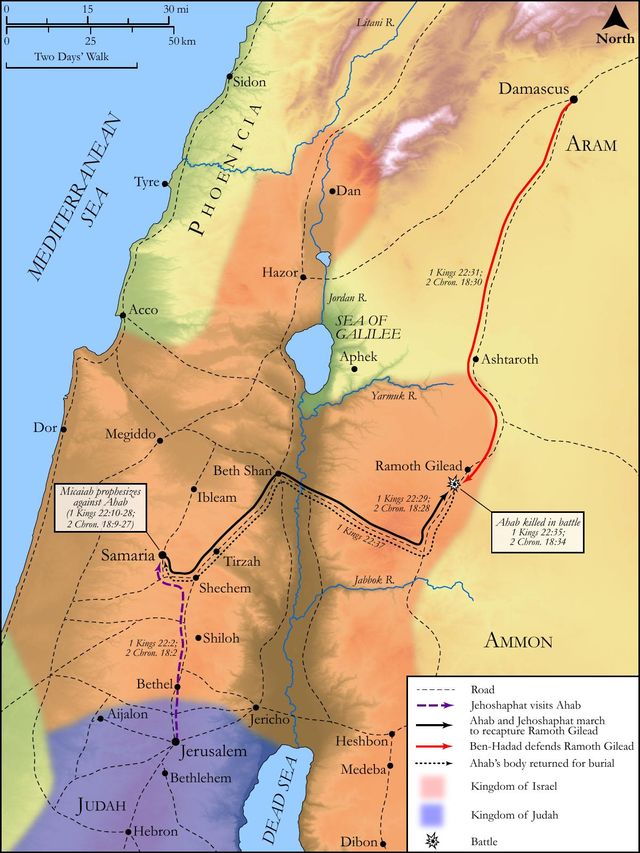
This verse provides the concluding summary of Jehoshaphat's reign in the book of 1 Kings, acting as a pivotal transition point. Immediately preceding it, the narrative in 1 Kings 22 recounts the ill-fated military alliance between Jehoshaphat and the wicked King Ahab of Israel against Ramoth-gilead. Despite the prophetic warning from Micaiah, Jehoshaphat joined Ahab in battle, narrowly escaping death himself when the Arameans mistook him for Ahab (1 Kings 22:32). The preceding verses detail Ahab's demise and Jehoshaphat's safe return to Jerusalem. Therefore, 1 Kings 22:50 functions as a formal, traditional closing statement for a monarch's account, neatly wrapping up Jehoshaphat's story within 1 Kings and setting the stage for the subsequent narratives of both Judah and Israel that will unfold in the book of 2 Kings, beginning with Jehoram's reign.
Historical & Cultural Context
King Jehoshaphat governed Judah during the mid-9th century BC, a period characterized by significant political maneuvering and religious challenges within the divided monarchy. His reign, spanning approximately 25 years, is generally presented positively, particularly in 2 Chronicles 17-20, where he is lauded for his religious reforms, judicial improvements, and military strength. The phrase "slept with his fathers" is a deeply ingrained and respectful euphemism for death, consistently employed throughout the books of Kings and Chronicles for deceased monarchs and patriarchs. It implies a natural, peaceful passing, distinguishing it from violent or premature ends. This idiom also suggests a joining of one's ancestors in the afterlife, reinforcing the concept of lineage and continuity. The specific mention of burial in the "city of David" (Jerusalem) was the customary and highly honorable resting place for the legitimate kings of Judah, signifying their rightful claim to the throne and their integral connection to the foundational covenant God established with King David (2 Samuel 7:12). This practice visually reinforced the stability and divine sanction of the Davidic monarchy.
Key Themes
ShowHideThis concise verse encapsulates several profound and recurring themes within the Deuteronomistic history. Firstly, it starkly highlights the inevitability of death and the necessity of succession for all human leaders, regardless of their piety, power, or accomplishments. Even a king like Jehoshaphat, who largely "walked in the way of Asa his father and did not turn aside from it, doing what was right in the sight of the Lord" (1 Kings 22:43), must ultimately yield to mortality. Secondly, the verse powerfully underscores the unwavering continuity of the Davidic covenant and lineage. Jehoshaphat's burial in the "city of David" and the immediate, undisputed succession of Jehoram reaffirm God's faithfulness to His promise to David that his house and kingdom would endure forever (2 Samuel 7:16). This continuity was not merely political but profoundly theological, serving as the essential thread leading to the eventual coming of the Messiah. Thirdly, the verse implicitly points to the legacy of a ruler, prompting reflection on the impact of Jehoshaphat's reign, which, despite some notable compromises (such as the alliance with Ahab), was predominantly characterized by devotion to the Lord and efforts to uphold justice.
Exposition and Analysis
ShowHideKey Word Analysis
ShowHideDerived from the Hebrew for "Jehovah-judged," this name signifies the divine oversight and justice of God. For the king of Judah, it underscores the theological lens through which his reign is viewed, implying that his actions and legacy are subject to divine scrutiny and judgment. The name itself serves as a reminder of God's active involvement in the affairs of His people and their leaders.
This primitive root literally means "to lie down," but in this context, it functions as a well-established euphemism for death, particularly for monarchs and patriarchs in the Old Testament. Its use here conveys a sense of a natural, peaceful, and accepted passing, in contrast to violent or premature ends. The idiom "slept with his fathers" suggests a joining of one's ancestors in the realm of the dead, emphasizing the common human experience of mortality and the continuity of familial and dynastic lines.
This primitive root signifies "to reign" or, inceptively, "to ascend the throne." Its use here marks the formal and legitimate transfer of royal authority from Jehoshaphat to his son, Jehoram. It denotes the establishment of the new king's rule and the continuity of the monarchy, ensuring there is no power vacuum or dispute over the succession, thereby maintaining stability within the kingdom.
Verse Breakdown
ShowHide"And Jehoshaphat slept with his fathers"
This initial clause formally announces the death of King Jehoshaphat, concluding his earthly reign. The use of the euphemism "slept with his fathers" indicates a natural, peaceful, and legitimate end to his life, distinguishing it from the often violent or tragic deaths recorded for other kings in the historical narratives. It places his passing within the established, divinely ordained pattern of royal succession and mortality in ancient Israel and Judah.
"and was buried with his fathers in the city of David his father"
This segment specifies the sacred and honorable location of Jehoshaphat's interment. Being buried "with his fathers" in the "city of David" (Jerusalem) unequivocally confirms his legitimate status as a king of the Davidic lineage. This was the traditional royal necropolis for the kings of Judah, and burial there was a profound mark of honor, signifying his rightful place within the covenant lineage initiated by King David. It powerfully reinforces the themes of dynastic continuity, divine faithfulness to the Davidic covenant, and the enduring nature of the monarchy.
"and Jehoram his son reigned in his stead"
This final, formulaic clause declares the immediate and orderly succession of Jehoshaphat's son, Jehoram, to the throne. This statement is crucial for the Deuteronomistic historian, as it assures the reader that the transfer of power was smooth and undisputed, preventing any interregnum or civil strife. It highlights the stability of the monarchy and the ongoing fulfillment of God's promise to maintain a continuous line of Davidic rulers, ensuring the perpetuation of the royal house.
Literary Devices
ShowHide1 Kings 22:50, though brief, is rich in literary devices that enhance its meaning and impact. The most prominent is Euphemism, particularly in the phrase "slept with his fathers," which politely and indirectly refers to death. This softens the harsh reality of mortality, presenting it as a peaceful rest. This expression is also a prime example of Formulaic Language, a recurring phrase used throughout the books of Kings and Chronicles to mark the end of a monarch's reign. This formula provides structural consistency and emphasizes the cyclical nature of human rule. The phrase "slept with his fathers" also subtly employs Metonymy, where "fathers" represents the collective ancestors or the entire ancestral line, thereby emphasizing the king's integration into the historical and dynastic continuity of his lineage. Furthermore, the "city of David" functions as a Synecdoche, where a part (the royal burial ground in Jerusalem) stands for the whole (the entire Davidic kingdom, its covenant, and its theological significance), underscoring the profound spiritual and political importance of the burial place for the legitimacy and continuity of the Davidic dynasty.
Theological and Thematic Connections
ShowHide1 Kings 22:50, despite its brevity, is pregnant with theological significance, serving as a powerful reminder of fundamental truths. It underscores the profound reality of human mortality and the transient nature of all earthly power, even that wielded by divinely appointed kings. God's sovereignty remains absolute, orchestrating the rise and fall of rulers according to His eternal, unfolding plan. The orderly succession from Jehoshaphat to Jehoram, coupled with Jehoshaphat's burial in the "city of David," powerfully affirms the unwavering faithfulness of God to His covenant with David (2 Samuel 7:12). Despite the flaws, compromises, and ultimate mortality of individual kings, the divine promise to maintain a perpetual "lamp" for David's house continued to be fulfilled, steadfastly pointing forward to the ultimate, eternal King who would one day sit on David's throne. This verse thus stands as a testament to God's enduring covenant love and His meticulous preservation of the lineage through which the Messiah would eventually come.
Reflection and Application
ShowHideThe quiet finality of 1 Kings 22:50 serves as a profound and sobering reminder of life's brevity and the inevitable conclusion of all earthly reigns, endeavors, and achievements. Like King Jehoshaphat, whose reign was a complex tapestry woven with threads of both sincere devotion and regrettable compromise, our own lives are finite, and our allotted time to impact the world for God's kingdom is precious and limited. This verse compels us to deeply consider our legacy: not merely the material wealth we accumulate or the accolades we achieve, but the spiritual impact we make, the character we cultivate, and the faithfulness with which we steward the unique responsibilities and opportunities God has entrusted to us. It challenges us to live with an eternal perspective, recognizing that while our individual earthly lives conclude, God's overarching, redemptive plan continues through successive generations. Furthermore, it highlights the critical importance of intentionally discipling, mentoring, and preparing the next generation for faithful leadership, ensuring the continuity of faith, truth, and service beyond our own time, reflecting God's commitment to His enduring covenant.
Questions for Reflection
ShowHideFAQ
ShowHideWhat does "slept with his fathers" mean in the Bible?
ShowHide"Slept with his fathers" is a widely used and respectful euphemism in the Old Testament for death, particularly for kings, patriarchs, and significant figures. It signifies a natural, peaceful passing, as opposed to a violent or untimely end. The phrase implies joining one's ancestors in the realm of the dead, emphasizing the common human experience of mortality and the continuity of family and dynastic lines. It does not necessarily convey a specific theological understanding of the afterlife, but rather the cessation of earthly life and the formal transition of leadership. This idiom is applied to both righteous and unrighteous kings, indicating a legitimate and accepted end to their reign (e.g., Deuteronomy 31:16, 1 Kings 2:10).
Why is burial in the "city of David" significant for a king of Judah?
ShowHideBurial in the "city of David" refers to interment within Jerusalem, specifically the royal burial grounds located in the ancient fortified core captured by King David (2 Samuel 5:7). This was the customary and highly honorable resting place for the legitimate kings of Judah. Its profound significance lies in several interconnected aspects: it underscored the king's rightful claim to the throne, affirmed his direct connection to the foundational Davidic covenant, and powerfully symbolized the continuity and stability of the Davidic dynasty. It was a mark of supreme honor and a public declaration of the king's legitimate place within the sacred history and lineage of God's chosen people, reinforcing the divine sanction and enduring nature of the monarchy (e.g., 1 Kings 2:10).
Christ-Centered Fulfillment
ShowHideThe seemingly routine record of Jehoshaphat's death and succession in 1 Kings 22:50 finds its ultimate and profound Christ-centered fulfillment in the person and redemptive work of Jesus of Nazareth. The verse, by meticulously emphasizing the continuity of the Davidic line through Jehoram and Jehoshaphat's burial in the "city of David," subtly yet powerfully points to God's unwavering faithfulness to His covenant with David (2 Samuel 7:12). While earthly kings like Jehoshaphat "slept with their fathers" and their reigns inevitably concluded in mortality, the Davidic covenant ultimately finds its perfect, eternal, and indestructible fulfillment in Jesus Christ. He is the true and everlasting Son of David, whose kingdom will have no end, unlike the temporary reigns of mortal monarchs (Luke 1:32-33). Unlike all human kings who succumb to the power of death, Jesus triumphantly conquered death itself, rising victoriously from the grave and declaring, "I am the living one. I was dead, and behold, I am alive forevermore, and I have the keys of Death and Hades" (Revelation 1:18). The transient reigns of Judah's kings, even the relatively righteous ones like Jehoshaphat, serve as a prophetic shadow, a temporary and imperfect foreshadowing of the perfect, eternal, and truly righteous reign of Christ, who is the ultimate King, High Priest, and Prophet, establishing a spiritual kingdom that will never pass away and whose dominion is forever (Hebrews 7:23-25).