


1 Kings 11:43
- וַיִּשְׁכַּבvai·yish·Kavand he lay downH7901Conj-w ¦ V-Qal-ConsecImperf-3msVerb Qal Consecutive Imperfect 3rd Singular Masculineוַandיִּשְׁכַּבhe lay down
- שְׁלֹמֹהshe·lo·MohSolomonH8010N-proper-mNoun Proper Masculine
- עִם'imwithH5973PrepPreposition
- אֲבֹתָיו'a·vo·Tavhis ancestorsH1N-fpc ¦ 3msNoun Plural Feminine Constructאֲבֹתָיancestorsוhis
- וַיִּקָּבֵרvai·Yi·ka·Verand he was buriedH6912Conj-w ¦ V-Niphal-ConsecImperf-3msVerb Niphal Consecutive Imperfect 3rd Singular Masculineוַandיִּקָּבֵרhe was buried
- בְּעִירbe·'Irin [the] city ofH5892Prep-b ¦ N-fscNoun Singular Feminine Constructבְּinעִיר[the] city of
- דָּוִדda·VidDavidH1732N-proper-mNoun Proper Masculine
- אָבִיו'a·Vivhis fatherH1N-msc ¦ 3msNoun Singular Masculine Constructאָבִיfatherוhis
- וַיִּמְלֹךְvai·yim·Lokhand he became kingH4427Conj-w ¦ V-Qal-ConsecImperf-3msVerb Qal Consecutive Imperfect 3rd Singular Masculineוַandיִּמְלֹךְhe became king
- רְחַבְעָםre·chav·'AmRehoboamH7346N-proper-mNoun Proper Masculine
- בְּנוֹbe·Nohis sonH1121N-msc ¦ 3msNoun Singular Masculine Constructבְּנsonוֹhis
- תַּחְתָּיוtach·Tavin place of himH8478N-mpc ¦ 3msNoun Plural Masculine Constructתַּחְתָּיin place ofוhim
English is a literal word-by-word gloss of the Hebrew, not the KJV's wording. Why?
This is the original text the KJV's translators worked from — each Hebrew word with its own literal English meaning in this verse, prepared by scholars at Tyndale House, Cambridge. The KJV translates whole sentences, not word by word, so its wording differs: one Hebrew word can become several English words, and the KJV may choose “the LORD” where the gloss reads “Yahweh”. Both are faithful — they answer different questions. For the KJV's own rendering, switch to the KJV text.
Details
See on the biblical-era map
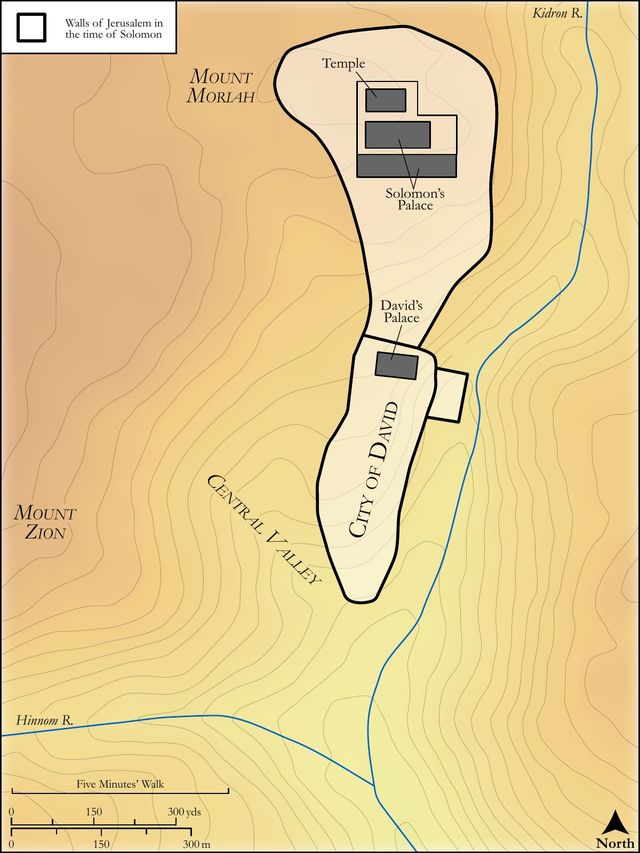
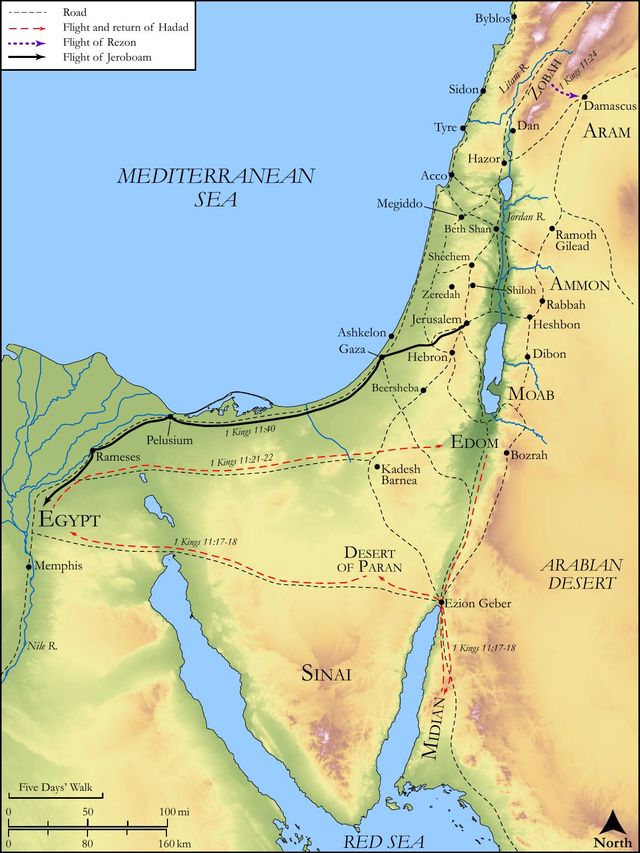
Study this verse
Public-domain commentary
Matthew Henry
From his Commentary on the Whole Bible. Henry comments on passages, not single verses — this entry covers 1 Kings 11:41–43.
We have here the conclusion of Solomon's story, and in it, 1. Reference is had to another history then extant, but (not being divinely inspired) since lost, the Book of the Acts of Solomon, Kg1 11:41. Probably this book was written by a chronologer or historiographer, whom Solomon employed to write his annals, out of which the sacred writer extracted what God saw fit to transmit to the church. 2. A summary of the years of his reign (Kg1 11:42): He reigned in Jerusalem (not, as his father, part of his time in Hebron and part in Jerusalem), over all Israel (not as his son, and his father in the beginning of his time, over Judah only), forty years. His reign was as long as his father's, but not his life. Sin shortened his days. 3. His death and burial, and his successor, Kg1 11:43. (1.) He followed his fathers to the grave, slept with them, and was buried in David's burying-place, with honour no doubt. (2.) His son followed him in the throne. Thus the graves are filling with the generations that go off, and houses are filling with those that are growing up. As the grave cries, "Give, give," so land is never lost for want of an heir.
Historical interpretation
Historical reception
1 surviving comment on this verse from the historical church.
Solomon slept: That is, died. He was then about fifty-eight years of age, having reigned forty years.
Continue studying 1 Kings 11:43 across the web’s major study libraries — every link below opens this exact verse, chapter, or book on the destination site.
Read & Compare
 BibleGatewayThis verse in more than 200 translations and 70 languages.
 Bible.comThe YouVersion reader — hundreds of translations, reading plans, and highlights.
 ESV.orgCrossway's official English Standard Version reader.
 NET BibleThe NET translation with 60,000+ translators' notes on every rendering decision.
 STEP BibleTyndale House's free study tool — original text, vocabulary, and scholarly resources.
 BibliaLogos Bible Software's free web reader.
 USCCBThe New American Bible (Revised Edition) with the U.S. bishops' study notes.
Commentaries
 BibleHub CommentariesDozens of classic commentaries on this verse, gathered on one page.
 StudyLightMore than 100 commentary sets — the largest collection on the web.
 BibleRefPlain-English commentary on what this verse means, verse by verse.
 Enduring WordDavid Guzik's free commentary on this chapter, widely used by Bible teachers.
 Bible Study ToolsVerse commentary alongside Greek and Hebrew study aids.
Original Language & Research
- BibleHub InterlinearThe verse word by word — original language, transliteration, and English.
- BibleHub LexiconEvery word's original-language definition and Strong's entry.
 Blue Letter BibleDeep-study tools — Strong's numbers, concordance, and word studies.
 SefariaThe Hebrew text with Rashi and centuries of Jewish commentary.
Sermons, Hymns & Audio


TrulyRandomVerse is not affiliated with these sites and doesn’t control their content. They’re linked because they’re genuinely useful.
Summary
1 Kings 11:43 serves as a poignant narrative conclusion to King Solomon's four-decade reign over a united Israel. This pivotal verse marks the passing of the kingdom's most magnificent monarch, whose rule began with unparalleled wisdom and prosperity but tragically ended in spiritual compromise and divine judgment. It simultaneously announces the immediate, yet fraught, succession of his son Rehoboam, thereby setting the stage for the impending and dramatic division of the Israelite monarchy.
Context
ShowHideLiterary Context
This verse provides the definitive narrative closure to the account of King Solomon's reign, particularly the somber details of his spiritual decline chronicled in 1 Kings 11. The preceding verses meticulously detail how Solomon's heart was turned away from the Lord by his numerous foreign wives, leading him into idolatry and the worship of pagan deities. This apostasy stands in stark contrast to his earlier devotion and the monumental achievement of building the Temple in Jerusalem. God's righteous anger and His pronouncement of judgment—that the kingdom would be torn from Solomon's hand, though not in his lifetime, and a remnant would be left for David's sake—are explicitly recorded in 1 Kings 11:9-13. Thus, 1 Kings 11:43 functions as the final, mournful note on Solomon's rule, immediately preceding the dramatic account of the kingdom's division under Rehoboam in 1 Kings 12. It acts as a crucial narrative fulcrum, transitioning from the personal failures of the king to their catastrophic national consequences.
Historical & Cultural Context
Solomon's reign (c. 970-931 BC) is widely regarded as the golden age of Israel's united monarchy, a period characterized by immense wealth, architectural marvels like the Temple and his palace, and a reputation for wisdom that extended throughout the ancient Near East. The "city of David" refers to Jerusalem, specifically the ancient Jebusite stronghold conquered by King David, which subsequently became the political and religious capital of Israel. Burial within the city, particularly in a royal tomb, was a high honor, signifying legitimate succession and ancestral connection within the dynastic line. The phrase "slept with his fathers" is a common ancient Near Eastern euphemism for death, especially for monarchs, emphasizing a peaceful passing and joining the lineage of ancestors. Dynastic succession, where the son inherited the throne, was paramount in ancient monarchies, ensuring continuity and stability. However, Solomon's later years were marked by internal discontent due to heavy taxation and forced labor, alongside external threats from adversaries raised by God (Hadad the Edomite, Rezon of Zobah, and Jeroboam), all of which contributed to the unstable environment Rehoboam inherited.
Key Themes
ShowHide1 Kings 11:43 encapsulates several profound themes crucial to the broader narrative of Kings. Primarily, it underscores the mortality and transience of even the greatest human leaders, reminding readers that all earthly power is temporary and subject to the ultimate sovereignty of God. Solomon, despite his unparalleled wisdom and wealth, was not exempt from the universal decree of death. Secondly, the verse highlights the far-reaching consequences of disobedience and spiritual compromise. Solomon's apostasy, detailed throughout 1 Kings 11, directly led to the divine judgment of kingdom division, illustrating the principle that sin has profound effects beyond the individual, impacting generations and nations. This stands in stark contrast to the blessings promised for obedience in Deuteronomy 28:1-14. Thirdly, the verse subtly points to the continuity of the Davidic covenant despite human failure. Even as the kingdom is about to be divided, the lineage of David is preserved through Rehoboam's succession, a testament to God's unwavering faithfulness to His promises made to David in 2 Samuel 7:12-16, ensuring that a "lamp" would always remain for David's house.
Exposition and Analysis
ShowHideKey Word Analysis
ShowHideThis verb, often translated as "to lie down," is used here as a common biblical euphemism for death. It softens the stark reality of demise, implying a peaceful rest and a joining of one's ancestors. In the context of kings, it often suggests a natural, honored passing and the continuity of the royal line, even when the reign itself ended under a cloud of divine judgment.
This term refers to one's ancestors or forefathers. When a king is said to "sleep with his fathers," it signifies his passing into the realm of the dead to join his lineage, often implying burial in a family tomb or a shared royal necropolis. It emphasizes the king's legitimate place within the dynastic succession and the historical continuity of the royal house.
This verb signifies the act of ruling as a king, encompassing the ascension to the throne and the exercise of royal authority. Its use here indicates the formal and immediate transfer of kingship from Solomon to Rehoboam, highlighting the established process of dynastic succession in ancient Israel. Despite the impending political turmoil, the transfer of power itself followed the expected pattern of royal continuity.
Verse Breakdown
ShowHide"And Solomon slept with his fathers"
This clause announces the death of King Solomon, using the respectful and common biblical euphemism for passing away. It marks the definitive end of his earthly reign, highlighting the universal mortality that applies even to the most powerful and wise human leaders.
"and was buried in the city of David his father"
This part specifies Solomon's burial location, emphasizing his royal lineage and his deep connection to Jerusalem, the capital city established by his father, King David. Burial in the "city of David" was a significant honor, affirming his place within the Davidic dynasty and the historical continuity of the kingdom, even as his reign concluded under the shadow of divine judgment.
"and Rehoboam his son reigned in his stead"
This final clause declares the immediate and legitimate succession of Solomon's son, Rehoboam, to the throne. It signifies the formal transfer of power and the continuation of the Davidic line, which was central to God's covenant promises. This transition, however, would prove to be the catalyst for the dramatic division of the united monarchy, as Rehoboam's unwise decisions soon alienated the northern tribes.
Literary Devices
ShowHideThe verse employs several significant literary devices. The most prominent is Euphemism, specifically in the phrase "slept with his fathers," which softens the harsh reality of death while simultaneously connecting the deceased king to his ancestral lineage and the continuity of the royal line. This gentle phrasing stands in stark contrast to the severe divine judgment detailed in the preceding verses, perhaps serving as a moment of narrative pause before the impending national crisis. The verse also functions as a crucial Narrative Transition, marking the definitive end of one era and the immediate beginning of another. It acts as a pivot point, closing the account of Solomon's reign and setting the stage for the dramatic events of the kingdom's division in the subsequent chapter. Furthermore, the mention of "the city of David his father" and "Rehoboam his son" highlights Dynastic Continuity, emphasizing the unbroken line of succession from David, despite the personal failures of Solomon and the impending political fragmentation. This continuity underscores God's faithfulness to His covenant promises, even when human actors fall short.
Theological and Thematic Connections
ShowHide1 Kings 11:43, though brief, is pregnant with theological significance, serving as a powerful reminder of God's sovereignty over human history and the enduring consequences of spiritual compromise. Solomon's reign, initially a testament to God's blessing on obedience, ultimately became a stark illustration of how even the most gifted individuals can stray from divine precepts, leading to personal and national decline. Yet, amidst this judgment, God's faithfulness to His covenant with David shines through; the transfer of power to Rehoboam ensures the continuation of the Davidic line, a crucial thread in the unfolding tapestry of salvation history. This verse underscores that while human actions have real consequences, God's ultimate purposes and promises will prevail, often working through and despite human frailty. It highlights the tension between human responsibility and divine sovereignty, a recurring theme throughout the biblical narrative.
Reflection and Application
ShowHideThe conclusion of Solomon's reign in 1 Kings 11:43 offers profound lessons for believers today. It serves as a sobering reminder that spiritual vigilance is paramount, regardless of one's past achievements or initial devotion. Solomon, who began with such promise and wisdom, ultimately allowed compromise and idolatry to corrupt his heart, demonstrating that a strong start does not guarantee a strong finish. This should prompt us to consistently guard our hearts, remain steadfast in our devotion to God, and resist the subtle allure of worldly entanglements that can draw us away from Him. Furthermore, the verse highlights the far-reaching impact of leadership, both for good and for ill. Solomon's personal failures had national consequences, leading to the division of the kingdom. This underscores the immense responsibility of those in positions of influence, whether in families, churches, or communities, to lead with integrity and a heart fully devoted to God, recognizing that their spiritual state profoundly affects those under their care. Ultimately, it calls us to live lives of unwavering faithfulness, trusting in God's sovereignty even when human leaders falter, and striving to finish our race with integrity and devotion.
Questions for Reflection
ShowHideFAQ
ShowHideWhat is the significance of the phrase "slept with his fathers"?
ShowHideThe phrase "slept with his fathers" is a common biblical euphemism for death, particularly used for kings and patriarchs in the Old Testament. It conveys a sense of peaceful passing and emphasizes the continuity of the family or dynastic line. It suggests that the deceased has joined their ancestors in the afterlife or in a shared burial place, highlighting their legitimate place within their lineage rather than simply stating their demise. This idiom is used throughout the books of Kings and Chronicles to mark the end of a monarch's reign and the transition to the next, such as in 2 Samuel 7:12.
Why was Solomon buried in the "city of David his father"?
ShowHideSolomon's burial in the "city of David his father" (Jerusalem) was highly significant for several reasons. Firstly, it affirmed his legitimate succession and his place within the Davidic dynasty, connecting him directly to the revered King David, who had established Jerusalem as the capital (2 Samuel 5:7-9). Secondly, Jerusalem was the capital of the united monarchy and the spiritual center where Solomon had built the magnificent Temple (1 Kings 6). Being buried there underscored his royal status and his integral role in the history of Israel. It was a mark of honor, signifying that he died as the reigning king and was laid to rest in the royal necropolis, thus maintaining the continuity of the royal house.
What does this verse foreshadow for the kingdom of Israel?
ShowHideThis verse, marking Solomon's death and Rehoboam's succession, immediately foreshadows the dramatic division of the united kingdom of Israel. While it maintains the Davidic line, the preceding verses in 1 Kings 11 detail God's judgment against Solomon for his idolatry, specifically His promise to tear the kingdom away from his son, leaving only one tribe for David's sake (1 Kings 11:11-13). Therefore, the succession of Rehoboam sets the stage for the pivotal events of 1 Kings 12, where Rehoboam's unwise decision to increase the burdens on the people leads to the secession of the ten northern tribes, resulting in the divided kingdoms of Israel (north) and Judah (south).
Christ-Centered Fulfillment
ShowHide1 Kings 11:43, while marking the end of a glorious yet flawed earthly reign, powerfully points to the ultimate and perfect King, Jesus Christ. Solomon, the son of David, was a significant type of Christ—a king of peace (shalom), builder of the Temple, and renowned for wisdom. However, his failure to maintain fidelity to God, leading to the division of the kingdom, underscores the inherent limitations and sinfulness of all human kings. The Davidic covenant, which promised an eternal throne and kingdom to David's descendant (2 Samuel 7:12-16), found its true and unblemished fulfillment not in Solomon or Rehoboam, but in Jesus. He is the true Son of David, born into that very lineage (Matthew 1:1). Unlike Solomon, whose heart was turned away by foreign wives, Jesus remained perfectly obedient to His Father, even to the point of death on a cross (Philippians 2:8). His "reign in His stead" is not merely a succession of an earthly throne, but the establishment of an eternal, spiritual kingdom that will never end or be divided (Luke 1:32-33). Jesus is the perfect builder of a new, spiritual Temple—His body, the Church (John 2:19-21). Thus, Solomon's death and the subsequent fracturing of his kingdom highlight humanity's desperate need for a King who is not subject to sin or mortality, a King whose kingdom is truly everlasting and whose wisdom is unfailing, found only in the person of Jesus Christ, in whom "are hidden all the treasures of wisdom and knowledge" (Colossians 2:3).