


1 Kings 11:42
Bible text: King James Version (1769 Blayney text) · Public domain
Bible text: Berean Standard Bible · Public domain
Bible text: American Standard Version (1901) · Public domain
Bible text: World English Bible, Messianic edition · Public domain
Bible text: Geneva Bible (1599) · Public domain
Bible text: Young's Literal Translation · Public domain
- וְהַיָּמִיםve·hai·ya·Mimand the daysH3117Conj-w ¦ Art ¦ N-mpNoun Plural Masculine Absoluteוְandהַtheיָּמִיםdays
- אֲשֶׁר'a·SherwhichH834RelParticle Relative
- מָלַךְma·Lakhhe reignedH4427V-Qal-Perf-3msVerb Qal Perfect 3rd Singular Masculine
- שְׁלֹמֹהshe·lo·MohSolomonH8010N-proper-mNoun Proper Masculine
- בִירוּשָׁלִַםvi·ru·sha·Limin JerusalemH3389Prep-b ¦ N-properNoun Proper LocationבִinירוּשָׁלִַםJerusalem
- עַל'aloverH5921PrepPreposition
- כָּלkolallH3605N-mscNoun Singular Masculine Construct
- יִשְׂרָאֵלYis·ra·'ElIsraelH3478N-properNoun Proper Location
- אַרְבָּעִים'ar·ba·'Im[were] fortyH705N-mpNoun Plural Masculine Absolute
- שָׁנָהsha·Nahyear[s]H8141N-fsNoun Singular Feminine Absolute
English is a literal word-by-word gloss of the Hebrew, not the KJV's wording. Why?
This is the original text the KJV's translators worked from — each Hebrew word with its own literal English meaning in this verse, prepared by scholars at Tyndale House, Cambridge. The KJV translates whole sentences, not word by word, so its wording differs: one Hebrew word can become several English words, and the KJV may choose “the LORD” where the gloss reads “Yahweh”. Both are faithful — they answer different questions. For the KJV's own rendering, switch to the KJV text.
Details
See on the biblical-era maps
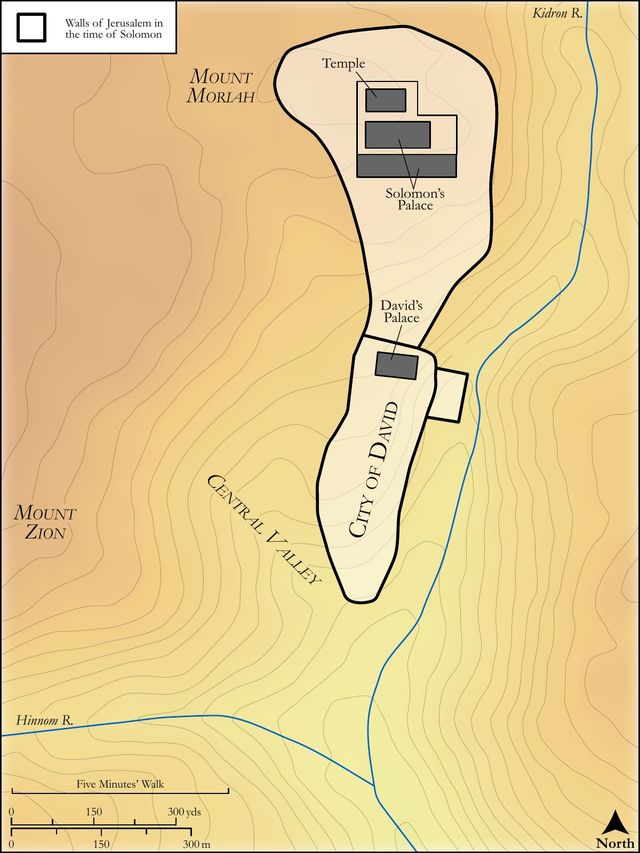
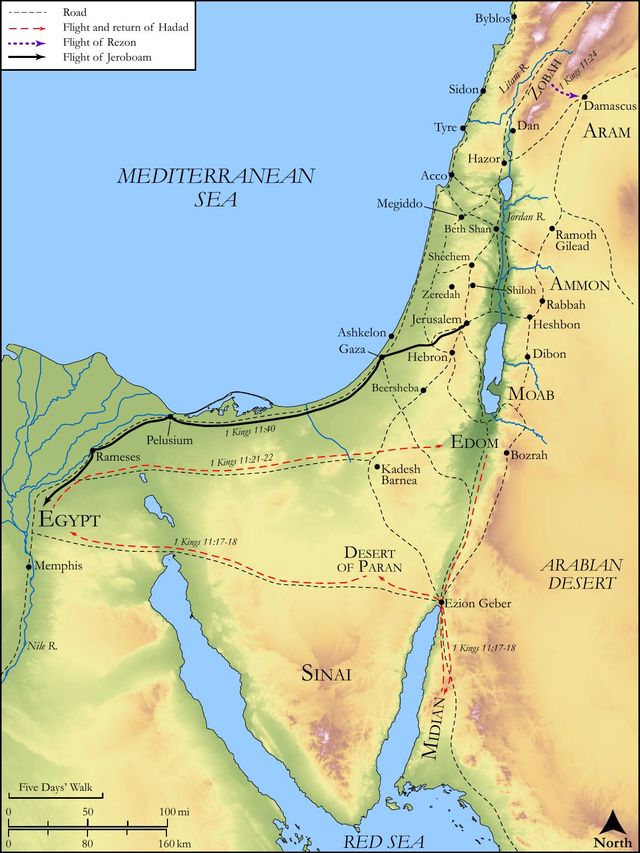
Study this verse
Public-domain commentary
Matthew Henry
From his Commentary on the Whole Bible. Henry comments on passages, not single verses — this entry covers 1 Kings 11:41–43.
We have here the conclusion of Solomon's story, and in it, 1. Reference is had to another history then extant, but (not being divinely inspired) since lost, the Book of the Acts of Solomon, Kg1 11:41. Probably this book was written by a chronologer or historiographer, whom Solomon employed to write his annals, out of which the sacred writer extracted what God saw fit to transmit to the church. 2. A summary of the years of his reign (Kg1 11:42): He reigned in Jerusalem (not, as his father, part of his time in Hebron and part in Jerusalem), over all Israel (not as his son, and his father in the beginning of his time, over Judah only), forty years. His reign was as long as his father's, but not his life. Sin shortened his days. 3. His death and burial, and his successor, Kg1 11:43. (1.) He followed his fathers to the grave, slept with them, and was buried in David's burying-place, with honour no doubt. (2.) His son followed him in the throne. Thus the graves are filling with the generations that go off, and houses are filling with those that are growing up. As the grave cries, "Give, give," so land is never lost for want of an heir.
Continue studying 1 Kings 11:42 across the web’s major study libraries — every link below opens this exact verse, chapter, or book on the destination site.
Read & Compare
 BibleGatewayThis verse in more than 200 translations and 70 languages.
 Bible.comThe YouVersion reader — hundreds of translations, reading plans, and highlights.
 ESV.orgCrossway's official English Standard Version reader.
 NET BibleThe NET translation with 60,000+ translators' notes on every rendering decision.
 STEP BibleTyndale House's free study tool — original text, vocabulary, and scholarly resources.
 BibliaLogos Bible Software's free web reader.
 USCCBThe New American Bible (Revised Edition) with the U.S. bishops' study notes.
Commentaries
 BibleHub CommentariesDozens of classic commentaries on this verse, gathered on one page.
 StudyLightMore than 100 commentary sets — the largest collection on the web.
 BibleRefPlain-English commentary on what this verse means, verse by verse.
 Enduring WordDavid Guzik's free commentary on this chapter, widely used by Bible teachers.
 Bible Study ToolsVerse commentary alongside Greek and Hebrew study aids.
Original Language & Research
- BibleHub InterlinearThe verse word by word — original language, transliteration, and English.
- BibleHub LexiconEvery word's original-language definition and Strong's entry.
 Blue Letter BibleDeep-study tools — Strong's numbers, concordance, and word studies.
 SefariaThe Hebrew text with Rashi and centuries of Jewish commentary.
Sermons, Hymns & Audio


TrulyRandomVerse is not affiliated with these sites and doesn’t control their content. They’re linked because they’re genuinely useful.
Summary
First Kings 11:42 serves as the formal conclusion to the reign of King Solomon, succinctly stating the duration of his forty-year rule over the unified kingdom of Israel from Jerusalem. This concise statement encapsulates a period of unparalleled prosperity, wisdom, and the construction of the Temple, yet it is presented immediately following a detailed account of his tragic spiritual decline and apostasy, thereby setting the stage for the dramatic and immediate division of the monarchy that follows.
Context
ShowHideLiterary Context
This verse functions as a conventional concluding formula for a king's reign within the Deuteronomistic History, a pattern observed throughout the books of Kings (e.g., 2 Samuel 5:4). Its placement is highly significant: it immediately follows the detailed exposition of Solomon's profound spiritual failures, particularly his turning to idolatry due to his numerous foreign wives and their gods, which is extensively documented in 1 Kings 11:1-8. The divine judgment pronounced against him, including the explicit promise of a divided kingdom, is articulated in 1 Kings 11:9-13. Therefore, the summary of Solomon's forty-year reign, initially glorious, is now viewed through the somber lens of its tragic end, serving as a poignant prelude to the narrative of national fragmentation that commences in 1 Kings 12.
Historical & Cultural Context
Solomon's reign, traditionally dated from approximately 970 to 931 BC, represents the pinnacle of Israel's power, wealth, and international influence during the period of the united monarchy. Jerusalem, his chosen capital, flourished into a prominent administrative and spiritual center, marked by the construction of the magnificent Temple and the royal palace. The "forty years" mentioned is a conventional biblical figure, often employed to signify a complete generation or a significant, full period, notably mirroring the length of King David's reign (1 Kings 2:11). Culturally, the practice of accumulating foreign wives was a common diplomatic strategy among the kings of that day to forge political alliances. However, for Israelite kings, this practice was explicitly forbidden by divine law due to the inherent risk of syncretism and apostasy, as clearly stated in Deuteronomy 17:17. Solomon's tragic failure to adhere to this crucial divine command ultimately led to the unraveling of the kingdom's spiritual and political fabric.
Key Themes
ShowHideThis concluding verse encapsulates several pivotal themes within the book of Kings and the broader Deuteronomistic History. Firstly, the Duration of Rule is underscored, with "forty years" signifying a complete and significant era, a period marked by both unparalleled blessing and profound spiritual decline. Secondly, it definitively marks the End of the Golden Age of the united monarchy, a period of peace and prosperity extensively detailed in 1 Kings 4:20-25, a zenith that Israel would not experience again until the future Messianic age. Thirdly, the phrase "over all Israel" highlights the critical theme of the Unified Kingdom, a fragile unity maintained throughout Solomon's reign but destined for immediate dissolution due to his unfaithfulness, as prophetically declared in 1 Kings 11:11. Thus, the verse serves as a pivotal point, closing the chapter on Israel's peak and opening the door to its subsequent fragmentation and decline.
Exposition and Analysis
ShowHideKey Word Analysis
ShowHideThis verb (H4427) denotes the exercise of royal authority and governance. In the context of biblical kingship, it carries profound political and theological weight, implying a divinely appointed role to rule God's people according to His laws. While Solomon's reign was outwardly successful and long, it ultimately failed in its spiritual dimension, as he did not fully 'reign' in accordance with God's covenant, leading to the consequences detailed earlier in the chapter.
More than merely a geographical location, Jerusalem (H3389) was the spiritual and political heart of the united kingdom, the city where David established his throne and where Solomon built the magnificent Temple, the very dwelling place of God's presence among His people. The phrase "reigned in Jerusalem" underscores the centrality of this city to the monarchy and to Israel's identity as a nation under God. Its mention here highlights the unified nature of the kingdom under Solomon's direct rule from its capital, a unity soon to be shattered.
This numerical statement (H705) is not merely a chronological marker but often carries significant symbolic weight in biblical narratives. It frequently denotes a complete period, a generation, or a time of testing and transition. It mirrors the length of David's reign (1 Kings 2:11) and recalls other significant forty-year periods in Israel's history, such as their wilderness wanderings (Numbers 14:33). Here, it marks the full, complete span of Solomon's complex rule, from its glorious inception to its tragic spiritual decline.
Verse Breakdown
ShowHide"And the time that Solomon reigned"
This opening clause formally introduces the concluding statement regarding Solomon's kingship. It signals a shift from the narrative of his actions, achievements, and failures to a concise summary of his overall tenure. The emphasis is on the duration of his exercise of royal power, setting the stage for the specific period to be stated.
"in Jerusalem over all Israel"
This crucial clause specifies both the seat and the comprehensive scope of Solomon's authority. "In Jerusalem" reiterates the capital city's paramount importance as the administrative and spiritual center of the united kingdom. "Over all Israel" is particularly poignant, emphasizing that for the entire duration of his reign, Solomon maintained dominion over all twelve tribes, preserving the national unity established by his father, David. This detail becomes deeply significant given the immediate subsequent division of the kingdom.
"[was] forty years"
This is the precise and definitive duration of Solomon's rule. As previously discussed, "forty years" is a significant biblical number, here signifying the full completion of his reign. It provides a definitive historical marker, effectively closing the chapter on the united monarchy's golden age and preparing the reader for the narrative of the divided kingdom that immediately follows.
Literary Devices
ShowHideThe verse primarily functions as a Summary Statement, a common and formulaic literary device within the Deuteronomistic History. It is used to formally conclude a king's reign with a concise record of its duration and geographical scope, providing a clear transition point in the narrative. Furthermore, it employs subtle Foreshadowing by explicitly highlighting the unity "over all Israel," a unity that the informed reader, having just read the preceding prophecies of division, knows is about to shatter. This makes the statement of his forty-year reign over a unified kingdom particularly poignant and laden with dramatic irony. There is also an element of Irony present; a reign that began with such profound divine wisdom and promises of enduring blessing (1 Kings 3:5-14) concludes with a simple chronological marker, notably devoid of praise, immediately following a detailed account of his apostasy. The repeated use of "forty years" also carries significant Numerical Symbolism, representing a complete generation or a significant period, often associated with testing, transition, or the culmination of a divine plan. In Solomon's case, it marks the completion of a period that encompassed both unparalleled glory and profound spiritual decline, a full cycle from promise to tragic failure.
Theological and Thematic Connections
ShowHideFirst Kings 11:42, though a simple chronological statement, carries profound theological weight. It underscores the biblical principle that even divinely appointed leaders are ultimately accountable for their faithfulness to God's covenant. Solomon's forty-year reign, initially blessed with wisdom, immense wealth, and extensive peace, ultimately serves as a stark testament to the devastating consequences of spiritual compromise and idolatry. The verse subtly highlights the transient nature of earthly power and the enduring sovereignty of God, whose plans for His people persist despite human failure. It also emphasizes the inherent fragility of the united kingdom, a unity that was contingent upon the king's obedience, and whose dissolution serves as a somber and enduring lesson on the paramount importance of covenant fidelity for national well-being and divine blessing.
Reflection and Application
ShowHideThe conclusion of Solomon's forty-year reign offers timeless and sobering lessons for believers today. It serves as a powerful reminder that a strong start in faith does not inherently guarantee a faithful finish. Solomon, who at the outset of his reign humbly sought God's wisdom above all else, gradually allowed worldly enticements—such as unchecked power, immense wealth, and politically motivated foreign alliances—to subtly erode his singular devotion to the Lord, leading to a tragic and profound spiritual decline. This narrative should prompt us to vigilant self-examination, recognizing that spiritual complacency can insidiously set in even after periods of great blessing, significant achievement, or sustained spiritual growth. Our walk with God is indeed a marathon, not a sprint, requiring sustained faithfulness, humble dependence, and a continual turning away from anything that might subtly draw our hearts from Him. The verse also implicitly teaches us about the inherent impermanence of earthly glory, human achievements, and the ultimate sovereignty of God, whose eternal purposes transcend the rise and fall of human leaders and kingdoms. Our ultimate hope, security, and identity must rest not in the stability of worldly structures or personal accomplishments, but in the unchanging character and unfailing promises of God alone.
Questions for Reflection
ShowHideFAQ
ShowHideWhy is the "forty years" significant in the Bible?
ShowHideThe number forty frequently appears in the Bible to denote a complete, significant period, often associated with testing, judgment, or the duration of a generation. For example, the great flood lasted forty days and forty nights, Israel wandered in the wilderness for forty years as a consequence of their disobedience, and Jesus fasted for forty days in the wilderness before beginning His public ministry. In the context of Israelite kings, both Saul (Acts 13:21) and David (1 Kings 2:11) also reigned for forty years. For Solomon, it marks the full span of his rule, encompassing both his glorious beginning and his tragic spiritual decline, thereby signifying a complete and pivotal era for the united monarchy.
Did Solomon truly reign over "all Israel" for forty years, given the prophecy of division?
ShowHideYes, the text explicitly states that Solomon reigned "over all Israel" for the entire forty years of his rule. While God had indeed prophetically declared the division of the kingdom due to Solomon's profound sin and idolatry (1 Kings 11:11-13), this divine judgment was mercifully postponed until after Solomon's death. This meant that the unity of the twelve tribes under one king, a unity painstakingly established by David, was maintained throughout Solomon's lifetime. The dramatic division, as meticulously detailed in 1 Kings 12, occurred immediately upon the succession of his son, Rehoboam, fulfilling God's word precisely as foretold.
Christ-Centered Fulfillment
ShowHideSolomon's forty-year reign, though marking the historical pinnacle of Israel's earthly kingdom in terms of wealth, wisdom, and peace, ultimately serves as a profound pointer to the far greater and eternally enduring reign of Jesus Christ. Solomon's renowned wisdom, his vast wealth, and the peace he brought were but fleeting shadows of the perfect wisdom, inexhaustible riches, and eternal peace found in Christ. Unlike Solomon, whose reign ended in spiritual compromise and tragically led to the kingdom's fragmentation, Jesus's reign is one of perfect faithfulness, unwavering obedience, and eternal unity. He is the true and greater Son of David, the promised Messiah, whose kingdom "will have no end" (Luke 1:33). While Solomon built a magnificent temple of stone, Jesus declared Himself to be the true Temple (John 2:19-21), and through His perfect sacrifice on the cross, He builds a spiritual temple composed of living stones, His church (1 Peter 2:5). Solomon's failure to maintain covenant fidelity led directly to divine judgment and national division, but Christ's perfect obedience and atoning work secure an everlasting covenant for His people, a covenant founded on better promises (Hebrews 8:6). Thus, the conclusion of Solomon's earthly, flawed reign serves powerfully to magnify the perfect, eternal, and perfectly faithful reign of our Lord Jesus Christ, the King of kings and Lord of lords (Revelation 19:16).