


1 Kings 2:11
Bible text: King James Version (1769 Blayney text) · Public domain
Bible text: King James Version with Strong's numbers · Public domain
Bible text: Berean Standard Bible · Public domain
Bible text: American Standard Version (1901) · Public domain
Bible text: World English Bible, Messianic edition · Public domain
Bible text: Geneva Bible (1599) · Public domain
Bible text: Young's Literal Translation · Public domain
- וְהַיָּמִיםve·hai·ya·Mimand the daysH3117Conj-w ¦ Art ¦ N-mpNoun Plural Masculine Absoluteוְandהַtheיָּמִיםdays
- אֲשֶׁר'a·SherwhichH834RelParticle Relative
- מָלַךְma·Lakhhe reignedH4427V-Qal-Perf-3msVerb Qal Perfect 3rd Singular Masculine
- דָּוִדda·VidDavidH1732N-proper-mNoun Proper Masculine
- עַל'aloverH5921PrepPreposition
- יִשְׂרָאֵלYis·ra·'ElIsraelH3478N-properNoun Proper Location
- אַרְבָּעִים'ar·ba·'Im[were] fortyH705N-mpNoun Plural Masculine Absolute
- שָׁנָהsha·Nahyear[s]H8141N-fsNoun Singular Feminine Absolute
- בְּחֶבְרוֹןbe·chev·Ronin HebronH2275Prep-b ¦ N-properNoun Proper LocationבְּinחֶבְרוֹןHebron
- מָלַךְma·laKhhe reignedH4427V-Qal-Perf-3msVerb Qal Perfect 3rd Singular Masculine
- שֶׁבַעShe·va'sevenH7651N-csNoun Singular common gender Absolute
- שָׁנִיםsha·NimyearsH8141N-mpNoun Plural Masculine Absolute
- וּבִירוּשָׁלִַםu·vi·ru·sha·Limand in JerusalemH3389Conj-w ¦ Prep-b ¦ N-properNoun Proper LocationוּandבִinירוּשָׁלִַםJerusalem
- מָלַךְma·Lakhhe reignedH4427V-Qal-Perf-3msVerb Qal Perfect 3rd Singular Masculine
- שְׁלֹשִׁיםshe·lo·ShimthirtyH7970N-mpNoun Plural Masculine Absolute
- וְשָׁלֹשׁve·sha·Loshand threeH7969Conj-w ¦ N-csNoun Singular common gender Absoluteוְandשָׁלֹשׁthree
- שָׁנִיםsha·NimyearsH8141N-mpNoun Plural Masculine Absolute
English is a literal word-by-word gloss of the Hebrew, not the KJV's wording. Why?
This is the original text the KJV's translators worked from — each Hebrew word with its own literal English meaning in this verse, prepared by scholars at Tyndale House, Cambridge. The KJV translates whole sentences, not word by word, so its wording differs: one Hebrew word can become several English words, and the KJV may choose “the LORD” where the gloss reads “Yahweh”. Both are faithful — they answer different questions. For the KJV's own rendering, switch to the KJV text.
Details
See on the biblical-era maps
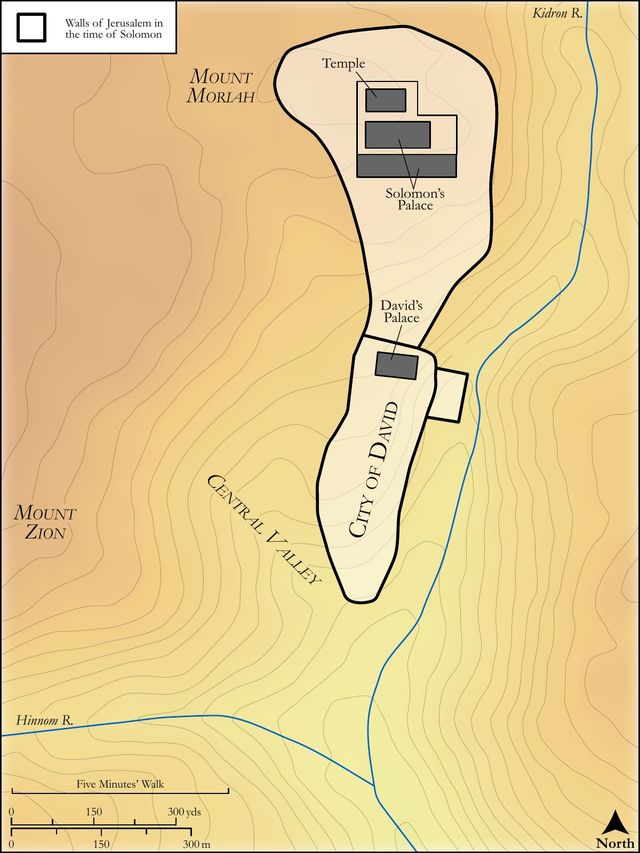
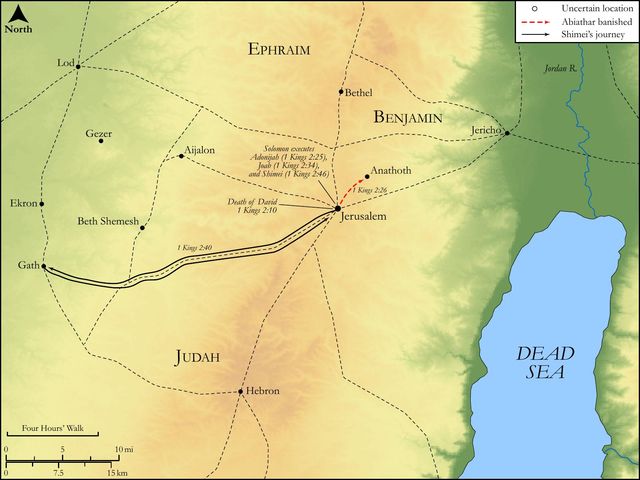
Study this verse
Continue studying 1 Kings 2:11 across the web’s major study libraries — every link below opens this exact verse, chapter, or book on the destination site.
Read & Compare
 BibleGatewayThis verse in more than 200 translations and 70 languages.
 Bible.comThe YouVersion reader — hundreds of translations, reading plans, and highlights.
 ESV.orgCrossway's official English Standard Version reader.
 NET BibleThe NET translation with 60,000+ translators' notes on every rendering decision.
 STEP BibleTyndale House's free study tool — original text, vocabulary, and scholarly resources.
 BibliaLogos Bible Software's free web reader.
 USCCBThe New American Bible (Revised Edition) with the U.S. bishops' study notes.
Commentaries
 BibleHub CommentariesDozens of classic commentaries on this verse, gathered on one page.
 StudyLightMore than 100 commentary sets — the largest collection on the web.
 BibleRefPlain-English commentary on what this verse means, verse by verse.
 Enduring WordDavid Guzik's free commentary on this chapter, widely used by Bible teachers.
 Bible Study ToolsVerse commentary alongside Greek and Hebrew study aids.
Original Language & Research
- BibleHub InterlinearThe verse word by word — original language, transliteration, and English.
- BibleHub LexiconEvery word's original-language definition and Strong's entry.
 Blue Letter BibleDeep-study tools — Strong's numbers, concordance, and word studies.
 SefariaThe Hebrew text with Rashi and centuries of Jewish commentary.
Sermons, Hymns & Audio


TrulyRandomVerse is not affiliated with these sites and doesn’t control their content. They’re linked because they’re genuinely useful.
Summary
1 Kings 2:11 serves as a concise yet profound chronological summary of King David's reign over Israel, marking the conclusion of his life and kingship. This pivotal verse encapsulates the forty years of his rule, meticulously detailing the initial seven years spent reigning from Hebron over Judah, followed by thirty-three years from Jerusalem over all Israel. It provides a definitive historical marker, closing the narrative chapter on one of Israel's most significant monarchs and setting the immediate stage for the ascension and secure establishment of his son, Solomon, on the throne.
Context
ShowHideLiterary Context
This verse appears immediately after David's final, weighty instructions to his son Solomon, which include charges to walk in God's ways, to deal with certain individuals, and to uphold justice (see 1 Kings 2:1-10). 1 Kings 2:11 functions as a concluding summary statement, a common literary device in biblical historical narratives to provide closure to a significant figure's life or reign before transitioning to the next. It acts as an epilogue to David's kingship, providing a precise chronological detail that validates the extent and duration of his rule. Its placement directly precedes the account of Solomon's secure establishment on the throne (see 1 Kings 2:12), highlighting the continuity of the divinely ordained monarchy from father to son.
Historical & Cultural Context
David's reign (circa 1010-970 BC) was a transformative era for ancient Israel, transitioning from a tribal confederacy to a unified monarchy. His initial seven years in Hebron (a major city in Judah, David's tribe) reflect the initial phase of his rule, where he was recognized as king by Judah alone, as detailed in 2 Samuel 2:4. The subsequent thirty-three years in Jerusalem signify the full consolidation of his kingdom over all twelve tribes. Jerusalem, a neutral Jebusite city, was strategically captured by David (as recounted in 2 Samuel 5:6-9), becoming the unified political and religious capital. The mention of "forty years" is a significant biblical number, often symbolizing a complete generation, a period of testing, or a full and significant era, underscoring the comprehensive nature of David's foundational reign.
Key Themes
ShowHideThis verse powerfully contributes to several overarching themes within 1 Kings and the broader Deuteronomistic History. Firstly, it underscores the theme of Divine Appointment and Covenant Fulfillment. David's reign, its duration, and its success are consistently presented as part of God's sovereign plan, fulfilling the promises of the Davidic Covenant, particularly the establishment of an enduring dynasty (see 2 Samuel 7:12-16). Secondly, it highlights the Consolidation and Unification of Israel. The distinct phases of David's rule, from Hebron to Jerusalem, illustrate the successful process of uniting disparate tribes into a cohesive nation under a central authority, a crucial step in Israel's national development. Finally, it emphasizes the theme of Legacy and Succession. By summarizing David's reign, the verse not only provides closure to his era but also sets the stage for the peaceful and divinely sanctioned transition of power to Solomon, ensuring the continuity of the Davidic line.
Exposition and Analysis
ShowHideKey Word Analysis
ShowHideFrom an unused root meaning to be hot, this word primarily denotes a day (as the warm hours), whether literal (sunrise to sunset or one sunset to the next) or figurative (a space of time defined by an associated term). In this context, "days" refers to the entire duration of David's reign, emphasizing the full span of time he served as king, encompassing both the initial and consolidated phases of his rule.
This primitive root means "to reign" or, inceptively, "to ascend the throne." Causatively, it means "to induct into royalty." Here, it describes David's active exercise of kingship, signifying his authority, governance, and the establishment of his royal office. The repetition of this verb three times in the verse underscores the continuity and comprehensive nature of his rule over both Judah and, subsequently, all Israel.
Probably meaning "founded peaceful," Jerusalem became the capital city of Palestine and the unified capital of all Israel under David. Its mention here signifies the culmination of David's efforts to centralize the kingdom both politically and religiously. The thirty-three years David reigned from Jerusalem represent the period of his full, consolidated rule over the entire nation, marking the establishment of a central hub for governance and worship, especially after the Ark of the Covenant was brought there (see 2 Samuel 6).
Verse Breakdown
ShowHide"And the days that David reigned over Israel [were] forty years"
This opening clause provides the overarching summary of David's entire kingship. It highlights the significant duration of his rule, emphasizing its completeness and the profound impact he had on the nation of Israel. The "forty years" serves as a comprehensive marker for his foundational reign, a period often symbolizing a divinely appointed and complete era in biblical narrative.
"seven years reigned he in Hebron"
This specifies the initial phase of David's kingship. During this period, he was recognized as king primarily by the tribe of Judah, operating from the ancient city of Hebron. This detail underscores the historical progression of his reign, beginning with a more limited scope before expanding to encompass all of Israel, reflecting the political realities of the time.
"and thirty and three years reigned he in Jerusalem"
This clause details the longer and more significant phase of David's rule. After capturing Jerusalem and making it his capital, he reigned over the united kingdom of Israel for over three decades. This period represents the zenith of his power and the full establishment of the Davidic monarchy, from which he governed the entire nation, solidifying its political and religious identity.
Literary Devices
ShowHideThe verse employs several literary devices to convey its meaning effectively. Chronological Summary is the most prominent, providing a concise historical overview of David's entire reign. This device is characteristic of biblical historical books, offering definitive markers for periods of leadership and national development. The specific breakdown of "seven years in Hebron" and "thirty and three years in Jerusalem" utilizes Precision in Detail, lending an air of historical accuracy and authenticity to the narrative. Furthermore, the use of the number "forty" for the total duration of his reign carries Symbolism or Numerology. While literally denoting a period of time, "forty" in biblical contexts often symbolizes a complete generation, a period of testing, or a significant, divinely appointed era, thereby imbuing David's reign with theological significance beyond mere historical fact. This numerical symbolism underscores the completeness and providential nature of his rule.
Theological and Thematic Connections
ShowHide1 Kings 2:11, while a straightforward historical summary, is rich with theological implications, serving as a testament to God's faithfulness and the unfolding of His redemptive plan. David's forty-year reign, marked by both triumphs and failures, stands as a foundational period for the Israelite monarchy, establishing a dynasty that God Himself promised would endure. This verse quietly affirms the stability and divine backing of David's rule, even in its transition, reinforcing the concept that human leadership operates within the framework of God's sovereign purposes. It highlights the importance of a divinely appointed leader in unifying a people and establishing a kingdom, setting a precedent for future kings and ultimately pointing to the eternal King.
Reflection and Application
ShowHideThe summary of David's forty-year reign in 1 Kings 2:11 offers profound lessons for believers today concerning leadership, legacy, and God's sovereign timing. David's life was a testament to faithful, albeit imperfect, stewardship of God-given responsibilities. His progression from a shepherd boy to a regional king in Hebron, and then to the ruler of a unified nation from Jerusalem, illustrates God's patient and purposeful leading. This verse reminds us that significant impact often requires sustained commitment and a willingness to follow God's unfolding plan, even when it involves gradual steps and transitions. It challenges us to consider the long-term impact of our own "reigns"—the periods of influence and responsibility God entrusts to us—and to strive for a legacy that honors Him, knowing that our efforts contribute to a larger, divine narrative.
Questions for Reflection
ShowHideFAQ
ShowHideWhy is David's reign split into "seven years in Hebron" and "thirty and three years in Jerusalem"?
ShowHideThis division provides precise historical and political context for David's reign. The "seven years in Hebron" refers to his initial period as king over the tribe of Judah alone, reflecting the tribal divisions that existed after Saul's death. Hebron was a significant city in Judah and served as his first capital. The "thirty and three years in Jerusalem" signifies the much longer and more impactful period after he successfully captured Jerusalem from the Jebusites and made it the unified capital for all twelve tribes of Israel. This transition marked the full consolidation of his kingdom and the establishment of a central political and religious hub for the nation.
What is the significance of the "forty years" mentioned for David's total reign?
ShowHideThe number "forty" is highly symbolic in biblical literature, often representing a complete generation, a period of testing, purification, or a significant, full era. While it denotes a substantial duration in David's case, its use here emphasizes the completeness and foundational nature of his reign. It signifies that David's rule was a full and divinely appointed period that laid crucial groundwork for the future of Israel's monarchy and its national identity, setting the stage for the Davidic dynasty promised by God in 2 Samuel 7:12-16.
How does this verse, summarizing David's reign, relate to the broader narrative of God's covenant with David?
ShowHideThis verse serves as a historical confirmation of the successful establishment and longevity of the Davidic dynasty, which was central to God's covenant with David (see 2 Samuel 7). The forty years of David's reign, culminating in a peaceful transition to Solomon, demonstrate God's faithfulness in fulfilling His promise to establish David's house and kingdom forever. It underscores that David's kingship was not merely a human endeavor but a divinely ordained institution, laying the groundwork for the enduring line of kings that would eventually lead to the Messiah, Jesus Christ.
Christ-Centered Fulfillment
ShowHide1 Kings 2:11, in its concise summary of David's earthly reign, inherently points forward to the ultimate and eternal reign of Jesus Christ. David, though a great king, was but a shadow of the perfect King to come. His "forty years" of rule, marked by both triumphs and failures, established a temporal kingdom that would eventually decline and fall. However, God's covenant with David promised an eternal throne (see 2 Samuel 7:16), a promise fulfilled not in any earthly successor, but in Jesus, who is repeatedly identified as the "Son of David" (e.g., Matthew 1:1). Unlike David's reign, which transitioned from Hebron to Jerusalem and eventually concluded, Jesus's kingdom is not of this world (as He declared in John 18:36), yet it is universal and everlasting. He is the Lamb who was slain, worthy to reign (as proclaimed in Revelation 5:12), and His dominion will have no end (as prophesied in Luke 1:32-33). Thus, David's foundational reign, summarized in this verse, serves as a powerful type, foreshadowing the perfect, eternal, and all-encompassing kingdom of our Lord and of His Christ (as seen in Revelation 11:15).