


Revelation 11:15
Bible text: King James Version (1769 Blayney text) · Public domain
Bible text: King James Version with Strong's numbers · Public domain
Bible text: Berean Standard Bible · Public domain
Bible text: American Standard Version (1901) · Public domain
Bible text: World English Bible, Messianic edition · Public domain
Bible text: Geneva Bible (1599) · Public domain
Bible text: Young's Literal Translation · Public domain
- ΚαὶKaiAndG2532CONJConjunction
- ὁhotheG3588T-NSMDefinite article Nominative Singular Masculine
- ἕβδομοςhebdomosseventhG1442A-NSMAdjective Nominative Singular Masculine
- ἄγγελοςangelosangelG32N-NSMNoun Nominative Singular Masculine
- ἐσάλπισενesalpisensounded [his] trumpetG4537V-AAI-3SVerb Aorist Active Indicative 3rd Singular
- καὶkaiandG2532CONJConjunction
- ἐγένοντοegenontothere wereG1096V-2ADI-3PVerb 2nd Aorist Middle Deponent Indicative 3rd Plural
- φωναὶphōnaivoicesG5456N-NPFNoun Nominative Plural Feminine
- μεγάλαιmegalaigreatG3173A-NPFAdjective Nominative Plural Feminine
- ἐνeninG1722PREPPreposition
- τῷtō<the>G3588T-DSMDefinite article Dative Singular Masculine
- οὐρανῷouranōheavenG3772N-DSMNoun Dative Singular Masculine
- λέγοντες·legontessayingG3004V-PAP-NPMVerb Present Active Participle Nominative Plural Masculine
- ἐγένετοegenetoHas becomeG1096V-2ADI-3SVerb 2nd Aorist Middle Deponent Indicative 3rd Singular
- ἡhētheG3588T-NSFDefinite article Nominative Singular Feminine
- βασιλείαbasileiakingdomG932N-NSFNoun Nominative Singular Feminine
- τοῦtouof theG3588T-GSMDefinite article Genitive Singular Masculine
- κόσμουkosmouworldG2889N-GSMNoun Genitive Singular Masculine
- τοῦtou[that] of theG3588T-GSMDefinite article Genitive Singular Masculine
- κυρίουkuriouLordG2962N-GSM-TNoun Genitive Singular Masculine Title
- ἡμῶνhēmōnof usG3165P-1GPPersonal pronoun Genitive 1st Plural
- καὶkaiandG2532CONJConjunction
- τοῦtouof theG3588T-GSMDefinite article Genitive Singular Masculine
- χριστοῦchristouChristG5547N-GSM-TNoun Genitive Singular Masculine Title
- αὐτοῦautouof HimG846P-GSMPersonal pronoun Genitive Singular Masculine
- καὶkaiandG2532CONJConjunction
- βασιλεύσειbasileuseiHe will reignG936V-FAI-3SVerb Future Active Indicative 3rd Singular
- εἰςeistoG1519PREPPreposition
- τοὺςtoustheG3588T-APMDefinite article Accusative Plural Masculine
- αἰῶναςaiōnasagesG165N-APMNoun Accusative Plural Masculine
- τῶνtōnof theG3588T-GPMDefinite article Genitive Plural Masculine
- αἰώνωνaiōnōnagesG165N-GPMNoun Genitive Plural Masculine
English is a literal word-by-word gloss of the Greek, not the KJV's wording. Why?
This is the original text the KJV's translators worked from — each Greek word with its own literal English meaning in this verse, prepared by scholars at Tyndale House, Cambridge. The KJV translates whole sentences, not word by word, so its wording differs: one Greek word can become several English words, and the KJV may choose “charity” where the gloss reads “love”. Both are faithful — they answer different questions. For the KJV's own rendering, switch to the KJV text.
Details
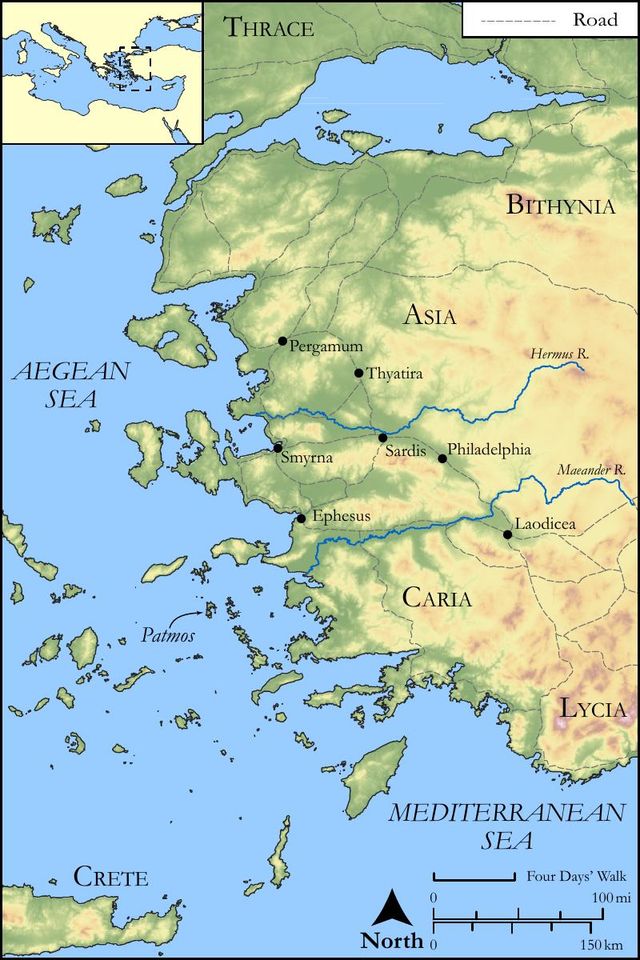
See on the biblical-era maps

Study this verse
Public-domain commentary
Matthew Henry
From his Commentary on the Whole Bible. Henry comments on passages, not single verses — this entry covers Revelation 11:14–19. His three-level outline is real structure in the source text, so it is rendered as structure.
We have here the sounding of the seventh and last trumpet, which is ushered in by the usual warning and demand of attention: The second woe is past, and, behold, the third woe cometh quickly. Then the seventh angel sounded. This had been suspended for some time, till the apostle had been made acquainted with some intervening occurrences of very great moment, and worthy of his notice and observation. But what he before expected he now heard - the seventh angel sounding. Here observe the effects and consequences of this trumpet, thus sounded.
I.Here were loud and joyful acclamations of the saints and angels in heaven. Observe,
1.The manner of their adorations: they rose from their seats, and fell upon their faces, and worshipped God; they did it with reverence and humility.
2.The matter of their adorations.
(1.)They thankfully recognize the right of our God and Saviour to rule and reign over all the world: The kingdoms of this world have become the kingdoms of our Lord and of his Christ, Rev 11:15. They were always so in title, both by creation and purchase.
(2.)They thankfully observe his actual possession of them, and reign over them; they give him thanks because he had taken to him his great power, asserted his rights, exerted his power, and so turned title into possession.
(3.)They rejoice that this his reign shall never end: He shall reign for ever and ever, till all enemies be put under his feet; none shall ever wrest the sceptre out of his hand.
II.Here were angry resentments in the world at these just appearances and actings of the power of God (Rev 11:18):
The nations were angry; not only had been so, but were so still: their hearts rose up against God; they met his wrath with their own anger. It was a time when God was taking a just revenge upon the enemies of his people, recompensing tribulation to those who had troubled them. It was a time in which he was beginning to reward his people's faithful services and sufferings; and their enemies could not bear it, they fretted against God, and so increased their guilt and hastened their destruction.
III.Another consequence was the opening of the temple of God in heaven.
By this may be meant that here is now a more free communication between heaven and earth, prayer and praises more freely and frequently ascending and graces and blessings plentifully descending. But it rather seems to intend the church of God on earth, a heavenly temple. It is an allusion to the various circumstances of things in the time of the first temple. Under idolatrous and wicked princes, it was shut up and neglected; but, under religious and reforming princes, it was opened and frequented. So, during the power of antichrist, the temple of God seemed to be shut up, and was so in a great degree; but now it was opened again. At this opening of it observe,
1.What was seen there: the ark of God's testament. This was in the holy of holies; in this ark the tables of the law were kept. As before Josiah's time the law of God had been lost, but was then found, so in the reign of antichrist God's law was laid aside, and made void by their traditions and decrees; the scriptures were locked up from the people, and they must not look into these divine oracles; now they are opened, now they are brought to the view of all. This was an unspeakable and invaluable privilege; and this, like the ark of the testament, was a token of the presence of God returned to his people, and his favour towards them in Jesus Christ the propitiation.
2.What was heard and felt there: Lightnings, voices, thunderings, an earthquake, and great hail. The great blessing of the reformation was attended with very awful providences; and by terrible things in righteousness God would answer those prayers that were presented in his holy temple, now opened. All the great revolutions of the world are concerted in heaven, and are the answers of the prayers of the saints.
Historical interpretation
Three Centuries of Reception
3 surviving comments on this verse. Each one is dated, so this reads as a timeline rather than a list.
Select a marker to jump to its quote. Markers stagger vertically where authors wrote within a few decades of each other.
And the seventh angel sounded his trumpet, etc. The first six trumpets, compared to the ages of this present world, announced various conflicts of wars for the Church. But the seventh, the herald of eternal Sabbath, proclaims only the victory and dominion of the true king.
And the seventh sounded the trumpet: and there were great voices in heaven. This seventh angel sounds the trumpet as the Lord appears for the judgment. By this angel we understand the Church, no longer preaching, but singing mercy and judgment for the Lord. This is why the angel standing upon the earth and the sea swears that time shall be no longer but the end will come with the seventh trumpet. The great voices in heaven, that is in the Church, are thanksgivings; and it is right to call them great, because a great desire is arising concerning great things. John shows where these voices come from, adding, saying: The kingdom of this world— that is the kingdom in which the old enemy used to reign — is become God's and his Christ's, and they shall reign for ever and ever. In them, that is the Father and the Son, the Trinity is understood.
As a detour, the vision recounts the matters concerning the two witnesses, who are identified as prophets, and elaborates on all that pertains to them, focusing on their origin and where they have come from. They have come forth from the holy restitution of the future, and that the number of those from the nations surpasses that of Israel, and that those who have pleased God in the New Covenant exceed those in the Old.
And it states that when the seventh angel sounded his trumpet, voices were heard in heaven proclaiming that the kingdom of the world has become the kingdom of God and of His Christ. God always reigns, and He neither began nor will cease to reign over heaven and earth and all things visible and invisible within them, but He is the Ruler and Lord of all things without beginning and without end. Since men also became kings on earth, God had a certain way of sharing kingship with them; but when the earthly kingdom of men is dissolved at the end of the present age, only God will reign. Therefore, it has been said that the kingdom of the world has become the kingdom of God and of His Christ, with the men who ruled on earth and the tyrannical demons having been destroyed and ceased.
Continue studying Revelation 11:15 across the web’s major study libraries — every link below opens this exact verse, chapter, or book on the destination site.
Read & Compare
 BibleGatewayThis verse in more than 200 translations and 70 languages.
 Bible.comThe YouVersion reader — hundreds of translations, reading plans, and highlights.
 ESV.orgCrossway's official English Standard Version reader.
 NET BibleThe NET translation with 60,000+ translators' notes on every rendering decision.
 STEP BibleTyndale House's free study tool — original text, vocabulary, and scholarly resources.
 BibliaLogos Bible Software's free web reader.
 USCCBThe New American Bible (Revised Edition) with the U.S. bishops' study notes.
Commentaries
 BibleHub CommentariesDozens of classic commentaries on this verse, gathered on one page.
 StudyLightMore than 100 commentary sets — the largest collection on the web.
 BibleRefPlain-English commentary on what this verse means, verse by verse.
 Enduring WordDavid Guzik's free commentary on this chapter, widely used by Bible teachers.
 Bible Study ToolsVerse commentary alongside Greek and Hebrew study aids.
Original Language & Research
- BibleHub InterlinearThe verse word by word — original language, transliteration, and English.
- BibleHub LexiconEvery word's original-language definition and Strong's entry.
 Blue Letter BibleDeep-study tools — Strong's numbers, concordance, and word studies.
 CNTR CollationThe earliest Greek manuscripts of this verse, collated letter by letter.
Sermons, Hymns & Audio


TrulyRandomVerse is not affiliated with these sites and doesn’t control their content. They’re linked because they’re genuinely useful.
Summary
Revelation 11:15 marks a climactic moment in John's apocalyptic vision, as the sounding of the seventh trumpet heralds a definitive shift in cosmic authority. It announces a triumphant heavenly declaration that the kingdoms of this world, long under human and spiritual rebellion, have now irrevocably become the rightful possession and dominion of God our Lord and His Anointed One, Jesus Christ, who is declared to reign eternally without end. This verse serves as a powerful theological affirmation of God's ultimate sovereignty and the assured victory of His redemptive plan over all earthly opposition.
Context
ShowHideLiterary Context
This verse is strategically placed as the culmination of the trumpet judgments, which began in Revelation 8. The first six trumpets brought escalating judgments upon the earth, affecting creation, humanity, and demonic forces. Specifically, the seventh trumpet follows the dramatic interlude involving the two witnesses, their martyrdom, resurrection, and ascension, and the subsequent earthquake that concludes the second woe (Revelation 11:14). Unlike the previous trumpets, which primarily described destructive judgments, the seventh trumpet's sounding is met with a declaration of God's established reign, signaling the transition from judgment to the full realization of His kingdom. It sets the stage for the final series of judgments (the bowl judgments) and the ultimate consummation of God's purposes.
Historical & Cultural Context
John wrote Revelation during a time of intense Roman imperial power, likely under the reign of Emperor Domitian, who demanded worship as "Lord and God." The early Christians faced persecution for refusing to acknowledge Caesar's divinity, clinging instead to the exclusive Lordship of Jesus Christ. In this context, the declaration that "the kingdoms of this world are become the kingdoms of our Lord, and of his Christ" would have been a profoundly subversive and encouraging message. It directly challenged the prevailing political and religious claims of the Roman Empire, asserting that ultimate authority did not reside in earthly rulers or their gods, but in the one true God and His Messiah, Jesus. This message provided hope and steadfastness for believers enduring suffering, reminding them that their true allegiance was to an eternal, triumphant King.
Key Themes
ShowHideRevelation 11:15 powerfully contributes to several overarching themes within the book of Revelation and biblical theology. The most prominent is Divine Sovereignty and Triumph, asserting that despite the chaos, evil, and apparent dominion of worldly powers, God remains ultimately in control and His plan will prevail. This declaration is a triumphant announcement that God's ultimate reign is at hand, signifying the overthrow of all opposition. Closely related is the theme of Christ's Eternal Reign, explicitly stating that the kingdoms "are become the kingdoms of our Lord, and of his Christ." This highlights the co-regency of God the Father and Jesus Christ, emphasizing that Christ's reign will be everlasting, fulfilling numerous Old Testament prophecies about the Messiah's kingdom, such as in Daniel 7:14 and Psalm 2:6-8. Finally, it underscores the Culmination of Prophecy, marking a major turning point in the eschatological narrative, transitioning from a period of escalating judgments to the final establishment of God's kingdom. It assures believers that God's plan is unfolding precisely as prophesied and will culminate in His ultimate victory and the establishment of the new heaven and new earth.
Exposition and Analysis
ShowHideKey Word Analysis
ShowHideThis verb signifies a dynamic process of coming into being or a definitive transformation. Here, in the aorist tense, it emphasizes a completed action with lasting results. The kingdoms of this world do not merely begin to be God's, but they have definitively become His, indicating an irreversible transfer of ownership and authority. It speaks to a new state of being, a decisive change in cosmic governance.
Derived from the word for "king," this term refers to royalty, rule, or a realm. In this context, it denotes the earthly political, social, and spiritual systems and structures that have historically operated independently of, and often in opposition to, God's will. The plural "kingdoms" acknowledges the diverse manifestations of human power and rebellion, all of which are now subsumed under the singular, supreme authority of God and His Christ.
This is a powerful double plural, literally "unto the ages of the ages." The term aiṓn denotes an age or a period of time, but in this construct, it expresses the strongest possible emphasis on eternity, perpetuity, and endlessness. It signifies a reign that transcends all temporal boundaries, a dominion that is absolute, unceasing, and without any conceivable end, reinforcing the ultimate and permanent nature of Christ's sovereignty.
Verse Breakdown
ShowHide"And the seventh angel sounded;"
This clause marks the final and most significant trumpet blast, signaling the culmination of the divine judgments and the transition to the ultimate phase of God's redemptive plan. Unlike previous trumpets that initiated specific woes, this sounding initiates a declaration of triumph.
"and there were great voices in heaven, saying,"
The immediate response to the trumpet is a chorus of powerful, authoritative voices emanating from heaven. These "great voices" likely represent the angelic hosts, the twenty-four elders, and possibly the redeemed saints, all joining in a unified proclamation of God's victory and reign. Their declaration is not a prayer or a plea, but an announcement of accomplished fact.
"The kingdoms of this world are become the kingdoms of our Lord, and of his Christ;"
This is the core declaration. It asserts a definitive, irreversible transfer of dominion. "The kingdoms of this world" (referring to all earthly powers and systems, often characterized by rebellion against God) are now declared to belong to "our Lord" (God the Father, the ultimate sovereign) and "his Christ" (Jesus, the Messiah, the Anointed King). This signifies the end of human and satanic usurpation and the restoration of rightful divine rule.
"and he shall reign for ever and ever."
This final clause emphatically declares the eternal nature of Christ's reign. The singular "he" refers to Christ, whose dominion is not temporary or limited, but absolute and unending. This affirms the fulfillment of Old Testament prophecies concerning the Messiah's everlasting kingdom, establishing a reign of righteousness and peace that will never be overthrown.
Literary Devices
ShowHideRevelation 11:15 is rich in Symbolism. The "seventh angel" and his "sounding" are symbolic of the culmination of God's predetermined plan and the finality of His judgments and declarations. The "great voices in heaven" symbolize the unified acclamation of the heavenly host, representing divine approval and cosmic jubilation at the establishment of God's sovereignty. The "kingdoms of this world" are a symbolic representation of all human political, economic, and social systems that operate apart from God, while "our Lord, and of his Christ" symbolizes the singular, unified, and ultimate divine authority. The phrase "for ever and ever" employs Hyperbole and Repetition to emphasize the absolute and unending nature of Christ's reign, transcending all temporal limitations. The entire verse functions as a Proclamation, a formal and authoritative declaration of an accomplished reality, rather than a mere statement or prophecy.
Theological and Thematic Connections
ShowHideRevelation 11:15 stands as a pivotal theological statement, affirming the ultimate triumph of God's sovereign plan over all opposing forces. It declares the decisive moment when all earthly authority, which has long been in rebellion or under the sway of the "prince of this world," is definitively brought under the rightful, eternal dominion of the Triune God and His Messiah. This declaration is a cosmic victory cry, assuring believers that the seemingly chaotic and often oppressive realities of human history are ultimately subservient to God's overarching purpose. It underscores the biblical narrative's trajectory from creation to consummation, where God's original intent for His reign is fully realized through Christ. This verse serves as a powerful reminder that while evil may appear to flourish for a time, its ultimate defeat is certain, and God's kingdom will stand forever.
Reflection and Application
ShowHideRevelation 11:15 offers profound spiritual nourishment and practical guidance for believers navigating a world often characterized by turmoil, injustice, and the apparent dominance of ungodly powers. This verse calls us to lift our gaze beyond the temporal and to anchor our hope in the eternal reality of Christ's coming kingdom. It encourages us to live with an eschatological perspective, understanding that every earthly system, no matter how formidable, is transient and ultimately subject to the sovereign will of God. This truth should inspire unwavering confidence in God's ultimate justice and His unwavering commitment to His people. In a world that often feels out of control, this declaration provides immense peace, reminding us that the true King is on His throne, and His reign will never end. Therefore, our allegiance, our efforts, and our hope should be directed towards His kingdom, living out its values even now.
Questions for Reflection
ShowHideFAQ
ShowHideDoes Revelation 11:15 mean that all earthly kingdoms immediately cease to exist when the seventh trumpet sounds?
ShowHideNot immediately in a physical, visible sense. Revelation 11:15 is a declaration from heaven, a prophetic pronouncement of a definitive transfer of ultimate authority and ownership. It signifies that from God's heavenly perspective, the rightful dominion over all earthly kingdoms has now been irrevocably claimed by Him and His Christ. While the full, visible manifestation of this reign, including the complete overthrow of all opposing powers, will unfold through subsequent events described in Revelation (e.g., the bowl judgments, the battle of Armageddon, the binding of Satan, and the Great White Throne Judgment), this verse marks the decisive turning point where the outcome is sealed. It's a declaration of victory before the final battles are fought, establishing the theological truth that God's kingdom has arrived in power and will soon be consummated on earth, as seen in Revelation 19:11-16.
What is the significance of "great voices in heaven" making this declaration?
ShowHideThe "great voices" represent a powerful, unified, and authoritative heavenly chorus – likely angels, the twenty-four elders, and perhaps the multitude of redeemed saints. Their collective proclamation emphasizes the universal significance and divine certainty of this event. It's not a whispered hope or a private revelation, but a loud, public, cosmic announcement, signifying that all of heaven acknowledges and rejoices in the transfer of dominion. This heavenly acclamation validates the divine decree and underscores the absolute truth of the declaration, reinforcing the idea that this is a pivotal moment in God's eternal plan, acknowledged by all of creation, as described in Revelation 5:11-14.
Christ-Centered Fulfillment
ShowHideRevelation 11:15 finds its profound Christ-centered fulfillment in the person and work of Jesus Christ, who is explicitly named as the co-recipient of this eternal dominion. While the Old Testament prophets foretold a coming Messiah who would establish an everlasting kingdom (Isaiah 9:6-7), this verse in Revelation declares the decisive moment of its ultimate realization. Jesus inaugurated His kingdom at His first coming, proclaiming its nearness (Mark 1:15) and demonstrating its power over sin, sickness, and death. His resurrection and ascension to the right hand of the Father marked His enthronement as King of kings and Lord of lords, where He now reigns with all authority in heaven and on earth (Matthew 28:18; Ephesians 1:20-22). Revelation 11:15 looks forward to the consummation of this inaugurated kingdom, when Christ will return in glory to fully establish His reign on earth, vanquishing all opposition and bringing about a new heaven and new earth where righteousness dwells (Revelation 19:11-16; Revelation 21:1-4). Thus, this verse is a triumphant declaration of Christ's ultimate and eternal sovereignty, affirming that the Lamb who was slain is indeed the Lion of the tribe of Judah, worthy to receive power, wealth, wisdom, strength, honor, glory, and praise, and to reign forever and ever (Revelation 5:5-13).